Culture in International Business: Preferences and Ethics

Verified

Added on  2023/01/18

|8
|2091
|79
Report
AI Summary
This report provides a comprehensive literature review on the influence of culture in international business. It begins by identifying culture-specific preferences and rapport management strategies within an international context, emphasizing their importance for employee retention and product development. The report then explores cultural differences in impression management and ethical considerations, highlighting how these factors impact business operations across different nations. The main body delves into the concepts of individualism and collectivism, examining their effects on organizational structures, decision-making processes, and employee motivation. The review analyzes the benefits and drawbacks of each approach, comparing their impact on innovation, cooperation, and workplace environments. The report concludes by summarizing the complexities of navigating cultural differences in international business and the difficulty in selecting a single best approach for all situations. The report uses various academic sources to support its arguments.

Document Page
lLITERATURE REVIEW
tabler-icon-diamond-filled.svg

Paraphrase This Document

Need a fresh take? Get an instant paraphrase of this document with our AI Paraphraser
Document Page
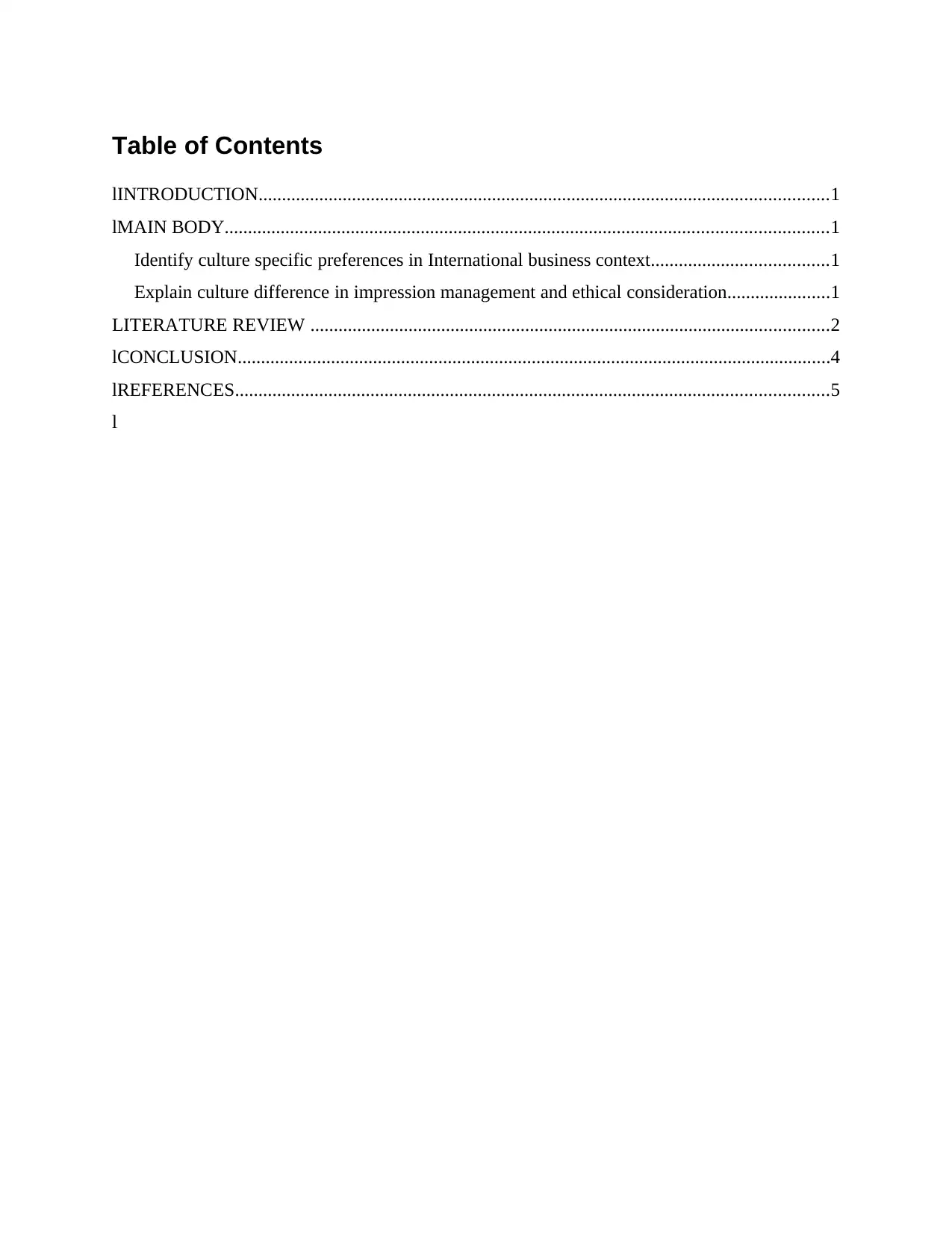
Table of Contents
lINTRODUCTION..........................................................................................................................1
lMAIN BODY.................................................................................................................................1
Identify culture specific preferences in International business context......................................1
Explain culture difference in impression management and ethical consideration......................1
LITERATURE REVIEW ...............................................................................................................2
lCONCLUSION...............................................................................................................................4
lREFERENCES...............................................................................................................................5
l
Document Page
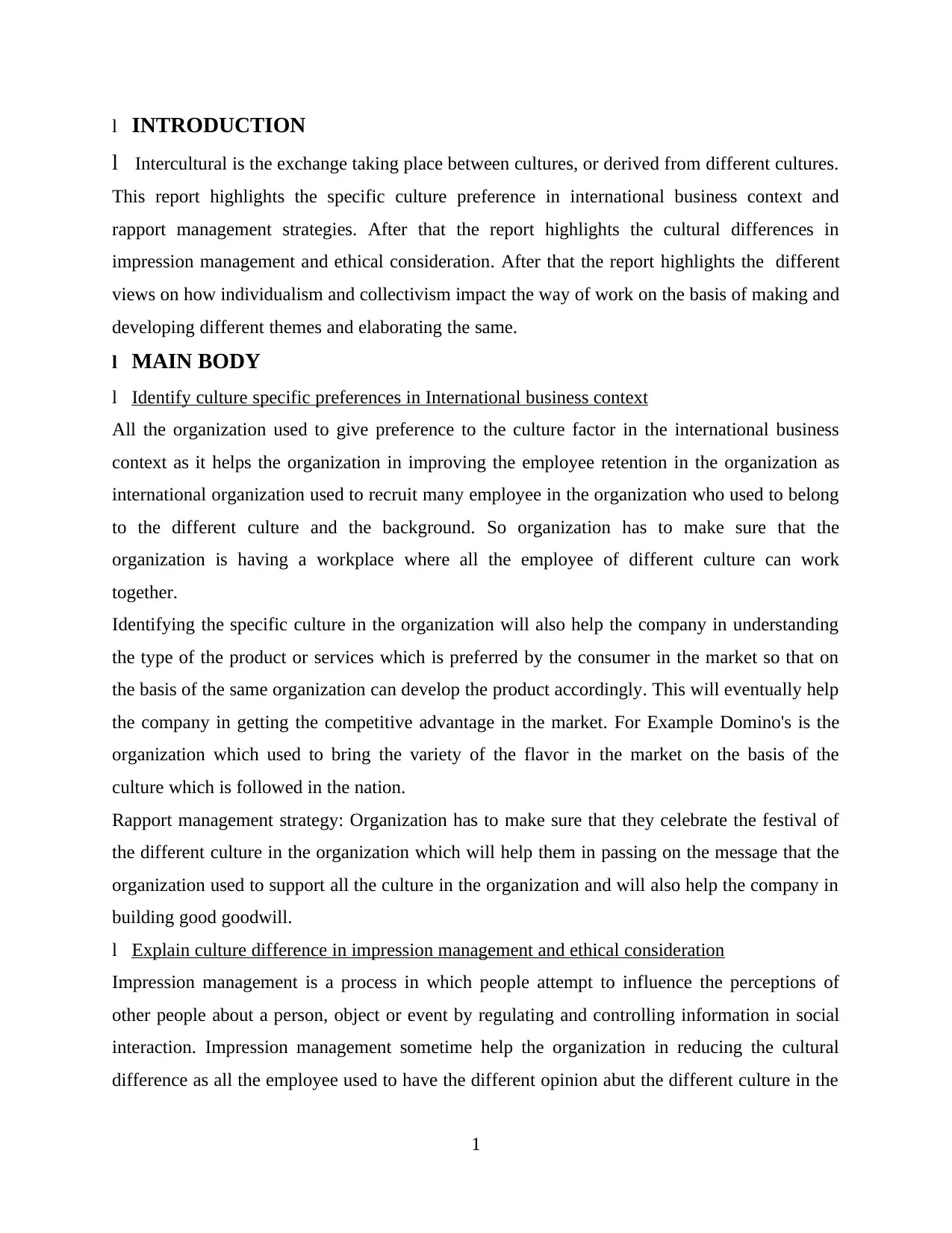
lINTRODUCTION
lIntercultural is the exchange taking place between cultures, or derived from different cultures.
This report highlights the specific culture preference in international business context and
rapport management strategies. After that the report highlights the cultural differences in
impression management and ethical consideration. After that the report highlights the different
views on how individualism and collectivism impact the way of work on the basis of making and
developing different themes and elaborating the same.
lMAIN BODY
lIdentify culture specific preferences in International business context
All the organization used to give preference to the culture factor in the international business
context as it helps the organization in improving the employee retention in the organization as
international organization used to recruit many employee in the organization who used to belong
to the different culture and the background. So organization has to make sure that the
organization is having a workplace where all the employee of different culture can work
together.
Identifying the specific culture in the organization will also help the company in understanding
the type of the product or services which is preferred by the consumer in the market so that on
the basis of the same organization can develop the product accordingly. This will eventually help
the company in getting the competitive advantage in the market. For Example Domino's is the
organization which used to bring the variety of the flavor in the market on the basis of the
culture which is followed in the nation.
Rapport management strategy: Organization has to make sure that they celebrate the festival of
the different culture in the organization which will help them in passing on the message that the
organization used to support all the culture in the organization and will also help the company in
building good goodwill.
lExplain culture difference in impression management and ethical consideration
Impression management is a process in which people attempt to influence the perceptions of
other people about a person, object or event by regulating and controlling information in social
interaction. Impression management sometime help the organization in reducing the cultural
difference as all the employee used to have the different opinion abut the different culture in the
1
Document Page
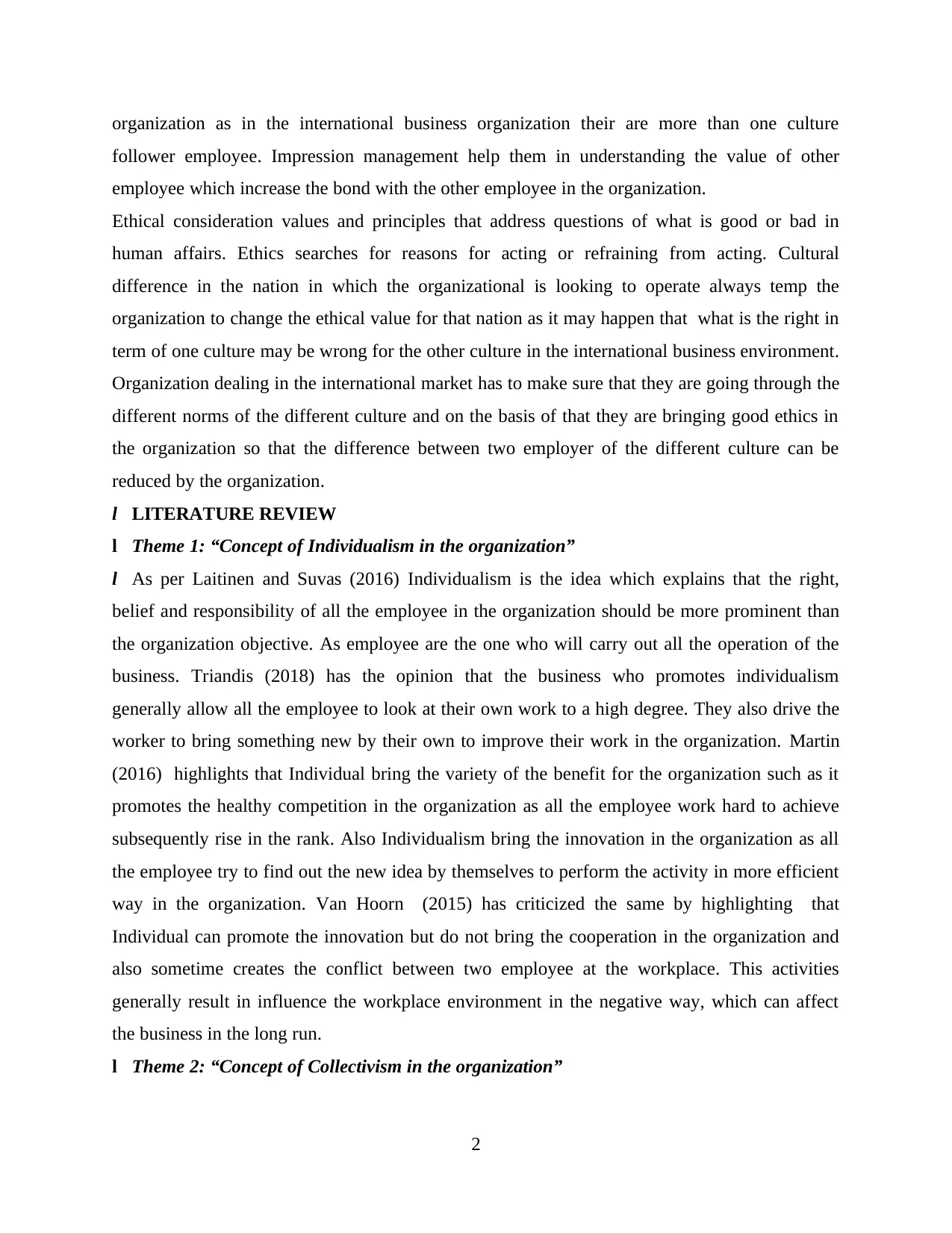
organization as in the international business organization their are more than one culture
follower employee. Impression management help them in understanding the value of other
employee which increase the bond with the other employee in the organization.
Ethical consideration values and principles that address questions of what is good or bad in
human affairs. Ethics searches for reasons for acting or refraining from acting. Cultural
difference in the nation in which the organizational is looking to operate always temp the
organization to change the ethical value for that nation as it may happen that what is the right in
term of one culture may be wrong for the other culture in the international business environment.
Organization dealing in the international market has to make sure that they are going through the
different norms of the different culture and on the basis of that they are bringing good ethics in
the organization so that the difference between two employer of the different culture can be
reduced by the organization.
lLITERATURE REVIEW
lTheme 1: “Concept of Individualism in the organization”
lAs per Laitinen and Suvas (2016) Individualism is the idea which explains that the right,
belief and responsibility of all the employee in the organization should be more prominent than
the organization objective. As employee are the one who will carry out all the operation of the
business. Triandis (2018) has the opinion that the business who promotes individualism
generally allow all the employee to look at their own work to a high degree. They also drive the
worker to bring something new by their own to improve their work in the organization. Martin
(2016) highlights that Individual bring the variety of the benefit for the organization such as it
promotes the healthy competition in the organization as all the employee work hard to achieve
subsequently rise in the rank. Also Individualism bring the innovation in the organization as all
the employee try to find out the new idea by themselves to perform the activity in more efficient
way in the organization. Van Hoorn (2015) has criticized the same by highlighting that
Individual can promote the innovation but do not bring the cooperation in the organization and
also sometime creates the conflict between two employee at the workplace. This activities
generally result in influence the workplace environment in the negative way, which can affect
the business in the long run.
lTheme 2: “Concept of Collectivism in the organization”
2
tabler-icon-diamond-filled.svg

Paraphrase This Document

Need a fresh take? Get an instant paraphrase of this document with our AI Paraphraser
Document Page
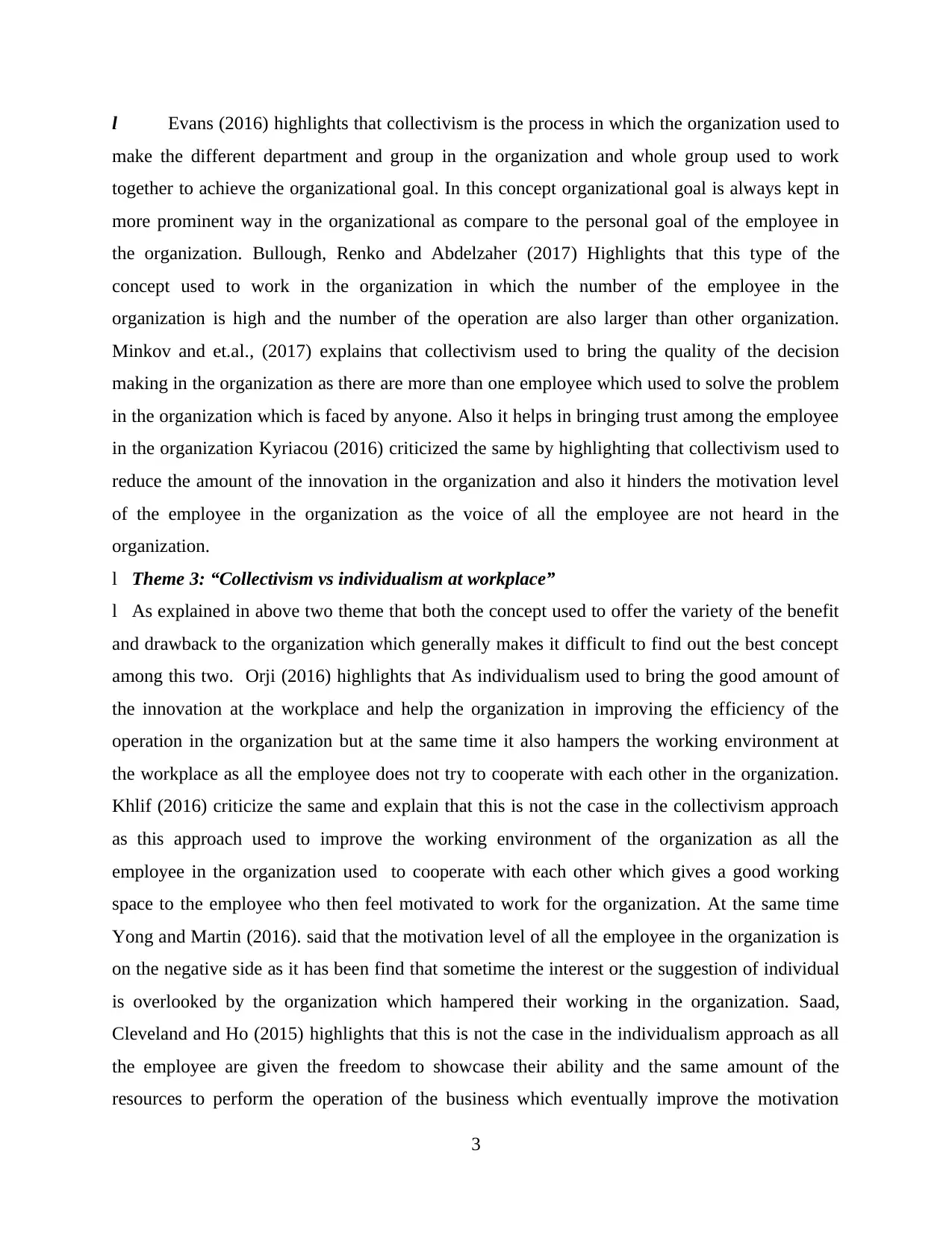
l Evans (2016) highlights that collectivism is the process in which the organization used to
make the different department and group in the organization and whole group used to work
together to achieve the organizational goal. In this concept organizational goal is always kept in
more prominent way in the organizational as compare to the personal goal of the employee in
the organization. Bullough, Renko and Abdelzaher (2017) Highlights that this type of the
concept used to work in the organization in which the number of the employee in the
organization is high and the number of the operation are also larger than other organization.
Minkov and et.al., (2017) explains that collectivism used to bring the quality of the decision
making in the organization as there are more than one employee which used to solve the problem
in the organization which is faced by anyone. Also it helps in bringing trust among the employee
in the organization Kyriacou (2016) criticized the same by highlighting that collectivism used to
reduce the amount of the innovation in the organization and also it hinders the motivation level
of the employee in the organization as the voice of all the employee are not heard in the
organization.
lTheme 3: “Collectivism vs individualism at workplace”
lAs explained in above two theme that both the concept used to offer the variety of the benefit
and drawback to the organization which generally makes it difficult to find out the best concept
among this two. Orji (2016) highlights that As individualism used to bring the good amount of
the innovation at the workplace and help the organization in improving the efficiency of the
operation in the organization but at the same time it also hampers the working environment at
the workplace as all the employee does not try to cooperate with each other in the organization.
Khlif (2016) criticize the same and explain that this is not the case in the collectivism approach
as this approach used to improve the working environment of the organization as all the
employee in the organization used to cooperate with each other which gives a good working
space to the employee who then feel motivated to work for the organization. At the same time
Yong and Martin (2016). said that the motivation level of all the employee in the organization is
on the negative side as it has been find that sometime the interest or the suggestion of individual
is overlooked by the organization which hampered their working in the organization. Saad,
Cleveland and Ho (2015) highlights that this is not the case in the individualism approach as all
the employee are given the freedom to showcase their ability and the same amount of the
resources to perform the operation of the business which eventually improve the motivation
3
Document Page
level of the employee. Zalewska and Zawadzka (2016) highlights that at the same time the
quality of the decision making in the Individualism approach is not that good as all the
employee used to take the decision for their improvement which eventually means that
organization in whole used to get affected by the decision. Arpaci, Balo?lu and Kesici (2018)
highlights that this is not the case in the collectivism approach as all the decision which are taken
in the organization are taken with the sole motive of overcoming the issue which is faced by the
organization and in this approach all the employee are involved in the decision making and after
going through all the suggestion best suggestion is being selected by the organization. Huang
and Crotts (2019) highlights that Individualism used to increase the number of the conflict in the
organization whereas this is not the case in the Collectivism approach as this approach reduces
the number of the conflict in the organization.
lCONCLUSION
lAfter going through the above report it has been summarized that there are many different
type of the preference about the organizational culture in the different business context. It has
also been summarized that there is huge difference between impression management and ethical
consideration. In the end the report summarized that there are many effect which used to be
brought by Individualism and collectivism on the working of the organization so it is hard to
select any one out of this two approach of working.
4
Document Page
lREFERENCES
Books and Journal
lArpaci, I., Balo?lu, M. and Kesici, Ş., 2018. The relationship among individual differences in
individualism-collectivism, extraversion, and self-presentation. Personality and Individual
Differences. 121. pp.89-92.
lBullough, A., Renko, M. and Abdelzaher, D., 2017. Women’s business ownership: Operating
within the context of institutional and in-group collectivism. Journal of Management. 43(7).
pp.2037-2064.
lEvans, E. J., 2016. Social policy 1830-1914: individualism, collectivism and the origins of the
welfare state. Routledge.
lHuang, S.S. and Crotts, J., 2019. Relationships between Hofstede's cultural dimensions and
tourist satisfaction: A cross-country cross-sample examination. Tourism Management. 72.
pp.232-241.
lKhlif, H., 2016. Hofstede’s cultural dimensions in accounting research: a review. Meditari
Accountancy Research. 24(4). pp.545-573.
lKyriacou, A. P., 2016. Individualism–collectivism, governance and economic development.
European Journal of Political Economy. 42. pp.91-104.
lLaitinen, E.K. and Suvas, A., 2016. Financial distress prediction in an international context:
Moderating effects of Hofstede’s original cultural dimensions. Journal of Behavioral and
Experimental Finance. 9. pp.98-118.
lMartin, J., 2016. Myths of Renaissance individualism. Springer.
lMinkov, M. and et.al., 2017. A revision of Hofstede’s individualism-collectivism dimension:
A new national index from a 56-country study. Cross Cultural & Strategic Management, 24(3),
pp.386-404.
lOrji, R., 2016, April. Persuasion and Culture: Individualism-Collectivism and Susceptibility
to Influence Strategies. In PPT@ PERSUASIVE (pp. 30-39).
l壱壱Saad, G., Cleveland, M. and Ho, L., 2015. Individualism–collectivism and the quantity
versus quality dimensions of individual and group creative performance. Journal of business
research. 68(3). pp.578-586.
lTriandis, H. C., 2018. Individualism and collectivism. Routledge.
lVan Hoorn, A., 2015. Individualist–collectivist culture and trust radius: A multilevel
approach. Journal of Cross-Cultural Psychology. 46(2). pp.269-276.
lYong, S. and Martin, F., 2016. Tax Compliance and Cultural Values: The Impact of
Individualism and Collectivism on the Behaviour of New Zealand Small Business
Owners. Austl. Tax F.. 31. p.289.
lZalewska, A.M. and Zawadzka, A., 2016. Subjective well-being and Citizenship dimensions
according to individualism and collectivism beliefs among Polish adolescents. Psychology. 4.
p.3.
5
tabler-icon-diamond-filled.svg

Paraphrase This Document

Need a fresh take? Get an instant paraphrase of this document with our AI Paraphraser
Document Page
1
6
chevron_up_icon
1 out of 8
circle_padding
hide_on_mobile
zoom_out_icon
[object Object]