Strategic Business Report: Hungary Market Analysis and Expansion
VerifiedAdded on 2022/07/29
|9
|2372
|27
Report
AI Summary
This report provides a comprehensive analysis of Hungary's business environment, crucial for an Australian company's international expansion. It begins with an overview of Hungary, including its geography, demographics, and economic activities. The report then delves into formal institutional analysis, examining the political, economic, technological, and legal environments, including corruption, property rights, taxation, economic freedom, and technological advancements. Informal institutional analysis explores Hofstede's cultural dimensions for Hungary, such as power distance, individualism, masculinity, and uncertainty avoidance, and their impact on management practices. The report also considers language, religion, and social-cultural elements, and their impact on the role of a manager. It discusses expatriate considerations, focusing on problem-solving, decision-making, and leadership skills. Finally, the report provides recommendations for the company's expansion into Hungary, considering both financial and non-financial aspects.
International Business Management 1
International business management- Hungary
Name
(Affiliation institution)
International business management- Hungary
Name
(Affiliation institution)

Paraphrase This Document
Need a fresh take? Get an instant paraphrase of this document with our AI Paraphraser
International Business Management 2
Introduction
Engaging in international business means a country having sufficient knowledge of rules,
regulations and cultures. Issues with political, economic, diversity and multicultural have
frequent reported to be a roadblock to expansion. Knowing about the external and internal
environment of a country before engaging in business helps to address all the issues. Therefore,
the paper seeks to develop a report to strategic management on the Hungary for the business to
expand its operations to the country. The subsection of the business reports will include a
description of Hungary, formal institutional analysis, Informal Institutional Analysis, expatriate
and recommendations.
Hungary
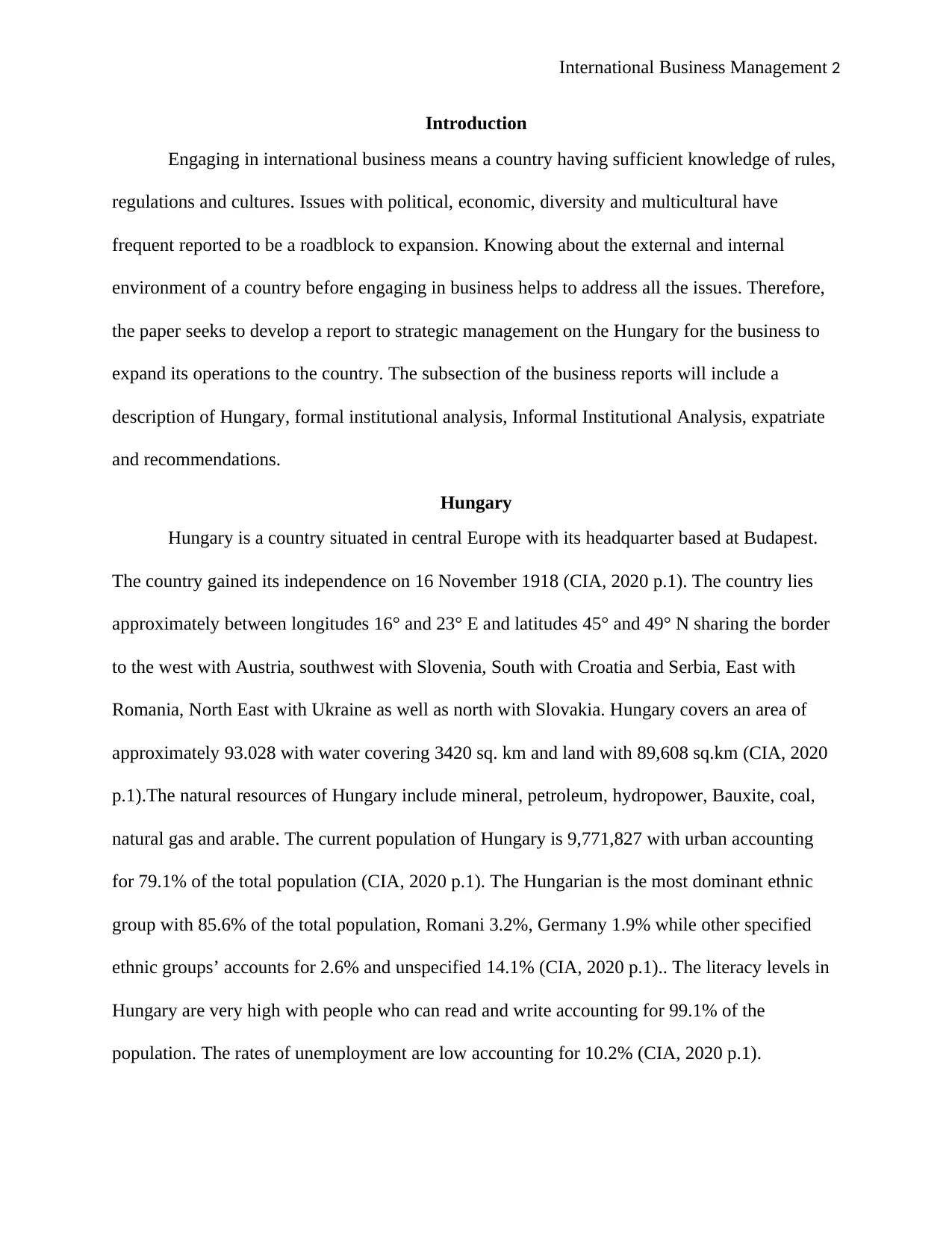
Hungary is a country situated in central Europe with its headquarter based at Budapest.
The country gained its independence on 16 November 1918 (CIA, 2020 p.1). The country lies
approximately between longitudes 16° and 23° E and latitudes 45° and 49° N sharing the border
to the west with Austria, southwest with Slovenia, South with Croatia and Serbia, East with
Romania, North East with Ukraine as well as north with Slovakia. Hungary covers an area of
approximately 93.028 with water covering 3420 sq. km and land with 89,608 sq.km (CIA, 2020
p.1).The natural resources of Hungary include mineral, petroleum, hydropower, Bauxite, coal,
natural gas and arable. The current population of Hungary is 9,771,827 with urban accounting
for 79.1% of the total population (CIA, 2020 p.1). The Hungarian is the most dominant ethnic
group with 85.6% of the total population, Romani 3.2%, Germany 1.9% while other specified
ethnic groups’ accounts for 2.6% and unspecified 14.1% (CIA, 2020 p.1).. The literacy levels in
Hungary are very high with people who can read and write accounting for 99.1% of the
population. The rates of unemployment are low accounting for 10.2% (CIA, 2020 p.1).
Introduction
Engaging in international business means a country having sufficient knowledge of rules,
regulations and cultures. Issues with political, economic, diversity and multicultural have
frequent reported to be a roadblock to expansion. Knowing about the external and internal
environment of a country before engaging in business helps to address all the issues. Therefore,
the paper seeks to develop a report to strategic management on the Hungary for the business to
expand its operations to the country. The subsection of the business reports will include a
description of Hungary, formal institutional analysis, Informal Institutional Analysis, expatriate
and recommendations.
Hungary
Hungary is a country situated in central Europe with its headquarter based at Budapest.
The country gained its independence on 16 November 1918 (CIA, 2020 p.1). The country lies
approximately between longitudes 16° and 23° E and latitudes 45° and 49° N sharing the border
to the west with Austria, southwest with Slovenia, South with Croatia and Serbia, East with
Romania, North East with Ukraine as well as north with Slovakia. Hungary covers an area of
approximately 93.028 with water covering 3420 sq. km and land with 89,608 sq.km (CIA, 2020
p.1).The natural resources of Hungary include mineral, petroleum, hydropower, Bauxite, coal,
natural gas and arable. The current population of Hungary is 9,771,827 with urban accounting
for 79.1% of the total population (CIA, 2020 p.1). The Hungarian is the most dominant ethnic
group with 85.6% of the total population, Romani 3.2%, Germany 1.9% while other specified
ethnic groups’ accounts for 2.6% and unspecified 14.1% (CIA, 2020 p.1).. The literacy levels in
Hungary are very high with people who can read and write accounting for 99.1% of the
population. The rates of unemployment are low accounting for 10.2% (CIA, 2020 p.1).
International Business Management 3
In the context of economic activities, Hungary is ranked as the 6th largest perlite producer
accounting for over 0.6% of the total global production (CIA, 2020 P.1). Currently, the Hungary
has put much focus on large scale mining with companies focusing on highly skilled labour. The
country has evolved significantly shifting from the mining industry to the current Valued-added
production which feeds supply chain of the world.
Formal Institution Analysis
International institution exists as either informal or formal characters. The financial
institution includes an institutions which a government establishes and has rules, policies and
regulations. Therefore, the section will conduct a formal institution analysis of Hungary in terms
of political, economic, technological and legal.
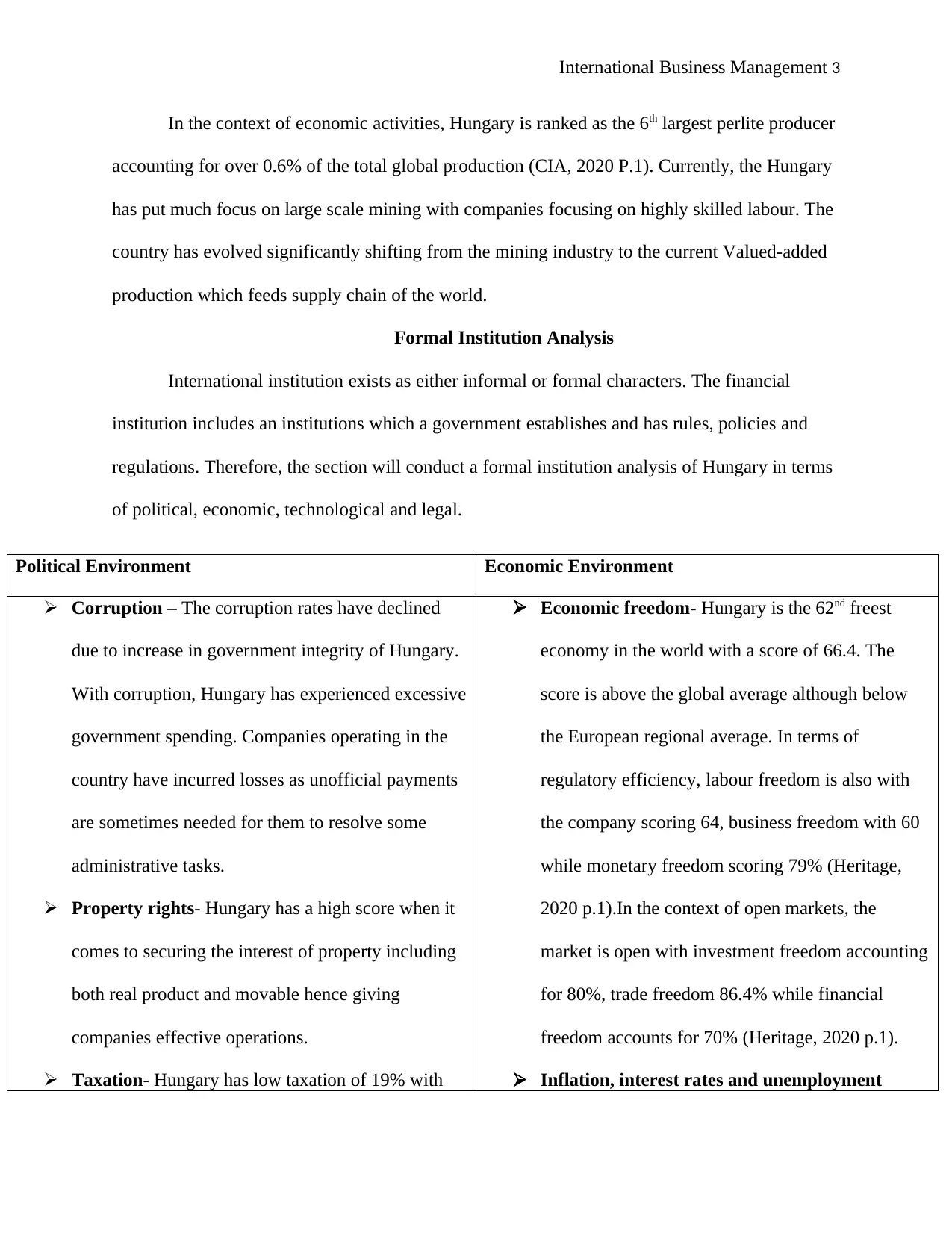
Political Environment Economic Environment
Corruption – The corruption rates have declined
due to increase in government integrity of Hungary.
With corruption, Hungary has experienced excessive
government spending. Companies operating in the
country have incurred losses as unofficial payments
are sometimes needed for them to resolve some
administrative tasks.
Property rights- Hungary has a high score when it
comes to securing the interest of property including
both real product and movable hence giving
companies effective operations.
Taxation- Hungary has low taxation of 19% with
Economic freedom- Hungary is the 62nd freest
economy in the world with a score of 66.4. The
score is above the global average although below
the European regional average. In terms of
regulatory efficiency, labour freedom is also with
the company scoring 64, business freedom with 60
while monetary freedom scoring 79% (Heritage,
2020 p.1).In the context of open markets, the
market is open with investment freedom accounting
for 80%, trade freedom 86.4% while financial
freedom accounts for 70% (Heritage, 2020 p.1).
Inflation, interest rates and unemployment
In the context of economic activities, Hungary is ranked as the 6th largest perlite producer
accounting for over 0.6% of the total global production (CIA, 2020 P.1). Currently, the Hungary
has put much focus on large scale mining with companies focusing on highly skilled labour. The
country has evolved significantly shifting from the mining industry to the current Valued-added
production which feeds supply chain of the world.
Formal Institution Analysis
International institution exists as either informal or formal characters. The financial
institution includes an institutions which a government establishes and has rules, policies and
regulations. Therefore, the section will conduct a formal institution analysis of Hungary in terms
of political, economic, technological and legal.
Political Environment Economic Environment
Corruption – The corruption rates have declined
due to increase in government integrity of Hungary.
With corruption, Hungary has experienced excessive
government spending. Companies operating in the
country have incurred losses as unofficial payments
are sometimes needed for them to resolve some
administrative tasks.
Property rights- Hungary has a high score when it
comes to securing the interest of property including
both real product and movable hence giving
companies effective operations.
Taxation- Hungary has low taxation of 19% with
Economic freedom- Hungary is the 62nd freest
economy in the world with a score of 66.4. The
score is above the global average although below
the European regional average. In terms of
regulatory efficiency, labour freedom is also with
the company scoring 64, business freedom with 60
while monetary freedom scoring 79% (Heritage,
2020 p.1).In the context of open markets, the
market is open with investment freedom accounting
for 80%, trade freedom 86.4% while financial
freedom accounts for 70% (Heritage, 2020 p.1).
Inflation, interest rates and unemployment
⊘ This is a preview!⊘
Do you want full access?
Subscribe today to unlock all pages.

Trusted by 1+ million students worldwide
International Business Management 4
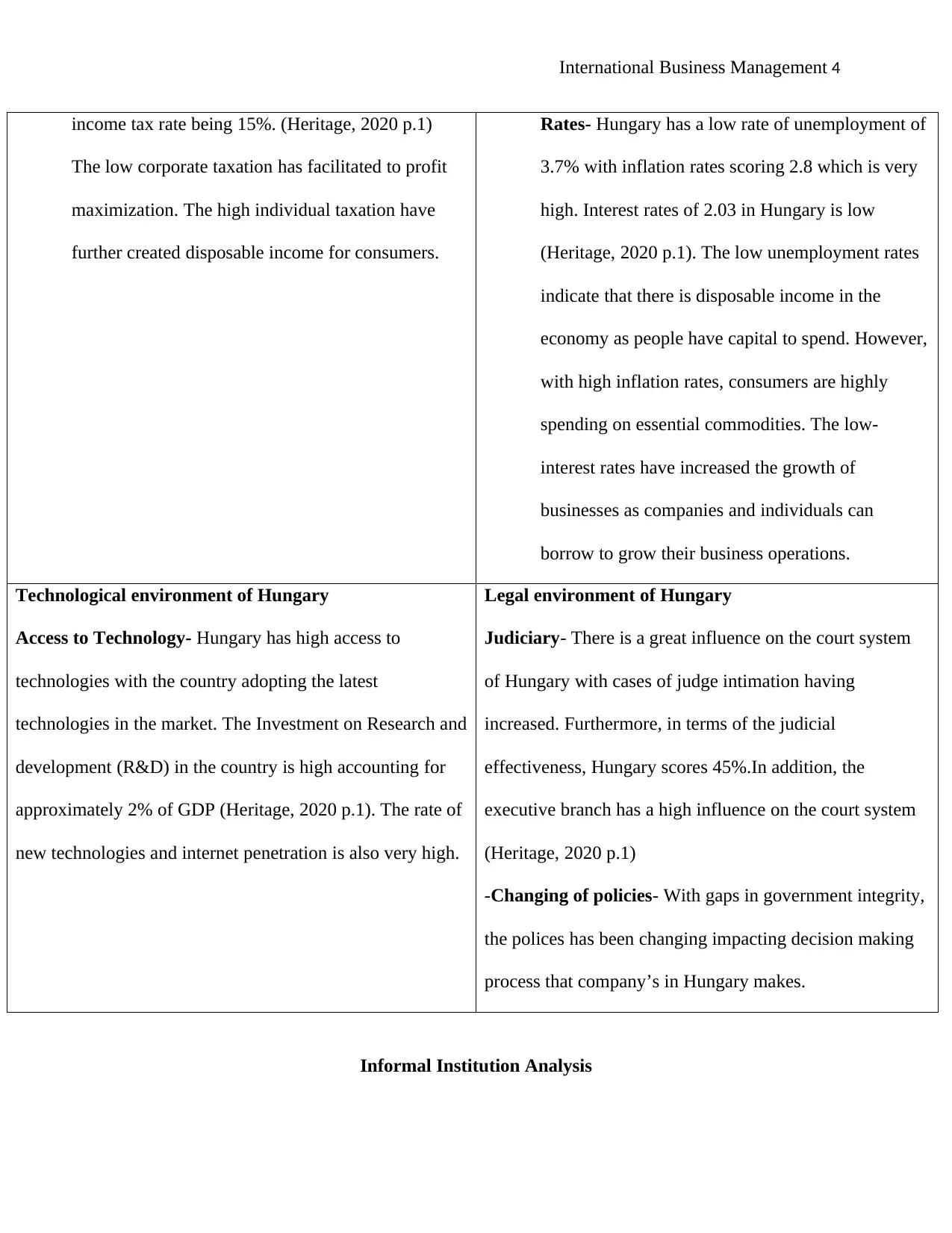
income tax rate being 15%. (Heritage, 2020 p.1)
The low corporate taxation has facilitated to profit
maximization. The high individual taxation have
further created disposable income for consumers.
Rates- Hungary has a low rate of unemployment of
3.7% with inflation rates scoring 2.8 which is very
high. Interest rates of 2.03 in Hungary is low
(Heritage, 2020 p.1). The low unemployment rates
indicate that there is disposable income in the
economy as people have capital to spend. However,
with high inflation rates, consumers are highly
spending on essential commodities. The low-
interest rates have increased the growth of
businesses as companies and individuals can
borrow to grow their business operations.
Technological environment of Hungary
Access to Technology- Hungary has high access to
technologies with the country adopting the latest
technologies in the market. The Investment on Research and
development (R&D) in the country is high accounting for
approximately 2% of GDP (Heritage, 2020 p.1). The rate of
new technologies and internet penetration is also very high.
Legal environment of Hungary
Judiciary- There is a great influence on the court system
of Hungary with cases of judge intimation having
increased. Furthermore, in terms of the judicial
effectiveness, Hungary scores 45%.In addition, the
executive branch has a high influence on the court system
(Heritage, 2020 p.1)
-Changing of policies- With gaps in government integrity,
the polices has been changing impacting decision making
process that company’s in Hungary makes.
Informal Institution Analysis
income tax rate being 15%. (Heritage, 2020 p.1)
The low corporate taxation has facilitated to profit
maximization. The high individual taxation have
further created disposable income for consumers.
Rates- Hungary has a low rate of unemployment of
3.7% with inflation rates scoring 2.8 which is very
high. Interest rates of 2.03 in Hungary is low
(Heritage, 2020 p.1). The low unemployment rates
indicate that there is disposable income in the
economy as people have capital to spend. However,
with high inflation rates, consumers are highly
spending on essential commodities. The low-
interest rates have increased the growth of
businesses as companies and individuals can
borrow to grow their business operations.
Technological environment of Hungary
Access to Technology- Hungary has high access to
technologies with the country adopting the latest
technologies in the market. The Investment on Research and
development (R&D) in the country is high accounting for
approximately 2% of GDP (Heritage, 2020 p.1). The rate of
new technologies and internet penetration is also very high.
Legal environment of Hungary
Judiciary- There is a great influence on the court system
of Hungary with cases of judge intimation having
increased. Furthermore, in terms of the judicial
effectiveness, Hungary scores 45%.In addition, the
executive branch has a high influence on the court system
(Heritage, 2020 p.1)
-Changing of policies- With gaps in government integrity,
the polices has been changing impacting decision making
process that company’s in Hungary makes.
Informal Institution Analysis
Paraphrase This Document
Need a fresh take? Get an instant paraphrase of this document with our AI Paraphraser
International Business Management 5
Informal institution involves traditions, cultures, values, beliefs and social norms that
particular society holds in a particular region and which impacts people perception and
judgments. Cultural demission framework is commonly used to analyze and determine cultures
of various countries and how they affect performance and decision making. The dimensions
included power distance, individualism, masculinity, uncertainty avoidance as well as long
orientation (Hofstede, 2020 p.1).
Hofstede cultural dimension of Hungary
Power distance dimensions deal with the way people believes power is not distributed
equally in their society. Hungary scores low (score of 46) in power distance indicating that there
are equal rights, institutions are independent, there is accessible of superiors, hierarchy is used
only for convenience purposes and a high degree of management empowerment is experienced
(Hofstede, 2020 p.1). Hungary is an individualist society with a high score of 80. The high score
on individualism shows that Hungarians have a high preference for taking care of themselves and
immediate family members rather than society. Hungary scores very high at masculine
dimension indicating it is a masculinity society. A high score in masculinity cultures shows that
Hungary society is highly driven by success, achievement and competition. The success in the
society is determined by a winner or best candidate in a particular activity. Hungary scores high
in uncertainty avoidance with a score of 82 (Hofstede, 2020 p.1). The scores indicate that
Hungarians are high threatened by unknown situations as well as ambiguous. In long-term
orientation which involves how societies maintain links with past while encountering the present
and future challenges, Hungary scores high at 58% which indicates it is a pragmatic society
(Hofstede, 2020 p.1). The pragmatic society has a high encouragement of modern education as a
way preparing about the future. Indulgence involves how people in society try to control
Informal institution involves traditions, cultures, values, beliefs and social norms that
particular society holds in a particular region and which impacts people perception and
judgments. Cultural demission framework is commonly used to analyze and determine cultures
of various countries and how they affect performance and decision making. The dimensions
included power distance, individualism, masculinity, uncertainty avoidance as well as long
orientation (Hofstede, 2020 p.1).
Hofstede cultural dimension of Hungary
Power distance dimensions deal with the way people believes power is not distributed
equally in their society. Hungary scores low (score of 46) in power distance indicating that there
are equal rights, institutions are independent, there is accessible of superiors, hierarchy is used
only for convenience purposes and a high degree of management empowerment is experienced
(Hofstede, 2020 p.1). Hungary is an individualist society with a high score of 80. The high score
on individualism shows that Hungarians have a high preference for taking care of themselves and
immediate family members rather than society. Hungary scores very high at masculine
dimension indicating it is a masculinity society. A high score in masculinity cultures shows that
Hungary society is highly driven by success, achievement and competition. The success in the
society is determined by a winner or best candidate in a particular activity. Hungary scores high
in uncertainty avoidance with a score of 82 (Hofstede, 2020 p.1). The scores indicate that
Hungarians are high threatened by unknown situations as well as ambiguous. In long-term
orientation which involves how societies maintain links with past while encountering the present
and future challenges, Hungary scores high at 58% which indicates it is a pragmatic society
(Hofstede, 2020 p.1). The pragmatic society has a high encouragement of modern education as a
way preparing about the future. Indulgence involves how people in society try to control
International Business Management 6
impulses and desires. Strong control is termed as “Restraint” while weak is called “Indulgence”.
Hungary scores low (30) in the indulgence dimension indicating that Hungarians don’t put much
emphasize on control of their desires and leisure time (Hofstede, 2020 p.1).
Language, religion, language and other social-cultural elements
The main language of Hungary is Hungarian which accounts for 99.6% (the official
language), English 16%, German 11.2%, Russian 1.6%, Romanian 1.3%, French 1.2%, and other
languages amounting to 4.2% (Mouzenidis Travel, 2020 p.1). Hungary is a strong Christianity
country. In the regional context, Hungary has the freedom to worship. The country is highly
dominated by Catholics who occupy a large segment of the population. Currently, more than
54% of the Hungarian total population is catholic (Mouzenidis Travel, 2020 p.1). Furthermore,
3% of the Hungarian’s population are Greek Catholics. Protestants (Calvinist) occupies 20%
with the history showing that the religion is common in the Eastern religions. Other religions
account for 1% in Hungary includes Jews, Muslims and Orthodox Christians (Mouzenidis
Travel, 2020 p.1). Hungary demographics show that the country is experiencing reduced birth
rates leading to a reduction in the number of workforces and an increase aging population.
Impact of Hungarian informal norms on my day to day role
The aging population means low levels of productivity in my workplace. Therefore, with
the aging population, I will have to set deadlines and targets which are not strict as researches
suggest that tight deadlines in aging populations lead to high rates of employees’ turnover. The
low power distance will make sure I decentralize the power to all the department in an effort of
creating and maintaining effective relationship employees. Therefore, as I leader I will be forced
to recruit departmental survivors with low commands or power over other employees and who
are influential to accelerate performance.
impulses and desires. Strong control is termed as “Restraint” while weak is called “Indulgence”.
Hungary scores low (30) in the indulgence dimension indicating that Hungarians don’t put much
emphasize on control of their desires and leisure time (Hofstede, 2020 p.1).
Language, religion, language and other social-cultural elements
The main language of Hungary is Hungarian which accounts for 99.6% (the official
language), English 16%, German 11.2%, Russian 1.6%, Romanian 1.3%, French 1.2%, and other
languages amounting to 4.2% (Mouzenidis Travel, 2020 p.1). Hungary is a strong Christianity
country. In the regional context, Hungary has the freedom to worship. The country is highly
dominated by Catholics who occupy a large segment of the population. Currently, more than
54% of the Hungarian total population is catholic (Mouzenidis Travel, 2020 p.1). Furthermore,
3% of the Hungarian’s population are Greek Catholics. Protestants (Calvinist) occupies 20%
with the history showing that the religion is common in the Eastern religions. Other religions
account for 1% in Hungary includes Jews, Muslims and Orthodox Christians (Mouzenidis
Travel, 2020 p.1). Hungary demographics show that the country is experiencing reduced birth
rates leading to a reduction in the number of workforces and an increase aging population.
Impact of Hungarian informal norms on my day to day role
The aging population means low levels of productivity in my workplace. Therefore, with
the aging population, I will have to set deadlines and targets which are not strict as researches
suggest that tight deadlines in aging populations lead to high rates of employees’ turnover. The
low power distance will make sure I decentralize the power to all the department in an effort of
creating and maintaining effective relationship employees. Therefore, as I leader I will be forced
to recruit departmental survivors with low commands or power over other employees and who
are influential to accelerate performance.
⊘ This is a preview!⊘
Do you want full access?
Subscribe today to unlock all pages.
Trusted by 1+ million students worldwide
International Business Management 7
The communication style will also change as Hungarians need direct and participative
communication. The communication via social media platforms will be ideal and therefore I will
have to sharpen my skillset in this area. The Masculinity culture of Hungary indicates that people
“live to work” in the country and therefore as a manager I will be forced to make assertive and
decision when it comes to performance, competition and equity.
Impact of Hungarian informal norms on Management practices
The rewarding and compensation in Hungary will change significantly due to the issue of
the aging population. The company will be forced to invest more on wellbeing programs as
research conducted by Brooks-Wilson (2013 P.1323) has shown that lifestyles diseases are
prevalent on the aging population. The investment in health, wellbeing initiatives and other
benefits in compensation and rewards package might be expensive for the company. The low
political power culture of Hungary will significantly impact leading and controlling as a function
of management. The culture will demand employees to be consulted indicating that for a leader
to be successful in the culture they must adopt a transformational or situational leadership
approach. The approaches will involve employees being involved in the decision making process
of the company and therefore it will be easier to implement a change. With individualists culture
prevailing, hiring and making decisions in Hungry are based on merit only. Hungarians believe
in individuals’ performance and competition and therefore motivating individual employees
through financial benefits boost motivation and engagement businesses as compared to group
compensation.
The expatriate
Problem solving and decision making skills- To be successful in Hungary, potential
expatriate’s needs to have the capability of making effective decisions with inclusivity in the
workforce. Hungarians tends to be effective with autocratic decision-making style which
The communication style will also change as Hungarians need direct and participative
communication. The communication via social media platforms will be ideal and therefore I will
have to sharpen my skillset in this area. The Masculinity culture of Hungary indicates that people
“live to work” in the country and therefore as a manager I will be forced to make assertive and
decision when it comes to performance, competition and equity.
Impact of Hungarian informal norms on Management practices
The rewarding and compensation in Hungary will change significantly due to the issue of
the aging population. The company will be forced to invest more on wellbeing programs as
research conducted by Brooks-Wilson (2013 P.1323) has shown that lifestyles diseases are
prevalent on the aging population. The investment in health, wellbeing initiatives and other
benefits in compensation and rewards package might be expensive for the company. The low
political power culture of Hungary will significantly impact leading and controlling as a function
of management. The culture will demand employees to be consulted indicating that for a leader
to be successful in the culture they must adopt a transformational or situational leadership
approach. The approaches will involve employees being involved in the decision making process
of the company and therefore it will be easier to implement a change. With individualists culture
prevailing, hiring and making decisions in Hungry are based on merit only. Hungarians believe
in individuals’ performance and competition and therefore motivating individual employees
through financial benefits boost motivation and engagement businesses as compared to group
compensation.
The expatriate
Problem solving and decision making skills- To be successful in Hungary, potential
expatriate’s needs to have the capability of making effective decisions with inclusivity in the
workforce. Hungarians tends to be effective with autocratic decision-making style which
Paraphrase This Document
Need a fresh take? Get an instant paraphrase of this document with our AI Paraphraser
International Business Management 8
sometimes maybe not effective especially where high performance is needed. Therefore for
success the culture the potential expatriates must be able to make decisions which aligns with
cultures of Hungarians. The Hungarians also have a lose self-esteem and therefore they get
offended easily. Therefore, potential expatriates with effective problem solving skills and
capabilities will assist to fit in the culture.
Leadership skills- To be successful in Hungary, potential expatriate’s needs to have
effective leadership skills. The culture of Hungary shows that employees dislike much control in
their workforce and therefore if there are leadership gaps in an organization, the low
performances are likely to be experienced. Hungarians emphasizes so much on developing,
nurturing, maintaining social networks and further favours group decision in consensus building
and dialogue and therefore expatriates with effective leadership can motivate the Hungarians t
perform.
Recommendation
With consideration of the financial and non-financial analysis, The Company should
consider exploring all opportunities in Hungary and open its business. The country is attractive
for investment with consideration of low taxations, flat rate individual income taxation, and
property right as well as corruption levels. The rates of government interference are medium
hence businesses don’t experience high efficiencies in their operations. The microeconomics are
promising with free economy minimizing regulations and interference in the market which may
be costly for an organization. The cultures are very attractive and promising for business to be
successful in the country.
sometimes maybe not effective especially where high performance is needed. Therefore for
success the culture the potential expatriates must be able to make decisions which aligns with
cultures of Hungarians. The Hungarians also have a lose self-esteem and therefore they get
offended easily. Therefore, potential expatriates with effective problem solving skills and
capabilities will assist to fit in the culture.
Leadership skills- To be successful in Hungary, potential expatriate’s needs to have
effective leadership skills. The culture of Hungary shows that employees dislike much control in
their workforce and therefore if there are leadership gaps in an organization, the low
performances are likely to be experienced. Hungarians emphasizes so much on developing,
nurturing, maintaining social networks and further favours group decision in consensus building
and dialogue and therefore expatriates with effective leadership can motivate the Hungarians t
perform.
Recommendation
With consideration of the financial and non-financial analysis, The Company should
consider exploring all opportunities in Hungary and open its business. The country is attractive
for investment with consideration of low taxations, flat rate individual income taxation, and
property right as well as corruption levels. The rates of government interference are medium
hence businesses don’t experience high efficiencies in their operations. The microeconomics are
promising with free economy minimizing regulations and interference in the market which may
be costly for an organization. The cultures are very attractive and promising for business to be
successful in the country.
International Business Management 9
References
Brooks-Wilson, A.R., 2013. Genetics of healthy aging and longevity. Human genetics, 132(12),
pp.1323-1338.
CIA, 2020. Hungary. [Online] Available at: https://https://www.cia.gov/library/publications/the-
world-factbook/geos/hu.html [Accessed 20 April 2020]
Hofstede, 2020. Cultural dimensions of Hungary. [Online] Available at: https://
https://www.hofstede-insights.com/country/hungary/ [Accessed 20 April 2020]
Heritage, 2020. Hungary. [Online] Available at https://www.heritage.org/index/country/hungary
[Accessed 20 April 2020].
Mouzenidis Travel, 2020. Religion in Hungary. [Online] Available at: https://
https://www.mouzenidis.com/en-us/hungary/article/religion [Accessed 20 April 2020]
References
Brooks-Wilson, A.R., 2013. Genetics of healthy aging and longevity. Human genetics, 132(12),
pp.1323-1338.
CIA, 2020. Hungary. [Online] Available at: https://https://www.cia.gov/library/publications/the-
world-factbook/geos/hu.html [Accessed 20 April 2020]
Hofstede, 2020. Cultural dimensions of Hungary. [Online] Available at: https://
https://www.hofstede-insights.com/country/hungary/ [Accessed 20 April 2020]
Heritage, 2020. Hungary. [Online] Available at https://www.heritage.org/index/country/hungary
[Accessed 20 April 2020].
Mouzenidis Travel, 2020. Religion in Hungary. [Online] Available at: https://
https://www.mouzenidis.com/en-us/hungary/article/religion [Accessed 20 April 2020]
⊘ This is a preview!⊘
Do you want full access?
Subscribe today to unlock all pages.
Trusted by 1+ million students worldwide

1 out of 9


Related Documents


Your All-in-One AI-Powered Toolkit for Academic Success.
+13062052269
info@desklib.com
Available 24*7 on WhatsApp / Email
![[object Object]](/_next/static/media/star-bottom.7253800d.svg)
Unlock your academic potential
Copyright © 2020–2026 A2Z Services. All Rights Reserved. Developed and managed by ZUCOL.