International Business Report: India and Singapore Comparison
VerifiedAdded on 2021/04/24
|12
|3474
|455
Report
AI Summary
This report provides a comprehensive analysis of international business, focusing on India and its comparison with Singapore. It begins with an introduction to India, highlighting its key attributes like economy, culture, and geography. The report delves into a detailed cultural analysis of India, discussing its people, languages, traditions, and unique cultural elements. It then explores the business culture of India, including meeting etiquette and business practices, and compares it with Singapore's business environment, highlighting differences in ease of doing business, import processes, credit access, and land acquisition. The report also incorporates Hofstede's cultural dimensions to further analyze and compare the cultural nuances of both countries. The analysis covers individualism vs. collectivism, power distance, uncertainty avoidance, achievement vs. nurturing, and long-term orientation, providing valuable insights for international business strategies and decision-making. The report concludes with a summary of the findings and references used.
Running head: INTERNATIONAL BUSINESS
International Business
Name of the Student
Name of the University
Author note
International Business
Name of the Student
Name of the University
Author note

Paraphrase This Document
Need a fresh take? Get an instant paraphrase of this document with our AI Paraphraser
1INTERNATIONAL BUSINESS
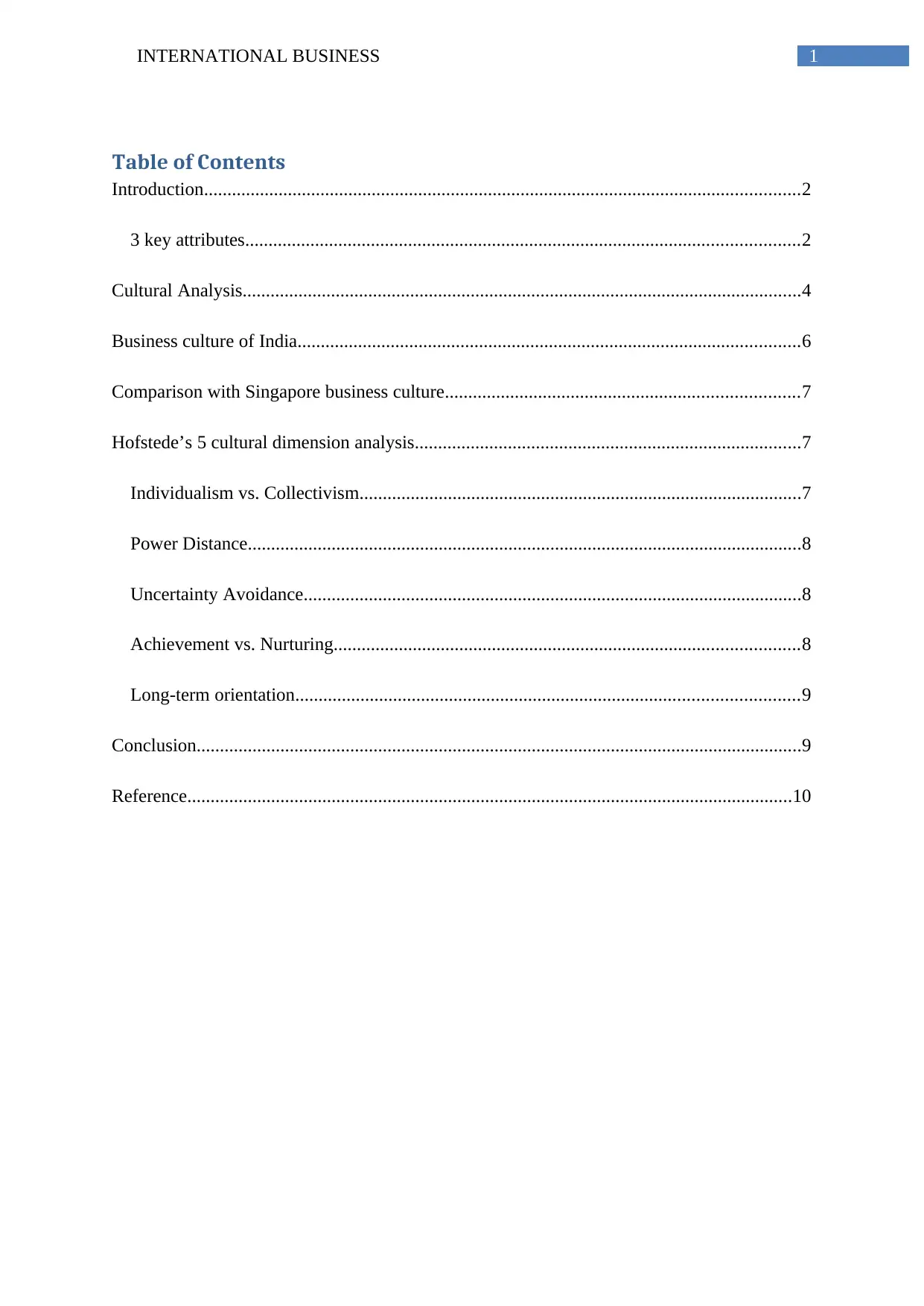
Table of Contents
Introduction................................................................................................................................2
3 key attributes.......................................................................................................................2
Cultural Analysis........................................................................................................................4
Business culture of India............................................................................................................6
Comparison with Singapore business culture............................................................................7
Hofstede’s 5 cultural dimension analysis...................................................................................7
Individualism vs. Collectivism...............................................................................................7
Power Distance.......................................................................................................................8
Uncertainty Avoidance...........................................................................................................8
Achievement vs. Nurturing....................................................................................................8
Long-term orientation............................................................................................................9
Conclusion..................................................................................................................................9
Reference..................................................................................................................................10
Table of Contents
Introduction................................................................................................................................2
3 key attributes.......................................................................................................................2
Cultural Analysis........................................................................................................................4
Business culture of India............................................................................................................6
Comparison with Singapore business culture............................................................................7
Hofstede’s 5 cultural dimension analysis...................................................................................7
Individualism vs. Collectivism...............................................................................................7
Power Distance.......................................................................................................................8
Uncertainty Avoidance...........................................................................................................8
Achievement vs. Nurturing....................................................................................................8
Long-term orientation............................................................................................................9
Conclusion..................................................................................................................................9
Reference..................................................................................................................................10
2INTERNATIONAL BUSINESS
Introduction
India is a known as the largest country in the South Asia region. The country shares
its border with countries like China, Nepal, Pakistan, Bangladesh and Sri Lanka (Spate &
Learmonth, 2017). The country is vast in its cultural and religious variation. India is regarded
as largest democracy in the world. The country is expected to become the most populous
country in the world by overtaking China by the year 2028. The country is selected because it
is one of the fastest developing countries and a huge area for international business to enter
and make a mark on. The country has an economy that is strong and the trade policies are
lenient which further make it one of the most suitable countries to create a market report.
3 key attributes
Economy- India is a country that is extensively dependent on agriculture and
the various products from it. The working population of the country is mostly
engaged into farming and other agriculture activities (Yadav et al., 2015). The
income from agriculture and related activities make up for most of the annual
income of the country. Around 21% of the national income was attributed to
agriculture and related activities in the year 2004. The agricultural set up of
the country has the maximum pressure on it to perform and deliver so that the
economy of the country keeps progressing in the right direction. The country
has a fertile land and the practice of agriculture is attributed to the history of
the place. The rate of capital formation of the country is low and the income
per capita is low in comparison to other countries. The wealth distribution
pattern in the society is uneven and it is seen that the wealth is stagnated with
a certain section of the society. Obsolete technologies used in the production
process makes it further difficult for the country to gain economic boost. The
Introduction
India is a known as the largest country in the South Asia region. The country shares
its border with countries like China, Nepal, Pakistan, Bangladesh and Sri Lanka (Spate &
Learmonth, 2017). The country is vast in its cultural and religious variation. India is regarded
as largest democracy in the world. The country is expected to become the most populous
country in the world by overtaking China by the year 2028. The country is selected because it
is one of the fastest developing countries and a huge area for international business to enter
and make a mark on. The country has an economy that is strong and the trade policies are
lenient which further make it one of the most suitable countries to create a market report.
3 key attributes
Economy- India is a country that is extensively dependent on agriculture and
the various products from it. The working population of the country is mostly
engaged into farming and other agriculture activities (Yadav et al., 2015). The
income from agriculture and related activities make up for most of the annual
income of the country. Around 21% of the national income was attributed to
agriculture and related activities in the year 2004. The agricultural set up of
the country has the maximum pressure on it to perform and deliver so that the
economy of the country keeps progressing in the right direction. The country
has a fertile land and the practice of agriculture is attributed to the history of
the place. The rate of capital formation of the country is low and the income
per capita is low in comparison to other countries. The wealth distribution
pattern in the society is uneven and it is seen that the wealth is stagnated with
a certain section of the society. Obsolete technologies used in the production
process makes it further difficult for the country to gain economic boost. The
⊘ This is a preview!⊘
Do you want full access?
Subscribe today to unlock all pages.

Trusted by 1+ million students worldwide
3INTERNATIONAL BUSINESS
use of backdated technology has held the country back in terms of the
economic development that is expected from the country.
Culture- The culture of the place is huge in terms of variety and this is
primarily due to the huge geographical expanse of the nation. The country has
mountains, plains and even deserts. It shows that the demography of the
country is varied and hence their culture is varied too. The country is referred
to as cultural museum due to the huge number of races it has within. The
second most populous country in the world, India, has a variety of races that is
unprecedented in other parts of the world. The variety in races reflects that the
country has an immense diversity in the number of languages prevailing in the
country. A total of 179 languages and 544 dialects exist in the country
(Weiner, 2015). People from different regions have different languages that
they use. The religious variety in India is huge and as it a country that allows
the following of any religion without any barrier, the diversity in the culture is
further enhanced. Each of the religious group has their different culture and
practice that creates the Indian mainland into a pool of diversity.
Geography- The huge expanse of the Indian mainland brings to the account
the huge variety and list of features that it has in its geography. The country
has many rivers flowing throughout the country. Each of these rivers have
significant influence on the market and economy of the country. The country
has some plains which are very fertile and they add to the economic growth of
the nation. The Chhattisgarh Plateau is one of the most important source of
minerals for the entire nation and it is rich in all kinds of minerals that can be
excavated from under the ground (Bhausaheb et al., 2014). The Gangetic plain
of the country is a hub of natural resource for the entire country and it
use of backdated technology has held the country back in terms of the
economic development that is expected from the country.
Culture- The culture of the place is huge in terms of variety and this is
primarily due to the huge geographical expanse of the nation. The country has
mountains, plains and even deserts. It shows that the demography of the
country is varied and hence their culture is varied too. The country is referred
to as cultural museum due to the huge number of races it has within. The
second most populous country in the world, India, has a variety of races that is
unprecedented in other parts of the world. The variety in races reflects that the
country has an immense diversity in the number of languages prevailing in the
country. A total of 179 languages and 544 dialects exist in the country
(Weiner, 2015). People from different regions have different languages that
they use. The religious variety in India is huge and as it a country that allows
the following of any religion without any barrier, the diversity in the culture is
further enhanced. Each of the religious group has their different culture and
practice that creates the Indian mainland into a pool of diversity.
Geography- The huge expanse of the Indian mainland brings to the account
the huge variety and list of features that it has in its geography. The country
has many rivers flowing throughout the country. Each of these rivers have
significant influence on the market and economy of the country. The country
has some plains which are very fertile and they add to the economic growth of
the nation. The Chhattisgarh Plateau is one of the most important source of
minerals for the entire nation and it is rich in all kinds of minerals that can be
excavated from under the ground (Bhausaheb et al., 2014). The Gangetic plain
of the country is a hub of natural resource for the entire country and it
Paraphrase This Document
Need a fresh take? Get an instant paraphrase of this document with our AI Paraphraser
4INTERNATIONAL BUSINESS
provides huge amounts of required resource to the production process of the
country. The mountains of the country have importance as they act as a shield
to winds that may harm the country. The Himalayas make sure that the
country does not face the cold winds that blow from the other side of the huge
mountains. It blocks such winds and also provides security from any kind of
invaders easily entering the country. The mountains also act as a huge source
of natural resource and play a major role in attracting tourists into the country.
Cultural Analysis
The culture of the country is hugely varied. The different regions and religions have
their set of beliefs and code of conduct which they adhere to in the society. Some of the
attributes of the culture are presented in brief below-
People- The people of India are the best thing that a foreign person can witness in the
country. The people are very celebrating in nature and fun loving. Each of the citizen
is a passionate person and be it for cricket, movies, food or anything they are in the
mood to celebrate the event. The people believe in making most of any celebration
that takes place. The common characteristic for the people of India is that they are
emotional in nature and have a strong sense of family. The level of attachment that
each of the members have for each other in the family is huge and once a person is
part of a family it is seen that the members stick around with the person even at the
toughest of the times. The entire population is known to be great host for guests and
the warmth and intimacy that the Indians will make a person feel is to be found in no
other place on earth. The generosity that the Indians have is huge and they believe that
the best practice is serving others. Any religious place in India serves free meals to
thousands of people on a daily basis and this is done free of cost (Jatt, 2015).
provides huge amounts of required resource to the production process of the
country. The mountains of the country have importance as they act as a shield
to winds that may harm the country. The Himalayas make sure that the
country does not face the cold winds that blow from the other side of the huge
mountains. It blocks such winds and also provides security from any kind of
invaders easily entering the country. The mountains also act as a huge source
of natural resource and play a major role in attracting tourists into the country.
Cultural Analysis
The culture of the country is hugely varied. The different regions and religions have
their set of beliefs and code of conduct which they adhere to in the society. Some of the
attributes of the culture are presented in brief below-
People- The people of India are the best thing that a foreign person can witness in the
country. The people are very celebrating in nature and fun loving. Each of the citizen
is a passionate person and be it for cricket, movies, food or anything they are in the
mood to celebrate the event. The people believe in making most of any celebration
that takes place. The common characteristic for the people of India is that they are
emotional in nature and have a strong sense of family. The level of attachment that
each of the members have for each other in the family is huge and once a person is
part of a family it is seen that the members stick around with the person even at the
toughest of the times. The entire population is known to be great host for guests and
the warmth and intimacy that the Indians will make a person feel is to be found in no
other place on earth. The generosity that the Indians have is huge and they believe that
the best practice is serving others. Any religious place in India serves free meals to
thousands of people on a daily basis and this is done free of cost (Jatt, 2015).
5INTERNATIONAL BUSINESS
Language- India is a land with huge variety in its culture and the variety cannot be
understood unless the language of the place is discussed. The country has a total of 18
languages that are regarded by the constitution as official language. The Indian
currency has the 18 different languages imprinted on it and it shows the diversity the
country holds within itself. Respect is provided to all the languages and due to such
variation it is seen that no place has a fixed language the dialect changes after every
mile shift in the country. Though the official numbers suggests 18 languages,
unofficial figures suggest that India is house to over 2500 dialects in total (Harrison,
2015). The most widely and commonly used language in the country is Hindi. Hindi
is now referred to as the second most used language in the entire world after
Mandarin which of Chinese origin and stands in the first place.
Traditions- India is a place that is rich in folk and traditional practices. The history of
the country is rich and makes sure that all the ideas of tradition and culture are richly
incorporated in the population. The Chhou and Kabelia folks of Bengal and Rajasthan
respectively have earned a place in the global domain due to their eminent style
unique presentation form (SARKAR & MISTRI, 2015). The Ramlila, which is an
ancient drama about the abduction of Sita by Ravana and the revenge story of Lord
Ram, has been picked up by UNESCO and a documentary has been made on it
(Gopalakrishnan, 2016). It is said the Indian culture dates back to 4500 years and it is
the oldest of the cultures in this entire world.
Unique cultural elements- The ‘Namaste’ is a practice that is absolutely unique to the
country and is a practice that has evolved in the country itself and hence unique to the
entire world. It basically is a greeting to another person with folded hands showing
pleasure and generosity on part of the host. The notion of ‘Atithi Devo Bhava’ is
unique to the country. It shows that the people of the country are very generous to the
Language- India is a land with huge variety in its culture and the variety cannot be
understood unless the language of the place is discussed. The country has a total of 18
languages that are regarded by the constitution as official language. The Indian
currency has the 18 different languages imprinted on it and it shows the diversity the
country holds within itself. Respect is provided to all the languages and due to such
variation it is seen that no place has a fixed language the dialect changes after every
mile shift in the country. Though the official numbers suggests 18 languages,
unofficial figures suggest that India is house to over 2500 dialects in total (Harrison,
2015). The most widely and commonly used language in the country is Hindi. Hindi
is now referred to as the second most used language in the entire world after
Mandarin which of Chinese origin and stands in the first place.
Traditions- India is a place that is rich in folk and traditional practices. The history of
the country is rich and makes sure that all the ideas of tradition and culture are richly
incorporated in the population. The Chhou and Kabelia folks of Bengal and Rajasthan
respectively have earned a place in the global domain due to their eminent style
unique presentation form (SARKAR & MISTRI, 2015). The Ramlila, which is an
ancient drama about the abduction of Sita by Ravana and the revenge story of Lord
Ram, has been picked up by UNESCO and a documentary has been made on it
(Gopalakrishnan, 2016). It is said the Indian culture dates back to 4500 years and it is
the oldest of the cultures in this entire world.
Unique cultural elements- The ‘Namaste’ is a practice that is absolutely unique to the
country and is a practice that has evolved in the country itself and hence unique to the
entire world. It basically is a greeting to another person with folded hands showing
pleasure and generosity on part of the host. The notion of ‘Atithi Devo Bhava’ is
unique to the country. It shows that the people of the country are very generous to the
⊘ This is a preview!⊘
Do you want full access?
Subscribe today to unlock all pages.
Trusted by 1+ million students worldwide
6INTERNATIONAL BUSINESS
guests that come to the nation and they shall greet them as Gods (Yameen, 2013). The
people of India believe that the guests are another form of God and they should hence
be treated like one.
Business culture of India
As it is evident from the previous part of the report that India is a place that is rich
with culture and certain formalities that are unique to the nation. The business practice in the
country is marked with certain etiquettes that are needed to be followed by anyone trying to
partner or build a business in the country. The openings and greetings in a business meeting
are with a handshake or a ‘namaste’ (Dahwa, Al-Hakim & Ng, 2013). It is essential that
respect is shown to all the people who are involved in the business meet. The seniors in the
business meet should be greeted with the position they hold, it shows the respect that the
person has in the society. One should refer to people as Sir or Madam and even the use of ‘ji’
after the name shows immense respect to the person who is being referred to. The business
attire of the country does not mention ties as mandatory and hence formal trousers and
lightweight coats are appreciated for the business meets. The most widely used language in
the business meets is English. It is to be understood that the people in India refrain from
saying ‘no’ and rather use other sentences such as ‘we will see’, ‘we will try’, ‘It may be
difficult’ and many more. The underlying meanings of such words should be understood and
it should be made sure that too much pestering is not done. The timings and venue of an
Indian business meet can be changed even at the last moment and interruptions are expected
numerous times. The start and end time of a business meet should not be expected on time as
people tend to delay such proceedings in India. For a country like India, trust and good
relationship matters as much as statistics and data so it has to be made sure that a good
relationship is built with the people before looking at getting a deal fixed with them.
guests that come to the nation and they shall greet them as Gods (Yameen, 2013). The
people of India believe that the guests are another form of God and they should hence
be treated like one.
Business culture of India
As it is evident from the previous part of the report that India is a place that is rich
with culture and certain formalities that are unique to the nation. The business practice in the
country is marked with certain etiquettes that are needed to be followed by anyone trying to
partner or build a business in the country. The openings and greetings in a business meeting
are with a handshake or a ‘namaste’ (Dahwa, Al-Hakim & Ng, 2013). It is essential that
respect is shown to all the people who are involved in the business meet. The seniors in the
business meet should be greeted with the position they hold, it shows the respect that the
person has in the society. One should refer to people as Sir or Madam and even the use of ‘ji’
after the name shows immense respect to the person who is being referred to. The business
attire of the country does not mention ties as mandatory and hence formal trousers and
lightweight coats are appreciated for the business meets. The most widely used language in
the business meets is English. It is to be understood that the people in India refrain from
saying ‘no’ and rather use other sentences such as ‘we will see’, ‘we will try’, ‘It may be
difficult’ and many more. The underlying meanings of such words should be understood and
it should be made sure that too much pestering is not done. The timings and venue of an
Indian business meet can be changed even at the last moment and interruptions are expected
numerous times. The start and end time of a business meet should not be expected on time as
people tend to delay such proceedings in India. For a country like India, trust and good
relationship matters as much as statistics and data so it has to be made sure that a good
relationship is built with the people before looking at getting a deal fixed with them.
Paraphrase This Document
Need a fresh take? Get an instant paraphrase of this document with our AI Paraphraser
7INTERNATIONAL BUSINESS
Comparison with Singapore business culture
Efforts to make business in India easier has constantly been on rise but have yielded
very low results as it remains a tough place for new businesses to develop. The world bank
ease of doing business reports reflects that India is placed at #130 in the list whereas
Singapore is positioned at #2 (Besley, 2015). The process of import for a new business is
very difficult for India when compared with Singapore. In India the imports are delayed and
at times forfeited due to theft and lack of security whereas in Singapore the imports are
completely safe and the transportation system is so efficient that it makes sure that the
shipments are delivered at the right time. The ease of getting a credit for a new business is
easy for Singapore whereas in India the situation is completely adverse and it takes a lot of
effort to make sure that credit is approved for a business to come into the country. The ease
of getting land and security for a new business is easier in Singapore than in India. The land
permitted for business may face revolt from the natives due to unfair encroachment policies.
The revolt can lead to loss for the business and the company may face serious legal
implications and notice for the same. These make it difficult for new businesses to enter into
the country and make a positive mark. The taxation system of India imposes up to 30% of
taxes on earning individuals whereas Singapore has a maximum of 22% tax to be imposed on
the earning population.
Hofstede’s 5 cultural dimension analysis
Individualism vs. Collectivism
India has a score of 48 in this section of the Hofstede and it shows that the society has
both individualistic and collectivist traits in it (Country Comparison - Hofstede Insights,
2018). The collectivist trait is reflective of the desire of the people to be part of larger social
framework. With such traits, it is expected that a person is dependent on many of the social
Comparison with Singapore business culture
Efforts to make business in India easier has constantly been on rise but have yielded
very low results as it remains a tough place for new businesses to develop. The world bank
ease of doing business reports reflects that India is placed at #130 in the list whereas
Singapore is positioned at #2 (Besley, 2015). The process of import for a new business is
very difficult for India when compared with Singapore. In India the imports are delayed and
at times forfeited due to theft and lack of security whereas in Singapore the imports are
completely safe and the transportation system is so efficient that it makes sure that the
shipments are delivered at the right time. The ease of getting a credit for a new business is
easy for Singapore whereas in India the situation is completely adverse and it takes a lot of
effort to make sure that credit is approved for a business to come into the country. The ease
of getting land and security for a new business is easier in Singapore than in India. The land
permitted for business may face revolt from the natives due to unfair encroachment policies.
The revolt can lead to loss for the business and the company may face serious legal
implications and notice for the same. These make it difficult for new businesses to enter into
the country and make a positive mark. The taxation system of India imposes up to 30% of
taxes on earning individuals whereas Singapore has a maximum of 22% tax to be imposed on
the earning population.
Hofstede’s 5 cultural dimension analysis
Individualism vs. Collectivism
India has a score of 48 in this section of the Hofstede and it shows that the society has
both individualistic and collectivist traits in it (Country Comparison - Hofstede Insights,
2018). The collectivist trait is reflective of the desire of the people to be part of larger social
framework. With such traits, it is expected that a person is dependent on many of the social
8INTERNATIONAL BUSINESS
constraint around and makes decision which are influenced by the views and opinions of all
the people around that individual such as family, society and friends. The individualist
approach reflects that the people of India believe that a person is the one who is responsible
for all the work that is done by the individual. The Hinduism and the theory of birth and
death associated with it further instates the individualism.
Power Distance
India has a score of 78 in this section and it shows that the people of India have a
highly structured society (Country Comparison - Hofstede Insights, 2018). The Indian idea is
that a person is dependent on the boss who has the power to provide discretion. The element
of control is huge in the society and it further ensures that the communication is one way in
the society. The feedback, which is negative in nature, from the lower section of the society
does not reach to the top order.
Uncertainty Avoidance
The score for India in this section is 40 (Country Comparison - Hofstede Insights,
2018). It reflects that India is a country that accepts that uncertainties that are prevalent in
life. The country has a medium to low level of uncertainty avoidance. The people often use
the idea of bypassing the rules to get their motives sanctioned. The quality of adjustment is
high among the workforce and hence they do not react on unexpected events and at times feel
happy as it breaks the monotony.
Achievement vs. Nurturing
The score for India in this section is 56 (Country Comparison - Hofstede Insights,
2018). It reflects that India is focused towards achievement and the country has high regards
for power and success. The country is a spiritual land and hence the nurturing provided to the
constraint around and makes decision which are influenced by the views and opinions of all
the people around that individual such as family, society and friends. The individualist
approach reflects that the people of India believe that a person is the one who is responsible
for all the work that is done by the individual. The Hinduism and the theory of birth and
death associated with it further instates the individualism.
Power Distance
India has a score of 78 in this section and it shows that the people of India have a
highly structured society (Country Comparison - Hofstede Insights, 2018). The Indian idea is
that a person is dependent on the boss who has the power to provide discretion. The element
of control is huge in the society and it further ensures that the communication is one way in
the society. The feedback, which is negative in nature, from the lower section of the society
does not reach to the top order.
Uncertainty Avoidance
The score for India in this section is 40 (Country Comparison - Hofstede Insights,
2018). It reflects that India is a country that accepts that uncertainties that are prevalent in
life. The country has a medium to low level of uncertainty avoidance. The people often use
the idea of bypassing the rules to get their motives sanctioned. The quality of adjustment is
high among the workforce and hence they do not react on unexpected events and at times feel
happy as it breaks the monotony.
Achievement vs. Nurturing
The score for India in this section is 56 (Country Comparison - Hofstede Insights,
2018). It reflects that India is focused towards achievement and the country has high regards
for power and success. The country is a spiritual land and hence the nurturing provided to the
⊘ This is a preview!⊘
Do you want full access?
Subscribe today to unlock all pages.
Trusted by 1+ million students worldwide
9INTERNATIONAL BUSINESS
people is high as the religious texts provide motivation for the people. The people have
regards for achievement but care is taken of those who are need of nurturing.
Long-term orientation
India has a score of 51 in this section and it reflects that the history and age old
believes of the country has considerable impact on the present ethics of work (Country
Comparison - Hofstede Insights, 2018). Time is not taken as an important aspect in the
country but the ethics and good deeds are taken up into account. The idea of ‘karma’ is used
and everyone believes that if a sin is committed then the punishments of it shall be suffered in
the same birth by the person. The society is pragmatic in the country and people are not
judged based on punctuality but based on the event that leads to the consequent result or
delay.
Conclusion
India is a country that is developing every single day and the resource and labor base
of the country attracts new businesses. However it is seen that setting up a business is not that
easy in a country like India because of the various governing and laws that persist in the
nation. The people of the country are its biggest advantage as it makes sure that the foreign
people feel comfortable and get the best of reception in the country. In comparison with
Singapore, it has drawbacks as the business environment is not as rewarding as it should be.
The country of India has its own nature and style and if adjustments are made then it could
well be a suitable business destination for any new venture.
people is high as the religious texts provide motivation for the people. The people have
regards for achievement but care is taken of those who are need of nurturing.
Long-term orientation
India has a score of 51 in this section and it reflects that the history and age old
believes of the country has considerable impact on the present ethics of work (Country
Comparison - Hofstede Insights, 2018). Time is not taken as an important aspect in the
country but the ethics and good deeds are taken up into account. The idea of ‘karma’ is used
and everyone believes that if a sin is committed then the punishments of it shall be suffered in
the same birth by the person. The society is pragmatic in the country and people are not
judged based on punctuality but based on the event that leads to the consequent result or
delay.
Conclusion
India is a country that is developing every single day and the resource and labor base
of the country attracts new businesses. However it is seen that setting up a business is not that
easy in a country like India because of the various governing and laws that persist in the
nation. The people of the country are its biggest advantage as it makes sure that the foreign
people feel comfortable and get the best of reception in the country. In comparison with
Singapore, it has drawbacks as the business environment is not as rewarding as it should be.
The country of India has its own nature and style and if adjustments are made then it could
well be a suitable business destination for any new venture.
Paraphrase This Document
Need a fresh take? Get an instant paraphrase of this document with our AI Paraphraser
10INTERNATIONAL BUSINESS
Reference
Besley, T. (2015). Law, regulation, and the business climate: The nature and influence of the
World Bank Doing Business project. Journal of Economic Perspectives, 29(3), 99-
120. Retrieved from: http://pubs.aeaweb.org/doi/pdf/10.1257%2Fjep.29.3.99
Bhausaheb, K. S., Tiwari, S. P., Sahu, T., Naik, S. K., & Gendley, M. K. (2014). Trace
mineral status of soil, feed and animal in Chhattisgarh state (India). Int. J. Adv.
Res, 2(5), 443-448. Retrieved from: http://www.journalijar.com/uploads/438_IJAR-
3281.pdf
Country Comparison - Hofstede Insights. (2018). Hofstede Insights. Retrieved 23 March
2018, from https://www.hofstede-insights.com/country-comparison/india/
Dahwa, M. P., Al-Hakim, L., & Ng, E. (2013). The importance of trust in procurement
practices and its impact on business performance: An empirical investigation from the
perspective of the buyer–supplier dyad. Journal of Relationship Marketing, 12(4),
280-300. Retrieved from: https://eprints.usq.edu.au/24492/7/Dahwa_Al-
Hakim_Ng_JRM_2013_AV.pdf
Gopalakrishnan, S. (2016). UNESCO Masterpieces Proclamation Programme and
Safeguarding Strategies for Intangible Cultural Heritage: A View from India. Journal
of Heritage Management, 1(1), 12-21. Retrieved from:
http://journals.sagepub.com/doi/full/10.1177/2455929616643803
Harrison, S. S. (2015). India: The most dangerous decades. Princeton University Press. ISBN
1400877806, 9781400877805
Reference
Besley, T. (2015). Law, regulation, and the business climate: The nature and influence of the
World Bank Doing Business project. Journal of Economic Perspectives, 29(3), 99-
120. Retrieved from: http://pubs.aeaweb.org/doi/pdf/10.1257%2Fjep.29.3.99
Bhausaheb, K. S., Tiwari, S. P., Sahu, T., Naik, S. K., & Gendley, M. K. (2014). Trace
mineral status of soil, feed and animal in Chhattisgarh state (India). Int. J. Adv.
Res, 2(5), 443-448. Retrieved from: http://www.journalijar.com/uploads/438_IJAR-
3281.pdf
Country Comparison - Hofstede Insights. (2018). Hofstede Insights. Retrieved 23 March
2018, from https://www.hofstede-insights.com/country-comparison/india/
Dahwa, M. P., Al-Hakim, L., & Ng, E. (2013). The importance of trust in procurement
practices and its impact on business performance: An empirical investigation from the
perspective of the buyer–supplier dyad. Journal of Relationship Marketing, 12(4),
280-300. Retrieved from: https://eprints.usq.edu.au/24492/7/Dahwa_Al-
Hakim_Ng_JRM_2013_AV.pdf
Gopalakrishnan, S. (2016). UNESCO Masterpieces Proclamation Programme and
Safeguarding Strategies for Intangible Cultural Heritage: A View from India. Journal
of Heritage Management, 1(1), 12-21. Retrieved from:
http://journals.sagepub.com/doi/full/10.1177/2455929616643803
Harrison, S. S. (2015). India: The most dangerous decades. Princeton University Press. ISBN
1400877806, 9781400877805
11INTERNATIONAL BUSINESS
Jatt, Z. R. (2015). Exploring Tourism Opportunities: Documentation of the Use of Spaces of
the Pre-Partitioned Temples and Gurudwaras in Punjab, Pakistan. Chitrolekha
International Magazine on Art and Design, Volume 5, Number 2, 2015, 59.
SARKAR, A., & MISTRI, B. (2015). Folk Resource Utilization and Sustainability of Rural
Livelihood: An Inquiry on Purulia Chhau Mask Making Art in Chorda Village,
Baghmundi CD Block, Purulia District. The Journal of Social Science
Researcher, 4(7), 83-96. Retrieved from:
http://ssresearcher.com/journals/pdf/108_8.pdf
Spate, O. H. K., & Learmonth, A. T. A. (2017). India and Pakistan: A general and regional
geography (Vol. 12). Routledge. ISBN 135196898X, 9781351968980
Weiner, M. (2015). Sons of the soil: Migration and ethnic conflict in India. Princeton
University Press. ISBN 1400871719, 9781400871711
Yadav, I. C., Devi, N. L., Syed, J. H., Cheng, Z., Li, J., Zhang, G., & Jones, K. C. (2015).
Current status of persistent organic pesticides residues in air, water, and soil, and their
possible effect on neighboring countries: A comprehensive review of India. Science of
the Total Environment, 511, 123-137. Retrieved from:
http://www.academia.edu/download/38032798/STOTEN_POPs_review.pdf
Yameen, M. (2013). Marketing strategies of hotel industry in India. Global J. of Arts &
Mgmt, 3(3). Retrieved from:
http://rrjp.in/admin/papers/Marketing_strategies_of_hotel_industry_in_India.pdf
Jatt, Z. R. (2015). Exploring Tourism Opportunities: Documentation of the Use of Spaces of
the Pre-Partitioned Temples and Gurudwaras in Punjab, Pakistan. Chitrolekha
International Magazine on Art and Design, Volume 5, Number 2, 2015, 59.
SARKAR, A., & MISTRI, B. (2015). Folk Resource Utilization and Sustainability of Rural
Livelihood: An Inquiry on Purulia Chhau Mask Making Art in Chorda Village,
Baghmundi CD Block, Purulia District. The Journal of Social Science
Researcher, 4(7), 83-96. Retrieved from:
http://ssresearcher.com/journals/pdf/108_8.pdf
Spate, O. H. K., & Learmonth, A. T. A. (2017). India and Pakistan: A general and regional
geography (Vol. 12). Routledge. ISBN 135196898X, 9781351968980
Weiner, M. (2015). Sons of the soil: Migration and ethnic conflict in India. Princeton
University Press. ISBN 1400871719, 9781400871711
Yadav, I. C., Devi, N. L., Syed, J. H., Cheng, Z., Li, J., Zhang, G., & Jones, K. C. (2015).
Current status of persistent organic pesticides residues in air, water, and soil, and their
possible effect on neighboring countries: A comprehensive review of India. Science of
the Total Environment, 511, 123-137. Retrieved from:
http://www.academia.edu/download/38032798/STOTEN_POPs_review.pdf
Yameen, M. (2013). Marketing strategies of hotel industry in India. Global J. of Arts &
Mgmt, 3(3). Retrieved from:
http://rrjp.in/admin/papers/Marketing_strategies_of_hotel_industry_in_India.pdf
⊘ This is a preview!⊘
Do you want full access?
Subscribe today to unlock all pages.
Trusted by 1+ million students worldwide

1 out of 12


Related Documents


Your All-in-One AI-Powered Toolkit for Academic Success.
+13062052269
info@desklib.com
Available 24*7 on WhatsApp / Email
![[object Object]](/_next/static/media/star-bottom.7253800d.svg)
Unlock your academic potential
Copyright © 2020–2026 A2Z Services. All Rights Reserved. Developed and managed by ZUCOL.