Individual Reflective Report on Cultural Context in Global Business

Verified

Added on  2020/06/06

|5
|771
|232
Report
AI Summary
This individual reflective report examines the crucial role of cultural differences in international business communication and relationship building. The report delves into high-context and low-context cultures, exploring their impact on communication styles and business practices. It emphasizes the importance of understanding these cultural nuances for effective global operations. Furthermore, the report highlights the significance of emotional intelligence in navigating cross-cultural interactions and fostering successful business relationships. The author discusses the implementation of combined cultural approaches and the need for emotional intelligence in an era of artificial intelligence. The report references academic sources to support its arguments and provides insights into the practical application of cultural understanding in international business settings.

Document Page
INDIVIDUAL
REFLECTIVE REPORT
tabler-icon-diamond-filled.svg

Paraphrase This Document

Need a fresh take? Get an instant paraphrase of this document with our AI Paraphraser
Document Page
TABLE OF CONTENTS
INTRODUCTION...........................................................................................................................1
REFERENCES................................................................................................................................3
Document Page
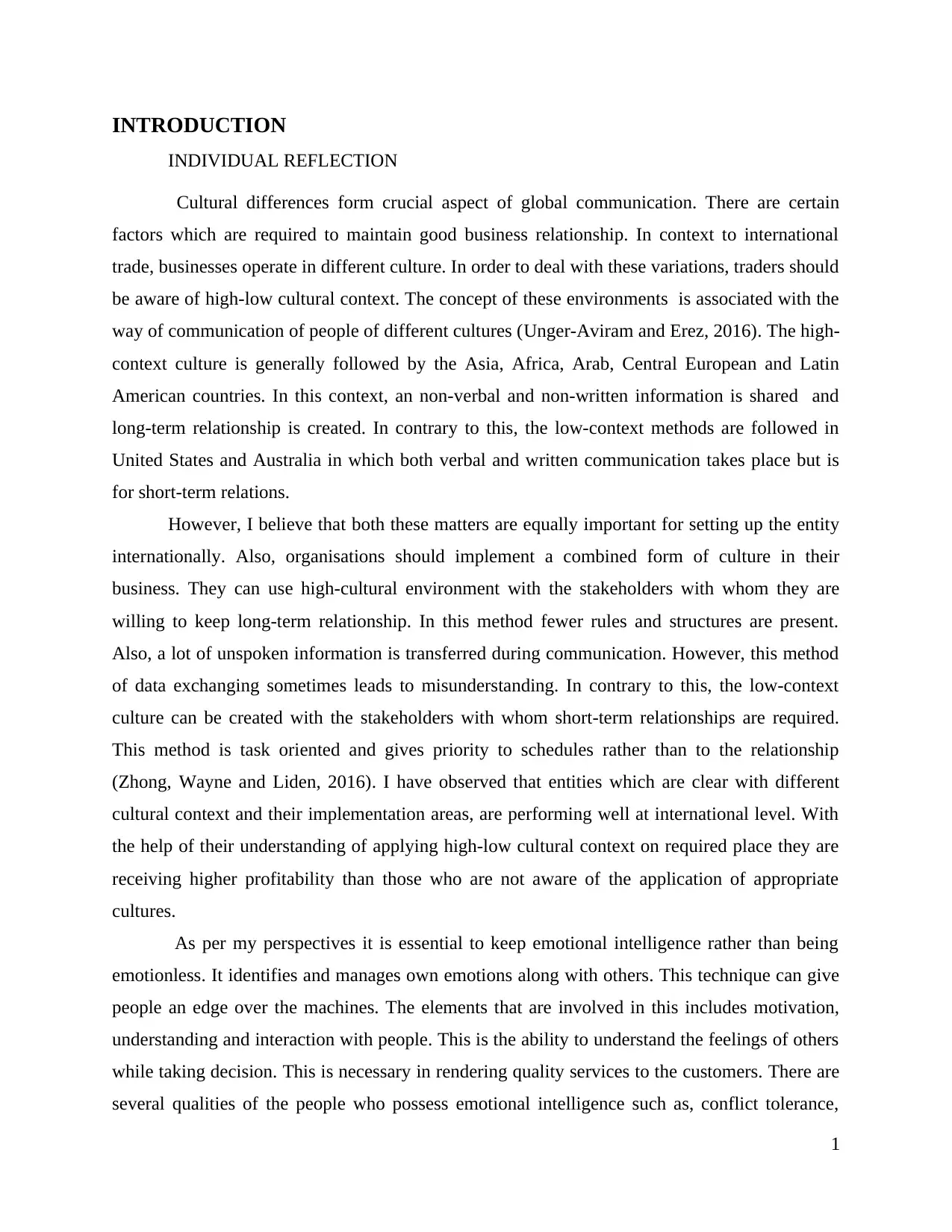
INTRODUCTION
INDIVIDUAL REFLECTION
Cultural differences form crucial aspect of global communication. There are certain
factors which are required to maintain good business relationship. In context to international
trade, businesses operate in different culture. In order to deal with these variations, traders should
be aware of high-low cultural context. The concept of these environments is associated with the
way of communication of people of different cultures (Unger-Aviram and Erez, 2016). The high-
context culture is generally followed by the Asia, Africa, Arab, Central European and Latin
American countries. In this context, an non-verbal and non-written information is shared and
long-term relationship is created. In contrary to this, the low-context methods are followed in
United States and Australia in which both verbal and written communication takes place but is
for short-term relations.
However, I believe that both these matters are equally important for setting up the entity
internationally. Also, organisations should implement a combined form of culture in their
business. They can use high-cultural environment with the stakeholders with whom they are
willing to keep long-term relationship. In this method fewer rules and structures are present.
Also, a lot of unspoken information is transferred during communication. However, this method
of data exchanging sometimes leads to misunderstanding. In contrary to this, the low-context
culture can be created with the stakeholders with whom short-term relationships are required.
This method is task oriented and gives priority to schedules rather than to the relationship
(Zhong, Wayne and Liden, 2016). I have observed that entities which are clear with different
cultural context and their implementation areas, are performing well at international level. With
the help of their understanding of applying high-low cultural context on required place they are
receiving higher profitability than those who are not aware of the application of appropriate
cultures.
As per my perspectives it is essential to keep emotional intelligence rather than being
emotionless. It identifies and manages own emotions along with others. This technique can give
people an edge over the machines. The elements that are involved in this includes motivation,
understanding and interaction with people. This is the ability to understand the feelings of others
while taking decision. This is necessary in rendering quality services to the customers. There are
several qualities of the people who possess emotional intelligence such as, conflict tolerance,
1
Document Page
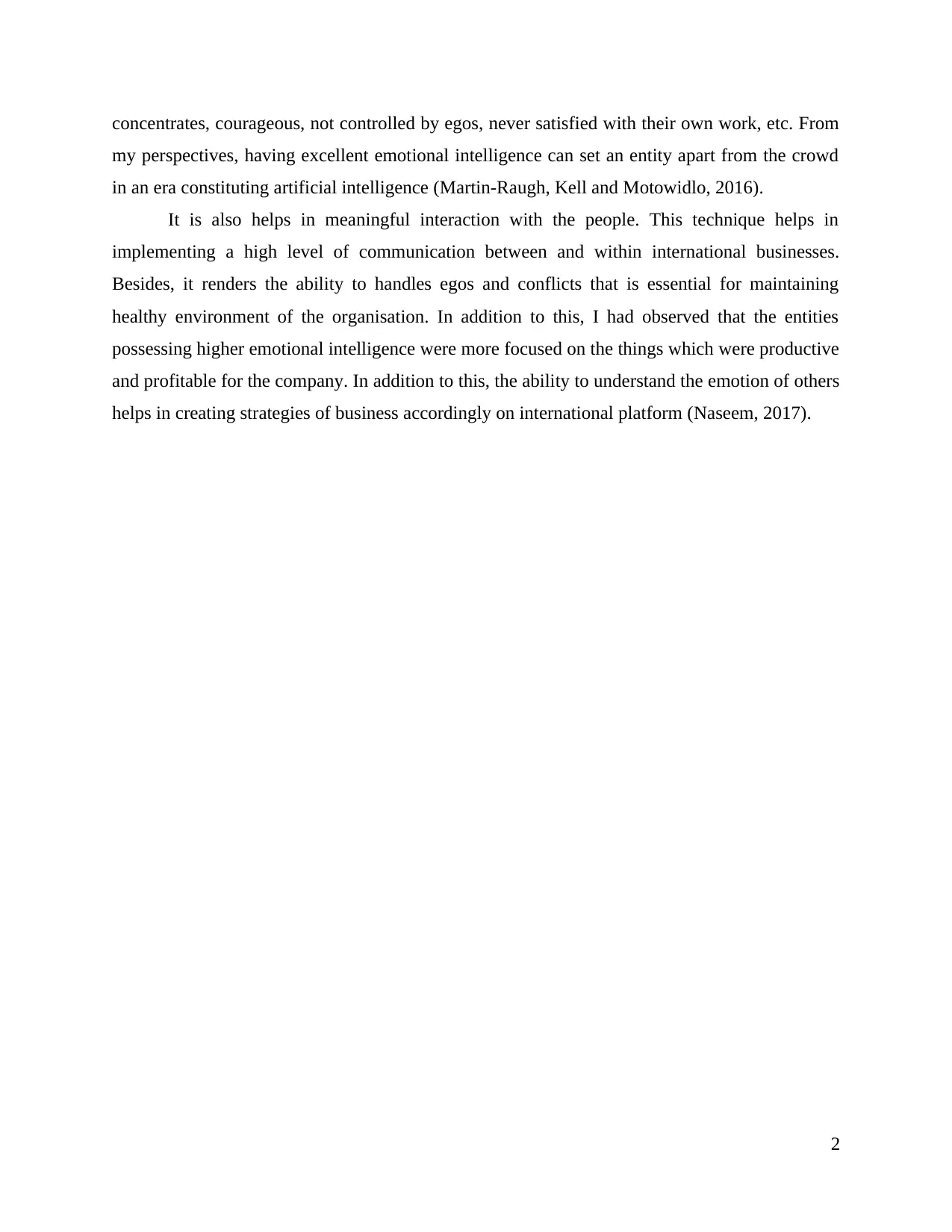
concentrates, courageous, not controlled by egos, never satisfied with their own work, etc. From
my perspectives, having excellent emotional intelligence can set an entity apart from the crowd
in an era constituting artificial intelligence (Martin-Raugh, Kell and Motowidlo, 2016).
It is also helps in meaningful interaction with the people. This technique helps in
implementing a high level of communication between and within international businesses.
Besides, it renders the ability to handles egos and conflicts that is essential for maintaining
healthy environment of the organisation. In addition to this, I had observed that the entities
possessing higher emotional intelligence were more focused on the things which were productive
and profitable for the company. In addition to this, the ability to understand the emotion of others
helps in creating strategies of business accordingly on international platform (Naseem, 2017).
2
tabler-icon-diamond-filled.svg

Paraphrase This Document

Need a fresh take? Get an instant paraphrase of this document with our AI Paraphraser
Document Page
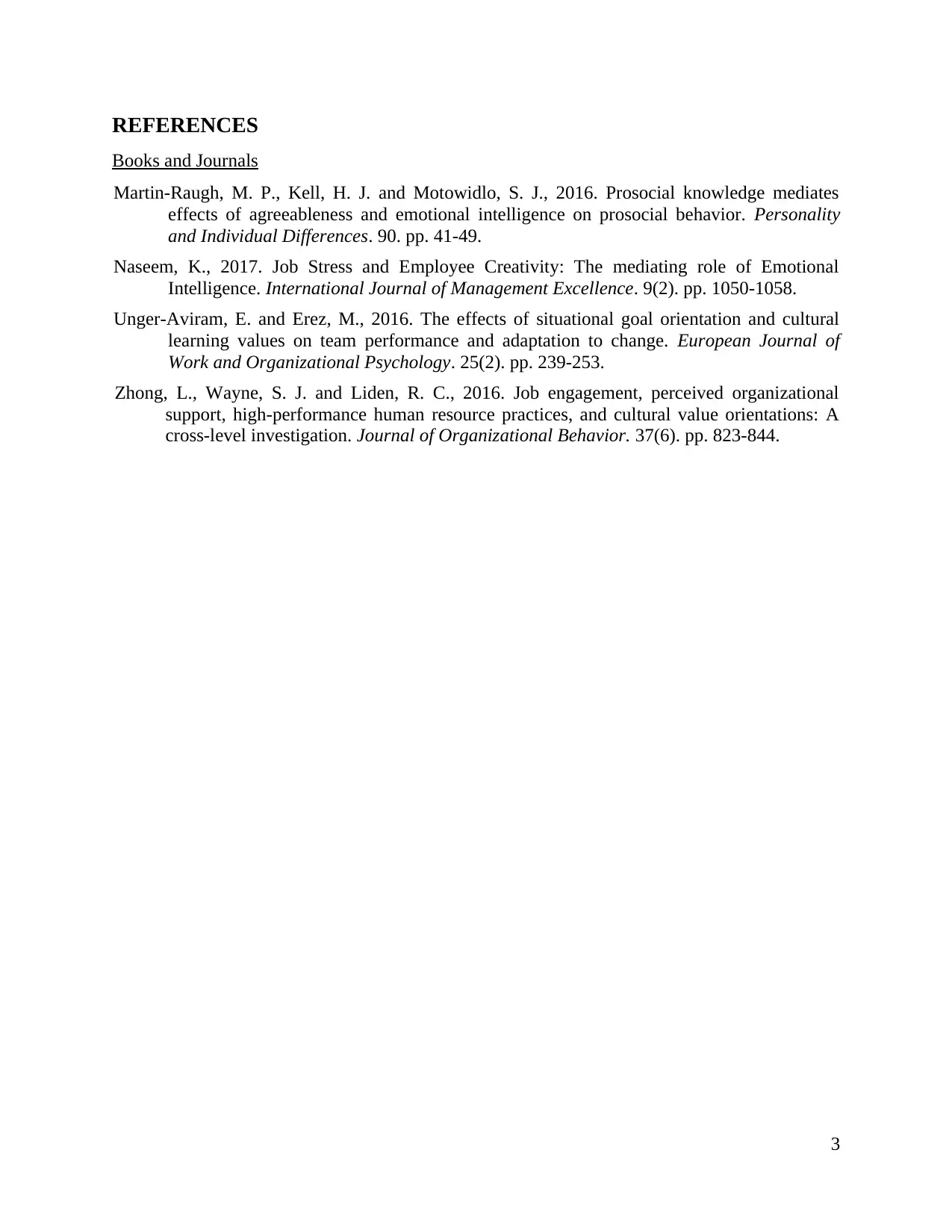
REFERENCES
Books and Journals
Martin-Raugh, M. P., Kell, H. J. and Motowidlo, S. J., 2016. Prosocial knowledge mediates
effects of agreeableness and emotional intelligence on prosocial behavior. Personality
and Individual Differences. 90. pp. 41-49.
Naseem, K., 2017. Job Stress and Employee Creativity: The mediating role of Emotional
Intelligence. International Journal of Management Excellence. 9(2). pp. 1050-1058.
Unger-Aviram, E. and Erez, M., 2016. The effects of situational goal orientation and cultural
learning values on team performance and adaptation to change. European Journal of
Work and Organizational Psychology. 25(2). pp. 239-253.
Zhong, L., Wayne, S. J. and Liden, R. C., 2016. Job engagement, perceived organizational
support, high‐performance human resource practices, and cultural value orientations: A
cross‐level investigation. Journal of Organizational Behavior. 37(6). pp. 823-844.
3
chevron_up_icon
1 out of 5
circle_padding
hide_on_mobile
zoom_out_icon
[object Object]