International Business Report: Easy Jet Strategic Alliances Analysis
VerifiedAdded on 2022/11/24
|12
|3704
|102
Report
AI Summary
This report provides an executive summary and in-depth analysis of international business, focusing on strategic alliances and their role in foreign market expansion. It examines the concept of international business, highlighting the benefits of collaboration, risk reduction, and improved competitiveness. The report defines various business strategies and tactics, including joint ventures, licensing, and franchising. It includes a literature review that identifies the use of international strategic alliances in foreign market expansion and analyzes the motivations behind their formation, as well as the benefits and challenges associated with them, using EasyJet as a case study. The report explores different types of alliances, such as single and multiple local and global alliances. It concludes with recommendations for the firm to achieve greater success and capitalize on opportunities in the global market.

INTERNATIONAL
BUSINESS
BUSINESS

Paraphrase This Document
Need a fresh take? Get an instant paraphrase of this document with our AI Paraphraser
EXECUTIVE SUMMARY
The report describes the idea of international business, which is founded on the basic that
when a company operates and trades its goods and services across many boundaries and nations,
the firm's operations are carried out in an international business environment. The international
business environment provides businesses with the potential to improve their competitiveness by
decreasing risk and uncertainty, which may be accomplished through collaborating with other
businesses. This type of partnership allows businesses to enhance their performance, which may
help them generate more money, deal with difficulties more effectively, and manage
organizational success. In order to accomplish aims and objectives, the study defines several
business techniques and tactics. The benefits of creating an international strategic alliance are
also listed in the report. A comprehensive study of the global strategic problems and their
relationships with the parties concerned. The study will provide a few suggestions for the firm to
use more appealing approaches in order to attain more success and possibilities.
The report describes the idea of international business, which is founded on the basic that
when a company operates and trades its goods and services across many boundaries and nations,
the firm's operations are carried out in an international business environment. The international
business environment provides businesses with the potential to improve their competitiveness by
decreasing risk and uncertainty, which may be accomplished through collaborating with other
businesses. This type of partnership allows businesses to enhance their performance, which may
help them generate more money, deal with difficulties more effectively, and manage
organizational success. In order to accomplish aims and objectives, the study defines several
business techniques and tactics. The benefits of creating an international strategic alliance are
also listed in the report. A comprehensive study of the global strategic problems and their
relationships with the parties concerned. The study will provide a few suggestions for the firm to
use more appealing approaches in order to attain more success and possibilities.
Table of Contents
EXECUTIVE SUMMARY.............................................................................................................2
INTRODUCTION...........................................................................................................................4
LITERATURE REVIEW................................................................................................................4
Identify the use of international strategic alliance in foreign market expansion.........................4
ANALYSIS AND DISCSSION......................................................................................................7
State understanding of motivation behind formation of international strategic alliance.............7
Describe benefits and challenges of international strategic alliance...........................................8
Recommendations......................................................................................................................10
CONCLUSION..............................................................................................................................10
REFERENCES..............................................................................................................................12
EXECUTIVE SUMMARY.............................................................................................................2
INTRODUCTION...........................................................................................................................4
LITERATURE REVIEW................................................................................................................4
Identify the use of international strategic alliance in foreign market expansion.........................4
ANALYSIS AND DISCSSION......................................................................................................7
State understanding of motivation behind formation of international strategic alliance.............7
Describe benefits and challenges of international strategic alliance...........................................8
Recommendations......................................................................................................................10
CONCLUSION..............................................................................................................................10
REFERENCES..............................................................................................................................12
⊘ This is a preview!⊘
Do you want full access?
Subscribe today to unlock all pages.

Trusted by 1+ million students worldwide
INTRODUCTION
Global business refers to the exchange of commodities, services, technology,
information, and capital across national or global borders. Transactions of business operations
including cross-border transactions and activities are required in international business.
Exporting, licensing, franchising, joint ventures, and foreign direct investments are all examples
of ways to do international business (FDI). International trade is the exchange of goods, services,
or resources across national borders between two or more countries (Aguilera and Grøgaard,
2019). An international strategic alliance is a collaboration between a firm and its parent
company that has operations in many countries. A mutual agreement between a group of airline
firms to collaborate and coordinate all commercial activities with the goal of maximizing profits
is known as an airline alliance. Easy Jet is a British worldwide low-cost airline business that was
formed in March 1995 in London, United Kingdom. The company operates local and
international flights on over 1000 routes in over 30 countries. The study outlines the literature on
the use and practice of international strategic alliances as a means for a company to compete in a
global market. The study is based on the identification of numerous motivating factors for the
establishment of worldwide strategic alliances, as well as the benefits and obstacles that partners
experience while working in foreign markets.
LITERATURE REVIEW
Identify the use of international strategic alliance in foreign market expansion
International strategic alliance- An international strategic alliance is a partnership
between a company and its parent company that operates in various nations. International
strategic alliances can participate in a single activity or a mix of activities that can be classified
as licensing, franchising, management services, manufacturing, marketing, supply chain, and
other activities. An alliance is a real example of a form of economic partnership that takes place
over a certain period of time with the purpose of achieving the organization's objectives.
Types of strategic alliance- Joint ventures, equity strategic alliances, and non-equity
strategic alliances are the three basic kinds of strategic alliances (Berger and et.al, 2017). Such
techniques assist businesses in creating value by enhancing current operations, which can assist
in adapting in today's competitive business climate. When it comes to entering a new market, a
Global business refers to the exchange of commodities, services, technology,
information, and capital across national or global borders. Transactions of business operations
including cross-border transactions and activities are required in international business.
Exporting, licensing, franchising, joint ventures, and foreign direct investments are all examples
of ways to do international business (FDI). International trade is the exchange of goods, services,
or resources across national borders between two or more countries (Aguilera and Grøgaard,
2019). An international strategic alliance is a collaboration between a firm and its parent
company that has operations in many countries. A mutual agreement between a group of airline
firms to collaborate and coordinate all commercial activities with the goal of maximizing profits
is known as an airline alliance. Easy Jet is a British worldwide low-cost airline business that was
formed in March 1995 in London, United Kingdom. The company operates local and
international flights on over 1000 routes in over 30 countries. The study outlines the literature on
the use and practice of international strategic alliances as a means for a company to compete in a
global market. The study is based on the identification of numerous motivating factors for the
establishment of worldwide strategic alliances, as well as the benefits and obstacles that partners
experience while working in foreign markets.
LITERATURE REVIEW
Identify the use of international strategic alliance in foreign market expansion
International strategic alliance- An international strategic alliance is a partnership
between a company and its parent company that operates in various nations. International
strategic alliances can participate in a single activity or a mix of activities that can be classified
as licensing, franchising, management services, manufacturing, marketing, supply chain, and
other activities. An alliance is a real example of a form of economic partnership that takes place
over a certain period of time with the purpose of achieving the organization's objectives.
Types of strategic alliance- Joint ventures, equity strategic alliances, and non-equity
strategic alliances are the three basic kinds of strategic alliances (Berger and et.al, 2017). Such
techniques assist businesses in creating value by enhancing current operations, which can assist
in adapting in today's competitive business climate. When it comes to entering a new market, a
Paraphrase This Document
Need a fresh take? Get an instant paraphrase of this document with our AI Paraphraser
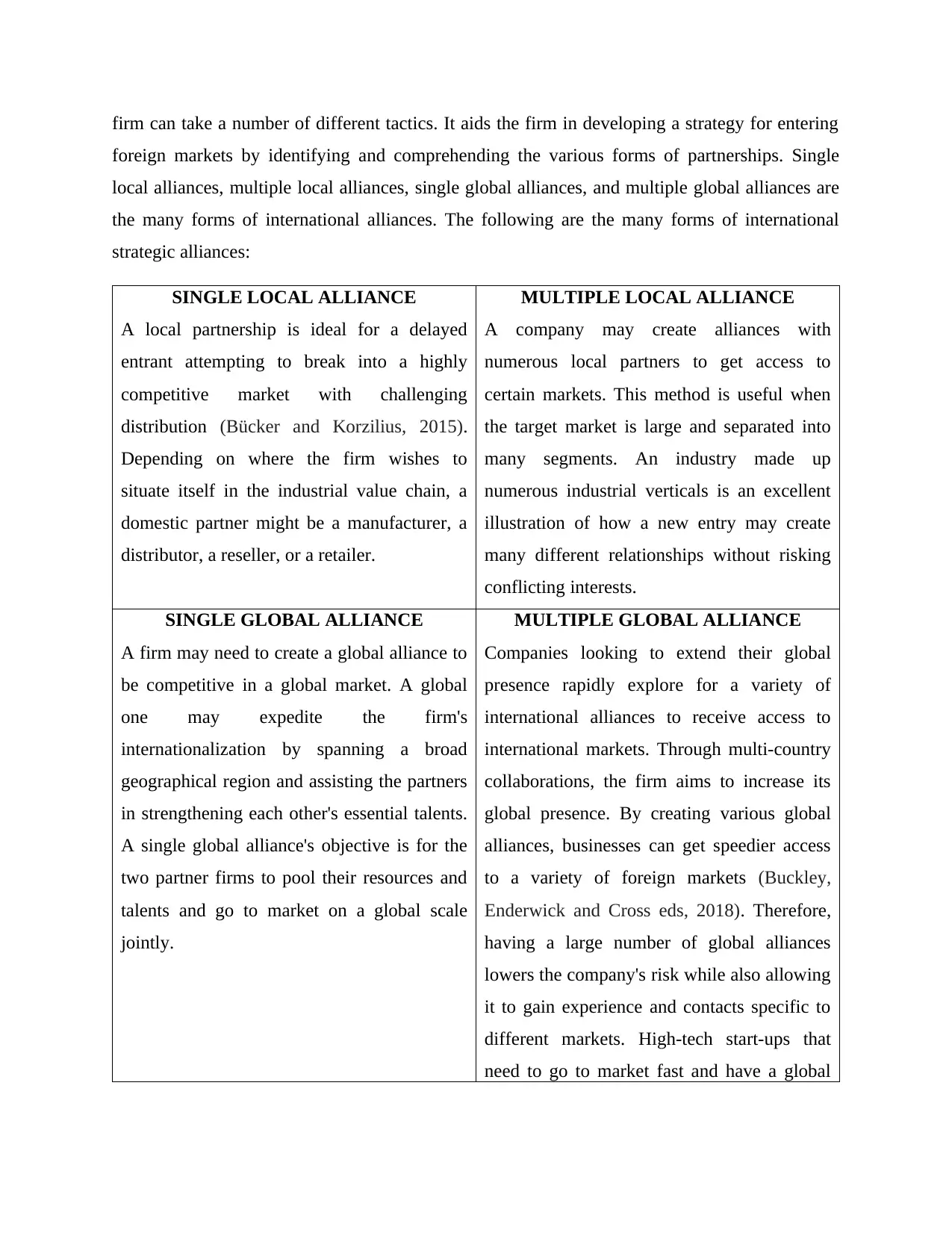
firm can take a number of different tactics. It aids the firm in developing a strategy for entering
foreign markets by identifying and comprehending the various forms of partnerships. Single
local alliances, multiple local alliances, single global alliances, and multiple global alliances are
the many forms of international alliances. The following are the many forms of international
strategic alliances:
SINGLE LOCAL ALLIANCE
A local partnership is ideal for a delayed
entrant attempting to break into a highly
competitive market with challenging
distribution (Bücker and Korzilius, 2015).
Depending on where the firm wishes to
situate itself in the industrial value chain, a
domestic partner might be a manufacturer, a
distributor, a reseller, or a retailer.
MULTIPLE LOCAL ALLIANCE
A company may create alliances with
numerous local partners to get access to
certain markets. This method is useful when
the target market is large and separated into
many segments. An industry made up
numerous industrial verticals is an excellent
illustration of how a new entry may create
many different relationships without risking
conflicting interests.
SINGLE GLOBAL ALLIANCE
A firm may need to create a global alliance to
be competitive in a global market. A global
one may expedite the firm's
internationalization by spanning a broad
geographical region and assisting the partners
in strengthening each other's essential talents.
A single global alliance's objective is for the
two partner firms to pool their resources and
talents and go to market on a global scale
jointly.
MULTIPLE GLOBAL ALLIANCE
Companies looking to extend their global
presence rapidly explore for a variety of
international alliances to receive access to
international markets. Through multi-country
collaborations, the firm aims to increase its
global presence. By creating various global
alliances, businesses can get speedier access
to a variety of foreign markets (Buckley,
Enderwick and Cross eds, 2018). Therefore,
having a large number of global alliances
lowers the company's risk while also allowing
it to gain experience and contacts specific to
different markets. High-tech start-ups that
need to go to market fast and have a global
foreign markets by identifying and comprehending the various forms of partnerships. Single
local alliances, multiple local alliances, single global alliances, and multiple global alliances are
the many forms of international alliances. The following are the many forms of international
strategic alliances:
SINGLE LOCAL ALLIANCE
A local partnership is ideal for a delayed
entrant attempting to break into a highly
competitive market with challenging
distribution (Bücker and Korzilius, 2015).
Depending on where the firm wishes to
situate itself in the industrial value chain, a
domestic partner might be a manufacturer, a
distributor, a reseller, or a retailer.
MULTIPLE LOCAL ALLIANCE
A company may create alliances with
numerous local partners to get access to
certain markets. This method is useful when
the target market is large and separated into
many segments. An industry made up
numerous industrial verticals is an excellent
illustration of how a new entry may create
many different relationships without risking
conflicting interests.
SINGLE GLOBAL ALLIANCE
A firm may need to create a global alliance to
be competitive in a global market. A global
one may expedite the firm's
internationalization by spanning a broad
geographical region and assisting the partners
in strengthening each other's essential talents.
A single global alliance's objective is for the
two partner firms to pool their resources and
talents and go to market on a global scale
jointly.
MULTIPLE GLOBAL ALLIANCE
Companies looking to extend their global
presence rapidly explore for a variety of
international alliances to receive access to
international markets. Through multi-country
collaborations, the firm aims to increase its
global presence. By creating various global
alliances, businesses can get speedier access
to a variety of foreign markets (Buckley,
Enderwick and Cross eds, 2018). Therefore,
having a large number of global alliances
lowers the company's risk while also allowing
it to gain experience and contacts specific to
different markets. High-tech start-ups that
need to go to market fast and have a global
presence frequently form these alliances.
Methods of business expansion international markets
Join venture- This is a strategy in which a larger firm agrees to share its assets with a
smaller company in order to increase profitability.
Licensing- The organizations are involved in licensing, which is granting authorization to
another firm to create their services at the same price as their own.
Franchising- This is a technique of forming an organization in which the company's
owner used numerous strategies to deliver the same services to their franchisees.
Use of strategic alliance- Three global airline strategic alliances- Star Alliance, Sky
Team, and Oneworld, promote linkages and partnerships between businesses to make collecting
and standing easier. On May 14, 1997, the first airline alliance, Star Alliance, was founded. De
Star Alliance brought in Habitat continent to the company when Air Canada and Lufthansa for
Thai Airways came together to expand their commercial and wealth cooperation (Cumming and
Zahra, 2016). The Sky Team Alliance is a relatively new alliance, having been founded in 2000,
and is the second largest in terms of airline members. Easy Jet is a member of the Oneworld
alliance, which includes 13 of the world's largest airlines and about 30 affiliates. Consumers and
carriers benefit from services and value that member airlines could not provide on their own. The
second strategic alliance, Oneworld, was founded in 1998 by American Airlines or Easy Jet,
Cathay Pacific, and Qantas.
In order to expand their business, Easy Jet is considering joining the Oneworld Alliance, Start
Lines, and Sky Team Alliance. Easy Jet wishes to collaborate with Easy Jet in order to expand its
prospects. It assists Easy Jet in obtaining additional chances and improving overall performance.
Due of the possible economic effect and various issues such as migrating labor force and
changes in rules and regulations that are established by the new authority, every line industry is
touched by Brexit. Easy Jet recently launched an airline alliance with the goal of better
connecting travellers throughout the low-cost network. Easy Jet has formed a cooperation with
two other airlines in order to expand its court-style relationship (Forsgren, Holm and Johanson,
2015). Easy Jet is a business that has partnered with Europe Easy Jet and Switzerland Easy Jet
vacations to boost their efficiency. It is a firm that offers a vast and diverse network of low-cost
Methods of business expansion international markets
Join venture- This is a strategy in which a larger firm agrees to share its assets with a
smaller company in order to increase profitability.
Licensing- The organizations are involved in licensing, which is granting authorization to
another firm to create their services at the same price as their own.
Franchising- This is a technique of forming an organization in which the company's
owner used numerous strategies to deliver the same services to their franchisees.
Use of strategic alliance- Three global airline strategic alliances- Star Alliance, Sky
Team, and Oneworld, promote linkages and partnerships between businesses to make collecting
and standing easier. On May 14, 1997, the first airline alliance, Star Alliance, was founded. De
Star Alliance brought in Habitat continent to the company when Air Canada and Lufthansa for
Thai Airways came together to expand their commercial and wealth cooperation (Cumming and
Zahra, 2016). The Sky Team Alliance is a relatively new alliance, having been founded in 2000,
and is the second largest in terms of airline members. Easy Jet is a member of the Oneworld
alliance, which includes 13 of the world's largest airlines and about 30 affiliates. Consumers and
carriers benefit from services and value that member airlines could not provide on their own. The
second strategic alliance, Oneworld, was founded in 1998 by American Airlines or Easy Jet,
Cathay Pacific, and Qantas.
In order to expand their business, Easy Jet is considering joining the Oneworld Alliance, Start
Lines, and Sky Team Alliance. Easy Jet wishes to collaborate with Easy Jet in order to expand its
prospects. It assists Easy Jet in obtaining additional chances and improving overall performance.
Due of the possible economic effect and various issues such as migrating labor force and
changes in rules and regulations that are established by the new authority, every line industry is
touched by Brexit. Easy Jet recently launched an airline alliance with the goal of better
connecting travellers throughout the low-cost network. Easy Jet has formed a cooperation with
two other airlines in order to expand its court-style relationship (Forsgren, Holm and Johanson,
2015). Easy Jet is a business that has partnered with Europe Easy Jet and Switzerland Easy Jet
vacations to boost their efficiency. It is a firm that offers a vast and diverse network of low-cost
⊘ This is a preview!⊘
Do you want full access?
Subscribe today to unlock all pages.
Trusted by 1+ million students worldwide
flights from London Luton to a nearby airport. On the basis of the organization's statement, Easy
Jet Company intends to add and build alliances with other companies in order to gain
opportunities. Easy Jet then announced a collaboration with one of their other airlines, allowing
the firm to book and connect with more low-cost flights. The organisation wants to recruit one
world members in order to gain full access to possibilities. There are numerous perks of one
world status, which is a premium status membership that is structured in several tiers (Kaynak
ed, 2015). Rachel Smith and Easy Jet are the commercial partners, and they are thrilled to
announce their collaboration with Etihad Airways, which will allow users to book flights from
Abu Dhabi to Europe using their applications. The company uses a variety of extension
techniques to enter new markets, including acquisition, joint venture licensing, franchising, and
Green Field investment, in order to achieve more success and extend their business in the most
effective way possible.
ANALYSIS AND DISCSSION
State understanding of motivation behind formation of international strategic alliance
The desire to create a strategic partnership in order to enter the international market; it
aids the firm in boosting production, exchanging talents and information, and earning
competitive advantages. The four major motivators for creating strategic partnerships for the
firm are resource expansion, variety of resources, resource imitation, and resource specialization.
Easy Jet is motivated to form a strategic alliance for a variety of reasons, including the
chance to increase market share, improve competitive advantages, and develop economies of
scale. As a strategic alliance is a collaboration arrangement between firms from different nations,
it also aids the organization in getting additional access to supplemental resources. Easy Jet
adopted strategic alliances to boost corporate performance, and in order to do so, they followed
specific protocols, the most significant of which was choosing a suitable and appropriate
connection for their organization (Kostova and Hult, 2016). The main objective of the Easy Jet
joint venture is to promote the firms in other countries. In addition, Easy Jet will discuss their
shared values and market share in order to make decisions, as well as the operation carried out as
part of the partnership in order to analyze their company's influence. Several reasons influenced
Easy Jet decision to concentrate on foreign strategic alliances, including the following:
Jet Company intends to add and build alliances with other companies in order to gain
opportunities. Easy Jet then announced a collaboration with one of their other airlines, allowing
the firm to book and connect with more low-cost flights. The organisation wants to recruit one
world members in order to gain full access to possibilities. There are numerous perks of one
world status, which is a premium status membership that is structured in several tiers (Kaynak
ed, 2015). Rachel Smith and Easy Jet are the commercial partners, and they are thrilled to
announce their collaboration with Etihad Airways, which will allow users to book flights from
Abu Dhabi to Europe using their applications. The company uses a variety of extension
techniques to enter new markets, including acquisition, joint venture licensing, franchising, and
Green Field investment, in order to achieve more success and extend their business in the most
effective way possible.
ANALYSIS AND DISCSSION
State understanding of motivation behind formation of international strategic alliance
The desire to create a strategic partnership in order to enter the international market; it
aids the firm in boosting production, exchanging talents and information, and earning
competitive advantages. The four major motivators for creating strategic partnerships for the
firm are resource expansion, variety of resources, resource imitation, and resource specialization.
Easy Jet is motivated to form a strategic alliance for a variety of reasons, including the
chance to increase market share, improve competitive advantages, and develop economies of
scale. As a strategic alliance is a collaboration arrangement between firms from different nations,
it also aids the organization in getting additional access to supplemental resources. Easy Jet
adopted strategic alliances to boost corporate performance, and in order to do so, they followed
specific protocols, the most significant of which was choosing a suitable and appropriate
connection for their organization (Kostova and Hult, 2016). The main objective of the Easy Jet
joint venture is to promote the firms in other countries. In addition, Easy Jet will discuss their
shared values and market share in order to make decisions, as well as the operation carried out as
part of the partnership in order to analyze their company's influence. Several reasons influenced
Easy Jet decision to concentrate on foreign strategic alliances, including the following:
Paraphrase This Document
Need a fresh take? Get an instant paraphrase of this document with our AI Paraphraser
Easy Jet goal is to achieve economies of scale through horizontal alliances and/or input
supply security.
Easy Jet can obtain resources or information from collaborating firms that it would not
otherwise be able to obtain.
Easy Jet incentives include access to creative managerial and technological talent,
financial resources, and the opportunity to learn about international markets.
The potential to share the risks and costs of international growth into new and/or
unknown geographic areas is an incentive for Easy Jet (Mäkelä, Kinnunen and Suutari,
2015).
Easy Jet focuses on ensuring their international competitiveness among rival firms,
understanding the dynamic business environment, and having broad industry and market
coverage with the aid of strategic alliances.
Describe benefits and challenges of international strategic alliance
International strategic alliance- A global strategic alliance is created when two or more
firms from different countries join forces to achieve organizational goals. In the aviation sector,
international strategic alliances are strictly controlled and decided by bilateral government
agreements.
Benefits of international strategic alliance
Easy Jet is focusing on overcoming the oligopoly market in order to attract additional
commercial possibilities, which may be accomplished through international strategic alliances.
Easy Jet has benefited from a number of advantages provided by worldwide strategic alliances,
some of which are noted below:
When Easy Jet operated under a strategic partnership, it aided the firm in increasing its
competitiveness in both the home and worldwide markets in which it operated.
Easy Jet' international strategic partnership enabled the firm to pursue possibilities on a
worldwide scale, allowing the company to expand the breadth and pace of its operations.
International strategic alliances were a means of improving company competence in
terms of performing tasks swiftly and increasing cash flow, which will be a useful source
of avoiding and confronting risks (Nambisan, Zahra and Luo, 2019).
supply security.
Easy Jet can obtain resources or information from collaborating firms that it would not
otherwise be able to obtain.
Easy Jet incentives include access to creative managerial and technological talent,
financial resources, and the opportunity to learn about international markets.
The potential to share the risks and costs of international growth into new and/or
unknown geographic areas is an incentive for Easy Jet (Mäkelä, Kinnunen and Suutari,
2015).
Easy Jet focuses on ensuring their international competitiveness among rival firms,
understanding the dynamic business environment, and having broad industry and market
coverage with the aid of strategic alliances.
Describe benefits and challenges of international strategic alliance
International strategic alliance- A global strategic alliance is created when two or more
firms from different countries join forces to achieve organizational goals. In the aviation sector,
international strategic alliances are strictly controlled and decided by bilateral government
agreements.
Benefits of international strategic alliance
Easy Jet is focusing on overcoming the oligopoly market in order to attract additional
commercial possibilities, which may be accomplished through international strategic alliances.
Easy Jet has benefited from a number of advantages provided by worldwide strategic alliances,
some of which are noted below:
When Easy Jet operated under a strategic partnership, it aided the firm in increasing its
competitiveness in both the home and worldwide markets in which it operated.
Easy Jet' international strategic partnership enabled the firm to pursue possibilities on a
worldwide scale, allowing the company to expand the breadth and pace of its operations.
International strategic alliances were a means of improving company competence in
terms of performing tasks swiftly and increasing cash flow, which will be a useful source
of avoiding and confronting risks (Nambisan, Zahra and Luo, 2019).
An international strategic partnership allowed Easy Jet to operate internationally,
allowing them to expand their target market and increase revenue and profitability.
The global strategic alliance provided Easy Jet with a chance to make their business more
inventive and competitive, which was beneficial in the face of a very competitive
business environment.
It was an opportunity for Easy Jet to develop and extend their market position through
strategic alliance by providing seamless services to their consumers.
The worldwide strategic partnership allows Easy Jet to advertise more destinations and
reach more people without having to undertake operations (Rao, 2021). By combining
their networks, member airlines can serve many more destinations than they could on
their own.
Easy Jet was able to diversify their company, increase their market expansion, acquire a
cost competitive edge, and enhance their cash flow thanks to an international strategic
partnership.
Challenges of international strategic alliance
Strategic partnerships' influence on service quality, economic performance, and fares are
assessed. Market concentration has several implications, including effective monopolization of
nonstop services between alliance partnership centers and a small reduction in concentration in
areas where alliance partners provide connecting services. Essentially, the results show that
alliance power is redistributive. The following are some of the problems Easy Jet has
experienced as a result of its international strategic alliance:
The main challenge of the strategic Alliance arises when Easy Jet is compelled to enter
into a joint venture that demands investment (Roberts and Dörrenbächer, 2016). The
majority of conflicts are avoided, and the majority of joint ventures manage to avoid
conflict action among partners, when a sufficient set of contracts and unique transfer
pricing are in place for any sort of plan from a partner in order to establish a joint
Alliance.
Profit sharing is another issue for Easy Jet, because when the company's revenue is
shared, it travels to several nations, each of which cannot support the company's
economic growth.
allowing them to expand their target market and increase revenue and profitability.
The global strategic alliance provided Easy Jet with a chance to make their business more
inventive and competitive, which was beneficial in the face of a very competitive
business environment.
It was an opportunity for Easy Jet to develop and extend their market position through
strategic alliance by providing seamless services to their consumers.
The worldwide strategic partnership allows Easy Jet to advertise more destinations and
reach more people without having to undertake operations (Rao, 2021). By combining
their networks, member airlines can serve many more destinations than they could on
their own.
Easy Jet was able to diversify their company, increase their market expansion, acquire a
cost competitive edge, and enhance their cash flow thanks to an international strategic
partnership.
Challenges of international strategic alliance
Strategic partnerships' influence on service quality, economic performance, and fares are
assessed. Market concentration has several implications, including effective monopolization of
nonstop services between alliance partnership centers and a small reduction in concentration in
areas where alliance partners provide connecting services. Essentially, the results show that
alliance power is redistributive. The following are some of the problems Easy Jet has
experienced as a result of its international strategic alliance:
The main challenge of the strategic Alliance arises when Easy Jet is compelled to enter
into a joint venture that demands investment (Roberts and Dörrenbächer, 2016). The
majority of conflicts are avoided, and the majority of joint ventures manage to avoid
conflict action among partners, when a sufficient set of contracts and unique transfer
pricing are in place for any sort of plan from a partner in order to establish a joint
Alliance.
Profit sharing is another issue for Easy Jet, because when the company's revenue is
shared, it travels to several nations, each of which cannot support the company's
economic growth.
⊘ This is a preview!⊘
Do you want full access?
Subscribe today to unlock all pages.
Trusted by 1+ million students worldwide
It's also reasonable to conclude that their competitors may find it tough, as many
businesses lack access to information technology or any kind of business strategy with
their partners. To adopt more technology, more skills and experience are necessary,
which might result in greater expenses for the firm.
Another issue that has arisen as a result of this strategic relationship is financial blockade,
as there are numerous firms involved and Easy Jet does not want to share its financial
operations with its partner.
If the firm is unable to contribute to the company's growth and give a degree of
dedication, honesty, and integrity to the partnership, selecting the wrong partner might be
costly for Easy Jet (Rohlfer and Zhang, 2016).
Without some amount of trust and honesty, an alliance cannot be formed. It is important
for Easy Jet and other parties considering an alliance to express their expectations clearly
and precisely before forming a relationship.
Recommendations
Following the analysis of the above-mentioned data, many solutions may be developed to
assist Easy Jet in improving company operations and increasing competitiveness. The strategies
that will be beneficial in improving the company's position and performing all functions
efficiently. The following are some of the Easy Jet recommendations:
Easy Jet must also utilize franchising as a method of business expansion in order to
expand and enhance by reaching out to the worldwide market.
It is also advised that Easy Jet improve their abilities and knowledge in order to adopt
updated technology that will help them improve their efficiency and effectiveness and
solve their difficulties (Shams and et.al, 2021).
In order to create profit targets and improve business profitability, Easy Jet should also
identify its potential and effective partners, as well as do research on those partners.
Easy Jet must utilize a range of methods depending on their consumers' impressions of
the market if they want to improve their profitability and efficiency.
It is also recommended that Easy Jet should form effective strategic partnerships in order
to expand their customer base and meet market demands, allowing them to change their
strategy.
businesses lack access to information technology or any kind of business strategy with
their partners. To adopt more technology, more skills and experience are necessary,
which might result in greater expenses for the firm.
Another issue that has arisen as a result of this strategic relationship is financial blockade,
as there are numerous firms involved and Easy Jet does not want to share its financial
operations with its partner.
If the firm is unable to contribute to the company's growth and give a degree of
dedication, honesty, and integrity to the partnership, selecting the wrong partner might be
costly for Easy Jet (Rohlfer and Zhang, 2016).
Without some amount of trust and honesty, an alliance cannot be formed. It is important
for Easy Jet and other parties considering an alliance to express their expectations clearly
and precisely before forming a relationship.
Recommendations
Following the analysis of the above-mentioned data, many solutions may be developed to
assist Easy Jet in improving company operations and increasing competitiveness. The strategies
that will be beneficial in improving the company's position and performing all functions
efficiently. The following are some of the Easy Jet recommendations:
Easy Jet must also utilize franchising as a method of business expansion in order to
expand and enhance by reaching out to the worldwide market.
It is also advised that Easy Jet improve their abilities and knowledge in order to adopt
updated technology that will help them improve their efficiency and effectiveness and
solve their difficulties (Shams and et.al, 2021).
In order to create profit targets and improve business profitability, Easy Jet should also
identify its potential and effective partners, as well as do research on those partners.
Easy Jet must utilize a range of methods depending on their consumers' impressions of
the market if they want to improve their profitability and efficiency.
It is also recommended that Easy Jet should form effective strategic partnerships in order
to expand their customer base and meet market demands, allowing them to change their
strategy.
Paraphrase This Document
Need a fresh take? Get an instant paraphrase of this document with our AI Paraphraser
CONCLUSION
According to the study, international business is defined as a method of doing
commercial activities across national borders or throughout the world. A strategic alliance assists
a company in successfully implementing its plan in order to compete in the global market and
achieve a competitive edge. It is one of the strategies that assists a company in functioning in
global markets and provides a chance to enhance the economic condition and achieve
organizational goals, allowing the company to acquire a competitive edge. Strategic alliances are
one of the ways that a company may work with other firms and manage their management
operations in different nations with the goal of maximizing earnings and increasing the
company's profitability. There are numerous ways that provide a firm with the potential to
expand its operations; some of the channels include exporting, franchising, and foreign direct
investments. International strategic alliances provide opportunities for businesses that might help
them improve their profitability and position of the company. International strategic alliances
also provide problems for businesses, making it harder for them to operate in global
marketplaces. There are a variety of business techniques that can be beneficial to improving
corporate performance.
According to the study, international business is defined as a method of doing
commercial activities across national borders or throughout the world. A strategic alliance assists
a company in successfully implementing its plan in order to compete in the global market and
achieve a competitive edge. It is one of the strategies that assists a company in functioning in
global markets and provides a chance to enhance the economic condition and achieve
organizational goals, allowing the company to acquire a competitive edge. Strategic alliances are
one of the ways that a company may work with other firms and manage their management
operations in different nations with the goal of maximizing earnings and increasing the
company's profitability. There are numerous ways that provide a firm with the potential to
expand its operations; some of the channels include exporting, franchising, and foreign direct
investments. International strategic alliances provide opportunities for businesses that might help
them improve their profitability and position of the company. International strategic alliances
also provide problems for businesses, making it harder for them to operate in global
marketplaces. There are a variety of business techniques that can be beneficial to improving
corporate performance.
REFERENCES
Books and journals
Aguilera, R. V. and Grøgaard, B., 2019. The dubious role of institutions in international
business: A road forward. Journal of International Business Studies. 50(1). pp.20-35.
Berger, R and et.al., 2017. Developing international business relationships in a Russian
context. Management International Review. 57(3). pp.441-471.
Bücker, J. J. and Korzilius, H., 2015. Developing cultural intelligence: assessing the effect of the
Ecotonos cultural simulation game for international business students. The International
Journal of Human Resource Management. 26(15). pp.1995-2014.
Buckley, P. J., Enderwick, P. and Cross, A. R. eds., 2018. International business. Oxford
University Press.
Cumming, D. J. and Zahra, S. A., 2016. International business and entrepreneurship implications
of Brexit. British Journal of Management. 27(4). pp.687-692.
Forsgren, M., Holm, U. and Johanson, J., 2015. Knowledge, Networks and Power—The Uppsala
School of International Business. In Knowledge, networks and power (pp. 3-38). Palgrave
Macmillan, London.
Kaynak, E. ed., 2015. International business in the Middle East (Vol. 5). Walter de Gruyter
GmbH & Co KG.
Kostova, T. and Hult, G. T. M., 2016. Meyer and Peng’s 2005 article as a foundation for an
expanded and refined international business research agenda: Context, organizations, and
theories. Journal of International Business Studies. 47(1). pp.23-32.
Mäkelä, L., Kinnunen, U. and Suutari, V., 2015. Work‐to‐life conflict and enrichment among
international business travelers: The role of international career orientation. Human
Resource Management. 54(3). pp.517-531.
Nambisan, S., Zahra, S. A. and Luo, Y., 2019. Global platforms and ecosystems: Implications for
international business theories. Journal of International Business Studies. 50(9). pp.1464-
1486.
Rao, S., 2021. International business environment. Himalaya Publishing House.
Roberts, J. and Dörrenbächer, C., 2016. Renewing the call for critical perspectives on
international business. critical perspectives on international business.
Rohlfer, S. and Zhang, Y., 2016. Culture studies in international business: paradigmatic
shifts. European Business Review.
Shams, R and et.al., 2021. Strategic agility in international business: A conceptual framework for
“agile” multinationals. Journal of International Management. 27(1). p.100737.
You, K and et.al., 2019. Bridging technology divide to improve business environment: Insights
from African nations. Journal of Business Research. 97. pp.268-280.
Books and journals
Aguilera, R. V. and Grøgaard, B., 2019. The dubious role of institutions in international
business: A road forward. Journal of International Business Studies. 50(1). pp.20-35.
Berger, R and et.al., 2017. Developing international business relationships in a Russian
context. Management International Review. 57(3). pp.441-471.
Bücker, J. J. and Korzilius, H., 2015. Developing cultural intelligence: assessing the effect of the
Ecotonos cultural simulation game for international business students. The International
Journal of Human Resource Management. 26(15). pp.1995-2014.
Buckley, P. J., Enderwick, P. and Cross, A. R. eds., 2018. International business. Oxford
University Press.
Cumming, D. J. and Zahra, S. A., 2016. International business and entrepreneurship implications
of Brexit. British Journal of Management. 27(4). pp.687-692.
Forsgren, M., Holm, U. and Johanson, J., 2015. Knowledge, Networks and Power—The Uppsala
School of International Business. In Knowledge, networks and power (pp. 3-38). Palgrave
Macmillan, London.
Kaynak, E. ed., 2015. International business in the Middle East (Vol. 5). Walter de Gruyter
GmbH & Co KG.
Kostova, T. and Hult, G. T. M., 2016. Meyer and Peng’s 2005 article as a foundation for an
expanded and refined international business research agenda: Context, organizations, and
theories. Journal of International Business Studies. 47(1). pp.23-32.
Mäkelä, L., Kinnunen, U. and Suutari, V., 2015. Work‐to‐life conflict and enrichment among
international business travelers: The role of international career orientation. Human
Resource Management. 54(3). pp.517-531.
Nambisan, S., Zahra, S. A. and Luo, Y., 2019. Global platforms and ecosystems: Implications for
international business theories. Journal of International Business Studies. 50(9). pp.1464-
1486.
Rao, S., 2021. International business environment. Himalaya Publishing House.
Roberts, J. and Dörrenbächer, C., 2016. Renewing the call for critical perspectives on
international business. critical perspectives on international business.
Rohlfer, S. and Zhang, Y., 2016. Culture studies in international business: paradigmatic
shifts. European Business Review.
Shams, R and et.al., 2021. Strategic agility in international business: A conceptual framework for
“agile” multinationals. Journal of International Management. 27(1). p.100737.
You, K and et.al., 2019. Bridging technology divide to improve business environment: Insights
from African nations. Journal of Business Research. 97. pp.268-280.
⊘ This is a preview!⊘
Do you want full access?
Subscribe today to unlock all pages.
Trusted by 1+ million students worldwide

1 out of 12


Related Documents


Your All-in-One AI-Powered Toolkit for Academic Success.
+13062052269
info@desklib.com
Available 24*7 on WhatsApp / Email
![[object Object]](/_next/static/media/star-bottom.7253800d.svg)
Unlock your academic potential
Copyright © 2020–2026 A2Z Services. All Rights Reserved. Developed and managed by ZUCOL.