International Business Report: Trade, FDI, and Government Assistance
VerifiedAdded on 2022/08/17
|12
|2906
|14
Report
AI Summary
This report analyzes international business operations, focusing on the economic systems of Sweden and Dubai and comparing them to Canada using indicators like GDP, GNP, PPP, and HDI. It examines trade barriers, absolute and comparative advantages, and applies Michael Porter's Diamond Model to assess Sweden's competitiveness. The report also addresses government interference, foreign direct investment (FDI) and foreign portfolio investment (FPI), and the Canadian government's business assistance programs, including CanExport and the Canada Small Business Financing Program. It explores financing options for e-commerce businesses, such as loans and equity, highlighting the role of government support in promoting Canadian businesses internationally.
Running head: INTERNATIONAL BUSINESS
INTERNATIONAL BUSINESS
Name of Student:
Name of University:
Author Note:
INTERNATIONAL BUSINESS
Name of Student:
Name of University:
Author Note:

Paraphrase This Document
Need a fresh take? Get an instant paraphrase of this document with our AI Paraphraser
1INTERNATIONAL BUSINESS
Table of Contents
Part A: Economic Systems..............................................................................................................2
Part B: Trade barriers and Treaties..................................................................................................3
Part C: Government Interference and Foreign Direct Investment...................................................6
Part D: Canadian Government Business Assistance.......................................................................8
Reference List................................................................................................................................10
Table of Contents
Part A: Economic Systems..............................................................................................................2
Part B: Trade barriers and Treaties..................................................................................................3
Part C: Government Interference and Foreign Direct Investment...................................................6
Part D: Canadian Government Business Assistance.......................................................................8
Reference List................................................................................................................................10
2INTERNATIONAL BUSINESS
Part A: Economic Systems
From the Multi-Attribute Rating Technique Model, Sweden and Dubai has been selected
for expanding the set-up of e-commerce business. The growth of business in these sectors can be
presented by the market structure of these economies with respect to mixed, free or centrally
planned market economies. A centrally planned market economy acts like a command economy
where decisions are taken by a central authority like the government. An economy is known as
the free market economy when economic decisions relating to supply and demand of goods are
taken by individuals and government has little or no control over the market. Mixed economy is
the culmination of two economies, free and centrally planned where economic freedom is
allowed for several private enterprises but also has government regulations in certain areas.
Sweden has the market structure of a mixed economy where the trading system is export
oriented with effective modern distribution system and skilled labor force. The economy is
driven by the high income taxes that is financed from the entire society. Mixed economies
encourages the development of private sectors with more freedom, optimum usage of resources,
more competition, efficient production and lower income inequalities (Białowąs, 2016). Dubai is
known as a centrally-planned free market economy where trade of goods are free in certain free
trade zones and regulated by government in some sectors. Most of the regulations are free and
thus cannot be called a mixed economy. Benefits of free market economy are same as that of
mixed economy with the added advantage of free movement of goods, capital, technology,
resources, ideas and maximized profits.
Part A: Economic Systems
From the Multi-Attribute Rating Technique Model, Sweden and Dubai has been selected
for expanding the set-up of e-commerce business. The growth of business in these sectors can be
presented by the market structure of these economies with respect to mixed, free or centrally
planned market economies. A centrally planned market economy acts like a command economy
where decisions are taken by a central authority like the government. An economy is known as
the free market economy when economic decisions relating to supply and demand of goods are
taken by individuals and government has little or no control over the market. Mixed economy is
the culmination of two economies, free and centrally planned where economic freedom is
allowed for several private enterprises but also has government regulations in certain areas.
Sweden has the market structure of a mixed economy where the trading system is export
oriented with effective modern distribution system and skilled labor force. The economy is
driven by the high income taxes that is financed from the entire society. Mixed economies
encourages the development of private sectors with more freedom, optimum usage of resources,
more competition, efficient production and lower income inequalities (Białowąs, 2016). Dubai is
known as a centrally-planned free market economy where trade of goods are free in certain free
trade zones and regulated by government in some sectors. Most of the regulations are free and
thus cannot be called a mixed economy. Benefits of free market economy are same as that of
mixed economy with the added advantage of free movement of goods, capital, technology,
resources, ideas and maximized profits.
⊘ This is a preview!⊘
Do you want full access?
Subscribe today to unlock all pages.

Trusted by 1+ million students worldwide
3INTERNATIONAL BUSINESS
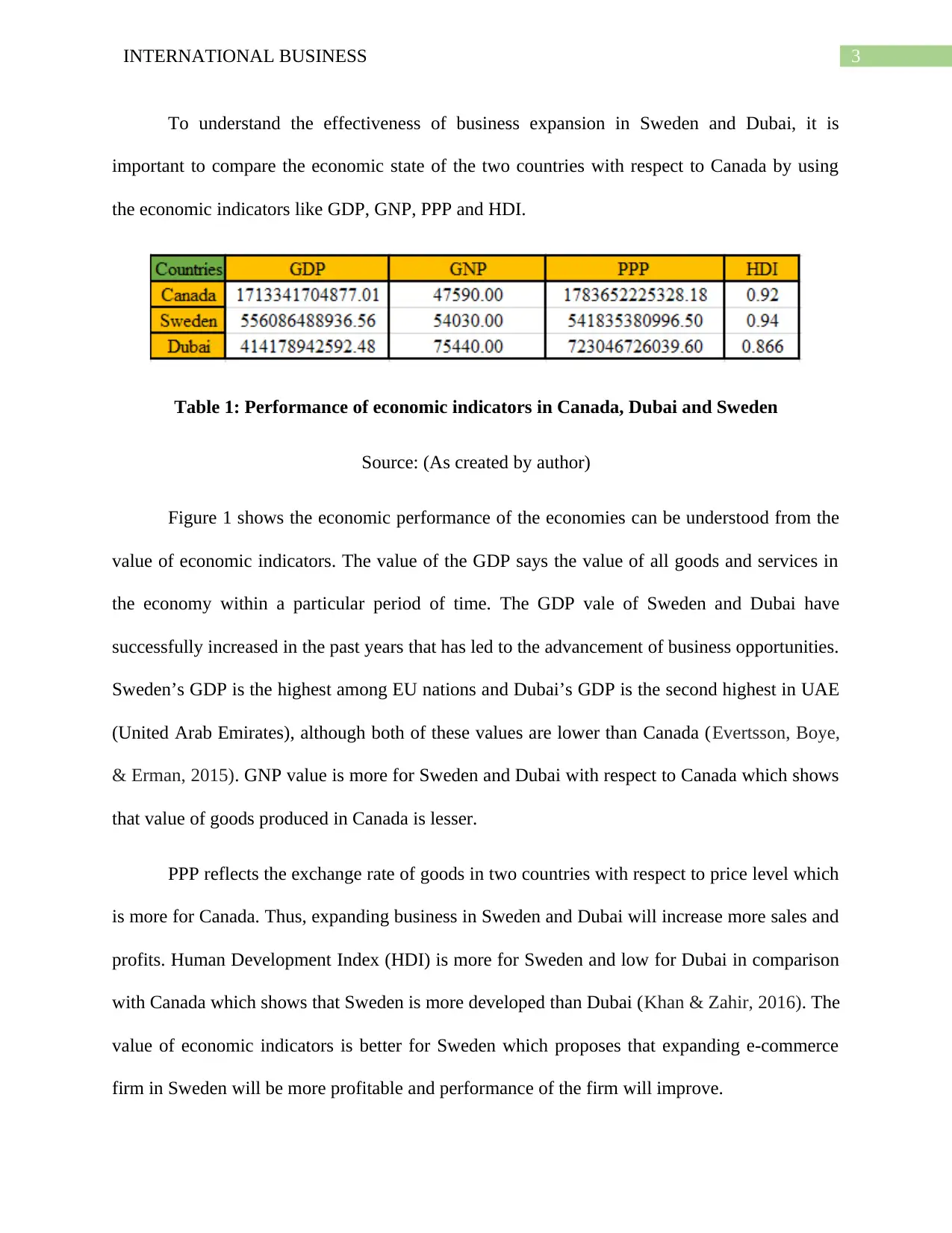
To understand the effectiveness of business expansion in Sweden and Dubai, it is
important to compare the economic state of the two countries with respect to Canada by using
the economic indicators like GDP, GNP, PPP and HDI.
Table 1: Performance of economic indicators in Canada, Dubai and Sweden
Source: (As created by author)
Figure 1 shows the economic performance of the economies can be understood from the
value of economic indicators. The value of the GDP says the value of all goods and services in
the economy within a particular period of time. The GDP vale of Sweden and Dubai have
successfully increased in the past years that has led to the advancement of business opportunities.
Sweden’s GDP is the highest among EU nations and Dubai’s GDP is the second highest in UAE
(United Arab Emirates), although both of these values are lower than Canada (Evertsson, Boye,
& Erman, 2015). GNP value is more for Sweden and Dubai with respect to Canada which shows
that value of goods produced in Canada is lesser.
PPP reflects the exchange rate of goods in two countries with respect to price level which
is more for Canada. Thus, expanding business in Sweden and Dubai will increase more sales and
profits. Human Development Index (HDI) is more for Sweden and low for Dubai in comparison
with Canada which shows that Sweden is more developed than Dubai (Khan & Zahir, 2016). The
value of economic indicators is better for Sweden which proposes that expanding e-commerce
firm in Sweden will be more profitable and performance of the firm will improve.
To understand the effectiveness of business expansion in Sweden and Dubai, it is
important to compare the economic state of the two countries with respect to Canada by using
the economic indicators like GDP, GNP, PPP and HDI.
Table 1: Performance of economic indicators in Canada, Dubai and Sweden
Source: (As created by author)
Figure 1 shows the economic performance of the economies can be understood from the
value of economic indicators. The value of the GDP says the value of all goods and services in
the economy within a particular period of time. The GDP vale of Sweden and Dubai have
successfully increased in the past years that has led to the advancement of business opportunities.
Sweden’s GDP is the highest among EU nations and Dubai’s GDP is the second highest in UAE
(United Arab Emirates), although both of these values are lower than Canada (Evertsson, Boye,
& Erman, 2015). GNP value is more for Sweden and Dubai with respect to Canada which shows
that value of goods produced in Canada is lesser.
PPP reflects the exchange rate of goods in two countries with respect to price level which
is more for Canada. Thus, expanding business in Sweden and Dubai will increase more sales and
profits. Human Development Index (HDI) is more for Sweden and low for Dubai in comparison
with Canada which shows that Sweden is more developed than Dubai (Khan & Zahir, 2016). The
value of economic indicators is better for Sweden which proposes that expanding e-commerce
firm in Sweden will be more profitable and performance of the firm will improve.
Paraphrase This Document
Need a fresh take? Get an instant paraphrase of this document with our AI Paraphraser
4INTERNATIONAL BUSINESS
Part B: Trade barriers and Treaties
The system through which the government regulates the value of international trade into
the system and generate successive growth from a positive value of international trade, which
strengthens the national economy and generates wealth. When the value of export is bigger than
imports, economies have a positive value on the balance of trade and government regulates
policies strengthens the economic performance and enhances economic growth. However, the
system was criticized as it led to the development of foreign countries and slowed economic
growth in some domestic countries.
An economy gains absolute advantage when it is able to produce large number of goods
by using similar resources like the other countries (Al Muthanna, 2015). Comparative advantage
is gained by an economy when that country gains an efficiency in production by providing better
quality products at a price that is lower than the other economies. The value of absolute and
comparative advantage can be affected by several factors like the size of economy and diversity.
If the size of economy is significantly bigger such that they have ample resources to produce the
good then they can gain a comparative advantage in production. Moreover, when has diverse
cultures and production techniques they are able to produce goods at lesser time at cheap rates,
they gain absolute advantage with low resources. In case of technological improvement, the
production level goes up with usage of similar resources at low prices leading to both
comparative and absolute advantage.
Michael Porter’s Diamond Model helps to explain those factors that can lead to the
attainment of comparative advantage for one economy over another (Deringer, 2017). It explains
that economies can attain comparative advantage by having modern technologies, investment,
government’ support and skilled labors. It is represented by a diamond shaped diagram that
Part B: Trade barriers and Treaties
The system through which the government regulates the value of international trade into
the system and generate successive growth from a positive value of international trade, which
strengthens the national economy and generates wealth. When the value of export is bigger than
imports, economies have a positive value on the balance of trade and government regulates
policies strengthens the economic performance and enhances economic growth. However, the
system was criticized as it led to the development of foreign countries and slowed economic
growth in some domestic countries.
An economy gains absolute advantage when it is able to produce large number of goods
by using similar resources like the other countries (Al Muthanna, 2015). Comparative advantage
is gained by an economy when that country gains an efficiency in production by providing better
quality products at a price that is lower than the other economies. The value of absolute and
comparative advantage can be affected by several factors like the size of economy and diversity.
If the size of economy is significantly bigger such that they have ample resources to produce the
good then they can gain a comparative advantage in production. Moreover, when has diverse
cultures and production techniques they are able to produce goods at lesser time at cheap rates,
they gain absolute advantage with low resources. In case of technological improvement, the
production level goes up with usage of similar resources at low prices leading to both
comparative and absolute advantage.
Michael Porter’s Diamond Model helps to explain those factors that can lead to the
attainment of comparative advantage for one economy over another (Deringer, 2017). It explains
that economies can attain comparative advantage by having modern technologies, investment,
government’ support and skilled labors. It is represented by a diamond shaped diagram that
5INTERNATIONAL BUSINESS
contains four factors in its four sides such as demand conditions; firm structure, strategy and
rivalry; factor conditions; and performance of supporting industries. This model will help to
understand the conditions that is refraining a firm to gain comparative advantage with in the
international market. It effectively acknowledges the factors that can lead to business
development. As Sweden is the best preference for business expansion, Porter’s Diamond
Analysis has to be performed on Sweden (Moreau, et al., 2017).
Factor conditions – The factor conditions involves factors like infrastructure, knowledge,
human resources, labor cost, qualifications and skills that can lead to an increase in
competitiveness in particular industries (Chung, 2016). These factors now relates to the liquidity
of stock markets, quality of research, oil, minerals, climate and factors that is effective for
maintaining an competitive position in the international market. Sweden is well-known for its
advanced and sophisticated technologies that has developed the industrial sector. It has the most
liquid market in Europe due to conventional exchanges and easier execution. Sweden has highly
skilled labors that is crucial for business development.
Demand condition- It relates to all factors that measures the aggregate demand of the
economy such as transportation and transaction cost, standard of living, size of home market,
economies of scale and the aggregate expenditure of the economy. Businesses extract huge
profits when the demand for a certain good is high which is dependent on its economic standards
(Rodrigues & Khan, 2015). Customer demand for e-commerce products has hugely increased in
Sweden and it is expected to go up in the future. Firms are able to generate economies of scale in
production that provides them with huge profits.
Related and supporting industries- The profitability of a firm is dependent on the
availability of producers and related industries in a specific region. Firms perform efficient when
contains four factors in its four sides such as demand conditions; firm structure, strategy and
rivalry; factor conditions; and performance of supporting industries. This model will help to
understand the conditions that is refraining a firm to gain comparative advantage with in the
international market. It effectively acknowledges the factors that can lead to business
development. As Sweden is the best preference for business expansion, Porter’s Diamond
Analysis has to be performed on Sweden (Moreau, et al., 2017).
Factor conditions – The factor conditions involves factors like infrastructure, knowledge,
human resources, labor cost, qualifications and skills that can lead to an increase in
competitiveness in particular industries (Chung, 2016). These factors now relates to the liquidity
of stock markets, quality of research, oil, minerals, climate and factors that is effective for
maintaining an competitive position in the international market. Sweden is well-known for its
advanced and sophisticated technologies that has developed the industrial sector. It has the most
liquid market in Europe due to conventional exchanges and easier execution. Sweden has highly
skilled labors that is crucial for business development.
Demand condition- It relates to all factors that measures the aggregate demand of the
economy such as transportation and transaction cost, standard of living, size of home market,
economies of scale and the aggregate expenditure of the economy. Businesses extract huge
profits when the demand for a certain good is high which is dependent on its economic standards
(Rodrigues & Khan, 2015). Customer demand for e-commerce products has hugely increased in
Sweden and it is expected to go up in the future. Firms are able to generate economies of scale in
production that provides them with huge profits.
Related and supporting industries- The profitability of a firm is dependent on the
availability of producers and related industries in a specific region. Firms perform efficient when
⊘ This is a preview!⊘
Do you want full access?
Subscribe today to unlock all pages.
Trusted by 1+ million students worldwide
6INTERNATIONAL BUSINESS
it gets support from other industries with raw materials, handling of clients, business
development and management of resources (Fang et al., 2018). This not only creates a quality
relation, but also helps in the process of development, innovation and internationalization. They
are benefitted with the production of complementary goods and extract huge sales. Sweden has a
stable e-commerce industry which is supported by several firms who sell products to the e-
commerce industry, who then sells it to the potential buyers. The e-commerce industry has
successfully grown in Sweden since 2015 due to the quality support from related firms.
Firm strategy, structure and rivalry- The factors that are related to the strategies opted by
firms to manage their corporate objectives and estimate the level of rivalry prevailing inside its
own organizational culture (Husain et al., 2016). It estimates the effectiveness of factors like
religion, culture, working morale, management decisions and interactions between companies.
Sweden basically follows the strategy of technological innovation that gives them a comparative
advantage in production with respect to market oriented outcomes.
Part C: Government Interference and Foreign Direct Investment
In several cases, markets cannot perform effectively and therefore, intervention of
government is important. Government tries to maintain a positive value of international trade and
lower the value of trade deficit of the country. The government effectively acknowledges market
equities through taxation, subsidies and taxes. It promotes businesses that are sustainable in the
long run and imposes huge taxes that is illegal and harmful. The aim is to promote general
economic fairness in the overall market and ensure that equity is maintained without any
biasness. The government tries to protect small or new industries from fierce competition from
international market and big businesses (Frieden, & Lake, 2015). The economic motive is to
increase the level of exports and lower the level of imports to support the domestic firms and
it gets support from other industries with raw materials, handling of clients, business
development and management of resources (Fang et al., 2018). This not only creates a quality
relation, but also helps in the process of development, innovation and internationalization. They
are benefitted with the production of complementary goods and extract huge sales. Sweden has a
stable e-commerce industry which is supported by several firms who sell products to the e-
commerce industry, who then sells it to the potential buyers. The e-commerce industry has
successfully grown in Sweden since 2015 due to the quality support from related firms.
Firm strategy, structure and rivalry- The factors that are related to the strategies opted by
firms to manage their corporate objectives and estimate the level of rivalry prevailing inside its
own organizational culture (Husain et al., 2016). It estimates the effectiveness of factors like
religion, culture, working morale, management decisions and interactions between companies.
Sweden basically follows the strategy of technological innovation that gives them a comparative
advantage in production with respect to market oriented outcomes.
Part C: Government Interference and Foreign Direct Investment
In several cases, markets cannot perform effectively and therefore, intervention of
government is important. Government tries to maintain a positive value of international trade and
lower the value of trade deficit of the country. The government effectively acknowledges market
equities through taxation, subsidies and taxes. It promotes businesses that are sustainable in the
long run and imposes huge taxes that is illegal and harmful. The aim is to promote general
economic fairness in the overall market and ensure that equity is maintained without any
biasness. The government tries to protect small or new industries from fierce competition from
international market and big businesses (Frieden, & Lake, 2015). The economic motive is to
increase the level of exports and lower the level of imports to support the domestic firms and
Paraphrase This Document
Need a fresh take? Get an instant paraphrase of this document with our AI Paraphraser
7INTERNATIONAL BUSINESS
maintain social welfare of the economy. As a result, government imposes tariffs or trade barriers
to increase the price of imported good and shift consumers to use domestic goods.
In Sweden, the government restricts the flow of international trade by imposing import
licensing, tariffs and import quotas. The economy of Sweden is hugely dependent on
international trade where raw materials are imported from other countries (Rodrik, 2018). For
such materials, import tariffs are negligible and quotes and only imposed on certain goods that
can hamper the trade flow of Sweden. Dubai is more like a free economy with little or no
restriction in international trade which makes the business profitable in the long run.
Government supports e-commerce industries as it helps them to generate a huge revenue
from tax amount. Consumer demand and expenditure for goods has significantly increased after
the expansion of e-commerce industry as a basis of shopping (Conconi, Sapir & Zanardi, 2016).
This has increased government revenues by successive proportion and Sweden government
actively entertains businesses related to e-commerce industry.
Firms can promote foreign investment in two primary ways, Foreign Direct Investment
(FDI) and Foreign Portfolio Investment (FPI). When a foreign firm opens a business in domestic
economy and directly regulates it, it is known as FDI. When financial assets like loans, stocks
and bonds are invested in foreign countries then it is known as FPI. FDI is more favorable than
FPI as FPI can be sold off quickly. Whereas, FPI and bring about huge profits and thus FDI is
more favorable for business expansion (Lu, Tao & Zhu, 2017). Therefore, it is profitable to open
business in foreign country and extract economic profits to the domestic economy. This rise in
profit margin will adequately enhance the level of investment for further growth objectives in the
long-run.
maintain social welfare of the economy. As a result, government imposes tariffs or trade barriers
to increase the price of imported good and shift consumers to use domestic goods.
In Sweden, the government restricts the flow of international trade by imposing import
licensing, tariffs and import quotas. The economy of Sweden is hugely dependent on
international trade where raw materials are imported from other countries (Rodrik, 2018). For
such materials, import tariffs are negligible and quotes and only imposed on certain goods that
can hamper the trade flow of Sweden. Dubai is more like a free economy with little or no
restriction in international trade which makes the business profitable in the long run.
Government supports e-commerce industries as it helps them to generate a huge revenue
from tax amount. Consumer demand and expenditure for goods has significantly increased after
the expansion of e-commerce industry as a basis of shopping (Conconi, Sapir & Zanardi, 2016).
This has increased government revenues by successive proportion and Sweden government
actively entertains businesses related to e-commerce industry.
Firms can promote foreign investment in two primary ways, Foreign Direct Investment
(FDI) and Foreign Portfolio Investment (FPI). When a foreign firm opens a business in domestic
economy and directly regulates it, it is known as FDI. When financial assets like loans, stocks
and bonds are invested in foreign countries then it is known as FPI. FDI is more favorable than
FPI as FPI can be sold off quickly. Whereas, FPI and bring about huge profits and thus FDI is
more favorable for business expansion (Lu, Tao & Zhu, 2017). Therefore, it is profitable to open
business in foreign country and extract economic profits to the domestic economy. This rise in
profit margin will adequately enhance the level of investment for further growth objectives in the
long-run.
8INTERNATIONAL BUSINESS
Part D: Canadian Government Business Assistance
E-commerce business can be financed in several ways such as loans (like per-to-peer loan, equity
loan, bank loan etcetera), personal savings, online lender, crowd funding and venture capital.
Borrowing serves as the best option when it comes to expansion of business in foreign countries.
Equity is also an effective way to manage finances where fresh capital is raised through selling
shares of the business to institutional investors, public and financial institutions. Another way to
finance the e-commerce business is by redesigning the website from technicians by giving
certain amount as cash amount (Brouard, McMurtry, & Vieta, 2015).
The government of Canada takes active role in the expansion of Canadian business in
foreign economies to extract huge revenues that can retain positive profits. There are several
funding programs and government grants to support the e-commerce firms. The program of
CanExport is engaged in the task of supporting the export oriented projects by giving a minimum
grant of 75,000 dollars for each application, which comprise of participation in government led
trade missions and trade shows.
There is a program named as the Canada Small Business Financing Program (CSBFP)
where small enterprises can get up to a million dollar for expansion of business in domestic and
foreign economy for businesses who has annual revenue less than ten million dollars (Seally,
2017). The government can regulate the competitive interest rates and apply at credit union or
financial institution.
Part D: Canadian Government Business Assistance
E-commerce business can be financed in several ways such as loans (like per-to-peer loan, equity
loan, bank loan etcetera), personal savings, online lender, crowd funding and venture capital.
Borrowing serves as the best option when it comes to expansion of business in foreign countries.
Equity is also an effective way to manage finances where fresh capital is raised through selling
shares of the business to institutional investors, public and financial institutions. Another way to
finance the e-commerce business is by redesigning the website from technicians by giving
certain amount as cash amount (Brouard, McMurtry, & Vieta, 2015).
The government of Canada takes active role in the expansion of Canadian business in
foreign economies to extract huge revenues that can retain positive profits. There are several
funding programs and government grants to support the e-commerce firms. The program of
CanExport is engaged in the task of supporting the export oriented projects by giving a minimum
grant of 75,000 dollars for each application, which comprise of participation in government led
trade missions and trade shows.
There is a program named as the Canada Small Business Financing Program (CSBFP)
where small enterprises can get up to a million dollar for expansion of business in domestic and
foreign economy for businesses who has annual revenue less than ten million dollars (Seally,
2017). The government can regulate the competitive interest rates and apply at credit union or
financial institution.
⊘ This is a preview!⊘
Do you want full access?
Subscribe today to unlock all pages.
Trusted by 1+ million students worldwide

9INTERNATIONAL BUSINESS
Paraphrase This Document
Need a fresh take? Get an instant paraphrase of this document with our AI Paraphraser
10INTERNATIONAL BUSINESS
Reference List
Al Muthanna, D. (2015). Business model innovation to promote a low carbon economy in Dubai.
Białowąs, P. J. (2016). ANTIDOTE TO CURRENT PROBLES OF WORLD’S ECONOMY:
NEOLIBERALISM OR CENTRALLY PLANNED SYSTEM?. Czech Journal of Social
Sciences Business and Economics, 5(4), 14-19.
Brouard, F., McMurtry, J. J., & Vieta, M. (2015). Social Enterprises Models in Canada:
Ontario. Canadian journal of nonprofit and social economy research, 6(1).
Chung, T. W. (2016). A study on logistics cluster competitiveness among Asia main countries
using the Porter's diamond model. The Asian Journal of Shipping and Logistics, 32(4),
257-264.
Conconi, P., Sapir, A., & Zanardi, M. (2016). The internationalization process of firms: From
exports to FDI. Journal of International Economics, 99, 16-30.
Deringer, W. (2017). “It was their business to know”: British merchants and mercantile
epistemology in the eighteenth century. History of Political Economy, 49(2), 177-206.
Evertsson, M., Boye, K., & Erman, J. (2015). Fathers on call–A study on the sharing of care
work among parents in Sweden. A mixed methods approach. Family and Societies.
Fang, K., Zhou, Y., Wang, S., Ye, R., & Guo, S. (2018). Assessing national renewable energy
competitiveness of the G20: A revised Porter's Diamond Model. Renewable and
Sustainable Energy Reviews, 93, 719-731.
Frieden, J. A., & Lake, D. A. (2015). World Politics: Interests, Interactions, Institutions: Third
International Student Edition. WW Norton & Company.
Reference List
Al Muthanna, D. (2015). Business model innovation to promote a low carbon economy in Dubai.
Białowąs, P. J. (2016). ANTIDOTE TO CURRENT PROBLES OF WORLD’S ECONOMY:
NEOLIBERALISM OR CENTRALLY PLANNED SYSTEM?. Czech Journal of Social
Sciences Business and Economics, 5(4), 14-19.
Brouard, F., McMurtry, J. J., & Vieta, M. (2015). Social Enterprises Models in Canada:
Ontario. Canadian journal of nonprofit and social economy research, 6(1).
Chung, T. W. (2016). A study on logistics cluster competitiveness among Asia main countries
using the Porter's diamond model. The Asian Journal of Shipping and Logistics, 32(4),
257-264.
Conconi, P., Sapir, A., & Zanardi, M. (2016). The internationalization process of firms: From
exports to FDI. Journal of International Economics, 99, 16-30.
Deringer, W. (2017). “It was their business to know”: British merchants and mercantile
epistemology in the eighteenth century. History of Political Economy, 49(2), 177-206.
Evertsson, M., Boye, K., & Erman, J. (2015). Fathers on call–A study on the sharing of care
work among parents in Sweden. A mixed methods approach. Family and Societies.
Fang, K., Zhou, Y., Wang, S., Ye, R., & Guo, S. (2018). Assessing national renewable energy
competitiveness of the G20: A revised Porter's Diamond Model. Renewable and
Sustainable Energy Reviews, 93, 719-731.
Frieden, J. A., & Lake, D. A. (2015). World Politics: Interests, Interactions, Institutions: Third
International Student Edition. WW Norton & Company.
11INTERNATIONAL BUSINESS
Husain, F., Ab Halim, N., Hassan, M. G. B., Kassim, A. W. B. M., & Shamsudin, A. S. B.
(2016) THE COMPETITIVE ADVANTAGE OF MALAYSIAN SME’s: THE IMPACT
OF UNCERTAINITY AVOIDANCE-A MISSING ELEMENT IN PORTER'S
ANALYSIS?. The International Journal of Management Research (JMIJMR), 1(6), 560-
569.
Khan, Z. R., & Zahir, M. (2016). Restless n'youthful: Study into barriers young entrepreneurs
face in Dubai.
Lu, Y., Tao, Z., & Zhu, L. (2017). Identifying FDI spillovers. Journal of International
Economics, 107, 75-90.
Moreau, P. A., Sabines-Chesterking, J., Whittaker, R., Joshi, S. K., Birchall, P. M., McMillan,
A., ... & Matthews, J. C. (2017). Demonstrating an absolute quantum advantage in direct
absorption measurement. Scientific reports, 7(1), 1-7.
Rodrigues, G., & Khan, Z. R. (2015). Competitiveness of clothing industry based on Porter's
diamond model: SAFTA countries.
Rodrik, D. (2018). What do trade agreements really do?. Journal of economic
perspectives, 32(2), 73-90.
Seally, K. (2017). Government Grants in Canada: The Commemoration of the War of 1812. The
iJournal: Graduate Student Journal of the Faculty of Information, 2(3).
Husain, F., Ab Halim, N., Hassan, M. G. B., Kassim, A. W. B. M., & Shamsudin, A. S. B.
(2016) THE COMPETITIVE ADVANTAGE OF MALAYSIAN SME’s: THE IMPACT
OF UNCERTAINITY AVOIDANCE-A MISSING ELEMENT IN PORTER'S
ANALYSIS?. The International Journal of Management Research (JMIJMR), 1(6), 560-
569.
Khan, Z. R., & Zahir, M. (2016). Restless n'youthful: Study into barriers young entrepreneurs
face in Dubai.
Lu, Y., Tao, Z., & Zhu, L. (2017). Identifying FDI spillovers. Journal of International
Economics, 107, 75-90.
Moreau, P. A., Sabines-Chesterking, J., Whittaker, R., Joshi, S. K., Birchall, P. M., McMillan,
A., ... & Matthews, J. C. (2017). Demonstrating an absolute quantum advantage in direct
absorption measurement. Scientific reports, 7(1), 1-7.
Rodrigues, G., & Khan, Z. R. (2015). Competitiveness of clothing industry based on Porter's
diamond model: SAFTA countries.
Rodrik, D. (2018). What do trade agreements really do?. Journal of economic
perspectives, 32(2), 73-90.
Seally, K. (2017). Government Grants in Canada: The Commemoration of the War of 1812. The
iJournal: Graduate Student Journal of the Faculty of Information, 2(3).
⊘ This is a preview!⊘
Do you want full access?
Subscribe today to unlock all pages.
Trusted by 1+ million students worldwide

1 out of 12


Related Documents


Your All-in-One AI-Powered Toolkit for Academic Success.
+13062052269
info@desklib.com
Available 24*7 on WhatsApp / Email
![[object Object]](/_next/static/media/star-bottom.7253800d.svg)
Unlock your academic potential
Copyright © 2020–2026 A2Z Services. All Rights Reserved. Developed and managed by ZUCOL.