International Business Strategy: Critical Analysis of Core Competence

Verified

Added on  2023/05/29

|7
|1475
|149
Essay
AI Summary
This essay provides a critical analysis of the article 'The Core Competence of the Corporation' by Gary Hamel and C.K. Prahalad, focusing on the application of core competency frameworks in capturing the global market and delivering customer benefits. It reviews the three conditions necessary for businesses to enhance core competency: providing superior customer value, ensuring immitability, and possessing rare qualities. The essay highlights the importance of corporate imagination, innovative product concepts, and the ability to transcend SBU lines. It emphasizes that core products are the tangible outcomes of core competencies, representing collective learning within the organization and the capacity to coordinate diverse production skills. The analysis concludes that the article rightly identifies core competency as a key driver of competitiveness, while suggesting a need for a more integrated discussion beyond the core competence-to-end products roadmap. Desklib provides a platform for students to access this and other solved assignments.

Document Page
Running head: International business strategy
International business strategy
Name of the student
Name of the University
Author note
tabler-icon-diamond-filled.svg

Paraphrase This Document

Need a fresh take? Get an instant paraphrase of this document with our AI Paraphraser
Document Page
1International business strategy
Introduction
The term core competency refers to the strategic advantages of an enterprise or resources
with technical abilities and advanced knowledge application which allow the company to remain
competitive in the industry in which it deals in (Prahalad and Hamel 2006). In a more specific
manner, the area in which the company gives its best effort and remains in the better position in
comparison with other similar companies is considered to be the company’s core competency
which distinguishes the company from other companies (Morden 2016). It can be noticed that
the theory and concepts of core competency was first introduced by Gary Hamel and C. K.
Prahalad. By applying the framework of core competency the organizations are able to capture
the global market. Moreover, it has been monitored that by adopting core competence
organizations are able to contribute towards the benefits of the customers in a better manner.
Hence, the relatively new theory core competency is a management theory which the article
named ‘The Core Competence of the Corporation’ discusses about. Thus, the discussion below
will give a critical analysis of the article by Gary Harmel and C K Prahalad. The two authors
in their article had reviewed three conditions which must be fulfilled by a business in order to
increase core competency.
Discussion
As mentioned in the above, there are three conditions which must be reviewed a business
activity in order to assure core competency as emergent process of strategy (Waddell 2017). In
accordance with the statements made by the article, the very first condition is about providing
superior value or benefits to the customers whereas the second condition is about immitability
Document Page
2International business strategy
(Jiang 2016). To be more specific, the company must assure that the core competency is not
easily is not easily replicated or followed by other rival companies in the same industry (Yang
2015). The third condition is nothing but related to the quality of rare which falls under the
deliberate process of strategy. A company should concentrate on such an area to be increasing its
strength which will be hardly found in other companies.
The article ‘Core Competence of the Corporation’ makes an urge to the leaders in order
to reconsider the idea of the corporation from the perspective of business portfolio management
and optimization of interdependency to the competency portfolio widened all over individual
businesses at the same time providing sustaining and factual competitive advantage. The article
gives special attention on the nurture of core competency which requires different thought
process along with the different process of operation, suggested by the lines: “When the
organization is conceived of as a multiplicity of SBUs, no single business may feel responsible
for maintaining a viable position in core products nor be able to justify the investment required to
build world leadership in some core competence. In the absence of a more comprehensive view
imposed by corporate management, SBU managers will tend to under invest.”
The article also gives a word of cautions to the businesses who are presently
concentrating on the recent economic environment as an appropriate one with which the
acquisition will result ensuing suitability. The article suggests while challenging the present push
towards the business process that are more decentralized in manner as implied by the excerpt of
the article “the fragmentation of core competencies becomes inevitable when a diversified
company’s information systems, patterns of communication, career paths, managerial rewards,
and processes of strategy development do not transcend SBU lines.”
Document Page
3International business strategy
However, there are high possibilities that efficiency can be gleaned from decentralization
(Galpin 2018). Possibly, the prediction should receive more credence so that businesses can be
assessed through the means of their abilities in order to “individual imagination must become
corporate imagination.”
Few elements or components have been outlined by the authors of the article that enables
the corporate imagination. The components are thus as follows:
The individuals responsible for the managerial skills must consider thinking
beyond the current boundaries and sets while are required to explore the white spaces as the
emergent or current strategy that exists among the current businesses (Park 2018). Hence, this
creates a ground of deliberate strategic process in which the approach of core competency
actually works. In the meantime, the managers should avoid eying each new scope from the
perspective of current businesses (Guo et al. 2017).
Another element is the search of innovative concepts of products (Fleisch,
Weinberger and Wortmann 2015). Approach towards the market analysis does not have the
possibility of yielding rock solid innovative concepts (Njiraini 2016). Hence, a clear
understanding of the requirements as well as of the functionalities is required in order to replace
the traditional and conventional approach of products along with customers “Asking ‘innocent’
questions (why does the product have to be this way?), understanding what the current product
concept doesn’t do for customers, and imagining how functionalities could be unbundled and
rebundled…”
tabler-icon-diamond-filled.svg

Paraphrase This Document

Need a fresh take? Get an instant paraphrase of this document with our AI Paraphraser
Document Page
4International business strategy
Conclusion
The major strength of the article is that it has rightly analyzed that the factor of core
competency plays the major role behind a company’s core competitiveness. The most important
factor that the article has brought into highlight is that core products are the tangible outcomes of
core competencies. This suggests core competence as the learning in a collective manner within
the organization. To be more specific, core competence refers to the capacity in order to develop
coordination among a wide as diverse range of production skills at the same time in order create
integrated technological streams. The most important aspect that the article rightly articulated is
that main aspect of core competence is the ability work beyond the boundaries of organizational
set up. While initial step is to identifying core competencies the later steps is the ability of
reforming the company’s architecture along with the ability of providing the impetus of learning
through strategic alliances. In addition it also includes the focus of internal development. In the
meantime, weakness is that it only given the roadmap of competitive advantage that moves from
core competence to core products and then end products while the discussion needed to be more
integrated in manner.
Document Page
5International business strategy
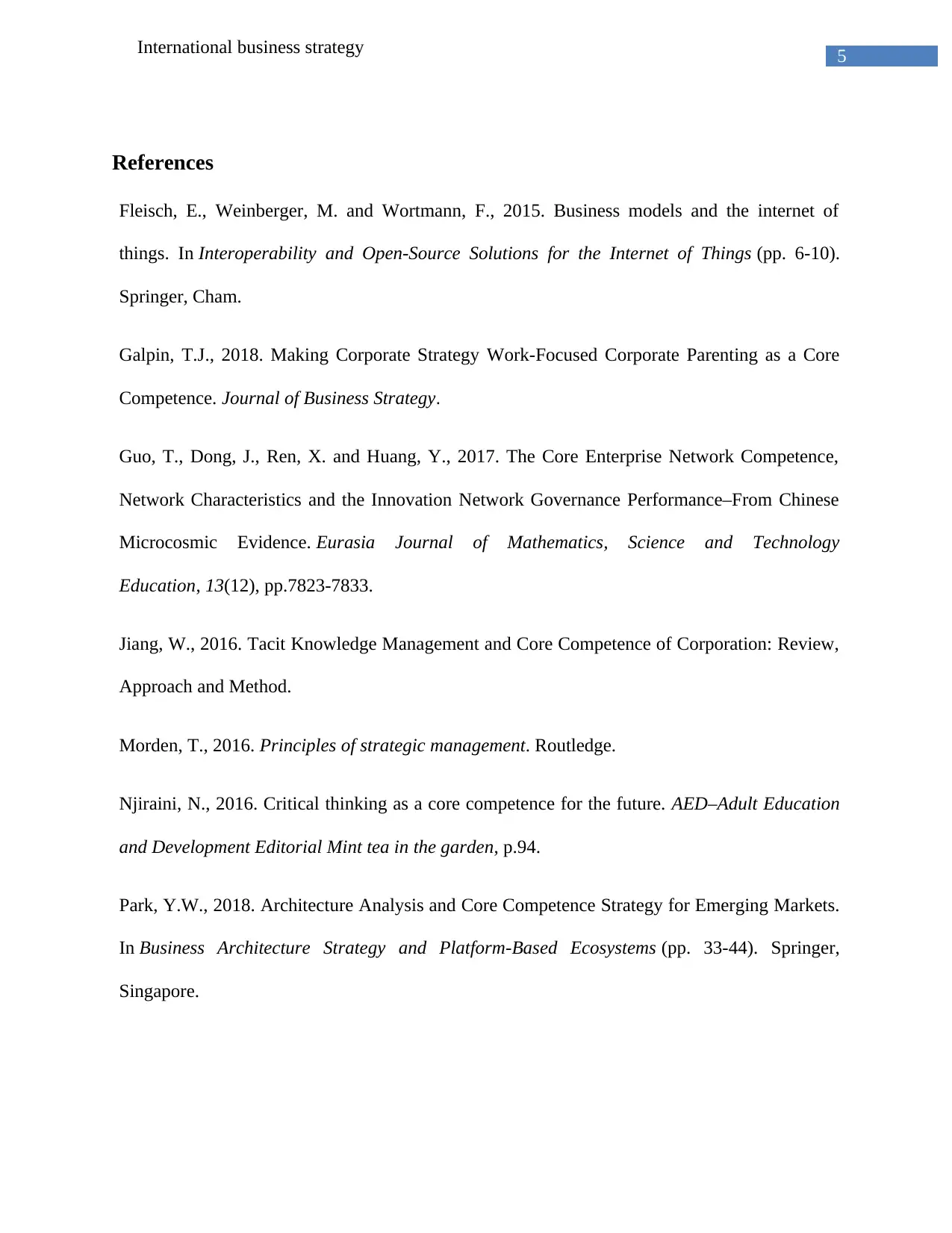
References
Fleisch, E., Weinberger, M. and Wortmann, F., 2015. Business models and the internet of
things. In Interoperability and Open-Source Solutions for the Internet of Things (pp. 6-10).
Springer, Cham.
Galpin, T.J., 2018. Making Corporate Strategy Work-Focused Corporate Parenting as a Core
Competence. Journal of Business Strategy.
Guo, T., Dong, J., Ren, X. and Huang, Y., 2017. The Core Enterprise Network Competence,
Network Characteristics and the Innovation Network Governance Performance–From Chinese
Microcosmic Evidence. Eurasia Journal of Mathematics, Science and Technology
Education, 13(12), pp.7823-7833.
Jiang, W., 2016. Tacit Knowledge Management and Core Competence of Corporation: Review,
Approach and Method.
Morden, T., 2016. Principles of strategic management. Routledge.
Njiraini, N., 2016. Critical thinking as a core competence for the future. AED–Adult Education
and Development Editorial Mint tea in the garden, p.94.
Park, Y.W., 2018. Architecture Analysis and Core Competence Strategy for Emerging Markets.
In Business Architecture Strategy and Platform-Based Ecosystems (pp. 33-44). Springer,
Singapore.
Document Page
6International business strategy
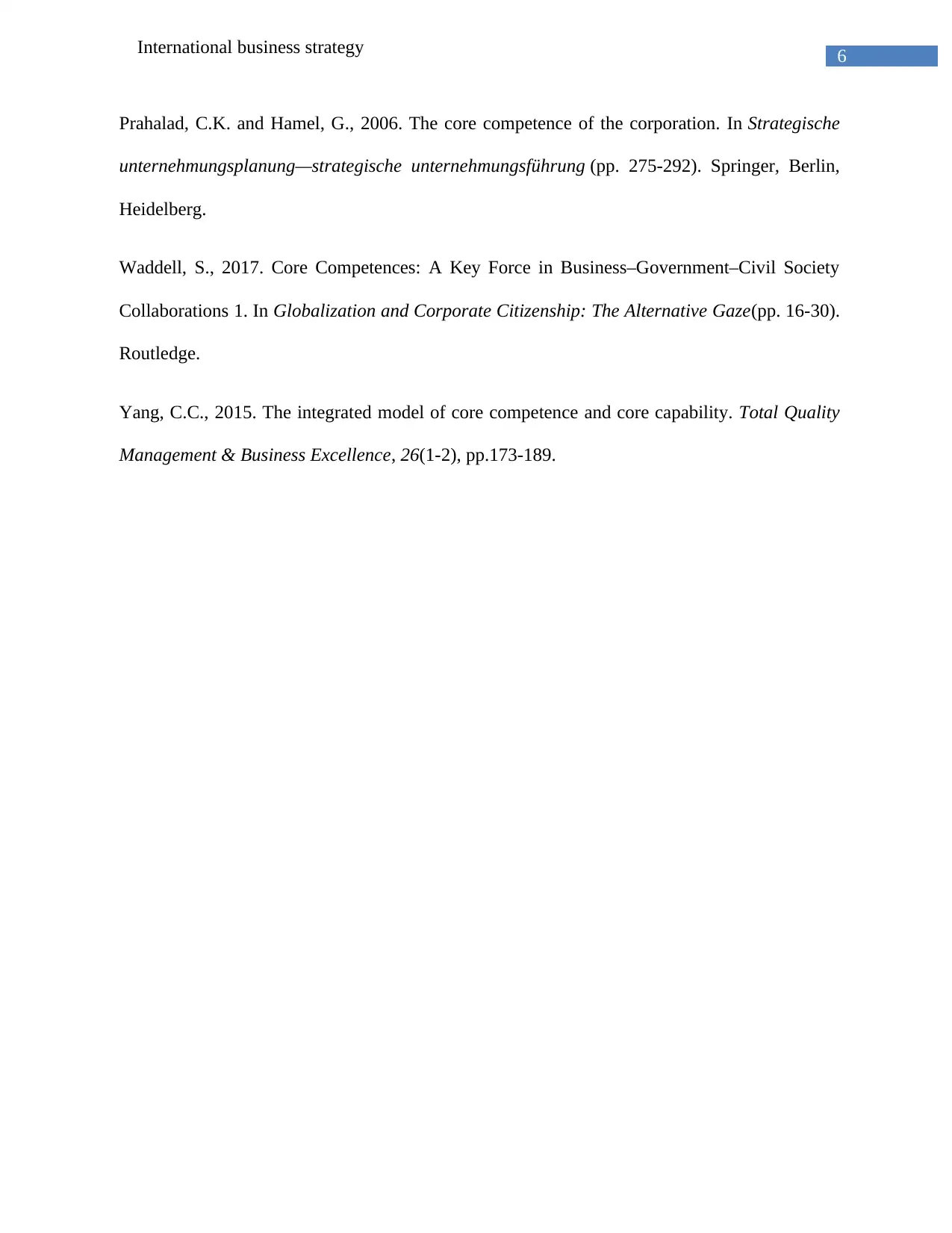
Prahalad, C.K. and Hamel, G., 2006. The core competence of the corporation. In Strategische
unternehmungsplanung—strategische unternehmungsführung (pp. 275-292). Springer, Berlin,
Heidelberg.
Waddell, S., 2017. Core Competences: A Key Force in Business–Government–Civil Society
Collaborations 1. In Globalization and Corporate Citizenship: The Alternative Gaze(pp. 16-30).
Routledge.
Yang, C.C., 2015. The integrated model of core competence and core capability. Total Quality
Management & Business Excellence, 26(1-2), pp.173-189.
chevron_up_icon
1 out of 7
circle_padding
hide_on_mobile
zoom_out_icon
[object Object]