International Economics Report: Economic Analysis of Tariffs in Greece
VerifiedAdded on 2020/01/07
|11
|2951
|145
Report
AI Summary
This report provides an analysis of international economics, focusing on the impact of tariffs on a small economy, using Greece as a case study. It explores the effects of tariffs on revenue generation, protection of domestic industries, and remedies for trade distortions. The report delves into the infant industry argument, examining its benefits and drawbacks, particularly in the context of Greece's economic policies. Furthermore, it investigates market distortions in both the goods and factor markets, highlighting the role of government intervention through taxation, price regulation, subsidies, and regulations on goods. The report examines the impact of these distortions on the welfare of the Greek economy and industries. It concludes by summarizing the implications of these economic factors, offering insights into the complexities of international trade and economic development. The report is contributed by a student and available on Desklib, a platform providing AI-based study tools and resources for students.
International
Economics
Economics

Paraphrase This Document
Need a fresh take? Get an instant paraphrase of this document with our AI Paraphraser
TABLE OF CONTENTS
INTRODUCTION...........................................................................................................................3
Impact of imposition of tariffs on small country.............................................................................3
Infant Industry Argument................................................................................................................4
Distortions in goods market.............................................................................................................6
Distortions in factor market.............................................................................................................8
CONCLUSION................................................................................................................................9
REFERENCES..............................................................................................................................10
INTRODUCTION...........................................................................................................................3
Impact of imposition of tariffs on small country.............................................................................3
Infant Industry Argument................................................................................................................4
Distortions in goods market.............................................................................................................6
Distortions in factor market.............................................................................................................8
CONCLUSION................................................................................................................................9
REFERENCES..............................................................................................................................10
INTRODUCTION
Globalisation has dwindled the boundaries between countries with respect to different
activities specifically in context of trade. This has escalated the flow of capital from one country
to the other. International Economics is the study of different trade, development and financial
issues associated with the economies operating. With the movement of money from one country
to the other significantly affects the associated country. Each country caters to maximize the
gross domestic products and growth rates. For that different measures are adopted by them.
Economic policies and measures differs as per the size of economy and resources available.
Small economies in order to bring growth and development adopt various measures to boost the
economy and protect from the developed and large economies. One such measure is implication
of tariff which plays vital role in balancing the welfare of small economy. Tariffs refers to the
imposition of taxes on the imports of goods and services from the other country to maintain the
equilibrium in balance of payments (Gandolfo, 2013). Instead of having general implication it
benefits the country imposing it in certain conditions. For the study, a small economy Greece is
taken into account. Report throws light on three concepts which largely affects it that are infant
industry argument, distortions in goods market and distortion in factor market.
Impact of imposition of tariffs on small country
From the different measures adopted by the countries in order to balance their economy
one such measure is tariffs on their imports. It refers to the process of laying extra charges on the
items moving from foreign country to the home country at the time of crossing the border. The
imposition of revenue by the small countries gives them the lucrative results and outcomes.
Three fundamental uses of tariff imposition are revenue generation, protection of domestic
industries and providing remedies fir trade distortions (Dunning, 2014).
Revenue Generation
This function increases the welfare of the selected small economy. Government impose
tariffs on the goods and services on the basis of several grounds and consideration. In that regard
it has varied impacts on the economy of the country. Government generally impose taxes on
luxury goods, narcotics, drugs and other high value goods. This makes the government to
stabilize the trade of certain goods such as high tariffs on luxury goods increases the foreign
exchange along with limiting the imports and deficit balance of payments. This leads to the
welfare of the economy in several aspects.
Globalisation has dwindled the boundaries between countries with respect to different
activities specifically in context of trade. This has escalated the flow of capital from one country
to the other. International Economics is the study of different trade, development and financial
issues associated with the economies operating. With the movement of money from one country
to the other significantly affects the associated country. Each country caters to maximize the
gross domestic products and growth rates. For that different measures are adopted by them.
Economic policies and measures differs as per the size of economy and resources available.
Small economies in order to bring growth and development adopt various measures to boost the
economy and protect from the developed and large economies. One such measure is implication
of tariff which plays vital role in balancing the welfare of small economy. Tariffs refers to the
imposition of taxes on the imports of goods and services from the other country to maintain the
equilibrium in balance of payments (Gandolfo, 2013). Instead of having general implication it
benefits the country imposing it in certain conditions. For the study, a small economy Greece is
taken into account. Report throws light on three concepts which largely affects it that are infant
industry argument, distortions in goods market and distortion in factor market.
Impact of imposition of tariffs on small country
From the different measures adopted by the countries in order to balance their economy
one such measure is tariffs on their imports. It refers to the process of laying extra charges on the
items moving from foreign country to the home country at the time of crossing the border. The
imposition of revenue by the small countries gives them the lucrative results and outcomes.
Three fundamental uses of tariff imposition are revenue generation, protection of domestic
industries and providing remedies fir trade distortions (Dunning, 2014).
Revenue Generation
This function increases the welfare of the selected small economy. Government impose
tariffs on the goods and services on the basis of several grounds and consideration. In that regard
it has varied impacts on the economy of the country. Government generally impose taxes on
luxury goods, narcotics, drugs and other high value goods. This makes the government to
stabilize the trade of certain goods such as high tariffs on luxury goods increases the foreign
exchange along with limiting the imports and deficit balance of payments. This leads to the
welfare of the economy in several aspects.
⊘ This is a preview!⊘
Do you want full access?
Subscribe today to unlock all pages.

Trusted by 1+ million students worldwide
Protection of domestic goods
Small economies are having many growing industries catering towards the development
and upliftment in terms of income and establishment in market place. By imposing taxes and
heavy duties on the goods and services imported from the foreign country bring reduction in the
quantity which enables the domestic industries to establish in the international market in the
better manner (McMillan, 2013).
Remedy for trade distortions
Along with fulfilling other purposes, imposition of taxes also provides remedy for the
trade distortions made by the other countries in different ways. Few measures are the anti-
dumping duties and the countervailing duties which protects the countries from the damage to
the domestic companies.
Infant Industry Argument
More specifically the protection provided by the government to the domestic industries is
the Infant industry Argument. It refers to the adoption of certain measures such as imposition of
custom and import duties, raising tariffs and charges, trade protection measures and making
respective policies and regulation that helps in raising the economies of scale of the small
countries. In the report, case study is presented with respect to the small economy Greece.
Greece is the country with small economy that adopts various measures to boost the countries
different sectors and companies operating in them (Crucini And et.al, 2011). Greece uses the
trade protection measures to make the companies and organisation grow on global scale. It
allows competing with the industries already established or catering to expand in the
international market. Greece is well utilizing this concept to bring improvements in the growth
rate through initiation of enhancement of trade activities from the part of home country. It has
significant spillover effects on the industries as well the economy of the country. Greek domestic
companies experiences positive impacts on their profitability and growth through different
measures such as it enables the easy accessibility to the international market (Deardorff, 2014). It
provides exposure to the industries with minimum number of restrictions and distortions in the
competition sceneries. Further, it also has the learning effects on the domestic infant or growing
industries such as it increases the efficiency in the production through the inculcation of
technological advancements in the operations. Further, measures such as production subsidy
granted in the field and manufacturing of new goods encourages the new industries to enter the
Small economies are having many growing industries catering towards the development
and upliftment in terms of income and establishment in market place. By imposing taxes and
heavy duties on the goods and services imported from the foreign country bring reduction in the
quantity which enables the domestic industries to establish in the international market in the
better manner (McMillan, 2013).
Remedy for trade distortions
Along with fulfilling other purposes, imposition of taxes also provides remedy for the
trade distortions made by the other countries in different ways. Few measures are the anti-
dumping duties and the countervailing duties which protects the countries from the damage to
the domestic companies.
Infant Industry Argument
More specifically the protection provided by the government to the domestic industries is
the Infant industry Argument. It refers to the adoption of certain measures such as imposition of
custom and import duties, raising tariffs and charges, trade protection measures and making
respective policies and regulation that helps in raising the economies of scale of the small
countries. In the report, case study is presented with respect to the small economy Greece.
Greece is the country with small economy that adopts various measures to boost the countries
different sectors and companies operating in them (Crucini And et.al, 2011). Greece uses the
trade protection measures to make the companies and organisation grow on global scale. It
allows competing with the industries already established or catering to expand in the
international market. Greece is well utilizing this concept to bring improvements in the growth
rate through initiation of enhancement of trade activities from the part of home country. It has
significant spillover effects on the industries as well the economy of the country. Greek domestic
companies experiences positive impacts on their profitability and growth through different
measures such as it enables the easy accessibility to the international market (Deardorff, 2014). It
provides exposure to the industries with minimum number of restrictions and distortions in the
competition sceneries. Further, it also has the learning effects on the domestic infant or growing
industries such as it increases the efficiency in the production through the inculcation of
technological advancements in the operations. Further, measures such as production subsidy
granted in the field and manufacturing of new goods encourages the new industries to enter the
Paraphrase This Document
Need a fresh take? Get an instant paraphrase of this document with our AI Paraphraser
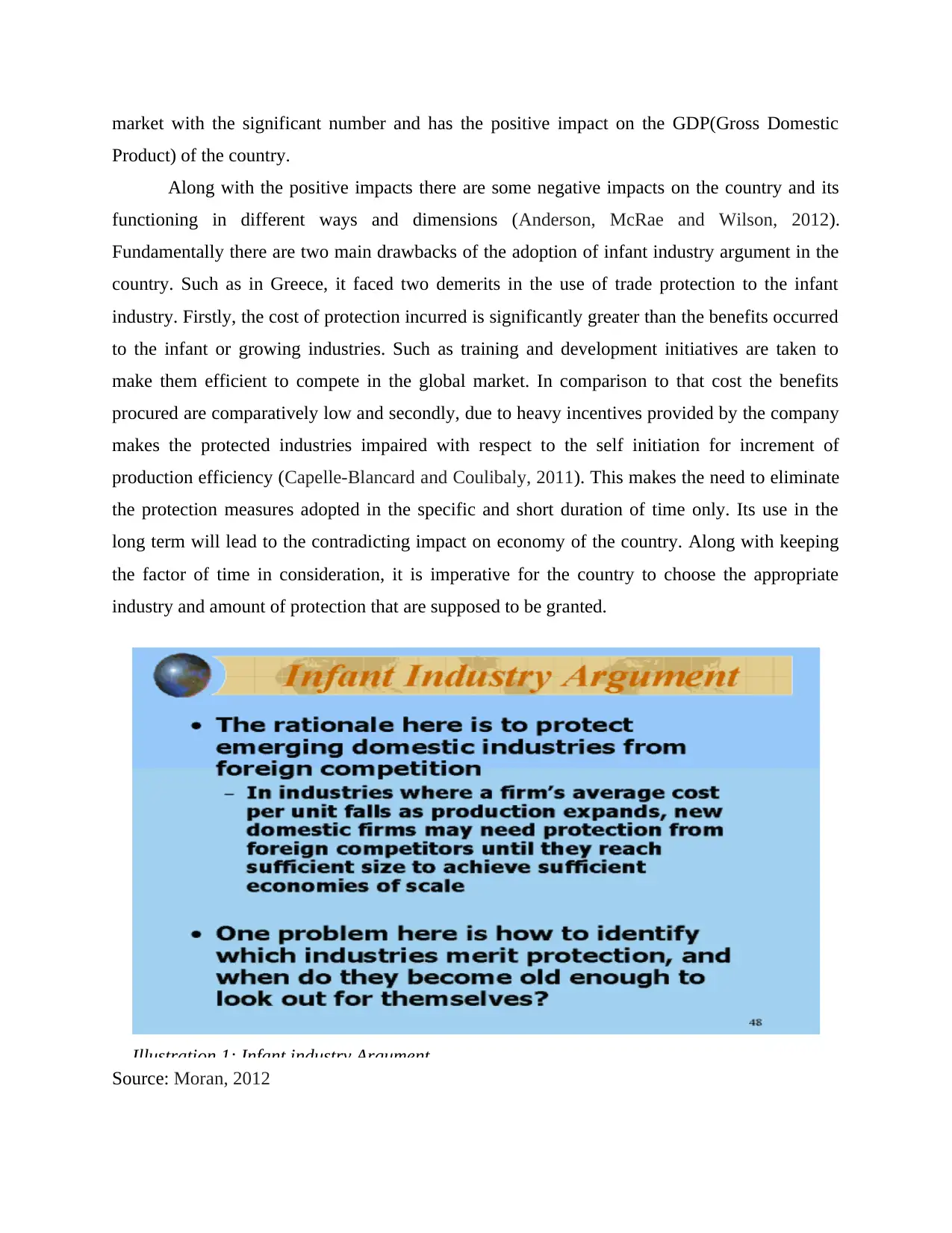
market with the significant number and has the positive impact on the GDP(Gross Domestic
Product) of the country.
Along with the positive impacts there are some negative impacts on the country and its
functioning in different ways and dimensions (Anderson, McRae and Wilson, 2012).
Fundamentally there are two main drawbacks of the adoption of infant industry argument in the
country. Such as in Greece, it faced two demerits in the use of trade protection to the infant
industry. Firstly, the cost of protection incurred is significantly greater than the benefits occurred
to the infant or growing industries. Such as training and development initiatives are taken to
make them efficient to compete in the global market. In comparison to that cost the benefits
procured are comparatively low and secondly, due to heavy incentives provided by the company
makes the protected industries impaired with respect to the self initiation for increment of
production efficiency (Capelle-Blancard and Coulibaly, 2011). This makes the need to eliminate
the protection measures adopted in the specific and short duration of time only. Its use in the
long term will lead to the contradicting impact on economy of the country. Along with keeping
the factor of time in consideration, it is imperative for the country to choose the appropriate
industry and amount of protection that are supposed to be granted.
Source: Moran, 2012
Illustration 1: Infant industry Argument
Product) of the country.
Along with the positive impacts there are some negative impacts on the country and its
functioning in different ways and dimensions (Anderson, McRae and Wilson, 2012).
Fundamentally there are two main drawbacks of the adoption of infant industry argument in the
country. Such as in Greece, it faced two demerits in the use of trade protection to the infant
industry. Firstly, the cost of protection incurred is significantly greater than the benefits occurred
to the infant or growing industries. Such as training and development initiatives are taken to
make them efficient to compete in the global market. In comparison to that cost the benefits
procured are comparatively low and secondly, due to heavy incentives provided by the company
makes the protected industries impaired with respect to the self initiation for increment of
production efficiency (Capelle-Blancard and Coulibaly, 2011). This makes the need to eliminate
the protection measures adopted in the specific and short duration of time only. Its use in the
long term will lead to the contradicting impact on economy of the country. Along with keeping
the factor of time in consideration, it is imperative for the country to choose the appropriate
industry and amount of protection that are supposed to be granted.
Source: Moran, 2012
Illustration 1: Infant industry Argument
Distortions in goods market
Government is responsible to stabilize the condition of the economy of the country in
different dimensions such as capital market, goods market and the factor market. Capital market
refers to the system in which there is exchange or flow of money across the different
components. Goods market is the selling and purchasing of commodities and the factor market
refers to the movement of factors of production such as land and labour from one business entity
to the other through buying and selling (Eslava and et.al, 2013). All the three mentioned markets
are regulated and controlled by the government and other legislation in different degrees and
intervention. In the pure form of markets, operations are done in uncontrolled manner in the self
regulated manner whereas in the mixed forms, it consists the attributes of all the types. The
selected country that is Greece is the mixed capitalist economy with the 40% of the public sector
companies with the average growth rate of economy as 4%. It infers that there is significant
amount of intervention of the government body in the operations of the economy (Bouvatier and
Lepetit, 2012). This process is refers to the market distortion. When there is the involvement of
legislative bodies or government in order to regulate the operations, it refers to the market
distortions. This leads to the enhancement of the welfare of the Greece Economy in different
ways. Government intervenes in the process through the adoption various policy measures such
as taxation, regulating prices, granting subsidies and laying regulations on certain goods. These
steps are adopted by the Government to increase the well being of different market entities and to
protect them. This increases the efficiency of the market products along with increasing welfare
on the wider scale.
Taxation
It refers to the imposition of taxes and heavy charges on certain products. There is the
fixed or particular trend I composition of trade executed by the economy. In Greece as well there
are some products which are exported to earn profitability whereas deficient are imported from
the least disadvantage products. In that respect taxation is laid in accordance to the profitability
and comparative advantage conditions (Oldenski, 2012). Taxes are imposed on the imports of
commercial goods to make their quantity rational and limiting them to the certain amount only
letting them not to exceed beyond the limit which can further harm the economy in considerable
manner. Along with that taxes are reduced on some goods that are exported to the foreign
Government is responsible to stabilize the condition of the economy of the country in
different dimensions such as capital market, goods market and the factor market. Capital market
refers to the system in which there is exchange or flow of money across the different
components. Goods market is the selling and purchasing of commodities and the factor market
refers to the movement of factors of production such as land and labour from one business entity
to the other through buying and selling (Eslava and et.al, 2013). All the three mentioned markets
are regulated and controlled by the government and other legislation in different degrees and
intervention. In the pure form of markets, operations are done in uncontrolled manner in the self
regulated manner whereas in the mixed forms, it consists the attributes of all the types. The
selected country that is Greece is the mixed capitalist economy with the 40% of the public sector
companies with the average growth rate of economy as 4%. It infers that there is significant
amount of intervention of the government body in the operations of the economy (Bouvatier and
Lepetit, 2012). This process is refers to the market distortion. When there is the involvement of
legislative bodies or government in order to regulate the operations, it refers to the market
distortions. This leads to the enhancement of the welfare of the Greece Economy in different
ways. Government intervenes in the process through the adoption various policy measures such
as taxation, regulating prices, granting subsidies and laying regulations on certain goods. These
steps are adopted by the Government to increase the well being of different market entities and to
protect them. This increases the efficiency of the market products along with increasing welfare
on the wider scale.
Taxation
It refers to the imposition of taxes and heavy charges on certain products. There is the
fixed or particular trend I composition of trade executed by the economy. In Greece as well there
are some products which are exported to earn profitability whereas deficient are imported from
the least disadvantage products. In that respect taxation is laid in accordance to the profitability
and comparative advantage conditions (Oldenski, 2012). Taxes are imposed on the imports of
commercial goods to make their quantity rational and limiting them to the certain amount only
letting them not to exceed beyond the limit which can further harm the economy in considerable
manner. Along with that taxes are reduced on some goods that are exported to the foreign
⊘ This is a preview!⊘
Do you want full access?
Subscribe today to unlock all pages.
Trusted by 1+ million students worldwide
countries. Implementing this process will lead to making the domestic countries with the better
condition in global market.
Regulating prices
Price regulation is the effectual measure adopted by the Greece economy with respect to
the enabling of the welfare of the domestic business entities. Price regulation comprises the two
segments in which different approaches is adopted by the government. One is the price ceiling
and another is price flooring. Price flooring refers to the process of fixing the minimum price of
any goods or products sold in the market (Chor and Manova, 2012). Through this measure
several small business entities are protected from the loss and damage. Fundamentally it is used
in the agricultural sector to protect the farmers from the financial crises. In this at-least particular
amount is provided to the farmers which enables them to stay away from the loss. Next is the
price ceiling which is widely adopted by the Government to prevent the economy from the
balance of payments deficits. This measure is used in all the sectors of the economy such as in
commercial goods markets use of this measure make the purchase of goods feasible for the
traders and customers.
Granting subsidies
Subsidies is the prerequisite in the process of enhancing welfare in the economy. It refers
to the method adopted to encourage small business entities or any particular sector to boost their
growth through certain amount of relaxation or incentives provided (Reinert, 2011). Such as
Greece economy provides the incentives to export or selling of some goods in the prescribed
amount and quantity. This plays pivotal role in incrementing the welfare of the different
dimensions of the economy
Regulation on goods
Government intervenes in the trade and goods market thought some other measures as
well. In order to continue the smooth and effective functioning in the Greece economy,
Government has imposed some laws and regulations with respect to the selling and purchasing of
goods and services. Rules such as prohibition of selling of any particular goods are laid by the
government such as which is either harming the economy or to boost the domestic industries.
Further, there are some laws which encourages the trade of some goods and services that are
significantly beneficial for the growth and development of the economy (Card and Krueger,
2015).
condition in global market.
Regulating prices
Price regulation is the effectual measure adopted by the Greece economy with respect to
the enabling of the welfare of the domestic business entities. Price regulation comprises the two
segments in which different approaches is adopted by the government. One is the price ceiling
and another is price flooring. Price flooring refers to the process of fixing the minimum price of
any goods or products sold in the market (Chor and Manova, 2012). Through this measure
several small business entities are protected from the loss and damage. Fundamentally it is used
in the agricultural sector to protect the farmers from the financial crises. In this at-least particular
amount is provided to the farmers which enables them to stay away from the loss. Next is the
price ceiling which is widely adopted by the Government to prevent the economy from the
balance of payments deficits. This measure is used in all the sectors of the economy such as in
commercial goods markets use of this measure make the purchase of goods feasible for the
traders and customers.
Granting subsidies
Subsidies is the prerequisite in the process of enhancing welfare in the economy. It refers
to the method adopted to encourage small business entities or any particular sector to boost their
growth through certain amount of relaxation or incentives provided (Reinert, 2011). Such as
Greece economy provides the incentives to export or selling of some goods in the prescribed
amount and quantity. This plays pivotal role in incrementing the welfare of the different
dimensions of the economy
Regulation on goods
Government intervenes in the trade and goods market thought some other measures as
well. In order to continue the smooth and effective functioning in the Greece economy,
Government has imposed some laws and regulations with respect to the selling and purchasing of
goods and services. Rules such as prohibition of selling of any particular goods are laid by the
government such as which is either harming the economy or to boost the domestic industries.
Further, there are some laws which encourages the trade of some goods and services that are
significantly beneficial for the growth and development of the economy (Card and Krueger,
2015).
Paraphrase This Document
Need a fresh take? Get an instant paraphrase of this document with our AI Paraphraser
Distortions in the goods market that is the intervention of government has the spillover
effects towards the enhancement of the welfare of the country having considerable amount of
impacts on the industries operating in it.
Distortions in factor market
In the economy as mentioned there are three types of market which plays crucial role in
the growth and development. Among the three factor market creates the foundational base of all
the activities. It refers to the regulation of activities related to the movement and regulation of the
factors of production that are labour and capital. Realising the importance of effective and
smooth functioning of the factor market, government body significantly intervenes in the factor
market (Van Staveren And et.al, 2012). The intervention or involvement of the government body
in the factor market is referred as the factor market distortion. In Greece it is used in the
comparatively small portions and degree. Greece economy adopts two ways in executing the
distortions in the factor markets that are factor immobility and differentials in factor's marginal
productivity. Factor immobility refers to restricting the movement of factors from one
geographic region to other. Greece economy is implicating factor immobility to protect the
domestic labour from any kind of financial harassment and provide them protection with respect
to labour prices. Secondly, differentials in factors marginal productivity refers to the balancing of
the differences in the varied productivity of the different factors of production such as labour and
capital. Government resolve it through its involvement at several stages (Engel and Wang, 2011).
To make the capital more productive, it is well utilized in the sectors where it is more resorceful
and revenue generating. In context of labour it is protected as well as trained in the context of
enhancement of efficiency.
effects towards the enhancement of the welfare of the country having considerable amount of
impacts on the industries operating in it.
Distortions in factor market
In the economy as mentioned there are three types of market which plays crucial role in
the growth and development. Among the three factor market creates the foundational base of all
the activities. It refers to the regulation of activities related to the movement and regulation of the
factors of production that are labour and capital. Realising the importance of effective and
smooth functioning of the factor market, government body significantly intervenes in the factor
market (Van Staveren And et.al, 2012). The intervention or involvement of the government body
in the factor market is referred as the factor market distortion. In Greece it is used in the
comparatively small portions and degree. Greece economy adopts two ways in executing the
distortions in the factor markets that are factor immobility and differentials in factor's marginal
productivity. Factor immobility refers to restricting the movement of factors from one
geographic region to other. Greece economy is implicating factor immobility to protect the
domestic labour from any kind of financial harassment and provide them protection with respect
to labour prices. Secondly, differentials in factors marginal productivity refers to the balancing of
the differences in the varied productivity of the different factors of production such as labour and
capital. Government resolve it through its involvement at several stages (Engel and Wang, 2011).
To make the capital more productive, it is well utilized in the sectors where it is more resorceful
and revenue generating. In context of labour it is protected as well as trained in the context of
enhancement of efficiency.
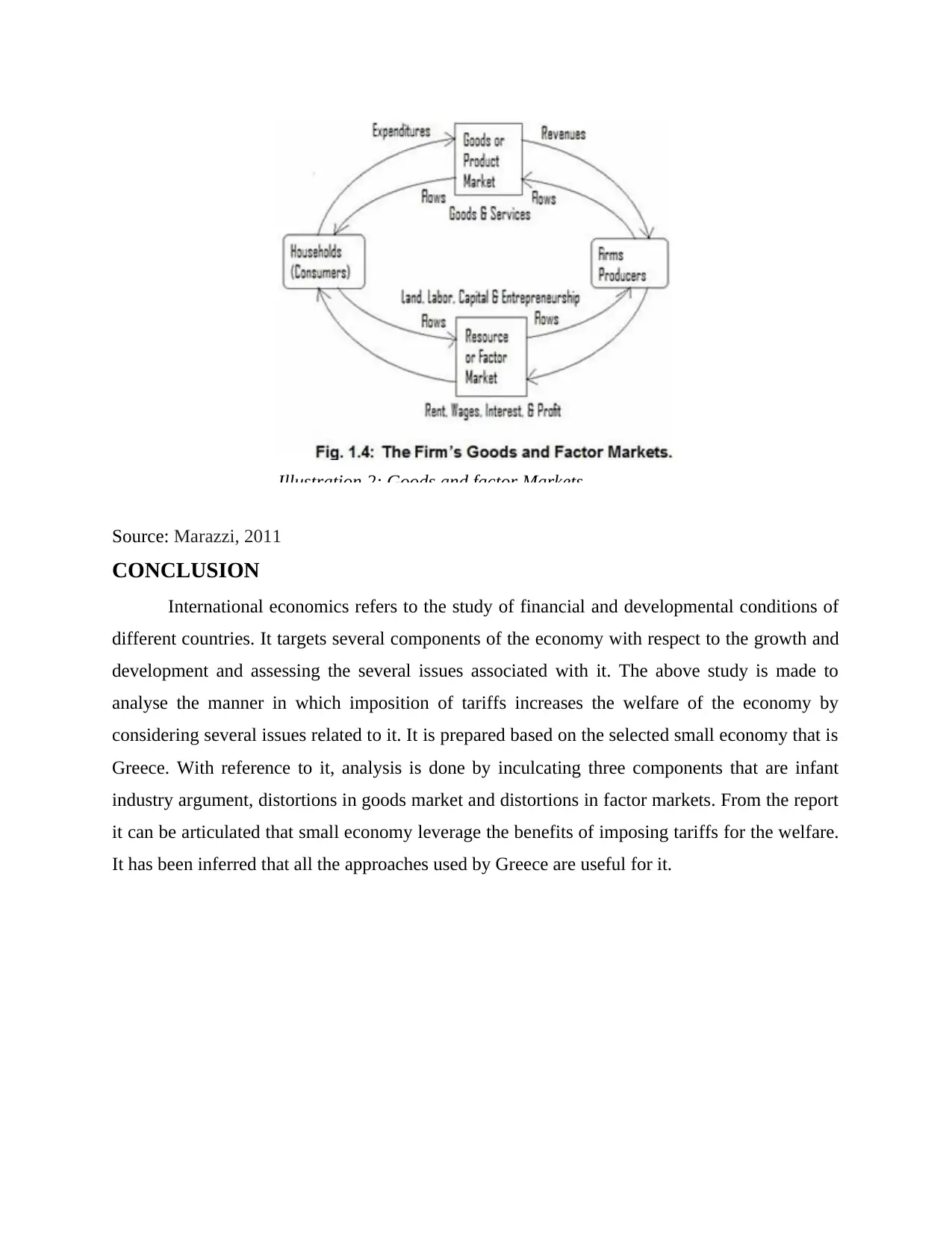
Source: Marazzi, 2011
CONCLUSION
International economics refers to the study of financial and developmental conditions of
different countries. It targets several components of the economy with respect to the growth and
development and assessing the several issues associated with it. The above study is made to
analyse the manner in which imposition of tariffs increases the welfare of the economy by
considering several issues related to it. It is prepared based on the selected small economy that is
Greece. With reference to it, analysis is done by inculcating three components that are infant
industry argument, distortions in goods market and distortions in factor markets. From the report
it can be articulated that small economy leverage the benefits of imposing tariffs for the welfare.
It has been inferred that all the approaches used by Greece are useful for it.
Illustration 2: Goods and factor Markets
CONCLUSION
International economics refers to the study of financial and developmental conditions of
different countries. It targets several components of the economy with respect to the growth and
development and assessing the several issues associated with it. The above study is made to
analyse the manner in which imposition of tariffs increases the welfare of the economy by
considering several issues related to it. It is prepared based on the selected small economy that is
Greece. With reference to it, analysis is done by inculcating three components that are infant
industry argument, distortions in goods market and distortions in factor markets. From the report
it can be articulated that small economy leverage the benefits of imposing tariffs for the welfare.
It has been inferred that all the approaches used by Greece are useful for it.
Illustration 2: Goods and factor Markets
⊘ This is a preview!⊘
Do you want full access?
Subscribe today to unlock all pages.
Trusted by 1+ million students worldwide
REFERENCES
Books and journals
Anderson, K., McRae, C.F. and Wilson, D.W. eds., 2012. The economics of quarantine and the
SPS agreement. University of Adelaide Press.
Bouvatier, V. and Lepetit, L., 2012. Effects of loan loss provisions on growth in bank lending:
some international comparisons. International Economics. 132. pp.91-116.
Capelle-Blancard, G. and Coulibaly, D., 2011. Index trading and agricultural commodity prices:
A panel Granger causality analysis. International Economics. 126. pp.51-71.
Card, D. and Krueger, A.B., 2015. Myth and measurement. Princeton University Pres.
Chor, D. and Manova, K., 2012. Off the cliff and back? Credit conditions and international trade
during the global financial crisis. Journal of international economics. 87(1). pp.117-133.
Crucini, M.J. And et.al., 2011. What are the driving forces of international business
cycles?. Review of Economic Dynamics. 14(1). pp.156-175.
Deardorff, A.V., 2014. Terms of trade: glossary of international economics. World Scientific.
Dunning, J.H., 2014. Economic analysis and multinational enterprise. Routledge.
Engel, C. and Wang, J., 2011. International trade in durable goods: Understanding volatility,
cyclicality, and elasticities. Journal of International Economics. 83(1). pp.37-52.
Eslava, M. and et.al., 2013. Trade and market selection: Evidence from manufacturing plants in
Colombia. Review of Economic Dynamics. 16(1). pp.135-158.
Gandolfo, G., 2013. International Economics II: International Monetary Theory and Open-
Economy Macroeconomics. Springer Science & Business Media.
Marazzi, C., 2011. The violence of financial capitalism. MIT Press Books, 1.
McMillan, J., 2013. Game theory in international economics. Taylor & francis.
Moran, T.H., 2012. Foreign Direct Investment. John Wiley & Sons, Ltd.
Oldenski, L., 2012. The task composition of offshoring by US multinationals.International
Economics. 131. pp.5-21.
Reinert, K.A., 2011. An introduction to international economics: new perspectives on the world
economy. Cambridge University Press.
Van Staveren, I. And et.al., 2012. The feminist economics of trade. Routledge.
Online
Books and journals
Anderson, K., McRae, C.F. and Wilson, D.W. eds., 2012. The economics of quarantine and the
SPS agreement. University of Adelaide Press.
Bouvatier, V. and Lepetit, L., 2012. Effects of loan loss provisions on growth in bank lending:
some international comparisons. International Economics. 132. pp.91-116.
Capelle-Blancard, G. and Coulibaly, D., 2011. Index trading and agricultural commodity prices:
A panel Granger causality analysis. International Economics. 126. pp.51-71.
Card, D. and Krueger, A.B., 2015. Myth and measurement. Princeton University Pres.
Chor, D. and Manova, K., 2012. Off the cliff and back? Credit conditions and international trade
during the global financial crisis. Journal of international economics. 87(1). pp.117-133.
Crucini, M.J. And et.al., 2011. What are the driving forces of international business
cycles?. Review of Economic Dynamics. 14(1). pp.156-175.
Deardorff, A.V., 2014. Terms of trade: glossary of international economics. World Scientific.
Dunning, J.H., 2014. Economic analysis and multinational enterprise. Routledge.
Engel, C. and Wang, J., 2011. International trade in durable goods: Understanding volatility,
cyclicality, and elasticities. Journal of International Economics. 83(1). pp.37-52.
Eslava, M. and et.al., 2013. Trade and market selection: Evidence from manufacturing plants in
Colombia. Review of Economic Dynamics. 16(1). pp.135-158.
Gandolfo, G., 2013. International Economics II: International Monetary Theory and Open-
Economy Macroeconomics. Springer Science & Business Media.
Marazzi, C., 2011. The violence of financial capitalism. MIT Press Books, 1.
McMillan, J., 2013. Game theory in international economics. Taylor & francis.
Moran, T.H., 2012. Foreign Direct Investment. John Wiley & Sons, Ltd.
Oldenski, L., 2012. The task composition of offshoring by US multinationals.International
Economics. 131. pp.5-21.
Reinert, K.A., 2011. An introduction to international economics: new perspectives on the world
economy. Cambridge University Press.
Van Staveren, I. And et.al., 2012. The feminist economics of trade. Routledge.
Online
Paraphrase This Document
Need a fresh take? Get an instant paraphrase of this document with our AI Paraphraser
Infant industry argument. 2016. [Online]. Available
through:<https://www.boundless.com/economics/textbooks/boundless-economics-
textbook/international-trade-31/arguments-for-and-against-protectionist-policy-128/
infant-industry-argument-505-12601/>. [Accessed on 22nd March 2016].
through:<https://www.boundless.com/economics/textbooks/boundless-economics-
textbook/international-trade-31/arguments-for-and-against-protectionist-policy-128/
infant-industry-argument-505-12601/>. [Accessed on 22nd March 2016].

1 out of 11


Related Documents


Your All-in-One AI-Powered Toolkit for Academic Success.
+13062052269
info@desklib.com
Available 24*7 on WhatsApp / Email
![[object Object]](/_next/static/media/star-bottom.7253800d.svg)
Unlock your academic potential
Copyright © 2020–2026 A2Z Services. All Rights Reserved. Developed and managed by ZUCOL.