International Economics Assignment: Global Trade and Policy Analysis
VerifiedAdded on 2022/11/25
|7
|1351
|408
Homework Assignment
AI Summary
This document provides comprehensive solutions to an International Economics assignment. The assignment delves into key concepts such as global trade, exploring its definition and the reasons countries engage in it. It examines factors influencing trade through the gravity model, analyzes the impact of changing trade compositions, and discusses intra-industry trade, including its popularity and strategies for market entry. Furthermore, the assignment covers trade policies, including dumping, import-substitution industrialization (ISI), and the infant industry argument, along with associated problems. The solution incorporates relevant economic models and theories, offering a detailed analysis of the questions posed in the assignment brief.
INTERNATIONAL ECONOMICS
International Economics
Paraphrase This Document
Need a fresh take? Get an instant paraphrase of this document with our AI Paraphraser

2
INTERNATIONAL ECONOMICS
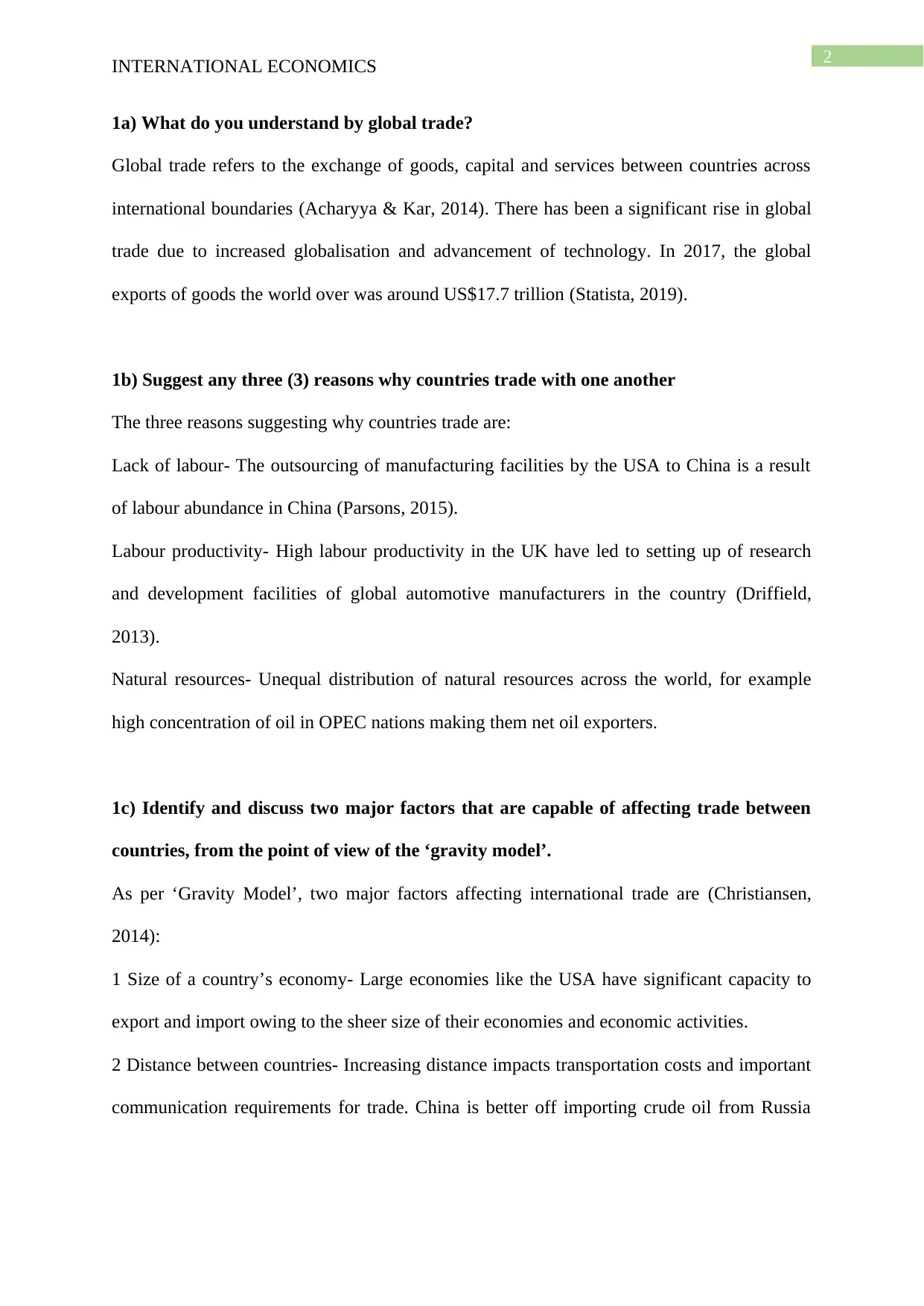
1a) What do you understand by global trade?
Global trade refers to the exchange of goods, capital and services between countries across
international boundaries (Acharyya & Kar, 2014). There has been a significant rise in global
trade due to increased globalisation and advancement of technology. In 2017, the global
exports of goods the world over was around US$17.7 trillion (Statista, 2019).
1b) Suggest any three (3) reasons why countries trade with one another
The three reasons suggesting why countries trade are:
Lack of labour- The outsourcing of manufacturing facilities by the USA to China is a result
of labour abundance in China (Parsons, 2015).
Labour productivity- High labour productivity in the UK have led to setting up of research
and development facilities of global automotive manufacturers in the country (Driffield,
2013).
Natural resources- Unequal distribution of natural resources across the world, for example
high concentration of oil in OPEC nations making them net oil exporters.
1c) Identify and discuss two major factors that are capable of affecting trade between
countries, from the point of view of the ‘gravity model’.
As per ‘Gravity Model’, two major factors affecting international trade are (Christiansen,
2014):
1 Size of a country’s economy- Large economies like the USA have significant capacity to
export and import owing to the sheer size of their economies and economic activities.
2 Distance between countries- Increasing distance impacts transportation costs and important
communication requirements for trade. China is better off importing crude oil from Russia
INTERNATIONAL ECONOMICS
1a) What do you understand by global trade?
Global trade refers to the exchange of goods, capital and services between countries across
international boundaries (Acharyya & Kar, 2014). There has been a significant rise in global
trade due to increased globalisation and advancement of technology. In 2017, the global
exports of goods the world over was around US$17.7 trillion (Statista, 2019).
1b) Suggest any three (3) reasons why countries trade with one another
The three reasons suggesting why countries trade are:
Lack of labour- The outsourcing of manufacturing facilities by the USA to China is a result
of labour abundance in China (Parsons, 2015).
Labour productivity- High labour productivity in the UK have led to setting up of research
and development facilities of global automotive manufacturers in the country (Driffield,
2013).
Natural resources- Unequal distribution of natural resources across the world, for example
high concentration of oil in OPEC nations making them net oil exporters.
1c) Identify and discuss two major factors that are capable of affecting trade between
countries, from the point of view of the ‘gravity model’.
As per ‘Gravity Model’, two major factors affecting international trade are (Christiansen,
2014):
1 Size of a country’s economy- Large economies like the USA have significant capacity to
export and import owing to the sheer size of their economies and economic activities.
2 Distance between countries- Increasing distance impacts transportation costs and important
communication requirements for trade. China is better off importing crude oil from Russia

3
INTERNATIONAL ECONOMICS
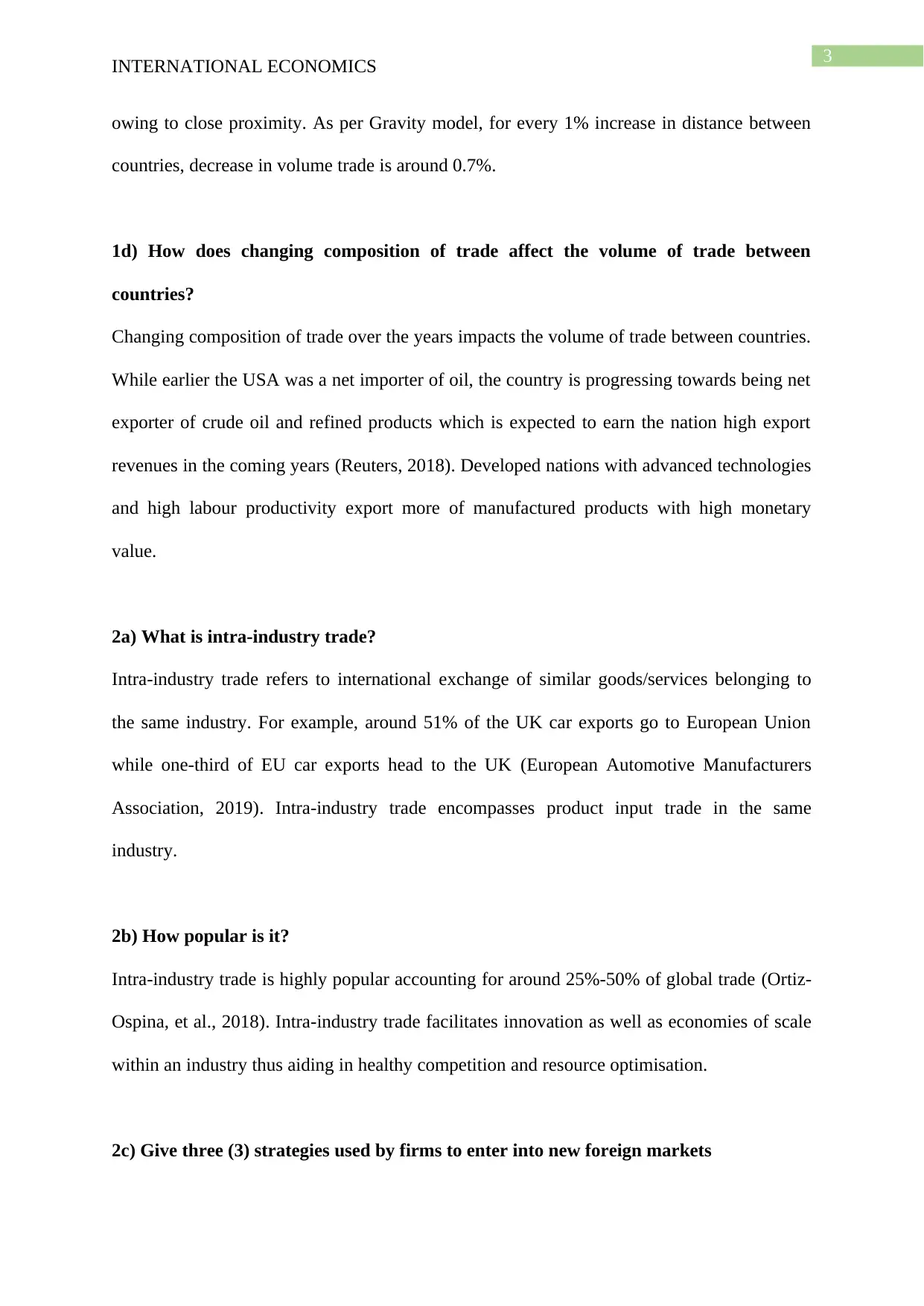
owing to close proximity. As per Gravity model, for every 1% increase in distance between
countries, decrease in volume trade is around 0.7%.
1d) How does changing composition of trade affect the volume of trade between
countries?
Changing composition of trade over the years impacts the volume of trade between countries.
While earlier the USA was a net importer of oil, the country is progressing towards being net
exporter of crude oil and refined products which is expected to earn the nation high export
revenues in the coming years (Reuters, 2018). Developed nations with advanced technologies
and high labour productivity export more of manufactured products with high monetary
value.
2a) What is intra-industry trade?
Intra-industry trade refers to international exchange of similar goods/services belonging to
the same industry. For example, around 51% of the UK car exports go to European Union
while one-third of EU car exports head to the UK (European Automotive Manufacturers
Association, 2019). Intra-industry trade encompasses product input trade in the same
industry.
2b) How popular is it?
Intra-industry trade is highly popular accounting for around 25%-50% of global trade (Ortiz-
Ospina, et al., 2018). Intra-industry trade facilitates innovation as well as economies of scale
within an industry thus aiding in healthy competition and resource optimisation.
2c) Give three (3) strategies used by firms to enter into new foreign markets
INTERNATIONAL ECONOMICS
owing to close proximity. As per Gravity model, for every 1% increase in distance between
countries, decrease in volume trade is around 0.7%.
1d) How does changing composition of trade affect the volume of trade between
countries?
Changing composition of trade over the years impacts the volume of trade between countries.
While earlier the USA was a net importer of oil, the country is progressing towards being net
exporter of crude oil and refined products which is expected to earn the nation high export
revenues in the coming years (Reuters, 2018). Developed nations with advanced technologies
and high labour productivity export more of manufactured products with high monetary
value.
2a) What is intra-industry trade?
Intra-industry trade refers to international exchange of similar goods/services belonging to
the same industry. For example, around 51% of the UK car exports go to European Union
while one-third of EU car exports head to the UK (European Automotive Manufacturers
Association, 2019). Intra-industry trade encompasses product input trade in the same
industry.
2b) How popular is it?
Intra-industry trade is highly popular accounting for around 25%-50% of global trade (Ortiz-
Ospina, et al., 2018). Intra-industry trade facilitates innovation as well as economies of scale
within an industry thus aiding in healthy competition and resource optimisation.
2c) Give three (3) strategies used by firms to enter into new foreign markets
⊘ This is a preview!⊘
Do you want full access?
Subscribe today to unlock all pages.

Trusted by 1+ million students worldwide

4
INTERNATIONAL ECONOMICS
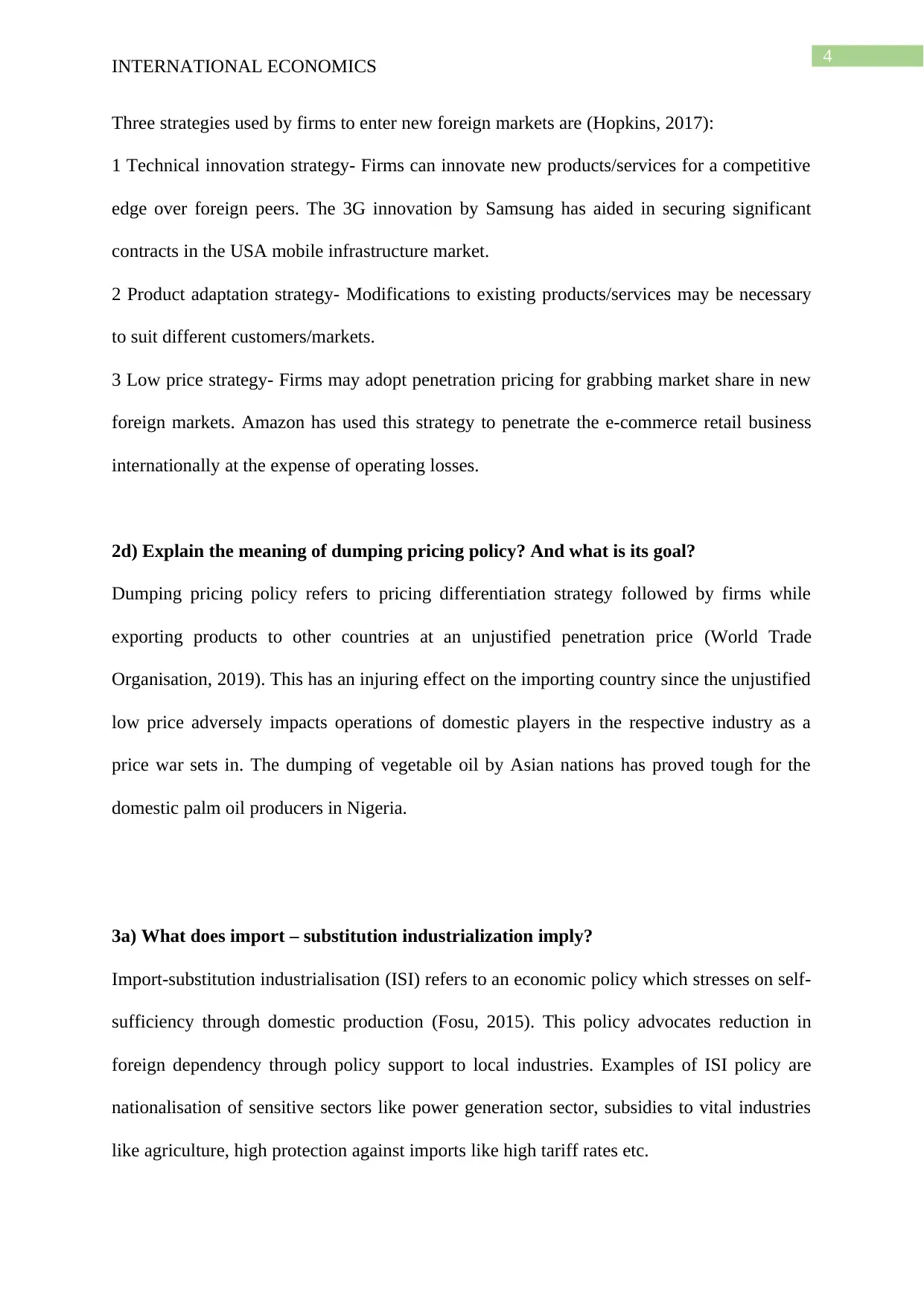
Three strategies used by firms to enter new foreign markets are (Hopkins, 2017):
1 Technical innovation strategy- Firms can innovate new products/services for a competitive
edge over foreign peers. The 3G innovation by Samsung has aided in securing significant
contracts in the USA mobile infrastructure market.
2 Product adaptation strategy- Modifications to existing products/services may be necessary
to suit different customers/markets.
3 Low price strategy- Firms may adopt penetration pricing for grabbing market share in new
foreign markets. Amazon has used this strategy to penetrate the e-commerce retail business
internationally at the expense of operating losses.
2d) Explain the meaning of dumping pricing policy? And what is its goal?
Dumping pricing policy refers to pricing differentiation strategy followed by firms while
exporting products to other countries at an unjustified penetration price (World Trade
Organisation, 2019). This has an injuring effect on the importing country since the unjustified
low price adversely impacts operations of domestic players in the respective industry as a
price war sets in. The dumping of vegetable oil by Asian nations has proved tough for the
domestic palm oil producers in Nigeria.
3a) What does import – substitution industrialization imply?
Import-substitution industrialisation (ISI) refers to an economic policy which stresses on self-
sufficiency through domestic production (Fosu, 2015). This policy advocates reduction in
foreign dependency through policy support to local industries. Examples of ISI policy are
nationalisation of sensitive sectors like power generation sector, subsidies to vital industries
like agriculture, high protection against imports like high tariff rates etc.
INTERNATIONAL ECONOMICS
Three strategies used by firms to enter new foreign markets are (Hopkins, 2017):
1 Technical innovation strategy- Firms can innovate new products/services for a competitive
edge over foreign peers. The 3G innovation by Samsung has aided in securing significant
contracts in the USA mobile infrastructure market.
2 Product adaptation strategy- Modifications to existing products/services may be necessary
to suit different customers/markets.
3 Low price strategy- Firms may adopt penetration pricing for grabbing market share in new
foreign markets. Amazon has used this strategy to penetrate the e-commerce retail business
internationally at the expense of operating losses.
2d) Explain the meaning of dumping pricing policy? And what is its goal?
Dumping pricing policy refers to pricing differentiation strategy followed by firms while
exporting products to other countries at an unjustified penetration price (World Trade
Organisation, 2019). This has an injuring effect on the importing country since the unjustified
low price adversely impacts operations of domestic players in the respective industry as a
price war sets in. The dumping of vegetable oil by Asian nations has proved tough for the
domestic palm oil producers in Nigeria.
3a) What does import – substitution industrialization imply?
Import-substitution industrialisation (ISI) refers to an economic policy which stresses on self-
sufficiency through domestic production (Fosu, 2015). This policy advocates reduction in
foreign dependency through policy support to local industries. Examples of ISI policy are
nationalisation of sensitive sectors like power generation sector, subsidies to vital industries
like agriculture, high protection against imports like high tariff rates etc.
Paraphrase This Document
Need a fresh take? Get an instant paraphrase of this document with our AI Paraphraser

5
INTERNATIONAL ECONOMICS
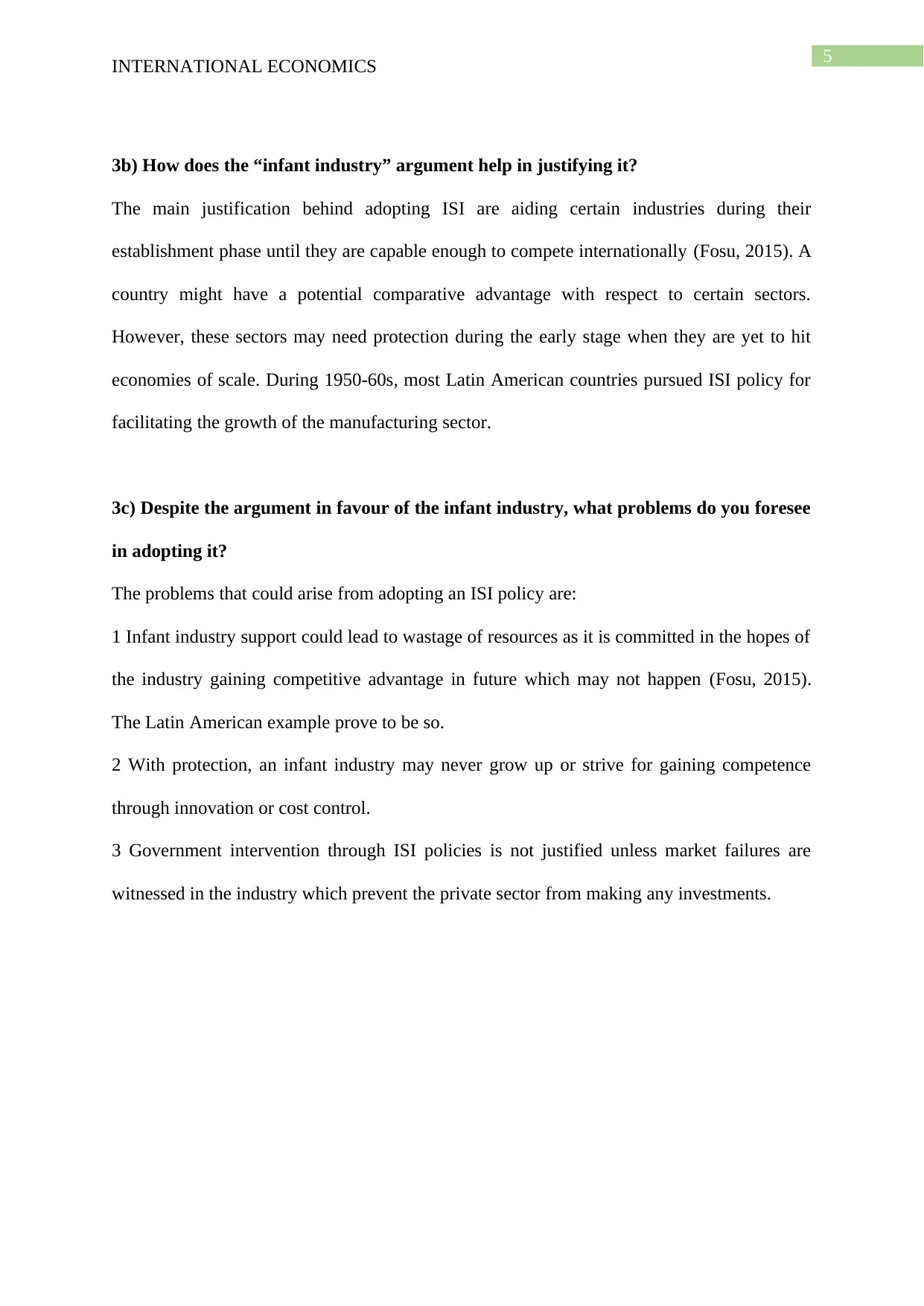
3b) How does the “infant industry” argument help in justifying it?
The main justification behind adopting ISI are aiding certain industries during their
establishment phase until they are capable enough to compete internationally (Fosu, 2015). A
country might have a potential comparative advantage with respect to certain sectors.
However, these sectors may need protection during the early stage when they are yet to hit
economies of scale. During 1950-60s, most Latin American countries pursued ISI policy for
facilitating the growth of the manufacturing sector.
3c) Despite the argument in favour of the infant industry, what problems do you foresee
in adopting it?
The problems that could arise from adopting an ISI policy are:
1 Infant industry support could lead to wastage of resources as it is committed in the hopes of
the industry gaining competitive advantage in future which may not happen (Fosu, 2015).
The Latin American example prove to be so.
2 With protection, an infant industry may never grow up or strive for gaining competence
through innovation or cost control.
3 Government intervention through ISI policies is not justified unless market failures are
witnessed in the industry which prevent the private sector from making any investments.
INTERNATIONAL ECONOMICS
3b) How does the “infant industry” argument help in justifying it?
The main justification behind adopting ISI are aiding certain industries during their
establishment phase until they are capable enough to compete internationally (Fosu, 2015). A
country might have a potential comparative advantage with respect to certain sectors.
However, these sectors may need protection during the early stage when they are yet to hit
economies of scale. During 1950-60s, most Latin American countries pursued ISI policy for
facilitating the growth of the manufacturing sector.
3c) Despite the argument in favour of the infant industry, what problems do you foresee
in adopting it?
The problems that could arise from adopting an ISI policy are:
1 Infant industry support could lead to wastage of resources as it is committed in the hopes of
the industry gaining competitive advantage in future which may not happen (Fosu, 2015).
The Latin American example prove to be so.
2 With protection, an infant industry may never grow up or strive for gaining competence
through innovation or cost control.
3 Government intervention through ISI policies is not justified unless market failures are
witnessed in the industry which prevent the private sector from making any investments.

6
INTERNATIONAL ECONOMICS
References
Acharyya, R. & Kar, S., 2014. International Trade and Economic Development. Oxford:
OUP Oxford.
Christiansen, B., 2014. Handbook of Research on Global Business Opportunities.
Pennsylvania: IGI Global.
Driffield, N., 2013. Global Competition and the Labour Market. Abingdon: Routledge.
European Automotive Manufacturers Association, 2019. Motor vehicle trade between the UK
and its main EU partners. [Online]
Available at: https://www.acea.be/statistics/article/motor-vehicle-trade-between-the-uk-and-
main-eu-partners
[Accessed 16th May 2019].
Fosu, A. K., 2015. Growth and Institutions in African Development. Abingdon: Routledge.
Hopkins, R. A., 2017. Grow Your Global Markets: A Handbook for Successful Market Entry.
New York: Apress.
Ortiz-Ospina, E., Beltekian, D. & Roser, M., 2018. Trade and Globalization. [Online]
Available at: https://ourworldindata.org/trade-and-globalization
[Accessed 16th May 2019].
Parsons, J. J., 2015. New Perspectives on Computer Concepts 2016, Comprehensive. Boston:
Cengage Learning.
Reuters, 2018. In major shift, U.S. now exports more oil than it ships in. [Online]
Available at: https://www.reuters.com/article/us-usa-oil-eia/in-major-shift-us-now-exports-
more-oil-than-it-ships-in-idUSKBN1O51X7
[Accessed 16th May 2019].
INTERNATIONAL ECONOMICS
References
Acharyya, R. & Kar, S., 2014. International Trade and Economic Development. Oxford:
OUP Oxford.
Christiansen, B., 2014. Handbook of Research on Global Business Opportunities.
Pennsylvania: IGI Global.
Driffield, N., 2013. Global Competition and the Labour Market. Abingdon: Routledge.
European Automotive Manufacturers Association, 2019. Motor vehicle trade between the UK
and its main EU partners. [Online]
Available at: https://www.acea.be/statistics/article/motor-vehicle-trade-between-the-uk-and-
main-eu-partners
[Accessed 16th May 2019].
Fosu, A. K., 2015. Growth and Institutions in African Development. Abingdon: Routledge.
Hopkins, R. A., 2017. Grow Your Global Markets: A Handbook for Successful Market Entry.
New York: Apress.
Ortiz-Ospina, E., Beltekian, D. & Roser, M., 2018. Trade and Globalization. [Online]
Available at: https://ourworldindata.org/trade-and-globalization
[Accessed 16th May 2019].
Parsons, J. J., 2015. New Perspectives on Computer Concepts 2016, Comprehensive. Boston:
Cengage Learning.
Reuters, 2018. In major shift, U.S. now exports more oil than it ships in. [Online]
Available at: https://www.reuters.com/article/us-usa-oil-eia/in-major-shift-us-now-exports-
more-oil-than-it-ships-in-idUSKBN1O51X7
[Accessed 16th May 2019].
⊘ This is a preview!⊘
Do you want full access?
Subscribe today to unlock all pages.

Trusted by 1+ million students worldwide

7
INTERNATIONAL ECONOMICS
Statista, 2019. Trends in global export volume of trade in goods from 1950 to 2017 (in billion
U.S. dollars). [Online]
Available at: https://www.statista.com/statistics/264682/worldwide-export-volume-in-the-
trade-since-1950/
[Accessed 16th May 2019].
World Trade Organisation, 2019. Technical Information on anti-dumping. [Online]
Available at: https://www.wto.org/english/tratop_e/adp_e/adp_info_e.htm
[Accessed 16th May 2019].
INTERNATIONAL ECONOMICS
Statista, 2019. Trends in global export volume of trade in goods from 1950 to 2017 (in billion
U.S. dollars). [Online]
Available at: https://www.statista.com/statistics/264682/worldwide-export-volume-in-the-
trade-since-1950/
[Accessed 16th May 2019].
World Trade Organisation, 2019. Technical Information on anti-dumping. [Online]
Available at: https://www.wto.org/english/tratop_e/adp_e/adp_info_e.htm
[Accessed 16th May 2019].
1 out of 7
Related Documents
Your All-in-One AI-Powered Toolkit for Academic Success.
+13062052269
info@desklib.com
Available 24*7 on WhatsApp / Email
Unlock your academic potential
Copyright © 2020–2026 A2Z Services. All Rights Reserved. Developed and managed by ZUCOL.