International Finance Report: Real Madrid's Global Strategy
VerifiedAdded on 2020/12/18
|12
|4009
|139
Report
AI Summary
This report provides a detailed analysis of Real Madrid C.F.'s international finance operations, focusing on the challenges and opportunities associated with its global expansion. The report examines the impact of standardized international accounting and reporting practices, particularly IFRS, on promoting and protecting stakeholder interests, including local authorities, sponsors, and shareholders. It identifies potential issues that multinational companies like Real Madrid face, such as reduced competitiveness, decreased investor returns, and problems with tax systems when different economies do not adopt the same accounting standards. The report also discusses the financial issues specific to Real Madrid, including government borrowing, cash flow management, and currency fluctuations, and outlines effective decisions the company can make to resolve these issues, such as using universally accepted payment methods and managing currency risks. Overall, the report offers insights into the complexities of international finance and its implications for a major global sports organization.
International Finance

Paraphrase This Document
Need a fresh take? Get an instant paraphrase of this document with our AI Paraphraser
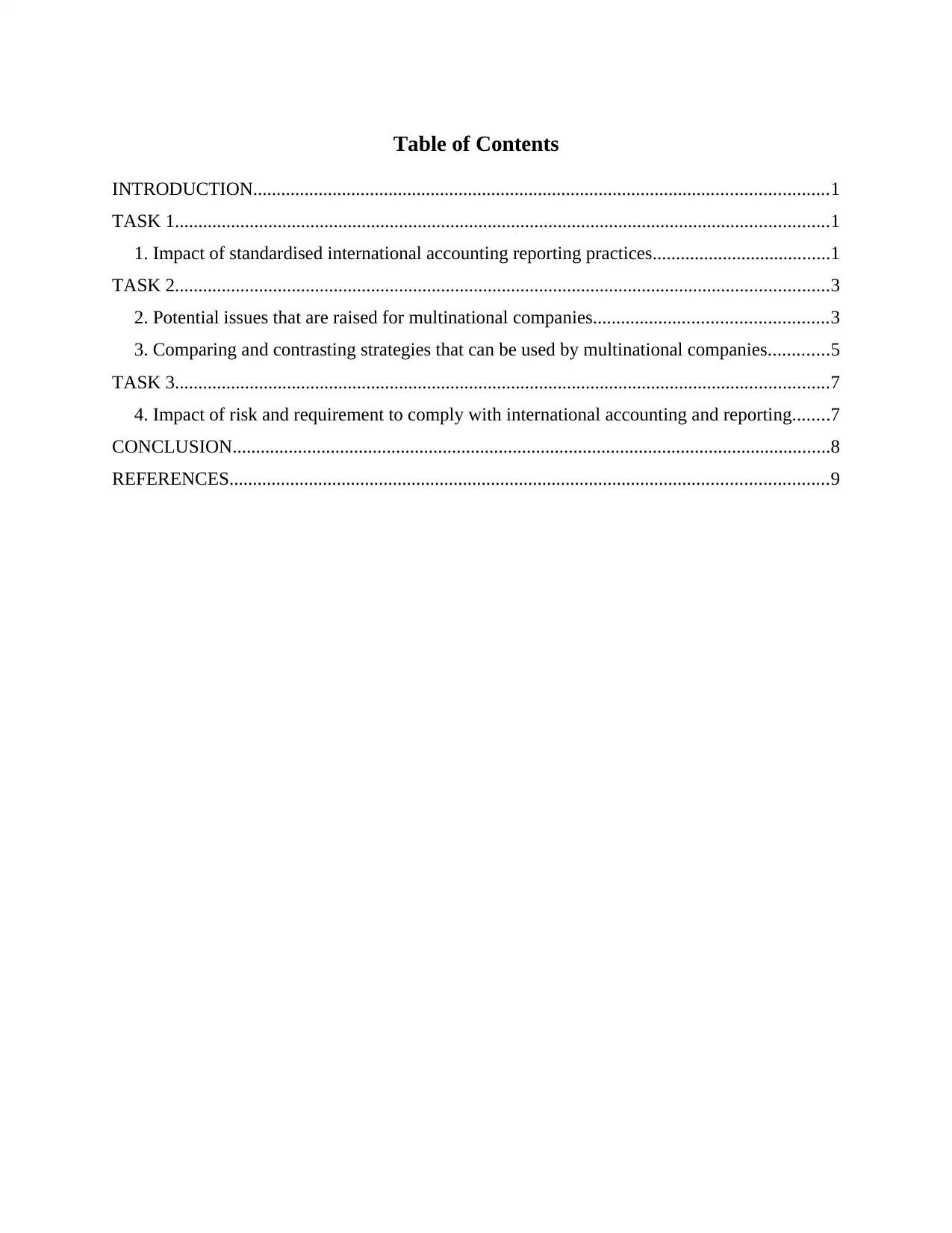
Table of Contents
INTRODUCTION...........................................................................................................................1
TASK 1............................................................................................................................................1
1. Impact of standardised international accounting reporting practices......................................1
TASK 2............................................................................................................................................3
2. Potential issues that are raised for multinational companies..................................................3
3. Comparing and contrasting strategies that can be used by multinational companies.............5
TASK 3............................................................................................................................................7
4. Impact of risk and requirement to comply with international accounting and reporting........7
CONCLUSION................................................................................................................................8
REFERENCES................................................................................................................................9
INTRODUCTION...........................................................................................................................1
TASK 1............................................................................................................................................1
1. Impact of standardised international accounting reporting practices......................................1
TASK 2............................................................................................................................................3
2. Potential issues that are raised for multinational companies..................................................3
3. Comparing and contrasting strategies that can be used by multinational companies.............5
TASK 3............................................................................................................................................7
4. Impact of risk and requirement to comply with international accounting and reporting........7
CONCLUSION................................................................................................................................8
REFERENCES................................................................................................................................9
INTRODUCTION
International finance is a broad term which is focused with the interrelation of monetary
resources and macro economics. IFC (International Financial Corporation) is an international
financial institution who publish principles, rules and regulations for the organisations to manage
their funds that are invested in international business. Under this various different activities are
performed by the organisations such as making investments in capital market, monitoring foreign
exchange rates and conducting trade practices in one or more countries (Abadie, Galarraga and
Rübbelke, 2013).
This project report is mainly based on the detailed study of international finance and its
uses. Company chosen for this report is Real Madrid C.F. which is a football club established in
Madrid, Spain. Recently Real Madrid is planing to execute business operation at global level . So
management of Football group has decided to expand their business in China Market. This is
because China have diversified economy and one of the most leading country in world that
have. Report shows the different problem faced by management of Real Madrid C.F and
different effective decision made to overcome these financial issues. Different topics have been
covered under this assignment that are impact of standardised international accounting and
reporting practices on promoting and protecting stakeholders interest etc. Potential issues that
may take place in market and affect multinational companies, comparing and contrasting various
strategies, an evaluation of impact of risk and requirement to comply with international
accounting and reporting standards have also been discussed in this report.
TASK 1
1. Impact of standardised international accounting reporting practices
International accounting and reporting: Both the terms are related to the reporting
system of financial transactions in financial statements as they are evaluated by stakeholders in
order to make strategic decision. Various types of standards and principles have been introduced
by regulatory authorities so that transparent final accounts can be formulated. For Real Madrid
C.F. it is very important to follow all the principles so that it can satisfy its stakeholders and gain
their trust by representing a transparent image of the organisation. IAS (International Accounting
Standards) and IFRS (International Financial Reporting Standards) are the standards that are
1
International finance is a broad term which is focused with the interrelation of monetary
resources and macro economics. IFC (International Financial Corporation) is an international
financial institution who publish principles, rules and regulations for the organisations to manage
their funds that are invested in international business. Under this various different activities are
performed by the organisations such as making investments in capital market, monitoring foreign
exchange rates and conducting trade practices in one or more countries (Abadie, Galarraga and
Rübbelke, 2013).
This project report is mainly based on the detailed study of international finance and its
uses. Company chosen for this report is Real Madrid C.F. which is a football club established in
Madrid, Spain. Recently Real Madrid is planing to execute business operation at global level . So
management of Football group has decided to expand their business in China Market. This is
because China have diversified economy and one of the most leading country in world that
have. Report shows the different problem faced by management of Real Madrid C.F and
different effective decision made to overcome these financial issues. Different topics have been
covered under this assignment that are impact of standardised international accounting and
reporting practices on promoting and protecting stakeholders interest etc. Potential issues that
may take place in market and affect multinational companies, comparing and contrasting various
strategies, an evaluation of impact of risk and requirement to comply with international
accounting and reporting standards have also been discussed in this report.
TASK 1
1. Impact of standardised international accounting reporting practices
International accounting and reporting: Both the terms are related to the reporting
system of financial transactions in financial statements as they are evaluated by stakeholders in
order to make strategic decision. Various types of standards and principles have been introduced
by regulatory authorities so that transparent final accounts can be formulated. For Real Madrid
C.F. it is very important to follow all the principles so that it can satisfy its stakeholders and gain
their trust by representing a transparent image of the organisation. IAS (International Accounting
Standards) and IFRS (International Financial Reporting Standards) are the standards that are
1
⊘ This is a preview!⊘
Do you want full access?
Subscribe today to unlock all pages.

Trusted by 1+ million students worldwide
imposed by IASC (International Accounting Standards Committee) and IASB (International
Accounting Standards Board) (Argy, 2013).
IAS: All the standards under IAS have been launched by IASC and all of them have been
introduced to guide organisations to conduct accounting practices in appropriate manner. These
were published in year 1973. Main objective of these standards is to enhance transparency in the
final accounts of the organisations so that their business can be executed successfully. When
come contradictions have taken place due to IAS than IASB lunched IFRS that are the modified
version of IAS (Armijo and Echeverri-Gent, 2014).
IFRS: All the standards were launched in year 2001 for the purpose of directing
organisations to appropriately formulate financial statements. Some of the selected IFRS are as
follows that should be followed by Real Madrid C.F.:
IFRS 1: It is related to first time adoption of financial reporting standards and it helps the
organisations to formulate all the financial statements appropriately. It set outs various
regulations and rules for the companies that are required to be followed at the time of recording.
IFRS 2: It is concerned with share based payments of an organisation. This standard
guide the companies to mention information about share based payments so that shareholders
can gather data of the returns or dividends that will are going to be received by them.
IFRS 9: This is based on the reporting of financial instruments that an organisation is
having in its balance sheet. According to this standard the companies should present appropriate
information of all the financial instruments that are used by the company in order to operate
business and increase its monetary resources.
IFRS 10: It is related to the consolidation of financial statements in which all the
financial information is recorded by the organisation. This standard guide the companies to form
their statements in consolidated form so that overall performance and profitability can be
measured. The parent company is responsible for the formulation of final accounts and measure
the financial strength.
All the above mentioned standards are followed by Real Madrid C.F. For the purpose of
providing appropriate information of business to its stakeholders. If the organisation is not able
to follow all the standards than it can create problems as it is a multinational company. It is not
possible for Real Madrid C.F. To implement reporting and accounting principles of all the
2
Accounting Standards Board) (Argy, 2013).
IAS: All the standards under IAS have been launched by IASC and all of them have been
introduced to guide organisations to conduct accounting practices in appropriate manner. These
were published in year 1973. Main objective of these standards is to enhance transparency in the
final accounts of the organisations so that their business can be executed successfully. When
come contradictions have taken place due to IAS than IASB lunched IFRS that are the modified
version of IAS (Armijo and Echeverri-Gent, 2014).
IFRS: All the standards were launched in year 2001 for the purpose of directing
organisations to appropriately formulate financial statements. Some of the selected IFRS are as
follows that should be followed by Real Madrid C.F.:
IFRS 1: It is related to first time adoption of financial reporting standards and it helps the
organisations to formulate all the financial statements appropriately. It set outs various
regulations and rules for the companies that are required to be followed at the time of recording.
IFRS 2: It is concerned with share based payments of an organisation. This standard
guide the companies to mention information about share based payments so that shareholders
can gather data of the returns or dividends that will are going to be received by them.
IFRS 9: This is based on the reporting of financial instruments that an organisation is
having in its balance sheet. According to this standard the companies should present appropriate
information of all the financial instruments that are used by the company in order to operate
business and increase its monetary resources.
IFRS 10: It is related to the consolidation of financial statements in which all the
financial information is recorded by the organisation. This standard guide the companies to form
their statements in consolidated form so that overall performance and profitability can be
measured. The parent company is responsible for the formulation of final accounts and measure
the financial strength.
All the above mentioned standards are followed by Real Madrid C.F. For the purpose of
providing appropriate information of business to its stakeholders. If the organisation is not able
to follow all the standards than it can create problems as it is a multinational company. It is not
possible for Real Madrid C.F. To implement reporting and accounting principles of all the
2
Paraphrase This Document
Need a fresh take? Get an instant paraphrase of this document with our AI Paraphraser
countries hence IFRS is the solution for this problem. It can help to record all the information
appropriately so that, stakeholders can analyse financial status of the company (Clarida, 2015).
Impact of standardised international accounting and reporting practices on
promoting and protecting stakeholders interest in an international market: IFRS and IAS
help to increase interest of stakeholders in an organisation. Real Madrid C.F. is implementing the
standards of IFRS that help to record appropriate information in the financial statements.
Standardised accounting and reporting is very beneficial for the organisation because it attracts
large number of investors by showing them a transparent image. Main stakeholders of Real
Madrid C.F. are local authorities, sponsors, shareholders etc. Impact of all the standards on the
promoting and protecting interest of stakeholders are as follows:
Local authorities: Real Madrid C.F. is using international standards to present
appropriate financial statements in front of local authorities so that it can be analysed that
organisation is not conducting any illegal activity and paying tax appropriately. They get
benefited when organisations help them to analyse actual position of the company by providing
actual information about all the business activities.
Sponsors: Sponsors are the persons who provide money to the organisation to operate
business and for them it is very important that companies should provide them higher returns on
their money so that they can increase their finance. Real Madrid C.F. is a multinational company
and it is essential for the organisation to attract foreign investment by attracting large number of
investors from different locations. IFRS are the international standards that can be adopted by
any country in order to attract sponsors by help them to analyse organisation's actual position
with the help of financial statements (Dunning, 2013).
Shareholders: The parties who invest money in a company to execute business are
called shareholders. They analyse actual performance of the o0rganisation and than make
investing decision. Shareholders of Real Madrid C.F. analyse financial strength of the
organisation and than invest their money in the company for the purpose of getting higher
dividend.
From all the above points it can be analysed that standardised international accounting
and reporting impact Real Madrid C.F. While protecting and promoting interest of stakeholders
by using IFRS as it is a tools that can be used by those companies who are operating business
globally (Gilpin, 2016).
3
appropriately so that, stakeholders can analyse financial status of the company (Clarida, 2015).
Impact of standardised international accounting and reporting practices on
promoting and protecting stakeholders interest in an international market: IFRS and IAS
help to increase interest of stakeholders in an organisation. Real Madrid C.F. is implementing the
standards of IFRS that help to record appropriate information in the financial statements.
Standardised accounting and reporting is very beneficial for the organisation because it attracts
large number of investors by showing them a transparent image. Main stakeholders of Real
Madrid C.F. are local authorities, sponsors, shareholders etc. Impact of all the standards on the
promoting and protecting interest of stakeholders are as follows:
Local authorities: Real Madrid C.F. is using international standards to present
appropriate financial statements in front of local authorities so that it can be analysed that
organisation is not conducting any illegal activity and paying tax appropriately. They get
benefited when organisations help them to analyse actual position of the company by providing
actual information about all the business activities.
Sponsors: Sponsors are the persons who provide money to the organisation to operate
business and for them it is very important that companies should provide them higher returns on
their money so that they can increase their finance. Real Madrid C.F. is a multinational company
and it is essential for the organisation to attract foreign investment by attracting large number of
investors from different locations. IFRS are the international standards that can be adopted by
any country in order to attract sponsors by help them to analyse organisation's actual position
with the help of financial statements (Dunning, 2013).
Shareholders: The parties who invest money in a company to execute business are
called shareholders. They analyse actual performance of the o0rganisation and than make
investing decision. Shareholders of Real Madrid C.F. analyse financial strength of the
organisation and than invest their money in the company for the purpose of getting higher
dividend.
From all the above points it can be analysed that standardised international accounting
and reporting impact Real Madrid C.F. While protecting and promoting interest of stakeholders
by using IFRS as it is a tools that can be used by those companies who are operating business
globally (Gilpin, 2016).
3
TASK 2
2. Potential issues that are raised for multinational companies
For all the multinational companies like Real Madrid C.F. to use such standards that can
be used internationally so that all type of stakeholders can analyse organisation's actual position.
For all the economies where a business is operated it is very important to follow same accounting
and reporting standards so that it can help to record all the appropriate information in financial
statements and also reduce the possibility of issues in the accounting system. All the issues that
are raised for multinational companies and other stakeholders when two economies do not adopt
same accounting and reporting standards are as follows:
Reduced competitiveness: When two different economies are not following same
accounting standards than it can affect the competitiveness of the multinational companies
because they will not be able to formulate their accounts and statements appropriately. As Real
Madrid C.F. is multinational company and the economy of the countries where it is executing its
business are not using same accounting and reporting system than it will result negatively for the
company. If financial statements are not formulated properly than can reduce the
competitiveness because actual; performance cannot be measured with inappropriate records
(Howarth, 2013).
Decreased rates of return for investors: Investors will have to suffer when two
economies do not use same accounting and reporting standards because they wont be able to get
the appropriate returns on their investments. If two different nations where Real Madrid C.F. Is
operating its executional activities are not using same system for reporting and accounting than it
is not possible to formulate all the statements accurately and the actual rate of return on investor
will also get affected due to this.
Decrement in profitability: As competitiveness of Real Madrid C.F. get decreased when
two economies do not use same accounting and reporting system and this will result in decreased
profitability for the company. If profitability get decreased then whole business get affected and
it will become more difficult for the organisation to execute business smoothly.
Problems in tax system: When two economies are not using same accounting and
reporting system than it will create problems in tax system of the company as it has to pay tax
according to the systems of two different countries. It will affect the overall profitability of the
organisation. It is very important for Real Madrid C.F. to have information of the accounting and
4
2. Potential issues that are raised for multinational companies
For all the multinational companies like Real Madrid C.F. to use such standards that can
be used internationally so that all type of stakeholders can analyse organisation's actual position.
For all the economies where a business is operated it is very important to follow same accounting
and reporting standards so that it can help to record all the appropriate information in financial
statements and also reduce the possibility of issues in the accounting system. All the issues that
are raised for multinational companies and other stakeholders when two economies do not adopt
same accounting and reporting standards are as follows:
Reduced competitiveness: When two different economies are not following same
accounting standards than it can affect the competitiveness of the multinational companies
because they will not be able to formulate their accounts and statements appropriately. As Real
Madrid C.F. is multinational company and the economy of the countries where it is executing its
business are not using same accounting and reporting system than it will result negatively for the
company. If financial statements are not formulated properly than can reduce the
competitiveness because actual; performance cannot be measured with inappropriate records
(Howarth, 2013).
Decreased rates of return for investors: Investors will have to suffer when two
economies do not use same accounting and reporting standards because they wont be able to get
the appropriate returns on their investments. If two different nations where Real Madrid C.F. Is
operating its executional activities are not using same system for reporting and accounting than it
is not possible to formulate all the statements accurately and the actual rate of return on investor
will also get affected due to this.
Decrement in profitability: As competitiveness of Real Madrid C.F. get decreased when
two economies do not use same accounting and reporting system and this will result in decreased
profitability for the company. If profitability get decreased then whole business get affected and
it will become more difficult for the organisation to execute business smoothly.
Problems in tax system: When two economies are not using same accounting and
reporting system than it will create problems in tax system of the company as it has to pay tax
according to the systems of two different countries. It will affect the overall profitability of the
organisation. It is very important for Real Madrid C.F. to have information of the accounting and
4
⊘ This is a preview!⊘
Do you want full access?
Subscribe today to unlock all pages.
Trusted by 1+ million students worldwide
reporting system so that it can formulate all its accounts and reports in an appropriate manner
and plan to deal with all the challenges that may occur in future (Masciandaro, 2017).
Not possible to formulate consolidated financial statements: If a company is
executing business all around the world than according to IFRS the organization have to
formulate all its statement in consolidated form so that overall profitability can be measured.
Real Madrid C.F. is operating business globally hence it is compulsory for the company to
formulate consolidated financial statements but when two economies are not implementing same
accounting and reporting standards than it is not possible to formulate the statements in
consolidated form.
Financial issues face by Real Madrid.
There are various types of international financial issues that are related with the company
after going into any foreign market for the purpose of expanding their business. Some of them
are mentioned below:
Government borrowing:This seems to be key issues facing in the nation of global
finance that is related with the rate at which government are borrowing or taking out loan to keep
the overall operation of the Real Madrid C.F.
Cash flow: It is basically related with the investment that they are going to be made after
entering into the market. Getting clients and customer to pay in a respective manner can keeps
their business more balance. But because of less inflow and outflows are taken into account for
Real Madrid C.F
Currency fluctuation: There are certain natural results of the floating exchange rate
system that is norm for most major economies. It is one of the impacts that can create maximum
burden on the operation of the real Madrid.
Effective decision taken to resolve issues.
To overcome the international financial issues Real Madrid Group should use those
payment methods which is acceptable universally and which ensure secure payment processing.
At the time of international business, currency fluctuation is considered as major issue so to
protect from this, company should pay to their suppliers and production cost in same currency in
which they are selling. As to maintain the cash flow, organisation can make budget for their
spendings so smooth cash flow can be maintained. The company should maintain their accounts
in compliance with international accounting so that any type of mismanagement can be avoided.
5
and plan to deal with all the challenges that may occur in future (Masciandaro, 2017).
Not possible to formulate consolidated financial statements: If a company is
executing business all around the world than according to IFRS the organization have to
formulate all its statement in consolidated form so that overall profitability can be measured.
Real Madrid C.F. is operating business globally hence it is compulsory for the company to
formulate consolidated financial statements but when two economies are not implementing same
accounting and reporting standards than it is not possible to formulate the statements in
consolidated form.
Financial issues face by Real Madrid.
There are various types of international financial issues that are related with the company
after going into any foreign market for the purpose of expanding their business. Some of them
are mentioned below:
Government borrowing:This seems to be key issues facing in the nation of global
finance that is related with the rate at which government are borrowing or taking out loan to keep
the overall operation of the Real Madrid C.F.
Cash flow: It is basically related with the investment that they are going to be made after
entering into the market. Getting clients and customer to pay in a respective manner can keeps
their business more balance. But because of less inflow and outflows are taken into account for
Real Madrid C.F
Currency fluctuation: There are certain natural results of the floating exchange rate
system that is norm for most major economies. It is one of the impacts that can create maximum
burden on the operation of the real Madrid.
Effective decision taken to resolve issues.
To overcome the international financial issues Real Madrid Group should use those
payment methods which is acceptable universally and which ensure secure payment processing.
At the time of international business, currency fluctuation is considered as major issue so to
protect from this, company should pay to their suppliers and production cost in same currency in
which they are selling. As to maintain the cash flow, organisation can make budget for their
spendings so smooth cash flow can be maintained. The company should maintain their accounts
in compliance with international accounting so that any type of mismanagement can be avoided.
5
Paraphrase This Document
Need a fresh take? Get an instant paraphrase of this document with our AI Paraphraser
From all the above mentioned points it can be analysed that if two economies are not
using same accounting and reporting standards than it will result in various issues for
multinational companies as well as the stakeholders of the company. When this problem occurs
it is not possible to generate financial statements with accurate information (Pavlova and
Rigobon, 2012).
3. Comparing and contrasting strategies that can be used by multinational companies
When various companies are operating business globally than it results in various risks
that can affect the profitability of the company. It is very important to implement appropriate
strategies or use financial instruments to limit the risks so that profits can be maximised. As Real
Madrid C.F. is a multinational company and have to face various issues when expanding
business in international market. Some of the selected issues are fluctuation in exchange rate,
country risk and diversification risks. Owner of top executives of Real Madrid C.F. can use
different types of financial instruments as strategies to reduce the risks and maximise the returns
of the shareholders.
Financial instruments: The assets that an organisation is having and if it can be traded
than it will be considered as a financial instrument. All of them help to maintain the effective
flow of cash and capital for a company so that all the operations can be executed in appropriate
manner (Financial Instruments, 2018). The instruments that can be used by Real Madrid C.F. in
order to ignore the risks that may take place in international market. All the instruments are as
follows:
Simple bonds: The bond that can be issued by Real Madrid C.F. In order to attain long
term debts and financing are the simple bonds. All of them are negotiable and the owner of the
bond is having the right of receiving interest on all the bonds on a fixed rate. It can help to deal
with the risks appropriately by having sufficient monetary resources.
Compound bonds: These bonds are same as simple bonds but the interest rate vary with
the profits of the organisation. If Real Madrid C.F. is having high profits than it can offer higher
rate of interest to the bond holder and if the company is not having good profits than there is no
compulsion to provide the fixed interest to the clients or the bond holder.
Convertible bonds: These are the bonds that can be converted from fixed to variable or
variable to fixed. These issues can be issued by Real Madrid C.F. In international market so that
customers can take more interest as they can convert the bonds whenever they want. These can
6
using same accounting and reporting standards than it will result in various issues for
multinational companies as well as the stakeholders of the company. When this problem occurs
it is not possible to generate financial statements with accurate information (Pavlova and
Rigobon, 2012).
3. Comparing and contrasting strategies that can be used by multinational companies
When various companies are operating business globally than it results in various risks
that can affect the profitability of the company. It is very important to implement appropriate
strategies or use financial instruments to limit the risks so that profits can be maximised. As Real
Madrid C.F. is a multinational company and have to face various issues when expanding
business in international market. Some of the selected issues are fluctuation in exchange rate,
country risk and diversification risks. Owner of top executives of Real Madrid C.F. can use
different types of financial instruments as strategies to reduce the risks and maximise the returns
of the shareholders.
Financial instruments: The assets that an organisation is having and if it can be traded
than it will be considered as a financial instrument. All of them help to maintain the effective
flow of cash and capital for a company so that all the operations can be executed in appropriate
manner (Financial Instruments, 2018). The instruments that can be used by Real Madrid C.F. in
order to ignore the risks that may take place in international market. All the instruments are as
follows:
Simple bonds: The bond that can be issued by Real Madrid C.F. In order to attain long
term debts and financing are the simple bonds. All of them are negotiable and the owner of the
bond is having the right of receiving interest on all the bonds on a fixed rate. It can help to deal
with the risks appropriately by having sufficient monetary resources.
Compound bonds: These bonds are same as simple bonds but the interest rate vary with
the profits of the organisation. If Real Madrid C.F. is having high profits than it can offer higher
rate of interest to the bond holder and if the company is not having good profits than there is no
compulsion to provide the fixed interest to the clients or the bond holder.
Convertible bonds: These are the bonds that can be converted from fixed to variable or
variable to fixed. These issues can be issued by Real Madrid C.F. In international market so that
customers can take more interest as they can convert the bonds whenever they want. These can
6
also be converted in the shares so it is a good opinion for the company to reduce the risks and
maximise the profits by increasing the funds (Smyth and et.al., 2015).
Profit participative bonds: These bonds are issued for the market in which a benefit is
provided to the buyer that a particular share of profit will be distributed. A fixed rate of interest
and share in profits will definitely attract large number of individuals to buy the bonds and than
lend money to the company so that they can work more productively and profit can be enhanced.
Equity loans: It remunerates the creditors of the company according to the profitability
which have been generated by the lending organisation. Such type of loans can be taken by Real
Madrid C.F. in order to operate business in more effective manner so that, risks that can take
place can be dealt effectively and profits can be maximised. The organisation may have to share
the decision making authority with the lender in this type of financial instrument.
Tracker certificates: This type of financial instrument can be issued by Real Madrid
C.F. as there is a variable rate of the interest which is set not on the profits of the company but on
the returns on the underlying assets that are used by the organisation to perform their activities.
PEC (Preferred equity certificates): It is a type of hybrid financial instrument which is
considered as a debt for the company in which interests are fixed for the buyer or holder of the
certificate.
CPEC (Convertible Preferred equity certificates): These are the the PECs that can be
converted in to shares and the return of this certificate depends upon the economy of the country
in which the business is executing (Shenkar, Luo and Chi, 2014).
All the above mentioned financial instruments can be used by Real Madrid C.F. in order
to minimise the risk and increase the profits as all of them can help to enhance the finance which
is required to operate business and enhance profitability.
TASK 3
4. Impact of risk and requirement to comply with international accounting and reporting
There are various market risks that can be faced by the organisation while operating
business in international market. The risks that may occur in future for an international football
business or the activities of Real Madrid C.F. are as follows:
Exchange rates: It is the rate that changes with the time and the fluctuations in the
economy of a country. As Real Madrid C.F. is a multinational company who is operating
7
maximise the profits by increasing the funds (Smyth and et.al., 2015).
Profit participative bonds: These bonds are issued for the market in which a benefit is
provided to the buyer that a particular share of profit will be distributed. A fixed rate of interest
and share in profits will definitely attract large number of individuals to buy the bonds and than
lend money to the company so that they can work more productively and profit can be enhanced.
Equity loans: It remunerates the creditors of the company according to the profitability
which have been generated by the lending organisation. Such type of loans can be taken by Real
Madrid C.F. in order to operate business in more effective manner so that, risks that can take
place can be dealt effectively and profits can be maximised. The organisation may have to share
the decision making authority with the lender in this type of financial instrument.
Tracker certificates: This type of financial instrument can be issued by Real Madrid
C.F. as there is a variable rate of the interest which is set not on the profits of the company but on
the returns on the underlying assets that are used by the organisation to perform their activities.
PEC (Preferred equity certificates): It is a type of hybrid financial instrument which is
considered as a debt for the company in which interests are fixed for the buyer or holder of the
certificate.
CPEC (Convertible Preferred equity certificates): These are the the PECs that can be
converted in to shares and the return of this certificate depends upon the economy of the country
in which the business is executing (Shenkar, Luo and Chi, 2014).
All the above mentioned financial instruments can be used by Real Madrid C.F. in order
to minimise the risk and increase the profits as all of them can help to enhance the finance which
is required to operate business and enhance profitability.
TASK 3
4. Impact of risk and requirement to comply with international accounting and reporting
There are various market risks that can be faced by the organisation while operating
business in international market. The risks that may occur in future for an international football
business or the activities of Real Madrid C.F. are as follows:
Exchange rates: It is the rate that changes with the time and the fluctuations in the
economy of a country. As Real Madrid C.F. is a multinational company who is operating
7
⊘ This is a preview!⊘
Do you want full access?
Subscribe today to unlock all pages.
Trusted by 1+ million students worldwide
business in various countries. If the economy and their inflation and deflation rates fluctuate
continuously than it will affect the profitability of the company because the fluctuations directly
affect the buying capacity of the customers. If the customers are not able to bear the cost of
tickets for the football match that are conducted by Real Madrid C.F. than it will affect the
overall profitability of the organisation and decrease the profits.
Country risk: It can be defined as the risk which is related to the investment which is
made by a person in another country and the government of that nation default the return on that
investment. Business is executed by Real Madrid C.F. in various countries and if this type of risk
occurs than it will directly affect overall capacity of the company to perform operational activity
because it will result in lack of financial resources.
Diversification risk: It is also called unsystematic risk which is related to a particular
industry not a market. It will affect the industry of Real Madrid C.F. not the market in which it is
operating business. When the company will face this risk than there is a possibility that
organisation will loose its market share.
All the above described risks will leave negative impact upon Real Madrid C.F. because
all of them are related to the business of the multinational companies and also result negatively.
They can reduce the profitability and productivity of the organisations because they directly
affect the financial market from where an organisation raise funds for the operations (Qiyue,
2013).
Financial reporting and accounting standards are required to be followed by all the
international football businesses like Real Madrid C.F. as they may help to conduct the financial
management activities effectively. They help to formulate all the financial statements in
consolidated form so that all the stakeholders can determine the overall profitability,
performance, productivity and financial strength. All the international standards help to generate
appropriate statements for the purpose of determining the rate of return on the investments that
are made by investors in order to attain higher returns on the money which was invested by them
in the company. It is also beneficial for the shareholders because they can also analyse that their
money is utilised appropriately or not.
CONCLUSION
From the above project report it has been concluded that international finance is mainly
focused with the international trade and other international transactions that are made by various
8
continuously than it will affect the profitability of the company because the fluctuations directly
affect the buying capacity of the customers. If the customers are not able to bear the cost of
tickets for the football match that are conducted by Real Madrid C.F. than it will affect the
overall profitability of the organisation and decrease the profits.
Country risk: It can be defined as the risk which is related to the investment which is
made by a person in another country and the government of that nation default the return on that
investment. Business is executed by Real Madrid C.F. in various countries and if this type of risk
occurs than it will directly affect overall capacity of the company to perform operational activity
because it will result in lack of financial resources.
Diversification risk: It is also called unsystematic risk which is related to a particular
industry not a market. It will affect the industry of Real Madrid C.F. not the market in which it is
operating business. When the company will face this risk than there is a possibility that
organisation will loose its market share.
All the above described risks will leave negative impact upon Real Madrid C.F. because
all of them are related to the business of the multinational companies and also result negatively.
They can reduce the profitability and productivity of the organisations because they directly
affect the financial market from where an organisation raise funds for the operations (Qiyue,
2013).
Financial reporting and accounting standards are required to be followed by all the
international football businesses like Real Madrid C.F. as they may help to conduct the financial
management activities effectively. They help to formulate all the financial statements in
consolidated form so that all the stakeholders can determine the overall profitability,
performance, productivity and financial strength. All the international standards help to generate
appropriate statements for the purpose of determining the rate of return on the investments that
are made by investors in order to attain higher returns on the money which was invested by them
in the company. It is also beneficial for the shareholders because they can also analyse that their
money is utilised appropriately or not.
CONCLUSION
From the above project report it has been concluded that international finance is mainly
focused with the international trade and other international transactions that are made by various
8
Paraphrase This Document
Need a fresh take? Get an instant paraphrase of this document with our AI Paraphraser
organisations to execute business. There are various different types of standards that are imposed
by legal authorities for the companies. All of them helps to formulate all the statements in
appropriate manner so that they can operate business in more effective manner. If organisations
who are operating their business globally are not able to implement international standards than
it can create issues for them like decreased interest on investors, reduced competitiveness. These
issues can be resolved when companies make strategies to implement international accounting
and reporting standards.
9
by legal authorities for the companies. All of them helps to formulate all the statements in
appropriate manner so that they can operate business in more effective manner. If organisations
who are operating their business globally are not able to implement international standards than
it can create issues for them like decreased interest on investors, reduced competitiveness. These
issues can be resolved when companies make strategies to implement international accounting
and reporting standards.
9
REFERENCES
Books and Journals:
Abadie, L. M., Galarraga, I. and Rübbelke, D., 2013. An analysis of the causes of the mitigation
bias in international climate finance. Mitigation and Adaptation Strategies for Global
Change. 18(7). pp.943-955.
Argy, V., 2013. The postwar international money crisis: an analysis. Routledge.
Armijo, L. E. and Echeverri-Gent, J., 2014. Brave new world? The politics of international
finance in Brazil and India. In The Financial Statecraft of Emerging Powers (pp. 47-
76). Palgrave Macmillan, London.
Clarida, R., 2015. The Fed is ready to raise rates: Will past be prologue?. International Finance.
18(1). pp.93-108.
Dunning, J. H., 2013. International Production and the Multinational Enterprise (RLE
International Business). Routledge.
Gilpin, R., 2016. The political economy of international relations. Princeton University Press.
Howarth, D., 2013. F rance and the International Financial Crisis: The Legacy of State‐Led
Finance. Governance. 26(3). pp.369-395.
Masciandaro, D. ed., 2017. Global financial crime: terrorism, money laundering and offshore
centres. Taylor & Francis.
Pavlova, A. and Rigobon, R., 2012. International macro-finance. In Handbook of Safeguarding
Global Financial Stability (pp. 169-176).
Qiyue, H. X. X., 2013. Research on Bank Capital Buffers, Credit Behaviors and Macro-
economic Fluctuations——Evidence from China's Banking Industry [J]. Studies of
International Finance. 1. p.007.
Shenkar, O., Luo, Y. and Chi, T., 2014. International business. Routledge.
Smyth, E. and et.al., 2015. Five ‘big’issues for land access, resettlement and livelihood
restoration practice: findings of an international symposium. Impact Assessment and
Project Appraisal. 33(3). pp.220-225.
Online
Financial Instruments. 2018. [Online]. Available through:
<https://www.creatrust.com/corporate-clients/hybrid-instrument/list-of-financial-
instruments>
10
Books and Journals:
Abadie, L. M., Galarraga, I. and Rübbelke, D., 2013. An analysis of the causes of the mitigation
bias in international climate finance. Mitigation and Adaptation Strategies for Global
Change. 18(7). pp.943-955.
Argy, V., 2013. The postwar international money crisis: an analysis. Routledge.
Armijo, L. E. and Echeverri-Gent, J., 2014. Brave new world? The politics of international
finance in Brazil and India. In The Financial Statecraft of Emerging Powers (pp. 47-
76). Palgrave Macmillan, London.
Clarida, R., 2015. The Fed is ready to raise rates: Will past be prologue?. International Finance.
18(1). pp.93-108.
Dunning, J. H., 2013. International Production and the Multinational Enterprise (RLE
International Business). Routledge.
Gilpin, R., 2016. The political economy of international relations. Princeton University Press.
Howarth, D., 2013. F rance and the International Financial Crisis: The Legacy of State‐Led
Finance. Governance. 26(3). pp.369-395.
Masciandaro, D. ed., 2017. Global financial crime: terrorism, money laundering and offshore
centres. Taylor & Francis.
Pavlova, A. and Rigobon, R., 2012. International macro-finance. In Handbook of Safeguarding
Global Financial Stability (pp. 169-176).
Qiyue, H. X. X., 2013. Research on Bank Capital Buffers, Credit Behaviors and Macro-
economic Fluctuations——Evidence from China's Banking Industry [J]. Studies of
International Finance. 1. p.007.
Shenkar, O., Luo, Y. and Chi, T., 2014. International business. Routledge.
Smyth, E. and et.al., 2015. Five ‘big’issues for land access, resettlement and livelihood
restoration practice: findings of an international symposium. Impact Assessment and
Project Appraisal. 33(3). pp.220-225.
Online
Financial Instruments. 2018. [Online]. Available through:
<https://www.creatrust.com/corporate-clients/hybrid-instrument/list-of-financial-
instruments>
10
⊘ This is a preview!⊘
Do you want full access?
Subscribe today to unlock all pages.
Trusted by 1+ million students worldwide

1 out of 12


Related Documents


Your All-in-One AI-Powered Toolkit for Academic Success.
+13062052269
info@desklib.com
Available 24*7 on WhatsApp / Email
![[object Object]](/_next/static/media/star-bottom.7253800d.svg)
Unlock your academic potential
Copyright © 2020–2026 A2Z Services. All Rights Reserved. Developed and managed by ZUCOL.