International Financial Markets: FX Strategy for Retail Expansion
VerifiedAdded on 2023/03/31
|12
|3041
|436
Report
AI Summary
This report assesses the financial management requirements for an Australian retailer expanding into China, focusing on the use of spot and forward markets in foreign exchange. It explains how retail outlets in China can utilize the spot market for immediate currency needs and the forward market to lock in prices and hedge against currency fluctuations. The report also discusses foreign exchange quotations, risks in operating a retail business in a foreign country (including political, exchange rate, interest rate, taxation, and customs risks), and transactional and translation exposures along with hedging methods. It provides insights into managing currency risks and ensuring profitability in international retail operations, with recommendations for the company's financial strategies.
IFM 1
Running Head: INTERNATIONAL FINANCIAL MARKET
International Financial Market
Running Head: INTERNATIONAL FINANCIAL MARKET
International Financial Market

Paraphrase This Document
Need a fresh take? Get an instant paraphrase of this document with our AI Paraphraser
IFM 2
Table of Contents
1) Spot Market in Foreign Exchange........................................................................................................3
2) Forward Market...................................................................................................................................3
3) Foreign Exchange quotation................................................................................................................4
4) Risks in retail business to operate in a country....................................................................................6
5) Transactional and Translation exposures and hedging methods..........................................................6
6) Alternatives with Chinese outlets to expand its operations................................................................8
References.................................................................................................................................................10
Table of Contents
1) Spot Market in Foreign Exchange........................................................................................................3
2) Forward Market...................................................................................................................................3
3) Foreign Exchange quotation................................................................................................................4
4) Risks in retail business to operate in a country....................................................................................6
5) Transactional and Translation exposures and hedging methods..........................................................6
6) Alternatives with Chinese outlets to expand its operations................................................................8
References.................................................................................................................................................10
IFM 3
1) Spot Market in Foreign Exchange
A sport transaction associated to foreign exchange describes as a legal contract between the two
or more individuals for purchase the cash or money in country’s currency against selling other
money a concurred rate for repayment on the particular date. The rates associated to foreign
exchange on a specific transaction and that called as spot swapping scale. The Foreign trade
market enables monetary standards to be traded so as to encourage global exchange or money
related exchanges. A spot foreign exchange rate demonstrates as rates of contract for overseas
exchange for quick conveyance like in two days. It denotes to the value that a purchaser hopes to
pay for remote money in cash (Arnold, 2012). These agreements are utilized by the organization
for prompt necessities to buy the material or installment to the vendors and also different parties.
Business banks help to the individuals by offering financial intermediaries in the market.
The main operations of the commercial banks are associated to exchanges in terms of currencies
in the blemish market and also in the future time as well as all the information and data
associated to the exchange are mentioned in the forwarding contract. It is necessary for the
retailers of Australia to purchase the foreign currencies because they want to reimburse for
imports as well as pass on the income to its parent business organization in the Melbourne,
Australia. Spot foreign exchange minimizes the risk of prices of products and services bought by
the Australian firm bought from foreign markets in China. Spot market helps the company to
protect the margin related to profits which earn on selling the products and services in
international market. China can use this instrument namely spot market at an agreed price to
purchase the material that helps the retailers to maintain its profits and mitigates the risk of high
prices on products bought through international markets. In the market, purchasers and also
sellers make decision and set the values according to their own by posting the orders (Brigham
and Houston, 2012). An Australian based retail stores in China requires the different monetary
standards to purchase products and services from different nations and after purchasing the
product again need to convert the money into different monetary standards in the blemish market
to buy these items and furthermore utilize the spot markets to change over abundance profit
named in (RMB) into Australian Dollars (AUD) that would be dispatched to the Australian
parent buiness organization located in Melbourne.
1) Spot Market in Foreign Exchange
A sport transaction associated to foreign exchange describes as a legal contract between the two
or more individuals for purchase the cash or money in country’s currency against selling other
money a concurred rate for repayment on the particular date. The rates associated to foreign
exchange on a specific transaction and that called as spot swapping scale. The Foreign trade
market enables monetary standards to be traded so as to encourage global exchange or money
related exchanges. A spot foreign exchange rate demonstrates as rates of contract for overseas
exchange for quick conveyance like in two days. It denotes to the value that a purchaser hopes to
pay for remote money in cash (Arnold, 2012). These agreements are utilized by the organization
for prompt necessities to buy the material or installment to the vendors and also different parties.
Business banks help to the individuals by offering financial intermediaries in the market.
The main operations of the commercial banks are associated to exchanges in terms of currencies
in the blemish market and also in the future time as well as all the information and data
associated to the exchange are mentioned in the forwarding contract. It is necessary for the
retailers of Australia to purchase the foreign currencies because they want to reimburse for
imports as well as pass on the income to its parent business organization in the Melbourne,
Australia. Spot foreign exchange minimizes the risk of prices of products and services bought by
the Australian firm bought from foreign markets in China. Spot market helps the company to
protect the margin related to profits which earn on selling the products and services in
international market. China can use this instrument namely spot market at an agreed price to
purchase the material that helps the retailers to maintain its profits and mitigates the risk of high
prices on products bought through international markets. In the market, purchasers and also
sellers make decision and set the values according to their own by posting the orders (Brigham
and Houston, 2012). An Australian based retail stores in China requires the different monetary
standards to purchase products and services from different nations and after purchasing the
product again need to convert the money into different monetary standards in the blemish market
to buy these items and furthermore utilize the spot markets to change over abundance profit
named in (RMB) into Australian Dollars (AUD) that would be dispatched to the Australian
parent buiness organization located in Melbourne.
⊘ This is a preview!⊘
Do you want full access?
Subscribe today to unlock all pages.

Trusted by 1+ million students worldwide
IFM 4
2) Forward Market
The forward market describes as a contradict marketplace because it helps in making decisions
on the values of instruments which are useful in the financial market in future. This type of
market is adopted by the business organization who wants to do trade in different financial
apparatus and utensils but the expression is specifically sued for the foreign exchange market.
Similarly, future contract also have unique characteristics as this contract include the size as well
as maturity date of the contract. This is helpful in the forward market as this contract is made
between the banks and the consumers and all the decisions as well as necessary details related to
the foreign exchange transactions or values are included in future contract. The Chinese forms
can use the forward contracts to lock the prices at specified currency rate to avoid any currency
fluctuations in an international market that can directly influence the prices of the products and
services bought by China for its retail stores. In this condition, the Chinese company can use the
forward contracts for immediate payments like in two or three days so that the company. In this
scenario, the retail company can use this hedging instrument to minimize the risk arise in the
future regarding high prices paid to products for import of goods from different countries in
different currencies. For example, the company needs not to pay high currency and pay for them
in another currency i.e. AUD and US Dollar (Burtonshaw-Gunn, 2017). The main benefit of the
forward contracts to the retailers is the customized agreement that helps the retailers to agree on
any amount or term that helps them to protect the price rise of inventory in the long run. These
are the over the counter products and easy to understand by both the parties as compared to
future contracts. Future contracts are also similar to forwarding contracts but it is not traded
officially on a specific exchange of overseas market. The foreign exchange markets are volatile
so that it is important for the retailers to buy these instruments to avoid any risk in the future that
will impact the profitability and revenue of the company. In this case, the Chinese retailers can
purchase the local currencies if they are anticipated that the decline of currency related to the
suppliers or subsidiaries in future so that they can use this currency for future use (Chi-Chi and
Ebimobowei, 2012).
3) Foreign Exchange quotation
Currencies are fluctuating in international markets due to strong demand and supply of the
products into the country or other foreign countries. A currency deal that would allow the
2) Forward Market
The forward market describes as a contradict marketplace because it helps in making decisions
on the values of instruments which are useful in the financial market in future. This type of
market is adopted by the business organization who wants to do trade in different financial
apparatus and utensils but the expression is specifically sued for the foreign exchange market.
Similarly, future contract also have unique characteristics as this contract include the size as well
as maturity date of the contract. This is helpful in the forward market as this contract is made
between the banks and the consumers and all the decisions as well as necessary details related to
the foreign exchange transactions or values are included in future contract. The Chinese forms
can use the forward contracts to lock the prices at specified currency rate to avoid any currency
fluctuations in an international market that can directly influence the prices of the products and
services bought by China for its retail stores. In this condition, the Chinese company can use the
forward contracts for immediate payments like in two or three days so that the company. In this
scenario, the retail company can use this hedging instrument to minimize the risk arise in the
future regarding high prices paid to products for import of goods from different countries in
different currencies. For example, the company needs not to pay high currency and pay for them
in another currency i.e. AUD and US Dollar (Burtonshaw-Gunn, 2017). The main benefit of the
forward contracts to the retailers is the customized agreement that helps the retailers to agree on
any amount or term that helps them to protect the price rise of inventory in the long run. These
are the over the counter products and easy to understand by both the parties as compared to
future contracts. Future contracts are also similar to forwarding contracts but it is not traded
officially on a specific exchange of overseas market. The foreign exchange markets are volatile
so that it is important for the retailers to buy these instruments to avoid any risk in the future that
will impact the profitability and revenue of the company. In this case, the Chinese retailers can
purchase the local currencies if they are anticipated that the decline of currency related to the
suppliers or subsidiaries in future so that they can use this currency for future use (Chi-Chi and
Ebimobowei, 2012).
3) Foreign Exchange quotation
Currencies are fluctuating in international markets due to strong demand and supply of the
products into the country or other foreign countries. A currency deal that would allow the
Paraphrase This Document
Need a fresh take? Get an instant paraphrase of this document with our AI Paraphraser
IFM 5
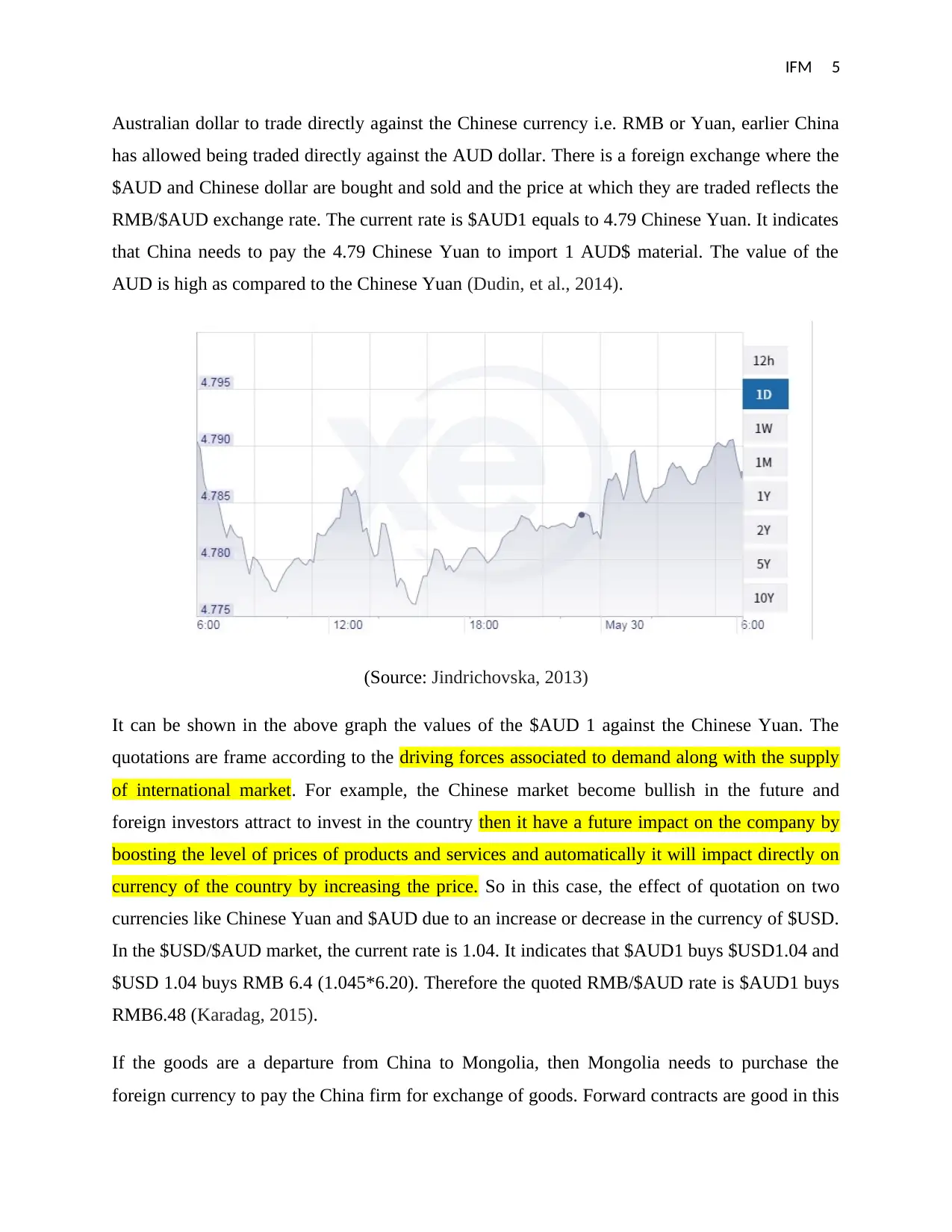
Australian dollar to trade directly against the Chinese currency i.e. RMB or Yuan, earlier China
has allowed being traded directly against the AUD dollar. There is a foreign exchange where the
$AUD and Chinese dollar are bought and sold and the price at which they are traded reflects the
RMB/$AUD exchange rate. The current rate is $AUD1 equals to 4.79 Chinese Yuan. It indicates
that China needs to pay the 4.79 Chinese Yuan to import 1 AUD$ material. The value of the
AUD is high as compared to the Chinese Yuan (Dudin, et al., 2014).
(Source: Jindrichovska, 2013)
It can be shown in the above graph the values of the $AUD 1 against the Chinese Yuan. The
quotations are frame according to the driving forces associated to demand along with the supply
of international market. For example, the Chinese market become bullish in the future and
foreign investors attract to invest in the country then it have a future impact on the company by
boosting the level of prices of products and services and automatically it will impact directly on
currency of the country by increasing the price. So in this case, the effect of quotation on two
currencies like Chinese Yuan and $AUD due to an increase or decrease in the currency of $USD.
In the $USD/$AUD market, the current rate is 1.04. It indicates that $AUD1 buys $USD1.04 and
$USD 1.04 buys RMB 6.4 (1.045*6.20). Therefore the quoted RMB/$AUD rate is $AUD1 buys
RMB6.48 (Karadag, 2015).
If the goods are a departure from China to Mongolia, then Mongolia needs to purchase the
foreign currency to pay the China firm for exchange of goods. Forward contracts are good in this
Australian dollar to trade directly against the Chinese currency i.e. RMB or Yuan, earlier China
has allowed being traded directly against the AUD dollar. There is a foreign exchange where the
$AUD and Chinese dollar are bought and sold and the price at which they are traded reflects the
RMB/$AUD exchange rate. The current rate is $AUD1 equals to 4.79 Chinese Yuan. It indicates
that China needs to pay the 4.79 Chinese Yuan to import 1 AUD$ material. The value of the
AUD is high as compared to the Chinese Yuan (Dudin, et al., 2014).
(Source: Jindrichovska, 2013)
It can be shown in the above graph the values of the $AUD 1 against the Chinese Yuan. The
quotations are frame according to the driving forces associated to demand along with the supply
of international market. For example, the Chinese market become bullish in the future and
foreign investors attract to invest in the country then it have a future impact on the company by
boosting the level of prices of products and services and automatically it will impact directly on
currency of the country by increasing the price. So in this case, the effect of quotation on two
currencies like Chinese Yuan and $AUD due to an increase or decrease in the currency of $USD.
In the $USD/$AUD market, the current rate is 1.04. It indicates that $AUD1 buys $USD1.04 and
$USD 1.04 buys RMB 6.4 (1.045*6.20). Therefore the quoted RMB/$AUD rate is $AUD1 buys
RMB6.48 (Karadag, 2015).
If the goods are a departure from China to Mongolia, then Mongolia needs to purchase the
foreign currency to pay the China firm for exchange of goods. Forward contracts are good in this
IFM 6
case if the goods are directly come from China to Mongolia then the Mongolian Tugriks needs to
pay in Yuan. In this situation, the role of foreign exchange is important to pay the number of
products in different currencies. Currently, the value of the 1 Chinese Yuan (CNY) equals to
382.97 Mongolian Tugriks (MNT). So, in this case, the Mongolians need to pay more amount to
buy 1CNY value material that will be high in future so the role of the foreign exchange and its
financial instruments namely forward or future contracts helps the Mongolian to pay the high
prices to pay for the material.
4) Risks in retail business to operate in a country
There are different types of risks for the business to operate in a different country. In the context
of the Melbourne retail business, there are major key important risks that need to be assessed by
the management to operate in the foreign country (Martin, 2016). It includes political risks,
exchange rate risks, interest rate risks and taxations and customs risks. Political risks refer that
the unstable government and strict money regulations affect the operations of the business. In
China the government is stable and the regulations regarding international transactions are not
strict so it less affects the retail store's operations in the business. Similarly, exchange rates
fluctuations can influence the business like the purchase of material at high prices leads to losses
or impact on profitability margins of the retail stores. When the currency in which you calculate
costs is different from that the revenue is received by the business. The differences in accounts
payables and receivables impact by the fluctuations in currency exchange value that impact the
overall profitability of the business. For example, currently, the value of 1CNY equals 0.21
$AUD. If the retailer agrees to purchase the material of 24000CNY material from Australia then
the value of the AUD was 0.21 $AUD against 1CNY in three to four days but suddenly after four
days if the value of the AUD would appreciate from 0.21 to 0.25 $AUD then it will be loss for
the business enterprise because they making the payments of their purchase material on a high
rate and it impacts on the profitability of the company. Lastly, taxation and customs laws are also
the risks for the business to increase its costs in the country when entering into the different ports
and sources (Matthew, 2017). So these are the important risks that need to be analyzed by the
management to operate the business into a different country. So these are the important risks that
exist in China that affect the retail business. Apart from that the major risks involved in the retail
business regarding the social and cultural risks that also impact the product demand (Pandey,
case if the goods are directly come from China to Mongolia then the Mongolian Tugriks needs to
pay in Yuan. In this situation, the role of foreign exchange is important to pay the number of
products in different currencies. Currently, the value of the 1 Chinese Yuan (CNY) equals to
382.97 Mongolian Tugriks (MNT). So, in this case, the Mongolians need to pay more amount to
buy 1CNY value material that will be high in future so the role of the foreign exchange and its
financial instruments namely forward or future contracts helps the Mongolian to pay the high
prices to pay for the material.
4) Risks in retail business to operate in a country
There are different types of risks for the business to operate in a different country. In the context
of the Melbourne retail business, there are major key important risks that need to be assessed by
the management to operate in the foreign country (Martin, 2016). It includes political risks,
exchange rate risks, interest rate risks and taxations and customs risks. Political risks refer that
the unstable government and strict money regulations affect the operations of the business. In
China the government is stable and the regulations regarding international transactions are not
strict so it less affects the retail store's operations in the business. Similarly, exchange rates
fluctuations can influence the business like the purchase of material at high prices leads to losses
or impact on profitability margins of the retail stores. When the currency in which you calculate
costs is different from that the revenue is received by the business. The differences in accounts
payables and receivables impact by the fluctuations in currency exchange value that impact the
overall profitability of the business. For example, currently, the value of 1CNY equals 0.21
$AUD. If the retailer agrees to purchase the material of 24000CNY material from Australia then
the value of the AUD was 0.21 $AUD against 1CNY in three to four days but suddenly after four
days if the value of the AUD would appreciate from 0.21 to 0.25 $AUD then it will be loss for
the business enterprise because they making the payments of their purchase material on a high
rate and it impacts on the profitability of the company. Lastly, taxation and customs laws are also
the risks for the business to increase its costs in the country when entering into the different ports
and sources (Matthew, 2017). So these are the important risks that need to be analyzed by the
management to operate the business into a different country. So these are the important risks that
exist in China that affect the retail business. Apart from that the major risks involved in the retail
business regarding the social and cultural risks that also impact the product demand (Pandey,
⊘ This is a preview!⊘
Do you want full access?
Subscribe today to unlock all pages.
Trusted by 1+ million students worldwide
IFM 7
2015). If the people of China not like the specific product taste and services then it will become
difficult for the country to survive in the long run.
5) Transactional and Translation exposures and hedging methods
Transactional risks refer that the transactions generate from the foreign exchange cash flows.
In transactional exposures, two different countries involved in transactions with different
currency rates that affect the overall profitability and budgeting of the company. For
example, in the case of China, the company purchases the material or inventory from
Australia for the operations so in this case, the supplier has an exposure to the RMB/AUD
cross rate. In this situation, the business will likely to create a forecast for this cash flow
during the entire process and compute the potential exposure in RMB during the budget rate.
The exposures like on currencies due to change in the value of the currency at the time of
order lock and final payment to the vendor (Parker, 2012). In between this period the
uncertainty of the values of the currencies is the biggest transactional exposure for the
companies.
Similarly, Translation risk refers that the business has the cash or assets in a foreign currency
and needs to be revalued in the business base currency for its subsidiary company and in
doing so the changes will affect the equity of the business. For example, Chinese retail
outlets have the cash in AUD and need to revalued for the business but the subsidiary
company currency i.e. AUD affects the business base currency i.e. RMB that leads to
influence the base currency of the company and that leads to change in equity.
The company can hedge risks through various financial instruments like investments,
currency swaps, forwards contracts or other hedging techniques. The company can use any of
these techniques to fix the value of the foreign subsidiary assets and liabilities to protect
against potential exchange rate fluctuations. For example, the current interest rates of the
Chinese banks and Australian banks are 4.5% and 1.5%. There is a great variation in the
interest rates of the countries which indicates that the Chinese retailers need to use
investment strategy or to invest in the different country’s assets to generate the good returns
so that the variations in the currency cannot impact the balance sheet of the company
(Perlman, et al., 2012). Similarly, currency swaps are also beneficial for the company which
2015). If the people of China not like the specific product taste and services then it will become
difficult for the country to survive in the long run.
5) Transactional and Translation exposures and hedging methods
Transactional risks refer that the transactions generate from the foreign exchange cash flows.
In transactional exposures, two different countries involved in transactions with different
currency rates that affect the overall profitability and budgeting of the company. For
example, in the case of China, the company purchases the material or inventory from
Australia for the operations so in this case, the supplier has an exposure to the RMB/AUD
cross rate. In this situation, the business will likely to create a forecast for this cash flow
during the entire process and compute the potential exposure in RMB during the budget rate.
The exposures like on currencies due to change in the value of the currency at the time of
order lock and final payment to the vendor (Parker, 2012). In between this period the
uncertainty of the values of the currencies is the biggest transactional exposure for the
companies.
Similarly, Translation risk refers that the business has the cash or assets in a foreign currency
and needs to be revalued in the business base currency for its subsidiary company and in
doing so the changes will affect the equity of the business. For example, Chinese retail
outlets have the cash in AUD and need to revalued for the business but the subsidiary
company currency i.e. AUD affects the business base currency i.e. RMB that leads to
influence the base currency of the company and that leads to change in equity.
The company can hedge risks through various financial instruments like investments,
currency swaps, forwards contracts or other hedging techniques. The company can use any of
these techniques to fix the value of the foreign subsidiary assets and liabilities to protect
against potential exchange rate fluctuations. For example, the current interest rates of the
Chinese banks and Australian banks are 4.5% and 1.5%. There is a great variation in the
interest rates of the countries which indicates that the Chinese retailers need to use
investment strategy or to invest in the different country’s assets to generate the good returns
so that the variations in the currency cannot impact the balance sheet of the company
(Perlman, et al., 2012). Similarly, currency swaps are also beneficial for the company which
Paraphrase This Document
Need a fresh take? Get an instant paraphrase of this document with our AI Paraphraser
IFM 8
includes the settlement between the two entities to exchange cash flows denominated for a
particular currency for a fixed period of time. Currency amount is swapped for a particular
period and interest is paid during a particular time span. Moreover, forward contracts are also
useful or the Chinese retail outlets to hedge the exposure of value of the currency in the
future through fix a specific exchange rate for the interchange of two currencies for a future
date. This hedging strategy helps the company to reduce the impact of volatility in the
foreign exchange on the company’s revenue and profitability in the long run.
6) Alternatives with Chinese outlets to expand its operations
There are various options with the boss to expand its outlets in China through key important
methods like debt capital and equity capital. In debt capital, the company can expand its
operations through bank loans and bonds.
Bank Loans: It is the key element of debt financing where the company can borrow the money
from the local banks or international banks to easily expand its operations in China. The current
business loan interest rate in China would be 4.35%. It means that the company needs to pay
only 4.35% interest on the borrowed amount yearly up to 2,000,000 RMB. It is the safest and
good alternative with a bank to finance its operations through this option. Similarly, the
commercial banks of Australia can take the loan as well as borrow the funds from the Australian
bank with the interest rate would be 13.50% that is merely high as compared to the Chinese
banks. So, in this case, the company can borrow the money from the Chinese banks to expand its
retail stores for further operations (Renz, 2016).
Bond market: It is another method that can use by the boss to expand its operations or retail
outlets in China through bond markets. Bonds means that the loan between the company and the
investor. When individual pay some amount of funds to the company for the investors, then they
are said to be an investors as in this, individual should invest the funds on a particular interest
and also a limited time. But on the other side, in the exchange of this investment he/she gets the
interest amount and this amount is also for the specific period of time. If the individual takes the
loan and the maturity date of that loan is completed, then he/she needs to repay the loan on a
decided rate. To raise the capital of business, companies provide bonds to their investors and it is
segments into two parts that is corporate bonds and asset-backed securities (NI Business, 2019).
includes the settlement between the two entities to exchange cash flows denominated for a
particular currency for a fixed period of time. Currency amount is swapped for a particular
period and interest is paid during a particular time span. Moreover, forward contracts are also
useful or the Chinese retail outlets to hedge the exposure of value of the currency in the
future through fix a specific exchange rate for the interchange of two currencies for a future
date. This hedging strategy helps the company to reduce the impact of volatility in the
foreign exchange on the company’s revenue and profitability in the long run.
6) Alternatives with Chinese outlets to expand its operations
There are various options with the boss to expand its outlets in China through key important
methods like debt capital and equity capital. In debt capital, the company can expand its
operations through bank loans and bonds.
Bank Loans: It is the key element of debt financing where the company can borrow the money
from the local banks or international banks to easily expand its operations in China. The current
business loan interest rate in China would be 4.35%. It means that the company needs to pay
only 4.35% interest on the borrowed amount yearly up to 2,000,000 RMB. It is the safest and
good alternative with a bank to finance its operations through this option. Similarly, the
commercial banks of Australia can take the loan as well as borrow the funds from the Australian
bank with the interest rate would be 13.50% that is merely high as compared to the Chinese
banks. So, in this case, the company can borrow the money from the Chinese banks to expand its
retail stores for further operations (Renz, 2016).
Bond market: It is another method that can use by the boss to expand its operations or retail
outlets in China through bond markets. Bonds means that the loan between the company and the
investor. When individual pay some amount of funds to the company for the investors, then they
are said to be an investors as in this, individual should invest the funds on a particular interest
and also a limited time. But on the other side, in the exchange of this investment he/she gets the
interest amount and this amount is also for the specific period of time. If the individual takes the
loan and the maturity date of that loan is completed, then he/she needs to repay the loan on a
decided rate. To raise the capital of business, companies provide bonds to their investors and it is
segments into two parts that is corporate bonds and asset-backed securities (NI Business, 2019).
IFM 9
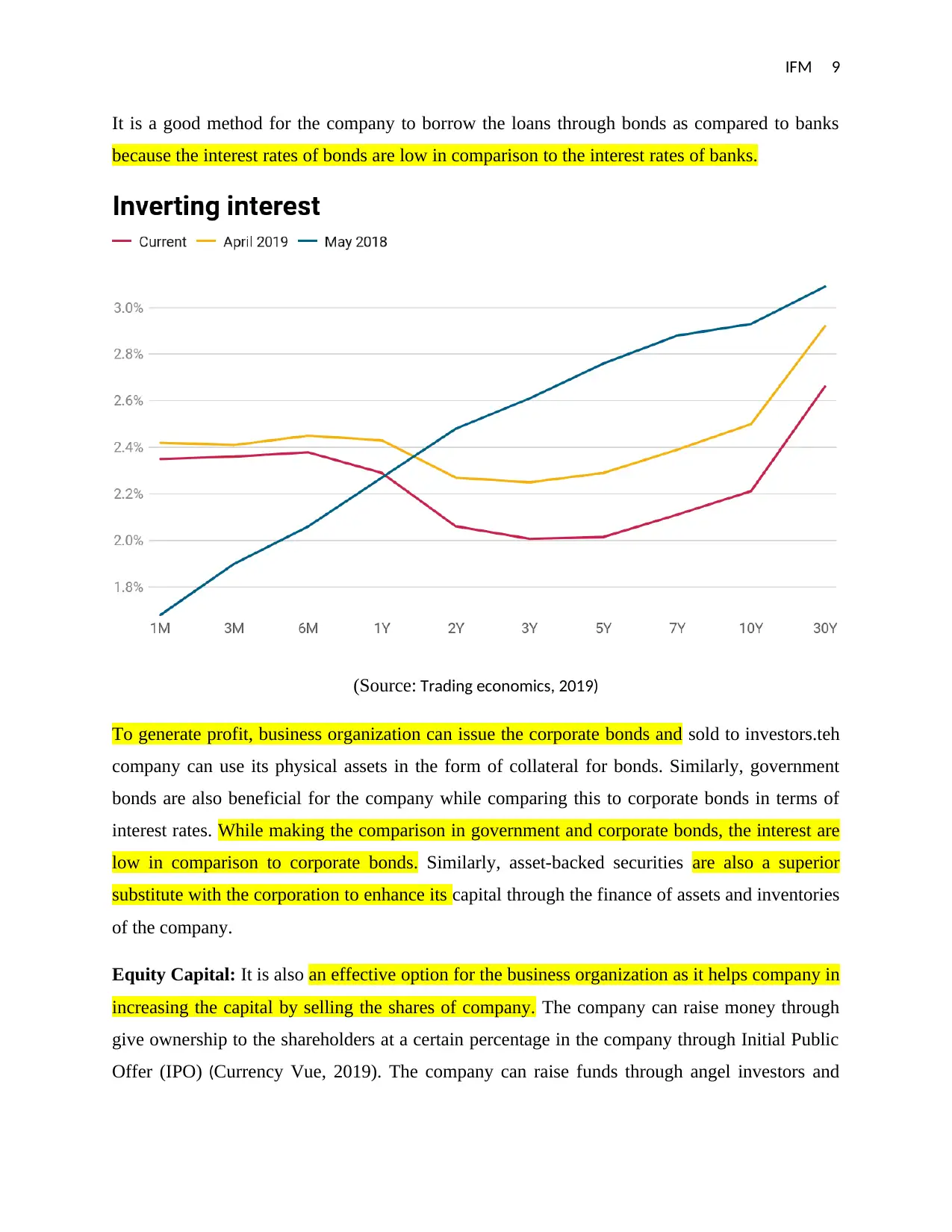
It is a good method for the company to borrow the loans through bonds as compared to banks
because the interest rates of bonds are low in comparison to the interest rates of banks.
(Source: Trading economics, 2019)
To generate profit, business organization can issue the corporate bonds and sold to investors.teh
company can use its physical assets in the form of collateral for bonds. Similarly, government
bonds are also beneficial for the company while comparing this to corporate bonds in terms of
interest rates. While making the comparison in government and corporate bonds, the interest are
low in comparison to corporate bonds. Similarly, asset-backed securities are also a superior
substitute with the corporation to enhance its capital through the finance of assets and inventories
of the company.
Equity Capital: It is also an effective option for the business organization as it helps company in
increasing the capital by selling the shares of company. The company can raise money through
give ownership to the shareholders at a certain percentage in the company through Initial Public
Offer (IPO) (Currency Vue, 2019). The company can raise funds through angel investors and
It is a good method for the company to borrow the loans through bonds as compared to banks
because the interest rates of bonds are low in comparison to the interest rates of banks.
(Source: Trading economics, 2019)
To generate profit, business organization can issue the corporate bonds and sold to investors.teh
company can use its physical assets in the form of collateral for bonds. Similarly, government
bonds are also beneficial for the company while comparing this to corporate bonds in terms of
interest rates. While making the comparison in government and corporate bonds, the interest are
low in comparison to corporate bonds. Similarly, asset-backed securities are also a superior
substitute with the corporation to enhance its capital through the finance of assets and inventories
of the company.
Equity Capital: It is also an effective option for the business organization as it helps company in
increasing the capital by selling the shares of company. The company can raise money through
give ownership to the shareholders at a certain percentage in the company through Initial Public
Offer (IPO) (Currency Vue, 2019). The company can raise funds through angel investors and
⊘ This is a preview!⊘
Do you want full access?
Subscribe today to unlock all pages.
Trusted by 1+ million students worldwide
IFM 10
venture capitalist who invested in the startups and preferred shareholders of the company rather
than common shareholders.
So these all above are the appropriate funding methods that help the company to become
successful in the long run and expand its retail outlets across China.
venture capitalist who invested in the startups and preferred shareholders of the company rather
than common shareholders.
So these all above are the appropriate funding methods that help the company to become
successful in the long run and expand its retail outlets across China.
Paraphrase This Document
Need a fresh take? Get an instant paraphrase of this document with our AI Paraphraser
IFM 11
References
Arnold, G. (2012). Corporate financial management. Pearson Education: UK
Brigham, E.F. and Houston, J.F. (2012). Fundamentals of financial management. Cengage
Learning: UK
Burtonshaw-Gunn, S.A. (2017). Risk and financial management in construction. Routledge: UK
Chi-Chi, O.A. and Ebimobowei, A. (2012). Accountability and public sector financial
management in Nigeria. Oman Chapter of Arabian Journal of Business and Management
Review, 34(953), 1-17.
Currency Vue (2019). FX hedging – Understanding Transaction vs. Translation Risk. Retrieved
from: https://www.currencyvue.com/2016/12/11/fx-hedging-understanding-transaction-
vs-translation-risk/
Dudin, M., Lyasnikov, N., Yahyaev, M. and Kuznecov, A. (2014). The organization approaches
peculiarities of an industrial enterprises financial management. Life Science
Journal, 11(9), 333-336.
Jindrichovska, I. (2013). Financial management in SMEs. European Research Studies
Journal, 16(4), 79-96.
Karadag, H. (2015). Financial management challenges in small and medium-sized enterprises: A
strategic management approach. EMAJ: Emerging Markets Journal, 5(1), 26-40.
Martin, L.L. (2016). Financial management for human service administrators. Waveland Press:
UK
Matthew, B.T. (2017). Financial management in the sport industry. Routledge: UK
NI Business (2019). Guide Raise long-term funding through debt capital markets. Retrieved
from: https://www.nibusinessinfo.co.uk/content/advantages-and-disadvantages-raising-
finance-issuing-corporate-bonds
References
Arnold, G. (2012). Corporate financial management. Pearson Education: UK
Brigham, E.F. and Houston, J.F. (2012). Fundamentals of financial management. Cengage
Learning: UK
Burtonshaw-Gunn, S.A. (2017). Risk and financial management in construction. Routledge: UK
Chi-Chi, O.A. and Ebimobowei, A. (2012). Accountability and public sector financial
management in Nigeria. Oman Chapter of Arabian Journal of Business and Management
Review, 34(953), 1-17.
Currency Vue (2019). FX hedging – Understanding Transaction vs. Translation Risk. Retrieved
from: https://www.currencyvue.com/2016/12/11/fx-hedging-understanding-transaction-
vs-translation-risk/
Dudin, M., Lyasnikov, N., Yahyaev, M. and Kuznecov, A. (2014). The organization approaches
peculiarities of an industrial enterprises financial management. Life Science
Journal, 11(9), 333-336.
Jindrichovska, I. (2013). Financial management in SMEs. European Research Studies
Journal, 16(4), 79-96.
Karadag, H. (2015). Financial management challenges in small and medium-sized enterprises: A
strategic management approach. EMAJ: Emerging Markets Journal, 5(1), 26-40.
Martin, L.L. (2016). Financial management for human service administrators. Waveland Press:
UK
Matthew, B.T. (2017). Financial management in the sport industry. Routledge: UK
NI Business (2019). Guide Raise long-term funding through debt capital markets. Retrieved
from: https://www.nibusinessinfo.co.uk/content/advantages-and-disadvantages-raising-
finance-issuing-corporate-bonds
IFM 12
Pandey, I.M. (2015). Essentials of Financial Management, 4th Edtion. Vikas publishing house:
UK
Parker, L.D. (2012). From privatised to hybrid corporatised higher education: A global financial
management discourse. Financial Accountability & Management, 28(3), 247-268.
Perlman, J.W. and Visa International Service Association (2012). Peer-to-peer and group
financial management systems and methods. U.S. Patent 8,280,788.
Pham, T.H., Yap, K. and Dowling, N.A. (2012). The impact of financial management practices
and financial attitudes on the relationship between materialism and compulsive
buying. Journal of Economic Psychology, 33(3), 461-470.
Renz, D.O. (2016). The Jossey-Bass handbook of nonprofit leadership and management. John
Wiley & Sons: USA
Trading economics (2019). China Interest Rate. Retrieved from:
https://tradingeconomics.com/china/interest-rate
Pandey, I.M. (2015). Essentials of Financial Management, 4th Edtion. Vikas publishing house:
UK
Parker, L.D. (2012). From privatised to hybrid corporatised higher education: A global financial
management discourse. Financial Accountability & Management, 28(3), 247-268.
Perlman, J.W. and Visa International Service Association (2012). Peer-to-peer and group
financial management systems and methods. U.S. Patent 8,280,788.
Pham, T.H., Yap, K. and Dowling, N.A. (2012). The impact of financial management practices
and financial attitudes on the relationship between materialism and compulsive
buying. Journal of Economic Psychology, 33(3), 461-470.
Renz, D.O. (2016). The Jossey-Bass handbook of nonprofit leadership and management. John
Wiley & Sons: USA
Trading economics (2019). China Interest Rate. Retrieved from:
https://tradingeconomics.com/china/interest-rate
⊘ This is a preview!⊘
Do you want full access?
Subscribe today to unlock all pages.
Trusted by 1+ million students worldwide

1 out of 12


Related Documents


Your All-in-One AI-Powered Toolkit for Academic Success.
+13062052269
info@desklib.com
Available 24*7 on WhatsApp / Email
![[object Object]](/_next/static/media/star-bottom.7253800d.svg)
Unlock your academic potential
Copyright © 2020–2026 A2Z Services. All Rights Reserved. Developed and managed by ZUCOL.