The Role of Financial Markets in Capital Allocation: UK and Hungary
VerifiedAdded on 2022/11/14
|22
|4733
|432
Report
AI Summary
This report provides a comprehensive analysis of financial markets, focusing on their role in capital allocation within domestic and international economies. It begins with an examination of the UK's financial market, including its historical context, current state, and factors influencing its performance, such as Brexit. The report then delves into the ways financial markets allocate capital, including the roles of money markets, financial intermediaries (like banks), and bond markets. It explores the impact of various factors, including political and economic conditions, such as the 2008 financial crisis. The report then shifts its focus to Hungary as an emerging economy, analyzing its industrialization and trade policies and the challenges it faces. The report aims to provide valuable insights into the dynamics of financial markets and their implications for investment and development.
INTERNATIONAL TRADE, FINANCE AND INVESTMENT 1
Analyzing the role of financial markets in terms of capital allocation with developed and
emerging economies: the United Kingdom and Hungary
Student’s name
Tutors name
Course
Institutional affiliation
City and state
Date
Analyzing the role of financial markets in terms of capital allocation with developed and
emerging economies: the United Kingdom and Hungary
Student’s name
Tutors name
Course
Institutional affiliation
City and state
Date

Paraphrase This Document
Need a fresh take? Get an instant paraphrase of this document with our AI Paraphraser
INTERNATIONAL TRADE, FINANCE AND INVESTMENT 2
Content template
2. Executive summary.............................................................................................................................3
Part A: assessing the ways through which financial markets work to allocate capital.................................3
3 Background of financial markets in the UK..........................................................................................3
4. Analyzing the role of allocating capital in the domestic economy.......................................................4
The money market...................................................................................................................................4
Intermediary roles towards capital allocation..........................................................................................5
The bond financial market/ fixed income investments.............................................................................7
Factors affecting financial market operations..........................................................................................8
Political factors........................................................................................................................................8
Economic factors.....................................................................................................................................9
Possible solutions to the crisis...............................................................................................................10
5. Role of allocating capital in international markets.............................................................................10
Role of exchange rates...........................................................................................................................11
INTEREST RATES...............................................................................................................................12
Inflation rates.........................................................................................................................................12
Part B: the emerging economy..................................................................................................................13
6. Analyzing Hungary............................................................................................................................13
7. The impacts brought by industrialization and other trade policies.....................................................15
8. Conclusion.........................................................................................................................................17
9. References............................................................................................................................................18
10. Appendix..............................................................................................................................................22
1.
Content template
2. Executive summary.............................................................................................................................3
Part A: assessing the ways through which financial markets work to allocate capital.................................3
3 Background of financial markets in the UK..........................................................................................3
4. Analyzing the role of allocating capital in the domestic economy.......................................................4
The money market...................................................................................................................................4
Intermediary roles towards capital allocation..........................................................................................5
The bond financial market/ fixed income investments.............................................................................7
Factors affecting financial market operations..........................................................................................8
Political factors........................................................................................................................................8
Economic factors.....................................................................................................................................9
Possible solutions to the crisis...............................................................................................................10
5. Role of allocating capital in international markets.............................................................................10
Role of exchange rates...........................................................................................................................11
INTEREST RATES...............................................................................................................................12
Inflation rates.........................................................................................................................................12
Part B: the emerging economy..................................................................................................................13
6. Analyzing Hungary............................................................................................................................13
7. The impacts brought by industrialization and other trade policies.....................................................15
8. Conclusion.........................................................................................................................................17
9. References............................................................................................................................................18
10. Appendix..............................................................................................................................................22
1.
INTERNATIONAL TRADE, FINANCE AND INVESTMENT 3
2. Executive summary
The major aim for writing this report is to provide a detailed analysis of financial
markets. Specifically, the report will assess the different impacts, roles, and functions of
financial markets towards capital allocation within both the domestic and international
economies. The two main economies that the paper focuses on are Hungary as an emerging
economy and the United Kingdom as a developed country between the two types of economies.
The report will, therefore, provide an overview of the prevailing financial market environments.
The report will continue to analyze the ways through which financial markets operate. The report
will specifically focus on the United Kingdom and Hungary. The assessment will be aimed at
providing assistance to the clients in making their investment decisions.
Part A: assessing the ways through which financial markets work to allocate capital
3 Background of financial markets in the UK
The background of the UK financial markets can be generated back to the times of the
Bretton Woods agreement. During such periods, the financial markets in the UK were highly
regulated. The listings on the London stock market were carried out through special settlements.
The companies provided shareholders with legal rights that were more than what the law
required. This was done through company articles of association. During the 1957 period, a
number of London banks were granted with minimal access so as to carry out cross-border
transactions in dollar accounts. (Napolitano, 2011). Up to date, the financial markets in the UK
are still suffering from the 2008 financial crisis effects. For example the capital markets in the
UK are relatively low developed as compared to the GDP over the past 10 years. Growth has
been realized although it is still at a low rate. However the financial market sector is estimated
2. Executive summary
The major aim for writing this report is to provide a detailed analysis of financial
markets. Specifically, the report will assess the different impacts, roles, and functions of
financial markets towards capital allocation within both the domestic and international
economies. The two main economies that the paper focuses on are Hungary as an emerging
economy and the United Kingdom as a developed country between the two types of economies.
The report will, therefore, provide an overview of the prevailing financial market environments.
The report will continue to analyze the ways through which financial markets operate. The report
will specifically focus on the United Kingdom and Hungary. The assessment will be aimed at
providing assistance to the clients in making their investment decisions.
Part A: assessing the ways through which financial markets work to allocate capital
3 Background of financial markets in the UK
The background of the UK financial markets can be generated back to the times of the
Bretton Woods agreement. During such periods, the financial markets in the UK were highly
regulated. The listings on the London stock market were carried out through special settlements.
The companies provided shareholders with legal rights that were more than what the law
required. This was done through company articles of association. During the 1957 period, a
number of London banks were granted with minimal access so as to carry out cross-border
transactions in dollar accounts. (Napolitano, 2011). Up to date, the financial markets in the UK
are still suffering from the 2008 financial crisis effects. For example the capital markets in the
UK are relatively low developed as compared to the GDP over the past 10 years. Growth has
been realized although it is still at a low rate. However the financial market sector is estimated
⊘ This is a preview!⊘
Do you want full access?
Subscribe today to unlock all pages.

Trusted by 1+ million students worldwide
INTERNATIONAL TRADE, FINANCE AND INVESTMENT 4
to be having a general contribution of about 119 billion pounds and this represents a 6.5%
contribution to GDP (Sampson, 2017). The future performance of the UK financial market is
largely influenced by a number of external and internal factors. These factors can take a wide
coverage to include political factors such as the BREXIT. For example the campaign to leave the
EU implies that the UK will lose about 25% of its financial sector. However this will not result
into devastating outcomes. The financial sector is still expected to be twice the size of any other
European financial center. Therefore one can reliably conclude that the financial market of the
UK will undergo a slight decline in the nearby future in case the country votes to leave the EU.
(Oxen ford, 208). The future of UKs financial markets is mostly very uncertain. With the
possibility of the BREXIT campaign, financial markets are likely to greatly decline in the future.
A hard British exit is likely to result into financial market instabilities unless plans are worked
out to improve the position of the country. Many UK financial institutions are establishing
various points with other EU countries so as to avoid the unfavorable outcomes of the EXIT.
4. Analyzing the role of allocating capital in the domestic economy
It is without doubt that financial markets play a very significant role in allocating capital
both on the national and international level (Wright et al, 2013). Globally, these financial
markets include the stock markets, derivatives markets, bond markets, and the commodities
markets. These different types of markets play various roles in capital allocation with in an
economy as discussed below:
The money market
An economy such as that of the United Kingdom is well known for its strong financial
market. Such a position, therefore, provides the financial market with a competitive advantage in
the economy. According to Porter's diamond theory of competitive advantage, this results into
to be having a general contribution of about 119 billion pounds and this represents a 6.5%
contribution to GDP (Sampson, 2017). The future performance of the UK financial market is
largely influenced by a number of external and internal factors. These factors can take a wide
coverage to include political factors such as the BREXIT. For example the campaign to leave the
EU implies that the UK will lose about 25% of its financial sector. However this will not result
into devastating outcomes. The financial sector is still expected to be twice the size of any other
European financial center. Therefore one can reliably conclude that the financial market of the
UK will undergo a slight decline in the nearby future in case the country votes to leave the EU.
(Oxen ford, 208). The future of UKs financial markets is mostly very uncertain. With the
possibility of the BREXIT campaign, financial markets are likely to greatly decline in the future.
A hard British exit is likely to result into financial market instabilities unless plans are worked
out to improve the position of the country. Many UK financial institutions are establishing
various points with other EU countries so as to avoid the unfavorable outcomes of the EXIT.
4. Analyzing the role of allocating capital in the domestic economy
It is without doubt that financial markets play a very significant role in allocating capital
both on the national and international level (Wright et al, 2013). Globally, these financial
markets include the stock markets, derivatives markets, bond markets, and the commodities
markets. These different types of markets play various roles in capital allocation with in an
economy as discussed below:
The money market
An economy such as that of the United Kingdom is well known for its strong financial
market. Such a position, therefore, provides the financial market with a competitive advantage in
the economy. According to Porter's diamond theory of competitive advantage, this results into
Paraphrase This Document
Need a fresh take? Get an instant paraphrase of this document with our AI Paraphraser
INTERNATIONAL TRADE, FINANCE AND INVESTMENT 5
creation of demand factors. Because the financial market in the United Kingdom is well
developed, the demand involved in such a market is assumed to be very high. Through such a
well developed financial market; business entities have improved access to daily working capital.
Because the UK financial market is highly developed, participants will create different demand
factors thereby facilitating the allocation of resources. These resources are as well aimed at
meeting the daily working capital especially through the money market.
Intermediary roles towards capital allocation
Banks as participants in the financial markets play the role of collecting funds in the
form of deposits and then give it out to potential borrowers. When these bank loans are given
out, interest is as well charged on the loan. The financial institutions, therefore, act as agents
between the lenders and the borrowers (Masoud, 2013).
In terms of determining Foreign Direct Investment (FDI), financial markets similarly
have a role they play. Well developed financial markets within a domestic economy imply that
there is an improved rate of foreign direct investment (sigh,2019). Since FDI requires extra costs,
the financial markets act as sources of information and extra funds to investors. This means that
a country with a developed financial market has the ability to attract more investors
(Ramskogler,2015). The investors assume that well developed financial markets will act as a
hedge against foreign exchange fluctuations (Goralczyk, 2015). Financial markets provide
significant assistance in the reallocation of funds and capital. For instance, investors reallocate
their funds from those entities that are not profitable to those that are more profitable. This is
determined by basing on the information provided through the stock market.
creation of demand factors. Because the financial market in the United Kingdom is well
developed, the demand involved in such a market is assumed to be very high. Through such a
well developed financial market; business entities have improved access to daily working capital.
Because the UK financial market is highly developed, participants will create different demand
factors thereby facilitating the allocation of resources. These resources are as well aimed at
meeting the daily working capital especially through the money market.
Intermediary roles towards capital allocation
Banks as participants in the financial markets play the role of collecting funds in the
form of deposits and then give it out to potential borrowers. When these bank loans are given
out, interest is as well charged on the loan. The financial institutions, therefore, act as agents
between the lenders and the borrowers (Masoud, 2013).
In terms of determining Foreign Direct Investment (FDI), financial markets similarly
have a role they play. Well developed financial markets within a domestic economy imply that
there is an improved rate of foreign direct investment (sigh,2019). Since FDI requires extra costs,
the financial markets act as sources of information and extra funds to investors. This means that
a country with a developed financial market has the ability to attract more investors
(Ramskogler,2015). The investors assume that well developed financial markets will act as a
hedge against foreign exchange fluctuations (Goralczyk, 2015). Financial markets provide
significant assistance in the reallocation of funds and capital. For instance, investors reallocate
their funds from those entities that are not profitable to those that are more profitable. This is
determined by basing on the information provided through the stock market.
INTERNATIONAL TRADE, FINANCE AND INVESTMENT 6
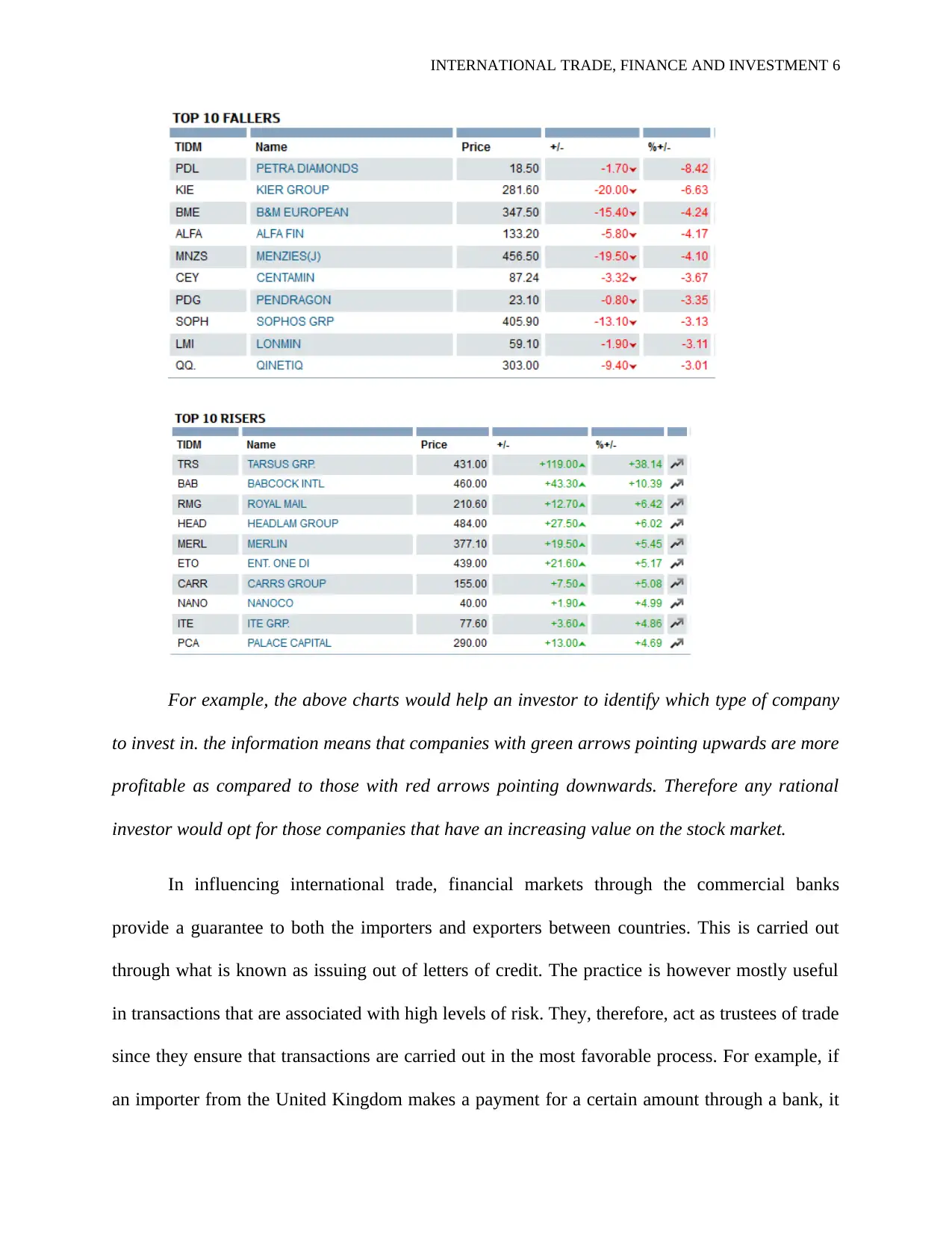
For example, the above charts would help an investor to identify which type of company
to invest in. the information means that companies with green arrows pointing upwards are more
profitable as compared to those with red arrows pointing downwards. Therefore any rational
investor would opt for those companies that have an increasing value on the stock market.
In influencing international trade, financial markets through the commercial banks
provide a guarantee to both the importers and exporters between countries. This is carried out
through what is known as issuing out of letters of credit. The practice is however mostly useful
in transactions that are associated with high levels of risk. They, therefore, act as trustees of trade
since they ensure that transactions are carried out in the most favorable process. For example, if
an importer from the United Kingdom makes a payment for a certain amount through a bank, it
For example, the above charts would help an investor to identify which type of company
to invest in. the information means that companies with green arrows pointing upwards are more
profitable as compared to those with red arrows pointing downwards. Therefore any rational
investor would opt for those companies that have an increasing value on the stock market.
In influencing international trade, financial markets through the commercial banks
provide a guarantee to both the importers and exporters between countries. This is carried out
through what is known as issuing out of letters of credit. The practice is however mostly useful
in transactions that are associated with high levels of risk. They, therefore, act as trustees of trade
since they ensure that transactions are carried out in the most favorable process. For example, if
an importer from the United Kingdom makes a payment for a certain amount through a bank, it
⊘ This is a preview!⊘
Do you want full access?
Subscribe today to unlock all pages.
Trusted by 1+ million students worldwide
INTERNATIONAL TRADE, FINANCE AND INVESTMENT 7
is up to that particular bank to deliver the goods. Failure to deliver the goods will imply that the
bank will refund the amount of money paid.
The bond financial market/ fixed income investments
The bond market is basically a tool used in the by public listed companies to raise
working capital. Under this particular tool, firms are obliged to make periodic payments to
investors (Jickling, 2010). They are therefore considered as a form of loans from the investors to
a business entity or the government (Hohlmeier and Fahrolz, 2018). Under such a tool of capital
allocation, interest rates are normally very low and the rate of return is similarly low. (Schmidt-
Eisenlohr and Niepmann,2014). These bonds can further be classified into high yield bonds,
investment grade bonds and the government bonds. For example, a corporate bond future value
can be calculated as follows: face value of the corporate bond is $150,000, 3% annual interest
payment and a maturity date of 4 years. The following formula can be used to calculate the
future value of the above corporate bond.
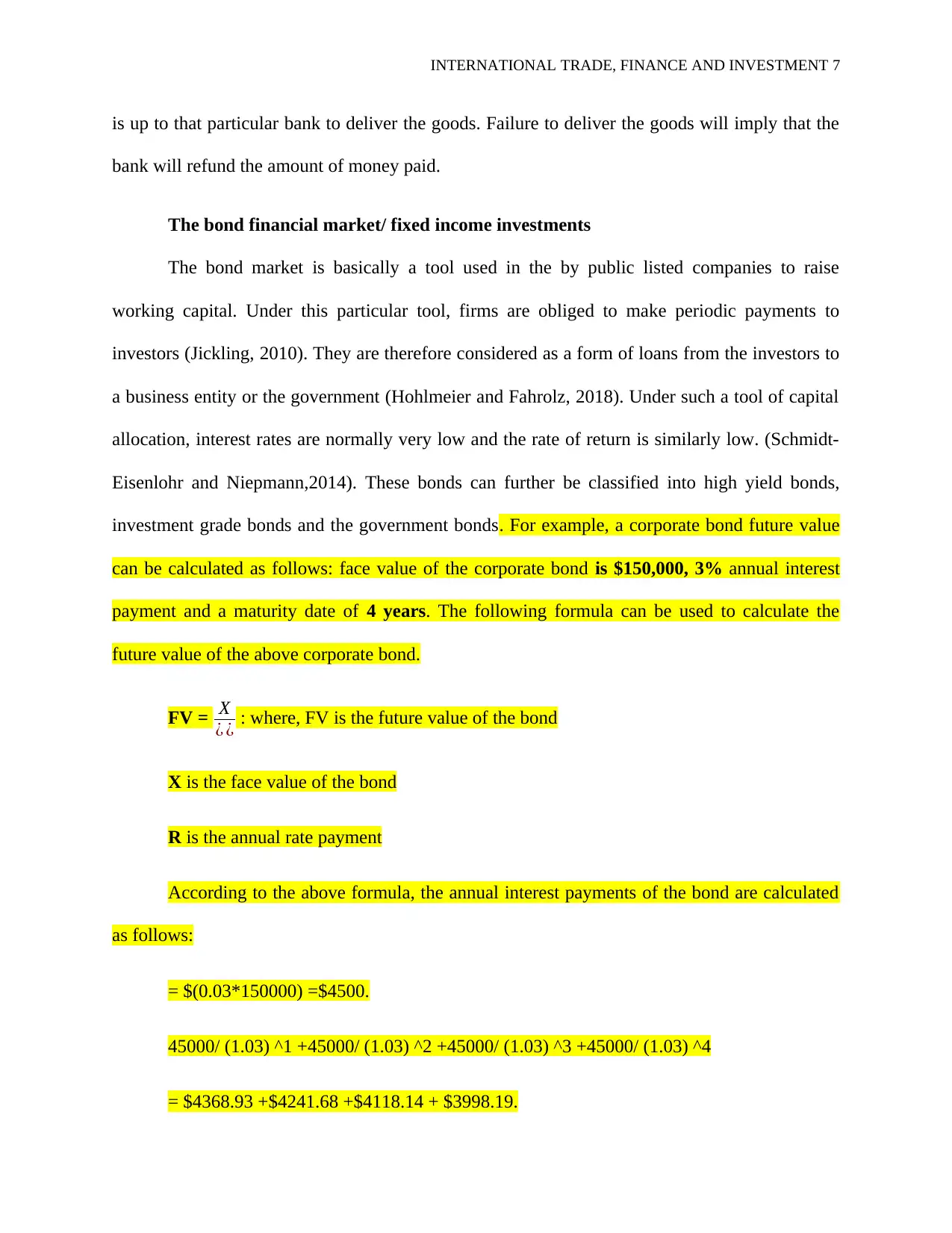
FV = X
¿ ¿ : where, FV is the future value of the bond
X is the face value of the bond
R is the annual rate payment
According to the above formula, the annual interest payments of the bond are calculated
as follows:
= $(0.03*150000) =$4500.
45000/ (1.03) ^1 +45000/ (1.03) ^2 +45000/ (1.03) ^3 +45000/ (1.03) ^4
= $4368.93 +$4241.68 +$4118.14 + $3998.19.
is up to that particular bank to deliver the goods. Failure to deliver the goods will imply that the
bank will refund the amount of money paid.
The bond financial market/ fixed income investments
The bond market is basically a tool used in the by public listed companies to raise
working capital. Under this particular tool, firms are obliged to make periodic payments to
investors (Jickling, 2010). They are therefore considered as a form of loans from the investors to
a business entity or the government (Hohlmeier and Fahrolz, 2018). Under such a tool of capital
allocation, interest rates are normally very low and the rate of return is similarly low. (Schmidt-
Eisenlohr and Niepmann,2014). These bonds can further be classified into high yield bonds,
investment grade bonds and the government bonds. For example, a corporate bond future value
can be calculated as follows: face value of the corporate bond is $150,000, 3% annual interest
payment and a maturity date of 4 years. The following formula can be used to calculate the
future value of the above corporate bond.
FV = X
¿ ¿ : where, FV is the future value of the bond
X is the face value of the bond
R is the annual rate payment
According to the above formula, the annual interest payments of the bond are calculated
as follows:
= $(0.03*150000) =$4500.
45000/ (1.03) ^1 +45000/ (1.03) ^2 +45000/ (1.03) ^3 +45000/ (1.03) ^4
= $4368.93 +$4241.68 +$4118.14 + $3998.19.
Paraphrase This Document
Need a fresh take? Get an instant paraphrase of this document with our AI Paraphraser
INTERNATIONAL TRADE, FINANCE AND INVESTMENT 8
=$ 16726.94
The bond present value = $150000
Therefore, at maturity, the total amount payable will be $ 16726.94+ $ 150000 =
$166,726.94.
Factors affecting financial market operations
However, the operations of financial markets have been subjected to numerous obstacles.
These factors range from the social, political, and economic factors among others. To assess
these impacts on the performance of financial markets, closer attention will be paid to the Brexit
campaign and the financial crisis of 2008.
Political factors
To begin with, the decision to exit the European Union by the British will have both
positive and negative impacts on the country. For example, the country's financial system is
likely to lose in value. Such a loss in value will be evidently reflected through the depreciation of
the pound sterling. If the country decides to go through with the decision, foreign exchange will
begin to arise. The pound will face stiff competition from other global currencies such as the
euro and the dollar. Consequently, potential investors will not find investing in the economy
attractive anymore and they will withdraw their investments. The removal of foreign investments
from the country will imply that even the financial market is on the decline as the trading
environment is not favorable.
The exit is further estimated to result in a reduction of the country’s GDP around 1.9% to
5.5% within a period of ten years. Expenditures on public finances are estimated to be at around
0.4% to 1.8% on gross domestic product during the same time period. Such estimates show that
=$ 16726.94
The bond present value = $150000
Therefore, at maturity, the total amount payable will be $ 16726.94+ $ 150000 =
$166,726.94.
Factors affecting financial market operations
However, the operations of financial markets have been subjected to numerous obstacles.
These factors range from the social, political, and economic factors among others. To assess
these impacts on the performance of financial markets, closer attention will be paid to the Brexit
campaign and the financial crisis of 2008.
Political factors
To begin with, the decision to exit the European Union by the British will have both
positive and negative impacts on the country. For example, the country's financial system is
likely to lose in value. Such a loss in value will be evidently reflected through the depreciation of
the pound sterling. If the country decides to go through with the decision, foreign exchange will
begin to arise. The pound will face stiff competition from other global currencies such as the
euro and the dollar. Consequently, potential investors will not find investing in the economy
attractive anymore and they will withdraw their investments. The removal of foreign investments
from the country will imply that even the financial market is on the decline as the trading
environment is not favorable.
The exit is further estimated to result in a reduction of the country’s GDP around 1.9% to
5.5% within a period of ten years. Expenditures on public finances are estimated to be at around
0.4% to 1.8% on gross domestic product during the same time period. Such estimates show that
INTERNATIONAL TRADE, FINANCE AND INVESTMENT 9
the exit would cost Britain in the long run majorly in terms of GDP as compared to staying part
of the European Union. The exit will affect Britain with reductions in the overall GDP by a 3.9
% decline.
On the positive note, however, leaving the EU would give the country an opportunity to
create new trade agreements with other countries. These would be countries outside the
European Union. Such countries would include those from the Far East and Asia. However, the
point to note is that such positive effects do not seem to outweigh the negative impacts that the
country is likely to face in the long run.
Economic factors
Economic factors would at the same time have a significant influence on the performance
of financial markets. The main example to consider is the 2008 financial crisis. During the time
of this crisis, many European countries faced a number of challenges. These were both long and
short term in nature. Up to date, some of the effects of this crisis are still being felt in countries
such as Spain, and Greece. For instance, Spain still suffers a 15% rate of unemployment whereas
Greece still registers unemployment rates at 20%. In the eurozone area, there is still about 4% of
nonperforming debts. All these macroeconomic constraints were however brought about by the
pronounced economic crisis of 2008.
Other influential factors in financial markets however include the legal factors of
operations, social factors within the country, technological and ultimately the ecological factors.
Just as the political and economical factors, all these other factors similarly have significant
impacts on the way financial markets operate. For example the technological factors greatly
influence how effective the markets operate. This can be done in terms of information flow.
the exit would cost Britain in the long run majorly in terms of GDP as compared to staying part
of the European Union. The exit will affect Britain with reductions in the overall GDP by a 3.9
% decline.
On the positive note, however, leaving the EU would give the country an opportunity to
create new trade agreements with other countries. These would be countries outside the
European Union. Such countries would include those from the Far East and Asia. However, the
point to note is that such positive effects do not seem to outweigh the negative impacts that the
country is likely to face in the long run.
Economic factors
Economic factors would at the same time have a significant influence on the performance
of financial markets. The main example to consider is the 2008 financial crisis. During the time
of this crisis, many European countries faced a number of challenges. These were both long and
short term in nature. Up to date, some of the effects of this crisis are still being felt in countries
such as Spain, and Greece. For instance, Spain still suffers a 15% rate of unemployment whereas
Greece still registers unemployment rates at 20%. In the eurozone area, there is still about 4% of
nonperforming debts. All these macroeconomic constraints were however brought about by the
pronounced economic crisis of 2008.
Other influential factors in financial markets however include the legal factors of
operations, social factors within the country, technological and ultimately the ecological factors.
Just as the political and economical factors, all these other factors similarly have significant
impacts on the way financial markets operate. For example the technological factors greatly
influence how effective the markets operate. This can be done in terms of information flow.
⊘ This is a preview!⊘
Do you want full access?
Subscribe today to unlock all pages.
Trusted by 1+ million students worldwide
INTERNATIONAL TRADE, FINANCE AND INVESTMENT 10
Possible solutions to the crisis
As the problem of financial crisis worsened, there was a great need to devise possible
ways through which the condition would be brought into control. All eurozone member countries
came up with a variety of possible approaches which included the provision of more liquidity by
central banks. This liquidity was to be used by the operating financial institutions as a way of
redeeming themselves from the problem. Government securities in form treasury bonds, bills,
and other equities were provided to most of the financial institutions on the continent. The major
reason for such grants and guarantees was to help the financial institutions be restored back to
their normal operating positions.
For those countries that were not developed at the time, interest rates had to be
significantly reduced during the financial crisis period. In some of the areas, these rates were
totally scraped to almost zero. As the cuts and policy reductions were not enough, national banks
went ahead to provide more support in specified market areas as well as economies. Taxes
payable were consequently reduced and many households received more aid in the form of basic
needs. With time, the situation slightly started to improve in the many different eurozone nations.
Up to the present date however, many European nations still fill the impact of the 2008 financial
crisis.
5. Role of allocating capital in international markets
Foreign Direct Investments play a very significant role in the economic growth and
development of a country. (Patricolo, 2017). Foreign direct investment can however be defined
as an international capital inflow that grants any multinational entity with control over foreign
subsidiaries. With effect from the 1980s, FDI has increasingly been used as an approach for
Possible solutions to the crisis
As the problem of financial crisis worsened, there was a great need to devise possible
ways through which the condition would be brought into control. All eurozone member countries
came up with a variety of possible approaches which included the provision of more liquidity by
central banks. This liquidity was to be used by the operating financial institutions as a way of
redeeming themselves from the problem. Government securities in form treasury bonds, bills,
and other equities were provided to most of the financial institutions on the continent. The major
reason for such grants and guarantees was to help the financial institutions be restored back to
their normal operating positions.
For those countries that were not developed at the time, interest rates had to be
significantly reduced during the financial crisis period. In some of the areas, these rates were
totally scraped to almost zero. As the cuts and policy reductions were not enough, national banks
went ahead to provide more support in specified market areas as well as economies. Taxes
payable were consequently reduced and many households received more aid in the form of basic
needs. With time, the situation slightly started to improve in the many different eurozone nations.
Up to the present date however, many European nations still fill the impact of the 2008 financial
crisis.
5. Role of allocating capital in international markets
Foreign Direct Investments play a very significant role in the economic growth and
development of a country. (Patricolo, 2017). Foreign direct investment can however be defined
as an international capital inflow that grants any multinational entity with control over foreign
subsidiaries. With effect from the 1980s, FDI has increasingly been used as an approach for
Paraphrase This Document
Need a fresh take? Get an instant paraphrase of this document with our AI Paraphraser
INTERNATIONAL TRADE, FINANCE AND INVESTMENT 11
allocating funds. The FDI relationship with foreign exchange rates is widely known to be
dependent on certain international market imperfections.
Role of exchange rates
Exchange rates play a significant role in capital allocation for global or multinational
companies. They find it more profitable to invest in foreign countries with depreciated
currencies. International companies enjoy a relative advantage over the local firms. Multinational
companies have better access to financing from markets with stronger currency terms yet they
invest at lower costs. This means that multinational companies will invest in a country such as
the UK at low costs and likewise generate high returns. Such an advantage, therefore, gives
international companies an upper hand against the domestic firms of the economy.
Depreciated domestic currency
A depreciated national currency such as the pound sterling lowers the cost of production
for the international company. For purposes of generating effective and efficient production,
multinational companies would definitely find it attractive to invest in the United Kingdom.
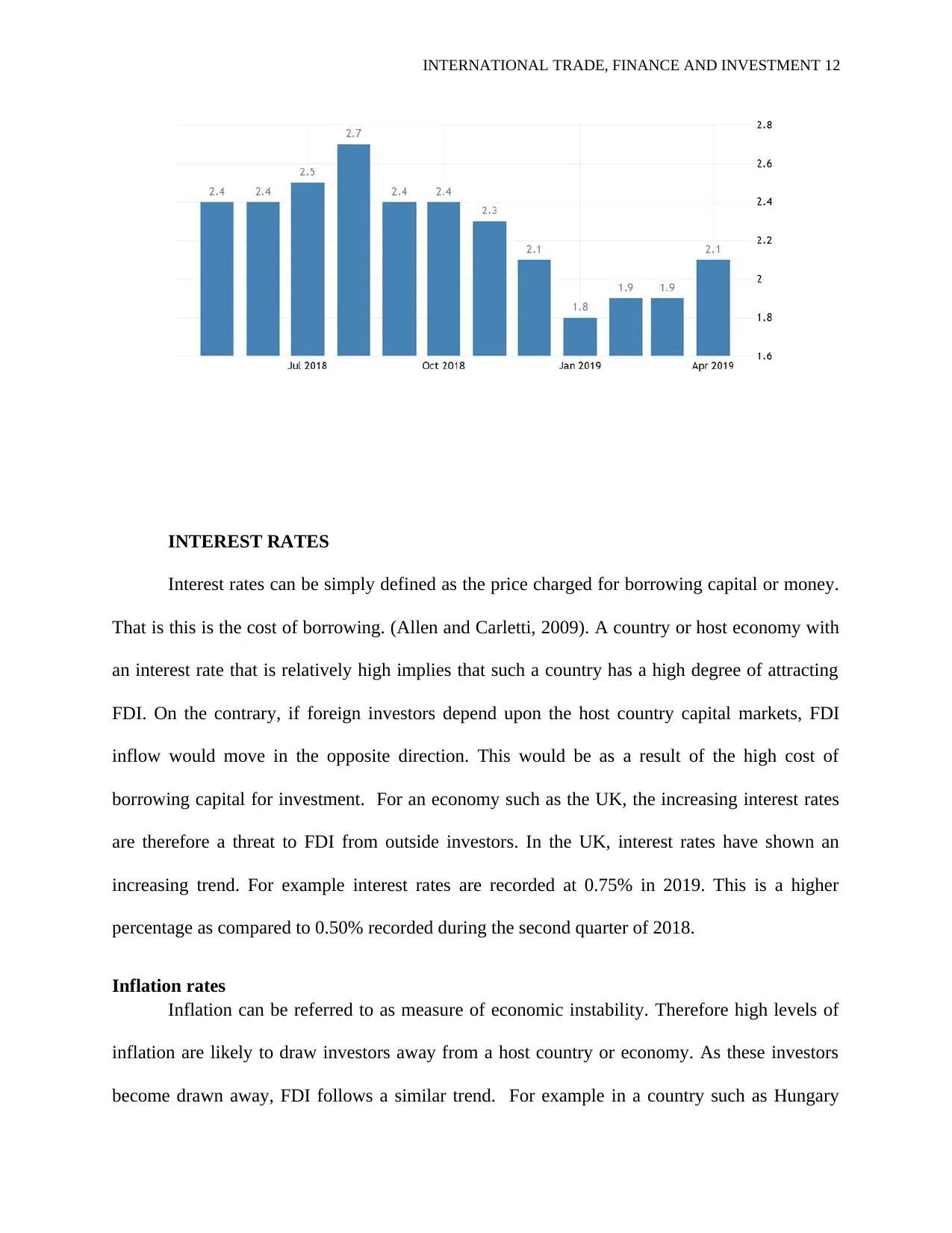
Recent information shows that the inflation rates in the country have been relatively increasing
over the past five years. The increase in inflation consequently implies depreciation in the
domestic currency. Such an economic condition would provide attractive grounds for FDI.
Below is a graphical representation of the inflationary rate trend in the UK for the year 2018-
2019. ;( tradingeconomics.com, office for national statistics)
allocating funds. The FDI relationship with foreign exchange rates is widely known to be
dependent on certain international market imperfections.
Role of exchange rates
Exchange rates play a significant role in capital allocation for global or multinational
companies. They find it more profitable to invest in foreign countries with depreciated
currencies. International companies enjoy a relative advantage over the local firms. Multinational
companies have better access to financing from markets with stronger currency terms yet they
invest at lower costs. This means that multinational companies will invest in a country such as
the UK at low costs and likewise generate high returns. Such an advantage, therefore, gives
international companies an upper hand against the domestic firms of the economy.
Depreciated domestic currency
A depreciated national currency such as the pound sterling lowers the cost of production
for the international company. For purposes of generating effective and efficient production,
multinational companies would definitely find it attractive to invest in the United Kingdom.
Recent information shows that the inflation rates in the country have been relatively increasing
over the past five years. The increase in inflation consequently implies depreciation in the
domestic currency. Such an economic condition would provide attractive grounds for FDI.
Below is a graphical representation of the inflationary rate trend in the UK for the year 2018-
2019. ;( tradingeconomics.com, office for national statistics)
INTERNATIONAL TRADE, FINANCE AND INVESTMENT 12
INTEREST RATES
Interest rates can be simply defined as the price charged for borrowing capital or money.
That is this is the cost of borrowing. (Allen and Carletti, 2009). A country or host economy with
an interest rate that is relatively high implies that such a country has a high degree of attracting
FDI. On the contrary, if foreign investors depend upon the host country capital markets, FDI
inflow would move in the opposite direction. This would be as a result of the high cost of
borrowing capital for investment. For an economy such as the UK, the increasing interest rates
are therefore a threat to FDI from outside investors. In the UK, interest rates have shown an
increasing trend. For example interest rates are recorded at 0.75% in 2019. This is a higher
percentage as compared to 0.50% recorded during the second quarter of 2018.
Inflation rates
Inflation can be referred to as measure of economic instability. Therefore high levels of
inflation are likely to draw investors away from a host country or economy. As these investors
become drawn away, FDI follows a similar trend. For example in a country such as Hungary
INTEREST RATES
Interest rates can be simply defined as the price charged for borrowing capital or money.
That is this is the cost of borrowing. (Allen and Carletti, 2009). A country or host economy with
an interest rate that is relatively high implies that such a country has a high degree of attracting
FDI. On the contrary, if foreign investors depend upon the host country capital markets, FDI
inflow would move in the opposite direction. This would be as a result of the high cost of
borrowing capital for investment. For an economy such as the UK, the increasing interest rates
are therefore a threat to FDI from outside investors. In the UK, interest rates have shown an
increasing trend. For example interest rates are recorded at 0.75% in 2019. This is a higher
percentage as compared to 0.50% recorded during the second quarter of 2018.
Inflation rates
Inflation can be referred to as measure of economic instability. Therefore high levels of
inflation are likely to draw investors away from a host country or economy. As these investors
become drawn away, FDI follows a similar trend. For example in a country such as Hungary
⊘ This is a preview!⊘
Do you want full access?
Subscribe today to unlock all pages.
Trusted by 1+ million students worldwide

1 out of 22


Related Documents


Your All-in-One AI-Powered Toolkit for Academic Success.
+13062052269
info@desklib.com
Available 24*7 on WhatsApp / Email
![[object Object]](/_next/static/media/star-bottom.7253800d.svg)
Unlock your academic potential
Copyright © 2020–2026 A2Z Services. All Rights Reserved. Developed and managed by ZUCOL.