An Investigation into Employee Commitment at McDonald's UK
VerifiedAdded on 2020/03/01
|87
|21771
|40
Report
AI Summary
This report presents an investigation into the levels of employee commitment of full-time and part-time workers within McDonald's UK. The study explores the significance of part-time employment in the service industry, highlighting its cost-saving benefits and the flexibility it offers in response to fluctuating customer demand. The research examines the differences in commitment levels, considering factors like job satisfaction, career opportunities, and the impact of employment contracts. The methodology involves both quantitative and qualitative data collection through surveys and interviews with McDonald's employees and managers. The findings reveal that full-time employees generally exhibit higher commitment levels compared to their part-time counterparts. The report also suggests strategies such as career planning, appropriate wage structures, and other measures to enhance part-time employee commitment. The research also includes comprehensive literature review and analysis to understand the factors that influences the level of commitment of both part-time and full-time employees in an organization. The study aims to provide a comprehensive understanding of the dynamics of employee commitment in the fast-food industry, offering insights into effective human resource management practices.
Running head: INTERNATIONAL HUMAN RESOURCE MANAGEMENT
International Human Resource Management
Name of the Student
Name of the University
Author Note
International Human Resource Management
Name of the Student
Name of the University
Author Note

Paraphrase This Document
Need a fresh take? Get an instant paraphrase of this document with our AI Paraphraser
1INTERNATIONAL HUMAN RESOURCE MANAGEMENT
Abstract
The present study is based on the investigation of level of commitment of both part-time and
full-time employees to the organization. The purpose of the study is to derive the understanding
about the factors that influence the level of commitment of both part-time and full-time
employees in an organization. Several researches have been carried out on this context but those
studies lack the actual findings based on which it can be determined that a difference between the
types of employment exists. The introductory section of the study provides a brief about the
significance of the studies. The introductory section presents the idea how the research can be
conducted analyzing the gaps in the previous studies. The first chapter of the study also provides
the key objectives on the basis of which, the entire dissertation has been designed. The literature
review conducted in the study helps to note that employment practices can be affected by both
external and internal factors. According to the previous studies, the internal factors such as wage
structure, flexible work hours, fringe benefits and others that certainly help the employees to
remain committed to the organization. The study includes primary the primary analysis has been
carried out by performing a survey and interview method. The survey has been conducted among
100 employees of McDonald, UK and the interview has been conducted among 5 managers of
McDonald. The data findings indicate that McDonald has an equal number of part-time and full-
time employees who serve the organization for a year. The findings also indicate that full-time
employees are broadly committed to the organization compared to part-time employees. Based
on the findings, it is also found that full-time employees are more committed to the organization.
However, in part-time employment, the issues are not actually associated with the individual
psychological belief; it is rather associated with the part-time employment contract. To design
the part-time employment contract appropriately, career plan strategies, proper wage structure
and some other strategies have been suggested to the organization. h
Abstract
The present study is based on the investigation of level of commitment of both part-time and
full-time employees to the organization. The purpose of the study is to derive the understanding
about the factors that influence the level of commitment of both part-time and full-time
employees in an organization. Several researches have been carried out on this context but those
studies lack the actual findings based on which it can be determined that a difference between the
types of employment exists. The introductory section of the study provides a brief about the
significance of the studies. The introductory section presents the idea how the research can be
conducted analyzing the gaps in the previous studies. The first chapter of the study also provides
the key objectives on the basis of which, the entire dissertation has been designed. The literature
review conducted in the study helps to note that employment practices can be affected by both
external and internal factors. According to the previous studies, the internal factors such as wage
structure, flexible work hours, fringe benefits and others that certainly help the employees to
remain committed to the organization. The study includes primary the primary analysis has been
carried out by performing a survey and interview method. The survey has been conducted among
100 employees of McDonald, UK and the interview has been conducted among 5 managers of
McDonald. The data findings indicate that McDonald has an equal number of part-time and full-
time employees who serve the organization for a year. The findings also indicate that full-time
employees are broadly committed to the organization compared to part-time employees. Based
on the findings, it is also found that full-time employees are more committed to the organization.
However, in part-time employment, the issues are not actually associated with the individual
psychological belief; it is rather associated with the part-time employment contract. To design
the part-time employment contract appropriately, career plan strategies, proper wage structure
and some other strategies have been suggested to the organization. h

2INTERNATIONAL HUMAN RESOURCE MANAGEMENT
Acknowledgement
The completion of the project gave me an enormous amount of satisfaction. I have received the
opportunity to enhance my knowledge in several fields related to employment contracts and
policies. I would like to thank a number of people who helped me throughout the dissertation.
Firstly, I would like to thank my supervisor who helped me to select the process of data
collection and data analysis. I thank my colleagues for helping me to collect data through survey
and interview. I thank my family and friends for encouraging me to work on this project.
Without your support, this project would not have been completed.
Thanking you all,
Acknowledgement
The completion of the project gave me an enormous amount of satisfaction. I have received the
opportunity to enhance my knowledge in several fields related to employment contracts and
policies. I would like to thank a number of people who helped me throughout the dissertation.
Firstly, I would like to thank my supervisor who helped me to select the process of data
collection and data analysis. I thank my colleagues for helping me to collect data through survey
and interview. I thank my family and friends for encouraging me to work on this project.
Without your support, this project would not have been completed.
Thanking you all,
⊘ This is a preview!⊘
Do you want full access?
Subscribe today to unlock all pages.

Trusted by 1+ million students worldwide
3INTERNATIONAL HUMAN RESOURCE MANAGEMENT
Table of Content
1.1 Introduction................................................................................................................................8
1.2 Overview....................................................................................................................................9
1.3 Background to the research.....................................................................................................13
1.4 Statement of Problem..............................................................................................................14
1.5 Purpose Statement and Research Question..............................................................................15
1.6 Research Aim and Objectives..................................................................................................15
1.7 Summary..................................................................................................................................15
CHAPTER 2- LITERATURE REVIEW.......................................................................................17
2.1 Introduction..............................................................................................................................17
2.2 Organizational commitment....................................................................................................18
2.3 Part-time contracts...................................................................................................................19
2.4 Theoretical Review..................................................................................................................21
2.5 Impact of short-term employment on the organization...........................................................25
2.6 Work commitment and employees..........................................................................................26
2.7 Psychological content to explain difference............................................................................28
2.8 Job attitude, job satisfaction and work commitment...............................................................30
2.9 Compensation strategies of the organization...........................................................................31
2.10 Research gap and contribution...............................................................................................33
CHAPTER 3- RESEARCH METHODOLOGY...........................................................................34
3.1 Introduction..............................................................................................................................34
3.2 Research Philosophy................................................................................................................34
3.3 Research Approach..................................................................................................................36
3.4 Research Design......................................................................................................................38
Table of Content
1.1 Introduction................................................................................................................................8
1.2 Overview....................................................................................................................................9
1.3 Background to the research.....................................................................................................13
1.4 Statement of Problem..............................................................................................................14
1.5 Purpose Statement and Research Question..............................................................................15
1.6 Research Aim and Objectives..................................................................................................15
1.7 Summary..................................................................................................................................15
CHAPTER 2- LITERATURE REVIEW.......................................................................................17
2.1 Introduction..............................................................................................................................17
2.2 Organizational commitment....................................................................................................18
2.3 Part-time contracts...................................................................................................................19
2.4 Theoretical Review..................................................................................................................21
2.5 Impact of short-term employment on the organization...........................................................25
2.6 Work commitment and employees..........................................................................................26
2.7 Psychological content to explain difference............................................................................28
2.8 Job attitude, job satisfaction and work commitment...............................................................30
2.9 Compensation strategies of the organization...........................................................................31
2.10 Research gap and contribution...............................................................................................33
CHAPTER 3- RESEARCH METHODOLOGY...........................................................................34
3.1 Introduction..............................................................................................................................34
3.2 Research Philosophy................................................................................................................34
3.3 Research Approach..................................................................................................................36
3.4 Research Design......................................................................................................................38
Paraphrase This Document
Need a fresh take? Get an instant paraphrase of this document with our AI Paraphraser
4INTERNATIONAL HUMAN RESOURCE MANAGEMENT
3.5 Data collection techniques.......................................................................................................39
3.6 Sampling method.....................................................................................................................41
3.7 Data analysis............................................................................................................................42
3.8 Reliability and Validity............................................................................................................42
3.9 Research Limitation.................................................................................................................43
3.10 Ethical Consideration.............................................................................................................44
3.11 Summary................................................................................................................................45
CHAPTER 4- RESEARCH FINDINGS AND ANALYSIS.........................................................46
4.1 Introduction..............................................................................................................................46
4.2 Quantitative data......................................................................................................................46
4.3 Qualitative data........................................................................................................................65
4.4 Discussion................................................................................................................................69
CHAPTER 5- CONCLUSION AND RECOMMENDATION.....................................................71
5.1 Conclusion...............................................................................................................................71
5.2 Recommendation.....................................................................................................................72
5.3 Future study.............................................................................................................................74
References and Bibliography.........................................................................................................75
3.5 Data collection techniques.......................................................................................................39
3.6 Sampling method.....................................................................................................................41
3.7 Data analysis............................................................................................................................42
3.8 Reliability and Validity............................................................................................................42
3.9 Research Limitation.................................................................................................................43
3.10 Ethical Consideration.............................................................................................................44
3.11 Summary................................................................................................................................45
CHAPTER 4- RESEARCH FINDINGS AND ANALYSIS.........................................................46
4.1 Introduction..............................................................................................................................46
4.2 Quantitative data......................................................................................................................46
4.3 Qualitative data........................................................................................................................65
4.4 Discussion................................................................................................................................69
CHAPTER 5- CONCLUSION AND RECOMMENDATION.....................................................71
5.1 Conclusion...............................................................................................................................71
5.2 Recommendation.....................................................................................................................72
5.3 Future study.............................................................................................................................74
References and Bibliography.........................................................................................................75
5INTERNATIONAL HUMAN RESOURCE MANAGEMENT
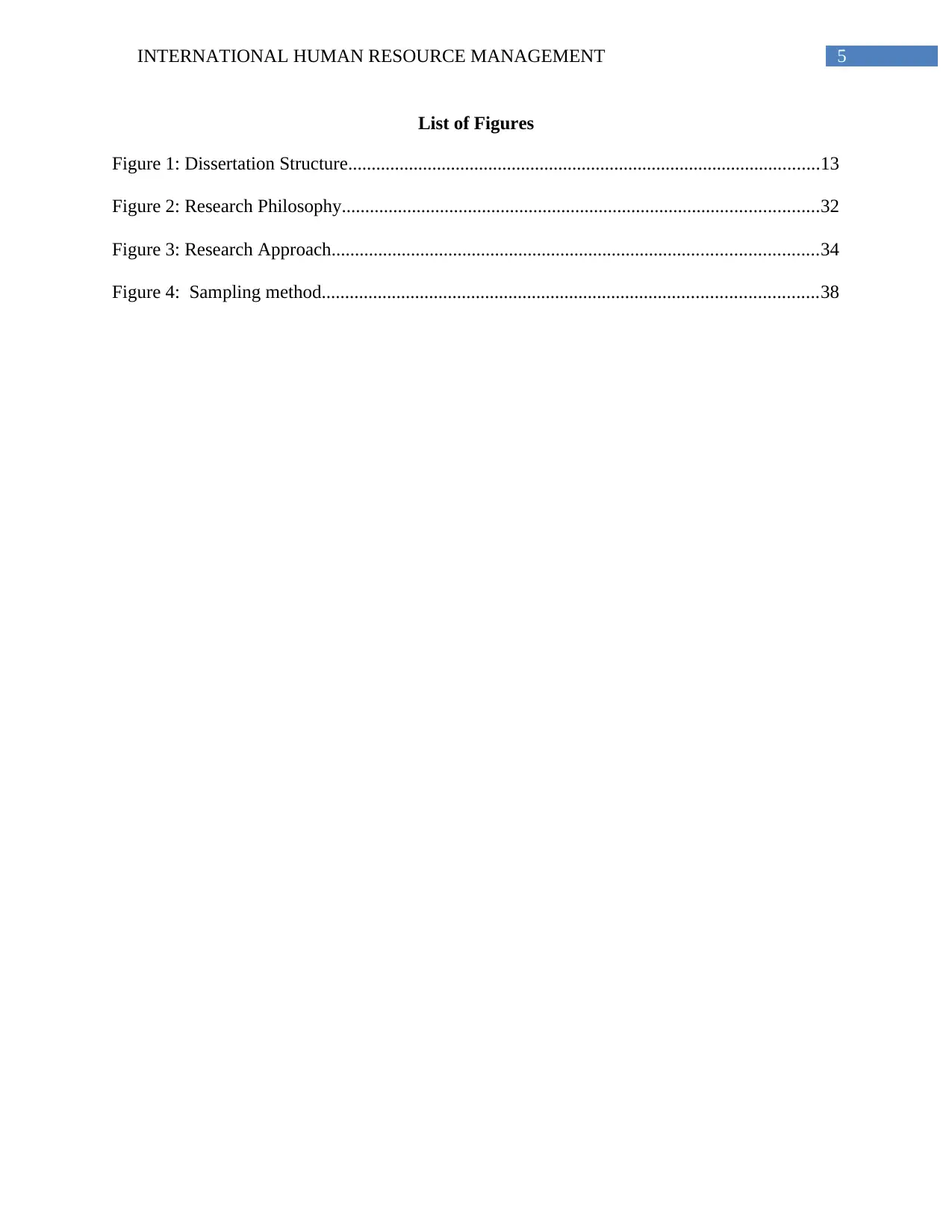
List of Figures
Figure 1: Dissertation Structure.....................................................................................................13
Figure 2: Research Philosophy......................................................................................................32
Figure 3: Research Approach........................................................................................................34
Figure 4: Sampling method..........................................................................................................38
List of Figures
Figure 1: Dissertation Structure.....................................................................................................13
Figure 2: Research Philosophy......................................................................................................32
Figure 3: Research Approach........................................................................................................34
Figure 4: Sampling method..........................................................................................................38
⊘ This is a preview!⊘
Do you want full access?
Subscribe today to unlock all pages.
Trusted by 1+ million students worldwide
6INTERNATIONAL HUMAN RESOURCE MANAGEMENT
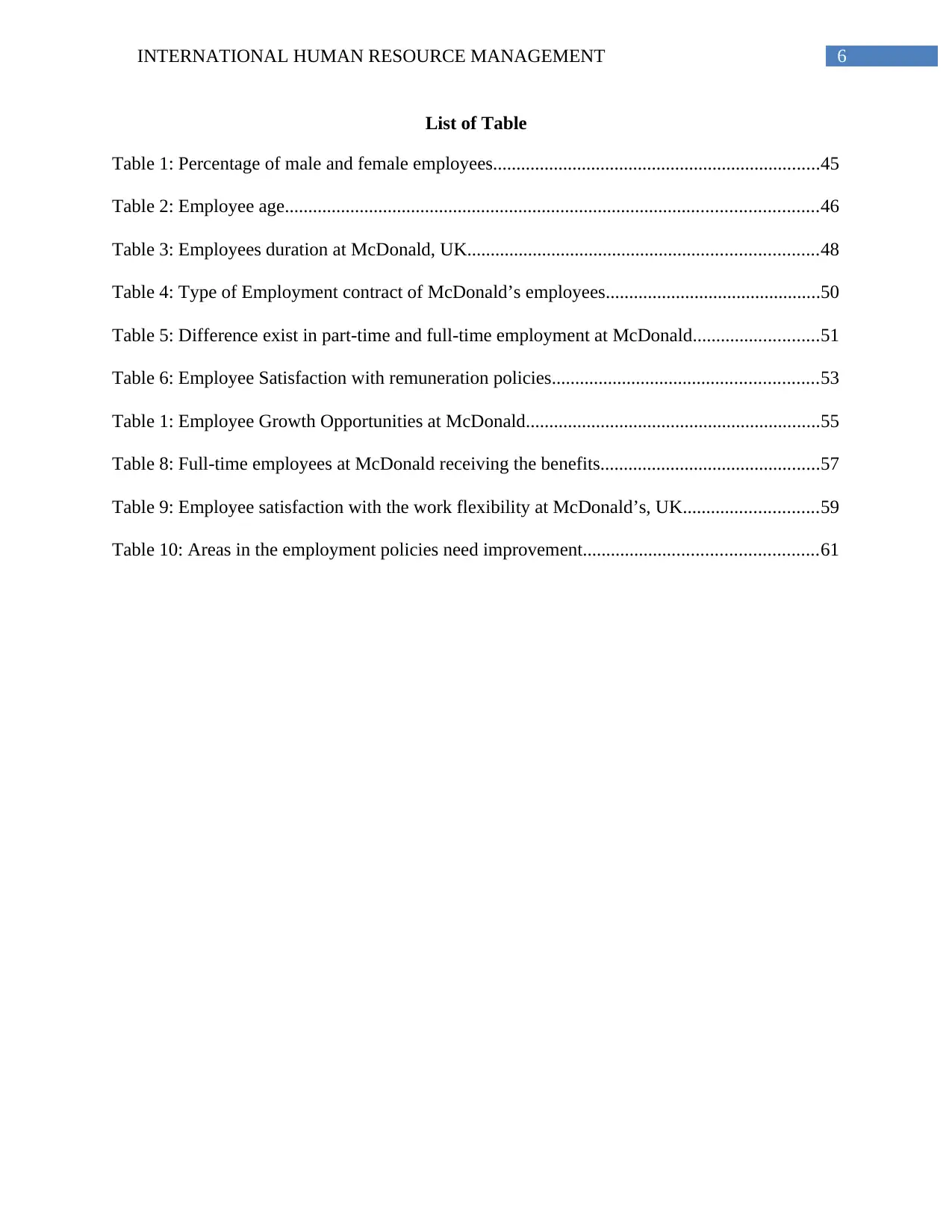
List of Table
Table 1: Percentage of male and female employees......................................................................45
Table 2: Employee age..................................................................................................................46
Table 3: Employees duration at McDonald, UK...........................................................................48
Table 4: Type of Employment contract of McDonald’s employees..............................................50
Table 5: Difference exist in part-time and full-time employment at McDonald...........................51
Table 6: Employee Satisfaction with remuneration policies.........................................................53
Table 1: Employee Growth Opportunities at McDonald...............................................................55
Table 8: Full-time employees at McDonald receiving the benefits...............................................57
Table 9: Employee satisfaction with the work flexibility at McDonald’s, UK.............................59
Table 10: Areas in the employment policies need improvement..................................................61
List of Table
Table 1: Percentage of male and female employees......................................................................45
Table 2: Employee age..................................................................................................................46
Table 3: Employees duration at McDonald, UK...........................................................................48
Table 4: Type of Employment contract of McDonald’s employees..............................................50
Table 5: Difference exist in part-time and full-time employment at McDonald...........................51
Table 6: Employee Satisfaction with remuneration policies.........................................................53
Table 1: Employee Growth Opportunities at McDonald...............................................................55
Table 8: Full-time employees at McDonald receiving the benefits...............................................57
Table 9: Employee satisfaction with the work flexibility at McDonald’s, UK.............................59
Table 10: Areas in the employment policies need improvement..................................................61
Paraphrase This Document
Need a fresh take? Get an instant paraphrase of this document with our AI Paraphraser
7INTERNATIONAL HUMAN RESOURCE MANAGEMENT
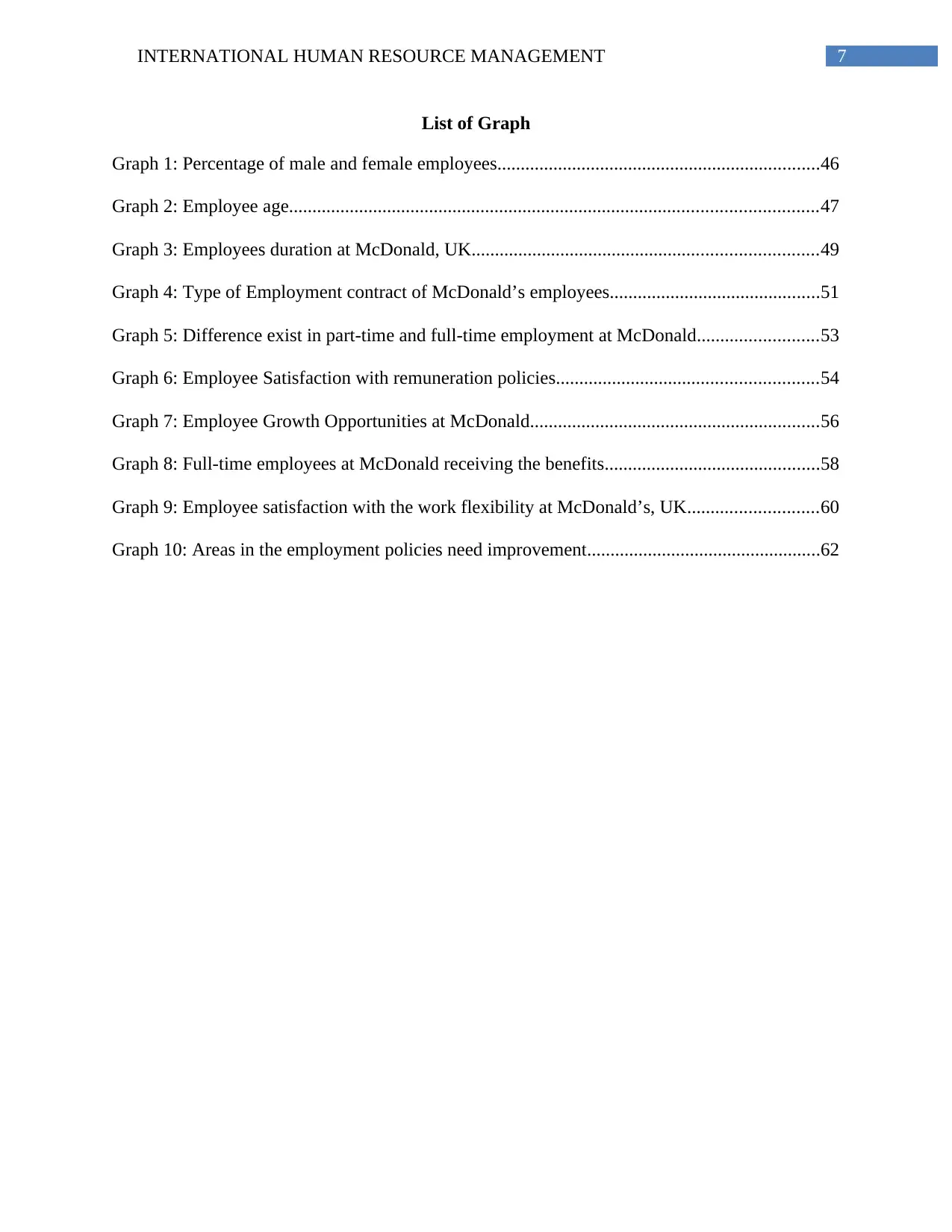
List of Graph
Graph 1: Percentage of male and female employees.....................................................................46
Graph 2: Employee age.................................................................................................................47
Graph 3: Employees duration at McDonald, UK..........................................................................49
Graph 4: Type of Employment contract of McDonald’s employees.............................................51
Graph 5: Difference exist in part-time and full-time employment at McDonald..........................53
Graph 6: Employee Satisfaction with remuneration policies........................................................54
Graph 7: Employee Growth Opportunities at McDonald..............................................................56
Graph 8: Full-time employees at McDonald receiving the benefits..............................................58
Graph 9: Employee satisfaction with the work flexibility at McDonald’s, UK............................60
Graph 10: Areas in the employment policies need improvement..................................................62
List of Graph
Graph 1: Percentage of male and female employees.....................................................................46
Graph 2: Employee age.................................................................................................................47
Graph 3: Employees duration at McDonald, UK..........................................................................49
Graph 4: Type of Employment contract of McDonald’s employees.............................................51
Graph 5: Difference exist in part-time and full-time employment at McDonald..........................53
Graph 6: Employee Satisfaction with remuneration policies........................................................54
Graph 7: Employee Growth Opportunities at McDonald..............................................................56
Graph 8: Full-time employees at McDonald receiving the benefits..............................................58
Graph 9: Employee satisfaction with the work flexibility at McDonald’s, UK............................60
Graph 10: Areas in the employment policies need improvement..................................................62
8INTERNATIONAL HUMAN RESOURCE MANAGEMENT
Topic- An Investigation into the levels of Employee Commitment of Full-Time and Part-
time Workers within McDonalds UK
CHAPTER 1-INRODUCTION
1.1 Introduction
The present dissertation explores the variation in the commitment of Full-Time and Part-
Time works in the organization. The Office of National Statistics of UK reported that almost
50% of overall service occupations fall under the part –time employment (Ons.gov.uk 2017). As
put forward by Giannikis and Mihail (2011) the flexibility in scheduling, particularly in the
service industry where the customer demand fluctuates across hours of the day of the week is
used to justify hiring part time employees. Gallie and Zhou (2011) claim that this is because of
the cost saving factors. The organizations have to make large investment to hire and retain the
full-time employees, whereas they could get the same work done by part-time employees
(Broadbent 2012). As put forward by Giannikis and Mihail (2011), in industrialized nations, the
proportion of part-time workers is particularly high among women. In many nations, the share of
part-time workers also remains high in the service sector among the low-skilled employees.
Topic- An Investigation into the levels of Employee Commitment of Full-Time and Part-
time Workers within McDonalds UK
CHAPTER 1-INRODUCTION
1.1 Introduction
The present dissertation explores the variation in the commitment of Full-Time and Part-
Time works in the organization. The Office of National Statistics of UK reported that almost
50% of overall service occupations fall under the part –time employment (Ons.gov.uk 2017). As
put forward by Giannikis and Mihail (2011) the flexibility in scheduling, particularly in the
service industry where the customer demand fluctuates across hours of the day of the week is
used to justify hiring part time employees. Gallie and Zhou (2011) claim that this is because of
the cost saving factors. The organizations have to make large investment to hire and retain the
full-time employees, whereas they could get the same work done by part-time employees
(Broadbent 2012). As put forward by Giannikis and Mihail (2011), in industrialized nations, the
proportion of part-time workers is particularly high among women. In many nations, the share of
part-time workers also remains high in the service sector among the low-skilled employees.
⊘ This is a preview!⊘
Do you want full access?
Subscribe today to unlock all pages.
Trusted by 1+ million students worldwide
9INTERNATIONAL HUMAN RESOURCE MANAGEMENT
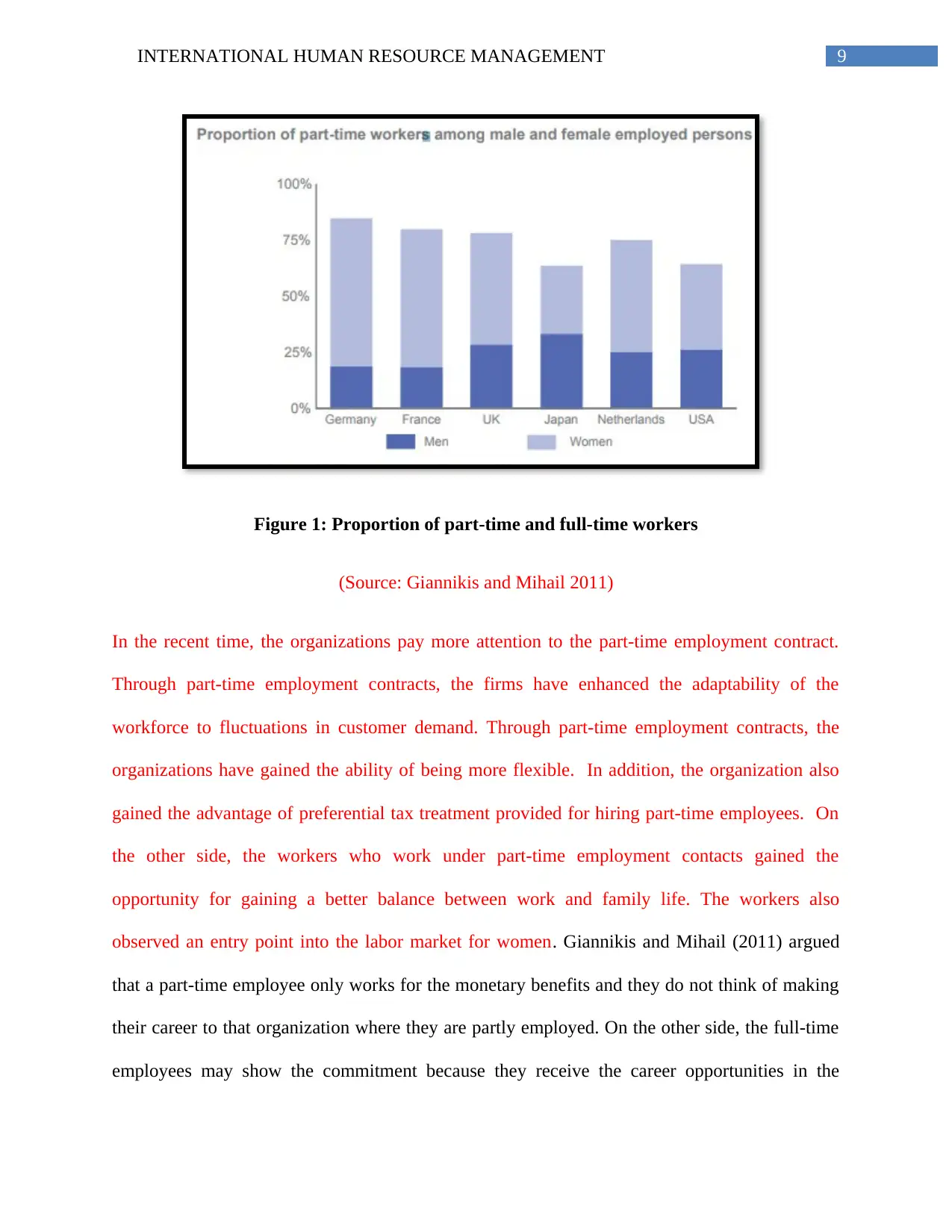
Figure 1: Proportion of part-time and full-time workers
(Source: Giannikis and Mihail 2011)
In the recent time, the organizations pay more attention to the part-time employment contract.
Through part-time employment contracts, the firms have enhanced the adaptability of the
workforce to fluctuations in customer demand. Through part-time employment contracts, the
organizations have gained the ability of being more flexible. In addition, the organization also
gained the advantage of preferential tax treatment provided for hiring part-time employees. On
the other side, the workers who work under part-time employment contacts gained the
opportunity for gaining a better balance between work and family life. The workers also
observed an entry point into the labor market for women. Giannikis and Mihail (2011) argued
that a part-time employee only works for the monetary benefits and they do not think of making
their career to that organization where they are partly employed. On the other side, the full-time
employees may show the commitment because they receive the career opportunities in the
Figure 1: Proportion of part-time and full-time workers
(Source: Giannikis and Mihail 2011)
In the recent time, the organizations pay more attention to the part-time employment contract.
Through part-time employment contracts, the firms have enhanced the adaptability of the
workforce to fluctuations in customer demand. Through part-time employment contracts, the
organizations have gained the ability of being more flexible. In addition, the organization also
gained the advantage of preferential tax treatment provided for hiring part-time employees. On
the other side, the workers who work under part-time employment contacts gained the
opportunity for gaining a better balance between work and family life. The workers also
observed an entry point into the labor market for women. Giannikis and Mihail (2011) argued
that a part-time employee only works for the monetary benefits and they do not think of making
their career to that organization where they are partly employed. On the other side, the full-time
employees may show the commitment because they receive the career opportunities in the
Paraphrase This Document
Need a fresh take? Get an instant paraphrase of this document with our AI Paraphraser
10INTERNATIONAL HUMAN RESOURCE MANAGEMENT
organizations where they are fully employed. Moreover, they are receiving all tangible and
intangible benefits from the organizations; thereby, they develop trust on their organizations.
However, in some industries such as law, FMCG (Fast Moving Consumer Goods) and others, the
benefits might differ.
Nonetheless, there are other related factors such as work roles and responsibility
associated with the part time and full time employment practice that differentiate these two
practices from each other. The work role and responsibilities of full-time and part-time
employees are probably same; the full time employees perform long chain of responsibilities. It
seems to be difficult to understand the different perception towards the job satisfaction and
commitment between full-time and part-time workers in the fast food industry since the part-
timers are half of the workforce in this sector. The present study investigates those factors more
intensively and provides a comprehensive outcome. In order to conduct the research practical
facts and issues, the present study is based upon the fast food organization McDonalds, UK.
McDonalds is one of the largest fast food chain restaurants in the world and it has more than
1200 restaurants in UK and the firm employs around 97000 people who work together to provide
services that customers know and trust (McDonald's 2017).
1.2 Scope of the Project
The present study investigates the level of commitment of full-time and part-time
employees. In order to perform the analysis with real-world evidence, the fast-food organization
McDonald’s UK has been considered. The study includes a primary analysis and to perform the
primary analysis, survey among the employees of McDonald’s, UK and interview among the
senior managers of the organization have been conducted. However, to select the members for
organizations where they are fully employed. Moreover, they are receiving all tangible and
intangible benefits from the organizations; thereby, they develop trust on their organizations.
However, in some industries such as law, FMCG (Fast Moving Consumer Goods) and others, the
benefits might differ.
Nonetheless, there are other related factors such as work roles and responsibility
associated with the part time and full time employment practice that differentiate these two
practices from each other. The work role and responsibilities of full-time and part-time
employees are probably same; the full time employees perform long chain of responsibilities. It
seems to be difficult to understand the different perception towards the job satisfaction and
commitment between full-time and part-time workers in the fast food industry since the part-
timers are half of the workforce in this sector. The present study investigates those factors more
intensively and provides a comprehensive outcome. In order to conduct the research practical
facts and issues, the present study is based upon the fast food organization McDonalds, UK.
McDonalds is one of the largest fast food chain restaurants in the world and it has more than
1200 restaurants in UK and the firm employs around 97000 people who work together to provide
services that customers know and trust (McDonald's 2017).
1.2 Scope of the Project
The present study investigates the level of commitment of full-time and part-time
employees. In order to perform the analysis with real-world evidence, the fast-food organization
McDonald’s UK has been considered. The study includes a primary analysis and to perform the
primary analysis, survey among the employees of McDonald’s, UK and interview among the
senior managers of the organization have been conducted. However, to select the members for
11INTERNATIONAL HUMAN RESOURCE MANAGEMENT
survey and interview, both probability and non-probability sampling methods have been applied.
Going forward, there are several types of research philosophies but positivism has been selected
for the present study, as this philosophy helps to derive the hidden truth from the facts related to
the level of commitment of part-time and full-time employees. On the other side, to conduct the
literature review, 30 different journals have been selected but 25 of them have been used in the
literature review and 5 have been excluded due to the lack of relevancy, reliability and validity.
1.3 Overview
A number of studies demonstrate that there is a significant difference between full-time
and part-time employees in respect to organizational commitment. Kim, Park and Chang (2011)
conducted a study on the differences existing in part-time and full-time employment contract and
they found that full-time employees are highly preferred in most of the large organizations. This
is related to commitment because the full-time employees receive a large set of benefits
compared due to their long chain of the job responsibilities and as they receive appropriate
benefits, they remain loyal to their organizations. Thus, the managers of fast food organizations
need to know whether is a difference between full-time and part-time employment in terms of
commitment exists. According to Beham, Präg and Drobnic (2012), have referred part-time
employees as “missing persons” in organizational research. As put forward by Gallie and Zhou
(2011), the study on part time employees is critical because of the sheer volume of the
emergence as the significant labor supply for the whole industry such as fast food and retail.
Beham, Präg and Drobnic (2012) found that part-time employees are preferred in small and
medium size organizations as the purpose of lowering the cost of operation. The part-time work
is frequent amongst the three major demographics groups; such as the younger workers, older
workers and the female workers (Beham, Präg and Drobnic 2012).
survey and interview, both probability and non-probability sampling methods have been applied.
Going forward, there are several types of research philosophies but positivism has been selected
for the present study, as this philosophy helps to derive the hidden truth from the facts related to
the level of commitment of part-time and full-time employees. On the other side, to conduct the
literature review, 30 different journals have been selected but 25 of them have been used in the
literature review and 5 have been excluded due to the lack of relevancy, reliability and validity.
1.3 Overview
A number of studies demonstrate that there is a significant difference between full-time
and part-time employees in respect to organizational commitment. Kim, Park and Chang (2011)
conducted a study on the differences existing in part-time and full-time employment contract and
they found that full-time employees are highly preferred in most of the large organizations. This
is related to commitment because the full-time employees receive a large set of benefits
compared due to their long chain of the job responsibilities and as they receive appropriate
benefits, they remain loyal to their organizations. Thus, the managers of fast food organizations
need to know whether is a difference between full-time and part-time employment in terms of
commitment exists. According to Beham, Präg and Drobnic (2012), have referred part-time
employees as “missing persons” in organizational research. As put forward by Gallie and Zhou
(2011), the study on part time employees is critical because of the sheer volume of the
emergence as the significant labor supply for the whole industry such as fast food and retail.
Beham, Präg and Drobnic (2012) found that part-time employees are preferred in small and
medium size organizations as the purpose of lowering the cost of operation. The part-time work
is frequent amongst the three major demographics groups; such as the younger workers, older
workers and the female workers (Beham, Präg and Drobnic 2012).
⊘ This is a preview!⊘
Do you want full access?
Subscribe today to unlock all pages.
Trusted by 1+ million students worldwide

1 out of 87


Related Documents


Your All-in-One AI-Powered Toolkit for Academic Success.
+13062052269
info@desklib.com
Available 24*7 on WhatsApp / Email
![[object Object]](/_next/static/media/star-bottom.7253800d.svg)
Unlock your academic potential
Copyright © 2020–2026 A2Z Services. All Rights Reserved. Developed and managed by ZUCOL.