International HRM: Strategies, Challenges, and Diverse Workplaces
VerifiedAdded on 2023/01/06
|10
|2675
|3
Report
AI Summary
This report provides a comprehensive overview of International Human Resource Management (IHRM). It defines IHRM and its objectives within a global context, emphasizing the importance of adapting HR strategies to international settings. The report details recruitment strategies, including attracting international talent, managing visa processes, and utilizing employee referral programs. It outlines selection criteria, focusing on adaptability, communication skills, and cultural sensitivity. Training and development strategies, particularly cross-cultural training, are discussed to prepare expats for international assignments. The report also addresses the challenges of hiring expats, such as high costs and burnout rates, and the complexities of managing a diverse workplace, including language barriers and resistance to change. The report highlights the importance of IHRM in achieving organizational objectives and enhancing company performance in the global market.
Running head: INTERNATIONAL HRM
International HRM
Name of Student:
Name of the University:
Author note:
International HRM
Name of Student:
Name of the University:
Author note:

Paraphrase This Document
Need a fresh take? Get an instant paraphrase of this document with our AI Paraphraser
1INTERNATIONAL HRM
Introduction:
International Human Resource is defined as the set of activities that the HR
department of a company takes care of by targeting their management strategies to an
international or global level (Stone and Deadrick 2015). The main aim of these strategies is to
be able to meet the various organizational objectives set by the company’s executives, along
with attempting to achieve competitive advantage over the other competitors present in the
community, either locally or on an international level. The functions of the IHRM department
does not vary so much from the usual HRM functions because it includes activities such as
recruitment, selection, training and the development of the employees in the organization
(Shen et al., 2015). However, including these there are other additional activities which apply
to the international scale such as the management of the global skills of all the employees
along with the technical management of the status of many expatriates working with the
company as well.
Companies are increasingly getting reeled into the concept of globalisation and the
appeal of expanding into foreign lands is not lost on the management. With globalisation
becoming such a commonly heard term, it is now becoming a threshold which companies
need to get past if they want to gain success in whichever market they are residing in (Garcia-
Lillo, Ubeda-Garcia and Marco-Lajara 2017). One of the other reasons why companies are
being somewhat forced into becoming global is because the technological advancements in
the society are making it easier for companies to do so, so taking a step as big as this does not
seem to be daunting on the executives and highly achievable.
Introduction:
International Human Resource is defined as the set of activities that the HR
department of a company takes care of by targeting their management strategies to an
international or global level (Stone and Deadrick 2015). The main aim of these strategies is to
be able to meet the various organizational objectives set by the company’s executives, along
with attempting to achieve competitive advantage over the other competitors present in the
community, either locally or on an international level. The functions of the IHRM department
does not vary so much from the usual HRM functions because it includes activities such as
recruitment, selection, training and the development of the employees in the organization
(Shen et al., 2015). However, including these there are other additional activities which apply
to the international scale such as the management of the global skills of all the employees
along with the technical management of the status of many expatriates working with the
company as well.
Companies are increasingly getting reeled into the concept of globalisation and the
appeal of expanding into foreign lands is not lost on the management. With globalisation
becoming such a commonly heard term, it is now becoming a threshold which companies
need to get past if they want to gain success in whichever market they are residing in (Garcia-
Lillo, Ubeda-Garcia and Marco-Lajara 2017). One of the other reasons why companies are
being somewhat forced into becoming global is because the technological advancements in
the society are making it easier for companies to do so, so taking a step as big as this does not
seem to be daunting on the executives and highly achievable.
2INTERNATIONAL HRM
Discussion:
Recruitment Strategies:
Only having the company expand into another foreign country means that the company’s
HR department will also have to think of ways to incorporate a diverse workplace in these
areas. This would require the IHRM to look into formulating strategies which will bring in
international talent to the company (Guest 2017). When hiring expats, it is important to keep
in mind that their visa process will also need to be handled by the company as the individual
alone cannot complete all the technical requirements. Each country has their own specific
immigration laws which will determine what sort of documents are required for an
international worker to be able to legally work in another country, with the permission of the
respective governments to do so. Due to this, it will be a good and effective initiate by the
executives working in the IHRM department to get help from legal experts in order to
navigate through the challenges.
It is also important for the HR executives to ensure that they have attractive relocation
packages because the employees will need some motivation to uproot their life and family
from one country and move to another one, where they might not know anyone around
(Cascio and Boudreau 2016). These relocation packages act as an incentive for the employees
to maintain their employed status with the company for a longer period of time, reducing the
stress on the IHRM department. The executives working with in the IHRM department
should also not ignore the help that they can get from their existing internal employees. This
is because these employees may have connections that go beyond the workplace and can
spread the word that the company is ready to hire international employees.
One of the primary benefits from asking the current employees for any possible leads for
new recruits is that they will be the one who will be in the best position to judge whether an
Discussion:
Recruitment Strategies:
Only having the company expand into another foreign country means that the company’s
HR department will also have to think of ways to incorporate a diverse workplace in these
areas. This would require the IHRM to look into formulating strategies which will bring in
international talent to the company (Guest 2017). When hiring expats, it is important to keep
in mind that their visa process will also need to be handled by the company as the individual
alone cannot complete all the technical requirements. Each country has their own specific
immigration laws which will determine what sort of documents are required for an
international worker to be able to legally work in another country, with the permission of the
respective governments to do so. Due to this, it will be a good and effective initiate by the
executives working in the IHRM department to get help from legal experts in order to
navigate through the challenges.
It is also important for the HR executives to ensure that they have attractive relocation
packages because the employees will need some motivation to uproot their life and family
from one country and move to another one, where they might not know anyone around
(Cascio and Boudreau 2016). These relocation packages act as an incentive for the employees
to maintain their employed status with the company for a longer period of time, reducing the
stress on the IHRM department. The executives working with in the IHRM department
should also not ignore the help that they can get from their existing internal employees. This
is because these employees may have connections that go beyond the workplace and can
spread the word that the company is ready to hire international employees.
One of the primary benefits from asking the current employees for any possible leads for
new recruits is that they will be the one who will be in the best position to judge whether an
⊘ This is a preview!⊘
Do you want full access?
Subscribe today to unlock all pages.

Trusted by 1+ million students worldwide
3INTERNATIONAL HRM
individual will be able to fit into the values of the company (Bakker 2015). One motivation
that can be offered by the company to ensure that these employees are actively looking for
more people is the placement of the employee referral program that states that the employee
will get a bonus if the person they referred is able to gain a permanent position in the
company.
Selection Criterion and Considerations:
It is imperative for the company to be able to have international knowledge along with
relevant experiencing when recruiting and selecting employees to work at the company. The
IHRM department is required to have adequate knowledge about what skills are available in
the different labour markets of the other foreign countries, and with this awareness they are
also expected to be able to foresee future changes in the market and be able to exploit these
opportunities efficiently (Deery and Jago 2015).
Cultural differences are expected to influence the selection procedure only to some
extent because most of these multinational companies usually tend to follow the same
methods as their local HR department. This is because the main aim of the selection process
remains unchanged – hire the most capable person for the job. However, the selection criteria
for selecting international workers is aimed at achieving the following five core areas:
Behaviour
Attitudes
Skills
Motivation
Personality
What sets IHRM selection process with the localised HRM process is that the HR executives
judge the incoming recruits according to their adaptability to new cultures, strength in
individual will be able to fit into the values of the company (Bakker 2015). One motivation
that can be offered by the company to ensure that these employees are actively looking for
more people is the placement of the employee referral program that states that the employee
will get a bonus if the person they referred is able to gain a permanent position in the
company.
Selection Criterion and Considerations:
It is imperative for the company to be able to have international knowledge along with
relevant experiencing when recruiting and selecting employees to work at the company. The
IHRM department is required to have adequate knowledge about what skills are available in
the different labour markets of the other foreign countries, and with this awareness they are
also expected to be able to foresee future changes in the market and be able to exploit these
opportunities efficiently (Deery and Jago 2015).
Cultural differences are expected to influence the selection procedure only to some
extent because most of these multinational companies usually tend to follow the same
methods as their local HR department. This is because the main aim of the selection process
remains unchanged – hire the most capable person for the job. However, the selection criteria
for selecting international workers is aimed at achieving the following five core areas:
Behaviour
Attitudes
Skills
Motivation
Personality
What sets IHRM selection process with the localised HRM process is that the HR executives
judge the incoming recruits according to their adaptability to new cultures, strength in
Paraphrase This Document
Need a fresh take? Get an instant paraphrase of this document with our AI Paraphraser
4INTERNATIONAL HRM
communication skills, their level of competence with technology, level of expertise as a
professional, whether they’ve had any global experiences and finally the most important
criteria, flexibility of the family to be able to move to the new country with the employee, if
offered a job (Stone et al. 2015).
Apart from the normal technical requirements being fulfilled by the employee which is
getting selected to work in the overseas operations, they also have to consider these following
attributes to ensure that this individual will be an added advantage to the company:
Comfortable with using technology, along with a highly developed sense of
technical skills that are required on the job
Effective and efficient communication skills that may help in closing the gap
between the different languages spoken by the different entities of the
organization.
Overall acceptance of diversity which includes tolerance of cultural, racial,
religious and habitual differences (Tulung 2017).
It is definitely the role of the HR department to ensure that the employees who are getting
selected are not taking on more work than reducing their work load. This means that during
the selection process of the new employee, previous experience in overseas organization is
considered, along with the employee’s family situation and circumstance.
Training and Development Strategies:
Multinational companies are increasingly hiring expats for their short and long term
international job assignments to satisfy the requirements such as:
Acquiring and transferring knowledge
Managing and/or coordinating a foreign subsidiary with respect to their mother
organizational practices
communication skills, their level of competence with technology, level of expertise as a
professional, whether they’ve had any global experiences and finally the most important
criteria, flexibility of the family to be able to move to the new country with the employee, if
offered a job (Stone et al. 2015).
Apart from the normal technical requirements being fulfilled by the employee which is
getting selected to work in the overseas operations, they also have to consider these following
attributes to ensure that this individual will be an added advantage to the company:
Comfortable with using technology, along with a highly developed sense of
technical skills that are required on the job
Effective and efficient communication skills that may help in closing the gap
between the different languages spoken by the different entities of the
organization.
Overall acceptance of diversity which includes tolerance of cultural, racial,
religious and habitual differences (Tulung 2017).
It is definitely the role of the HR department to ensure that the employees who are getting
selected are not taking on more work than reducing their work load. This means that during
the selection process of the new employee, previous experience in overseas organization is
considered, along with the employee’s family situation and circumstance.
Training and Development Strategies:
Multinational companies are increasingly hiring expats for their short and long term
international job assignments to satisfy the requirements such as:
Acquiring and transferring knowledge
Managing and/or coordinating a foreign subsidiary with respect to their mother
organizational practices
5INTERNATIONAL HRM
Fill a staffing vacancy
Uphold and maintain communication lines
Develop a competence and acceptance of global leadership.
The extent of the success that an expat can experience in the host country is greatly
determined by their capability to adjust in the cross-cultural environment (Albrecht et al.
2015). This is why it is important for expats to be prepared for the cultural shock that they
may experience in the host country, because if they are not able to do so then they cannot
adjust to the environment and it will result in them performing poorly professionally.
Cross-cultural training is defined as a planned intervention that takes place before the
employee shifts to the new country, and it is designed to increase the awareness and
knowledge level of the employee so that they are able to work effectively in the new country
and are able to be generally satisfied with their life in the unfamiliar country (Ran and Huang
2017). Through this process of training, the employees are able to have a better sense of the
cultural interactions that they are expected to face along with the adjustments they may have
to make to the way that they work, in order for it to comply with the organizational culture of
the company in the host country.
To be able to implement an effective cross cultural training program the IHRM
department must first identify what type of global assignment is being made, and then
according to that the training needs for the cross cultural training to be successful. After the
goals and objectives have been established and subsequently the training has been given to
the employee, it will be important for the company to be able to have effective evaluation
methods to prove that these training initiatives are being helpful.
Fill a staffing vacancy
Uphold and maintain communication lines
Develop a competence and acceptance of global leadership.
The extent of the success that an expat can experience in the host country is greatly
determined by their capability to adjust in the cross-cultural environment (Albrecht et al.
2015). This is why it is important for expats to be prepared for the cultural shock that they
may experience in the host country, because if they are not able to do so then they cannot
adjust to the environment and it will result in them performing poorly professionally.
Cross-cultural training is defined as a planned intervention that takes place before the
employee shifts to the new country, and it is designed to increase the awareness and
knowledge level of the employee so that they are able to work effectively in the new country
and are able to be generally satisfied with their life in the unfamiliar country (Ran and Huang
2017). Through this process of training, the employees are able to have a better sense of the
cultural interactions that they are expected to face along with the adjustments they may have
to make to the way that they work, in order for it to comply with the organizational culture of
the company in the host country.
To be able to implement an effective cross cultural training program the IHRM
department must first identify what type of global assignment is being made, and then
according to that the training needs for the cross cultural training to be successful. After the
goals and objectives have been established and subsequently the training has been given to
the employee, it will be important for the company to be able to have effective evaluation
methods to prove that these training initiatives are being helpful.
⊘ This is a preview!⊘
Do you want full access?
Subscribe today to unlock all pages.
Trusted by 1+ million students worldwide
6INTERNATIONAL HRM
Challenges of Hiring Expats
International recruitment is a way of helping businesses to be able to achieve their
organizational objectives along with boosting the company’s performance level
internationally (Laakso 2018). Before going ahead and hiring international talent, the
company executives should have weighed in their pros and cons with this issue. Some of the
pros of the situation include the following:
1. Expats will bring in valuable international experience that will enhance the
company’s processes.
2. Expats have a tendency to be self-motivated and daring individuals who are able to
look at life as a bigger picture because of them having left their comfort zone and
coming to this new country where they’re determined to make it worthwhile.
The advantages of hiring expats for an international organization is one of the best
avenues for expansion and it is increasingly proving itself to be a required aspect for these
multinational companies. Some of the challenges that the organizations face when hiring
expats are as follows:
1. Hiring expats can be an extremely expensive and problematic endeavour for the
companies to embark on. This is because the expenses of any issues related to
visas, differential taxed present in the host country and the home country and the
relocation, accommodation and transport allowances given to each of the expats
and their respective families. In this case, it will be important for the company to
determine if this higher cost is worth it.
2. There has been a lot of study that has been done on the challenges faced by
organization in hiring expats, and through these studies it has been proven that for
Challenges of Hiring Expats
International recruitment is a way of helping businesses to be able to achieve their
organizational objectives along with boosting the company’s performance level
internationally (Laakso 2018). Before going ahead and hiring international talent, the
company executives should have weighed in their pros and cons with this issue. Some of the
pros of the situation include the following:
1. Expats will bring in valuable international experience that will enhance the
company’s processes.
2. Expats have a tendency to be self-motivated and daring individuals who are able to
look at life as a bigger picture because of them having left their comfort zone and
coming to this new country where they’re determined to make it worthwhile.
The advantages of hiring expats for an international organization is one of the best
avenues for expansion and it is increasingly proving itself to be a required aspect for these
multinational companies. Some of the challenges that the organizations face when hiring
expats are as follows:
1. Hiring expats can be an extremely expensive and problematic endeavour for the
companies to embark on. This is because the expenses of any issues related to
visas, differential taxed present in the host country and the home country and the
relocation, accommodation and transport allowances given to each of the expats
and their respective families. In this case, it will be important for the company to
determine if this higher cost is worth it.
2. There has been a lot of study that has been done on the challenges faced by
organization in hiring expats, and through these studies it has been proven that for
Paraphrase This Document
Need a fresh take? Get an instant paraphrase of this document with our AI Paraphraser
7INTERNATIONAL HRM
an expat finds the job extremely demanding which has consequently resulted in a
high burnout rate.
3. There have been instances where companies have gotten disbarred from being
able to operate in certain countries because authorities of that country had found
the organization to not be following proper immigration requirements and
obligations of certain permits that are required. Companies need to pay extra close
attention to the position of the expats in their organization, as well as their
position in the country that they’re working in.
Challenges with a Diverse Workplace
With a multinational company, a diverse workplace comes with it and it is then the
responsibility of the executives working in the company to be able to tackle the difficulties
that it may arise among the employees working together (Hunt, Layton and Prince 2015).
Having a diverse workforce enables the company to be able to better formulate newer
innovation techniques because they will have the advantage of getting various different kinds
of point of view from the different employees, all of which will be important for the company
executives to take into consideration. Some of the challenges that workplaces faces when
diversity among employees increase are as follows:
Language barriers are required to be overcome in the workplace so that the
employees can efficiently work on their projects (Al-Jenaibi 2017).
Many employees will be highly resistant to change and will look at the new inflow
of employees as a negative thing and then the same has the potential to be
reflected in how they treat the other workers, causing imbalance and a hostile
environment in the workplace.
an expat finds the job extremely demanding which has consequently resulted in a
high burnout rate.
3. There have been instances where companies have gotten disbarred from being
able to operate in certain countries because authorities of that country had found
the organization to not be following proper immigration requirements and
obligations of certain permits that are required. Companies need to pay extra close
attention to the position of the expats in their organization, as well as their
position in the country that they’re working in.
Challenges with a Diverse Workplace
With a multinational company, a diverse workplace comes with it and it is then the
responsibility of the executives working in the company to be able to tackle the difficulties
that it may arise among the employees working together (Hunt, Layton and Prince 2015).
Having a diverse workforce enables the company to be able to better formulate newer
innovation techniques because they will have the advantage of getting various different kinds
of point of view from the different employees, all of which will be important for the company
executives to take into consideration. Some of the challenges that workplaces faces when
diversity among employees increase are as follows:
Language barriers are required to be overcome in the workplace so that the
employees can efficiently work on their projects (Al-Jenaibi 2017).
Many employees will be highly resistant to change and will look at the new inflow
of employees as a negative thing and then the same has the potential to be
reflected in how they treat the other workers, causing imbalance and a hostile
environment in the workplace.
8INTERNATIONAL HRM
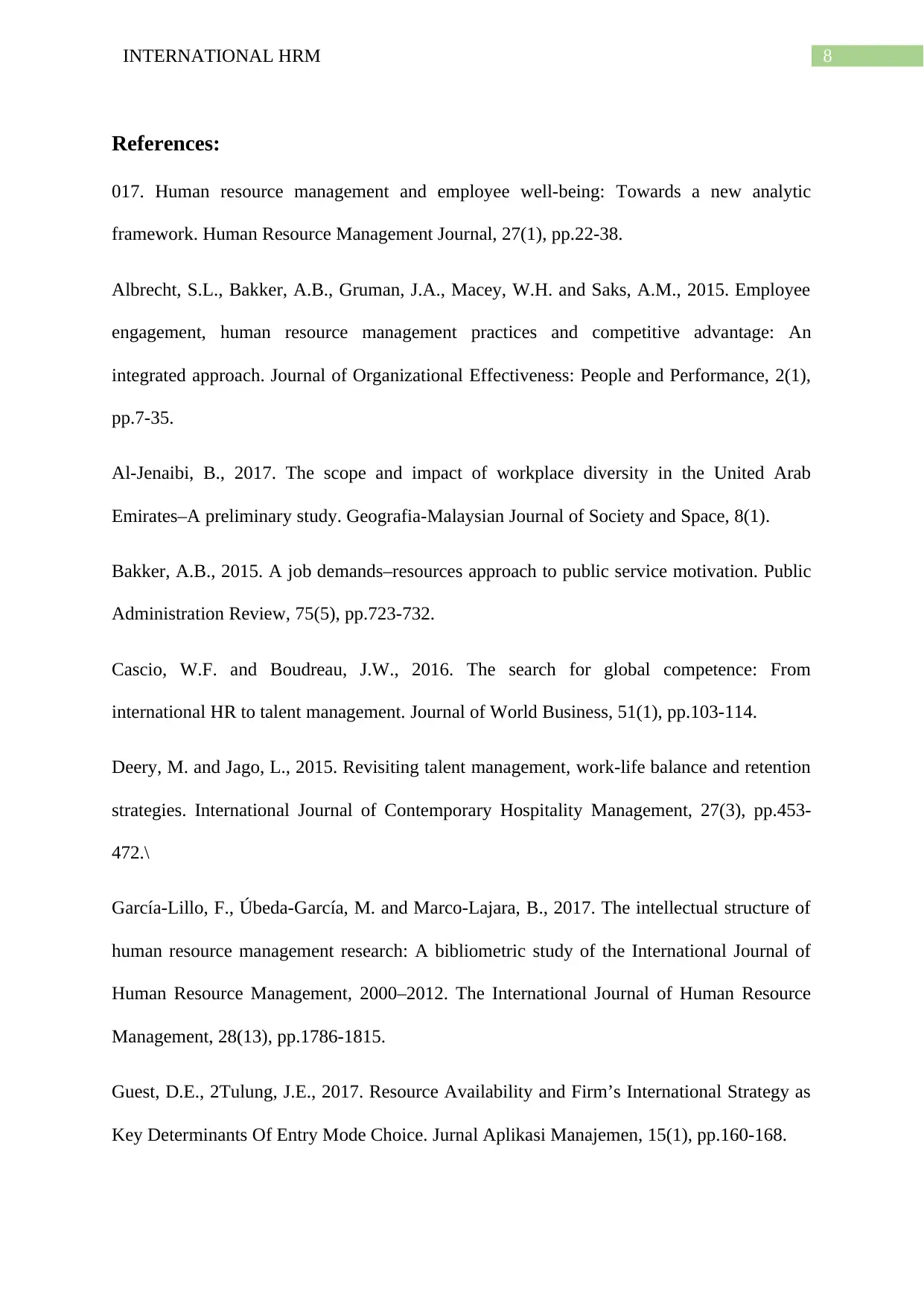
References:
017. Human resource management and employee well‐being: Towards a new analytic
framework. Human Resource Management Journal, 27(1), pp.22-38.
Albrecht, S.L., Bakker, A.B., Gruman, J.A., Macey, W.H. and Saks, A.M., 2015. Employee
engagement, human resource management practices and competitive advantage: An
integrated approach. Journal of Organizational Effectiveness: People and Performance, 2(1),
pp.7-35.
Al-Jenaibi, B., 2017. The scope and impact of workplace diversity in the United Arab
Emirates–A preliminary study. Geografia-Malaysian Journal of Society and Space, 8(1).
Bakker, A.B., 2015. A job demands–resources approach to public service motivation. Public
Administration Review, 75(5), pp.723-732.
Cascio, W.F. and Boudreau, J.W., 2016. The search for global competence: From
international HR to talent management. Journal of World Business, 51(1), pp.103-114.
Deery, M. and Jago, L., 2015. Revisiting talent management, work-life balance and retention
strategies. International Journal of Contemporary Hospitality Management, 27(3), pp.453-
472.\
García-Lillo, F., Úbeda-García, M. and Marco-Lajara, B., 2017. The intellectual structure of
human resource management research: A bibliometric study of the International Journal of
Human Resource Management, 2000–2012. The International Journal of Human Resource
Management, 28(13), pp.1786-1815.
Guest, D.E., 2Tulung, J.E., 2017. Resource Availability and Firm’s International Strategy as
Key Determinants Of Entry Mode Choice. Jurnal Aplikasi Manajemen, 15(1), pp.160-168.
References:
017. Human resource management and employee well‐being: Towards a new analytic
framework. Human Resource Management Journal, 27(1), pp.22-38.
Albrecht, S.L., Bakker, A.B., Gruman, J.A., Macey, W.H. and Saks, A.M., 2015. Employee
engagement, human resource management practices and competitive advantage: An
integrated approach. Journal of Organizational Effectiveness: People and Performance, 2(1),
pp.7-35.
Al-Jenaibi, B., 2017. The scope and impact of workplace diversity in the United Arab
Emirates–A preliminary study. Geografia-Malaysian Journal of Society and Space, 8(1).
Bakker, A.B., 2015. A job demands–resources approach to public service motivation. Public
Administration Review, 75(5), pp.723-732.
Cascio, W.F. and Boudreau, J.W., 2016. The search for global competence: From
international HR to talent management. Journal of World Business, 51(1), pp.103-114.
Deery, M. and Jago, L., 2015. Revisiting talent management, work-life balance and retention
strategies. International Journal of Contemporary Hospitality Management, 27(3), pp.453-
472.\
García-Lillo, F., Úbeda-García, M. and Marco-Lajara, B., 2017. The intellectual structure of
human resource management research: A bibliometric study of the International Journal of
Human Resource Management, 2000–2012. The International Journal of Human Resource
Management, 28(13), pp.1786-1815.
Guest, D.E., 2Tulung, J.E., 2017. Resource Availability and Firm’s International Strategy as
Key Determinants Of Entry Mode Choice. Jurnal Aplikasi Manajemen, 15(1), pp.160-168.
⊘ This is a preview!⊘
Do you want full access?
Subscribe today to unlock all pages.
Trusted by 1+ million students worldwide
9INTERNATIONAL HRM
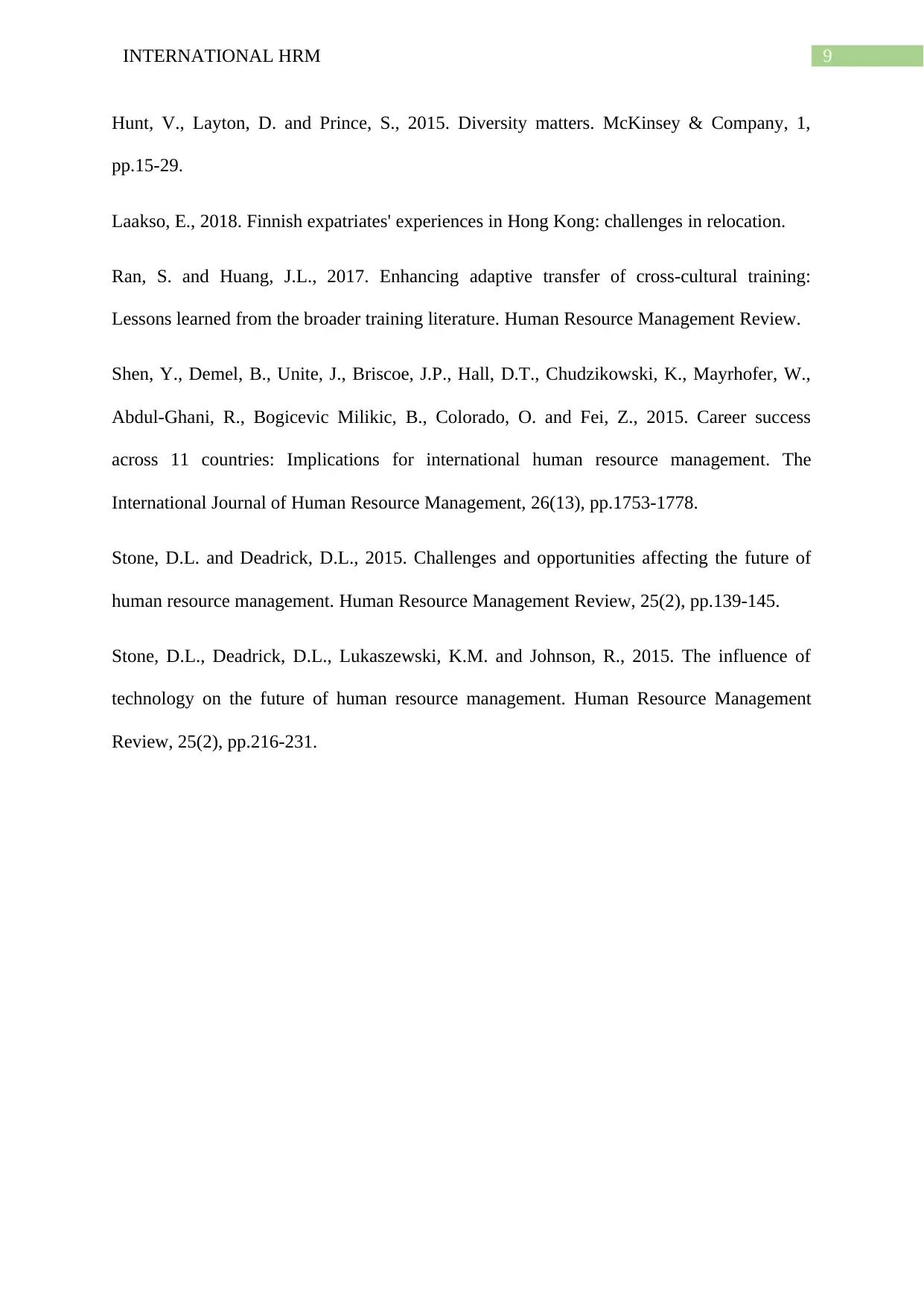
Hunt, V., Layton, D. and Prince, S., 2015. Diversity matters. McKinsey & Company, 1,
pp.15-29.
Laakso, E., 2018. Finnish expatriates' experiences in Hong Kong: challenges in relocation.
Ran, S. and Huang, J.L., 2017. Enhancing adaptive transfer of cross-cultural training:
Lessons learned from the broader training literature. Human Resource Management Review.
Shen, Y., Demel, B., Unite, J., Briscoe, J.P., Hall, D.T., Chudzikowski, K., Mayrhofer, W.,
Abdul-Ghani, R., Bogicevic Milikic, B., Colorado, O. and Fei, Z., 2015. Career success
across 11 countries: Implications for international human resource management. The
International Journal of Human Resource Management, 26(13), pp.1753-1778.
Stone, D.L. and Deadrick, D.L., 2015. Challenges and opportunities affecting the future of
human resource management. Human Resource Management Review, 25(2), pp.139-145.
Stone, D.L., Deadrick, D.L., Lukaszewski, K.M. and Johnson, R., 2015. The influence of
technology on the future of human resource management. Human Resource Management
Review, 25(2), pp.216-231.
Hunt, V., Layton, D. and Prince, S., 2015. Diversity matters. McKinsey & Company, 1,
pp.15-29.
Laakso, E., 2018. Finnish expatriates' experiences in Hong Kong: challenges in relocation.
Ran, S. and Huang, J.L., 2017. Enhancing adaptive transfer of cross-cultural training:
Lessons learned from the broader training literature. Human Resource Management Review.
Shen, Y., Demel, B., Unite, J., Briscoe, J.P., Hall, D.T., Chudzikowski, K., Mayrhofer, W.,
Abdul-Ghani, R., Bogicevic Milikic, B., Colorado, O. and Fei, Z., 2015. Career success
across 11 countries: Implications for international human resource management. The
International Journal of Human Resource Management, 26(13), pp.1753-1778.
Stone, D.L. and Deadrick, D.L., 2015. Challenges and opportunities affecting the future of
human resource management. Human Resource Management Review, 25(2), pp.139-145.
Stone, D.L., Deadrick, D.L., Lukaszewski, K.M. and Johnson, R., 2015. The influence of
technology on the future of human resource management. Human Resource Management
Review, 25(2), pp.216-231.

1 out of 10


Related Documents


Your All-in-One AI-Powered Toolkit for Academic Success.
+13062052269
info@desklib.com
Available 24*7 on WhatsApp / Email
![[object Object]](/_next/static/media/star-bottom.7253800d.svg)
Unlock your academic potential
Copyright © 2020–2026 A2Z Services. All Rights Reserved. Developed and managed by ZUCOL.