International Human Rights Law: Chapter 1 Analysis and Research
VerifiedAdded on 2022/12/30
|38
|11610
|67
Report
AI Summary
This report, focusing on International Human Rights Law, presents an in-depth analysis of Chapter 1, covering the background, research gaps, aims, and objectives. The study examines international legal instruments, treaties, and agreements aimed at promoting and protecting human rights at both domestic and international levels. It explores the evolution of human rights law, starting with the Universal Declaration of Human Rights in 1948, and its subsequent development through various covenants and conventions. The report investigates the role of international law in upholding human rights, assessing the effectiveness of treaties and agreements. It also addresses the mechanisms for state accountability and the challenges faced in ensuring human rights protection. The analysis incorporates literature reviews, identifies research questions, and proposes a hypothesis to test the effectiveness of international law in safeguarding human rights. Furthermore, it explores the purpose of the study to determine whether international law is effective in protecting human rights, with a focus on the role of international bodies and mechanisms.
Running head: INTERNATIONAL HUMAN RIGHTS LAW
International Human Rights Law
Name of the Student
Name of the University
Author Note
International Human Rights Law
Name of the Student
Name of the University
Author Note

Paraphrase This Document
Need a fresh take? Get an instant paraphrase of this document with our AI Paraphraser
1INTERNATIONAL HUMAN RIGHTS LAW
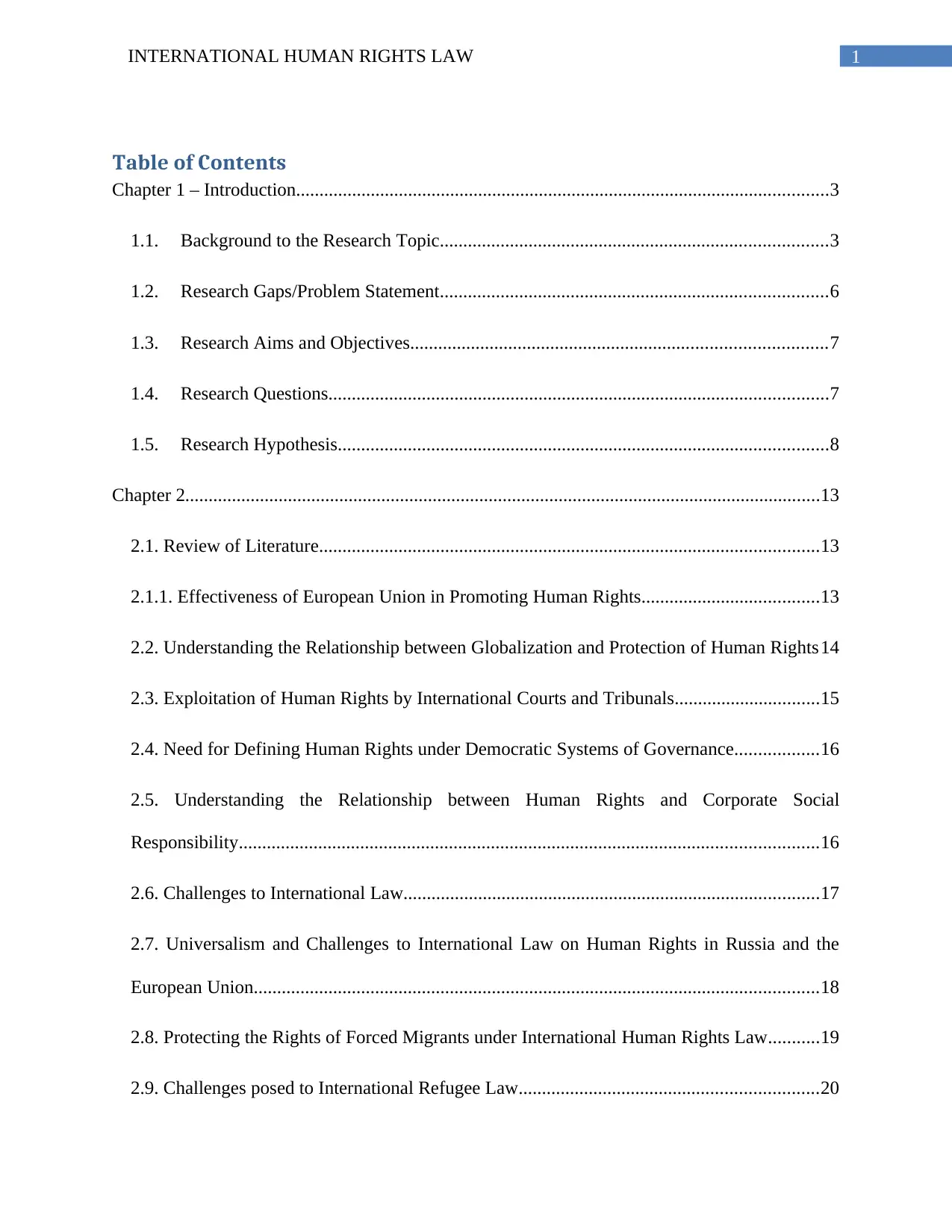
Table of Contents
Chapter 1 – Introduction..................................................................................................................3
1.1. Background to the Research Topic...................................................................................3
1.2. Research Gaps/Problem Statement...................................................................................6
1.3. Research Aims and Objectives.........................................................................................7
1.4. Research Questions...........................................................................................................7
1.5. Research Hypothesis.........................................................................................................8
Chapter 2........................................................................................................................................13
2.1. Review of Literature...........................................................................................................13
2.1.1. Effectiveness of European Union in Promoting Human Rights......................................13
2.2. Understanding the Relationship between Globalization and Protection of Human Rights14
2.3. Exploitation of Human Rights by International Courts and Tribunals...............................15
2.4. Need for Defining Human Rights under Democratic Systems of Governance..................16
2.5. Understanding the Relationship between Human Rights and Corporate Social
Responsibility............................................................................................................................16
2.6. Challenges to International Law.........................................................................................17
2.7. Universalism and Challenges to International Law on Human Rights in Russia and the
European Union.........................................................................................................................18
2.8. Protecting the Rights of Forced Migrants under International Human Rights Law...........19
2.9. Challenges posed to International Refugee Law................................................................20
Table of Contents
Chapter 1 – Introduction..................................................................................................................3
1.1. Background to the Research Topic...................................................................................3
1.2. Research Gaps/Problem Statement...................................................................................6
1.3. Research Aims and Objectives.........................................................................................7
1.4. Research Questions...........................................................................................................7
1.5. Research Hypothesis.........................................................................................................8
Chapter 2........................................................................................................................................13
2.1. Review of Literature...........................................................................................................13
2.1.1. Effectiveness of European Union in Promoting Human Rights......................................13
2.2. Understanding the Relationship between Globalization and Protection of Human Rights14
2.3. Exploitation of Human Rights by International Courts and Tribunals...............................15
2.4. Need for Defining Human Rights under Democratic Systems of Governance..................16
2.5. Understanding the Relationship between Human Rights and Corporate Social
Responsibility............................................................................................................................16
2.6. Challenges to International Law.........................................................................................17
2.7. Universalism and Challenges to International Law on Human Rights in Russia and the
European Union.........................................................................................................................18
2.8. Protecting the Rights of Forced Migrants under International Human Rights Law...........19
2.9. Challenges posed to International Refugee Law................................................................20
2INTERNATIONAL HUMAN RIGHTS LAW
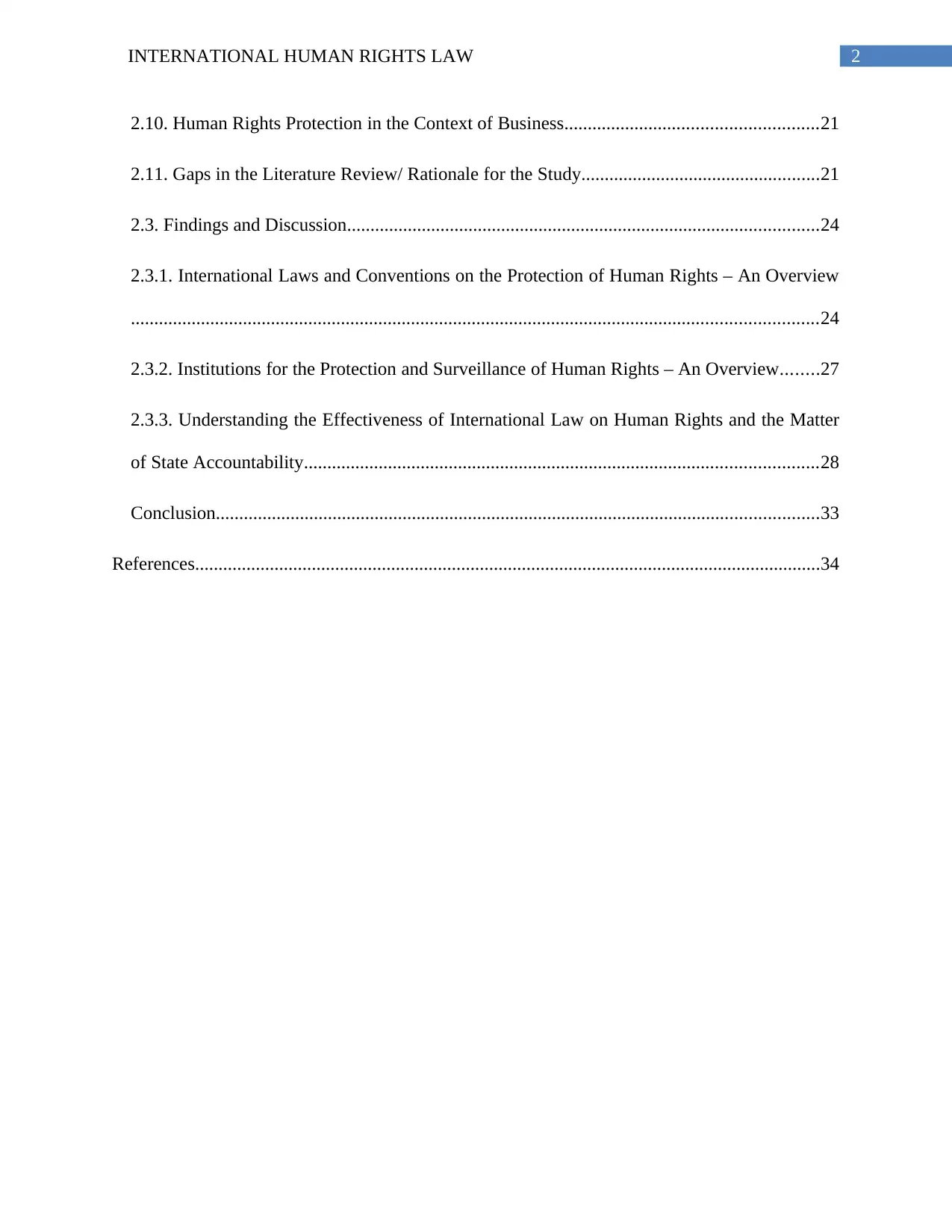
2.10. Human Rights Protection in the Context of Business......................................................21
2.11. Gaps in the Literature Review/ Rationale for the Study...................................................21
2.3. Findings and Discussion.....................................................................................................24
2.3.1. International Laws and Conventions on the Protection of Human Rights – An Overview
...................................................................................................................................................24
2.3.2. Institutions for the Protection and Surveillance of Human Rights – An Overview........27
2.3.3. Understanding the Effectiveness of International Law on Human Rights and the Matter
of State Accountability..............................................................................................................28
Conclusion.................................................................................................................................33
References......................................................................................................................................34
2.10. Human Rights Protection in the Context of Business......................................................21
2.11. Gaps in the Literature Review/ Rationale for the Study...................................................21
2.3. Findings and Discussion.....................................................................................................24
2.3.1. International Laws and Conventions on the Protection of Human Rights – An Overview
...................................................................................................................................................24
2.3.2. Institutions for the Protection and Surveillance of Human Rights – An Overview........27
2.3.3. Understanding the Effectiveness of International Law on Human Rights and the Matter
of State Accountability..............................................................................................................28
Conclusion.................................................................................................................................33
References......................................................................................................................................34
⊘ This is a preview!⊘
Do you want full access?
Subscribe today to unlock all pages.

Trusted by 1+ million students worldwide
3INTERNATIONAL HUMAN RIGHTS LAW
Chapter 1 – Introduction
1.1. Background to the Research Topic
International law on human rights refers to the legal instruments that are aimed at
promoting as well as protecting human rights at both the domestic and the international levels. It
is composed primarily of what may be termed as treaty law, that is, agreements of a legally
binding nature that are drawn up between state parties, and which are based on the principle of
customary international law.1 Customary international law refers to the legal rules and
regulations that have been derived from state practices especially practices of a consistent nature.
Although customary law and treaty law are seen to form the main basis of any international law
on human rights, various other types of legal instruments such as principles, guiding principles,
guidelines and declarations that have been adopted at the international level make a contribution
to the implementation, development as well as general understanding of human rights law. 2
In the view of Greenwood (2018), when it comes to the implementation of international
law on human rights, it needs to be remembered first and foremost, that enforcement is
something that can take place at both the domestic and international level, depending on whether
or not the country where the law is attempting to be enforced is a country that accepts human
rights law in the first place. 3States which are seen to sign and ratify treaties on the protection of
human rights, are states that make an official commitment to protecting and upholding human
rights and to adopting the measures that are needed to avoid human rights being violated for any
citizen. According to Claire (2017), it is also the responsibility of such states to make sure of the
1 Greenwood C, 'International Law And The Use Of Force' [2018] Oxford University Press
2 Ibid
3 Ibid
Chapter 1 – Introduction
1.1. Background to the Research Topic
International law on human rights refers to the legal instruments that are aimed at
promoting as well as protecting human rights at both the domestic and the international levels. It
is composed primarily of what may be termed as treaty law, that is, agreements of a legally
binding nature that are drawn up between state parties, and which are based on the principle of
customary international law.1 Customary international law refers to the legal rules and
regulations that have been derived from state practices especially practices of a consistent nature.
Although customary law and treaty law are seen to form the main basis of any international law
on human rights, various other types of legal instruments such as principles, guiding principles,
guidelines and declarations that have been adopted at the international level make a contribution
to the implementation, development as well as general understanding of human rights law. 2
In the view of Greenwood (2018), when it comes to the implementation of international
law on human rights, it needs to be remembered first and foremost, that enforcement is
something that can take place at both the domestic and international level, depending on whether
or not the country where the law is attempting to be enforced is a country that accepts human
rights law in the first place. 3States which are seen to sign and ratify treaties on the protection of
human rights, are states that make an official commitment to protecting and upholding human
rights and to adopting the measures that are needed to avoid human rights being violated for any
citizen. According to Claire (2017), it is also the responsibility of such states to make sure of the
1 Greenwood C, 'International Law And The Use Of Force' [2018] Oxford University Press
2 Ibid
3 Ibid
Paraphrase This Document
Need a fresh take? Get an instant paraphrase of this document with our AI Paraphraser
4INTERNATIONAL HUMAN RIGHTS LAW
fact that their domestic laws are those that are compatible or in keeping with international
standards of human rights. In the event that domestic law or the law of the land is not successful
in preserving and protecting human rights, it is possible for the injured parties to take recourse to
international laws on human rights in order to seek and acquire justice for the wrongs that have
been done to them. 4
As per the view of Gibson (2017), although international law on human rights is
something that bears a lot of resemblance to international humanitarian law, it is important to
remember that an important distinction exists between both types of law. Both laws are seen to
complement one another largely because of the fact the substantive norms which are contained in
such laws are related or similar to one another. For Hathaway (2018), the international
humanitarian legal regime is also one which is seen to apply exclusively to situations of armed
conflict, including the concept and occurrence of occupation, when both of the legal regimes are
made to apply in tandem with one another. 5
According to Hathaway (2018), international human rights law in the modern day and
age can be said to have come into existence with the drafting of what may be termed as the
Universal Declaration of Human Rights in the year of 1948. This is a non-binding legal
agreement that was drafted initially as a standard common for the achievement of humanitarian
goals and objectives and as such it spells out all the economic, civil, social as well as cultural
rights which human beings all over the world need to be given access to.6 The Universal
4 Claire M, 'The Emerging Norm Of Corporate Social Responsibility. In Human Rights And Corporations' [2017]
Routledge
5 Gibson KA Syrnington, 'Business And Human Rights: Current And Future Challenges'
6 Hathaway J, 'Special Feature: Eighth Colloquium On Challenges In International Refugee Law' (2018) 39
Michigan Journal of International Law
fact that their domestic laws are those that are compatible or in keeping with international
standards of human rights. In the event that domestic law or the law of the land is not successful
in preserving and protecting human rights, it is possible for the injured parties to take recourse to
international laws on human rights in order to seek and acquire justice for the wrongs that have
been done to them. 4
As per the view of Gibson (2017), although international law on human rights is
something that bears a lot of resemblance to international humanitarian law, it is important to
remember that an important distinction exists between both types of law. Both laws are seen to
complement one another largely because of the fact the substantive norms which are contained in
such laws are related or similar to one another. For Hathaway (2018), the international
humanitarian legal regime is also one which is seen to apply exclusively to situations of armed
conflict, including the concept and occurrence of occupation, when both of the legal regimes are
made to apply in tandem with one another. 5
According to Hathaway (2018), international human rights law in the modern day and
age can be said to have come into existence with the drafting of what may be termed as the
Universal Declaration of Human Rights in the year of 1948. This is a non-binding legal
agreement that was drafted initially as a standard common for the achievement of humanitarian
goals and objectives and as such it spells out all the economic, civil, social as well as cultural
rights which human beings all over the world need to be given access to.6 The Universal
4 Claire M, 'The Emerging Norm Of Corporate Social Responsibility. In Human Rights And Corporations' [2017]
Routledge
5 Gibson KA Syrnington, 'Business And Human Rights: Current And Future Challenges'
6 Hathaway J, 'Special Feature: Eighth Colloquium On Challenges In International Refugee Law' (2018) 39
Michigan Journal of International Law
5INTERNATIONAL HUMAN RIGHTS LAW
Declaration of Human Rights of 1948 is also an instrument that is accepted worldwide as one
which outlines the fundamental human rights norms which ought to be expected and respected in
each and every country of the world, with no exception being made in this respect. Together with
the International Covenant on Economic, Social and Cultural Rights and the International
Covenant on Civil and Political Rights, the Universal Declaration of Human rights forms what
may be termed as the International Human Rights Bill, a legal instrument that must be adhered to
by all countries of the world that believe in and profess to protect human rights and human
dignity rather than perpetrating its violation and abuse.7
As stated by Gready (2019), a number of international treaties and agreements on the
subject of human rights have been adopted ever since the year of 1945, all of which confer some
sort of legal form or basis on human rights of an inherent nature, and which have made a
contribution to human rights as a body being developed and expanded by a considerable extent8.
Some examples of such human rights treaties and agreements are Convention relating to the
Status of Refugees of 1951, Convention on Prevention and Punishment of the Crime of
Genocide, Convention on Elimination of All Forms of Discrimination against Women,
Conventional on Elimination of All Forms of Racial Discrimination, UN Convention on the
Rights of the Child, UN Convention on Torture, UN Convention on the Rights of People with
Disabilities, Convention on Protection of All Persons from Enforced Disappearance, and
Convention on the Protection of Rights of all Migrant Workers and Members of their
Families.9
7 Ibid
8 Paul Gready, 'Reflections On A Human Rights Decade: Near And Far' (2019) 11 Journal of Human Rights
Practice.
9 Greenwood C, 'International Law And The Use Of Force' [2018] Oxford University Press
Declaration of Human Rights of 1948 is also an instrument that is accepted worldwide as one
which outlines the fundamental human rights norms which ought to be expected and respected in
each and every country of the world, with no exception being made in this respect. Together with
the International Covenant on Economic, Social and Cultural Rights and the International
Covenant on Civil and Political Rights, the Universal Declaration of Human rights forms what
may be termed as the International Human Rights Bill, a legal instrument that must be adhered to
by all countries of the world that believe in and profess to protect human rights and human
dignity rather than perpetrating its violation and abuse.7
As stated by Gready (2019), a number of international treaties and agreements on the
subject of human rights have been adopted ever since the year of 1945, all of which confer some
sort of legal form or basis on human rights of an inherent nature, and which have made a
contribution to human rights as a body being developed and expanded by a considerable extent8.
Some examples of such human rights treaties and agreements are Convention relating to the
Status of Refugees of 1951, Convention on Prevention and Punishment of the Crime of
Genocide, Convention on Elimination of All Forms of Discrimination against Women,
Conventional on Elimination of All Forms of Racial Discrimination, UN Convention on the
Rights of the Child, UN Convention on Torture, UN Convention on the Rights of People with
Disabilities, Convention on Protection of All Persons from Enforced Disappearance, and
Convention on the Protection of Rights of all Migrant Workers and Members of their
Families.9
7 Ibid
8 Paul Gready, 'Reflections On A Human Rights Decade: Near And Far' (2019) 11 Journal of Human Rights
Practice.
9 Greenwood C, 'International Law And The Use Of Force' [2018] Oxford University Press
⊘ This is a preview!⊘
Do you want full access?
Subscribe today to unlock all pages.
Trusted by 1+ million students worldwide
6INTERNATIONAL HUMAN RIGHTS LAW
One of the most important roles of international law on human rights is that it prescribes
all the obligations that are bound to be respected by states. As stated by Greenwood (2018), by
ratifying an international treaty on human rights, it is expected that is expected that the state will
introduce domestic legislation or domestic measures that are compatible with all the obligations
that have been laid out in this treaty. 10For Hathaway (2018), when ratifying an international
treaty, a state assumes duties and obligations under the purview of international law that are
meant for the protection, preservation and fulfillment of human rights standards. States, in other
words, are placed under the obligation of preventing human rights violations and protecting
human dignity and human rights in their sovereign territory, and must refrain as such from
curtailing or interfering in the process of enjoyment of human rights by the people of the
country. It is under obligation to protection groups of people as well as individuals from the
abuse of human rights and has to undertake the positive course of action that is necessary for
making sure that basic human rights are enjoyed and respected by people of the country. 11
Gready (2019), states that there are of course a number of monitoring mechanisms that
are in place to make sure of the fact that human rights treaties or instruments as signed and
ratified by states are those that are being complied with. These are monitoring mechanisms or
bodies that have been created by the United Nations Organization and which are comprised of
what may be termed as independent experts for the most part. Secretariat support is received and
enjoyed by most of these bodies from the Office of the High Commissioner of Human Rights. It
may also be pointed out in this respect that similar mechanisms are not seen to exist for ensuring
the adequate protection and implementation of international humanitarian law.12
10 Ibid
11 Hathaway J, 'Special Feature: Eighth Colloquium On Challenges In International Refugee Law' (2018) 39
Michigan Journal of International Law
12 Paul Gready, 'Reflections On A Human Rights Decade: Near And Far' (2019) 11 Journal of Human Rights Practice.
One of the most important roles of international law on human rights is that it prescribes
all the obligations that are bound to be respected by states. As stated by Greenwood (2018), by
ratifying an international treaty on human rights, it is expected that is expected that the state will
introduce domestic legislation or domestic measures that are compatible with all the obligations
that have been laid out in this treaty. 10For Hathaway (2018), when ratifying an international
treaty, a state assumes duties and obligations under the purview of international law that are
meant for the protection, preservation and fulfillment of human rights standards. States, in other
words, are placed under the obligation of preventing human rights violations and protecting
human dignity and human rights in their sovereign territory, and must refrain as such from
curtailing or interfering in the process of enjoyment of human rights by the people of the
country. It is under obligation to protection groups of people as well as individuals from the
abuse of human rights and has to undertake the positive course of action that is necessary for
making sure that basic human rights are enjoyed and respected by people of the country. 11
Gready (2019), states that there are of course a number of monitoring mechanisms that
are in place to make sure of the fact that human rights treaties or instruments as signed and
ratified by states are those that are being complied with. These are monitoring mechanisms or
bodies that have been created by the United Nations Organization and which are comprised of
what may be termed as independent experts for the most part. Secretariat support is received and
enjoyed by most of these bodies from the Office of the High Commissioner of Human Rights. It
may also be pointed out in this respect that similar mechanisms are not seen to exist for ensuring
the adequate protection and implementation of international humanitarian law.12
10 Ibid
11 Hathaway J, 'Special Feature: Eighth Colloquium On Challenges In International Refugee Law' (2018) 39
Michigan Journal of International Law
12 Paul Gready, 'Reflections On A Human Rights Decade: Near And Far' (2019) 11 Journal of Human Rights Practice.
Paraphrase This Document
Need a fresh take? Get an instant paraphrase of this document with our AI Paraphraser
7INTERNATIONAL HUMAN RIGHTS LAW
1.2. Research Gaps/Problem Statement
A decent body of literature is seen to exist on international legal instruments for the
protection of human rights, as well as the international human rights standards that countries
around the world are expected to follow or to adhere to in order to ensure human rights is
something that is protected and respected on their individual territories. The literature clearly
establishes that governments around the world must take cognizance of international human
rights law and standards. Yet little information exists on how successful international treaties and
agreements can be in upholding and protecting human rights. This research aims to investigate
and provide an understanding of how international law has come to the aid of persons whose
human rights have been violated, assessing in the process the effectiveness of international law
in human rights in this respect.
1.3. Research Aims and Objectives
Some of the important aims and objectives of this research study are as follows –
To arrive at an understanding of the various treaties and agreements that exist on the
protection of human rights
To determine the role of human rights organizations and bodies that have been created by
the UN for ensuring adequate protection of human rights
To assess the effectiveness of international treaties on human rights in protecting and
upholding human rights.
To understand the ways and means by which states can be made more accountable in
protecting and upholding international treaties on human rights.
1.2. Research Gaps/Problem Statement
A decent body of literature is seen to exist on international legal instruments for the
protection of human rights, as well as the international human rights standards that countries
around the world are expected to follow or to adhere to in order to ensure human rights is
something that is protected and respected on their individual territories. The literature clearly
establishes that governments around the world must take cognizance of international human
rights law and standards. Yet little information exists on how successful international treaties and
agreements can be in upholding and protecting human rights. This research aims to investigate
and provide an understanding of how international law has come to the aid of persons whose
human rights have been violated, assessing in the process the effectiveness of international law
in human rights in this respect.
1.3. Research Aims and Objectives
Some of the important aims and objectives of this research study are as follows –
To arrive at an understanding of the various treaties and agreements that exist on the
protection of human rights
To determine the role of human rights organizations and bodies that have been created by
the UN for ensuring adequate protection of human rights
To assess the effectiveness of international treaties on human rights in protecting and
upholding human rights.
To understand the ways and means by which states can be made more accountable in
protecting and upholding international treaties on human rights.
8INTERNATIONAL HUMAN RIGHTS LAW
1.4. Research Questions
Some of the questions which this research project seeks to provide an answer to are as follows –
RQ 1 – What are the various treaties and agreements that exist on the protection of human
rights?
RQ 2 – What is the exact role that is played by organizations that have been created by the UN
in ensuring adequate protection of human rights?
RQ 3 – How effective are international treaties on human rights in actually protecting and
upholding human rights?
RQ -4 – What are the ways and means by which states can be made more accountable in
protecting and upholding international treaties on human rights?
1.5. Research Hypothesis
This research project aims to test the following hypothesis -
Hypothesis 1 - International law on human rights is effective when it comes to the protection of
human rights
Hypothesis 2 - International law on human rights is not effective when it comes to the protection
of human rights
1.6. Purpose of the Study
The purpose of this research is quite specific, which is to determine whether or not
international law appears to be effective when it comes to the protection of human rights. Human
1.4. Research Questions
Some of the questions which this research project seeks to provide an answer to are as follows –
RQ 1 – What are the various treaties and agreements that exist on the protection of human
rights?
RQ 2 – What is the exact role that is played by organizations that have been created by the UN
in ensuring adequate protection of human rights?
RQ 3 – How effective are international treaties on human rights in actually protecting and
upholding human rights?
RQ -4 – What are the ways and means by which states can be made more accountable in
protecting and upholding international treaties on human rights?
1.5. Research Hypothesis
This research project aims to test the following hypothesis -
Hypothesis 1 - International law on human rights is effective when it comes to the protection of
human rights
Hypothesis 2 - International law on human rights is not effective when it comes to the protection
of human rights
1.6. Purpose of the Study
The purpose of this research is quite specific, which is to determine whether or not
international law appears to be effective when it comes to the protection of human rights. Human
⊘ This is a preview!⊘
Do you want full access?
Subscribe today to unlock all pages.
Trusted by 1+ million students worldwide
9INTERNATIONAL HUMAN RIGHTS LAW
rights, as discussed in the background overview are violated frequently and extensively in each
and every part of the globe. The protection and the preservation of human rights is a subject that
merits discussion and debate not to mention research. This study undertakes an in-depth review
of literature on the subject of human rights and international law to understand what body of
research already exists on the subject, so that novel aspects associated with international law and
human rights and the effectiveness of international law in protecting human rights can be
discovered. It is hoped that this discovery in turn will contribute significantly to international
scholarship on human rights law, helping researchers and scholars around the world to
understand how instruments of human rights and human rights law, can be utilized to aid people
whose rights are being violated grossly.
1.6. Research Methods
1.6.1. Research Philosophy
Research philosophy is something that is utilized primarily for studying, analyzing and
scrutinizing a research project with a great amount of detail. Research philosophy provides the
normative basis for any research work that is undertaken and as such guides the focus and the
direction of the research. There are three important research perspectives or philosophies that are
seen to be in use among researchers today and these are interpretivism, realism as well as
positivism. Positivism is one of the most commonly used research philosophies and it concerns
itself primarily with the study of facts and figures. An objective outlook to a particular situation
or area of study is something that can be adopted by researchers when positivism is utilized for
the purpose of the study. Interpretivism is another well-known research philosophy that is
concerned mostly with the study and analysis of management functions as well as management
rights, as discussed in the background overview are violated frequently and extensively in each
and every part of the globe. The protection and the preservation of human rights is a subject that
merits discussion and debate not to mention research. This study undertakes an in-depth review
of literature on the subject of human rights and international law to understand what body of
research already exists on the subject, so that novel aspects associated with international law and
human rights and the effectiveness of international law in protecting human rights can be
discovered. It is hoped that this discovery in turn will contribute significantly to international
scholarship on human rights law, helping researchers and scholars around the world to
understand how instruments of human rights and human rights law, can be utilized to aid people
whose rights are being violated grossly.
1.6. Research Methods
1.6.1. Research Philosophy
Research philosophy is something that is utilized primarily for studying, analyzing and
scrutinizing a research project with a great amount of detail. Research philosophy provides the
normative basis for any research work that is undertaken and as such guides the focus and the
direction of the research. There are three important research perspectives or philosophies that are
seen to be in use among researchers today and these are interpretivism, realism as well as
positivism. Positivism is one of the most commonly used research philosophies and it concerns
itself primarily with the study of facts and figures. An objective outlook to a particular situation
or area of study is something that can be adopted by researchers when positivism is utilized for
the purpose of the study. Interpretivism is another well-known research philosophy that is
concerned mostly with the study and analysis of management functions as well as management
Paraphrase This Document
Need a fresh take? Get an instant paraphrase of this document with our AI Paraphraser
10INTERNATIONAL HUMAN RIGHTS LAW
activities. Business operations can be studied aptly and in detail using the perspective of
interpretivism. Realism is the third most crucial philosophy that is used by researchers when
undertaking an investigation, which offers mixed approaches to problems or situations and
which, as such entails a combination of the elements of both positivism and also interpretivism.
For this particular project it can be stated that the research philosophy of positivism is accepted
for use while the other two perspectives have been done away with. Interpretivism and realism it
is important to remember are quite subjective in their nature and scope, largely because of the
fact that these tend to focus and prioritize the individual in a given situation rather than the
circumstances, the climate or environment or political space which is being studied and its
interpretation therefore becomes quite subjective and abstract as well.
1.6.2. Research Design
When it comes to understanding the subject of research design, it is crucial to keep in
mind the fact that there are three types of research designs which are in use among investigators
around the world. These are the explanatory research design, the exploratory research design as
well as the analytical or descriptive research design. Flick (2015) has provided an interesting
overview on these different types of research designs. According to Flick (2015), the explanatory
research design is one that assists an investigator in understanding the various types of variables
that are being studied as part of the research process, the exploratory research design is one
which puts researchers in a position to understand the subject matter which is being investigated
while the descriptive or analytical research design helps an investigator to study and analyze the
contents of a situation or problem in the most detailed of ways. For this project, it is the
descriptive or analytical research design that has been chosen as it helps the researcher to arrive
activities. Business operations can be studied aptly and in detail using the perspective of
interpretivism. Realism is the third most crucial philosophy that is used by researchers when
undertaking an investigation, which offers mixed approaches to problems or situations and
which, as such entails a combination of the elements of both positivism and also interpretivism.
For this particular project it can be stated that the research philosophy of positivism is accepted
for use while the other two perspectives have been done away with. Interpretivism and realism it
is important to remember are quite subjective in their nature and scope, largely because of the
fact that these tend to focus and prioritize the individual in a given situation rather than the
circumstances, the climate or environment or political space which is being studied and its
interpretation therefore becomes quite subjective and abstract as well.
1.6.2. Research Design
When it comes to understanding the subject of research design, it is crucial to keep in
mind the fact that there are three types of research designs which are in use among investigators
around the world. These are the explanatory research design, the exploratory research design as
well as the analytical or descriptive research design. Flick (2015) has provided an interesting
overview on these different types of research designs. According to Flick (2015), the explanatory
research design is one that assists an investigator in understanding the various types of variables
that are being studied as part of the research process, the exploratory research design is one
which puts researchers in a position to understand the subject matter which is being investigated
while the descriptive or analytical research design helps an investigator to study and analyze the
contents of a situation or problem in the most detailed of ways. For this project, it is the
descriptive or analytical research design that has been chosen as it helps the researcher to arrive
11INTERNATIONAL HUMAN RIGHTS LAW
at a detailed understanding of the problems presented by the context of the study and the varied
ways by which the problem can be overcome.
1.6.3. Data Collection
The data for this research has been collected primarily using secondary methods of data
collection. Important books, journal articles and chapters in edited volumes have been studied in
great detail to understand if international human rights instruments are effective in upholding
human rights or not. Additionally, some primary research has also been undertaken as part of this
study by referring to case laws and the international legal instruments that have been designed
and conceived to protect and preserve human rights in each and every part of the world.
1.6.4. Data Analysis
The data that has been collected using the methods that have been described above has
been analyzed in detail using the process of what may be termed as thematic analysis. The data
has been divided and categorized into various themes following which each of these themes have
been discussed and analyzed in detail.
1.6.5. Sample Size
The fact that this is a project that is mostly based on secondary data and little primary
data and also the generic focus and scope of the project indicates that there was no sample that
was chosen for the research and an attempt was instead made to understand what scholarship and
legal documents have to say about effectiveness and importance of international laws in
protecting human rights.
1.6.6. Ethical Considerations
at a detailed understanding of the problems presented by the context of the study and the varied
ways by which the problem can be overcome.
1.6.3. Data Collection
The data for this research has been collected primarily using secondary methods of data
collection. Important books, journal articles and chapters in edited volumes have been studied in
great detail to understand if international human rights instruments are effective in upholding
human rights or not. Additionally, some primary research has also been undertaken as part of this
study by referring to case laws and the international legal instruments that have been designed
and conceived to protect and preserve human rights in each and every part of the world.
1.6.4. Data Analysis
The data that has been collected using the methods that have been described above has
been analyzed in detail using the process of what may be termed as thematic analysis. The data
has been divided and categorized into various themes following which each of these themes have
been discussed and analyzed in detail.
1.6.5. Sample Size
The fact that this is a project that is mostly based on secondary data and little primary
data and also the generic focus and scope of the project indicates that there was no sample that
was chosen for the research and an attempt was instead made to understand what scholarship and
legal documents have to say about effectiveness and importance of international laws in
protecting human rights.
1.6.6. Ethical Considerations
⊘ This is a preview!⊘
Do you want full access?
Subscribe today to unlock all pages.
Trusted by 1+ million students worldwide

1 out of 38


Related Documents


Your All-in-One AI-Powered Toolkit for Academic Success.
+13062052269
info@desklib.com
Available 24*7 on WhatsApp / Email
![[object Object]](/_next/static/media/star-bottom.7253800d.svg)
Unlock your academic potential
Copyright © 2020–2026 A2Z Services. All Rights Reserved. Developed and managed by ZUCOL.