International Criminal Court: Addressing Torture and Human Rights

Verified

Added on  2020/03/16

|3
|421
|405
Report
AI Summary
This report examines the International Criminal Court (ICC) and its effectiveness in delivering justice, focusing on its jurisdiction and the scope of crimes it addresses. The report highlights the need for the ICC to expand its focus to include issues of torture and human rights violations, particularly in countries where such acts are prevalent. It argues that the current focus on specific regions and types of crimes, such as genocide and civil war, limits the court's ability to provide comprehensive justice. The report references scholarly sources to support its arguments, including the need for the ICC to address cases of torture and other international crimes to maintain its credibility and ensure that justice is not only served but also perceived to be served. The report highlights the importance of broadening the ICC's mandate to cover a wider range of human rights abuses and ensure that all perpetrators are held accountable, regardless of their nationality or the location of their crimes.
Document Page
Running head: International Criminal Court 1
Jurisdiction of International Criminal Court
Name
Institution
tabler-icon-diamond-filled.svg

Paraphrase This Document

Need a fresh take? Get an instant paraphrase of this document with our AI Paraphraser
Document Page
2
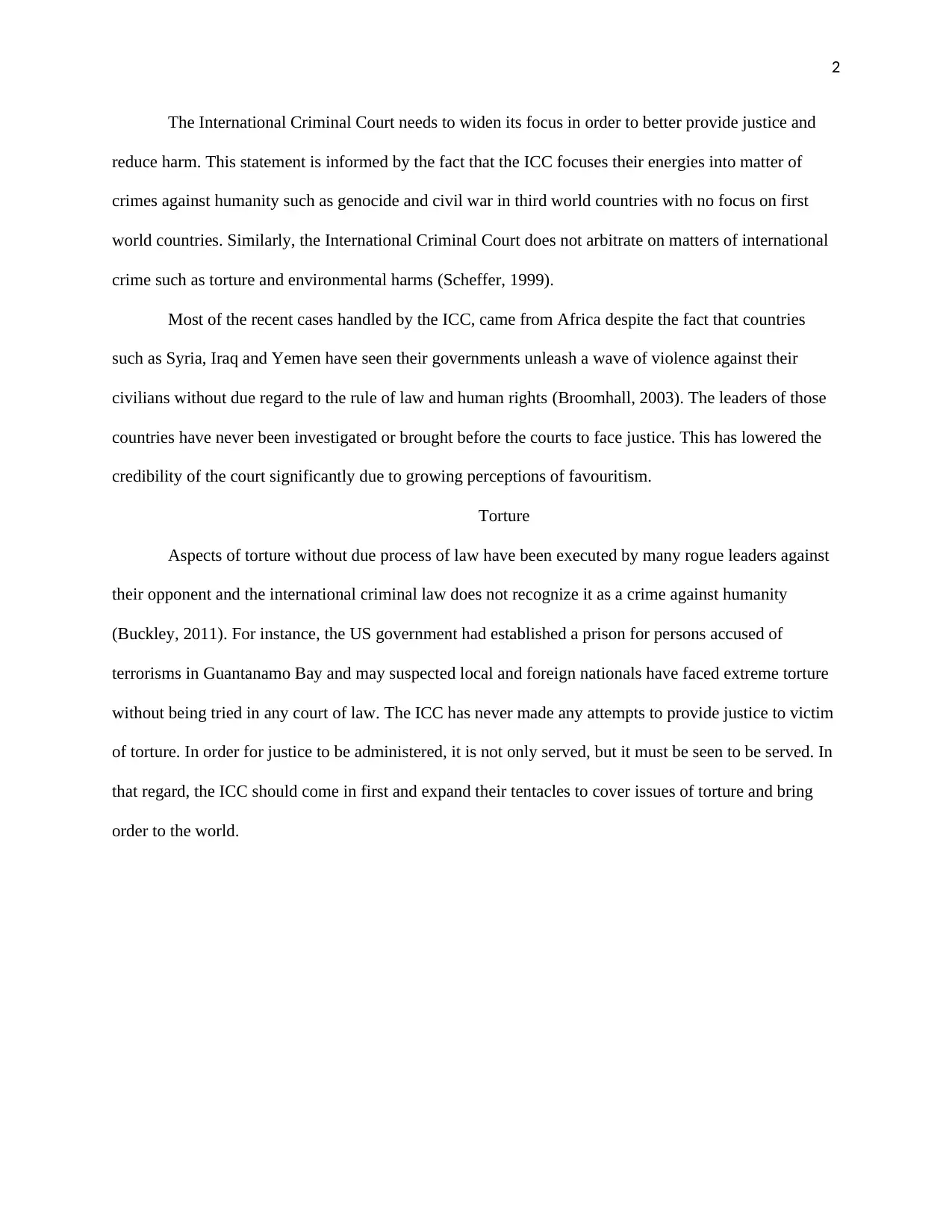
The International Criminal Court needs to widen its focus in order to better provide justice and
reduce harm. This statement is informed by the fact that the ICC focuses their energies into matter of
crimes against humanity such as genocide and civil war in third world countries with no focus on first
world countries. Similarly, the International Criminal Court does not arbitrate on matters of international
crime such as torture and environmental harms (Scheffer, 1999).
Most of the recent cases handled by the ICC, came from Africa despite the fact that countries
such as Syria, Iraq and Yemen have seen their governments unleash a wave of violence against their
civilians without due regard to the rule of law and human rights (Broomhall, 2003). The leaders of those
countries have never been investigated or brought before the courts to face justice. This has lowered the
credibility of the court significantly due to growing perceptions of favouritism.
Torture
Aspects of torture without due process of law have been executed by many rogue leaders against
their opponent and the international criminal law does not recognize it as a crime against humanity
(Buckley, 2011). For instance, the US government had established a prison for persons accused of
terrorisms in Guantanamo Bay and may suspected local and foreign nationals have faced extreme torture
without being tried in any court of law. The ICC has never made any attempts to provide justice to victim
of torture. In order for justice to be administered, it is not only served, but it must be seen to be served. In
that regard, the ICC should come in first and expand their tentacles to cover issues of torture and bring
order to the world.
Document Page
3
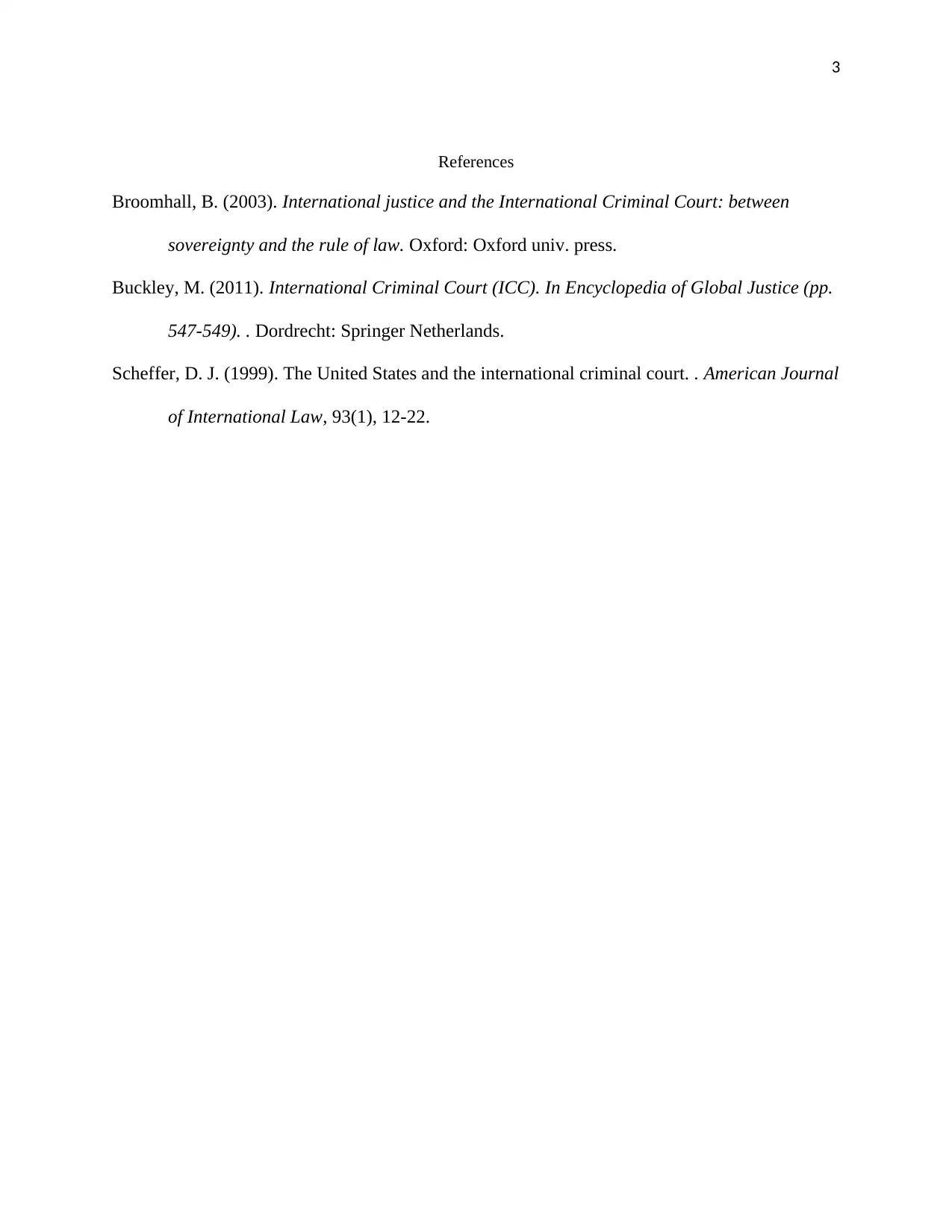
References
Broomhall, B. (2003). International justice and the International Criminal Court: between
sovereignty and the rule of law. Oxford: Oxford univ. press.
Buckley, M. (2011). International Criminal Court (ICC). In Encyclopedia of Global Justice (pp.
547-549). . Dordrecht: Springer Netherlands.
Scheffer, D. J. (1999). The United States and the international criminal court. . American Journal
of International Law, 93(1), 12-22.
chevron_up_icon
1 out of 3
circle_padding
hide_on_mobile
zoom_out_icon
[object Object]