International Law: Analysis of Whisky Shipment and Insurance Issues
VerifiedAdded on 2023/01/11
|9
|2900
|50
Case Study
AI Summary
This case study examines a legal dispute arising from the damage and loss of 2,000 bottles of whisky during sea transit. European Spirits, a French retailer, purchased the whisky from Rebel Distillery in Tasmania under CIF terms. Speedy Couriers was hired to transport the shipment, which was insured by Sleep Easy Insurers. The assignment analyzes the issues of liability, focusing on the Carriage of Goods by Sea Act 1991 and the Institute Marine Cargo Clause (A). Key considerations include the responsibility of Speedy Couriers, the validity of European Spirits' insurance claim, and the recoverability of the insurer. The analysis considers the limitation of liability clause, the duties of the carrier regarding storage, and exceptions to carrier liability, such as quarantine and inadequate packaging. The study explores the legal obligations of the parties involved, determining who is liable for the loss and the implications for insurance claims and potential subrogation.
Questions and Answer
International Law
International Law

Paraphrase This Document
Need a fresh take? Get an instant paraphrase of this document with our AI Paraphraser
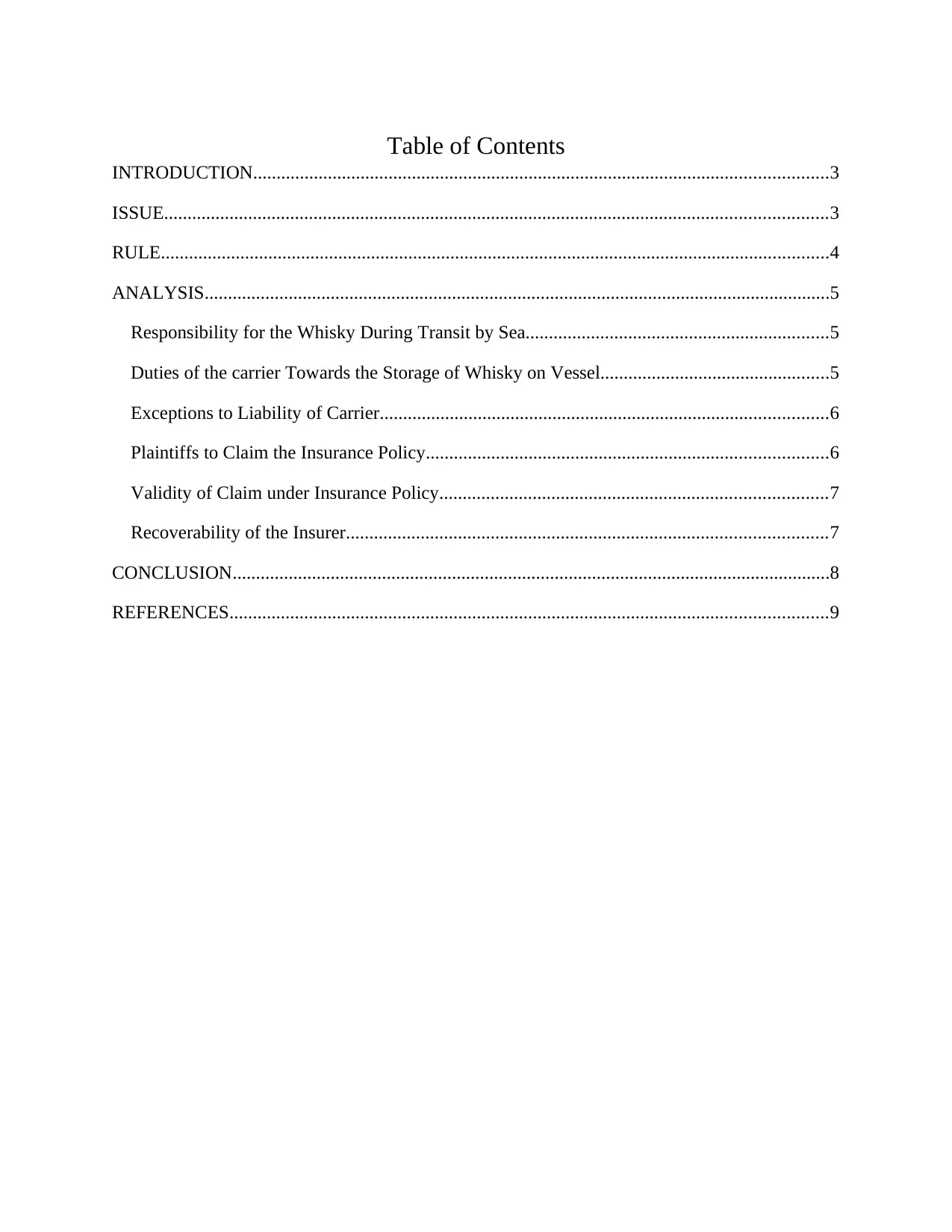
Table of Contents
INTRODUCTION...........................................................................................................................3
ISSUE..............................................................................................................................................3
RULE...............................................................................................................................................4
ANALYSIS......................................................................................................................................5
Responsibility for the Whisky During Transit by Sea.................................................................5
Duties of the carrier Towards the Storage of Whisky on Vessel.................................................5
Exceptions to Liability of Carrier................................................................................................6
Plaintiffs to Claim the Insurance Policy......................................................................................6
Validity of Claim under Insurance Policy...................................................................................7
Recoverability of the Insurer.......................................................................................................7
CONCLUSION................................................................................................................................8
REFERENCES................................................................................................................................9
INTRODUCTION...........................................................................................................................3
ISSUE..............................................................................................................................................3
RULE...............................................................................................................................................4
ANALYSIS......................................................................................................................................5
Responsibility for the Whisky During Transit by Sea.................................................................5
Duties of the carrier Towards the Storage of Whisky on Vessel.................................................5
Exceptions to Liability of Carrier................................................................................................6
Plaintiffs to Claim the Insurance Policy......................................................................................6
Validity of Claim under Insurance Policy...................................................................................7
Recoverability of the Insurer.......................................................................................................7
CONCLUSION................................................................................................................................8
REFERENCES................................................................................................................................9
INTRODUCTION
Whenever a party engages in transportation of goods and products across seas for their
operations, via hiring the services of external third party carriers, their operations are placed
under considerable risks relating to the effective and reliable transportation of their goods and
products to its desired recipients across the ocean. Though there are numerous internationally
mandated laws and regulations placed to manage the transportation of goods and products across
seas by third party carriers, should any damage or loss to transported goods and products occur
during transit by sea, all parties concerned i.e. the suppliers, carriers and buyers have to engage
in legal interactions in order to assess who is to be blamed for the loss, which is a time and
resource consuming process (Thomas, (2017)). This report assesses the case study of European
Spirits, a retailer of alcoholic beverages in France in their legal interactions with third party
carriers, suppliers and insurers over the damages and loss to their purchased shipment.
ISSUE
The main issues that occur in this case study arise due to the damage which was caused to
2000 bottles of whiskey supplied by Rebel Distillery, who hired external third party carriers
called Speedy Couriers to deliver the bottles to their owners European Spirits, from Tasmania to
France. As the shipment was insured through Sleep Easy Insurers for damages and loss to
shipping goods and products, all parties concerned face several issues pertaining to their
operations because of the loss and damages to the 2000 bottles of whiskey. As the third party
carriers inserted a limitation of liability clause in their contract of carriage with Rebel
Distilleries, this poses major issue towards the liability of Speedy Couriers for the damages and
loss to the 2000 bottles of whisky, which occurred during their operations. Another major issue
of the case study is if European Spirits are legally capable of filing a claim under their insurance
policy so that they can be indemnified for the expenses incurred due to the damage and loss
which occurred to the 2000 bottles of whisky during transportation by Speedy Couriers (Rogers,
Chuah & Dockray, (2016)). The other issue of the case study pertains to if Sleep Easy Insurers
do indemnify the expenses to European Spirits for the damage and loss to the 2000 bottles of
whiskey, will they be able to recover any amount paid and if so who can they recover this
Whenever a party engages in transportation of goods and products across seas for their
operations, via hiring the services of external third party carriers, their operations are placed
under considerable risks relating to the effective and reliable transportation of their goods and
products to its desired recipients across the ocean. Though there are numerous internationally
mandated laws and regulations placed to manage the transportation of goods and products across
seas by third party carriers, should any damage or loss to transported goods and products occur
during transit by sea, all parties concerned i.e. the suppliers, carriers and buyers have to engage
in legal interactions in order to assess who is to be blamed for the loss, which is a time and
resource consuming process (Thomas, (2017)). This report assesses the case study of European
Spirits, a retailer of alcoholic beverages in France in their legal interactions with third party
carriers, suppliers and insurers over the damages and loss to their purchased shipment.
ISSUE
The main issues that occur in this case study arise due to the damage which was caused to
2000 bottles of whiskey supplied by Rebel Distillery, who hired external third party carriers
called Speedy Couriers to deliver the bottles to their owners European Spirits, from Tasmania to
France. As the shipment was insured through Sleep Easy Insurers for damages and loss to
shipping goods and products, all parties concerned face several issues pertaining to their
operations because of the loss and damages to the 2000 bottles of whiskey. As the third party
carriers inserted a limitation of liability clause in their contract of carriage with Rebel
Distilleries, this poses major issue towards the liability of Speedy Couriers for the damages and
loss to the 2000 bottles of whisky, which occurred during their operations. Another major issue
of the case study is if European Spirits are legally capable of filing a claim under their insurance
policy so that they can be indemnified for the expenses incurred due to the damage and loss
which occurred to the 2000 bottles of whisky during transportation by Speedy Couriers (Rogers,
Chuah & Dockray, (2016)). The other issue of the case study pertains to if Sleep Easy Insurers
do indemnify the expenses to European Spirits for the damage and loss to the 2000 bottles of
whiskey, will they be able to recover any amount paid and if so who can they recover this
⊘ This is a preview!⊘
Do you want full access?
Subscribe today to unlock all pages.

Trusted by 1+ million students worldwide
amount from. These issues can only be solved when considering several legally mandated rules
and regulations which all these parties have to adhere to in order to assess their innocence or
culpability.
RULE
The most applicable legally mandated law and regulations that applies to this issue
between European Spirits, Rebel Couriers and Speedy Couriers is the Carriage of Goods by Sea
Act 1991, which lays out the numerous rules and regulations which third party carriers of
shipment over sea have to adhere to with the intention to safely delivering shipment of goods and
products to other destinations over sea. The Carriage of Goods by Sea Act 1991 also lays out the
legal obligations of the shipping carriers and their party shipping the products to desired
destinations with relation to how the bill of lading should be created and its appropriate
parameters to be included. Further the Carriage of Goods by Sea Act 1991 details the roles,
responsibilities and duties of shipping carriers such as Speedy Couriers for their successful
operations so that losses and damages to the transported goods and products can be actively
avoided (Todd, (2019)). In addition, the Carriage of Goods by Sea Act 1991 also details the
situations in which the third party carrier are liable for the expenses through the loss or damage
to transported goods and products and also excludes various situations which are out of the
control of third party carriers which can result in damage or loss to the transported products,
making them exempt from their liability to pay expenses to the owners for damages to
transported goods and products.
Further the other legally mandated rule that applies to the insurance interactions between
European Spirits, Sleep Easy insurers and Speedy Couriers is the clause A of the Institute Marine
Cargo law which decides which party can file for claim under the insurance policy and the
factors under which the claim has to be settled by Sleep Easy Insurers (Zhao, (2020)). The Right
to subrogation also details the right that insurers such as Sleep Easy Insurers have to recover the
amount paid to the insured from carriers and the situations under which they can exercise their
right.
and regulations which all these parties have to adhere to in order to assess their innocence or
culpability.
RULE
The most applicable legally mandated law and regulations that applies to this issue
between European Spirits, Rebel Couriers and Speedy Couriers is the Carriage of Goods by Sea
Act 1991, which lays out the numerous rules and regulations which third party carriers of
shipment over sea have to adhere to with the intention to safely delivering shipment of goods and
products to other destinations over sea. The Carriage of Goods by Sea Act 1991 also lays out the
legal obligations of the shipping carriers and their party shipping the products to desired
destinations with relation to how the bill of lading should be created and its appropriate
parameters to be included. Further the Carriage of Goods by Sea Act 1991 details the roles,
responsibilities and duties of shipping carriers such as Speedy Couriers for their successful
operations so that losses and damages to the transported goods and products can be actively
avoided (Todd, (2019)). In addition, the Carriage of Goods by Sea Act 1991 also details the
situations in which the third party carrier are liable for the expenses through the loss or damage
to transported goods and products and also excludes various situations which are out of the
control of third party carriers which can result in damage or loss to the transported products,
making them exempt from their liability to pay expenses to the owners for damages to
transported goods and products.
Further the other legally mandated rule that applies to the insurance interactions between
European Spirits, Sleep Easy insurers and Speedy Couriers is the clause A of the Institute Marine
Cargo law which decides which party can file for claim under the insurance policy and the
factors under which the claim has to be settled by Sleep Easy Insurers (Zhao, (2020)). The Right
to subrogation also details the right that insurers such as Sleep Easy Insurers have to recover the
amount paid to the insured from carriers and the situations under which they can exercise their
right.
Paraphrase This Document
Need a fresh take? Get an instant paraphrase of this document with our AI Paraphraser
ANALYSIS
Responsibility for the Whisky During Transit by Sea
The overall responsibility of the Whisky shipment undertaken by Speedy Couriers,
during the transit of shipment by sea rests entirely with the Speedy Couriers. The employees of
Speedy Couriers were legally mandated to ensure the safe transportation of 2000 bottles of
Whisky, as instructed by Rebel Distillery, to their buyers European Spirits, by safely transporting
the 2000 bottles of Whisky from Tasmania to France. Though Speedy Couriers had placed a
limitation of liability clause in their contract of carriage with Revel Distillery, they still were the
sole party responsible for the safe transportation of 2000 bottles from Tasmania to France so that
the shipment could be effectively delivered to European Spirits in a timely manner (Katsivela,
(2019, December)). This is further proved by the paragraph 5 of Article 3 of the Carriage of
Goods by Sea Act 1991, which states that the carrier of the shipment is responsible for the loss or
damage to shipped goods if any discrepancies or inaccuracies are found according to the
prescribed bill of lading as agreed upon by both carriers and shippers, who in this case of Speedy
Couriers and Rebel Distillery.
Duties of the carrier Towards the Storage of Whisky on Vessel
According to the paragraph 1 subsections a, b and c of the Carriage of Goods by Sea Act
1991, the carrier of goods being shipped over sea, who in this case are Speedy Couriers have to
follow and perform several duties or tasks with the intention to ensure that the sipping goods and
products are able to safely reach their desired destination without incurring any operational
damages or losses. It is a legally mandated duty of Speedy Couriers according to the Carriage of
Goods by Sea Act 1991 to make their shipping vessel seaworthy which means that Speedy
Couriers needs to ensure that their transportation vessel is maintained in good condition and is
capable of safely making the voyage in accordance with various other legal laws that regulate the
seaworthiness of a shipping vessel (Pejovic, (2020)). Another legally mandated duty of Speedy
Couriers is for them to adequately supply, man and equip their shipping vessel for their voyage
on the basis of the requirements of the journey from Tasmania to France. A major legal duty of
Speedy Couriers is for them to make their refrigerating, cool chambers, holds and all parts of
shipping vessel where goods are stored to be safe and fit for their preservation, shipment and
delivery over the shipping journey.
Responsibility for the Whisky During Transit by Sea
The overall responsibility of the Whisky shipment undertaken by Speedy Couriers,
during the transit of shipment by sea rests entirely with the Speedy Couriers. The employees of
Speedy Couriers were legally mandated to ensure the safe transportation of 2000 bottles of
Whisky, as instructed by Rebel Distillery, to their buyers European Spirits, by safely transporting
the 2000 bottles of Whisky from Tasmania to France. Though Speedy Couriers had placed a
limitation of liability clause in their contract of carriage with Revel Distillery, they still were the
sole party responsible for the safe transportation of 2000 bottles from Tasmania to France so that
the shipment could be effectively delivered to European Spirits in a timely manner (Katsivela,
(2019, December)). This is further proved by the paragraph 5 of Article 3 of the Carriage of
Goods by Sea Act 1991, which states that the carrier of the shipment is responsible for the loss or
damage to shipped goods if any discrepancies or inaccuracies are found according to the
prescribed bill of lading as agreed upon by both carriers and shippers, who in this case of Speedy
Couriers and Rebel Distillery.
Duties of the carrier Towards the Storage of Whisky on Vessel
According to the paragraph 1 subsections a, b and c of the Carriage of Goods by Sea Act
1991, the carrier of goods being shipped over sea, who in this case are Speedy Couriers have to
follow and perform several duties or tasks with the intention to ensure that the sipping goods and
products are able to safely reach their desired destination without incurring any operational
damages or losses. It is a legally mandated duty of Speedy Couriers according to the Carriage of
Goods by Sea Act 1991 to make their shipping vessel seaworthy which means that Speedy
Couriers needs to ensure that their transportation vessel is maintained in good condition and is
capable of safely making the voyage in accordance with various other legal laws that regulate the
seaworthiness of a shipping vessel (Pejovic, (2020)). Another legally mandated duty of Speedy
Couriers is for them to adequately supply, man and equip their shipping vessel for their voyage
on the basis of the requirements of the journey from Tasmania to France. A major legal duty of
Speedy Couriers is for them to make their refrigerating, cool chambers, holds and all parts of
shipping vessel where goods are stored to be safe and fit for their preservation, shipment and
delivery over the shipping journey.
Exceptions to Liability of Carrier
Under the Carriage of Goods by Sea Act 1991 there are several exceptions to liability of
carrier in the event loss or damage occurs to goods and products being shipped over sea. The
paragraph 2 of Article 4 of Carriage of Goods by Sea Act 1991 which includes subsections a to q
list these exceptions to liabilities for carriers. A carrier cannot be held liable for damages to
shipping goods and products which result from:
Navigational issues occurring during shipping journey by the carriers.
Operational fires, unless caused by a fault of the carrier or their employees.
Danger, perils and accidents which are bound to occur while shipping via seas.
Acts of God, war and public enemies such as criminals, pirates, etc.
Political reasons such as arrest of people, rulers or princes or seizure of shipping vessel
by legal authorities.
Any quarantine restrictions placed on the shipping vessel during voyage for fears of
disease or viruses.
Any operational strikes, lock downs or stoppage of labour due to unforeseen reasons.
Attempts made to save lives of people or property while at sea.
Insufficiency and inadequacy of packing etc.
Two of these exceptions apply to Speedy Couriers over their liability in the case for the
loss and damage of 2000 bottles while being transported from Tasmania to France. As the
shipping vessel was Quarantined in India for 3 weeks, over fears of the crew members of Speedy
Couriers carrying new virus known as H2-N26, the exception of liability for Speedy Couriers
due to quarantine restrictions applies (Al-Marzouqi, (2019)). As the 2000 bottles were not
individually packaged in cylindrical tubes by Rebel Distillery, this also amounts to inadequate
packaging of the shipment and Speedy Couriers can also apply the inadequacy of packaging
clause in the Carriage of Goods by Sea Act 1991 to exclude them of liability for loss and damage
of shipping 2000 bottles.
Plaintiffs to Claim the Insurance Policy
Rebel Distillery who hired Speedy Couriers for their operational requirement to transport
2000 bottles of alcohol to France from Tasmania via the seas and entered into a contract with
them in accordance with the Carriage of Goods by Sea Act 1991, by signing the bill of lading, in
Under the Carriage of Goods by Sea Act 1991 there are several exceptions to liability of
carrier in the event loss or damage occurs to goods and products being shipped over sea. The
paragraph 2 of Article 4 of Carriage of Goods by Sea Act 1991 which includes subsections a to q
list these exceptions to liabilities for carriers. A carrier cannot be held liable for damages to
shipping goods and products which result from:
Navigational issues occurring during shipping journey by the carriers.
Operational fires, unless caused by a fault of the carrier or their employees.
Danger, perils and accidents which are bound to occur while shipping via seas.
Acts of God, war and public enemies such as criminals, pirates, etc.
Political reasons such as arrest of people, rulers or princes or seizure of shipping vessel
by legal authorities.
Any quarantine restrictions placed on the shipping vessel during voyage for fears of
disease or viruses.
Any operational strikes, lock downs or stoppage of labour due to unforeseen reasons.
Attempts made to save lives of people or property while at sea.
Insufficiency and inadequacy of packing etc.
Two of these exceptions apply to Speedy Couriers over their liability in the case for the
loss and damage of 2000 bottles while being transported from Tasmania to France. As the
shipping vessel was Quarantined in India for 3 weeks, over fears of the crew members of Speedy
Couriers carrying new virus known as H2-N26, the exception of liability for Speedy Couriers
due to quarantine restrictions applies (Al-Marzouqi, (2019)). As the 2000 bottles were not
individually packaged in cylindrical tubes by Rebel Distillery, this also amounts to inadequate
packaging of the shipment and Speedy Couriers can also apply the inadequacy of packaging
clause in the Carriage of Goods by Sea Act 1991 to exclude them of liability for loss and damage
of shipping 2000 bottles.
Plaintiffs to Claim the Insurance Policy
Rebel Distillery who hired Speedy Couriers for their operational requirement to transport
2000 bottles of alcohol to France from Tasmania via the seas and entered into a contract with
them in accordance with the Carriage of Goods by Sea Act 1991, by signing the bill of lading, in
⊘ This is a preview!⊘
Do you want full access?
Subscribe today to unlock all pages.
Trusted by 1+ million students worldwide
addition to insuring the owners of the 2000 bottles i.e. European Spirits through Sleep Easy
Insurers. This contract of insurance incorporated the legally mandated Institute Marine Cargo
Clause (A), which states that in the event of loss or damage to goods and products being shipped
by third party couriers over sea, the insurance can only be claimed by the owner of the property
being shipped after the shipment has been delivered to them (Zhao, (2017)). As the owner of the
shipment consisting of 2000 bottles which underwent damage and loss during transportation are
European Distillery, they are the sole plaintiff legally capable of claiming the insurance policy
and not Rebel Distillery who are not the owner of the shipping goods, having sold it to European
Spirits prior to the transportation through Speedy Couriers.
Validity of Claim under Insurance Policy
A legal claim can be made by European Spirits under their insurance policy by Sleep
Easy insurers, as the third party carriers, Speedy Couriers who were hired by Rebel Distillery to
transport 2000 bottles of whisky from Tasmania to France were infringing upon the regulations
as is prescribed by the Carriage of Goods by Sea Act 1991. Speedy Couriers were infringing
upon the subsection a of paragraph 1 of Article 3 of Carriage of Goods by Sea Act 1991 which
states that the third party carriers such as Speedy Couriers are responsible for safeguarding and
guaranteeing the preservation, reception and carriage of transported goods in a fit and safe
manner in relation to their refrigerators, cooling chambers and other storage areas of the shipping
vessel (Bokareva, (2019)). As the 2000 bottles of whiskey were stored on the deck of the
shipping vessel where they were exposed to extreme heat over the entire course of the journey in
addition to the 3 weeks in which the shipping vessel was quarantined in India, Speedy Couriers
did not adhere to the subsection a, paragraph 1 of the Article 3 of Carriage of Goods by Sea Act
1991 and did not safeguard and guarantee adequate preservation of the 2000 whiskey bottles so
that they could be transported to France from Tasmania in a safe and fit manner, thus making
European Spirits capable of filing a legal claim under their insurance policy.
Recoverability of the Insurer
In the event that Sleep Easy Insurers do decide to indemnify the insured which is
European Spirits for all or part of the losses incurred to the 2000 bottles of whisky during the
transportation at sea from Tasmania to France, they are legally capable of recovering some
amount paid to European Spirits through their right called right to Subrogation. Sleep Easy
Insurers. This contract of insurance incorporated the legally mandated Institute Marine Cargo
Clause (A), which states that in the event of loss or damage to goods and products being shipped
by third party couriers over sea, the insurance can only be claimed by the owner of the property
being shipped after the shipment has been delivered to them (Zhao, (2017)). As the owner of the
shipment consisting of 2000 bottles which underwent damage and loss during transportation are
European Distillery, they are the sole plaintiff legally capable of claiming the insurance policy
and not Rebel Distillery who are not the owner of the shipping goods, having sold it to European
Spirits prior to the transportation through Speedy Couriers.
Validity of Claim under Insurance Policy
A legal claim can be made by European Spirits under their insurance policy by Sleep
Easy insurers, as the third party carriers, Speedy Couriers who were hired by Rebel Distillery to
transport 2000 bottles of whisky from Tasmania to France were infringing upon the regulations
as is prescribed by the Carriage of Goods by Sea Act 1991. Speedy Couriers were infringing
upon the subsection a of paragraph 1 of Article 3 of Carriage of Goods by Sea Act 1991 which
states that the third party carriers such as Speedy Couriers are responsible for safeguarding and
guaranteeing the preservation, reception and carriage of transported goods in a fit and safe
manner in relation to their refrigerators, cooling chambers and other storage areas of the shipping
vessel (Bokareva, (2019)). As the 2000 bottles of whiskey were stored on the deck of the
shipping vessel where they were exposed to extreme heat over the entire course of the journey in
addition to the 3 weeks in which the shipping vessel was quarantined in India, Speedy Couriers
did not adhere to the subsection a, paragraph 1 of the Article 3 of Carriage of Goods by Sea Act
1991 and did not safeguard and guarantee adequate preservation of the 2000 whiskey bottles so
that they could be transported to France from Tasmania in a safe and fit manner, thus making
European Spirits capable of filing a legal claim under their insurance policy.
Recoverability of the Insurer
In the event that Sleep Easy Insurers do decide to indemnify the insured which is
European Spirits for all or part of the losses incurred to the 2000 bottles of whisky during the
transportation at sea from Tasmania to France, they are legally capable of recovering some
amount paid to European Spirits through their right called right to Subrogation. Sleep Easy
Paraphrase This Document
Need a fresh take? Get an instant paraphrase of this document with our AI Paraphraser
Insurer’s right to subrogation allows them to legally recover the amount paid to European Spirits
from Speedy Couriers, as it was the responsibility of Speedy Couriers as is laid out in the
Carriage of Goods by Sea Act 1991, to safely transport the shipping goods and products to their
destinations (Mahdavian & Maruthi, (2018)). The right of subrogation allows Sleep Easy
Insurers to recover the amount paid to European Spirits from Speedy Couriers, as the loss and
damages to the 2000 bottles of whisky occurred due to the fault of Speedy Couriers and thus
makes Sleep Easy Insurers legally capable of exercising their right to subrogation and recover
the amount from Speedy Couriers who will have to comply with Sleep Easy Insurers in
accordance with all insurers right to subrogation.
CONCLUSION
Based on the findings of the report, it can effectively be concluded that Speedy Couriers
hired to transport the 2000 bottles by Rebel Distillery from Tasmania to France were infringing
on Articles of the Carriage of Goods by Sea Act 1991 and are responsible for the damage and
loss incurred to the 2000 bottles which are the property of European Spirits. European Spirits is
legally capable of filing a claim under their insurance policy from Sleep Easy Insurers who will
have to indemnify the expenses to European Spirits. Further Sleep Easy Insurers can exercise
their right to subrogation and recover whole or part of the amount indemnified to European
Spirits from Speedy Couriers as they were responsible for the safe transportation of 2000
whiskey bottles and were found to be infringing upon some articles of the Carriage of Goods by
Sea Act 1991.
from Speedy Couriers, as it was the responsibility of Speedy Couriers as is laid out in the
Carriage of Goods by Sea Act 1991, to safely transport the shipping goods and products to their
destinations (Mahdavian & Maruthi, (2018)). The right of subrogation allows Sleep Easy
Insurers to recover the amount paid to European Spirits from Speedy Couriers, as the loss and
damages to the 2000 bottles of whisky occurred due to the fault of Speedy Couriers and thus
makes Sleep Easy Insurers legally capable of exercising their right to subrogation and recover
the amount from Speedy Couriers who will have to comply with Sleep Easy Insurers in
accordance with all insurers right to subrogation.
CONCLUSION
Based on the findings of the report, it can effectively be concluded that Speedy Couriers
hired to transport the 2000 bottles by Rebel Distillery from Tasmania to France were infringing
on Articles of the Carriage of Goods by Sea Act 1991 and are responsible for the damage and
loss incurred to the 2000 bottles which are the property of European Spirits. European Spirits is
legally capable of filing a claim under their insurance policy from Sleep Easy Insurers who will
have to indemnify the expenses to European Spirits. Further Sleep Easy Insurers can exercise
their right to subrogation and recover whole or part of the amount indemnified to European
Spirits from Speedy Couriers as they were responsible for the safe transportation of 2000
whiskey bottles and were found to be infringing upon some articles of the Carriage of Goods by
Sea Act 1991.
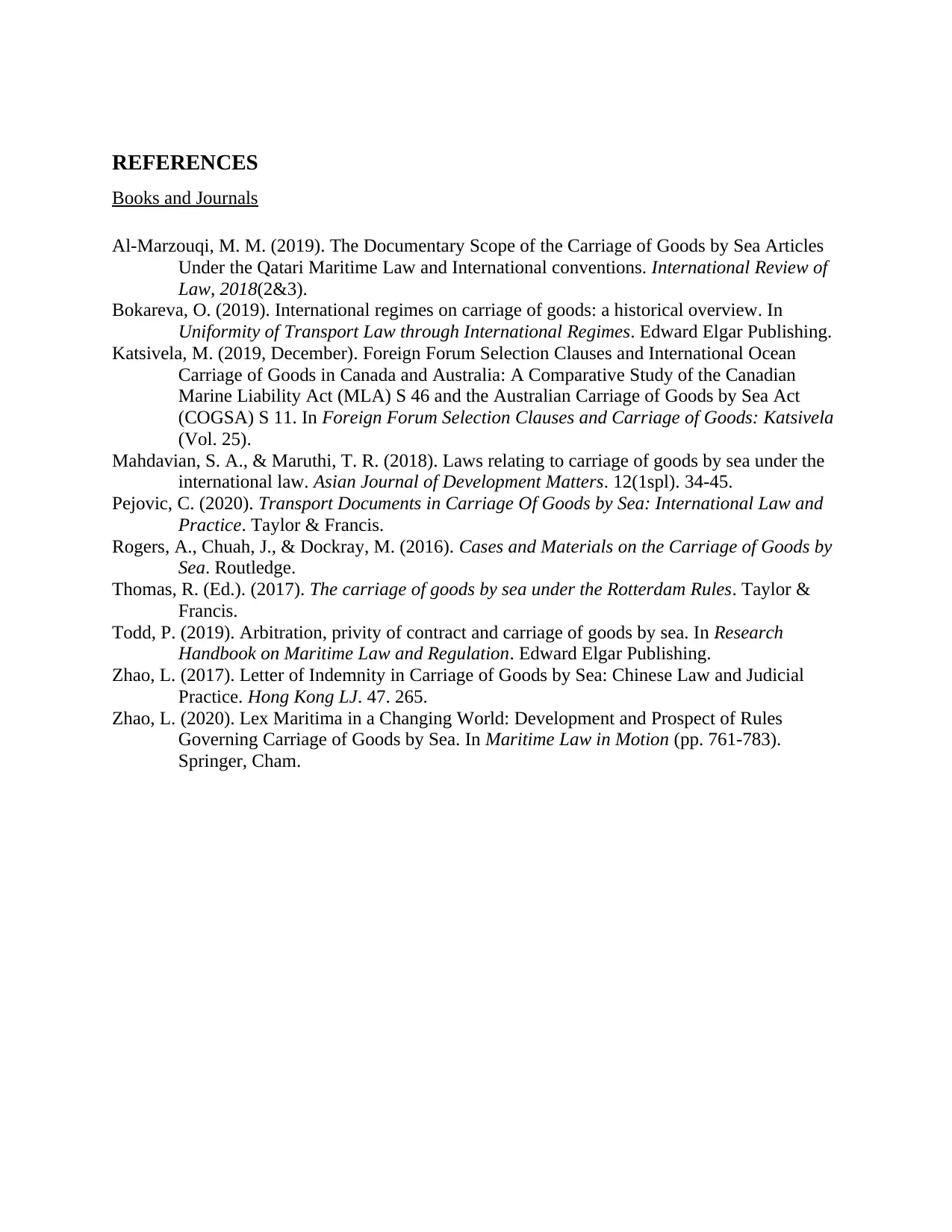
REFERENCES
Books and Journals
Al-Marzouqi, M. M. (2019). The Documentary Scope of the Carriage of Goods by Sea Articles
Under the Qatari Maritime Law and International conventions. International Review of
Law, 2018(2&3).
Bokareva, O. (2019). International regimes on carriage of goods: a historical overview. In
Uniformity of Transport Law through International Regimes. Edward Elgar Publishing.
Katsivela, M. (2019, December). Foreign Forum Selection Clauses and International Ocean
Carriage of Goods in Canada and Australia: A Comparative Study of the Canadian
Marine Liability Act (MLA) S 46 and the Australian Carriage of Goods by Sea Act
(COGSA) S 11. In Foreign Forum Selection Clauses and Carriage of Goods: Katsivela
(Vol. 25).
Mahdavian, S. A., & Maruthi, T. R. (2018). Laws relating to carriage of goods by sea under the
international law. Asian Journal of Development Matters. 12(1spl). 34-45.
Pejovic, C. (2020). Transport Documents in Carriage Of Goods by Sea: International Law and
Practice. Taylor & Francis.
Rogers, A., Chuah, J., & Dockray, M. (2016). Cases and Materials on the Carriage of Goods by
Sea. Routledge.
Thomas, R. (Ed.). (2017). The carriage of goods by sea under the Rotterdam Rules. Taylor &
Francis.
Todd, P. (2019). Arbitration, privity of contract and carriage of goods by sea. In Research
Handbook on Maritime Law and Regulation. Edward Elgar Publishing.
Zhao, L. (2017). Letter of Indemnity in Carriage of Goods by Sea: Chinese Law and Judicial
Practice. Hong Kong LJ. 47. 265.
Zhao, L. (2020). Lex Maritima in a Changing World: Development and Prospect of Rules
Governing Carriage of Goods by Sea. In Maritime Law in Motion (pp. 761-783).
Springer, Cham.
Books and Journals
Al-Marzouqi, M. M. (2019). The Documentary Scope of the Carriage of Goods by Sea Articles
Under the Qatari Maritime Law and International conventions. International Review of
Law, 2018(2&3).
Bokareva, O. (2019). International regimes on carriage of goods: a historical overview. In
Uniformity of Transport Law through International Regimes. Edward Elgar Publishing.
Katsivela, M. (2019, December). Foreign Forum Selection Clauses and International Ocean
Carriage of Goods in Canada and Australia: A Comparative Study of the Canadian
Marine Liability Act (MLA) S 46 and the Australian Carriage of Goods by Sea Act
(COGSA) S 11. In Foreign Forum Selection Clauses and Carriage of Goods: Katsivela
(Vol. 25).
Mahdavian, S. A., & Maruthi, T. R. (2018). Laws relating to carriage of goods by sea under the
international law. Asian Journal of Development Matters. 12(1spl). 34-45.
Pejovic, C. (2020). Transport Documents in Carriage Of Goods by Sea: International Law and
Practice. Taylor & Francis.
Rogers, A., Chuah, J., & Dockray, M. (2016). Cases and Materials on the Carriage of Goods by
Sea. Routledge.
Thomas, R. (Ed.). (2017). The carriage of goods by sea under the Rotterdam Rules. Taylor &
Francis.
Todd, P. (2019). Arbitration, privity of contract and carriage of goods by sea. In Research
Handbook on Maritime Law and Regulation. Edward Elgar Publishing.
Zhao, L. (2017). Letter of Indemnity in Carriage of Goods by Sea: Chinese Law and Judicial
Practice. Hong Kong LJ. 47. 265.
Zhao, L. (2020). Lex Maritima in a Changing World: Development and Prospect of Rules
Governing Carriage of Goods by Sea. In Maritime Law in Motion (pp. 761-783).
Springer, Cham.
⊘ This is a preview!⊘
Do you want full access?
Subscribe today to unlock all pages.
Trusted by 1+ million students worldwide

1 out of 9


Your All-in-One AI-Powered Toolkit for Academic Success.
+13062052269
info@desklib.com
Available 24*7 on WhatsApp / Email
![[object Object]](/_next/static/media/star-bottom.7253800d.svg)
Unlock your academic potential
Copyright © 2020–2026 A2Z Services. All Rights Reserved. Developed and managed by ZUCOL.