International Law and Power: A Comparative Analysis Essay
VerifiedAdded on 2023/02/01
|6
|1227
|58
Essay
AI Summary
This essay analyzes the effectiveness of international law compared to the influence of power in international relations. It begins with an introduction to international law and its historical context, including the League of Nations and the United Nations. The essay explores the sources of international law, citing Article 38 of the Statute of the International Court of Justice and relevant case laws like Columbia v Peru and Belgium v Spain. It then critiques international law, referencing John Austin's views and the concept of par in rem non habet imperium, discussing state immunity and the limitations of international law. The conclusion argues that power is more persuasive than international law in maintaining international relationships, emphasizing the capability of a country to influence global affairs. The essay is well-supported by legal sources and case studies.
1
International Law
International Law
Paraphrase This Document
Need a fresh take? Get an instant paraphrase of this document with our AI Paraphraser

2
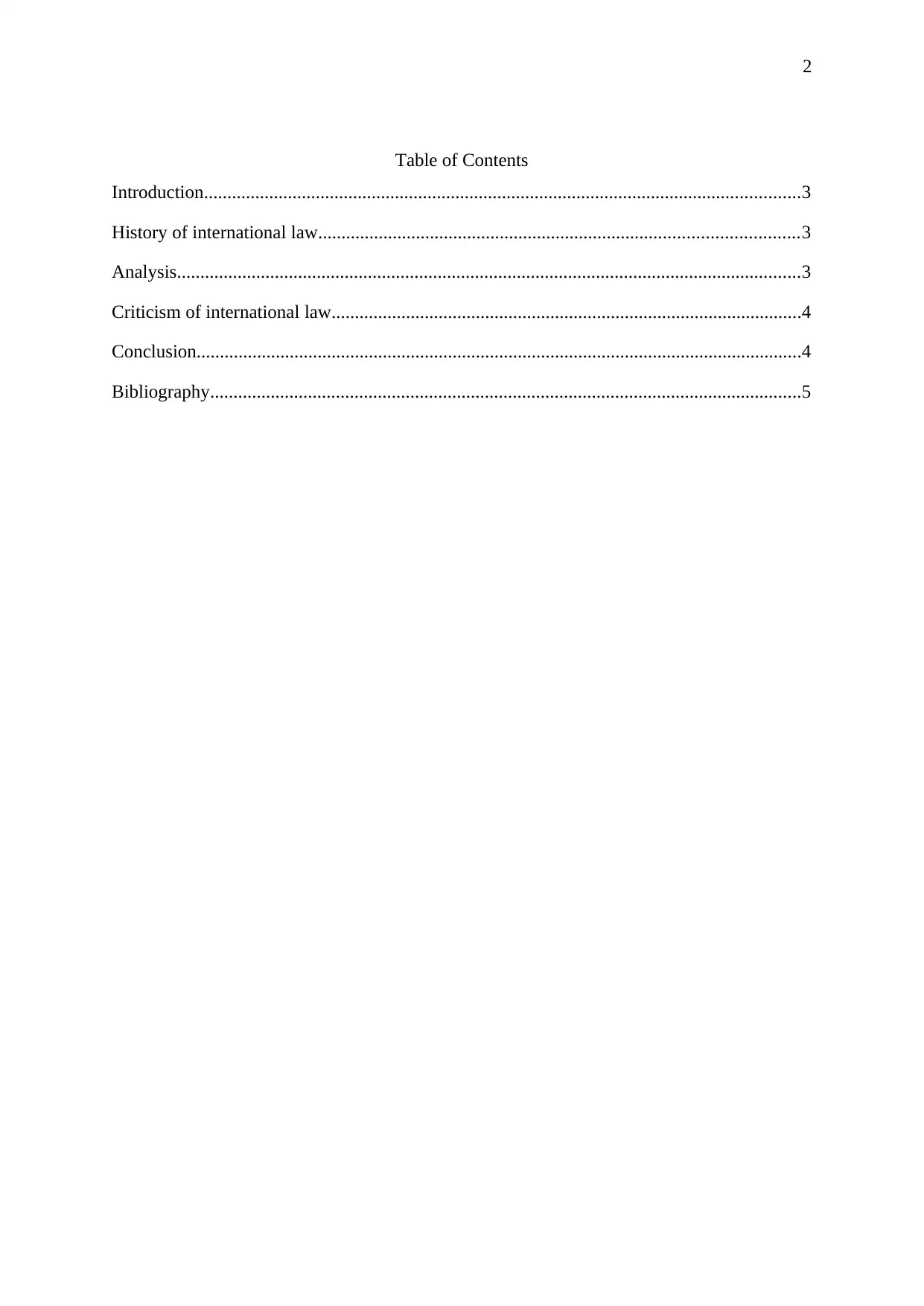
Table of Contents
Introduction................................................................................................................................3
History of international law.......................................................................................................3
Analysis......................................................................................................................................3
Criticism of international law.....................................................................................................4
Conclusion..................................................................................................................................4
Bibliography...............................................................................................................................5
Table of Contents
Introduction................................................................................................................................3
History of international law.......................................................................................................3
Analysis......................................................................................................................................3
Criticism of international law.....................................................................................................4
Conclusion..................................................................................................................................4
Bibliography...............................................................................................................................5

3
Introduction
The aspect of international law has been formulated for the purpose of the promotion of
humanitarianism amongst countries thereby leading to the maintenance of relationships in the
international interest in an amicable manner. As a result, various kinds of treaties and
agreements along with conventions have been formulated accordingly. The main objective of
this essay is to present an analysis pertaining to the question whether power is more effective
and efficient with regard to the various factors governing international relations instead of the
various aspects of international law. The answer to the question would be analyzed
accordingly as far as the deduction of a comprehensive solution is concerned. The appropriate
sources would be referred to in a proper and appropriate manner as far as the deduction of the
desired outcomes is concerned1. It would lead to the capitulation and elucidation upon the
aspect of international law and power in the desired manner. As a result the concept of power
politics would be taken into account with regard to the aspects pertaining to the criticism of
international law at a wider level. It would also imply the disciplines pertaining to
international politics.
History of international law
After the end of the First World War, the League of Nations was established accordingly for
the maintenance of international peace in a proper and appropriate manner. As a result, the
Permanent Court of International Justice was set up accordingly. However, the League of
Nations failed to make efforts with regard to the outbreak of Second World War and as a
Result the United Nations has been established accordingly thereby playing an extremely
vital role with regard to the maintenance of peace and security at the international level by
fostering amicable relationships amongst nations. The Permanent Court of International
Justice has also been replaced by the International Court of Justice.
Analysis
The main objective of international law is to promote international peace to a massive level
thereby leading to the maintenance of harmonious relationships amongst countries a t various
levels of politics. It implies the formation of various kinds of treaties amongst countries with
a certain set of objectives in the interest of humanitarianism and egalitarianism. As far as
1 David Kennedy, "Theses about international law discourse." Sources of International Law. (Routledge,
2017).
Introduction
The aspect of international law has been formulated for the purpose of the promotion of
humanitarianism amongst countries thereby leading to the maintenance of relationships in the
international interest in an amicable manner. As a result, various kinds of treaties and
agreements along with conventions have been formulated accordingly. The main objective of
this essay is to present an analysis pertaining to the question whether power is more effective
and efficient with regard to the various factors governing international relations instead of the
various aspects of international law. The answer to the question would be analyzed
accordingly as far as the deduction of a comprehensive solution is concerned. The appropriate
sources would be referred to in a proper and appropriate manner as far as the deduction of the
desired outcomes is concerned1. It would lead to the capitulation and elucidation upon the
aspect of international law and power in the desired manner. As a result the concept of power
politics would be taken into account with regard to the aspects pertaining to the criticism of
international law at a wider level. It would also imply the disciplines pertaining to
international politics.
History of international law
After the end of the First World War, the League of Nations was established accordingly for
the maintenance of international peace in a proper and appropriate manner. As a result, the
Permanent Court of International Justice was set up accordingly. However, the League of
Nations failed to make efforts with regard to the outbreak of Second World War and as a
Result the United Nations has been established accordingly thereby playing an extremely
vital role with regard to the maintenance of peace and security at the international level by
fostering amicable relationships amongst nations. The Permanent Court of International
Justice has also been replaced by the International Court of Justice.
Analysis
The main objective of international law is to promote international peace to a massive level
thereby leading to the maintenance of harmonious relationships amongst countries a t various
levels of politics. It implies the formation of various kinds of treaties amongst countries with
a certain set of objectives in the interest of humanitarianism and egalitarianism. As far as
1 David Kennedy, "Theses about international law discourse." Sources of International Law. (Routledge,
2017).
⊘ This is a preview!⊘
Do you want full access?
Subscribe today to unlock all pages.

Trusted by 1+ million students worldwide

4
Article 38 of the Statute of the International Court of Justice is concerned, the sources
pertaining to international law are inclusive of the customs, international treaties and the
basic principles of the law2. Additionally, decisions made by the courts of competent
jurisdiction also play an essential role with regard to the determinations pertaining to the rules
of law at the international level in an effective and efficient manner. In the case of Columbia
v Peru, it was held by International Court of Justice that custom can be treated as a valid
source of international law3. It was further asserted by the International Court of Justice the
aspect pertaining to the granting of asylum is not under the ambit of customary international
law as far as the merits of the case are concerned. In the case of Belgium v Spain, it was held
by International Court of Justice that the country where the company or the business entity
has been incorporated only can bring an action pertaining to the losses at the economic level,
not the country where the shareholders of the company are staying4.
Criticism of international law
The eminent legal scholar John Austin concluded that international law is devoid of any kind
of sovereign power thereby implying that it cannot be enforced and implemented in a proper
and appropriate manner. He further elucidated that international law is not a law but is a
concept implying morality at the international level5. Nations are in adherence to the
principle of par in rem non habet imperium which implies that no country can exercise its
sovereign power over another country as far as jurisdiction is concerned. As a result it implies
the aspect pertaining to non existence of sovereignty amongst equals. It leads to the misuse to
a huge extent as far as immunity of the state is concerned. It further implies that a state is
immune to be sued by another state as far as the aspect pertaining to the actions regarding
blatant violation of human rights and civil liberties being carried out by the state. As a result,
such a concept states that a nation cannot bring proceedings against another nation in courts
of competent jurisdiction which contravenes the aspect pertaining to equality and fairness as
far as natural justice is concerned. It is also implied that the heads of state enjoy immunity
from being prosecuted thereby implying legal terrorism for the heads of the state to a huge
extent. As a result it is implied that power has more preference in international relations in
comparison to the aspect of international law.
2 Statute of the International Court of Justice 1945
3 Colombia v Peru [1950] ICJ 6
4 Belgium v Spain [1970] ICJ 1
5 Anthony d’Amato,"Is International Law Really “Law”? ."⋆ The Nature of International Law.
(Routledge, 2017).
Article 38 of the Statute of the International Court of Justice is concerned, the sources
pertaining to international law are inclusive of the customs, international treaties and the
basic principles of the law2. Additionally, decisions made by the courts of competent
jurisdiction also play an essential role with regard to the determinations pertaining to the rules
of law at the international level in an effective and efficient manner. In the case of Columbia
v Peru, it was held by International Court of Justice that custom can be treated as a valid
source of international law3. It was further asserted by the International Court of Justice the
aspect pertaining to the granting of asylum is not under the ambit of customary international
law as far as the merits of the case are concerned. In the case of Belgium v Spain, it was held
by International Court of Justice that the country where the company or the business entity
has been incorporated only can bring an action pertaining to the losses at the economic level,
not the country where the shareholders of the company are staying4.
Criticism of international law
The eminent legal scholar John Austin concluded that international law is devoid of any kind
of sovereign power thereby implying that it cannot be enforced and implemented in a proper
and appropriate manner. He further elucidated that international law is not a law but is a
concept implying morality at the international level5. Nations are in adherence to the
principle of par in rem non habet imperium which implies that no country can exercise its
sovereign power over another country as far as jurisdiction is concerned. As a result it implies
the aspect pertaining to non existence of sovereignty amongst equals. It leads to the misuse to
a huge extent as far as immunity of the state is concerned. It further implies that a state is
immune to be sued by another state as far as the aspect pertaining to the actions regarding
blatant violation of human rights and civil liberties being carried out by the state. As a result,
such a concept states that a nation cannot bring proceedings against another nation in courts
of competent jurisdiction which contravenes the aspect pertaining to equality and fairness as
far as natural justice is concerned. It is also implied that the heads of state enjoy immunity
from being prosecuted thereby implying legal terrorism for the heads of the state to a huge
extent. As a result it is implied that power has more preference in international relations in
comparison to the aspect of international law.
2 Statute of the International Court of Justice 1945
3 Colombia v Peru [1950] ICJ 6
4 Belgium v Spain [1970] ICJ 1
5 Anthony d’Amato,"Is International Law Really “Law”? ."⋆ The Nature of International Law.
(Routledge, 2017).
Paraphrase This Document
Need a fresh take? Get an instant paraphrase of this document with our AI Paraphraser

5
Conclusion
As observed form the above discourse, it can be deduced by stating that the aspects in
relation to international law have been justified and appropriate as far as its implications in
the contemporary era are concerned with regard to the maintenance of relations between the
countries of the world. The aforesaid discourse has also presented the aspects pertaining to
the valid sources of international law in accordance with Article 38 of the Statute of the
International Court of Justice have also been taken into consideration accordingly along with
the relevant case laws heard by the International Court of Justice accordingly. The argument
comprehends upon the fact implying that power is more persuasive in comparison to
international law in the aspect pertaining to the maintenance of international relationships
amongst the nations of the world in an amicable manner as far as the concept of peace is
concerned. It further implies that states have power to influence international relationships to
an extent higher than the aspects pertaining to international law since it is basically a soft law.
In a nutshell, the capability of a country to influence international relationships plays a vital
role.
Conclusion
As observed form the above discourse, it can be deduced by stating that the aspects in
relation to international law have been justified and appropriate as far as its implications in
the contemporary era are concerned with regard to the maintenance of relations between the
countries of the world. The aforesaid discourse has also presented the aspects pertaining to
the valid sources of international law in accordance with Article 38 of the Statute of the
International Court of Justice have also been taken into consideration accordingly along with
the relevant case laws heard by the International Court of Justice accordingly. The argument
comprehends upon the fact implying that power is more persuasive in comparison to
international law in the aspect pertaining to the maintenance of international relationships
amongst the nations of the world in an amicable manner as far as the concept of peace is
concerned. It further implies that states have power to influence international relationships to
an extent higher than the aspects pertaining to international law since it is basically a soft law.
In a nutshell, the capability of a country to influence international relationships plays a vital
role.

6
Bibliography
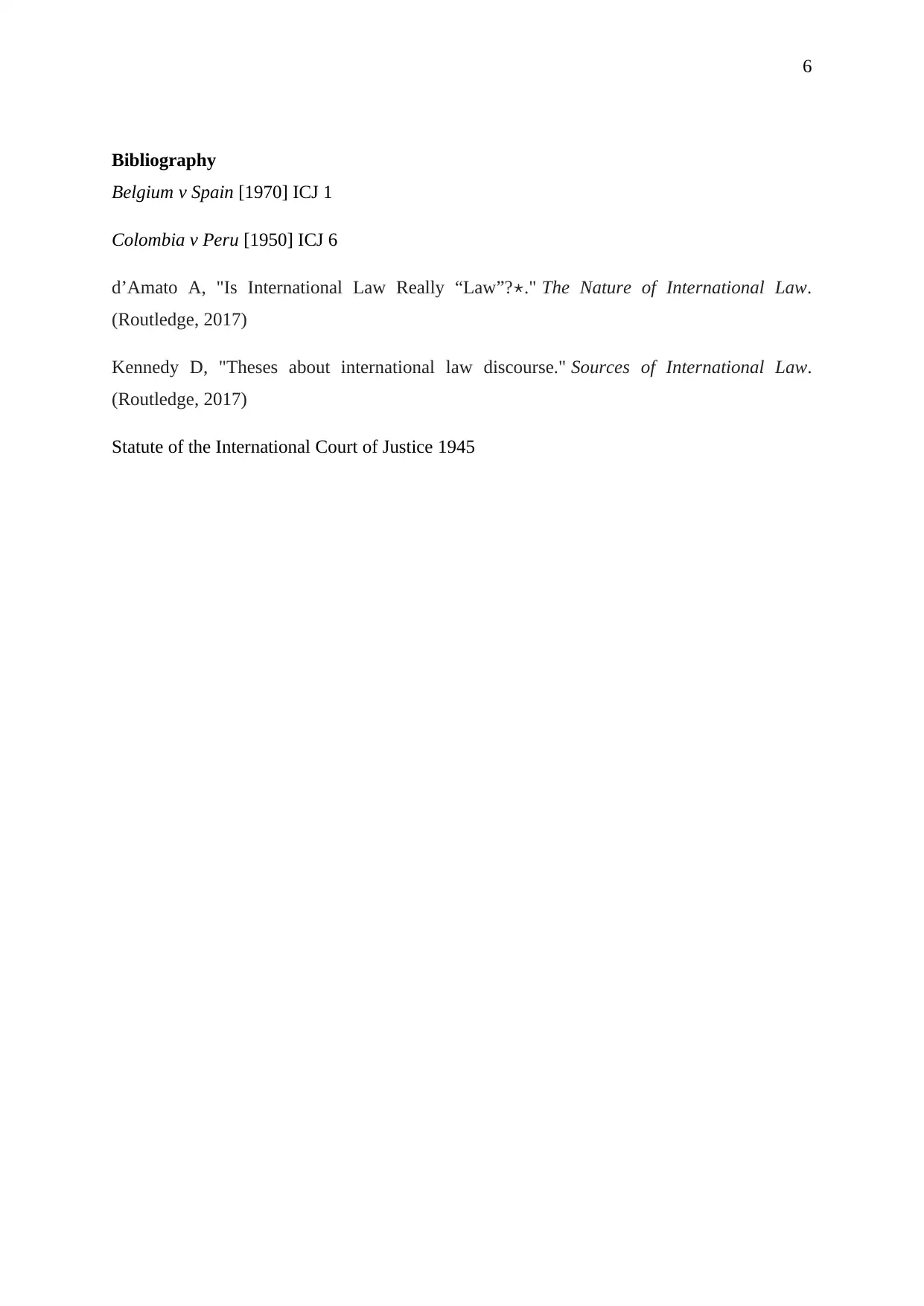
Belgium v Spain [1970] ICJ 1
Colombia v Peru [1950] ICJ 6
d’Amato A, "Is International Law Really “Law”? ."⋆ The Nature of International Law.
(Routledge, 2017)
Kennedy D, "Theses about international law discourse." Sources of International Law.
(Routledge, 2017)
Statute of the International Court of Justice 1945
Bibliography
Belgium v Spain [1970] ICJ 1
Colombia v Peru [1950] ICJ 6
d’Amato A, "Is International Law Really “Law”? ."⋆ The Nature of International Law.
(Routledge, 2017)
Kennedy D, "Theses about international law discourse." Sources of International Law.
(Routledge, 2017)
Statute of the International Court of Justice 1945
⊘ This is a preview!⊘
Do you want full access?
Subscribe today to unlock all pages.

Trusted by 1+ million students worldwide
1 out of 6
Related Documents
Your All-in-One AI-Powered Toolkit for Academic Success.
+13062052269
info@desklib.com
Available 24*7 on WhatsApp / Email
Unlock your academic potential
Copyright © 2020–2025 A2Z Services. All Rights Reserved. Developed and managed by ZUCOL.