International Management Report: Geography, Culture, and Politics
VerifiedAdded on 2020/01/15
|8
|2417
|330
Report
AI Summary
This report delves into the realm of international management, offering a comparative analysis of key regions including China, the USA, the European Union, Japan, India, and Australia. It explores the geographical aspects, calculating per capita land distribution and providing interpretations. The report further examines the cultural nuances, political and legal systems of each region, highlighting unique characteristics and influences. The analysis includes tables presenting average real GDP growth and trade data, such as export and import values. The conclusion summarizes the findings, emphasizing the fluctuating economic landscapes and the growth of the Australian region. The report references various books and journals, providing a comprehensive overview of international management principles and regional dynamics.

International management
1
1

Paraphrase This Document
Need a fresh take? Get an instant paraphrase of this document with our AI Paraphraser
TABLE OF CONTENTS
Table of Contents..................................................................................................................................2
Introduction..........................................................................................................................................3
Part 1 Geography..................................................................................................................................3
Part 3 culture and region.......................................................................................................................4
Part 3 Political and legal system...........................................................................................................5
Part 4 Table 1........................................................................................................................................6
Part 4 Table 2........................................................................................................................................7
CONCLUSION ...................................................................................................................................7
REFERENCES.....................................................................................................................................8
2
Table of Contents..................................................................................................................................2
Introduction..........................................................................................................................................3
Part 1 Geography..................................................................................................................................3
Part 3 culture and region.......................................................................................................................4
Part 3 Political and legal system...........................................................................................................5
Part 4 Table 1........................................................................................................................................6
Part 4 Table 2........................................................................................................................................7
CONCLUSION ...................................................................................................................................7
REFERENCES.....................................................................................................................................8
2
INTRODUCTION
International management is the practice of managing business operations in more than one
country. Professionals specialise in this sector are familiar with the language, culture, economic and
political environment. These are the basic areas which helps them in order to find out the future
outcomes . These business practices of countries in which multinational firms actively participate in
trade affairs. This report gives emphasise on different regions such as China, USA, The European
Union, Japan, India and especially Australia.
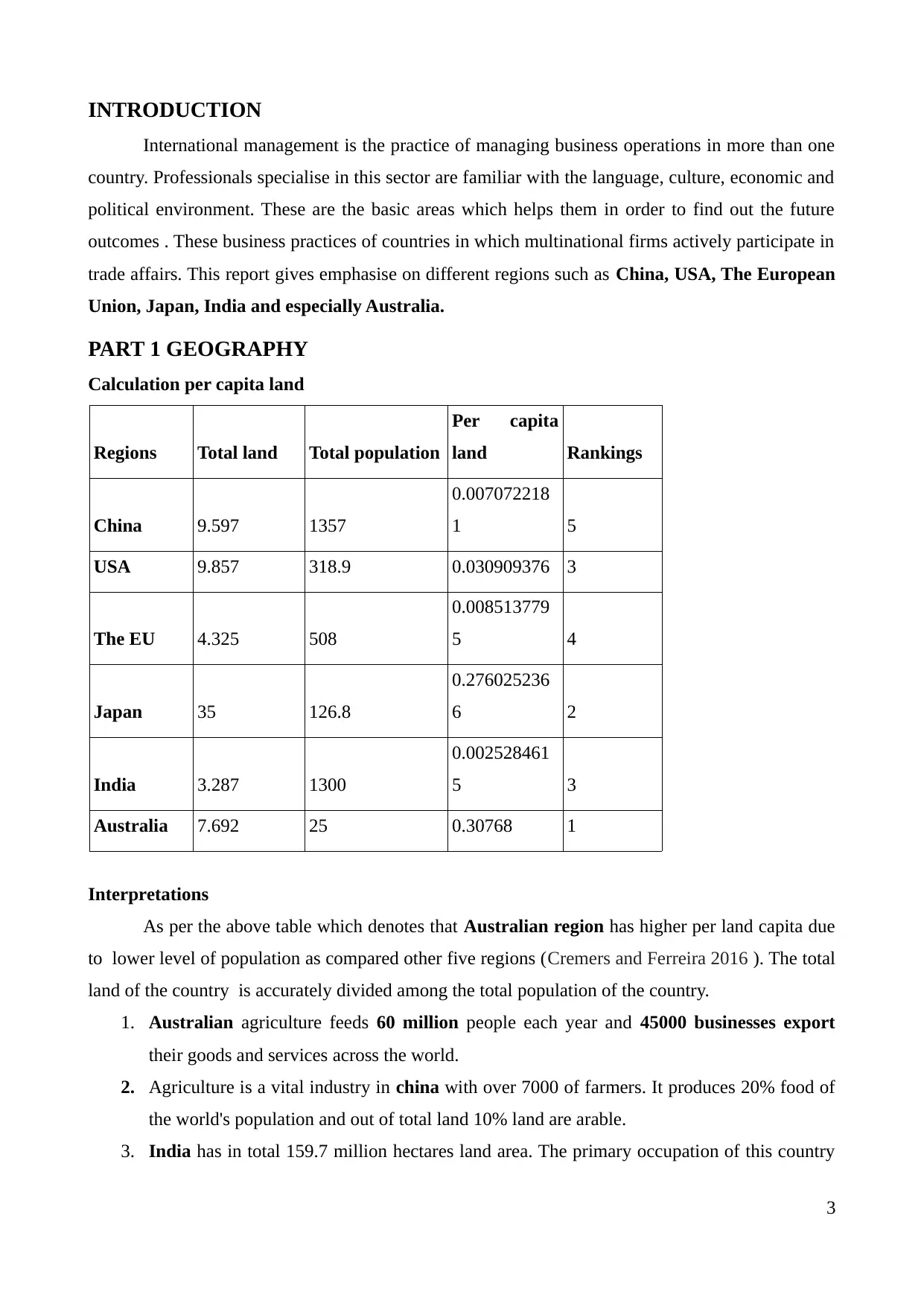
PART 1 GEOGRAPHY
Calculation per capita land
Regions Total land Total population
Per capita
land Rankings
China 9.597 1357
0.007072218
1 5
USA 9.857 318.9 0.030909376 3
The EU 4.325 508
0.008513779
5 4
Japan 35 126.8
0.276025236
6 2
India 3.287 1300
0.002528461
5 3
Australia 7.692 25 0.30768 1
Interpretations
As per the above table which denotes that Australian region has higher per land capita due
to lower level of population as compared other five regions (Cremers and Ferreira 2016 ). The total
land of the country is accurately divided among the total population of the country.
1. Australian agriculture feeds 60 million people each year and 45000 businesses export
their goods and services across the world.
2. Agriculture is a vital industry in china with over 7000 of farmers. It produces 20% food of
the world's population and out of total land 10% land are arable.
3. India has in total 159.7 million hectares land area. The primary occupation of this country
3
International management is the practice of managing business operations in more than one
country. Professionals specialise in this sector are familiar with the language, culture, economic and
political environment. These are the basic areas which helps them in order to find out the future
outcomes . These business practices of countries in which multinational firms actively participate in
trade affairs. This report gives emphasise on different regions such as China, USA, The European
Union, Japan, India and especially Australia.
PART 1 GEOGRAPHY
Calculation per capita land
Regions Total land Total population
Per capita
land Rankings
China 9.597 1357
0.007072218
1 5
USA 9.857 318.9 0.030909376 3
The EU 4.325 508
0.008513779
5 4
Japan 35 126.8
0.276025236
6 2
India 3.287 1300
0.002528461
5 3
Australia 7.692 25 0.30768 1
Interpretations
As per the above table which denotes that Australian region has higher per land capita due
to lower level of population as compared other five regions (Cremers and Ferreira 2016 ). The total
land of the country is accurately divided among the total population of the country.
1. Australian agriculture feeds 60 million people each year and 45000 businesses export
their goods and services across the world.
2. Agriculture is a vital industry in china with over 7000 of farmers. It produces 20% food of
the world's population and out of total land 10% land are arable.
3. India has in total 159.7 million hectares land area. The primary occupation of this country
3
⊘ This is a preview!⊘
Do you want full access?
Subscribe today to unlock all pages.

Trusted by 1+ million students worldwide
is agriculture.
4. Another country is Japan which is another country which have good growth of agriculture
industry and total cultivated area are 4776000 hectares.
5. The area of agricultural land in USA is around 2.3 billion acres while 80% of the total area
is covered with parks and other public infrastructure.
6. The European is that region which is a combination of 28 countries which have 175 million
hectares of agricultural land.
PART 3 CULTURE AND REGION
China- China is that country which is representing 56 ethnic minority group with about 900
million people. Chinese culture is oldest culture in the whole nation which includes ceramics,
architecture, martial arts and may more things (Sinatra and Singh 2016). The main languages of
china is Chinese and its unique cuisine such as food, tea culture. It can be said that the Chinese
emperors will serve 100 dishes per meal. The fashion styles of this country is famous in the whole
world and especially martial arts of this country. It also recognised for its visual arts, fork arts and
traditional paintings of old artists and artisans.
USA- This country adopt western culture highly influenced by different countries like African,
Native American, Asian and Latin American cultures. It has unique social and cultural features such
as dialect, music, arts, social, habits, cuisine and folklore. It involves both conservative and liberal
elements such as scientific and religious competitiveness, political structures, free expansions.
English language is common language of this nation (Kafel and Casadesus 2016). The traditional
cuisines of this country consists of several ingredients such as turkey, white-tailed deer , potatoes,
sweet potatoes and corn. In terms of education this country has many universities such as Oxford
university.
The European Union- The culture of this nation is rooted in the art, architecture, music, literature
and philosophy which was originated from the European Cultural region. This country has cultural
diversity in terms of different cultures, minority groups. The major impact of this culture is
generally linked to to the classical definition of Western world. The Western world comprises of
literacy, scientific, political, artistic and philosophical principles. It is rank at top position in terms
of providing quality of education (Cascio and Boudreau 2016). This region is a combination of
different countries which increases the overall scope of the region in terms of its increasing cultural
practices, trades and customs, rich heritage rituals, ancient cultures which is a gift given by the
ancestors to their successors to enhance their value.
Japan-The inhabitants of Japan has experienced a long period of relative isolation from the outside
4
4. Another country is Japan which is another country which have good growth of agriculture
industry and total cultivated area are 4776000 hectares.
5. The area of agricultural land in USA is around 2.3 billion acres while 80% of the total area
is covered with parks and other public infrastructure.
6. The European is that region which is a combination of 28 countries which have 175 million
hectares of agricultural land.
PART 3 CULTURE AND REGION
China- China is that country which is representing 56 ethnic minority group with about 900
million people. Chinese culture is oldest culture in the whole nation which includes ceramics,
architecture, martial arts and may more things (Sinatra and Singh 2016). The main languages of
china is Chinese and its unique cuisine such as food, tea culture. It can be said that the Chinese
emperors will serve 100 dishes per meal. The fashion styles of this country is famous in the whole
world and especially martial arts of this country. It also recognised for its visual arts, fork arts and
traditional paintings of old artists and artisans.
USA- This country adopt western culture highly influenced by different countries like African,
Native American, Asian and Latin American cultures. It has unique social and cultural features such
as dialect, music, arts, social, habits, cuisine and folklore. It involves both conservative and liberal
elements such as scientific and religious competitiveness, political structures, free expansions.
English language is common language of this nation (Kafel and Casadesus 2016). The traditional
cuisines of this country consists of several ingredients such as turkey, white-tailed deer , potatoes,
sweet potatoes and corn. In terms of education this country has many universities such as Oxford
university.
The European Union- The culture of this nation is rooted in the art, architecture, music, literature
and philosophy which was originated from the European Cultural region. This country has cultural
diversity in terms of different cultures, minority groups. The major impact of this culture is
generally linked to to the classical definition of Western world. The Western world comprises of
literacy, scientific, political, artistic and philosophical principles. It is rank at top position in terms
of providing quality of education (Cascio and Boudreau 2016). This region is a combination of
different countries which increases the overall scope of the region in terms of its increasing cultural
practices, trades and customs, rich heritage rituals, ancient cultures which is a gift given by the
ancestors to their successors to enhance their value.
Japan-The inhabitants of Japan has experienced a long period of relative isolation from the outside
4
Paraphrase This Document
Need a fresh take? Get an instant paraphrase of this document with our AI Paraphraser
world. The official languages of the country is Japanese but there are several different regional
languages and other minority groups. Main foreign languages applicable in this nation is English,
Russian, German, French, Portuguese and Spanish. Japanese cuisine has developed through
centuries of social and economic changes. The basic food of this cuisine is the rice and MISO
SOUP and other side dishes. Educational level of Japan is 99% literacy which further divided into
male and female ratio. Male literacy ratio is 99.9% and Female ratio is 99.7%.
India- India is that country which is recognised for all its unique cultures and customs. The Indian
culture is combination of several cultures, spans across the subcontinent and which has influenced
by their ancestors. The basic pillar of Indian culture is different rituals and religion. This consists of
several ingredients, Food preparation styles, cooking methods and creative presentation of the food.
Sweet is the important part of this cuisine (Bondarouk and Trullen 2016 ). Total education in India
is 75% and the female literacy level is lower as compared to the male members of the society.
Australia-It is sixth largest country in land area and is the only nation to govern an entire continent.
It has rich ancient culture in relation to different natural resources and architectural monuments. It is
a home of world's oldest living cultures with Aboriginal communities. This country has highest rate
of enrolment of secondary elementary school. It also provides education to remote areas of people
to study through computer. Almost 80% of Australians speaks English and rest other speaks
regional and minority languages. The main food of Australians is street food, meat pies and other
constituents such as beef, pork or mutton.
PART 3 POLITICAL AND LEGAL SYSTEM
China-The political state of china is Socialist with a unitary state that is one party rule system
which can be said that china is under Communist part rule. All citizen of the people's republic of
China above the age of 18 years have right to vote. The elections in China is based on Hierarchical
system of voting. Governor, mayor and other higher authority are elected by local people's
congresses. President of people's courts are elected local people's congress above the country level.
USA- This country follows the system of United States constitution which prescribes each and
every details regarding elections and all other guidelines (Adams and Smart 2016). This has
congress which has two dimensions one is US Senate and other one is House of Representatives.
The general public of this country have equal rights to vote and share their experiences as they are
the important person who will decide their own government. The elections of President and vice
president is regarded as a indirect election and other persons selection in the parliament is through
normal election through the involvement of public.
European Union- This union has seven principle decision making bodies which are listed in article
5
languages and other minority groups. Main foreign languages applicable in this nation is English,
Russian, German, French, Portuguese and Spanish. Japanese cuisine has developed through
centuries of social and economic changes. The basic food of this cuisine is the rice and MISO
SOUP and other side dishes. Educational level of Japan is 99% literacy which further divided into
male and female ratio. Male literacy ratio is 99.9% and Female ratio is 99.7%.
India- India is that country which is recognised for all its unique cultures and customs. The Indian
culture is combination of several cultures, spans across the subcontinent and which has influenced
by their ancestors. The basic pillar of Indian culture is different rituals and religion. This consists of
several ingredients, Food preparation styles, cooking methods and creative presentation of the food.
Sweet is the important part of this cuisine (Bondarouk and Trullen 2016 ). Total education in India
is 75% and the female literacy level is lower as compared to the male members of the society.
Australia-It is sixth largest country in land area and is the only nation to govern an entire continent.
It has rich ancient culture in relation to different natural resources and architectural monuments. It is
a home of world's oldest living cultures with Aboriginal communities. This country has highest rate
of enrolment of secondary elementary school. It also provides education to remote areas of people
to study through computer. Almost 80% of Australians speaks English and rest other speaks
regional and minority languages. The main food of Australians is street food, meat pies and other
constituents such as beef, pork or mutton.
PART 3 POLITICAL AND LEGAL SYSTEM
China-The political state of china is Socialist with a unitary state that is one party rule system
which can be said that china is under Communist part rule. All citizen of the people's republic of
China above the age of 18 years have right to vote. The elections in China is based on Hierarchical
system of voting. Governor, mayor and other higher authority are elected by local people's
congresses. President of people's courts are elected local people's congress above the country level.
USA- This country follows the system of United States constitution which prescribes each and
every details regarding elections and all other guidelines (Adams and Smart 2016). This has
congress which has two dimensions one is US Senate and other one is House of Representatives.
The general public of this country have equal rights to vote and share their experiences as they are
the important person who will decide their own government. The elections of President and vice
president is regarded as a indirect election and other persons selection in the parliament is through
normal election through the involvement of public.
European Union- This union has seven principle decision making bodies which are listed in article
5
13 of the treaty of European Union. It has different division of the overall government such as
European parliament, European council, Council of union, European commission, Court of justice,
central bank and court of auditors. These are the authorities which help an individual in order to
impose several rules and legislations and check the compliance with these acts. The elections are
held every 2 or 3 years depending on the size of the government (Anessi-Pessina, E., Barbera 2016).
The needs and expectations of an individuals are taking care by these people.
Japan- This country adopted one of the system of constitutional monarchy. The political system of
Japanese has three types such as general elections to the house of representatives held every 4 years,
House of Councillors held every 3 years and lastly local elections held every 4 years. The
comparison of the elections for different types contest for number seats . The national diet has two
chambers that is the House of Representatives which as 475 members elected for 4 years, further
division of these totals seats are: 295 members in single-seat constituencies and 180 members by
proportional representatives. In this type of election system voter gets 2 chances of voting such as
one chance for voting in constituency and another chance for party.
India- The India is a republic country which is following constitutional republic method by
adopting parliamentary republic system. In India Each and every person have right to vote who
have cross the age limit of 18 years by showing voter Id. Voter ID is the evidence of their age and
counting as their official vote (Cremers and Ferreira 2016). It has several division of the
government such as lok sabha and Rajya sabha these two are the house of parliaments. There are
different political parties who contest for this election. The election for Prime Minister is contest for
every five years.
Australia- The politics of Australia takes place within the federal parliamentary and constitutional
monarchy. It elects parliamentarians to the federal parliament of Australia which has bicameral
which incorporates elements of the fused executive inherited from the Westminster system. It
largely operates as a two-party voting systems which is mandatory fort the peoples of the nation.
This parliament is also known as the Commonwealth Parliament or Federal parliament that is the
legislative branch of the government (Sinatra and Singh 2016). The constitution of the country will
guide their local people and other legal authorities to work accordingly.
PART 4 TABLE 1
Average Real GDP Growth
Regions 2013 2014 2015
China 7.70% 7.30% 6.90%
USA 2.20% 2.52% 2.60%
6
European parliament, European council, Council of union, European commission, Court of justice,
central bank and court of auditors. These are the authorities which help an individual in order to
impose several rules and legislations and check the compliance with these acts. The elections are
held every 2 or 3 years depending on the size of the government (Anessi-Pessina, E., Barbera 2016).
The needs and expectations of an individuals are taking care by these people.
Japan- This country adopted one of the system of constitutional monarchy. The political system of
Japanese has three types such as general elections to the house of representatives held every 4 years,
House of Councillors held every 3 years and lastly local elections held every 4 years. The
comparison of the elections for different types contest for number seats . The national diet has two
chambers that is the House of Representatives which as 475 members elected for 4 years, further
division of these totals seats are: 295 members in single-seat constituencies and 180 members by
proportional representatives. In this type of election system voter gets 2 chances of voting such as
one chance for voting in constituency and another chance for party.
India- The India is a republic country which is following constitutional republic method by
adopting parliamentary republic system. In India Each and every person have right to vote who
have cross the age limit of 18 years by showing voter Id. Voter ID is the evidence of their age and
counting as their official vote (Cremers and Ferreira 2016). It has several division of the
government such as lok sabha and Rajya sabha these two are the house of parliaments. There are
different political parties who contest for this election. The election for Prime Minister is contest for
every five years.
Australia- The politics of Australia takes place within the federal parliamentary and constitutional
monarchy. It elects parliamentarians to the federal parliament of Australia which has bicameral
which incorporates elements of the fused executive inherited from the Westminster system. It
largely operates as a two-party voting systems which is mandatory fort the peoples of the nation.
This parliament is also known as the Commonwealth Parliament or Federal parliament that is the
legislative branch of the government (Sinatra and Singh 2016). The constitution of the country will
guide their local people and other legal authorities to work accordingly.
PART 4 TABLE 1
Average Real GDP Growth
Regions 2013 2014 2015
China 7.70% 7.30% 6.90%
USA 2.20% 2.52% 2.60%
6
⊘ This is a preview!⊘
Do you want full access?
Subscribe today to unlock all pages.
Trusted by 1+ million students worldwide
European Union 1.70% 1.85% 1.90%
Japan 1.60% 1.85% 2.50%
India 5.00% 7.24% 7.56%
Australia 2.50% 2.62% 2.48%
Interpretations
The Average GDP and account current balance these regions are fluctuating due to the
impact of external implications on the business and their business is affected due to the competitors.
PART 4 TABLE 2
1) Australia is the world's largest exporter of iron ore and this country trade with different
countries like China, Japan, United states, Korea and Singapore. The total Exports value of
the Australia is $318.5 Billion and the import value is $328.7 Billion. This is showing the
inability of the nation to minimize all its import amount and try to increase the overall
amount of export.
2) The Australia send their products to the different countries and earn different from various
regions such as China(101,590$ Million), Japan($49,532 Million), Korea($21,274Million),
United states($15,553Million), India($11,430Million). The total amount of investment done
by the country in other regions are China(49,239), United states(39,181), Japan(21,221),
Singapore(17,878), Thailand(13,832).
3) The Australia is biggest exporter in the whole world in terms of different sectors such as
Iron ores, gold and coal (Terjesena and Li 2016). Especially in Gold it was 13,987$ Million
and Coals it was 39,805$ million.
CONCLUSION
From the above study it can be concluded that the international management is an approach
used by the country offi8cials in order to find out the actual state of their country. These different
regions have fluctuating GDP, per capita income and most importantly the Australian region has
good rate of growth in terms of everything which increases their overall market share and market
growth.
7
Japan 1.60% 1.85% 2.50%
India 5.00% 7.24% 7.56%
Australia 2.50% 2.62% 2.48%
Interpretations
The Average GDP and account current balance these regions are fluctuating due to the
impact of external implications on the business and their business is affected due to the competitors.
PART 4 TABLE 2
1) Australia is the world's largest exporter of iron ore and this country trade with different
countries like China, Japan, United states, Korea and Singapore. The total Exports value of
the Australia is $318.5 Billion and the import value is $328.7 Billion. This is showing the
inability of the nation to minimize all its import amount and try to increase the overall
amount of export.
2) The Australia send their products to the different countries and earn different from various
regions such as China(101,590$ Million), Japan($49,532 Million), Korea($21,274Million),
United states($15,553Million), India($11,430Million). The total amount of investment done
by the country in other regions are China(49,239), United states(39,181), Japan(21,221),
Singapore(17,878), Thailand(13,832).
3) The Australia is biggest exporter in the whole world in terms of different sectors such as
Iron ores, gold and coal (Terjesena and Li 2016). Especially in Gold it was 13,987$ Million
and Coals it was 39,805$ million.
CONCLUSION
From the above study it can be concluded that the international management is an approach
used by the country offi8cials in order to find out the actual state of their country. These different
regions have fluctuating GDP, per capita income and most importantly the Australian region has
good rate of growth in terms of everything which increases their overall market share and market
growth.
7
Paraphrase This Document
Need a fresh take? Get an instant paraphrase of this document with our AI Paraphraser
REFERENCES
Books and Journals
Adams, R. J., Smart (2016). Shades of Grey: Guidelines for Working with the Grey Literature in
Systematic Reviews for Management and Organizational Studies. International Journal of
Management Reviews.
Anessi-Pessina, E., Barbera (2016). Public sector budgeting: a European review of accounting and
public management journals. Accounting, Auditing & Accountability Journal. 29(3). 491-519.
Bondarouk, T., Trullen (2016). Special Issue of International Journal of Human Resource
Management: Conceptual and empirical discoveries in successful HRM implementation. The
International Journal of Human Resource Management. 27(8). 906-908.
Cascio, W. F., & Boudreau, J. W. (2016). The search for global competence: From international HR
to talent management. Journal of World Business. 51(1). 103-114.
Cremers, M., Ferreira (2016). Indexing and active fund management: International evidence.
Journal of Financial Economics. 120(3). 539-560.
Kafel, P., & Casadesus, M. (2016). The order and level of management standards implementation:
Changes during the time. The TQM Journal. 28(4). 636-647.
Sinatra, A., Singh, (2016). The Management of Corporate Acquisitions: International Perspectives.
Springer.
Terjesen, S., Hessels, J., & Li, D. (2016). Comparative International Entrepreneurship A Review
and Research Agenda. Journal of Management. 42(1). 299-344.
8
Books and Journals
Adams, R. J., Smart (2016). Shades of Grey: Guidelines for Working with the Grey Literature in
Systematic Reviews for Management and Organizational Studies. International Journal of
Management Reviews.
Anessi-Pessina, E., Barbera (2016). Public sector budgeting: a European review of accounting and
public management journals. Accounting, Auditing & Accountability Journal. 29(3). 491-519.
Bondarouk, T., Trullen (2016). Special Issue of International Journal of Human Resource
Management: Conceptual and empirical discoveries in successful HRM implementation. The
International Journal of Human Resource Management. 27(8). 906-908.
Cascio, W. F., & Boudreau, J. W. (2016). The search for global competence: From international HR
to talent management. Journal of World Business. 51(1). 103-114.
Cremers, M., Ferreira (2016). Indexing and active fund management: International evidence.
Journal of Financial Economics. 120(3). 539-560.
Kafel, P., & Casadesus, M. (2016). The order and level of management standards implementation:
Changes during the time. The TQM Journal. 28(4). 636-647.
Sinatra, A., Singh, (2016). The Management of Corporate Acquisitions: International Perspectives.
Springer.
Terjesen, S., Hessels, J., & Li, D. (2016). Comparative International Entrepreneurship A Review
and Research Agenda. Journal of Management. 42(1). 299-344.
8

1 out of 8


Related Documents


Your All-in-One AI-Powered Toolkit for Academic Success.
+13062052269
info@desklib.com
Available 24*7 on WhatsApp / Email
![[object Object]](/_next/static/media/star-bottom.7253800d.svg)
Unlock your academic potential
Copyright © 2020–2026 A2Z Services. All Rights Reserved. Developed and managed by ZUCOL.