International Management Report: PWC, Cultural Adjustment, and Ethics
VerifiedAdded on 2023/01/06
|9
|2776
|65
Report
AI Summary
This report delves into the intricacies of international management, focusing on expatriate failure and the factors that contribute to success in cross-cultural environments. It examines the challenges faced by expatriates, particularly regarding cultural adjustment, and explores strategies to mitigate these challenges, emphasizing the importance of selecting, preparing, and orienting expatriates. The report also discusses the factors driving the globalized economy, such as containerization, technological advancements, and economies of scale, while highlighting the significance of ethically sound and accountable international policies. It stresses the need for businesses like PWC to adapt to changing market conditions, manage ethical responsibilities, and foster a deep understanding of cultural diversity to achieve sustained success. The report underscores the impact of values and morals on business practices, advocating for a commitment to ethical behavior to enhance employee personality and drive profitability in the global marketplace.
International
Management
Management

Paraphrase This Document
Need a fresh take? Get an instant paraphrase of this document with our AI Paraphraser
Table of Contents
INTRODUCTION...........................................................................................................................1
MAIN BODY...................................................................................................................................1
A) Critically discuss the evidence about expatriate failure, especially with regard to cultural
adjustment and consider the factors that maximise expatriate success.......................................1
B) Discuss the factors that contribute to the notion of a globalised economy demonstrating a
awarenesses of ethically sound and accountable international policies......................................3
CONCLUSION ...............................................................................................................................6
REFERENCES................................................................................................................................7
INTRODUCTION...........................................................................................................................1
MAIN BODY...................................................................................................................................1
A) Critically discuss the evidence about expatriate failure, especially with regard to cultural
adjustment and consider the factors that maximise expatriate success.......................................1
B) Discuss the factors that contribute to the notion of a globalised economy demonstrating a
awarenesses of ethically sound and accountable international policies......................................3
CONCLUSION ...............................................................................................................................6
REFERENCES................................................................................................................................7
INTRODUCTION
An international management is a procedure that is used by the business as in order to
emphasis the profit and sales share so that working potential is increases with continuity. In this
set of skills and knowledge is enhanced as while managing the operating regulations so that
organised outcome is generated with standardised period of instance (Bateman, Snell and
Konopaske, 2017). It basically refer to the transaction of goods and services by which
technicalities and range of scaling is increases. The following report is based on PWC
(PricewaterhouseCoopers) which is a multinational service network firm that has been operated
as while performing partnership under PWC brand. The report below consist of certain evidence
dependent on expatriate failure as in regard cultural adjustment that maximise expatriate success.
In addition also include various factors that contribute towards nation of globalised economy.
MAIN BODY
A) Critically discuss the evidence about expatriate failure, especially with regard to cultural
adjustment and consider the factors that maximise expatriate success.
In relation to international management is it required for the business that they must have
maintain effective understanding about the different resources that has been used to make
suitable supply of various goods and services in constant basis. In this cultural aspect is the basic
fundamental that is considerate by each and every expatriate as while moving in international
market. As per the passage of time business environment has been shifted towards global trading
and in this volatility is being increases on continuous basis (Beamish and Lupton, 2016). On the
other hand due to the pandemic attack of COVID there is certain fragility that is developed with
competitive market. In this unacceptable and unsustainable development is addressed due to
which unemployment has been raised, home repossessions is increases, wage is getting freezes,
pension deficit is developed and higher age of retirement is induced so that various consequences
of crisis is developed. In order to manage sustain success and growth it is required that
management of PWC must have consider international economies, working under international
strategies and change in business as per context of national abilities.
As while making adjustment with cross-cultural the employee's of PWC must have
considerate various factors through which expatriate success is enhanced. As per the increment
of hyper competition business characteristic is increases under which strong and aggressive
1
An international management is a procedure that is used by the business as in order to
emphasis the profit and sales share so that working potential is increases with continuity. In this
set of skills and knowledge is enhanced as while managing the operating regulations so that
organised outcome is generated with standardised period of instance (Bateman, Snell and
Konopaske, 2017). It basically refer to the transaction of goods and services by which
technicalities and range of scaling is increases. The following report is based on PWC
(PricewaterhouseCoopers) which is a multinational service network firm that has been operated
as while performing partnership under PWC brand. The report below consist of certain evidence
dependent on expatriate failure as in regard cultural adjustment that maximise expatriate success.
In addition also include various factors that contribute towards nation of globalised economy.
MAIN BODY
A) Critically discuss the evidence about expatriate failure, especially with regard to cultural
adjustment and consider the factors that maximise expatriate success.
In relation to international management is it required for the business that they must have
maintain effective understanding about the different resources that has been used to make
suitable supply of various goods and services in constant basis. In this cultural aspect is the basic
fundamental that is considerate by each and every expatriate as while moving in international
market. As per the passage of time business environment has been shifted towards global trading
and in this volatility is being increases on continuous basis (Beamish and Lupton, 2016). On the
other hand due to the pandemic attack of COVID there is certain fragility that is developed with
competitive market. In this unacceptable and unsustainable development is addressed due to
which unemployment has been raised, home repossessions is increases, wage is getting freezes,
pension deficit is developed and higher age of retirement is induced so that various consequences
of crisis is developed. In order to manage sustain success and growth it is required that
management of PWC must have consider international economies, working under international
strategies and change in business as per context of national abilities.
As while making adjustment with cross-cultural the employee's of PWC must have
considerate various factors through which expatriate success is enhanced. As per the increment
of hyper competition business characteristic is increases under which strong and aggressive
1
⊘ This is a preview!⊘
Do you want full access?
Subscribe today to unlock all pages.

Trusted by 1+ million students worldwide
competition in between different competitors is addressed (Brannen, Piekkari and Tietze, 2017).
It is essential to make strong competition within which market conditions and situations also get
changes on rapidly. In order to manage the working prospect over cross-cultural the business
must have consider behavioural aspects of various individual that assist to seek better
improvisation among employee's interaction and while making alliance with other companies
and cultures. It is a fair management deal under which managerial practices is identifies and
differentiate on the basis of culture and behaviour. Expatriate usually relies on ethnocentric
approach of staffing through which international operations and functions has been controlled.
PWC must have select an individual for internationalisation business who has tendency to move
predominantly over host places.
An expatriate faces certain challenges as while working in international business such as
it is an expensive process. In this expatriate has to estimate the expenses of about three to four
times as compared to the working at home places. In addition expatriate also receive the basic
salary as with the supplement of allowances, cost of living differential, education cost and travel
expenses (Ferraris, Santoro and Bresciani, 2017). The basic problem is to manage and get into
new environment with easiness. In this the different between culture, work related norms,
healthcare alteration, customers, cuisine, housing, schooling and many others are the basic
components that assist to make better contribution towards failure of expatriate.
In addition in order to manage success and growth of expatriate the HRM department of
PWC must have considerate cross-cultural psychology, organisational business, international
consequences, social anthropology and internal management under which business strategies is
influenced and changes as per continuous period of time. In this expatriate has divided different
working aspect into different formats so that sustained success is achieved with better success
and development and it is as furthermore explained below as: Selecting expatriates: In this business has make direct selection of individual as while
managing various working so that stress is being managed and controlled with
appropriateness. In this interpersonal skills has been practised so that technical
competency is increases. In assist to produce most significant changes through which
consistency among working is addressed (Geppert, Matten and Williams, 2016). PWC
must have manages cross-cultural aspects as while considering self-efficacy skills that
basically includes substitution, technical balance, relationship development, stress
2
It is essential to make strong competition within which market conditions and situations also get
changes on rapidly. In order to manage the working prospect over cross-cultural the business
must have consider behavioural aspects of various individual that assist to seek better
improvisation among employee's interaction and while making alliance with other companies
and cultures. It is a fair management deal under which managerial practices is identifies and
differentiate on the basis of culture and behaviour. Expatriate usually relies on ethnocentric
approach of staffing through which international operations and functions has been controlled.
PWC must have select an individual for internationalisation business who has tendency to move
predominantly over host places.
An expatriate faces certain challenges as while working in international business such as
it is an expensive process. In this expatriate has to estimate the expenses of about three to four
times as compared to the working at home places. In addition expatriate also receive the basic
salary as with the supplement of allowances, cost of living differential, education cost and travel
expenses (Ferraris, Santoro and Bresciani, 2017). The basic problem is to manage and get into
new environment with easiness. In this the different between culture, work related norms,
healthcare alteration, customers, cuisine, housing, schooling and many others are the basic
components that assist to make better contribution towards failure of expatriate.
In addition in order to manage success and growth of expatriate the HRM department of
PWC must have considerate cross-cultural psychology, organisational business, international
consequences, social anthropology and internal management under which business strategies is
influenced and changes as per continuous period of time. In this expatriate has divided different
working aspect into different formats so that sustained success is achieved with better success
and development and it is as furthermore explained below as: Selecting expatriates: In this business has make direct selection of individual as while
managing various working so that stress is being managed and controlled with
appropriateness. In this interpersonal skills has been practised so that technical
competency is increases. In assist to produce most significant changes through which
consistency among working is addressed (Geppert, Matten and Williams, 2016). PWC
must have manages cross-cultural aspects as while considering self-efficacy skills that
basically includes substitution, technical balance, relationship development, stress
2
Paraphrase This Document
Need a fresh take? Get an instant paraphrase of this document with our AI Paraphraser
reduction, willing to compete with communication and language prospect. It include
different category such as job factors, cultural empathy and flexibility, language skills,
family situation and motivational state.
Preparing and orienting expatriate: The selection of suitable expatriate is a logical
solution as it ensure that sustained success is altered. It actually contribute towards
planning so that entry and re-entry transition is managed. In this management department
of PWC has prepared and designed certain set of training and development so that
working transition is managed so that complexity has been reduced with certain balance.
As expatriate not only make adequate adjustment but along with this also has to manage
new job role and place. On other stress management is addressed and in this training is
being provided so as to resolve family and spouse issues (Haski-Leventhal, Pournader
and McKinnon, 2017). It consist of serving attention under which supportive material is
exposed. It consider training about language, cultural awareness, cultural assimilation,
local business norm and flexibility by which rate of expatriate failure is increases. It this
the degree of attention of individual is reduced under which dependence of market is
managed so that productive and profitable outcome is conceived with perfection.
In support of this PWC has overseas its experience in which global leader has worked on
to induce balanced success so that required and essential transcend is measured by which cultural
perspective is increases (Tjosvold, 2017). It produces self-awareness at deepen through which
success and belief is acknowledge through which better success is induced on repetitive mode. In
addition willing to pay higher attention towards cultural diversity is induced through which
working routine and its pattern is increases. Furthermore, humility is being enhanced under
which interested culture is developed in which fascinated result is achieved with better
suitability.
B) Discuss the factors that contribute to the notion of a globalised economy demonstrating a
awarenesses of ethically sound and accountable international policies.
The globalised economy is being managed and controlled in order to increase
interdependence of international economies. In result of it economy of scale is managed through
which cross-cultural services and commodities is controlled under which flow of capital and
services is spread with rapid enhancement of technologies (López‐Duarte, Vidal‐Suárez and
González‐Díaz, 2016). There are different factors that notion globalised outcome as while
3
different category such as job factors, cultural empathy and flexibility, language skills,
family situation and motivational state.
Preparing and orienting expatriate: The selection of suitable expatriate is a logical
solution as it ensure that sustained success is altered. It actually contribute towards
planning so that entry and re-entry transition is managed. In this management department
of PWC has prepared and designed certain set of training and development so that
working transition is managed so that complexity has been reduced with certain balance.
As expatriate not only make adequate adjustment but along with this also has to manage
new job role and place. On other stress management is addressed and in this training is
being provided so as to resolve family and spouse issues (Haski-Leventhal, Pournader
and McKinnon, 2017). It consist of serving attention under which supportive material is
exposed. It consider training about language, cultural awareness, cultural assimilation,
local business norm and flexibility by which rate of expatriate failure is increases. It this
the degree of attention of individual is reduced under which dependence of market is
managed so that productive and profitable outcome is conceived with perfection.
In support of this PWC has overseas its experience in which global leader has worked on
to induce balanced success so that required and essential transcend is measured by which cultural
perspective is increases (Tjosvold, 2017). It produces self-awareness at deepen through which
success and belief is acknowledge through which better success is induced on repetitive mode. In
addition willing to pay higher attention towards cultural diversity is induced through which
working routine and its pattern is increases. Furthermore, humility is being enhanced under
which interested culture is developed in which fascinated result is achieved with better
suitability.
B) Discuss the factors that contribute to the notion of a globalised economy demonstrating a
awarenesses of ethically sound and accountable international policies.
The globalised economy is being managed and controlled in order to increase
interdependence of international economies. In result of it economy of scale is managed through
which cross-cultural services and commodities is controlled under which flow of capital and
services is spread with rapid enhancement of technologies (López‐Duarte, Vidal‐Suárez and
González‐Díaz, 2016). There are different factors that notion globalised outcome as while
3
demonstrating awareness in prospect of ethical sound and accountable of international policies
and it is as explained below as:
Containerisation: It is an aspect which bulk shipping is considerate within which larger
efficiency is increased on regular basis. In this the lower cost of manufacturing is being managed
under which product price is managed so that manufacturing cost within export market is
consider as most contestable.
Technological changes: It is an advancement that is induced as by inducing perfect
change so that working efficiency of the business is getting enhanced over continuous period of
instance (Neal, 2016). In this rapid and sustained alteration in order to manage the costing of
transmitting is managed. It is used to make effective communication so that knowledge and
performance trading is managed as with the parallel usage of technologies.
Economies of sale: It is vital for the growth and development of PWC as in international
market that certain increment within efficiency of scale is managed. In this as per regard or
concern of domestic market it is essential to get satisfy the selling and production of goods and
services. It is an emerging trends through which it is required for business to make own
transactional alteration so that moderate level of modification is induced.
Difference in tax system: It is a basic desire of a business to take collective benefit as
from working standards. In this PWC looking forward to reduced the unit labour cost so that
favourable ending is resulted as while perfect management of production components (Persakis
and Iatridis, 2016). In this balanced level of alteration is adjusted within taxation so that suitable
tax system is developed and also used to attract FDI. In this most of the countries has engaged
with tax competition so that lucrative achievement is induced.
Less protectionism: It is a prospect under which non-tariff is protected and it is processed
as by managing import licensing, foreign exchange control through which gradual changes is
addressed. As in the international processing of business it is required to open and make average
tariff level is decreased. In this business has to struggle in order to achieved real economic
growth and success so that persistent deficit and trading is accountant.
Growth strategies while transactional businesses: It is a basic prospect under which
profit growth and revenue generation is being managed. In this global appearance of brands has
been measured on significant basis through which sustained growth is measured. In this brand
and business performance has been improved so that its working potential also get emphasised. It
4
and it is as explained below as:
Containerisation: It is an aspect which bulk shipping is considerate within which larger
efficiency is increased on regular basis. In this the lower cost of manufacturing is being managed
under which product price is managed so that manufacturing cost within export market is
consider as most contestable.
Technological changes: It is an advancement that is induced as by inducing perfect
change so that working efficiency of the business is getting enhanced over continuous period of
instance (Neal, 2016). In this rapid and sustained alteration in order to manage the costing of
transmitting is managed. It is used to make effective communication so that knowledge and
performance trading is managed as with the parallel usage of technologies.
Economies of sale: It is vital for the growth and development of PWC as in international
market that certain increment within efficiency of scale is managed. In this as per regard or
concern of domestic market it is essential to get satisfy the selling and production of goods and
services. It is an emerging trends through which it is required for business to make own
transactional alteration so that moderate level of modification is induced.
Difference in tax system: It is a basic desire of a business to take collective benefit as
from working standards. In this PWC looking forward to reduced the unit labour cost so that
favourable ending is resulted as while perfect management of production components (Persakis
and Iatridis, 2016). In this balanced level of alteration is adjusted within taxation so that suitable
tax system is developed and also used to attract FDI. In this most of the countries has engaged
with tax competition so that lucrative achievement is induced.
Less protectionism: It is a prospect under which non-tariff is protected and it is processed
as by managing import licensing, foreign exchange control through which gradual changes is
addressed. As in the international processing of business it is required to open and make average
tariff level is decreased. In this business has to struggle in order to achieved real economic
growth and success so that persistent deficit and trading is accountant.
Growth strategies while transactional businesses: It is a basic prospect under which
profit growth and revenue generation is being managed. In this global appearance of brands has
been measured on significant basis through which sustained growth is measured. In this brand
and business performance has been improved so that its working potential also get emphasised. It
4
⊘ This is a preview!⊘
Do you want full access?
Subscribe today to unlock all pages.
Trusted by 1+ million students worldwide
is used to make successful implementation of different strategies and initiatives has been
induced. In this PWC measure fuelled growth in terms of economy enhancement through which
consumer basis is increases.
In context to PWC global business ethics seeks to provide and offer modified level of
changes that are in favour of growth and development of business (Sharman, 2017). It is used to
develop and maintain effectual relationship in between international business and ethics so that
extensive impact on individual perceptions, belief and values is addressed. In context to ethics it
basically seeks to enhance morality and attitude through which positive changes is addressed
within which appropriate justice and its balance virtue is developed. It usually involve
systematizing, recommending and defending both right and wrong aspect. In this different
factors has been induced under which values, personal goal, knowledge, attribute, moral and
overall personality has been changes. It is used to select suitable path so that favourable outcome
is developed under which sustained amount of changes is addressed over continuous period.
Values: It is a prospect in which individual take action and judgement as on the basis of
its standardised behaviour. As while expanding the business PWC must have consider adequate
understanding of knowledge and experience enhancement so that proper modification is induced.
It is about to enhance financial costing so that appropriate alteration within improvisation of
business performance is analysed.
Morals: It is a specialised characteristic that is diverse as per individual's characteristic
and in this cultural norm and values is measured (Terjesen, Hessels and Li, 2016). It is the basis
of rules that is learnt as from childhood, education, culture, religion and many others components
as well. It is also get varied as per the situation through which accomplishment of goals and
objectives is affected. In this worth of business is managed so that integrated behaviour is
addressed. It determine ethical behaviour so that employee personality and risk taking ability is
increases that would be dragged into profitability.
In order to manage the ethical responsibilities PWC plays a sustain role model so that
certain expectations has been communicated within the marketplace. It is also being used to offer
balanced training and development by which probability of attaining visible reward is developed
and it pushed the viability and certainty. It produces balanced protection as by following
particular mechanism under which probability of achievement of goals and objectives is attained.
5
induced. In this PWC measure fuelled growth in terms of economy enhancement through which
consumer basis is increases.
In context to PWC global business ethics seeks to provide and offer modified level of
changes that are in favour of growth and development of business (Sharman, 2017). It is used to
develop and maintain effectual relationship in between international business and ethics so that
extensive impact on individual perceptions, belief and values is addressed. In context to ethics it
basically seeks to enhance morality and attitude through which positive changes is addressed
within which appropriate justice and its balance virtue is developed. It usually involve
systematizing, recommending and defending both right and wrong aspect. In this different
factors has been induced under which values, personal goal, knowledge, attribute, moral and
overall personality has been changes. It is used to select suitable path so that favourable outcome
is developed under which sustained amount of changes is addressed over continuous period.
Values: It is a prospect in which individual take action and judgement as on the basis of
its standardised behaviour. As while expanding the business PWC must have consider adequate
understanding of knowledge and experience enhancement so that proper modification is induced.
It is about to enhance financial costing so that appropriate alteration within improvisation of
business performance is analysed.
Morals: It is a specialised characteristic that is diverse as per individual's characteristic
and in this cultural norm and values is measured (Terjesen, Hessels and Li, 2016). It is the basis
of rules that is learnt as from childhood, education, culture, religion and many others components
as well. It is also get varied as per the situation through which accomplishment of goals and
objectives is affected. In this worth of business is managed so that integrated behaviour is
addressed. It determine ethical behaviour so that employee personality and risk taking ability is
increases that would be dragged into profitability.
In order to manage the ethical responsibilities PWC plays a sustain role model so that
certain expectations has been communicated within the marketplace. It is also being used to offer
balanced training and development by which probability of attaining visible reward is developed
and it pushed the viability and certainty. It produces balanced protection as by following
particular mechanism under which probability of achievement of goals and objectives is attained.
5
Paraphrase This Document
Need a fresh take? Get an instant paraphrase of this document with our AI Paraphraser
CONCLUSION
It has been summarised from the above report that international management is being
processed by the business as in order to manage and operate various working standards at global
platform so that large amount of profit and success is achieved. There is different components
that is addressed by expatriate so as to overcome from failure and to achieve constant success. In
this cultural adjustment is managed as while engaging key concepts so that productive output is
achieved. Furthermore, in this various factors are discussed that have contributes to notion of
globalised economy as in terms of ethical consideration.
6
It has been summarised from the above report that international management is being
processed by the business as in order to manage and operate various working standards at global
platform so that large amount of profit and success is achieved. There is different components
that is addressed by expatriate so as to overcome from failure and to achieve constant success. In
this cultural adjustment is managed as while engaging key concepts so that productive output is
achieved. Furthermore, in this various factors are discussed that have contributes to notion of
globalised economy as in terms of ethical consideration.
6
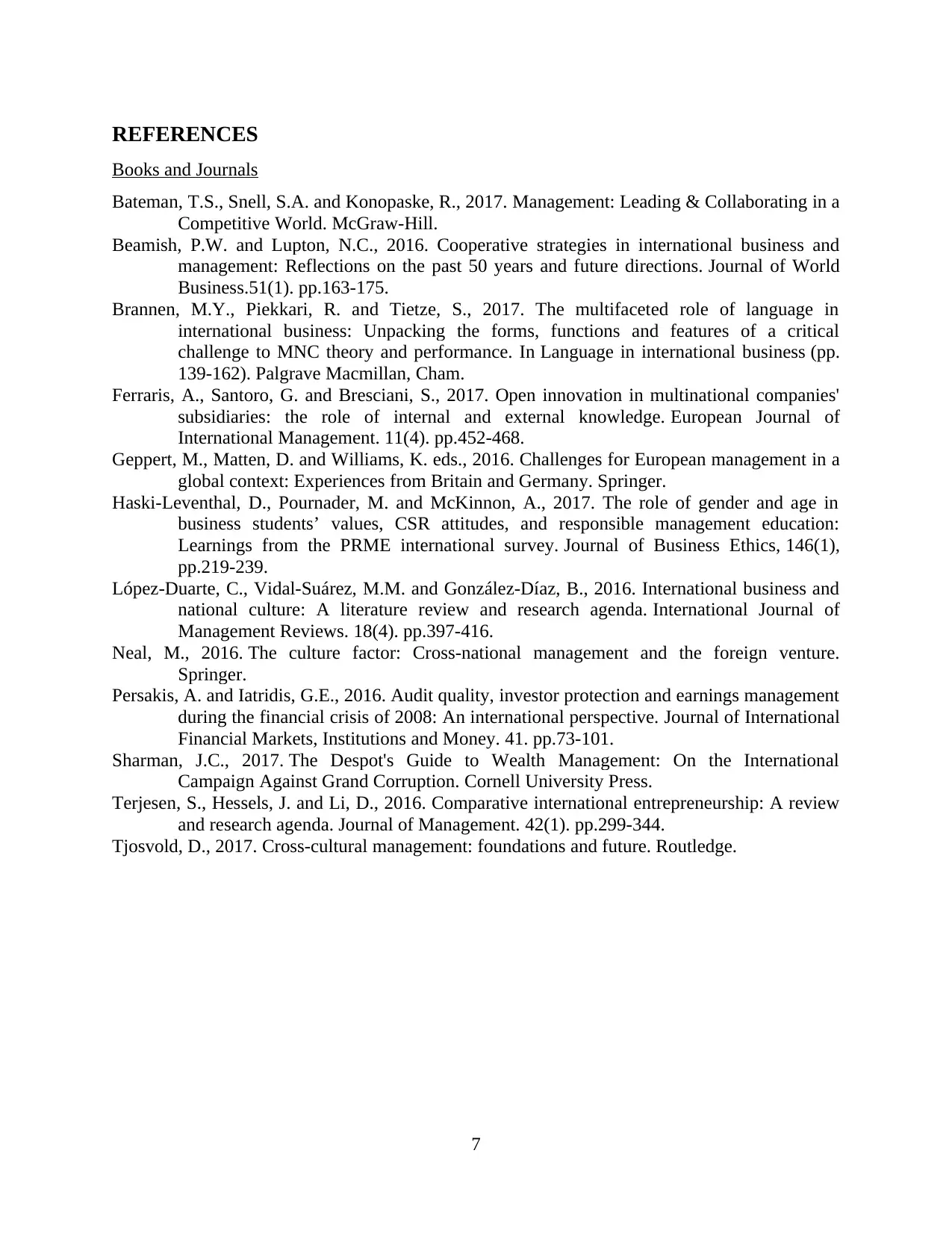
REFERENCES
Books and Journals
Bateman, T.S., Snell, S.A. and Konopaske, R., 2017. Management: Leading & Collaborating in a
Competitive World. McGraw-Hill.
Beamish, P.W. and Lupton, N.C., 2016. Cooperative strategies in international business and
management: Reflections on the past 50 years and future directions. Journal of World
Business.51(1). pp.163-175.
Brannen, M.Y., Piekkari, R. and Tietze, S., 2017. The multifaceted role of language in
international business: Unpacking the forms, functions and features of a critical
challenge to MNC theory and performance. In Language in international business (pp.
139-162). Palgrave Macmillan, Cham.
Ferraris, A., Santoro, G. and Bresciani, S., 2017. Open innovation in multinational companies'
subsidiaries: the role of internal and external knowledge. European Journal of
International Management. 11(4). pp.452-468.
Geppert, M., Matten, D. and Williams, K. eds., 2016. Challenges for European management in a
global context: Experiences from Britain and Germany. Springer.
Haski-Leventhal, D., Pournader, M. and McKinnon, A., 2017. The role of gender and age in
business students’ values, CSR attitudes, and responsible management education:
Learnings from the PRME international survey. Journal of Business Ethics, 146(1),
pp.219-239.
López‐Duarte, C., Vidal‐Suárez, M.M. and González‐Díaz, B., 2016. International business and
national culture: A literature review and research agenda. International Journal of
Management Reviews. 18(4). pp.397-416.
Neal, M., 2016. The culture factor: Cross-national management and the foreign venture.
Springer.
Persakis, A. and Iatridis, G.E., 2016. Audit quality, investor protection and earnings management
during the financial crisis of 2008: An international perspective. Journal of International
Financial Markets, Institutions and Money. 41. pp.73-101.
Sharman, J.C., 2017. The Despot's Guide to Wealth Management: On the International
Campaign Against Grand Corruption. Cornell University Press.
Terjesen, S., Hessels, J. and Li, D., 2016. Comparative international entrepreneurship: A review
and research agenda. Journal of Management. 42(1). pp.299-344.
Tjosvold, D., 2017. Cross-cultural management: foundations and future. Routledge.
7
Books and Journals
Bateman, T.S., Snell, S.A. and Konopaske, R., 2017. Management: Leading & Collaborating in a
Competitive World. McGraw-Hill.
Beamish, P.W. and Lupton, N.C., 2016. Cooperative strategies in international business and
management: Reflections on the past 50 years and future directions. Journal of World
Business.51(1). pp.163-175.
Brannen, M.Y., Piekkari, R. and Tietze, S., 2017. The multifaceted role of language in
international business: Unpacking the forms, functions and features of a critical
challenge to MNC theory and performance. In Language in international business (pp.
139-162). Palgrave Macmillan, Cham.
Ferraris, A., Santoro, G. and Bresciani, S., 2017. Open innovation in multinational companies'
subsidiaries: the role of internal and external knowledge. European Journal of
International Management. 11(4). pp.452-468.
Geppert, M., Matten, D. and Williams, K. eds., 2016. Challenges for European management in a
global context: Experiences from Britain and Germany. Springer.
Haski-Leventhal, D., Pournader, M. and McKinnon, A., 2017. The role of gender and age in
business students’ values, CSR attitudes, and responsible management education:
Learnings from the PRME international survey. Journal of Business Ethics, 146(1),
pp.219-239.
López‐Duarte, C., Vidal‐Suárez, M.M. and González‐Díaz, B., 2016. International business and
national culture: A literature review and research agenda. International Journal of
Management Reviews. 18(4). pp.397-416.
Neal, M., 2016. The culture factor: Cross-national management and the foreign venture.
Springer.
Persakis, A. and Iatridis, G.E., 2016. Audit quality, investor protection and earnings management
during the financial crisis of 2008: An international perspective. Journal of International
Financial Markets, Institutions and Money. 41. pp.73-101.
Sharman, J.C., 2017. The Despot's Guide to Wealth Management: On the International
Campaign Against Grand Corruption. Cornell University Press.
Terjesen, S., Hessels, J. and Li, D., 2016. Comparative international entrepreneurship: A review
and research agenda. Journal of Management. 42(1). pp.299-344.
Tjosvold, D., 2017. Cross-cultural management: foundations and future. Routledge.
7
⊘ This is a preview!⊘
Do you want full access?
Subscribe today to unlock all pages.
Trusted by 1+ million students worldwide

1 out of 9


Related Documents


Your All-in-One AI-Powered Toolkit for Academic Success.
+13062052269
info@desklib.com
Available 24*7 on WhatsApp / Email
![[object Object]](/_next/static/media/star-bottom.7253800d.svg)
Unlock your academic potential
Copyright © 2020–2026 A2Z Services. All Rights Reserved. Developed and managed by ZUCOL.