International Business Report: Nestle's Global Market Analysis
VerifiedAdded on 2023/01/11
|12
|4068
|29
Report
AI Summary
This report provides a comprehensive analysis of international business, focusing on the opportunities and threats faced by companies operating in global markets, with a specific focus on Nestle. It examines the benefits of globalization, the importance of market selection, and the need for effective strategies to maximize profits and gain a competitive edge. The report delves into the opportunities and threats in high-context and low-context cultural environments, including exports, imports, licensing, franchising, outsourcing, and online trading, while also addressing risks such as foreign exchange, political, regulatory, and economic factors. A literature review is included, along with recommendations for achieving cross-cultural proficiency, and a macro-environment analysis of political, economic, social, technological, environmental, and legal factors. The report highlights the importance of adapting strategies to navigate the complexities of the international business landscape and achieve sustainable growth.
International
Business
Business

Paraphrase This Document
Need a fresh take? Get an instant paraphrase of this document with our AI Paraphraser
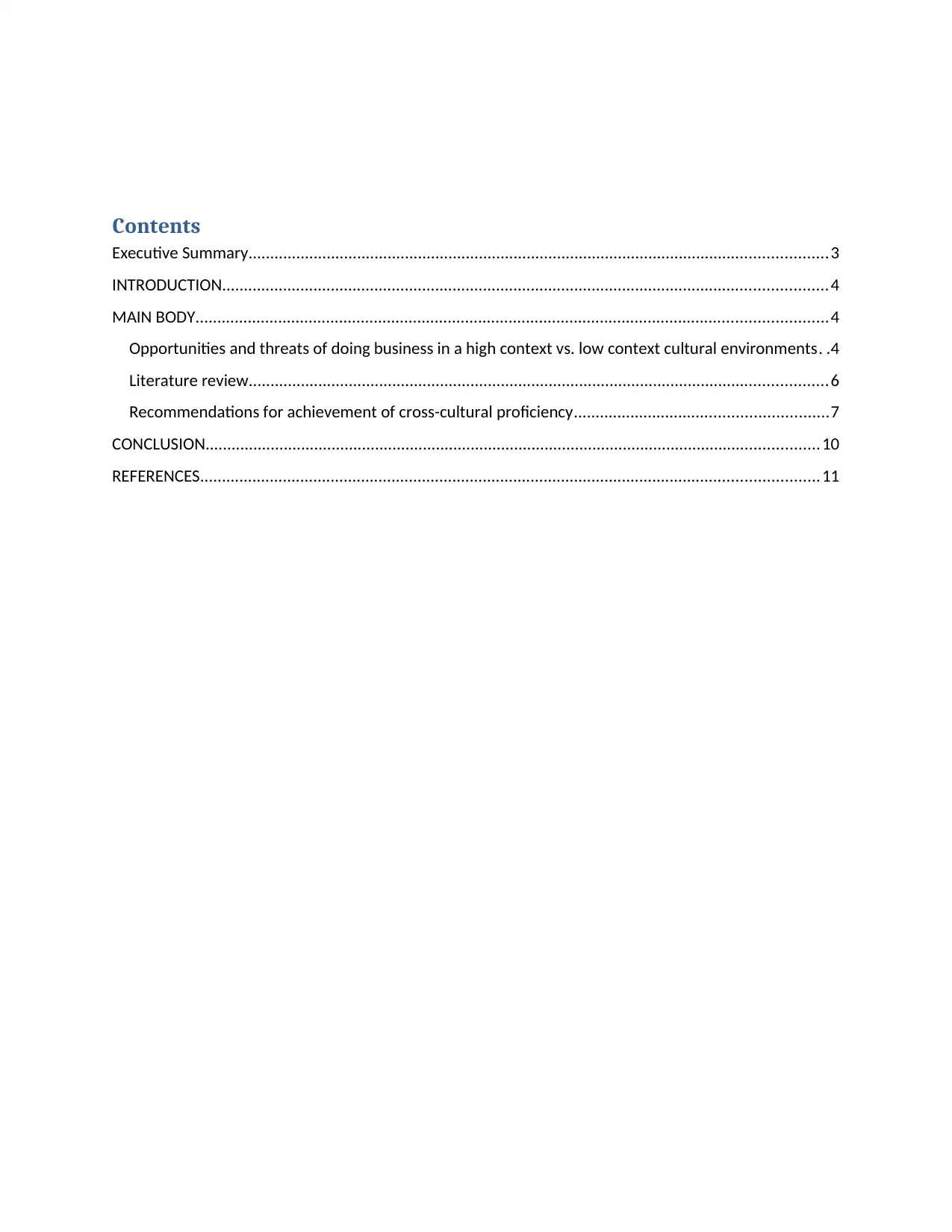
Contents
Executive Summary.....................................................................................................................................3
INTRODUCTION...........................................................................................................................................4
MAIN BODY.................................................................................................................................................4
Opportunities and threats of doing business in a high context vs. low context cultural environments. .4
Literature review.....................................................................................................................................6
Recommendations for achievement of cross-cultural proficiency..........................................................7
CONCLUSION.............................................................................................................................................10
REFERENCES..............................................................................................................................................11
Executive Summary.....................................................................................................................................3
INTRODUCTION...........................................................................................................................................4
MAIN BODY.................................................................................................................................................4
Opportunities and threats of doing business in a high context vs. low context cultural environments. .4
Literature review.....................................................................................................................................6
Recommendations for achievement of cross-cultural proficiency..........................................................7
CONCLUSION.............................................................................................................................................10
REFERENCES..............................................................................................................................................11
Executive Summary
This report is based on International Business. It analyzes the opportunities present for a
business overseas. Using it, businesses can identify the potential opportunities present in the
overseas market and use them so as to facilitate maximization of profits in the long-run. Through
maximization of profits, a business can attain long-term strategic edge over its various
competitors and can also use the benefits which globalization offers. Thus a business needs to
select an appropriate market for expansion and use effective strategies there so as to facilitate
achievement of higher growth rate as compared to the various competitors in the global market.
This report is based on International Business. It analyzes the opportunities present for a
business overseas. Using it, businesses can identify the potential opportunities present in the
overseas market and use them so as to facilitate maximization of profits in the long-run. Through
maximization of profits, a business can attain long-term strategic edge over its various
competitors and can also use the benefits which globalization offers. Thus a business needs to
select an appropriate market for expansion and use effective strategies there so as to facilitate
achievement of higher growth rate as compared to the various competitors in the global market.
⊘ This is a preview!⊘
Do you want full access?
Subscribe today to unlock all pages.

Trusted by 1+ million students worldwide
INTRODUCTION
International business refers to the trade of goods, services, technology, capital and/or
knowledge across national borders at a global scale (Baporikar, 2016). It has increased with the
advent of globalization. Since globalization means integration of various economies in the world
into one it gives a significant boost to the international business. This report is based on Nestle
which a Swiss Multinational Brand is selling different products to its various customers in the
market. Nestle is a global brand with a presence in many countries in the world. In this
assessment, a detailed analysis will be made on potential opportunities a business has in global
markets and the threats which are also present. Thus global chances which a business has will be
thoroughly discussed as a part of this report. Also the strategies which it must adopt for
increasing its profits in the global markets will also be analyzed in this project.
MAIN BODY
Opportunities and threats of doing business in a high context vs. low context
cultural environments
The potential opportunities of international business are as follows-
Exports and imports- International business offers significant opportunities for
conducting exports and imports (Choi and Contractor, 2016). Firms can use both of them
for doing their business effectively in the global scenario. This can enable them to
maximize their profits easily by earning significant profits so that they can acquire a
global competitive edge over their competitors easily. For Nestle, it is extremely
important to rely on exports and imports because it will enable it to earn higher profits in
the global markets. In a high-context market this opportunity is significant as compared
to a low-context market.
Licensing- Licensing refers to the grant of license by a firm to another firm for using its
products and selling them. This is done as per an agreement which is known as a
licensing agreement and specific charges are required to be paid by the using firm for
acquiring the license. In the context of Nestle, it presents a significant opportunity as the
firm can strike licensing agreements with other companies globally which will help it in
raising its overall level of profits. This opportunity is quite significant in both high-
context and low-context cultural environments.
Franchising- Franchising refers to the granting of permission by a big brand for running
its business through a franchise. This is done according to an agreement which is known
as a franchising agreement. It is quite useful for the firms to set themselves in a global
market. For Nestle, this is very useful as it presents them with a huge opportunity to earn
more profits in many countries of the world. This opportunity can be termed significant
in a high-context cultural environment.
International business refers to the trade of goods, services, technology, capital and/or
knowledge across national borders at a global scale (Baporikar, 2016). It has increased with the
advent of globalization. Since globalization means integration of various economies in the world
into one it gives a significant boost to the international business. This report is based on Nestle
which a Swiss Multinational Brand is selling different products to its various customers in the
market. Nestle is a global brand with a presence in many countries in the world. In this
assessment, a detailed analysis will be made on potential opportunities a business has in global
markets and the threats which are also present. Thus global chances which a business has will be
thoroughly discussed as a part of this report. Also the strategies which it must adopt for
increasing its profits in the global markets will also be analyzed in this project.
MAIN BODY
Opportunities and threats of doing business in a high context vs. low context
cultural environments
The potential opportunities of international business are as follows-
Exports and imports- International business offers significant opportunities for
conducting exports and imports (Choi and Contractor, 2016). Firms can use both of them
for doing their business effectively in the global scenario. This can enable them to
maximize their profits easily by earning significant profits so that they can acquire a
global competitive edge over their competitors easily. For Nestle, it is extremely
important to rely on exports and imports because it will enable it to earn higher profits in
the global markets. In a high-context market this opportunity is significant as compared
to a low-context market.
Licensing- Licensing refers to the grant of license by a firm to another firm for using its
products and selling them. This is done as per an agreement which is known as a
licensing agreement and specific charges are required to be paid by the using firm for
acquiring the license. In the context of Nestle, it presents a significant opportunity as the
firm can strike licensing agreements with other companies globally which will help it in
raising its overall level of profits. This opportunity is quite significant in both high-
context and low-context cultural environments.
Franchising- Franchising refers to the granting of permission by a big brand for running
its business through a franchise. This is done according to an agreement which is known
as a franchising agreement. It is quite useful for the firms to set themselves in a global
market. For Nestle, this is very useful as it presents them with a huge opportunity to earn
more profits in many countries of the world. This opportunity can be termed significant
in a high-context cultural environment.
Paraphrase This Document
Need a fresh take? Get an instant paraphrase of this document with our AI Paraphraser
Outsourcing- Outsourcing refers to getting certain tasks done through using the services
of people present in other countries (Clougherty and et.al., 2017). This is very useful for
the global firms and MNCs as they can get skilled workforce to do their tasks effectively
and efficiently. Therefore, for Nestle it is quite necessary that is uses outsourcing for
getting its tasks done. This opportunity has its significance both in low-context and high-
context cultural environments.
Online trading- Online trading refers to the conduction of business activities without
being necessarily present physically (Dana, 2017). In a modern global world, it has
achieved significance because of the wide scope it offers for conducting of business
activities digitally. In the context of Nestle, it achieves significance both in low-context
and high-context cultural environments. Therefore it’s important for the company to use
online trading effectively and efficiently for conducting its business globally because it
can turn out to be quite profitable for it in the short-run and long-run in the future.
Threats of international business-
Foreign exchange risk- It refers to the risk which incurs due to the fluctuation in the
value of foreign exchange in the country where a firm is operating in. This is a major risk
which is faced by almost all firms conducting international business. Therefore, Nestle
also faces this risk and needs to manage this risk effectively so that its level of profits is
not affected internationally. It has to bring the much-required efficiency and effectiveness
in its international operations. This will enable it to raise its profits internationally with
ease. The risk of foreign exchange is present in both low-context and high-context
cultural environments.
Political risk- It refers to the risk which arises due to the political situation which is
prevailing in a particular country at a certain point of time (Dimitratos and et.al., 2016).
These situations need to be considered by any firm which wishes to diversify its
operations globally. Nestle as an MNC is present in many countries worldwide and has
developed effective strategies to mitigate this risk should it arise in any of the countries
where it is present. Thus this risk is present both in the low-context and high-context
cultural environments. A firm which is able to mitigate this risk effectively is likely to
succeed in its international operations by making a lot of profits.
Regulatory risk- It refers to the risk arises due to a change in the rules and regulations of
the country where a firm is operating in. If the changed rules and regulations are in the
favor of the company then it can easily raise its level of profits but if the changed rules
and regulations are not in its favor then it will create problems for it in the future. This
risk is present both in low-context and high-context cultural environments. A firm which
can bring changes in its operations after the change in rules and regulations by the
government will be able to effectively mitigate this risk easily and maintain its level of
profits in the country. Thus Nestle needs to mitigate this risk.
Economic risk- This is a major risk which is a faced by the managers of a business while
operating the business internationally. It is faced due to change which can be witnessed in
rapidly-changing economic growth of the country. It is present both in high-context and
of people present in other countries (Clougherty and et.al., 2017). This is very useful for
the global firms and MNCs as they can get skilled workforce to do their tasks effectively
and efficiently. Therefore, for Nestle it is quite necessary that is uses outsourcing for
getting its tasks done. This opportunity has its significance both in low-context and high-
context cultural environments.
Online trading- Online trading refers to the conduction of business activities without
being necessarily present physically (Dana, 2017). In a modern global world, it has
achieved significance because of the wide scope it offers for conducting of business
activities digitally. In the context of Nestle, it achieves significance both in low-context
and high-context cultural environments. Therefore it’s important for the company to use
online trading effectively and efficiently for conducting its business globally because it
can turn out to be quite profitable for it in the short-run and long-run in the future.
Threats of international business-
Foreign exchange risk- It refers to the risk which incurs due to the fluctuation in the
value of foreign exchange in the country where a firm is operating in. This is a major risk
which is faced by almost all firms conducting international business. Therefore, Nestle
also faces this risk and needs to manage this risk effectively so that its level of profits is
not affected internationally. It has to bring the much-required efficiency and effectiveness
in its international operations. This will enable it to raise its profits internationally with
ease. The risk of foreign exchange is present in both low-context and high-context
cultural environments.
Political risk- It refers to the risk which arises due to the political situation which is
prevailing in a particular country at a certain point of time (Dimitratos and et.al., 2016).
These situations need to be considered by any firm which wishes to diversify its
operations globally. Nestle as an MNC is present in many countries worldwide and has
developed effective strategies to mitigate this risk should it arise in any of the countries
where it is present. Thus this risk is present both in the low-context and high-context
cultural environments. A firm which is able to mitigate this risk effectively is likely to
succeed in its international operations by making a lot of profits.
Regulatory risk- It refers to the risk arises due to a change in the rules and regulations of
the country where a firm is operating in. If the changed rules and regulations are in the
favor of the company then it can easily raise its level of profits but if the changed rules
and regulations are not in its favor then it will create problems for it in the future. This
risk is present both in low-context and high-context cultural environments. A firm which
can bring changes in its operations after the change in rules and regulations by the
government will be able to effectively mitigate this risk easily and maintain its level of
profits in the country. Thus Nestle needs to mitigate this risk.
Economic risk- This is a major risk which is a faced by the managers of a business while
operating the business internationally. It is faced due to change which can be witnessed in
rapidly-changing economic growth of the country. It is present both in high-context and
low-context cultural environments (Goedhuys and Sleuwaegen, 2016). For mitigating this
risk, firms like Nestle need to make sure that they have set their priorities right while
settling in an international market. This is required to make sure that they grow at a
steady rate while operating in international markets.
Literature review
According to Hakanen, Helander and Valkokari, global business refers to conducting of
business in a global environment without any boundaries. They state that firms can expand their
business globally in order to make more profits in the future. Also the firms can expand to find
out more business opportunities which can be used by them in the international markets. The
firms which expand globally make the best use of opportunities present there and use them
effectively for maximization of profits and increasing their global presence. Thus the firms need
to develop an effective strategy for shifting their operations globally in the future.
According to Kasemsap, opportunities in the global market have to be used effectively by
the firms operating there. The firms which make the best use of opportunities in the times of
globalization are the ones who attain a strategic edge over their competitors in the market. If the
firms obtain a strategic edge over their competitors by expanding in the international market it
will ensure that they grow sustainably in the long-term without any problems or issues. Thus a
clear strategy is required assessing the pros and cons of shifting operations internationally at a
large-scale so that a decision can be taken by the managers.
Macro-environment analysis
Macro-environment refers to the factors which operate in the external environment of a
firm. These factors can put an influence on the decision-making of a firm. An analysis of these
factors is as follows-
Political factors- These are government policy, political stability, foreign trade policy
etc. For Nestle, these factors are important because they have to be considered before
taking a decision of moving in a country for business operations. They can act like an
opportunity in some countries and like a threat in other countries. Thus, their importance
cannot be denied in the context of conducting of international business. Also these factors
can influence the profits of a company in the global markets.
Economic factors- These are economic growth, exchange rates, interest rates, disposable
income of the customers etc. These factors are quite important because they can influence
the level of profits of a firm while conducting international business (Gulanowski,
Papadopoulos and Plante, 2018). For Nestle, these factors are important because
economic conditions of a country matter a lot while taking a decision to shift business
there. Therefore, a decision needs to be taken after evaluation of economic conditions of
the country.
risk, firms like Nestle need to make sure that they have set their priorities right while
settling in an international market. This is required to make sure that they grow at a
steady rate while operating in international markets.
Literature review
According to Hakanen, Helander and Valkokari, global business refers to conducting of
business in a global environment without any boundaries. They state that firms can expand their
business globally in order to make more profits in the future. Also the firms can expand to find
out more business opportunities which can be used by them in the international markets. The
firms which expand globally make the best use of opportunities present there and use them
effectively for maximization of profits and increasing their global presence. Thus the firms need
to develop an effective strategy for shifting their operations globally in the future.
According to Kasemsap, opportunities in the global market have to be used effectively by
the firms operating there. The firms which make the best use of opportunities in the times of
globalization are the ones who attain a strategic edge over their competitors in the market. If the
firms obtain a strategic edge over their competitors by expanding in the international market it
will ensure that they grow sustainably in the long-term without any problems or issues. Thus a
clear strategy is required assessing the pros and cons of shifting operations internationally at a
large-scale so that a decision can be taken by the managers.
Macro-environment analysis
Macro-environment refers to the factors which operate in the external environment of a
firm. These factors can put an influence on the decision-making of a firm. An analysis of these
factors is as follows-
Political factors- These are government policy, political stability, foreign trade policy
etc. For Nestle, these factors are important because they have to be considered before
taking a decision of moving in a country for business operations. They can act like an
opportunity in some countries and like a threat in other countries. Thus, their importance
cannot be denied in the context of conducting of international business. Also these factors
can influence the profits of a company in the global markets.
Economic factors- These are economic growth, exchange rates, interest rates, disposable
income of the customers etc. These factors are quite important because they can influence
the level of profits of a firm while conducting international business (Gulanowski,
Papadopoulos and Plante, 2018). For Nestle, these factors are important because
economic conditions of a country matter a lot while taking a decision to shift business
there. Therefore, a decision needs to be taken after evaluation of economic conditions of
the country.
⊘ This is a preview!⊘
Do you want full access?
Subscribe today to unlock all pages.
Trusted by 1+ million students worldwide
Social factors- These are population growth rate, age distribution, lifestyle attitudes etc.
These factors are necessary because considering them is required on the part of managers
before taking a decision to move internationally. Therefore for Nestle these factors hold
supreme importance because if it decides to diversify further in countries where it is not
present it will need to take into consideration all of these factors because they can
influence its business and the level of profits it earns.
Technological factors- These are technology incentives, level of innovation, R&D
activity etc. For Nestle, these factors hold importance because technology has to be
improved by a firm before making a decision to move internationally (Larimo, Le
Nguyen and Ali, 2016). If the firm is able to improve on it then it will benefit in the
global markets. It is so because improvement in technology brings with it a reduction in
the overall costs being incurred within an enterprise and thus when the costs will be
reduced in the global markets it will lead towards maximization of the profits.
Environmental factors- These are weather, climate, environmental policies etc. These
factors need to be considered by Nestle. It is so because in many global markets people
are very conscious about the environment (Lin and et.al., 2016). Thus the firms shifting
in these markets have to make sure that their products and services do not hurt the
environment. If they will provide eco-friendly products and services to people in these
markets then it will lead towards increase in their profits.
Legal factors- These are discrimination laws, anti-trust laws, employment laws and other
rules and regulations which are brought by the government from time to time (Matheson
and Sutcliffe, 2017). For firms operating in international markets it is necessary that they
take a note of these factors because they need to make their products and services
according to the legal rules and regulations put in by the government. Thus it is required
on the part of firms like Nestle that if they set up their base and operations in an
international market then they should follow the legal rules and regulations of that
country and must comply with them strictly. Not doing so can create problems and issues
for them. If they are able to follow the legal rules and regulations then it will result in
creation of a good image and ease of conducting business which will allow them to
maximize their profits.
Recommendations for achievement of cross-cultural proficiency
Cross-cultural competence refers to the ability to understand people from different
cultures and engaging with them effectively (Cross Cultural Competence: Engage People from
any Culture, 2020). It is very important if a firm has to conduct international business and has to
set up its operations at a global scale. Nestle’s managers need to develop it. The
recommendations for Nestle to achieve cross-cultural proficiency are as follows-
Staying focused on goals- It is important to firstly define the goals and objectives which
are required to be achieved within a specific period of time by the firm. These goals and
objectives can be either short-term or long-term in nature. The managers of Nestle need
These factors are necessary because considering them is required on the part of managers
before taking a decision to move internationally. Therefore for Nestle these factors hold
supreme importance because if it decides to diversify further in countries where it is not
present it will need to take into consideration all of these factors because they can
influence its business and the level of profits it earns.
Technological factors- These are technology incentives, level of innovation, R&D
activity etc. For Nestle, these factors hold importance because technology has to be
improved by a firm before making a decision to move internationally (Larimo, Le
Nguyen and Ali, 2016). If the firm is able to improve on it then it will benefit in the
global markets. It is so because improvement in technology brings with it a reduction in
the overall costs being incurred within an enterprise and thus when the costs will be
reduced in the global markets it will lead towards maximization of the profits.
Environmental factors- These are weather, climate, environmental policies etc. These
factors need to be considered by Nestle. It is so because in many global markets people
are very conscious about the environment (Lin and et.al., 2016). Thus the firms shifting
in these markets have to make sure that their products and services do not hurt the
environment. If they will provide eco-friendly products and services to people in these
markets then it will lead towards increase in their profits.
Legal factors- These are discrimination laws, anti-trust laws, employment laws and other
rules and regulations which are brought by the government from time to time (Matheson
and Sutcliffe, 2017). For firms operating in international markets it is necessary that they
take a note of these factors because they need to make their products and services
according to the legal rules and regulations put in by the government. Thus it is required
on the part of firms like Nestle that if they set up their base and operations in an
international market then they should follow the legal rules and regulations of that
country and must comply with them strictly. Not doing so can create problems and issues
for them. If they are able to follow the legal rules and regulations then it will result in
creation of a good image and ease of conducting business which will allow them to
maximize their profits.
Recommendations for achievement of cross-cultural proficiency
Cross-cultural competence refers to the ability to understand people from different
cultures and engaging with them effectively (Cross Cultural Competence: Engage People from
any Culture, 2020). It is very important if a firm has to conduct international business and has to
set up its operations at a global scale. Nestle’s managers need to develop it. The
recommendations for Nestle to achieve cross-cultural proficiency are as follows-
Staying focused on goals- It is important to firstly define the goals and objectives which
are required to be achieved within a specific period of time by the firm. These goals and
objectives can be either short-term or long-term in nature. The managers of Nestle need
Paraphrase This Document
Need a fresh take? Get an instant paraphrase of this document with our AI Paraphraser
to define the goals they have to achieve in the international markets and must develop a
plan so as to achieve these goals. This will help in execution of strategies and will also
help in development of cross-cultural proficiency.
Understanding the culture- It is important that the firms realize the importance of
culture of the international market where they are going to operate in the future (Prange
and Pinho, 2017). As Nestle is an MNC which can develop plans to diversify to various
countries in the future its managers need to brush up their knowledge and understand the
culture of the area where they are planning to operate their business in the future. This
will enable the managers to develop cross-cultural proficiency.
Management of attitudes- It is also necessary from a company’s point of view that
attitudes are managed towards a country’s culture (Stoian, Rialp and Dimitratos, 2017).
The managers of Nestle should make sure that they are able to manage the attitudes
effectively without any problems. It is important for the managers to have a positive
attitude towards the culture of any particular country. This will make sure that the
company is able to adjust with the culture of the country while setting its operations
there. Also this will ensure that the firm is able to run its business successfully without
any problems in the country.
Learning the culture- For any firm shifting to a new country, it is necessary that it
understands and learns the new culture which is prevalent in the country. In the context of
Nestle, it is extremely essential that its managers learn the culture of the country where it
is focusing to start its operations. By learning the culture, the managers will be able to
know the needs and requirements of the people of the country and thus products and
services can be developed accordingly. This will ensure that the firm is able to maximize
its existing level of profits quite easily without facing any problems or issues. Thus this is
good from the point of view of a firm to learn the culture.
Development of reliable information sources- Reliable information sources are
required in order to get the right information about the country where the company plans
to shift its operations (Tsui and Fung, 2016). This will ensure that the right information is
managed effectively by the company which can be quite useful for its operations in the
long-run internationally. Thus Nestle needs to develop reliable information sources in the
countries where it plans to move in the future which can provide it with information
regarding the country.
Learning about new culture- It is important for the management of a company to
quickly learn about the new culture of the country where they are going to operate. Thus
Nestle’s managers need to quickly adapt to and learn about the new culture as soon as
possible so that no problems are faced while operating business.
Coping with cultural surprises- When a company shifts internationally, it needs to cope
up with the various cultural surprises which are present there. Thus, it is important for
Nestle to ensure that it copes effectively with the cultural surprises in a new country. This
will make sure that its managers are able to develop cross-cultural proficiency.
plan so as to achieve these goals. This will help in execution of strategies and will also
help in development of cross-cultural proficiency.
Understanding the culture- It is important that the firms realize the importance of
culture of the international market where they are going to operate in the future (Prange
and Pinho, 2017). As Nestle is an MNC which can develop plans to diversify to various
countries in the future its managers need to brush up their knowledge and understand the
culture of the area where they are planning to operate their business in the future. This
will enable the managers to develop cross-cultural proficiency.
Management of attitudes- It is also necessary from a company’s point of view that
attitudes are managed towards a country’s culture (Stoian, Rialp and Dimitratos, 2017).
The managers of Nestle should make sure that they are able to manage the attitudes
effectively without any problems. It is important for the managers to have a positive
attitude towards the culture of any particular country. This will make sure that the
company is able to adjust with the culture of the country while setting its operations
there. Also this will ensure that the firm is able to run its business successfully without
any problems in the country.
Learning the culture- For any firm shifting to a new country, it is necessary that it
understands and learns the new culture which is prevalent in the country. In the context of
Nestle, it is extremely essential that its managers learn the culture of the country where it
is focusing to start its operations. By learning the culture, the managers will be able to
know the needs and requirements of the people of the country and thus products and
services can be developed accordingly. This will ensure that the firm is able to maximize
its existing level of profits quite easily without facing any problems or issues. Thus this is
good from the point of view of a firm to learn the culture.
Development of reliable information sources- Reliable information sources are
required in order to get the right information about the country where the company plans
to shift its operations (Tsui and Fung, 2016). This will ensure that the right information is
managed effectively by the company which can be quite useful for its operations in the
long-run internationally. Thus Nestle needs to develop reliable information sources in the
countries where it plans to move in the future which can provide it with information
regarding the country.
Learning about new culture- It is important for the management of a company to
quickly learn about the new culture of the country where they are going to operate. Thus
Nestle’s managers need to quickly adapt to and learn about the new culture as soon as
possible so that no problems are faced while operating business.
Coping with cultural surprises- When a company shifts internationally, it needs to cope
up with the various cultural surprises which are present there. Thus, it is important for
Nestle to ensure that it copes effectively with the cultural surprises in a new country. This
will make sure that its managers are able to develop cross-cultural proficiency.
Formulation of cultural explanations- Cultural explanations are required in order to
identify the reasons of people acting in a particular behavior (Wang, Wang and Ma,
2016). For Nestle, it is essential that it formulates them so that it is able to identify the
reasons of behavior.
Cultural perspective- It is important for the managers of a company to see things from
the point of view of people of that country. This will help them in developing a new
perspective and outlook which will enable the development of cross-cultural proficiency
easily.
Cross-cultural communication- Cross-cultural communication enables thinking ahead
of time and identifying the techniques which are to be used in order to enable cross-
cultural communication. This will ensure that the managers of Nestle are able to
communicate effectively with the people of other culture which will ensure development
of cross-cultural proficiency easily.
Presentation- Good presentation is a must for putting a good impression. For the
managers of international companies and MNCs it is a must this is so because good
presentation ensures that a right impression is put on the mind of the person who belongs
to other country. For Nestle, it is important that its managers are taught presentation skills
so that they are able to effectively present their ideas and to be able to strike a deal with
the people of the country where the business is operating in. This will help a lot in
development of cross-cultural proficiency and other required skills easily in the
managers.
Reflecting and seeking feedback- It is necessary to reflect and seek a feedback so that
the learning experience never stops (Yang and Gabrielsson, 2017). While operating their
business in a foreign country, the managers of Nestle may make certain mistakes and
therefore it is important for them to seek appropriate feedback of where they have gone
wrong and in which areas they can improve upon so that they can satisfy the customers
and raise their satisfaction level. Thus it is quite important for the development of cross-
cultural proficiency. If the managers of Nestle are able to reflect and seek appropriate
feedback then they can easily develop cross-cultural proficiency which will enable them
to effectively raise the volume of business in the country which will result in increase in
the overall profits.
CONCLUSION
From the above report, it can be concluded that international business means trading with
the other countries in the world in a physical or digital form using a wide variety of techniques.
Globalization has made doing international business easier as it has made a connection between
different countries of the world which helps in global trade. Companies look to go international
when they intend to expand their operations as well as also raise their overall level of profits.
There are various opportunities and threats of doing business internationally. Many definitions of
identify the reasons of people acting in a particular behavior (Wang, Wang and Ma,
2016). For Nestle, it is essential that it formulates them so that it is able to identify the
reasons of behavior.
Cultural perspective- It is important for the managers of a company to see things from
the point of view of people of that country. This will help them in developing a new
perspective and outlook which will enable the development of cross-cultural proficiency
easily.
Cross-cultural communication- Cross-cultural communication enables thinking ahead
of time and identifying the techniques which are to be used in order to enable cross-
cultural communication. This will ensure that the managers of Nestle are able to
communicate effectively with the people of other culture which will ensure development
of cross-cultural proficiency easily.
Presentation- Good presentation is a must for putting a good impression. For the
managers of international companies and MNCs it is a must this is so because good
presentation ensures that a right impression is put on the mind of the person who belongs
to other country. For Nestle, it is important that its managers are taught presentation skills
so that they are able to effectively present their ideas and to be able to strike a deal with
the people of the country where the business is operating in. This will help a lot in
development of cross-cultural proficiency and other required skills easily in the
managers.
Reflecting and seeking feedback- It is necessary to reflect and seek a feedback so that
the learning experience never stops (Yang and Gabrielsson, 2017). While operating their
business in a foreign country, the managers of Nestle may make certain mistakes and
therefore it is important for them to seek appropriate feedback of where they have gone
wrong and in which areas they can improve upon so that they can satisfy the customers
and raise their satisfaction level. Thus it is quite important for the development of cross-
cultural proficiency. If the managers of Nestle are able to reflect and seek appropriate
feedback then they can easily develop cross-cultural proficiency which will enable them
to effectively raise the volume of business in the country which will result in increase in
the overall profits.
CONCLUSION
From the above report, it can be concluded that international business means trading with
the other countries in the world in a physical or digital form using a wide variety of techniques.
Globalization has made doing international business easier as it has made a connection between
different countries of the world which helps in global trade. Companies look to go international
when they intend to expand their operations as well as also raise their overall level of profits.
There are various opportunities and threats of doing business internationally. Many definitions of
⊘ This is a preview!⊘
Do you want full access?
Subscribe today to unlock all pages.
Trusted by 1+ million students worldwide

global business have been given by notable researchers. Macro-environment analysis is quite
essential before setting business in another country. Also, there are various ways through which
cross-cultural proficiency can be achieved by the managers of an organization.
essential before setting business in another country. Also, there are various ways through which
cross-cultural proficiency can be achieved by the managers of an organization.
Paraphrase This Document
Need a fresh take? Get an instant paraphrase of this document with our AI Paraphraser
REFERENCES
Books and Journals:
Baporikar, N., 2016. Effect of national culture on development of international business in the
Sultanate of Oman. In International business: concepts, methodologies, tools, and
applications (pp. 397-417). IGI Global.
Choi, J. and Contractor, F. J., 2016. Choosing an appropriate alliance governance mode: The role
of institutional, cultural and geographical distance in international research & development
(R&D) collaborations. Journal of International Business Studies. 47(2). pp.210-232.
Clougherty, J. A. and et.al., 2017. The foundations of international business: Cross‐border
investment activity and the balance between market‐power and efficiency effects. Journal of
Management Studies. 54(3). pp.340-365.
Dana, L. P., 2017. International entrepreneurship research: how it evolved and directions for the
future. International Journal of Entrepreneurship and Small Business. 30(4). pp.477-489.
Dimitratos, P. and et.al., 2016. SME internationalization: How does the opportunity-based
international entrepreneurial culture matter?. International Business Review. 25(6). pp.1211-
1222.
Goedhuys, M. and Sleuwaegen, L., 2016. International standards certification, institutional voids
and exports from developing country firms. International Business Review. 25(6). pp.1344-1355.
Gulanowski, D., Papadopoulos, N. and Plante, L., 2018. The role of knowledge in international
expansion. Review of International Business and Strategy.
Larimo, J., Le Nguyen, H. and Ali, T., 2016. Performance measurement choices in international
joint ventures: What factors drive them?. Journal of Business Research. 69(2). pp.877-887.
Lin, D. and et.al., 2016. International knowledge brokerage and returnees’ entrepreneurial
decisions. Journal of International Business Studies. 47(3). pp.295-318.
Matheson, R. and Sutcliffe, M., 2017. Creating belonging and transformation through the
adoption of flexible pedagogies in masters level international business management
students. Teaching in Higher Education. 22(1). pp.15-29.
Prange, C. and Pinho, J. C., 2017. How personal and organizational drivers impact on SME
international performance: The mediating role of organizational innovation. International
Business Review. 26(6). pp.1114-1123.
Stoian, M. C., Rialp, J. and Dimitratos, P., 2017. SME networks and international performance:
Unveiling the significance of foreign market entry mode. Journal of Small Business
Management. 55(1). pp.128-148.
Tsui, W. H. K. and Fung, M. K. Y., 2016. Causality between business travel and trade volumes:
Empirical evidence from Hong Kong. Tourism Management. 52. pp.395-404.
Books and Journals:
Baporikar, N., 2016. Effect of national culture on development of international business in the
Sultanate of Oman. In International business: concepts, methodologies, tools, and
applications (pp. 397-417). IGI Global.
Choi, J. and Contractor, F. J., 2016. Choosing an appropriate alliance governance mode: The role
of institutional, cultural and geographical distance in international research & development
(R&D) collaborations. Journal of International Business Studies. 47(2). pp.210-232.
Clougherty, J. A. and et.al., 2017. The foundations of international business: Cross‐border
investment activity and the balance between market‐power and efficiency effects. Journal of
Management Studies. 54(3). pp.340-365.
Dana, L. P., 2017. International entrepreneurship research: how it evolved and directions for the
future. International Journal of Entrepreneurship and Small Business. 30(4). pp.477-489.
Dimitratos, P. and et.al., 2016. SME internationalization: How does the opportunity-based
international entrepreneurial culture matter?. International Business Review. 25(6). pp.1211-
1222.
Goedhuys, M. and Sleuwaegen, L., 2016. International standards certification, institutional voids
and exports from developing country firms. International Business Review. 25(6). pp.1344-1355.
Gulanowski, D., Papadopoulos, N. and Plante, L., 2018. The role of knowledge in international
expansion. Review of International Business and Strategy.
Larimo, J., Le Nguyen, H. and Ali, T., 2016. Performance measurement choices in international
joint ventures: What factors drive them?. Journal of Business Research. 69(2). pp.877-887.
Lin, D. and et.al., 2016. International knowledge brokerage and returnees’ entrepreneurial
decisions. Journal of International Business Studies. 47(3). pp.295-318.
Matheson, R. and Sutcliffe, M., 2017. Creating belonging and transformation through the
adoption of flexible pedagogies in masters level international business management
students. Teaching in Higher Education. 22(1). pp.15-29.
Prange, C. and Pinho, J. C., 2017. How personal and organizational drivers impact on SME
international performance: The mediating role of organizational innovation. International
Business Review. 26(6). pp.1114-1123.
Stoian, M. C., Rialp, J. and Dimitratos, P., 2017. SME networks and international performance:
Unveiling the significance of foreign market entry mode. Journal of Small Business
Management. 55(1). pp.128-148.
Tsui, W. H. K. and Fung, M. K. Y., 2016. Causality between business travel and trade volumes:
Empirical evidence from Hong Kong. Tourism Management. 52. pp.395-404.
Wang, Y., Wang, K. Y. and Ma, X., 2016. Understanding international business negotiation
behavior: Credible commitments, dispute resolution, and the role of institutions. International
Negotiation. 21(1). pp.165-198.
Yang, M. and Gabrielsson, P., 2017. Entrepreneurial marketing of international high-tech
business-to-business new ventures: A decision-making process perspective. Industrial Marketing
Management. 64. pp.147-160.
Online
Cross Cultural Competence: Engage People from any Culture. 2020. [Online]. Available
through: <https://www.globalcognition.org/cross-cultural-competence/>
behavior: Credible commitments, dispute resolution, and the role of institutions. International
Negotiation. 21(1). pp.165-198.
Yang, M. and Gabrielsson, P., 2017. Entrepreneurial marketing of international high-tech
business-to-business new ventures: A decision-making process perspective. Industrial Marketing
Management. 64. pp.147-160.
Online
Cross Cultural Competence: Engage People from any Culture. 2020. [Online]. Available
through: <https://www.globalcognition.org/cross-cultural-competence/>
⊘ This is a preview!⊘
Do you want full access?
Subscribe today to unlock all pages.
Trusted by 1+ million students worldwide

1 out of 12


Related Documents


Your All-in-One AI-Powered Toolkit for Academic Success.
+13062052269
info@desklib.com
Available 24*7 on WhatsApp / Email
![[object Object]](/_next/static/media/star-bottom.7253800d.svg)
Unlock your academic potential
Copyright © 2020–2026 A2Z Services. All Rights Reserved. Developed and managed by ZUCOL.