International Marketing Report: IKEA, Market Entry, and Geography
VerifiedAdded on 2020/02/14
|15
|5243
|33
Report
AI Summary
This report delves into the realm of international marketing, exploring various market entry strategies, with a specific focus on licensing, using IKEA as a case study. The report analyzes the advantages and disadvantages of licensing compared to other market entry methods, such as direct and indirect exports and franchising, highlighting the factors that influence the choice of strategy. It examines the impact of geography and history on foreign marketing plans, emphasizing how these elements shape marketing decisions and strategies. Furthermore, the report addresses the concept that no single marketing strategy fits all circumstances, exploring the nuances of different approaches. It also discusses strategic options for dealing with non-tariff barriers and assesses the impact of the product life cycle on marketing plans, providing a comprehensive overview of international marketing principles and practices. The report covers topics such as the impact of geography and history, and the importance of adapting strategies to suit specific market conditions.
INTERNATIONAL
MARKETING
MARKETING

Paraphrase This Document
Need a fresh take? Get an instant paraphrase of this document with our AI Paraphraser
Table of Contents
ABSTRACT.....................................................................................................................................1
INTRODUCTION...........................................................................................................................1
QUESTION 1...................................................................................................................................1
Licensing, its use and advantages & disadvantages in comparison to other forms of market
entry.............................................................................................................................................1
QUESTION 2...................................................................................................................................3
Impact of Geography and History of Foreign marketing plans..................................................3
QUESTION 3...................................................................................................................................5
There is no single market strategies which is appropriate for all circumstances........................5
QUESTION 4...................................................................................................................................7
Strategic options to deal with Non Tariff Barriers......................................................................7
QUESTION 5...................................................................................................................................8
Impact of Product Life Cycle on Marketing Plans......................................................................8
CONCLUSION..............................................................................................................................10
REFERENCES..............................................................................................................................12
ABSTRACT.....................................................................................................................................1
INTRODUCTION...........................................................................................................................1
QUESTION 1...................................................................................................................................1
Licensing, its use and advantages & disadvantages in comparison to other forms of market
entry.............................................................................................................................................1
QUESTION 2...................................................................................................................................3
Impact of Geography and History of Foreign marketing plans..................................................3
QUESTION 3...................................................................................................................................5
There is no single market strategies which is appropriate for all circumstances........................5
QUESTION 4...................................................................................................................................7
Strategic options to deal with Non Tariff Barriers......................................................................7
QUESTION 5...................................................................................................................................8
Impact of Product Life Cycle on Marketing Plans......................................................................8
CONCLUSION..............................................................................................................................10
REFERENCES..............................................................................................................................12
ABSTRACT
In the present context, there has been fast pace development and technological
advancements. It has enabled the contraction of the world boundaries and connected people and
components in the considerable manner. It is identified that International marketing has been the
crucial concept used in the contemporary trade and business. Organisation are releasing their
confinement to the home countries and expanding the domain of their offering beyond
geographical locations. In that regard they promote their products to the potential consumers in
other countries through different means which is referred as International marketing. There are
different approaches used in this concept and adopt the market entry strategy
INTRODUCTION
Licensing is the options chosen among the different market entry strategies when the
brand owner is confident about the acceptance of the products and services offered by consumers
in the significant manner through brand extensions in other countries and geographical locations.
Present report is prepared to elucidate the concept of International Marketing and its components
with respect to licensing as the market entry strategy. To conduct the research in precise manner,
Swedish home furnishing brand, IKEA is taken into account which is catering to launch its
product in India. Report throws light on the different concepts and practices in international
marketing.
QUESTION 1
Licensing, its use and advantages & disadvantages in comparison to other forms of market entry
Licensing is the process in which a brand owner in the home country caters to expand its
operations in another country through leasing their intangible assets. A contract is signed
between the owner of the brand and the licensee who wants to use the brand in association for a
particular time duration. It is one of the method used by companies to expand business on
different geographical locations (McDonald, 2011). There are certain situations in which it is
widely used and derive lucrative results to the brand and owner.
It is used in the situation when the brand owner is experiencing high rate of inflation and
unfavourable exchange rate value. In that condition it is found that it is viable to expand
business in some other country that has favourable conditions with the availability of
1
In the present context, there has been fast pace development and technological
advancements. It has enabled the contraction of the world boundaries and connected people and
components in the considerable manner. It is identified that International marketing has been the
crucial concept used in the contemporary trade and business. Organisation are releasing their
confinement to the home countries and expanding the domain of their offering beyond
geographical locations. In that regard they promote their products to the potential consumers in
other countries through different means which is referred as International marketing. There are
different approaches used in this concept and adopt the market entry strategy
INTRODUCTION
Licensing is the options chosen among the different market entry strategies when the
brand owner is confident about the acceptance of the products and services offered by consumers
in the significant manner through brand extensions in other countries and geographical locations.
Present report is prepared to elucidate the concept of International Marketing and its components
with respect to licensing as the market entry strategy. To conduct the research in precise manner,
Swedish home furnishing brand, IKEA is taken into account which is catering to launch its
product in India. Report throws light on the different concepts and practices in international
marketing.
QUESTION 1
Licensing, its use and advantages & disadvantages in comparison to other forms of market entry
Licensing is the process in which a brand owner in the home country caters to expand its
operations in another country through leasing their intangible assets. A contract is signed
between the owner of the brand and the licensee who wants to use the brand in association for a
particular time duration. It is one of the method used by companies to expand business on
different geographical locations (McDonald, 2011). There are certain situations in which it is
widely used and derive lucrative results to the brand and owner.
It is used in the situation when the brand owner is experiencing high rate of inflation and
unfavourable exchange rate value. In that condition it is found that it is viable to expand
business in some other country that has favourable conditions with the availability of
1
⊘ This is a preview!⊘
Do you want full access?
Subscribe today to unlock all pages.

Trusted by 1+ million students worldwide
favourable inflation rate, adequate skilled-labour, liberalised government regulations and
restrictions and rationalised international competition.
Among the different market entry strategies, Licensing is the viable option in the
condition when the brand owner is having its operations in successful manner in the
home country. As per the market conditions it is identified that the demand of the
products and services offered by it exceeding the supply of their offerings. In that
condition brand owner caters to escalate its manufacturing capacity through providing
licensing to the individuals or groups in another country (Takano, 2009). It is viable in the situation in which brand owner is representing the multinational
organisation, possessing the innovative technologies. With the aim to commercial the
ideas in different geographical locations, brand owners adopt the option of Licensing.
Advantages of using Licensing
It enables the organisation to reach and expand in new market areas where it is unable to
leverage the benefits through exports from existing facilities.
It paves the way for the brand owners to have expansion through the future investments
There are many trade restrictions imposed by countries to inhibit the development of
foreign market. Hence, through licensing brand owners are able to retain the current
customer base and established markets (Wilson and Gilligan, 2015).
With the step adopted in the form of licensing it is found that risks are minimized in
different forms such as in the context of political and legal as licensee to whom it is
provided are locally owned.
There is minimum amount of risk associated with due to the expansion is done without
having so much time and capital investments that is required in other market entry
strategies. It is the lucrative means through which the country is able to generate revenues through
commercialising their ideas and know-how in other geographical regions.
Disadvantages of using Licensing
Adopting Licensing incur the less amount of incomes to the organisation such as the
profit margins are shared between the owners and licensee (Yan, 2016). Or in other case
the ratio is fixed in the context of the revenue distributed among the two parties and
hence it restricts the growth aspects and future development benefits.
2
restrictions and rationalised international competition.
Among the different market entry strategies, Licensing is the viable option in the
condition when the brand owner is having its operations in successful manner in the
home country. As per the market conditions it is identified that the demand of the
products and services offered by it exceeding the supply of their offerings. In that
condition brand owner caters to escalate its manufacturing capacity through providing
licensing to the individuals or groups in another country (Takano, 2009). It is viable in the situation in which brand owner is representing the multinational
organisation, possessing the innovative technologies. With the aim to commercial the
ideas in different geographical locations, brand owners adopt the option of Licensing.
Advantages of using Licensing
It enables the organisation to reach and expand in new market areas where it is unable to
leverage the benefits through exports from existing facilities.
It paves the way for the brand owners to have expansion through the future investments
There are many trade restrictions imposed by countries to inhibit the development of
foreign market. Hence, through licensing brand owners are able to retain the current
customer base and established markets (Wilson and Gilligan, 2015).
With the step adopted in the form of licensing it is found that risks are minimized in
different forms such as in the context of political and legal as licensee to whom it is
provided are locally owned.
There is minimum amount of risk associated with due to the expansion is done without
having so much time and capital investments that is required in other market entry
strategies. It is the lucrative means through which the country is able to generate revenues through
commercialising their ideas and know-how in other geographical regions.
Disadvantages of using Licensing
Adopting Licensing incur the less amount of incomes to the organisation such as the
profit margins are shared between the owners and licensee (Yan, 2016). Or in other case
the ratio is fixed in the context of the revenue distributed among the two parties and
hence it restricts the growth aspects and future development benefits.
2
Paraphrase This Document
Need a fresh take? Get an instant paraphrase of this document with our AI Paraphraser
There is high degree of risk associated with the licensing to the locally owned people in
the geographical location. Such as there are many conditions which can likely ruin the
image created by the brand among the customers (Adner and Levinthal, 2014). There are
many other risks associated with it such as due to incompetency tit can affect the quality
and standards of services set by the brand owner.
It threatens the loss of the idea and innovative techniques used by the brand such as it
requires sharing the methodology with the licensee to work in the collaborative manner.
It is further found that there is the risk of condition in the licensee can take the unfair
advantage of the name under which it is having its business operations.
With the liberalised control over the licensee, it is likely to happen that with the
hampering of discipline, quality of the services is also get affected.
It can raise extent of rivalry, if the partner working in the foreign land starts selling its
products in place of the offerings extended by the parent brand company.
QUESTION 2
Impact of Geography and History of Foreign marketing plans
Foreign marketing plans are prepared in a structured manner (Agle, B. R., 2014). There
are different components which are taken into consideration by the companies while preapring
the foreign marketing plans. Hence, it is found that if the selected organisational IKEA, keep in
consideration the geography and History of foreign marketing plans than it is able to promote the
products in the better manner. Following are the implications of the geography and history of the
foreign marketing plans. It is interpreted in the segmented manner to elucidate this in precise
manner.
Geography of Foreign marketing plan
The most important component that determines the growth and success of any
organisation or country is the extent to which the concerned entity utilize the resources available
for them. Geography determines the availability of resources at any location (Aljukhadar and
Senecal, 2011). It is not confined to the natural resources but also the human resources and other
tangibles that determines it. In the present illustration with respect to IKEA it can be stated that
the selected organisation is likely to suffer with the harmful consequences it the geography is not
taken into consideration. Such as the selected country India is the diverse country with different
3
the geographical location. Such as there are many conditions which can likely ruin the
image created by the brand among the customers (Adner and Levinthal, 2014). There are
many other risks associated with it such as due to incompetency tit can affect the quality
and standards of services set by the brand owner.
It threatens the loss of the idea and innovative techniques used by the brand such as it
requires sharing the methodology with the licensee to work in the collaborative manner.
It is further found that there is the risk of condition in the licensee can take the unfair
advantage of the name under which it is having its business operations.
With the liberalised control over the licensee, it is likely to happen that with the
hampering of discipline, quality of the services is also get affected.
It can raise extent of rivalry, if the partner working in the foreign land starts selling its
products in place of the offerings extended by the parent brand company.
QUESTION 2
Impact of Geography and History of Foreign marketing plans
Foreign marketing plans are prepared in a structured manner (Agle, B. R., 2014). There
are different components which are taken into consideration by the companies while preapring
the foreign marketing plans. Hence, it is found that if the selected organisational IKEA, keep in
consideration the geography and History of foreign marketing plans than it is able to promote the
products in the better manner. Following are the implications of the geography and history of the
foreign marketing plans. It is interpreted in the segmented manner to elucidate this in precise
manner.
Geography of Foreign marketing plan
The most important component that determines the growth and success of any
organisation or country is the extent to which the concerned entity utilize the resources available
for them. Geography determines the availability of resources at any location (Aljukhadar and
Senecal, 2011). It is not confined to the natural resources but also the human resources and other
tangibles that determines it. In the present illustration with respect to IKEA it can be stated that
the selected organisation is likely to suffer with the harmful consequences it the geography is not
taken into consideration. Such as the selected country India is the diverse country with different
3
geography and the characteristics associated with it. It further, determines the choices and
preferences of the individual prevailing in different geographical locations (Dibb, Simkin and
Wilson, 2012). It is found that the geography divides and creates the diversity of customs, rituals,
product inclination, needs and wants and other aspects. In that respect it is found that India is the
diverse country with having distinct features and characteristic at each physical division and
geographical bifurcation. In that respect it can be stated that it is found that distinct preferences
induces the requirement of the appropriate and respective offerings on the part of organisation.
Such as it is identified that there are some regions in India where laws and regulations restrict the
use of certain wood and hence, it necessitates IKEA to prohibit the availability of such restricted
items.
It is further, illustrated that the geography enables the organisation to determine the
liability of functions conducted such as it can be stated that manufacturing units are required to
situated at the plain area to avoid losses and damages (Dziri, 2013). With context to marketing it
can be stated that the steps adopted to capture the attention of the customers there is the
requirement to adopt the pragmatic approach through which the increment in the customer base
can be done. Further, it is found that on the economically and digitally developed regions, people
are communicated through virtual platforms where the products are promoted in lucrative
manner. On the contrary it is stated that the regions where conventional systems exists, the
modes are marketing are direct calling, personal selling and many other related.
History Of The foreign Marketing
History of marketing play vital role in an organisation which preparing foreign marketing
plans. Such as it signifies the methodology is used in the country since its inception and its
working in the market. History of the place is associated with the number of factors that entails
the organisation to frame the foreign marketing plan. According to the history the organisation is
able to identify the legal framework that exist in the country in different aspects such as
regulations on the basis of which certain market entry strategies are to be adopted by it such as
the Licensing (Figge and et. al, 2012). Further it is found that history of the economic condition
prevailing in the country helps in taking decision with respect to the investments in different
sections and domains. On that respect it can be said that history in different context enables the
organisation to identify the trends that exists ion the country so the strategies and plans can be
formulated in the context of marketing and licensing aspects.
4
preferences of the individual prevailing in different geographical locations (Dibb, Simkin and
Wilson, 2012). It is found that the geography divides and creates the diversity of customs, rituals,
product inclination, needs and wants and other aspects. In that respect it is found that India is the
diverse country with having distinct features and characteristic at each physical division and
geographical bifurcation. In that respect it can be stated that it is found that distinct preferences
induces the requirement of the appropriate and respective offerings on the part of organisation.
Such as it is identified that there are some regions in India where laws and regulations restrict the
use of certain wood and hence, it necessitates IKEA to prohibit the availability of such restricted
items.
It is further, illustrated that the geography enables the organisation to determine the
liability of functions conducted such as it can be stated that manufacturing units are required to
situated at the plain area to avoid losses and damages (Dziri, 2013). With context to marketing it
can be stated that the steps adopted to capture the attention of the customers there is the
requirement to adopt the pragmatic approach through which the increment in the customer base
can be done. Further, it is found that on the economically and digitally developed regions, people
are communicated through virtual platforms where the products are promoted in lucrative
manner. On the contrary it is stated that the regions where conventional systems exists, the
modes are marketing are direct calling, personal selling and many other related.
History Of The foreign Marketing
History of marketing play vital role in an organisation which preparing foreign marketing
plans. Such as it signifies the methodology is used in the country since its inception and its
working in the market. History of the place is associated with the number of factors that entails
the organisation to frame the foreign marketing plan. According to the history the organisation is
able to identify the legal framework that exist in the country in different aspects such as
regulations on the basis of which certain market entry strategies are to be adopted by it such as
the Licensing (Figge and et. al, 2012). Further it is found that history of the economic condition
prevailing in the country helps in taking decision with respect to the investments in different
sections and domains. On that respect it can be said that history in different context enables the
organisation to identify the trends that exists ion the country so the strategies and plans can be
formulated in the context of marketing and licensing aspects.
4
⊘ This is a preview!⊘
Do you want full access?
Subscribe today to unlock all pages.
Trusted by 1+ million students worldwide
QUESTION 3
There is no single market strategies which is appropriate for all circumstances
For any organisation in order to establish the prominent position in the foreign market it
is essential to adopt the appropriate strategy for its working and operations (Wilson, 2010). It is
found that among the availability of different market entry strategy, organisation adopt the one
which most suitable as per the resources available to it and core competencies it has. It is found
that each market entry strategy used by the organisation are having certain advantages and
disadvantages associated with it. There are basically six market entry strategies used by the
organisation which has both the positive and negative impacts to the organisation that are direct
and indirect exports, franchising turkey projects and wholly owned subsidiaries. In the context
of IKEA the assessment is done which has enabled to derived the following consequences.
Direct and indirect exports
It refers to the process in which the organisation such as IKEA directly sells its products
to the target markets in the strategic and significant manner directly or indirectly with their
mutual agreements made between them with context to the trade and business. It enables the
better control over the target market through precision in the choosing of the target companies
and getting the accurate feedbacks from the concerned buyers (Winston, 2012). Due to direct
control the organisation is able to protect the trademark and the reputation which has been built
by in the domestic market. In this sales figures are found to considerably greater and hence helps
to attain higher profits. On the other hand, the start up and establishment costs incurred in it is
significantly high. On the initial stage high investments are required to attain the information
related to market conditions. Further, high degree of risk is associated with it.
Franchising
In this market entry strategy, parent company enables the business owners to sell their
products and services through paying fees and royalties in their own business format and system.
It is the widely used method adopted by the multinational companies to operate in different parts
of the world in the lucrative manner (Wood, 2016). There are many advantages and
disadvantages associated with it while inculcating this process in the operation while having
working in other geographical locations. It is identified that it is having the low political risk hen
it enters in any foreign market such as it is seen that the business owners to whom the franchisee
is allotted are locally owned. Further, it is very low cost method in which it is processed. With
5
There is no single market strategies which is appropriate for all circumstances
For any organisation in order to establish the prominent position in the foreign market it
is essential to adopt the appropriate strategy for its working and operations (Wilson, 2010). It is
found that among the availability of different market entry strategy, organisation adopt the one
which most suitable as per the resources available to it and core competencies it has. It is found
that each market entry strategy used by the organisation are having certain advantages and
disadvantages associated with it. There are basically six market entry strategies used by the
organisation which has both the positive and negative impacts to the organisation that are direct
and indirect exports, franchising turkey projects and wholly owned subsidiaries. In the context
of IKEA the assessment is done which has enabled to derived the following consequences.
Direct and indirect exports
It refers to the process in which the organisation such as IKEA directly sells its products
to the target markets in the strategic and significant manner directly or indirectly with their
mutual agreements made between them with context to the trade and business. It enables the
better control over the target market through precision in the choosing of the target companies
and getting the accurate feedbacks from the concerned buyers (Winston, 2012). Due to direct
control the organisation is able to protect the trademark and the reputation which has been built
by in the domestic market. In this sales figures are found to considerably greater and hence helps
to attain higher profits. On the other hand, the start up and establishment costs incurred in it is
significantly high. On the initial stage high investments are required to attain the information
related to market conditions. Further, high degree of risk is associated with it.
Franchising
In this market entry strategy, parent company enables the business owners to sell their
products and services through paying fees and royalties in their own business format and system.
It is the widely used method adopted by the multinational companies to operate in different parts
of the world in the lucrative manner (Wood, 2016). There are many advantages and
disadvantages associated with it while inculcating this process in the operation while having
working in other geographical locations. It is identified that it is having the low political risk hen
it enters in any foreign market such as it is seen that the business owners to whom the franchisee
is allotted are locally owned. Further, it is very low cost method in which it is processed. With
5
Paraphrase This Document
Need a fresh take? Get an instant paraphrase of this document with our AI Paraphraser
the use of this method organisation is able to expand its business simultaneously in different
parts of the countries (Yi, 2014). In this type the human resources are paid the significant
attention such as it is seen that the high eligible and capable employees are recruited in the
organisation to perform the functions respectively. In contrast, it is found that there are many
disadvantages associated with it that are controlling of the franchisee is the cumbersome task that
is performed by the employees. It is found that the organisation is always threatened with the
spoiling of image on the part of the business owners' ho are assigned the franchise.
Turnkey Projects
It is the method in which the plants are being established in the foreign countries. This
type of process is being adopted by the largely owned companies who are having significant
amount of manufacturing in different sections. It is found that the IKEA is large enough with the
adequate amount of the infrastructure in which it can manufacture its product line at different
geographical locations in the similar system and processing (Gilligan and Wilson, 2012). It is
found that this is the lucrative means in which the foreign company is able to satiate the needs
and wants of the customers in the appropriate manner and on the larger perspective. Along with
this there are many risks associated with it that are the revealing of the data, information and the
innovative ideas possessed by the parent company.
Wholly owned subsidiaries
In this process control is provided to the business owners who are having the efficiencies
to run the business in the lucrative manner. In this the entitlement is given in all the context such
as trademark, intellectual property, name and other related aspects. It is found that the company
is able to expand the business through market entry strategies in the pragmatic manner. Such as it
is the process that helps it to avail the benefits associated with it (Gilmore, 2010). There are
many benefits associated with it such as in this type the concerned members who are controlling
the activities are highly skills and efficient that provides the adequate amount of services in
larger manner. There are many disadvantages associated with it such as there is large amount of
risk associated with in establishment. The gestation and establishment period is very large in the
context that it is found that it makes the working different for the organisation to have the
patience and control in the larger manner.
6
parts of the countries (Yi, 2014). In this type the human resources are paid the significant
attention such as it is seen that the high eligible and capable employees are recruited in the
organisation to perform the functions respectively. In contrast, it is found that there are many
disadvantages associated with it that are controlling of the franchisee is the cumbersome task that
is performed by the employees. It is found that the organisation is always threatened with the
spoiling of image on the part of the business owners' ho are assigned the franchise.
Turnkey Projects
It is the method in which the plants are being established in the foreign countries. This
type of process is being adopted by the largely owned companies who are having significant
amount of manufacturing in different sections. It is found that the IKEA is large enough with the
adequate amount of the infrastructure in which it can manufacture its product line at different
geographical locations in the similar system and processing (Gilligan and Wilson, 2012). It is
found that this is the lucrative means in which the foreign company is able to satiate the needs
and wants of the customers in the appropriate manner and on the larger perspective. Along with
this there are many risks associated with it that are the revealing of the data, information and the
innovative ideas possessed by the parent company.
Wholly owned subsidiaries
In this process control is provided to the business owners who are having the efficiencies
to run the business in the lucrative manner. In this the entitlement is given in all the context such
as trademark, intellectual property, name and other related aspects. It is found that the company
is able to expand the business through market entry strategies in the pragmatic manner. Such as it
is the process that helps it to avail the benefits associated with it (Gilmore, 2010). There are
many benefits associated with it such as in this type the concerned members who are controlling
the activities are highly skills and efficient that provides the adequate amount of services in
larger manner. There are many disadvantages associated with it such as there is large amount of
risk associated with in establishment. The gestation and establishment period is very large in the
context that it is found that it makes the working different for the organisation to have the
patience and control in the larger manner.
6
QUESTION 4
Strategic options to deal with Non Tariff Barriers
Non tariff barriers refers to special trade barriers which creates a significant impact on the
import and export of goods and services within the economy. These trade barriers have a
significant impact on internal trade prospects. In the recent time with the advancement of
globalisation there has been significant transition seen in the international trade (Hollensen,
2010). In that context it is stated that there is significant increase in the exchange of the products
and services among the different countries leading towards increased international trade. Along
with the benefits to the concerned countries in many aspects it is seen that there are many
harmful consequences with respect to it. It is seen that in order to prevent those harmful
consequences to the economy countries are adopting various methods such as imposing duties on
the export and import of the products (Jahdi and Acikdilli, 2012). Apart from that there are other
means as well that are referred as the non tariff barriers that could help the economies to prevent
from the negative impacts of the trade occurring between countries. But these attempts are
proved to be against the trading companies that are directly or indirectly associated in this. For
that purpose different strategies are being adopted by them to deal with these non tariff barriers.
Types of Non tariff barriers Licensing and Quota: This is the form in which the government and other legislative
bodies impose laws and regulations which are supposed to be abided by the respective
organisation. Export restrain: In order to restrict the trade between the different countries between two
countries it is identified that there is the imposition of laws and regulations by the
concerned authorities which requires the strict labelling and specifications of the process
adopted in the process (Kraus, Harms and Fink, 2010). Standards: These policies states specified trade barriers for the business unit to create a
significant impact on the business growth measures in the economy. These aspects deals
with trade regulations regarding policies and procedures demanded by the country.
Countries usually impose standards on classification, labeling and testing of products in
order to be able to sell domestic products, but also to block sales of products of foreign
manufacture
7
Strategic options to deal with Non Tariff Barriers
Non tariff barriers refers to special trade barriers which creates a significant impact on the
import and export of goods and services within the economy. These trade barriers have a
significant impact on internal trade prospects. In the recent time with the advancement of
globalisation there has been significant transition seen in the international trade (Hollensen,
2010). In that context it is stated that there is significant increase in the exchange of the products
and services among the different countries leading towards increased international trade. Along
with the benefits to the concerned countries in many aspects it is seen that there are many
harmful consequences with respect to it. It is seen that in order to prevent those harmful
consequences to the economy countries are adopting various methods such as imposing duties on
the export and import of the products (Jahdi and Acikdilli, 2012). Apart from that there are other
means as well that are referred as the non tariff barriers that could help the economies to prevent
from the negative impacts of the trade occurring between countries. But these attempts are
proved to be against the trading companies that are directly or indirectly associated in this. For
that purpose different strategies are being adopted by them to deal with these non tariff barriers.
Types of Non tariff barriers Licensing and Quota: This is the form in which the government and other legislative
bodies impose laws and regulations which are supposed to be abided by the respective
organisation. Export restrain: In order to restrict the trade between the different countries between two
countries it is identified that there is the imposition of laws and regulations by the
concerned authorities which requires the strict labelling and specifications of the process
adopted in the process (Kraus, Harms and Fink, 2010). Standards: These policies states specified trade barriers for the business unit to create a
significant impact on the business growth measures in the economy. These aspects deals
with trade regulations regarding policies and procedures demanded by the country.
Countries usually impose standards on classification, labeling and testing of products in
order to be able to sell domestic products, but also to block sales of products of foreign
manufacture
7
⊘ This is a preview!⊘
Do you want full access?
Subscribe today to unlock all pages.
Trusted by 1+ million students worldwide
Lack of adequate protection to IPR: In this process the protection provided to the
organisation in the context of the property rights are minimum.
There are range of strategies adopted by IKEA to deal with the mentioned non tariff
barriers. For that two countries are selected that are Thailand which is the developing country
and china which is an industrialised country.
Thailand: There are certain areas in which the country has the dominance and with the export of
these products the country is able to generate revenue in the lucrative manner along with having
the larger share in the Global GDP (Labbi and Berrospi, 2015). It is seen that there are many
reasons that threatens the export of these products in the considerable amount. Such as it is seen
that china is providing the same products in the very low cost and is exported in Thailand. It
affects the market share and earning of the country (Lee and Carter, 2011). Ikea has a significant
impact of business growth and development in Thailand. The Tariff rates of the country has been
effectively defined by the government in order to maintain the balance of trade within the
country. The impact of the same on international trade is wide. This has a restrictive impact on
the import policies of the country. Thus, Ikea will have to pay high cost to sell products within
the stated nation. Moreover, the import restrictions of the country has significantly defined
regulatory norms to expand the business growth in the nation. These policies create a trade
barrier for the prospective businesses to enhance the trade measures within the nation. However
free trade agreements with countries such as Australia, New Zealand, China, India has liberalized
the policies for these nations thus cost of trading in the stated business will be cost effective.
China: It is found that the countries position in the global market is relatively very strong due the
high value of the exchange rate. It is seen that if there exists the prevalence of any form of non
tariff barriers on the part of the trading groups it is found that countries retaliate it with the
adoption of appropriate strategies for that (McDonald, 2011). China is a sovereign country and
Non tariff policies of the nation are prominent and effective. This has created a significant
impact on the growth and development of trade measures within the country. Licensing
restrictions and trade barriers had a significant impact on international trade in the country in the
past. However, for enhancing growth aspects in the global world the organization has liberalized
the trade policies which has created a significant impact on the growth and development of the
business unit. The impact of the same has resulted in increased FDI and trade relations with
different countries. Ikea has a significant growth measure in china as the nation has developed a
8
organisation in the context of the property rights are minimum.
There are range of strategies adopted by IKEA to deal with the mentioned non tariff
barriers. For that two countries are selected that are Thailand which is the developing country
and china which is an industrialised country.
Thailand: There are certain areas in which the country has the dominance and with the export of
these products the country is able to generate revenue in the lucrative manner along with having
the larger share in the Global GDP (Labbi and Berrospi, 2015). It is seen that there are many
reasons that threatens the export of these products in the considerable amount. Such as it is seen
that china is providing the same products in the very low cost and is exported in Thailand. It
affects the market share and earning of the country (Lee and Carter, 2011). Ikea has a significant
impact of business growth and development in Thailand. The Tariff rates of the country has been
effectively defined by the government in order to maintain the balance of trade within the
country. The impact of the same on international trade is wide. This has a restrictive impact on
the import policies of the country. Thus, Ikea will have to pay high cost to sell products within
the stated nation. Moreover, the import restrictions of the country has significantly defined
regulatory norms to expand the business growth in the nation. These policies create a trade
barrier for the prospective businesses to enhance the trade measures within the nation. However
free trade agreements with countries such as Australia, New Zealand, China, India has liberalized
the policies for these nations thus cost of trading in the stated business will be cost effective.
China: It is found that the countries position in the global market is relatively very strong due the
high value of the exchange rate. It is seen that if there exists the prevalence of any form of non
tariff barriers on the part of the trading groups it is found that countries retaliate it with the
adoption of appropriate strategies for that (McDonald, 2011). China is a sovereign country and
Non tariff policies of the nation are prominent and effective. This has created a significant
impact on the growth and development of trade measures within the country. Licensing
restrictions and trade barriers had a significant impact on international trade in the country in the
past. However, for enhancing growth aspects in the global world the organization has liberalized
the trade policies which has created a significant impact on the growth and development of the
business unit. The impact of the same has resulted in increased FDI and trade relations with
different countries. Ikea has a significant growth measure in china as the nation has developed a
8
Paraphrase This Document
Need a fresh take? Get an instant paraphrase of this document with our AI Paraphraser
significant growth and development measure in the economy. From among the many, it is found
that in order to deal with the regulations and laws laid with respect to the banking and finance it
is found that the country adopts the fragmentation of finance regulation to affect the payment
side of the supply chain. It is regarded as the protection policy on the part of better transport and
distribution.
QUESTION 5
Impact of Product Life Cycle on Marketing Plans
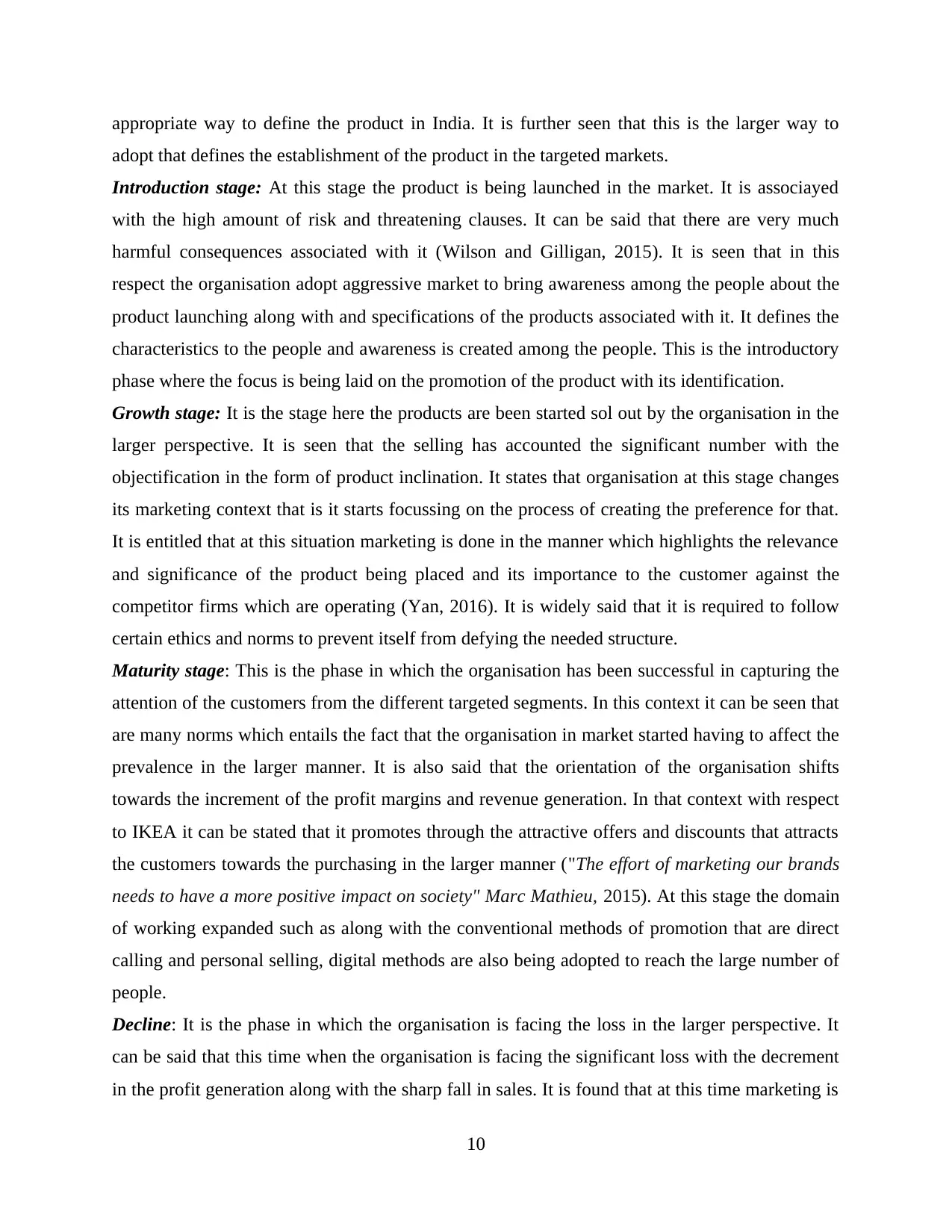
Product life cycle is the process in which the development of the product establishment is
done in the market place through different stages and methods. In this model there are four
stages described that are Introduction stage, growth stage, mature stage and decline stage. At
these stages different methods of the marketing decision are being taken (Takano, 2009). Such as
it is identified that IKEA is the recognized organisation with the structured and planned approach
to establish its working and products in the particular market. In that context it prefers the
product life cycle model which directs the organisation to have the proper functioning and
operations. It can be further seen that it is the lucrative means to capture the attention of the large
stream of customers around the world in the strategic manner. With the adoption of pragmatic
approach that is changing strategies with respect to the change in situation proves to be the
9
that in order to deal with the regulations and laws laid with respect to the banking and finance it
is found that the country adopts the fragmentation of finance regulation to affect the payment
side of the supply chain. It is regarded as the protection policy on the part of better transport and
distribution.
QUESTION 5
Impact of Product Life Cycle on Marketing Plans
Product life cycle is the process in which the development of the product establishment is
done in the market place through different stages and methods. In this model there are four
stages described that are Introduction stage, growth stage, mature stage and decline stage. At
these stages different methods of the marketing decision are being taken (Takano, 2009). Such as
it is identified that IKEA is the recognized organisation with the structured and planned approach
to establish its working and products in the particular market. In that context it prefers the
product life cycle model which directs the organisation to have the proper functioning and
operations. It can be further seen that it is the lucrative means to capture the attention of the large
stream of customers around the world in the strategic manner. With the adoption of pragmatic
approach that is changing strategies with respect to the change in situation proves to be the
9
appropriate way to define the product in India. It is further seen that this is the larger way to
adopt that defines the establishment of the product in the targeted markets.
Introduction stage: At this stage the product is being launched in the market. It is associayed
with the high amount of risk and threatening clauses. It can be said that there are very much
harmful consequences associated with it (Wilson and Gilligan, 2015). It is seen that in this
respect the organisation adopt aggressive market to bring awareness among the people about the
product launching along with and specifications of the products associated with it. It defines the
characteristics to the people and awareness is created among the people. This is the introductory
phase where the focus is being laid on the promotion of the product with its identification.
Growth stage: It is the stage here the products are been started sol out by the organisation in the
larger perspective. It is seen that the selling has accounted the significant number with the
objectification in the form of product inclination. It states that organisation at this stage changes
its marketing context that is it starts focussing on the process of creating the preference for that.
It is entitled that at this situation marketing is done in the manner which highlights the relevance
and significance of the product being placed and its importance to the customer against the
competitor firms which are operating (Yan, 2016). It is widely said that it is required to follow
certain ethics and norms to prevent itself from defying the needed structure.
Maturity stage: This is the phase in which the organisation has been successful in capturing the
attention of the customers from the different targeted segments. In this context it can be seen that
are many norms which entails the fact that the organisation in market started having to affect the
prevalence in the larger manner. It is also said that the orientation of the organisation shifts
towards the increment of the profit margins and revenue generation. In that context with respect
to IKEA it can be stated that it promotes through the attractive offers and discounts that attracts
the customers towards the purchasing in the larger manner ("The effort of marketing our brands
needs to have a more positive impact on society" Marc Mathieu, 2015). At this stage the domain
of working expanded such as along with the conventional methods of promotion that are direct
calling and personal selling, digital methods are also being adopted to reach the large number of
people.
Decline: It is the phase in which the organisation is facing the loss in the larger perspective. It
can be said that this time when the organisation is facing the significant loss with the decrement
in the profit generation along with the sharp fall in sales. It is found that at this time marketing is
10
adopt that defines the establishment of the product in the targeted markets.
Introduction stage: At this stage the product is being launched in the market. It is associayed
with the high amount of risk and threatening clauses. It can be said that there are very much
harmful consequences associated with it (Wilson and Gilligan, 2015). It is seen that in this
respect the organisation adopt aggressive market to bring awareness among the people about the
product launching along with and specifications of the products associated with it. It defines the
characteristics to the people and awareness is created among the people. This is the introductory
phase where the focus is being laid on the promotion of the product with its identification.
Growth stage: It is the stage here the products are been started sol out by the organisation in the
larger perspective. It is seen that the selling has accounted the significant number with the
objectification in the form of product inclination. It states that organisation at this stage changes
its marketing context that is it starts focussing on the process of creating the preference for that.
It is entitled that at this situation marketing is done in the manner which highlights the relevance
and significance of the product being placed and its importance to the customer against the
competitor firms which are operating (Yan, 2016). It is widely said that it is required to follow
certain ethics and norms to prevent itself from defying the needed structure.
Maturity stage: This is the phase in which the organisation has been successful in capturing the
attention of the customers from the different targeted segments. In this context it can be seen that
are many norms which entails the fact that the organisation in market started having to affect the
prevalence in the larger manner. It is also said that the orientation of the organisation shifts
towards the increment of the profit margins and revenue generation. In that context with respect
to IKEA it can be stated that it promotes through the attractive offers and discounts that attracts
the customers towards the purchasing in the larger manner ("The effort of marketing our brands
needs to have a more positive impact on society" Marc Mathieu, 2015). At this stage the domain
of working expanded such as along with the conventional methods of promotion that are direct
calling and personal selling, digital methods are also being adopted to reach the large number of
people.
Decline: It is the phase in which the organisation is facing the loss in the larger perspective. It
can be said that this time when the organisation is facing the significant loss with the decrement
in the profit generation along with the sharp fall in sales. It is found that at this time marketing is
10
⊘ This is a preview!⊘
Do you want full access?
Subscribe today to unlock all pages.
Trusted by 1+ million students worldwide

1 out of 15


Related Documents


Your All-in-One AI-Powered Toolkit for Academic Success.
+13062052269
info@desklib.com
Available 24*7 on WhatsApp / Email
![[object Object]](/_next/static/media/star-bottom.7253800d.svg)
Unlock your academic potential
Copyright © 2020–2026 A2Z Services. All Rights Reserved. Developed and managed by ZUCOL.