International Marketing Report: Nike's Global Expansion Strategies
VerifiedAdded on 2020/11/23
|10
|2571
|68
Report
AI Summary
This report provides a comprehensive analysis of Nike's international marketing strategies. It begins by evaluating the drivers of globalization that support Nike's business expansion, such as advancements in technology, international trade, and investment. The report then examines the global environment, including political, economic, social, and technological factors that influence Nike's international marketing decisions. A key section identifies Nike's target market, suggesting demographic and product innovation strategies. The report also explores Nike's global international strategies, including product development and cost leadership. Finally, it evaluates various international market entry strategies like direct exporting, licensing, and franchising, assessing their advantages and disadvantages for Nike's global expansion. This report is designed to provide a comprehensive understanding of Nike's approach to international marketing and the challenges and opportunities it faces in the global marketplace.

International Marketing

Paraphrase This Document
Need a fresh take? Get an instant paraphrase of this document with our AI Paraphraser
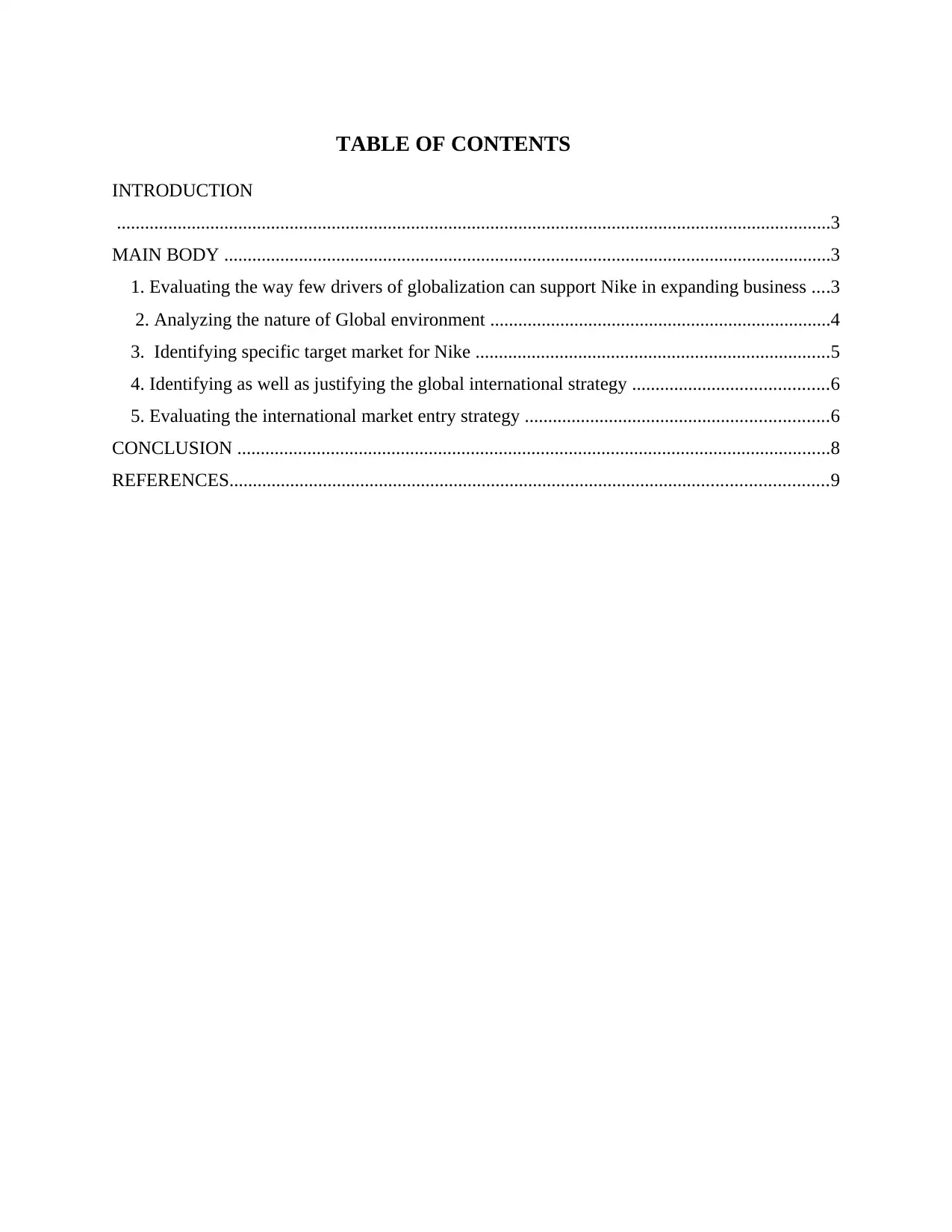
TABLE OF CONTENTS
INTRODUCTION
.........................................................................................................................................................3
MAIN BODY ..................................................................................................................................3
1. Evaluating the way few drivers of globalization can support Nike in expanding business ....3
2. Analyzing the nature of Global environment .........................................................................4
3. Identifying specific target market for Nike ............................................................................5
4. Identifying as well as justifying the global international strategy ..........................................6
5. Evaluating the international market entry strategy .................................................................6
CONCLUSION ...............................................................................................................................8
REFERENCES................................................................................................................................9
INTRODUCTION
.........................................................................................................................................................3
MAIN BODY ..................................................................................................................................3
1. Evaluating the way few drivers of globalization can support Nike in expanding business ....3
2. Analyzing the nature of Global environment .........................................................................4
3. Identifying specific target market for Nike ............................................................................5
4. Identifying as well as justifying the global international strategy ..........................................6
5. Evaluating the international market entry strategy .................................................................6
CONCLUSION ...............................................................................................................................8
REFERENCES................................................................................................................................9
INTRODUCTION
International marketing can be defined as the application of marketing principles at
global level. The purpose of international marketing is to satisfy the need as well as demands of
people residing outside national boundaries. It also involves trading of products or services at
global level. International marketing can be referred to as process which includes planning,
promotion and distribution of goods worldwide. It is considered to be as strategy which is
implemented by organisation for increasing market share. There are several variables such as
social, legal, environmental, political factors can have direct effect or influence on international
marketing activities. International marketing also includes the utilisation of various instruments
for achieving desired financial results.
The report have focus on evaluating the way few drivers of globalisation assist an
organisation in expanding business in context of Nike company. It also emphasizes on
addressing those factors which might have effect on the international marketing decision of an
enterprise.
MAIN BODY
1. Evaluating the way few drivers of globalization can support Nike in expanding business
Globalization can be defined as a procedure by which companies starts operating
business at global level. It can be referred to as interaction between business entities at
international level. Globalization is the procedure which supports firm in expanding business. It
also has helped Nike in increasing sales as well as profitability. There are different drivers of
globalization which has encouraged as well as supported Nike in expanding business operations.
These forces are :
Advancement in Technology: It is considered to be as the biggest driver of globalization.
Technological advancement has provided people or companies an ease in trading goods and
services. Development of Information technology has enabled business entities such as Nike to
send message as well as share information. Emergence of social media and internet has allowed
an organization to promote goods or services at international level. In addition to this
technological advancement has helped enterprise in increasing productivity as well as working
efficiency (Surdu, Irina and Keith Glaister,2018).
International marketing can be defined as the application of marketing principles at
global level. The purpose of international marketing is to satisfy the need as well as demands of
people residing outside national boundaries. It also involves trading of products or services at
global level. International marketing can be referred to as process which includes planning,
promotion and distribution of goods worldwide. It is considered to be as strategy which is
implemented by organisation for increasing market share. There are several variables such as
social, legal, environmental, political factors can have direct effect or influence on international
marketing activities. International marketing also includes the utilisation of various instruments
for achieving desired financial results.
The report have focus on evaluating the way few drivers of globalisation assist an
organisation in expanding business in context of Nike company. It also emphasizes on
addressing those factors which might have effect on the international marketing decision of an
enterprise.
MAIN BODY
1. Evaluating the way few drivers of globalization can support Nike in expanding business
Globalization can be defined as a procedure by which companies starts operating
business at global level. It can be referred to as interaction between business entities at
international level. Globalization is the procedure which supports firm in expanding business. It
also has helped Nike in increasing sales as well as profitability. There are different drivers of
globalization which has encouraged as well as supported Nike in expanding business operations.
These forces are :
Advancement in Technology: It is considered to be as the biggest driver of globalization.
Technological advancement has provided people or companies an ease in trading goods and
services. Development of Information technology has enabled business entities such as Nike to
send message as well as share information. Emergence of social media and internet has allowed
an organization to promote goods or services at international level. In addition to this
technological advancement has helped enterprise in increasing productivity as well as working
efficiency (Surdu, Irina and Keith Glaister,2018).
⊘ This is a preview!⊘
Do you want full access?
Subscribe today to unlock all pages.

Trusted by 1+ million students worldwide
International trade: This is also considered to be a major driver of innovation, as it promotes as
well as strengthen interdependence between nations. Country allows free flow of goods and
services for supporting citizen in improving living standards. Economic policies plays a
significant role in attracting companies to expand business. In context of Nike, fiscal policies
formulated by the UK government is attracting firm to exp[and business in particular region.
International investment : It the driver of globalization. Since, last few years there has been
increase in the global investment, such as portfolio, foreign direct investment, commercial loans
etc. In context of Nike, Easy availability of financial resources in UK is attracting an
organization to expand business in particular region.
In addition to this other drivers of globalization are :
Consumer demand : Continuous change in demands by customer force companies to search for
new customer by expanding business in new market. Social media and other advance
technology utilized by companies for marketing purpose is influencing people to buy products
from other countries.
Increase in cost : Due to the continuous rises in the prices of raw material as well as rise in the
cost of production many companies might prefer to expand business in such nations where labor
expenses are less.
Competitors: Companies might prefer to expand business in other countries due to stiff
competition in domestic market. In context of Nike, for escaping from the competition business
entity has decided to expand business in UK.
Reduction in government control : This is the factor which inspire companies to search for
immediate area for business partners.
2. Analysing the nature of Global environment
Global environment can be referred to as the cross nation situations in which an
organization operates business. In international business environment there are several factors
such as economic, political , technological can have direct effect on business. Changes in these
variables can have significant influence on decision of management related to expansion of
business in specific nation (Moon and Oh, 2017). In context of Nike, business entity is planning
to expand business in Uk, it is very much important for management to develop the
understanding about business environment of that nation as well as market, as this will assist
well as strengthen interdependence between nations. Country allows free flow of goods and
services for supporting citizen in improving living standards. Economic policies plays a
significant role in attracting companies to expand business. In context of Nike, fiscal policies
formulated by the UK government is attracting firm to exp[and business in particular region.
International investment : It the driver of globalization. Since, last few years there has been
increase in the global investment, such as portfolio, foreign direct investment, commercial loans
etc. In context of Nike, Easy availability of financial resources in UK is attracting an
organization to expand business in particular region.
In addition to this other drivers of globalization are :
Consumer demand : Continuous change in demands by customer force companies to search for
new customer by expanding business in new market. Social media and other advance
technology utilized by companies for marketing purpose is influencing people to buy products
from other countries.
Increase in cost : Due to the continuous rises in the prices of raw material as well as rise in the
cost of production many companies might prefer to expand business in such nations where labor
expenses are less.
Competitors: Companies might prefer to expand business in other countries due to stiff
competition in domestic market. In context of Nike, for escaping from the competition business
entity has decided to expand business in UK.
Reduction in government control : This is the factor which inspire companies to search for
immediate area for business partners.
2. Analysing the nature of Global environment
Global environment can be referred to as the cross nation situations in which an
organization operates business. In international business environment there are several factors
such as economic, political , technological can have direct effect on business. Changes in these
variables can have significant influence on decision of management related to expansion of
business in specific nation (Moon and Oh, 2017). In context of Nike, business entity is planning
to expand business in Uk, it is very much important for management to develop the
understanding about business environment of that nation as well as market, as this will assist
Paraphrase This Document
Need a fresh take? Get an instant paraphrase of this document with our AI Paraphraser
them in making an appropriate decision related to technique of promoting goods into
international market.
Political factors : Changes in the rules as well as regulations, political instability in the host
country has great influence on firms international marketing decision of Nike.
Economic factors: Increase in tax , prices of goods have significant influence on international
marketing decision of organization, Ass in such situation Nike have to find new ways for
influencing people buy particular products.
social factors: Changes in trends, culture, customer demand can have direct effect on the Nike
international marketing strategy. For instance, change in shopping pattern has force company to
use online marketing strategy and has encouraged business entity to mark online presence. In
addition to this, cultural factors can have significant impact on the global marketing strategy of
Nike.
Technological factors: Advancement in technology has enabled enterprises to identify more
new techniques for promoting goods or services at international level.
Legal factors : Government restriction on execution of specific promotional activity can have
impact in Nike marketing strategy (Oyewole, 2018.).
Environmental factor : Weather conditions, intensity competitions in international market can
have direct as well as great influence on an organization marketing strategy.
3. Identifying specific target market for Nike
Nike is leading sports footwear and apparel company. Annual sales of an organization is
approx. twenty-eight billion. Marketing strategy of an organization is developed by manager
considering the brand of firm. There are different strategies has been adopted by Nike for
reaching to the target market which has been proved to be successful only in domestic market. B
An organization utilized demographic marketing strategy. Nike is presently targeting sportsmen
for selling its products, which is not sufficient for earning huge revenue as well as profit.
Business entity has form strategic partnership with athletic teams which has assisted firm in
reaching to target group (Kaleka and Morgan, 2017). It is required by Nike to enter into new
market, as this will assist business entity in fostering growth. Now, Nike can still use
demographic market segmentation strategy, but it is required by the business entity to target
people belonging top the age of 18 to 40 years. An organization also can target youth embraced
with hip hop culture, as it will easier for firm to target such group. In addition to this, Nike can
international market.
Political factors : Changes in the rules as well as regulations, political instability in the host
country has great influence on firms international marketing decision of Nike.
Economic factors: Increase in tax , prices of goods have significant influence on international
marketing decision of organization, Ass in such situation Nike have to find new ways for
influencing people buy particular products.
social factors: Changes in trends, culture, customer demand can have direct effect on the Nike
international marketing strategy. For instance, change in shopping pattern has force company to
use online marketing strategy and has encouraged business entity to mark online presence. In
addition to this, cultural factors can have significant impact on the global marketing strategy of
Nike.
Technological factors: Advancement in technology has enabled enterprises to identify more
new techniques for promoting goods or services at international level.
Legal factors : Government restriction on execution of specific promotional activity can have
impact in Nike marketing strategy (Oyewole, 2018.).
Environmental factor : Weather conditions, intensity competitions in international market can
have direct as well as great influence on an organization marketing strategy.
3. Identifying specific target market for Nike
Nike is leading sports footwear and apparel company. Annual sales of an organization is
approx. twenty-eight billion. Marketing strategy of an organization is developed by manager
considering the brand of firm. There are different strategies has been adopted by Nike for
reaching to the target market which has been proved to be successful only in domestic market. B
An organization utilized demographic marketing strategy. Nike is presently targeting sportsmen
for selling its products, which is not sufficient for earning huge revenue as well as profit.
Business entity has form strategic partnership with athletic teams which has assisted firm in
reaching to target group (Kaleka and Morgan, 2017). It is required by Nike to enter into new
market, as this will assist business entity in fostering growth. Now, Nike can still use
demographic market segmentation strategy, but it is required by the business entity to target
people belonging top the age of 18 to 40 years. An organization also can target youth embraced
with hip hop culture, as it will easier for firm to target such group. In addition to this, Nike can
also target social economic class, ass it would be easier for firm to influence these people
through their marketing strategy. It is required by the firm to conduct more research as this
strategy will help Nike in identifying the suitable market. This marketing strategy will also
support an enterprise in addressing target group for offering products or services. Product
innovation strategy will assist Nike in increasing sales as well as profitability. Nike can integrate
cutting edge technology in the design of apparel or shoes, as this will assist business entity in
attracting more number of customers.
4. Identifying as well as justifying the global international strategy
The various marketing strategy has been adopted by Nike for promoting goods or
services at international level. Some strategies implemented by Nike are utilization of emotional
advertising as well as brand strategy has assisted firm in getting success in international market.
New product development : This is the strategy which can be adopted by the Nike. Product
development is considered to be an effective strategy which will help an organization in fostering
growth. Nike can Maximize organic growth opportunities by concentrating on develop
innovative products (Rao-Nicholson and Khan, 2017). It is required by an organization to make
investment on developing new products, as this strategy will assist firm in attracting the
customers in international market. Nike can utilize the latest technology for creating innovative
goods. Product development strategy will also assist Nike in differentiating its products from that
of competitors. It will support an organization in gaining the competitive advantage in
international market.
Lost cost pricing strategy: This is the strategy which can be adopted by Nike for entering
into the market. It is required by the firm to launch product in new market at low price. As this
pricing strategy will assist an enterprise in attracting the customer. It will also support business
entity in gaining competitive advantage.
5. Evaluating the international market entry strategy
There are various Global marketing strategy which can be adopted by Nike for entering
into international marketing these are :
Direct exporting : As per this strategy Nike can produce products in domestic country as well
ass shipping the surplus to other nation. This is considered to be as an effective as well as
simplest strategy for entering into new market. In addition to this, Nike does not require
through their marketing strategy. It is required by the firm to conduct more research as this
strategy will help Nike in identifying the suitable market. This marketing strategy will also
support an enterprise in addressing target group for offering products or services. Product
innovation strategy will assist Nike in increasing sales as well as profitability. Nike can integrate
cutting edge technology in the design of apparel or shoes, as this will assist business entity in
attracting more number of customers.
4. Identifying as well as justifying the global international strategy
The various marketing strategy has been adopted by Nike for promoting goods or
services at international level. Some strategies implemented by Nike are utilization of emotional
advertising as well as brand strategy has assisted firm in getting success in international market.
New product development : This is the strategy which can be adopted by the Nike. Product
development is considered to be an effective strategy which will help an organization in fostering
growth. Nike can Maximize organic growth opportunities by concentrating on develop
innovative products (Rao-Nicholson and Khan, 2017). It is required by an organization to make
investment on developing new products, as this strategy will assist firm in attracting the
customers in international market. Nike can utilize the latest technology for creating innovative
goods. Product development strategy will also assist Nike in differentiating its products from that
of competitors. It will support an organization in gaining the competitive advantage in
international market.
Lost cost pricing strategy: This is the strategy which can be adopted by Nike for entering
into the market. It is required by the firm to launch product in new market at low price. As this
pricing strategy will assist an enterprise in attracting the customer. It will also support business
entity in gaining competitive advantage.
5. Evaluating the international market entry strategy
There are various Global marketing strategy which can be adopted by Nike for entering
into international marketing these are :
Direct exporting : As per this strategy Nike can produce products in domestic country as well
ass shipping the surplus to other nation. This is considered to be as an effective as well as
simplest strategy for entering into new market. In addition to this, Nike does not require
⊘ This is a preview!⊘
Do you want full access?
Subscribe today to unlock all pages.
Trusted by 1+ million students worldwide
appointing distributor or other agents for promoting products or services. Direct exporting
involves selling products or services to customers directly. All the activities such as market
research, invoicing is done by the company itself.
Disadvantages of this strategy is that due to tariff barriers or changes in government rules
or other factors business entity may not able to export products or services.
The advantages of direct exporting strategy is that it will enable Nike to have control on
sales. By utilizing this strategy, Nike can communicate directly with the customers. As market
research is executed by an organization, it enables business entity to develop the understanding
about customers needs and demand. In context of Internationale business, Nike have greater
flexibility to improve their marketing efforts.
Licensing : Nike by entering into the contractual agreement can provide the proprietary assist to
other foreign organizations in exchange of royalty fees. This types of marketing strategy is
generally implemented by those firm which does not want to make huge investment in expanding
business in international market (De Mooij, 2018). It can also be adopted by those enterprises
which does not have high potential to bear risk.
The major advantage of this strategy is that Nike can enter into international market by
making less investment.
Major drawback of this strategy is that licensing agreement might restrict future activities
of NIKe.
Franchising : It is considered to be as most popular internal marketing strategy which is utilized
by many organizations for entering into international market. As Nike has good brand name in
the domestic market, firm can easily implement this strategy for entering into new market.
Franchising is considered to be as an effective strategy as company will not have to make huge
investment for entering into new as well as international market.
The major advantage is that by implementing the franchising strategy Nike can enhance
Its brand image (Madanoglu, Alon and Shoham, 2017). Franchising provide a way for business
to expand in new market with a level of control. In addition to this there is low cost as well as
minimum risk is associated with implementation of franchising strategy.
Big problem associated with this strategy are the regulation in host nation which includes
payments of franchise fees , restrictions on franchising agreement and transfer of money. In
addition to this Nike as a franchiser might have to face several issues such as communication ,
involves selling products or services to customers directly. All the activities such as market
research, invoicing is done by the company itself.
Disadvantages of this strategy is that due to tariff barriers or changes in government rules
or other factors business entity may not able to export products or services.
The advantages of direct exporting strategy is that it will enable Nike to have control on
sales. By utilizing this strategy, Nike can communicate directly with the customers. As market
research is executed by an organization, it enables business entity to develop the understanding
about customers needs and demand. In context of Internationale business, Nike have greater
flexibility to improve their marketing efforts.
Licensing : Nike by entering into the contractual agreement can provide the proprietary assist to
other foreign organizations in exchange of royalty fees. This types of marketing strategy is
generally implemented by those firm which does not want to make huge investment in expanding
business in international market (De Mooij, 2018). It can also be adopted by those enterprises
which does not have high potential to bear risk.
The major advantage of this strategy is that Nike can enter into international market by
making less investment.
Major drawback of this strategy is that licensing agreement might restrict future activities
of NIKe.
Franchising : It is considered to be as most popular internal marketing strategy which is utilized
by many organizations for entering into international market. As Nike has good brand name in
the domestic market, firm can easily implement this strategy for entering into new market.
Franchising is considered to be as an effective strategy as company will not have to make huge
investment for entering into new as well as international market.
The major advantage is that by implementing the franchising strategy Nike can enhance
Its brand image (Madanoglu, Alon and Shoham, 2017). Franchising provide a way for business
to expand in new market with a level of control. In addition to this there is low cost as well as
minimum risk is associated with implementation of franchising strategy.
Big problem associated with this strategy are the regulation in host nation which includes
payments of franchise fees , restrictions on franchising agreement and transfer of money. In
addition to this Nike as a franchiser might have to face several issues such as communication ,
Paraphrase This Document
Need a fresh take? Get an instant paraphrase of this document with our AI Paraphraser
quality and operational problems (Hagen, 2017). In addition to this, misuse of brand name by
franchises can have negative effect on the reputation of Nike.
CONCLUSION
It has been concluded from the report that competition in market, rise in cost,
international trade and investment are the major drivers of globalization. Study has also
concluded that there are several factors such social, economic, political variables which might
have direct as well as significant influence on firm decisions related to expansion of business in
other countries.
There are various strategies has been suggested which can be utilized by an organization
for entering into international market. Business entity has been suggested to adopt product
development strategy as this will assist an enterprise in fostering growth in international market.
franchises can have negative effect on the reputation of Nike.
CONCLUSION
It has been concluded from the report that competition in market, rise in cost,
international trade and investment are the major drivers of globalization. Study has also
concluded that there are several factors such social, economic, political variables which might
have direct as well as significant influence on firm decisions related to expansion of business in
other countries.
There are various strategies has been suggested which can be utilized by an organization
for entering into international market. Business entity has been suggested to adopt product
development strategy as this will assist an enterprise in fostering growth in international market.
REFERENCES
Books and Journals:
Gomes, E., Sousa, C. and Vendrell-Herrero, F., 2017. International marketing agility.
International Marketing Review.
Moon, B.J. and Oh, H.M., 2017. Country of origin effects in international marketing channels:
how overseas distributors account for the origins of products and brands. International
Marketing Review, 34(2), pp.224-238.
Li, R., Liu, Y. and Bustinza, O.F., 2018. FDI, service intensity, and international marketing
agility: The case of export quality of Chinese enterprises. International Marketing Review.
Surdu, Irina, Kamel Mellahi, and Keith Glaister. "Emerging market multinationals’ international
equity-based entry mode strategies: Review of theoretical foundations and future
directions." International Marketing Review 35, no. 2 (2018): 342-359.
Oyewole, P., 2018. International Marketing of Services and Developing Countries. Services
Marketing Quarterly, 39(2), pp.79-91.
Madanoglu, M., Alon, I. and Shoham, A., 2017. Push and pull factors in international
franchising. International Marketing Review, 34(1), pp.29-45.
Kaleka, A. and Morgan, N.A., 2017. How marketing capabilities and current performance drive
strategic intentions in international markets. Industrial Marketing Management.
Rao-Nicholson, R. and Khan, Z., 2017. Standardization versus adaptation of global marketing
strategies in emerging market cross-border acquisitions. International Marketing Review,
34(1), pp.138-158.
De Mooij, M., 2018. Global marketing and advertising: Understanding cultural paradoxes.
SAGE Publications Limited.
Hagen, J., 2017. MKTG3710-01. International Marketing. Sp17. Hagen, James.
Books and Journals:
Gomes, E., Sousa, C. and Vendrell-Herrero, F., 2017. International marketing agility.
International Marketing Review.
Moon, B.J. and Oh, H.M., 2017. Country of origin effects in international marketing channels:
how overseas distributors account for the origins of products and brands. International
Marketing Review, 34(2), pp.224-238.
Li, R., Liu, Y. and Bustinza, O.F., 2018. FDI, service intensity, and international marketing
agility: The case of export quality of Chinese enterprises. International Marketing Review.
Surdu, Irina, Kamel Mellahi, and Keith Glaister. "Emerging market multinationals’ international
equity-based entry mode strategies: Review of theoretical foundations and future
directions." International Marketing Review 35, no. 2 (2018): 342-359.
Oyewole, P., 2018. International Marketing of Services and Developing Countries. Services
Marketing Quarterly, 39(2), pp.79-91.
Madanoglu, M., Alon, I. and Shoham, A., 2017. Push and pull factors in international
franchising. International Marketing Review, 34(1), pp.29-45.
Kaleka, A. and Morgan, N.A., 2017. How marketing capabilities and current performance drive
strategic intentions in international markets. Industrial Marketing Management.
Rao-Nicholson, R. and Khan, Z., 2017. Standardization versus adaptation of global marketing
strategies in emerging market cross-border acquisitions. International Marketing Review,
34(1), pp.138-158.
De Mooij, M., 2018. Global marketing and advertising: Understanding cultural paradoxes.
SAGE Publications Limited.
Hagen, J., 2017. MKTG3710-01. International Marketing. Sp17. Hagen, James.
⊘ This is a preview!⊘
Do you want full access?
Subscribe today to unlock all pages.
Trusted by 1+ million students worldwide


1 out of 10


Related Documents


Your All-in-One AI-Powered Toolkit for Academic Success.
+13062052269
info@desklib.com
Available 24*7 on WhatsApp / Email
![[object Object]](/_next/static/media/star-bottom.7253800d.svg)
Unlock your academic potential
Copyright © 2020–2026 A2Z Services. All Rights Reserved. Developed and managed by ZUCOL.