International Marketing Strategy: Key Decisions and Approaches
VerifiedAdded on 2023/01/10
|7
|1566
|23
Report
AI Summary
This report provides a comprehensive overview of international marketing strategies, focusing on the contrasting approaches of standardization and adaptation. It explores the reasons behind a company's decision to develop an international marketing strategy, emphasizing the benefits of enhancing competitiveness, acquiring new skills and resources, and fostering innovation. The report delves into key decisions involved in strategy development, highlighting the debate between standardization and adaptation, and the factors influencing each choice. It examines the advantages and disadvantages of both approaches, providing insights into how multinational corporations navigate the complexities of global market expansion. The report concludes by summarizing the critical aspects of international marketing strategy and the importance of making informed decisions based on various market factors.

Marketing
Paraphrase This Document
Need a fresh take? Get an instant paraphrase of this document with our AI Paraphraser

Table of Contents
INTRODUCTION...........................................................................................................................1
Reasons for company’s international strategy development..................................................1
Key decisions in the strategy development............................................................................2
CONCLUSION................................................................................................................................4
REFERENCES................................................................................................................................5
INTRODUCTION...........................................................................................................................1
Reasons for company’s international strategy development..................................................1
Key decisions in the strategy development............................................................................2
CONCLUSION................................................................................................................................4
REFERENCES................................................................................................................................5

INTRODUCTION
Standardisation in context of marketing can be referred to as the approach whereby an entity has
the potential to make use of same marketing strategy across all the countries of the globe
(Sirajuddin and Kumar, 2018). Contrary to this, adaptation in relation to marketing is looked
upon as an approach wherein the company leverages different marketing strategy in every
country in accordance with the preferences and nature of customers within that nation. A
constant debate prevails in relation to adoption of the marketing approach whereby an entity
seeks to carry out expansion by way of international marketing. This selection is done by taking
into account the key trends that place impact over the operations of multinational corporations,
such as political, socio-cultural economic, technological and nature of rivalry, especially within
the target market.
Reasons for company’s international strategy development
There are different types of reasons that make organisations decide to develop international
strategy. In this, entity aim towards forming economics of scale, enhancing competitiveness,
dividing risk, entering into new market segment, setting new standards for technology and
acquiring new skills and resources to enhance their profitability at great extent (Young, 2018).
International marketing strategy development provides significant opportunities for a business
organisation through which they can enter into new market segment and can enhance their
business growth in a faster manner.
In addition to this, it has been identified that internationalisation allow entity to improve their
profitability as well as their sales ratio. It increases innovation and more efficient employees for
accomplishment of objectives (Serrat, 2017). Thus, in order to seek towards international growth
and gain more enormous opportunities entity can enhance their market share and diversify their
business activities with the help of international marketing strategy development. Mentioned
below there are certain reasons behind the intent of company to develop international marketing
strategy:-
Enhancing competitiveness:
With the increase in competition, entities are aiming towards undertaking unique measures and
developing effectual marketing strategy in order to maintain their core competencies. In this,
they can take their business on international platform so as to increase their competitiveness in
1
Standardisation in context of marketing can be referred to as the approach whereby an entity has
the potential to make use of same marketing strategy across all the countries of the globe
(Sirajuddin and Kumar, 2018). Contrary to this, adaptation in relation to marketing is looked
upon as an approach wherein the company leverages different marketing strategy in every
country in accordance with the preferences and nature of customers within that nation. A
constant debate prevails in relation to adoption of the marketing approach whereby an entity
seeks to carry out expansion by way of international marketing. This selection is done by taking
into account the key trends that place impact over the operations of multinational corporations,
such as political, socio-cultural economic, technological and nature of rivalry, especially within
the target market.
Reasons for company’s international strategy development
There are different types of reasons that make organisations decide to develop international
strategy. In this, entity aim towards forming economics of scale, enhancing competitiveness,
dividing risk, entering into new market segment, setting new standards for technology and
acquiring new skills and resources to enhance their profitability at great extent (Young, 2018).
International marketing strategy development provides significant opportunities for a business
organisation through which they can enter into new market segment and can enhance their
business growth in a faster manner.
In addition to this, it has been identified that internationalisation allow entity to improve their
profitability as well as their sales ratio. It increases innovation and more efficient employees for
accomplishment of objectives (Serrat, 2017). Thus, in order to seek towards international growth
and gain more enormous opportunities entity can enhance their market share and diversify their
business activities with the help of international marketing strategy development. Mentioned
below there are certain reasons behind the intent of company to develop international marketing
strategy:-
Enhancing competitiveness:
With the increase in competition, entities are aiming towards undertaking unique measures and
developing effectual marketing strategy in order to maintain their core competencies. In this,
they can take their business on international platform so as to increase their competitiveness in
1
⊘ This is a preview!⊘
Do you want full access?
Subscribe today to unlock all pages.

Trusted by 1+ million students worldwide

respective industrial sector (Telang and Deshpande, 2016). Within this, entity can undertake and
expand their business services capabilities through which they can effectively conduct their
operations while enhancing the overall rate of profitability and sales.
Acquiring new skills and resources:
It is one of the most essential reasons because of which organisations engage in the operation of
international marketing strategy development. In this entities acquire new resources and skills
through which they can conduct their organisational operations with more effectiveness. Due to
evolvement in technological developments it is essential for an organisation to maximise
efficiency of the resources as well as skills to maximize that profitability generation capability
and market share holding (Anwar, 2019). Development of international marketing strategy
allows organisation to partner with other entities to fulfil their capital needs and enhance their
service network through which they can serve large number of consumers with more efficient
skills and resources.
Innovation:
This is another crucial reason that facilitates an organisation for undergoing international
marketing strategy development. Due to increase in competition among every sector it is
essential for organisation to gain more competitiveness in order to serve their customers
according to latest trend and factors that are prevailing within market place. In this innovation
play key significant role that allows entity to develop unique product, services and process that
further aid them to differentiate their offerings from other competitors. This significantly aid
business organisation to enhance their brand image in market segment (Zook and Smith, 2016).
Further it has been identified that innovation also enhances entity efficiency to conduct their
business operations while having different image in market segment. In this entity is required to
continuously engage in the process of innovating their product and services by adding new
feature and launching new services and products. Thus by taking business operations to
international platform, company can not only expand their innovation opportunities but can also
take advantage of hi tech processes to accelerate their brand value and image.
Key decisions in the strategy development
While an entity decides to develop an international marketing strategy, it has to take into account
its intent and tactic behind the same. There are probably two options available to the firm while
making this decision and these are acknowledged to be standardisation and adaptation (Newman,
2
expand their business services capabilities through which they can effectively conduct their
operations while enhancing the overall rate of profitability and sales.
Acquiring new skills and resources:
It is one of the most essential reasons because of which organisations engage in the operation of
international marketing strategy development. In this entities acquire new resources and skills
through which they can conduct their organisational operations with more effectiveness. Due to
evolvement in technological developments it is essential for an organisation to maximise
efficiency of the resources as well as skills to maximize that profitability generation capability
and market share holding (Anwar, 2019). Development of international marketing strategy
allows organisation to partner with other entities to fulfil their capital needs and enhance their
service network through which they can serve large number of consumers with more efficient
skills and resources.
Innovation:
This is another crucial reason that facilitates an organisation for undergoing international
marketing strategy development. Due to increase in competition among every sector it is
essential for organisation to gain more competitiveness in order to serve their customers
according to latest trend and factors that are prevailing within market place. In this innovation
play key significant role that allows entity to develop unique product, services and process that
further aid them to differentiate their offerings from other competitors. This significantly aid
business organisation to enhance their brand image in market segment (Zook and Smith, 2016).
Further it has been identified that innovation also enhances entity efficiency to conduct their
business operations while having different image in market segment. In this entity is required to
continuously engage in the process of innovating their product and services by adding new
feature and launching new services and products. Thus by taking business operations to
international platform, company can not only expand their innovation opportunities but can also
take advantage of hi tech processes to accelerate their brand value and image.
Key decisions in the strategy development
While an entity decides to develop an international marketing strategy, it has to take into account
its intent and tactic behind the same. There are probably two options available to the firm while
making this decision and these are acknowledged to be standardisation and adaptation (Newman,
2
Paraphrase This Document
Need a fresh take? Get an instant paraphrase of this document with our AI Paraphraser

Peck and Wilhide, 2017). The selection of one approach out of these for international companies
has always been a topic of debate. This is because there are equal chances of success and failure
associated with it which must be considered by the multinational corporations (Resnick and et.
al, 2016). The two approaches are thus briefly described as follows:-
Standardisation:
This approach to marketing can be viewed as the process whereby the firm applies same
marketing strategy in every location whereby it seeks to expand its business operations (Nowak,
Gellin and MacDonald, 2015). Standardized marketing mix strategy tends to give rise to a
number of merits and demerits. However, this strategy is chosen by a large number of
organisations as this enables larger sale volume, low production costs, higher profitability and
integrated image across the globe.
Adaptation:
This approach to marketing is looked upon as the approach whereby the entity devises and
implements a distinct and unique marketing strategy for every location (Pike, 2015). This
strategy is solely based on the nature, attitude, preferences and demands of population within the
bounds of that market. Adaptation is usually adopted by the corporations when they seek to
become the market leader or reach out to new market segments in an effectual way.
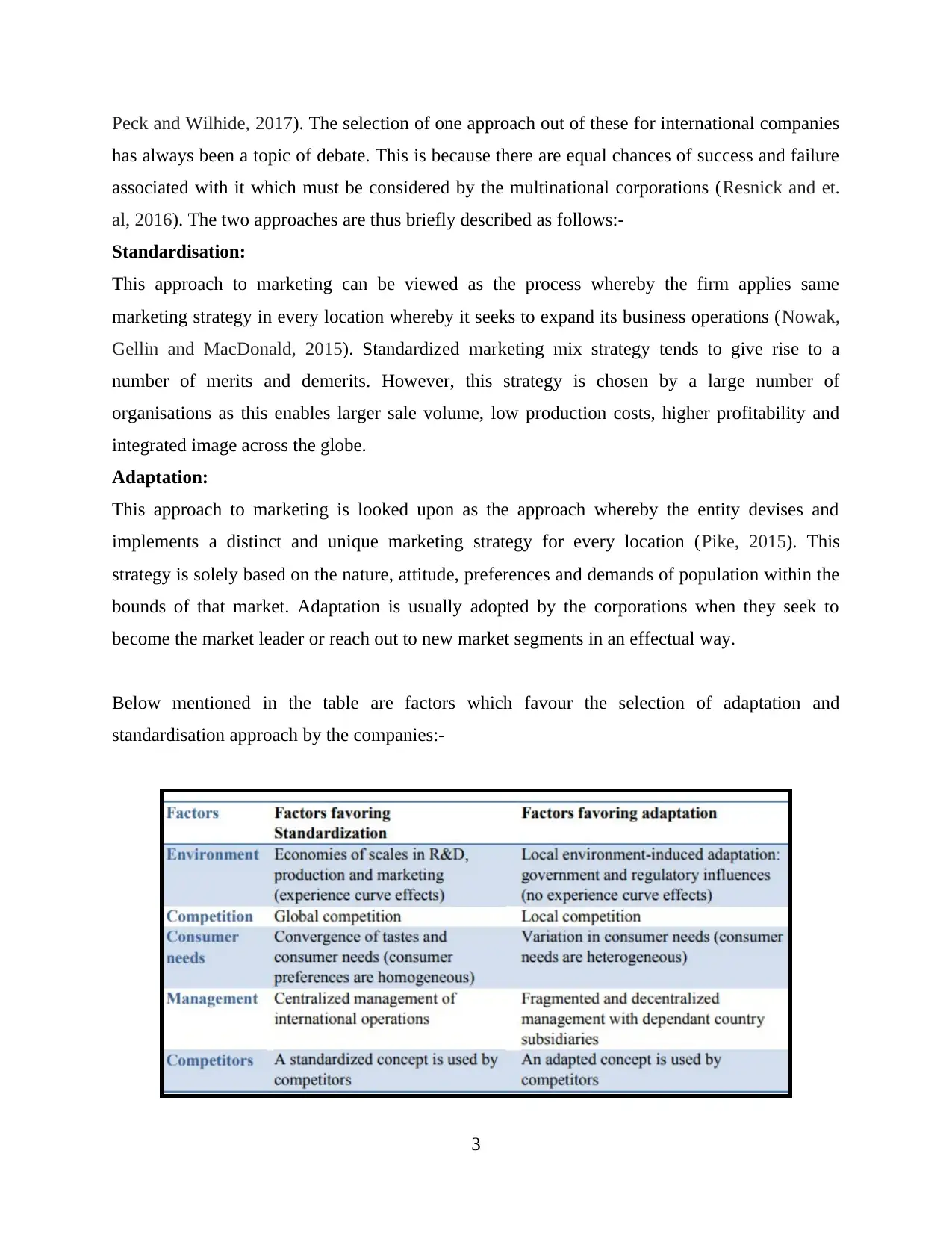
Below mentioned in the table are factors which favour the selection of adaptation and
standardisation approach by the companies:-
3
has always been a topic of debate. This is because there are equal chances of success and failure
associated with it which must be considered by the multinational corporations (Resnick and et.
al, 2016). The two approaches are thus briefly described as follows:-
Standardisation:
This approach to marketing can be viewed as the process whereby the firm applies same
marketing strategy in every location whereby it seeks to expand its business operations (Nowak,
Gellin and MacDonald, 2015). Standardized marketing mix strategy tends to give rise to a
number of merits and demerits. However, this strategy is chosen by a large number of
organisations as this enables larger sale volume, low production costs, higher profitability and
integrated image across the globe.
Adaptation:
This approach to marketing is looked upon as the approach whereby the entity devises and
implements a distinct and unique marketing strategy for every location (Pike, 2015). This
strategy is solely based on the nature, attitude, preferences and demands of population within the
bounds of that market. Adaptation is usually adopted by the corporations when they seek to
become the market leader or reach out to new market segments in an effectual way.
Below mentioned in the table are factors which favour the selection of adaptation and
standardisation approach by the companies:-
3

An entity decides the approach to marketing by taking into account its prime objective or long
drawn vision behind the action. Whether the products and services are adapted or standardised,
the intent of the multinational organisation behind the same is to attain a high share of market
place. Also, the business organisations intend to gain a competitive edge over the rivals
prevailing in market place by choosing a sound marketing strategy that can render fruitful
outcomes in the long run.
CONCLUSION
On the basis of above discussion, it can be summarised that adaptation and standardisation are
two different approaches to marketing on an international platform. It is on the discretion of the
company to make the selection of the strategy. However, this selection is made while taking into
account certain factors that may place impact over the international operations of the business
entity.
4
drawn vision behind the action. Whether the products and services are adapted or standardised,
the intent of the multinational organisation behind the same is to attain a high share of market
place. Also, the business organisations intend to gain a competitive edge over the rivals
prevailing in market place by choosing a sound marketing strategy that can render fruitful
outcomes in the long run.
CONCLUSION
On the basis of above discussion, it can be summarised that adaptation and standardisation are
two different approaches to marketing on an international platform. It is on the discretion of the
company to make the selection of the strategy. However, this selection is made while taking into
account certain factors that may place impact over the international operations of the business
entity.
4
⊘ This is a preview!⊘
Do you want full access?
Subscribe today to unlock all pages.

Trusted by 1+ million students worldwide

REFERENCES
Books and Journals
Sirajuddin, M.M. and Kumar, M.P.S., 2018. INNOVATIVE MARKETING STRATEGIES IN
RETAILING GIANTS: BIG BAZAR &D-MART. International Journal of Pure and
Applied Mathematics, 118(15), pp.151-156.
Young, P.N., 2018. A Practice-based Model of Effective Marketing Based on an Auto-
ethnographical Observation of Brand Management Training at Procter & Gamble
(p&g). The Marketing Review, 18(3), pp.243-269.
Telang, A. and Deshpande, A., 2016. Keep calm and carry on: A crisis communication study of
Cadbury and McDonalds. Management & Marketing, 11(1), pp.371-379.
Anwar, S.T., 2019. Kraft's acquisition of Cadbury: Was it an amicable transatlantic merger or a
hostile takeover?. Thunderbird International Business Review, 61(2), pp.439-451.
Zook, Z. and Smith, P.R., 2016. Marketing communications: offline and online integration,
engagement and analytics. Kogan Page Publishers.
Newman, T., Peck, J. and Wilhide, B., 2017. Social media in sport marketing. Routledge.
Nowak, G. J., Gellin, B. G. And MacDonald, N. E. 2015. Addressing vaccine hesitancy: the
potential value of commercial and social marketing principles and
practices. Vaccine. 33(34), pp.4204-4211.
Pike, S., 2015. Destination marketing: essentials. Routledge.
Resnick, S. M. and et. al, 2016. Marketing in SMEs: a “4Ps” self-branding model. International
Journal of Entrepreneurial Behavior & Research, 22(1), pp.155-174.
Serrat, O., 2017. The future of social marketing. In Knowledge solutions (pp. 119-128).
Springer, Singapore.
5
Books and Journals
Sirajuddin, M.M. and Kumar, M.P.S., 2018. INNOVATIVE MARKETING STRATEGIES IN
RETAILING GIANTS: BIG BAZAR &D-MART. International Journal of Pure and
Applied Mathematics, 118(15), pp.151-156.
Young, P.N., 2018. A Practice-based Model of Effective Marketing Based on an Auto-
ethnographical Observation of Brand Management Training at Procter & Gamble
(p&g). The Marketing Review, 18(3), pp.243-269.
Telang, A. and Deshpande, A., 2016. Keep calm and carry on: A crisis communication study of
Cadbury and McDonalds. Management & Marketing, 11(1), pp.371-379.
Anwar, S.T., 2019. Kraft's acquisition of Cadbury: Was it an amicable transatlantic merger or a
hostile takeover?. Thunderbird International Business Review, 61(2), pp.439-451.
Zook, Z. and Smith, P.R., 2016. Marketing communications: offline and online integration,
engagement and analytics. Kogan Page Publishers.
Newman, T., Peck, J. and Wilhide, B., 2017. Social media in sport marketing. Routledge.
Nowak, G. J., Gellin, B. G. And MacDonald, N. E. 2015. Addressing vaccine hesitancy: the
potential value of commercial and social marketing principles and
practices. Vaccine. 33(34), pp.4204-4211.
Pike, S., 2015. Destination marketing: essentials. Routledge.
Resnick, S. M. and et. al, 2016. Marketing in SMEs: a “4Ps” self-branding model. International
Journal of Entrepreneurial Behavior & Research, 22(1), pp.155-174.
Serrat, O., 2017. The future of social marketing. In Knowledge solutions (pp. 119-128).
Springer, Singapore.
5
1 out of 7
Related Documents
Your All-in-One AI-Powered Toolkit for Academic Success.
+13062052269
info@desklib.com
Available 24*7 on WhatsApp / Email
Unlock your academic potential
Copyright © 2020–2025 A2Z Services. All Rights Reserved. Developed and managed by ZUCOL.