Cultural Origins of MPA Students in Australia: Intentions and Goals
VerifiedAdded on 2023/01/04
|10
|2861
|59
Essay
AI Summary
This essay analyzes the long-term intentions of four MPA students from diverse cultural backgrounds studying in Australia, examining how their cultural origins influence their academic and professional goals. It investigates the mechanisms and resources available to these students, considering the factors that make Australia an attractive destination for international students, such as its high-quality education, multicultural environment, and opportunities for part-time work. The essay delves into the cultural dimensions of Australia, highlighting the country's relatively laid-back approach to education and its welcoming environment for international students. The study also provides a literature review on the challenges and opportunities faced by international students, drawing on various research articles and reports to support its arguments. Ultimately, the essay aims to understand the motivations, aspirations, and strategies of international students pursuing an MPA in Australia and how they intend to achieve their goals within the Australian context.
Running head: DIFFERENT CULTURE-ORIGIN STUDENTS
DIFFERENT CULTURE-ORIGIN STUDENTS
What & Why is the long term intention of four different culture-origin students studying
MPA in Australia and how & why do they intend to accomplish those goals?
Name of the Student:
Name of the University:
Author Note:
DIFFERENT CULTURE-ORIGIN STUDENTS
What & Why is the long term intention of four different culture-origin students studying
MPA in Australia and how & why do they intend to accomplish those goals?
Name of the Student:
Name of the University:
Author Note:

Paraphrase This Document
Need a fresh take? Get an instant paraphrase of this document with our AI Paraphraser
DIFFERENT CULTURE-ORIGIN STUDENTS 1
b. What means/mechanism might there be available to the student? What? How? Why?
The aim of the study is to carry out a literature review on the mechanism available to
the students from the different culture-origin studying at MPA. In the view point of Browne,
Fetherston and Medigovich (2015), Australia is no longer a destination with outback bush,
kangaroos and koalas with clean air and water but it is much more than it. As a growing
destination in terms of its educational exposure or other factors of the global recognition,
Australia has showed great evidences for being a loved nation by the students around the
world (Tran and Pham 2016). Primarily, it has been observed that Australia ranks third in the
global and international destination as the destination for international students speaking
English (Repo et al. 2017). The most important factor behind this is the friendly environment
and the ability to give chance to the students from abroad. Australia ranks third after the
United States and United Kingdom when it comes to the exposure of high quality education.
There are certain factors that are helping Australian school and Universities to get
recognition worldwide. Firstly, it is the standard of Education that Australia follows which is
accepted worldwide. The certificates gained from the Australian government maintain a high
standard of education associated with the country (Gondwe and Longnecker 2015). Secondly,
comparing the cost of living with the other nations of the world, Australia still lies at a lower
slab where the students can work and earn and at the same time can invest in their own
education (Kent-Wilkinson et al. 2015). This in turns helps the international students from
the different culture origins to survive in an international land. The students would earn
enough money and at the same time would continue with their study as well (Wang, Andre
and Greenwood 2015). Thirdly, it is the availability of the diversity of education at Australia.
People from around the world have the option and interest towards choosing a degree
program of their choice towards their own need and interest (Akanwa 2015). The Universities
in Australia offer courses ranging from English, vocational training, Engineering or any
b. What means/mechanism might there be available to the student? What? How? Why?
The aim of the study is to carry out a literature review on the mechanism available to
the students from the different culture-origin studying at MPA. In the view point of Browne,
Fetherston and Medigovich (2015), Australia is no longer a destination with outback bush,
kangaroos and koalas with clean air and water but it is much more than it. As a growing
destination in terms of its educational exposure or other factors of the global recognition,
Australia has showed great evidences for being a loved nation by the students around the
world (Tran and Pham 2016). Primarily, it has been observed that Australia ranks third in the
global and international destination as the destination for international students speaking
English (Repo et al. 2017). The most important factor behind this is the friendly environment
and the ability to give chance to the students from abroad. Australia ranks third after the
United States and United Kingdom when it comes to the exposure of high quality education.
There are certain factors that are helping Australian school and Universities to get
recognition worldwide. Firstly, it is the standard of Education that Australia follows which is
accepted worldwide. The certificates gained from the Australian government maintain a high
standard of education associated with the country (Gondwe and Longnecker 2015). Secondly,
comparing the cost of living with the other nations of the world, Australia still lies at a lower
slab where the students can work and earn and at the same time can invest in their own
education (Kent-Wilkinson et al. 2015). This in turns helps the international students from
the different culture origins to survive in an international land. The students would earn
enough money and at the same time would continue with their study as well (Wang, Andre
and Greenwood 2015). Thirdly, it is the availability of the diversity of education at Australia.
People from around the world have the option and interest towards choosing a degree
program of their choice towards their own need and interest (Akanwa 2015). The Universities
in Australia offer courses ranging from English, vocational training, Engineering or any
DIFFERENT CULTURE-ORIGIN STUDENTS 2
subject available under the sun. Thus, any student can opt for any subject of their choice.
Reading Gautam et al. (2016), it has been found that the international students always look
for an appealing aspect when it comes to their scientific research and study. Australia offers
that technological and innovative output that would encourage the people from different
nations across the world to study and learn. Moreover, Australia also offers the facility of part
time and full time jobs to the student so that they can avail the opportunity to earn and save
money for themselves (Day et al. 2015). The international students can easily get a job of
their desire and earn as per hour and earn their education cost as well as the living. All these
factors are enough for the students from around the world to opt for the education at Australia
and give a boost to their career.
It has been found that students from every part of the globe come at Australia to study
because of the availability of a variety of options to them for studying. If the culture of four
origins is taken into consideration, an analysis can be done (Gomes 2015). For instance,
considering the most number of students from Asian countries like China, Malaysia,
Singapore and on the other hand, a large number of people from the countries like India and
Pakistan, it can be said that a Chinese culture and Indian or Hinduism or Islam culture can be
pre-dominating factors in the cultural context of the people studying in Australia. Apart from
this, the culture of Africa and that of UK or Britain are the two other cultures to be
considered (Straker 2016). In the view point of Wang and Greenwood (2015), people from all
these 4 countries have their own set of cultures. According to the recent reports, students
across the world are looking to study in Australia rather than the other preferred countries
like the USA and UK. The reasons behind the same are many but one of those reasons is
definitely because of the affluent culture of Australia as a nation state (Presbitero2016).
It has been clearly evident that people from various cultural origins come to Australia
to study. In this aspect, the cultural dimensions of Australia can be discussed as it is basis the
subject available under the sun. Thus, any student can opt for any subject of their choice.
Reading Gautam et al. (2016), it has been found that the international students always look
for an appealing aspect when it comes to their scientific research and study. Australia offers
that technological and innovative output that would encourage the people from different
nations across the world to study and learn. Moreover, Australia also offers the facility of part
time and full time jobs to the student so that they can avail the opportunity to earn and save
money for themselves (Day et al. 2015). The international students can easily get a job of
their desire and earn as per hour and earn their education cost as well as the living. All these
factors are enough for the students from around the world to opt for the education at Australia
and give a boost to their career.
It has been found that students from every part of the globe come at Australia to study
because of the availability of a variety of options to them for studying. If the culture of four
origins is taken into consideration, an analysis can be done (Gomes 2015). For instance,
considering the most number of students from Asian countries like China, Malaysia,
Singapore and on the other hand, a large number of people from the countries like India and
Pakistan, it can be said that a Chinese culture and Indian or Hinduism or Islam culture can be
pre-dominating factors in the cultural context of the people studying in Australia. Apart from
this, the culture of Africa and that of UK or Britain are the two other cultures to be
considered (Straker 2016). In the view point of Wang and Greenwood (2015), people from all
these 4 countries have their own set of cultures. According to the recent reports, students
across the world are looking to study in Australia rather than the other preferred countries
like the USA and UK. The reasons behind the same are many but one of those reasons is
definitely because of the affluent culture of Australia as a nation state (Presbitero2016).
It has been clearly evident that people from various cultural origins come to Australia
to study. In this aspect, the cultural dimensions of Australia can be discussed as it is basis the
⊘ This is a preview!⊘
Do you want full access?
Subscribe today to unlock all pages.

Trusted by 1+ million students worldwide
DIFFERENT CULTURE-ORIGIN STUDENTS 3
culture of Australia, people from other countries and culture try to adapt themselves. Reading
Na, Kosinski and Stillwell (2015), it has been found that Australians are actually a bit laid
back and easy going people. They like to spend their time leisurely and also feel like going on
vacations once or twice a year. These practices are very common among the students and the
academic pursuant. As stated by Zajda (2015), that people from around the world prefers to
study in Australia rather than the other countries like US and UK because the curriculum of
those countries are very strict and they have the culture towards a strong education system.
The students are more academically qualified and people are more inclined towards scientific
and technological innovation and advancements (Bierwiaczonek and Waldzus 2016). As a
result of which, it is difficult for the students from around the world to get admission in the
colleges and Universities of US and UK. Contrary to this, Chalmers, (2019) highlighted the
recent statistics of the education and the students taking admission in the Universities of
Australia. These students do not hold a good academic profile and they are the ones who do
not get admission in a good University. It has been noticed that the students get admission in
the University at just 50% grade (Cruz and Sonn 2015). Therefore, it can be assumed that
these students are not from a strict cultural background and they prefer to live a smoother and
easy life. This is one of the reasons that the population of students in Australia has been
increasing and students from around the globe prefer to study in Australia.
Masters in Public Administration courses have equally attracted people from different
nations to Australia to carry out their education and at the same time seek certain jobs at the
country in various platforms (Lumby and Foskett 2016). The MPA programs prepare the
student to act as a leader or a manger for the government jobs and services. The typical
program is based on the various subjects including micro and macro economics, sociology,
law, political science and others those are needed for the sake of governing a country. As
pointed out by Jonson, McGuire and O’Neill (2015), that it is important to understand the
culture of Australia, people from other countries and culture try to adapt themselves. Reading
Na, Kosinski and Stillwell (2015), it has been found that Australians are actually a bit laid
back and easy going people. They like to spend their time leisurely and also feel like going on
vacations once or twice a year. These practices are very common among the students and the
academic pursuant. As stated by Zajda (2015), that people from around the world prefers to
study in Australia rather than the other countries like US and UK because the curriculum of
those countries are very strict and they have the culture towards a strong education system.
The students are more academically qualified and people are more inclined towards scientific
and technological innovation and advancements (Bierwiaczonek and Waldzus 2016). As a
result of which, it is difficult for the students from around the world to get admission in the
colleges and Universities of US and UK. Contrary to this, Chalmers, (2019) highlighted the
recent statistics of the education and the students taking admission in the Universities of
Australia. These students do not hold a good academic profile and they are the ones who do
not get admission in a good University. It has been noticed that the students get admission in
the University at just 50% grade (Cruz and Sonn 2015). Therefore, it can be assumed that
these students are not from a strict cultural background and they prefer to live a smoother and
easy life. This is one of the reasons that the population of students in Australia has been
increasing and students from around the globe prefer to study in Australia.
Masters in Public Administration courses have equally attracted people from different
nations to Australia to carry out their education and at the same time seek certain jobs at the
country in various platforms (Lumby and Foskett 2016). The MPA programs prepare the
student to act as a leader or a manger for the government jobs and services. The typical
program is based on the various subjects including micro and macro economics, sociology,
law, political science and others those are needed for the sake of governing a country. As
pointed out by Jonson, McGuire and O’Neill (2015), that it is important to understand the
Paraphrase This Document
Need a fresh take? Get an instant paraphrase of this document with our AI Paraphraser
DIFFERENT CULTURE-ORIGIN STUDENTS 4
culture of the people or the country in order to understand the culture of the people. As
pointed out by, Jones (2017) that it is not much difficult to become a part of the people in
Australia as the people are very friendly and they are equally adaptive and understanding to
the culture of other countries. This is the reason it has been found that people from different
parts of the world come to Australia to study and carry on their education.
It has been noticed that the students are always finding out new ways to go for a
vacation and spend some time away from their academic time. Considering the formalities in
the academic sphere, it can be said that in other countries, students are found to address their
teachers and professors as Sir/Ma’am or Mr. or Dr. depending on the designation and the title
of the person (Dall'Alba and Sidhu 2015). However, if the situation of Australia is
considered, it has been seen that the students as well as the professors are not much formal
and they have the tendency of calling each other by name and the practice is very common as
well. This is another factor in the cultural aspect of Australians that they are not much formal.
Considering all these factors, Le, LaCost and Wismer (2016) commented for the sake of the
international students that it is not much difficult for the students coming from abroad to
carry out the education here at Australia as there is no such rigid culture that the people in
Australia follow. In fact, Australia creates a very friendly environment for the people that
reduce any kind of misunderstanding or confusion among the people and there remains a
scope of working amicably without much stress and formality (Wu and Wilkes 2017).
A detailed analysis on the cultural origin of four different countries has been carried
out in the essay and the reason behind the movement of the students from one country to
Australia has been discussed. It has been found that Australians do not have any rigid culture
that they force others to follow and this is one of the reasons that make it easy for the students
to study and survive in the country. It has been well noted that the people from US or UK
have a strong culture and they are very focused towards their work as well. These people are
culture of the people or the country in order to understand the culture of the people. As
pointed out by, Jones (2017) that it is not much difficult to become a part of the people in
Australia as the people are very friendly and they are equally adaptive and understanding to
the culture of other countries. This is the reason it has been found that people from different
parts of the world come to Australia to study and carry on their education.
It has been noticed that the students are always finding out new ways to go for a
vacation and spend some time away from their academic time. Considering the formalities in
the academic sphere, it can be said that in other countries, students are found to address their
teachers and professors as Sir/Ma’am or Mr. or Dr. depending on the designation and the title
of the person (Dall'Alba and Sidhu 2015). However, if the situation of Australia is
considered, it has been seen that the students as well as the professors are not much formal
and they have the tendency of calling each other by name and the practice is very common as
well. This is another factor in the cultural aspect of Australians that they are not much formal.
Considering all these factors, Le, LaCost and Wismer (2016) commented for the sake of the
international students that it is not much difficult for the students coming from abroad to
carry out the education here at Australia as there is no such rigid culture that the people in
Australia follow. In fact, Australia creates a very friendly environment for the people that
reduce any kind of misunderstanding or confusion among the people and there remains a
scope of working amicably without much stress and formality (Wu and Wilkes 2017).
A detailed analysis on the cultural origin of four different countries has been carried
out in the essay and the reason behind the movement of the students from one country to
Australia has been discussed. It has been found that Australians do not have any rigid culture
that they force others to follow and this is one of the reasons that make it easy for the students
to study and survive in the country. It has been well noted that the people from US or UK
have a strong culture and they are very focused towards their work as well. These people are
DIFFERENT CULTURE-ORIGIN STUDENTS 5
more inclined towards technology and scientific inventions. However, Australia offers the
vivid opportunities to the people around the world to study and to work as per their desire.
There is a lot of availability of options that this is making the country a welcoming place for
all. It is expected that more number of students will be joining to study in Australia for MPA
and other programs.
more inclined towards technology and scientific inventions. However, Australia offers the
vivid opportunities to the people around the world to study and to work as per their desire.
There is a lot of availability of options that this is making the country a welcoming place for
all. It is expected that more number of students will be joining to study in Australia for MPA
and other programs.
⊘ This is a preview!⊘
Do you want full access?
Subscribe today to unlock all pages.
Trusted by 1+ million students worldwide
DIFFERENT CULTURE-ORIGIN STUDENTS 6
References:
Akanwa, E.E., 2015. International students in western developed countries: History,
challenges, and prospects. Journal of International Students, 5(3), pp.271-284.
Bierwiaczonek, K. and Waldzus, S., 2016. Socio-cultural factors as antecedents of cross-
cultural adaptation in expatriates, international students, and migrants: A review. Journal of
cross-cultural psychology, 47(6), pp.767-817.
Browne, C.A., Fetherston, C.M. and Medigovich, K., 2015. International clinical placements
for Australian undergraduate nursing students: A systematic thematic synthesis of the
literature. Nurse Education Today, 35(10), pp.1028-1036.
Chalmers, F.G., 2019. Celebrating pluralism six years later: Visual transculture/s, education,
and critical multiculturalism. In Art, Culture, and Pedagogy (pp. 57-70). Brill Sense.
Cruz, M.R. and Sonn, C.C., 2015. (De) colonizing culture in community psychology:
Reflections from critical social science. In Decolonizing “multicultural” counseling through
social justice (pp. 127-146). Springer, New York, NY.
Dall'Alba, G. and Sidhu, R., 2015. Australian undergraduate students on the move:
experiencing outbound mobility. Studies in Higher Education, 40(4), pp.721-744.
Day, A., Nakata, V., Nakata, M. and Martin, G., 2015. Indigenous students' persistence in
higher education in Australia: contextualising models of change from psychology to
understand and aid students' practices at a cultural interface. Higher Education Research &
Development, 34(3), pp.501-512.
References:
Akanwa, E.E., 2015. International students in western developed countries: History,
challenges, and prospects. Journal of International Students, 5(3), pp.271-284.
Bierwiaczonek, K. and Waldzus, S., 2016. Socio-cultural factors as antecedents of cross-
cultural adaptation in expatriates, international students, and migrants: A review. Journal of
cross-cultural psychology, 47(6), pp.767-817.
Browne, C.A., Fetherston, C.M. and Medigovich, K., 2015. International clinical placements
for Australian undergraduate nursing students: A systematic thematic synthesis of the
literature. Nurse Education Today, 35(10), pp.1028-1036.
Chalmers, F.G., 2019. Celebrating pluralism six years later: Visual transculture/s, education,
and critical multiculturalism. In Art, Culture, and Pedagogy (pp. 57-70). Brill Sense.
Cruz, M.R. and Sonn, C.C., 2015. (De) colonizing culture in community psychology:
Reflections from critical social science. In Decolonizing “multicultural” counseling through
social justice (pp. 127-146). Springer, New York, NY.
Dall'Alba, G. and Sidhu, R., 2015. Australian undergraduate students on the move:
experiencing outbound mobility. Studies in Higher Education, 40(4), pp.721-744.
Day, A., Nakata, V., Nakata, M. and Martin, G., 2015. Indigenous students' persistence in
higher education in Australia: contextualising models of change from psychology to
understand and aid students' practices at a cultural interface. Higher Education Research &
Development, 34(3), pp.501-512.
Paraphrase This Document
Need a fresh take? Get an instant paraphrase of this document with our AI Paraphraser
DIFFERENT CULTURE-ORIGIN STUDENTS 7
Gautam, C., Lowery, C.L., Mays, C. and Durant, D., 2016. Challenges for global learners: A
qualitative study of the concerns and difficulties of international students. Journal of
International Students, 6(2), pp.501-526.
Gomes, C., 2015. Footloose transients: International students in Australia and their
aspirations for transnational mobility after graduation. Crossings: Journal of Migration &
Culture, 6(1), pp.41-57.
Gondwe, M. and Longnecker, N., 2015. Scientific and cultural knowledge in intercultural
science education: Student perceptions of common ground. Research in Science
Education, 45(1), pp.117-147.
Jones, E., 2017. Problematising and reimagining the notion of ‘international student
experience’. Studies in Higher Education, 42(5), pp.933-943.
Jonson, E.P., McGuire, L.M. and O’Neill, D., 2015. Teaching ethics to undergraduate
business students in Australia: comparison of integrated and stand-alone approaches. Journal
of Business Ethics, 132(2), pp.477-491.
Kent-Wilkinson, A., Leurer, M.D., Luimes, J., Ferguson, L. and Murray, L., 2015. Studying
abroad: Exploring factors influencing nursing students’ decisions to apply for clinical
placements in international settings. Nurse education today, 35(8), pp.941-947.
Le, A.T., LaCost, B.Y. and Wismer, M., 2016. International Female Graduate Students'
Experience at a Midwestern University: Sense of Belonging and Identity
Development. Journal of International Students, 6(1), pp.128-152.
Lumby, J. and Foskett, N., 2016. Internationalization and culture in higher
education. Educational Management Administration & Leadership, 44(1), pp.95-111.
Gautam, C., Lowery, C.L., Mays, C. and Durant, D., 2016. Challenges for global learners: A
qualitative study of the concerns and difficulties of international students. Journal of
International Students, 6(2), pp.501-526.
Gomes, C., 2015. Footloose transients: International students in Australia and their
aspirations for transnational mobility after graduation. Crossings: Journal of Migration &
Culture, 6(1), pp.41-57.
Gondwe, M. and Longnecker, N., 2015. Scientific and cultural knowledge in intercultural
science education: Student perceptions of common ground. Research in Science
Education, 45(1), pp.117-147.
Jones, E., 2017. Problematising and reimagining the notion of ‘international student
experience’. Studies in Higher Education, 42(5), pp.933-943.
Jonson, E.P., McGuire, L.M. and O’Neill, D., 2015. Teaching ethics to undergraduate
business students in Australia: comparison of integrated and stand-alone approaches. Journal
of Business Ethics, 132(2), pp.477-491.
Kent-Wilkinson, A., Leurer, M.D., Luimes, J., Ferguson, L. and Murray, L., 2015. Studying
abroad: Exploring factors influencing nursing students’ decisions to apply for clinical
placements in international settings. Nurse education today, 35(8), pp.941-947.
Le, A.T., LaCost, B.Y. and Wismer, M., 2016. International Female Graduate Students'
Experience at a Midwestern University: Sense of Belonging and Identity
Development. Journal of International Students, 6(1), pp.128-152.
Lumby, J. and Foskett, N., 2016. Internationalization and culture in higher
education. Educational Management Administration & Leadership, 44(1), pp.95-111.
DIFFERENT CULTURE-ORIGIN STUDENTS 8
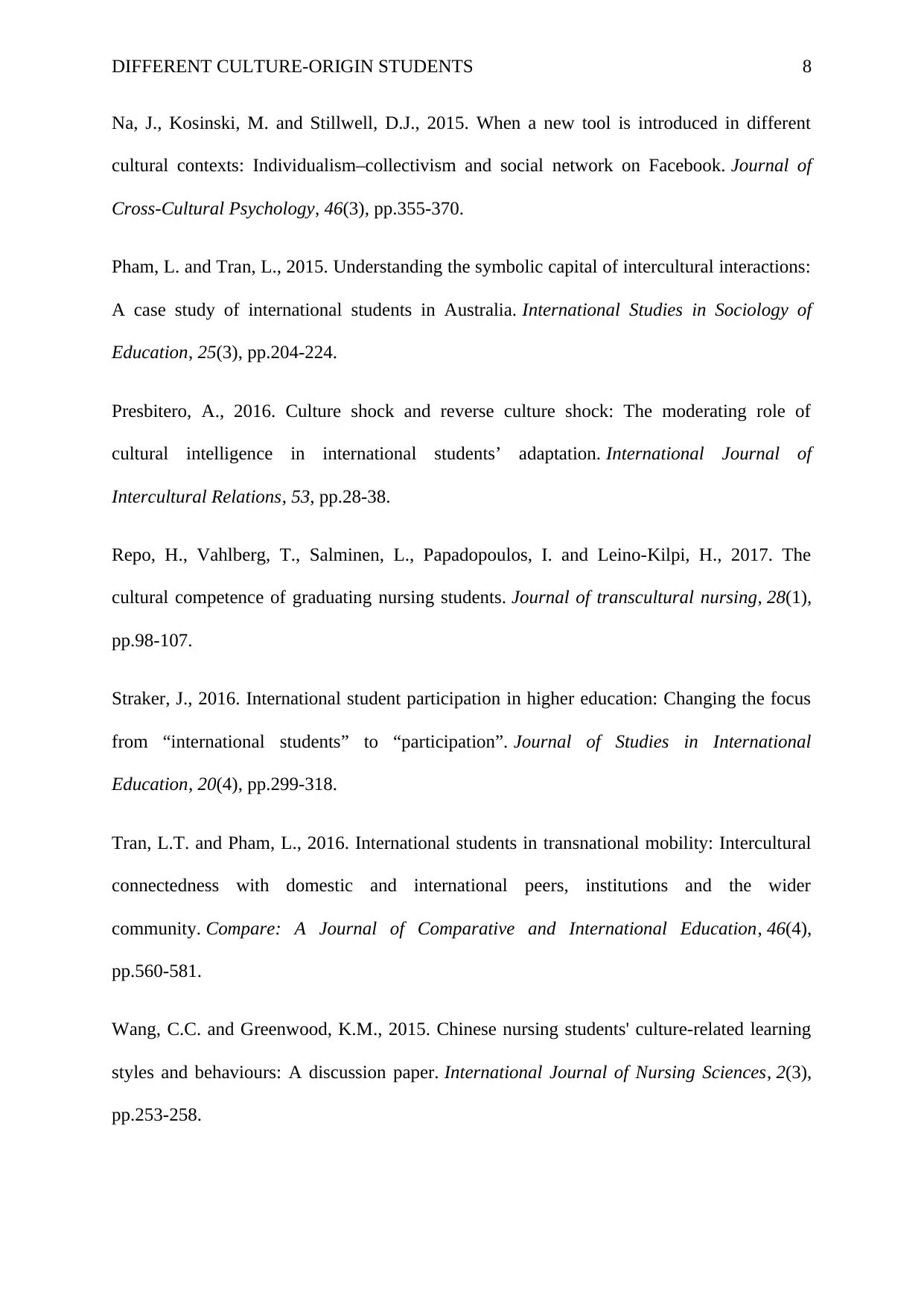
Na, J., Kosinski, M. and Stillwell, D.J., 2015. When a new tool is introduced in different
cultural contexts: Individualism–collectivism and social network on Facebook. Journal of
Cross-Cultural Psychology, 46(3), pp.355-370.
Pham, L. and Tran, L., 2015. Understanding the symbolic capital of intercultural interactions:
A case study of international students in Australia. International Studies in Sociology of
Education, 25(3), pp.204-224.
Presbitero, A., 2016. Culture shock and reverse culture shock: The moderating role of
cultural intelligence in international students’ adaptation. International Journal of
Intercultural Relations, 53, pp.28-38.
Repo, H., Vahlberg, T., Salminen, L., Papadopoulos, I. and Leino-Kilpi, H., 2017. The
cultural competence of graduating nursing students. Journal of transcultural nursing, 28(1),
pp.98-107.
Straker, J., 2016. International student participation in higher education: Changing the focus
from “international students” to “participation”. Journal of Studies in International
Education, 20(4), pp.299-318.
Tran, L.T. and Pham, L., 2016. International students in transnational mobility: Intercultural
connectedness with domestic and international peers, institutions and the wider
community. Compare: A Journal of Comparative and International Education, 46(4),
pp.560-581.
Wang, C.C. and Greenwood, K.M., 2015. Chinese nursing students' culture-related learning
styles and behaviours: A discussion paper. International Journal of Nursing Sciences, 2(3),
pp.253-258.
Na, J., Kosinski, M. and Stillwell, D.J., 2015. When a new tool is introduced in different
cultural contexts: Individualism–collectivism and social network on Facebook. Journal of
Cross-Cultural Psychology, 46(3), pp.355-370.
Pham, L. and Tran, L., 2015. Understanding the symbolic capital of intercultural interactions:
A case study of international students in Australia. International Studies in Sociology of
Education, 25(3), pp.204-224.
Presbitero, A., 2016. Culture shock and reverse culture shock: The moderating role of
cultural intelligence in international students’ adaptation. International Journal of
Intercultural Relations, 53, pp.28-38.
Repo, H., Vahlberg, T., Salminen, L., Papadopoulos, I. and Leino-Kilpi, H., 2017. The
cultural competence of graduating nursing students. Journal of transcultural nursing, 28(1),
pp.98-107.
Straker, J., 2016. International student participation in higher education: Changing the focus
from “international students” to “participation”. Journal of Studies in International
Education, 20(4), pp.299-318.
Tran, L.T. and Pham, L., 2016. International students in transnational mobility: Intercultural
connectedness with domestic and international peers, institutions and the wider
community. Compare: A Journal of Comparative and International Education, 46(4),
pp.560-581.
Wang, C.C. and Greenwood, K.M., 2015. Chinese nursing students' culture-related learning
styles and behaviours: A discussion paper. International Journal of Nursing Sciences, 2(3),
pp.253-258.
⊘ This is a preview!⊘
Do you want full access?
Subscribe today to unlock all pages.
Trusted by 1+ million students worldwide
DIFFERENT CULTURE-ORIGIN STUDENTS 9
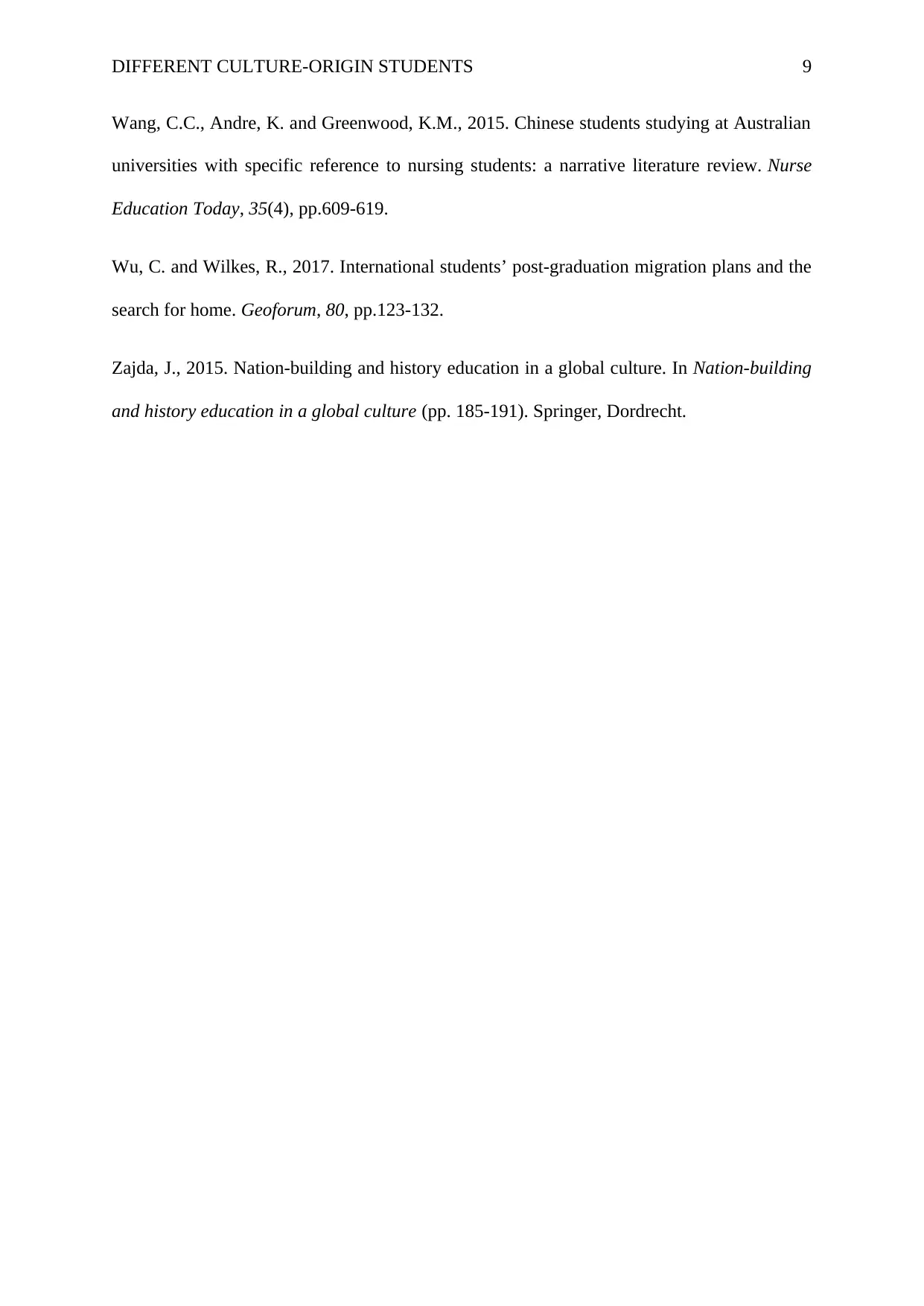
Wang, C.C., Andre, K. and Greenwood, K.M., 2015. Chinese students studying at Australian
universities with specific reference to nursing students: a narrative literature review. Nurse
Education Today, 35(4), pp.609-619.
Wu, C. and Wilkes, R., 2017. International students’ post-graduation migration plans and the
search for home. Geoforum, 80, pp.123-132.
Zajda, J., 2015. Nation-building and history education in a global culture. In Nation-building
and history education in a global culture (pp. 185-191). Springer, Dordrecht.
Wang, C.C., Andre, K. and Greenwood, K.M., 2015. Chinese students studying at Australian
universities with specific reference to nursing students: a narrative literature review. Nurse
Education Today, 35(4), pp.609-619.
Wu, C. and Wilkes, R., 2017. International students’ post-graduation migration plans and the
search for home. Geoforum, 80, pp.123-132.
Zajda, J., 2015. Nation-building and history education in a global culture. In Nation-building
and history education in a global culture (pp. 185-191). Springer, Dordrecht.

1 out of 10


Related Documents


Your All-in-One AI-Powered Toolkit for Academic Success.
+13062052269
info@desklib.com
Available 24*7 on WhatsApp / Email
![[object Object]](/_next/static/media/star-bottom.7253800d.svg)
Unlock your academic potential
Copyright © 2020–2026 A2Z Services. All Rights Reserved. Developed and managed by ZUCOL.