International Public Relations: Campaign Plan for Non-Profit Indonesia
VerifiedAdded on 2023/06/15
|9
|2000
|396
Report
AI Summary
This report presents a comprehensive campaign plan for a non-profit organization, Gawad Kalinga, operating in Indonesia, utilizing the circuit of culture model for analysis. It includes a situation analysis, definition of the situation, and analysis of the issue, followed by a strategic framework encompassing goals, objectives, stakeholder identification, key messages, risk assessment, and ethical considerations. The implementation phase outlines project management strategies, timeframes, and evaluation methods. The plan addresses the complexities of poverty alleviation in Indonesia, leveraging volunteerism and public-private partnerships. The document also includes a proposed budget and a justification for the chosen strategies, referencing relevant academic literature. This detailed plan aims to guide Gawad Kalinga in achieving its goal of ending poverty for five million families by 2024.
CAMPAIGN PLAN
FOR A NON-PROFIT ORGANIZATION
IN
INDONESIA
November 30, 2017
FOR A NON-PROFIT ORGANIZATION
IN
INDONESIA
November 30, 2017

Paraphrase This Document
Need a fresh take? Get an instant paraphrase of this document with our AI Paraphraser
I N T E R N A T I O N A L P U B L I C R E L A T I O N S P a g e | 2
EXECUTIVE SUMMARY
Utilizing the contextual investigation approach, this article is an inside and out the examination
and campaign of the Gawad Kalinga program. As a result of the multifaceted nature of the issue
and the need to give careful consideration to the impact of its social, political, and different
settings, the contextual investigation approach is utilized in this examination. Contextual
analyses are helpful in giving an all-encompassing comprehension of an issue, issue, or marvel
inside its social setting.
Contextual analyses are suitable when logical conditions are important to the issue under
scrutiny, particularly in contemplating marvels where the scientist has little control.
Consequently, the contextual investigation will utilize examination of media writings and sites.
EXECUTIVE SUMMARY
Utilizing the contextual investigation approach, this article is an inside and out the examination
and campaign of the Gawad Kalinga program. As a result of the multifaceted nature of the issue
and the need to give careful consideration to the impact of its social, political, and different
settings, the contextual investigation approach is utilized in this examination. Contextual
analyses are helpful in giving an all-encompassing comprehension of an issue, issue, or marvel
inside its social setting.
Contextual analyses are suitable when logical conditions are important to the issue under
scrutiny, particularly in contemplating marvels where the scientist has little control.
Consequently, the contextual investigation will utilize examination of media writings and sites.
I N T E R N A T I O N A L P U B L I C R E L A T I O N S P a g e | 3
Table of Contents
RESEARCH AND ANALYSIS..........................................................................................................................4
Background Information.........................................................................................................................4
Definition of the situation......................................................................................................................5
Analysis of the situation/issue...............................................................................................................5
STRATEGY....................................................................................................................................................6
Goals and Objectives..............................................................................................................................6
Stakeholders...........................................................................................................................................6
Key messages..........................................................................................................................................6
An outline of any risks to the client/organization..................................................................................6
Review of Ethical Dilemmas...................................................................................................................7
Proposed Budget.....................................................................................................................................7
IMPLEMENTATION......................................................................................................................................7
Project Management..............................................................................................................................7
Timeframes and Evaluation methods.....................................................................................................8
Justification.............................................................................................................................................8
Table of Contents
RESEARCH AND ANALYSIS..........................................................................................................................4
Background Information.........................................................................................................................4
Definition of the situation......................................................................................................................5
Analysis of the situation/issue...............................................................................................................5
STRATEGY....................................................................................................................................................6
Goals and Objectives..............................................................................................................................6
Stakeholders...........................................................................................................................................6
Key messages..........................................................................................................................................6
An outline of any risks to the client/organization..................................................................................6
Review of Ethical Dilemmas...................................................................................................................7
Proposed Budget.....................................................................................................................................7
IMPLEMENTATION......................................................................................................................................7
Project Management..............................................................................................................................7
Timeframes and Evaluation methods.....................................................................................................8
Justification.............................................................................................................................................8
⊘ This is a preview!⊘
Do you want full access?
Subscribe today to unlock all pages.

Trusted by 1+ million students worldwide
I N T E R N A T I O N A L P U B L I C R E L A T I O N S P a g e | 4
RESEARCH AND ANALYSIS
Background Information
Since public relations includes correspondence, it impacts and is affected by culture. The
crossing point of culture and PR, both at the full scale (societal) and small scale (authoritative,
relational) level, has been investigated by various researchers. Utilizing the circuit of culture
show as a theoretical and methodological system, this paper analyzes the development of
importance and the social setting of a public relations crusade in contemporary Indonesian
society and a globalized world.
The examination perceives the centrality of culture at the two its neighborhood and worldwide
measurements since people are interpretive creatures. It subscribes to the possibility that
public relations professionals are conceivably social go-betweens or as middle people amongst
makers and customers who effectively make implications by building up a recognizable proof
between items or issues and the public (David & Amanda, 2005).
By anchorage of this work on the circuit of culture display, it takes after the fundamental
supposition that partners of public relations battles are occupied with dynamic significance
making that is setting particular and is continually changing as it is consulted over the long run.
The model-driven calculated examination is gone for refining the social powers that advance or
compel key correspondence programs.
The learning picked up from the examination will add to the writing in worldwide public
relations and all the more particularly in the zone of social ways to deal with public relations. By
concentrating on a homegrown philanthropic association in a creating nation, this examination
is a humble endeavor to fill a moderately unexplored region in worldwide public relations
inquire about, which tends to benefit intense non-administrative associations (NGOs). Since this
private non-benefit is flexing to grow internationally, it gives an intriguing contradiction to the
standardizing West to East stream of correspondence and social impact (Lucia et al., 2017).
RESEARCH AND ANALYSIS
Background Information
Since public relations includes correspondence, it impacts and is affected by culture. The
crossing point of culture and PR, both at the full scale (societal) and small scale (authoritative,
relational) level, has been investigated by various researchers. Utilizing the circuit of culture
show as a theoretical and methodological system, this paper analyzes the development of
importance and the social setting of a public relations crusade in contemporary Indonesian
society and a globalized world.
The examination perceives the centrality of culture at the two its neighborhood and worldwide
measurements since people are interpretive creatures. It subscribes to the possibility that
public relations professionals are conceivably social go-betweens or as middle people amongst
makers and customers who effectively make implications by building up a recognizable proof
between items or issues and the public (David & Amanda, 2005).
By anchorage of this work on the circuit of culture display, it takes after the fundamental
supposition that partners of public relations battles are occupied with dynamic significance
making that is setting particular and is continually changing as it is consulted over the long run.
The model-driven calculated examination is gone for refining the social powers that advance or
compel key correspondence programs.
The learning picked up from the examination will add to the writing in worldwide public
relations and all the more particularly in the zone of social ways to deal with public relations. By
concentrating on a homegrown philanthropic association in a creating nation, this examination
is a humble endeavor to fill a moderately unexplored region in worldwide public relations
inquire about, which tends to benefit intense non-administrative associations (NGOs). Since this
private non-benefit is flexing to grow internationally, it gives an intriguing contradiction to the
standardizing West to East stream of correspondence and social impact (Lucia et al., 2017).
Paraphrase This Document
Need a fresh take? Get an instant paraphrase of this document with our AI Paraphraser
I N T E R N A T I O N A L P U B L I C R E L A T I O N S P a g e | 5
Definition of the situation
The focal start of the model is the supremacy of power in relations and the meeting of culture,
information, and power. The circuit has the accompanying moments where significance is
made: portrayal (representation), creation (production), utilization (consumption), personality
(identity), and direction (regulation). To give elective pathways to hypothesis working in public
relations that 'mirror its extensive variety of genuine applications and social settings and not
simply benefit Western, corporate settings,' Manfred & Stefanie (2017) said the displaying of
the circuit of culture in public relations.
Analysis of the situation/issue
Gawad Kalinga or GK (to give mind) is a group building, a philanthropic development that began
in 1995. GK expects to destroy neediness through volunteerism. From its initial beginnings as an
out-of-school youth mediation program managed by a Catholic gathering, GK advanced as a
common establishment that facilitates homes and groups in addition to incorporating
occupation programs with a mission to 'end neediness for five million families by 2024'.
Joining foundation, advancement of capacity, and public-private associations, its program is
executed in 2000 groups in Indonesia and additionally in other Asian and African nations. The
utilization of the circuit of culture presentation in breaking down Gawad Kalinga uncovers the
significance of understanding social esteems in correspondence crusades. While GK began as a
nearby group advancement venture by a religious gathering, it formed into a national and
worldwide program that demonstrates the interaction of culture, religion, and groups in
producing a significant social change in Indonesia. As a common group advancement unit, GK is
powered by an enormous armed force of volunteers who are cooperating to realize change and
to reestablish the nobility of the poorest of poor people.
Definition of the situation
The focal start of the model is the supremacy of power in relations and the meeting of culture,
information, and power. The circuit has the accompanying moments where significance is
made: portrayal (representation), creation (production), utilization (consumption), personality
(identity), and direction (regulation). To give elective pathways to hypothesis working in public
relations that 'mirror its extensive variety of genuine applications and social settings and not
simply benefit Western, corporate settings,' Manfred & Stefanie (2017) said the displaying of
the circuit of culture in public relations.
Analysis of the situation/issue
Gawad Kalinga or GK (to give mind) is a group building, a philanthropic development that began
in 1995. GK expects to destroy neediness through volunteerism. From its initial beginnings as an
out-of-school youth mediation program managed by a Catholic gathering, GK advanced as a
common establishment that facilitates homes and groups in addition to incorporating
occupation programs with a mission to 'end neediness for five million families by 2024'.
Joining foundation, advancement of capacity, and public-private associations, its program is
executed in 2000 groups in Indonesia and additionally in other Asian and African nations. The
utilization of the circuit of culture presentation in breaking down Gawad Kalinga uncovers the
significance of understanding social esteems in correspondence crusades. While GK began as a
nearby group advancement venture by a religious gathering, it formed into a national and
worldwide program that demonstrates the interaction of culture, religion, and groups in
producing a significant social change in Indonesia. As a common group advancement unit, GK is
powered by an enormous armed force of volunteers who are cooperating to realize change and
to reestablish the nobility of the poorest of poor people.
I N T E R N A T I O N A L P U B L I C R E L A T I O N S P a g e | 6
STRATEGY
Goals and Objectives
The main goal of Gawad Kalinga is:
To end poverty for 5 million families by 2024
Stakeholders
The GK Board comprises of a blend of outer trustees and key individuals inside the GK
association to have the capacity to bring the broadest scope of mastery in key ranges of GK's
operation. They were not quite recently looking for people of uprightness and impact. All the
more essentially, they needed GK companions that they had constructed a relationship with,
and had broad experience and energy about their foundation to have the capacity to make
sound approaches that help and encourage crafted by their overseers.
Key messages
The utilization of a military talk, for example, 'armed force' or 'war against neediness' with
destitution as the deceptive foe summons assurance, solidarity, phlebotomy or forfeit and valor
among its huge numbers of partners that incorporate government, organizations, givers,
recipients, and volunteers. GK rose up out of the miserable dinginess of one of the greatest
ghettos in Metro Manila. Here a Catholic bunch in Indonesia sorted out an adolescent camp
that additionally contacted groups of posse individuals to deal with group recovery ventures.
The exertion prompted the primary Gawad Kalinga people group.
An outline of any risks to the client/organization
Fast urbanization in the Philippines created various issues, for example, blockage,
contamination, wrongdoing, destitution, natural corruption, and absence of adequate lodging.
The nonstop inundation of vagrants from country to urban territories brought about expanding
quantities of casual pioneers or squatters ('iskwater' is the disparaging slang utilized locally). In
2004, Indonesia had 1, 408, 492 casual pilgrim family units of which 51.6% live in urban areas. It
was the need to give a satisfactory safe house as a way to break the cycle of destitution that
brought forth GK.
STRATEGY
Goals and Objectives
The main goal of Gawad Kalinga is:
To end poverty for 5 million families by 2024
Stakeholders
The GK Board comprises of a blend of outer trustees and key individuals inside the GK
association to have the capacity to bring the broadest scope of mastery in key ranges of GK's
operation. They were not quite recently looking for people of uprightness and impact. All the
more essentially, they needed GK companions that they had constructed a relationship with,
and had broad experience and energy about their foundation to have the capacity to make
sound approaches that help and encourage crafted by their overseers.
Key messages
The utilization of a military talk, for example, 'armed force' or 'war against neediness' with
destitution as the deceptive foe summons assurance, solidarity, phlebotomy or forfeit and valor
among its huge numbers of partners that incorporate government, organizations, givers,
recipients, and volunteers. GK rose up out of the miserable dinginess of one of the greatest
ghettos in Metro Manila. Here a Catholic bunch in Indonesia sorted out an adolescent camp
that additionally contacted groups of posse individuals to deal with group recovery ventures.
The exertion prompted the primary Gawad Kalinga people group.
An outline of any risks to the client/organization
Fast urbanization in the Philippines created various issues, for example, blockage,
contamination, wrongdoing, destitution, natural corruption, and absence of adequate lodging.
The nonstop inundation of vagrants from country to urban territories brought about expanding
quantities of casual pioneers or squatters ('iskwater' is the disparaging slang utilized locally). In
2004, Indonesia had 1, 408, 492 casual pilgrim family units of which 51.6% live in urban areas. It
was the need to give a satisfactory safe house as a way to break the cycle of destitution that
brought forth GK.
⊘ This is a preview!⊘
Do you want full access?
Subscribe today to unlock all pages.
Trusted by 1+ million students worldwide
I N T E R N A T I O N A L P U B L I C R E L A T I O N S P a g e | 7
Review of Ethical Dilemmas
Ethical difficulties emerge at all levels in a wide range of associations—revenue driven, not-for-
profit, and government—and include a mind-boggling relationship between singular character
and social impacts (Michael et al., 2016). Some of these difficulties can bring about criminal
infringement or common obligation: extortion, distortion, and misappropriation of advantages
fall into this classification. More typical ethical issues include hazy areas—exercises that are on
the edges of extortion, or that include irreconcilable circumstances, misallocation of assets, or
lacking responsibility and straightforwardness (Mart & Gergely, 2017).
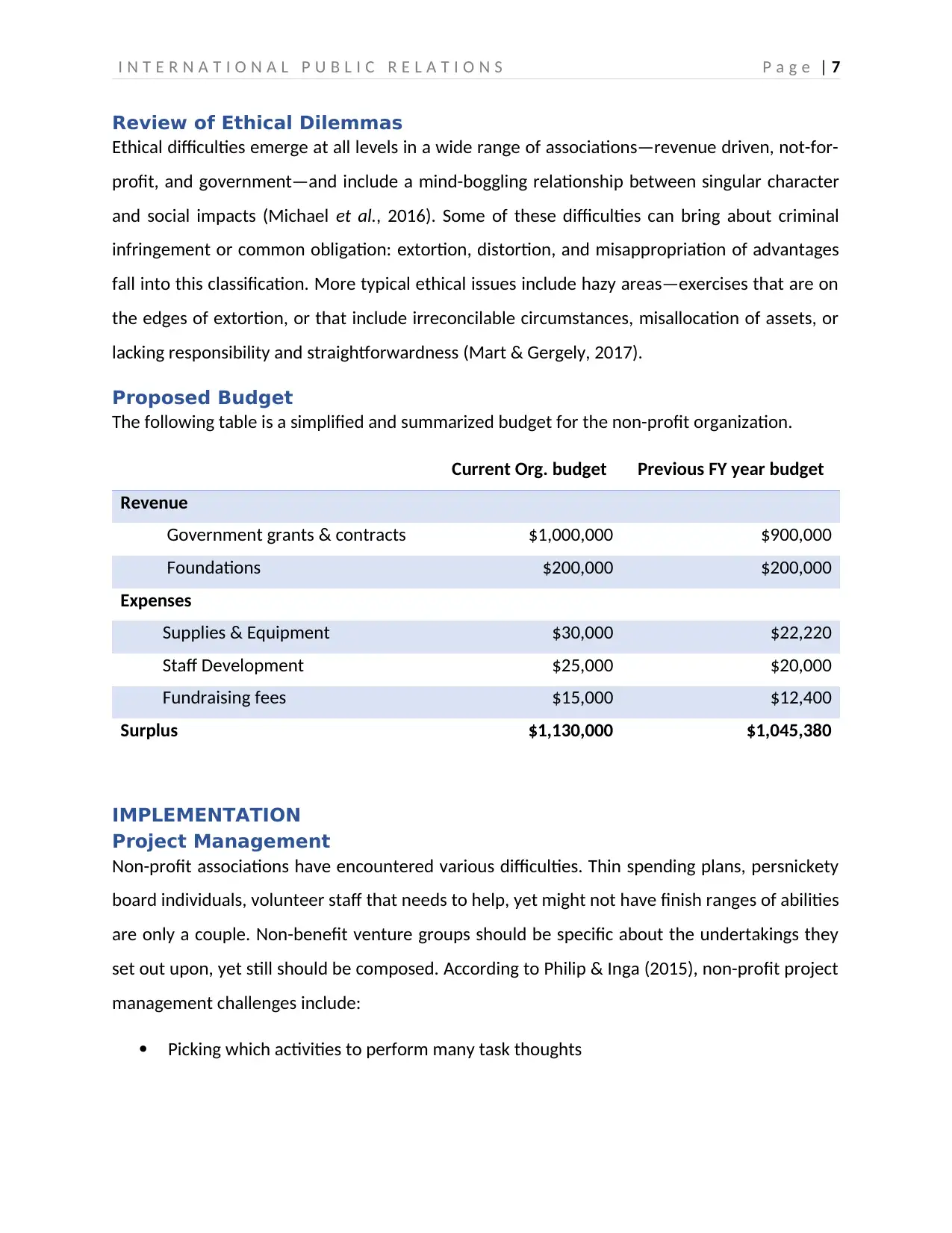
Proposed Budget
The following table is a simplified and summarized budget for the non-profit organization.
Current Org. budget Previous FY year budget
Revenue
Government grants & contracts $1,000,000 $900,000
Foundations $200,000 $200,000
Expenses
Supplies & Equipment $30,000 $22,220
Staff Development $25,000 $20,000
Fundraising fees $15,000 $12,400
Surplus $1,130,000 $1,045,380
IMPLEMENTATION
Project Management
Non-profit associations have encountered various difficulties. Thin spending plans, persnickety
board individuals, volunteer staff that needs to help, yet might not have finish ranges of abilities
are only a couple. Non-benefit venture groups should be specific about the undertakings they
set out upon, yet still should be composed. According to Philip & Inga (2015), non-profit project
management challenges include:
Picking which activities to perform many task thoughts
Review of Ethical Dilemmas
Ethical difficulties emerge at all levels in a wide range of associations—revenue driven, not-for-
profit, and government—and include a mind-boggling relationship between singular character
and social impacts (Michael et al., 2016). Some of these difficulties can bring about criminal
infringement or common obligation: extortion, distortion, and misappropriation of advantages
fall into this classification. More typical ethical issues include hazy areas—exercises that are on
the edges of extortion, or that include irreconcilable circumstances, misallocation of assets, or
lacking responsibility and straightforwardness (Mart & Gergely, 2017).
Proposed Budget
The following table is a simplified and summarized budget for the non-profit organization.
Current Org. budget Previous FY year budget
Revenue
Government grants & contracts $1,000,000 $900,000
Foundations $200,000 $200,000
Expenses
Supplies & Equipment $30,000 $22,220
Staff Development $25,000 $20,000
Fundraising fees $15,000 $12,400
Surplus $1,130,000 $1,045,380
IMPLEMENTATION
Project Management
Non-profit associations have encountered various difficulties. Thin spending plans, persnickety
board individuals, volunteer staff that needs to help, yet might not have finish ranges of abilities
are only a couple. Non-benefit venture groups should be specific about the undertakings they
set out upon, yet still should be composed. According to Philip & Inga (2015), non-profit project
management challenges include:
Picking which activities to perform many task thoughts
Paraphrase This Document
Need a fresh take? Get an instant paraphrase of this document with our AI Paraphraser
I N T E R N A T I O N A L P U B L I C R E L A T I O N S P a g e | 8
Giving volunteers enough direction on the most proficient method to play out an
undertaking
Permitting any venture assets outside the association to get to undertakings and errands
Offering administrators and board individuals see into dynamic undertakings in the
portfolio
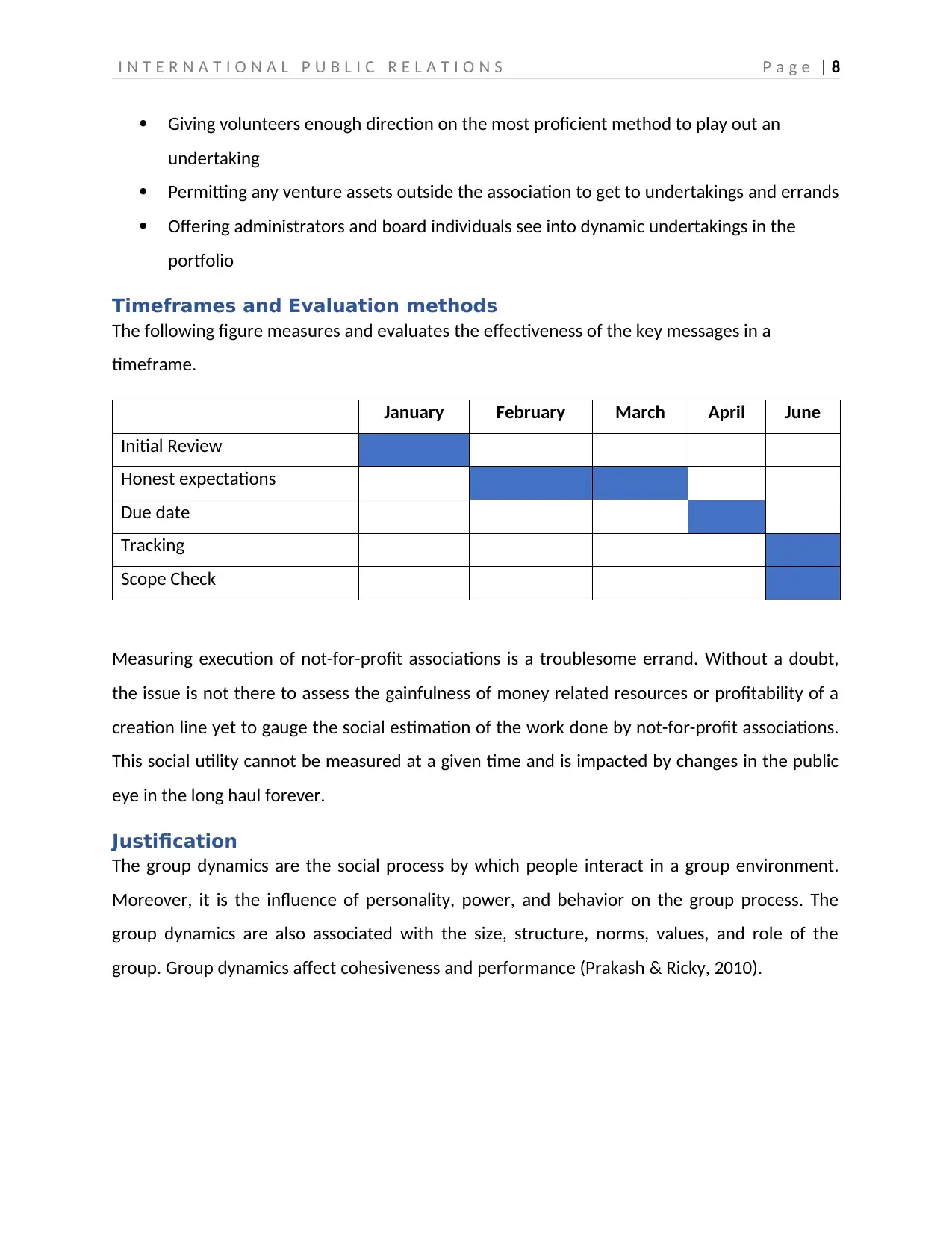
Timeframes and Evaluation methods
The following figure measures and evaluates the effectiveness of the key messages in a
timeframe.
January February March April June
Initial Review
Honest expectations
Due date
Tracking
Scope Check
Measuring execution of not-for-profit associations is a troublesome errand. Without a doubt,
the issue is not there to assess the gainfulness of money related resources or profitability of a
creation line yet to gauge the social estimation of the work done by not-for-profit associations.
This social utility cannot be measured at a given time and is impacted by changes in the public
eye in the long haul forever.
Justification
The group dynamics are the social process by which people interact in a group environment.
Moreover, it is the influence of personality, power, and behavior on the group process. The
group dynamics are also associated with the size, structure, norms, values, and role of the
group. Group dynamics affect cohesiveness and performance (Prakash & Ricky, 2010).
Giving volunteers enough direction on the most proficient method to play out an
undertaking
Permitting any venture assets outside the association to get to undertakings and errands
Offering administrators and board individuals see into dynamic undertakings in the
portfolio
Timeframes and Evaluation methods
The following figure measures and evaluates the effectiveness of the key messages in a
timeframe.
January February March April June
Initial Review
Honest expectations
Due date
Tracking
Scope Check
Measuring execution of not-for-profit associations is a troublesome errand. Without a doubt,
the issue is not there to assess the gainfulness of money related resources or profitability of a
creation line yet to gauge the social estimation of the work done by not-for-profit associations.
This social utility cannot be measured at a given time and is impacted by changes in the public
eye in the long haul forever.
Justification
The group dynamics are the social process by which people interact in a group environment.
Moreover, it is the influence of personality, power, and behavior on the group process. The
group dynamics are also associated with the size, structure, norms, values, and role of the
group. Group dynamics affect cohesiveness and performance (Prakash & Ricky, 2010).
I N T E R N A T I O N A L P U B L I C R E L A T I O N S P a g e | 9
References
Åke F. & Christian G. (2017). Communication-in-use: customer-integrated marketing communication.
European Journal of Marketing, 445-463.
David P. & Amanda B. (2005). Integrated Marketing Communications (Second ed.). England: Pearson
Education Limited.
Lucia P., Salvador Del B. & Philip J. Kitchen. (2017). Measuring integrated marketing communication by
taking a broad organizational approach: The firm-wide IMC scale. European Journal of
Marketing, 692-718.
Manfred B. & Stefanie S. (2017). Integrated marketing communication – from an instrumental to a
customer-centric perspective. European Journal of Marketing, 464-489.
Mart O. & Gergely N. (2017). Just doing it: theorizing integrated marketing communications (IMC)
practices. European Journal of Marketing, 490-510.
Michael J. Valos, Fatemeh H. Habibi, Riza C., Carl B. Driesener & Vanya L. Maplestone. (2016). Exploring
the integration of social media within integrated marketing communication frameworks:
Perspectives of services marketers. Marketing Intelligence & Planning, 19-40.
Philip J. Kitchen & Inga B. (2015). Integrated marketing communication: making it work at a strategic
level. Journal of Business Strategy, 34-39.
Prakash K. Vel & Ricky S. (2010). Megamarketing an event using integrated marketing communications:
the success story of TMH. Business Strategy Series, 371-382.
Robert L. Harrison, Timothy M. Reilly. (2011). Mixed methods designs in marketing research. Qualitative
Market Research: An International Journal, 7-26.
References
Åke F. & Christian G. (2017). Communication-in-use: customer-integrated marketing communication.
European Journal of Marketing, 445-463.
David P. & Amanda B. (2005). Integrated Marketing Communications (Second ed.). England: Pearson
Education Limited.
Lucia P., Salvador Del B. & Philip J. Kitchen. (2017). Measuring integrated marketing communication by
taking a broad organizational approach: The firm-wide IMC scale. European Journal of
Marketing, 692-718.
Manfred B. & Stefanie S. (2017). Integrated marketing communication – from an instrumental to a
customer-centric perspective. European Journal of Marketing, 464-489.
Mart O. & Gergely N. (2017). Just doing it: theorizing integrated marketing communications (IMC)
practices. European Journal of Marketing, 490-510.
Michael J. Valos, Fatemeh H. Habibi, Riza C., Carl B. Driesener & Vanya L. Maplestone. (2016). Exploring
the integration of social media within integrated marketing communication frameworks:
Perspectives of services marketers. Marketing Intelligence & Planning, 19-40.
Philip J. Kitchen & Inga B. (2015). Integrated marketing communication: making it work at a strategic
level. Journal of Business Strategy, 34-39.
Prakash K. Vel & Ricky S. (2010). Megamarketing an event using integrated marketing communications:
the success story of TMH. Business Strategy Series, 371-382.
Robert L. Harrison, Timothy M. Reilly. (2011). Mixed methods designs in marketing research. Qualitative
Market Research: An International Journal, 7-26.
⊘ This is a preview!⊘
Do you want full access?
Subscribe today to unlock all pages.
Trusted by 1+ million students worldwide

1 out of 9


Related Documents


Your All-in-One AI-Powered Toolkit for Academic Success.
+13062052269
info@desklib.com
Available 24*7 on WhatsApp / Email
![[object Object]](/_next/static/media/star-bottom.7253800d.svg)
Unlock your academic potential
Copyright © 2020–2026 A2Z Services. All Rights Reserved. Developed and managed by ZUCOL.