Legal and Regulatory Considerations for Shea Butter Trade in France
VerifiedAdded on 2023/01/23
|12
|2084
|31
Report
AI Summary
This report provides a comprehensive analysis of the international trade of shea butter in France, focusing on the legal and regulatory requirements for market entry. The study examines product compliance, including adherence to European cosmetics legislation, REACH regulations, and contaminant levels. It explores the French government's policies regarding international expansion, particularly the legal framework for joint ventures, and assesses the opportunities for Karitenature to establish a joint venture in France. The report highlights the benefits of operating as a joint venture in the French market, considering the growing demand for organic shea butter and the government's support for companies complying with regulations. The report concludes with a reflection on the learning experience, emphasizing the importance of considering legal, financial, and regulatory factors for international expansion and the value of strategic planning in navigating international markets. The author learned about the critical role of legal compliance and the benefits of joint ventures in the French market, drawing on the insights gained from the Young Enterprise project.

Global and international context

Paraphrase This Document
Need a fresh take? Get an instant paraphrase of this document with our AI Paraphraser
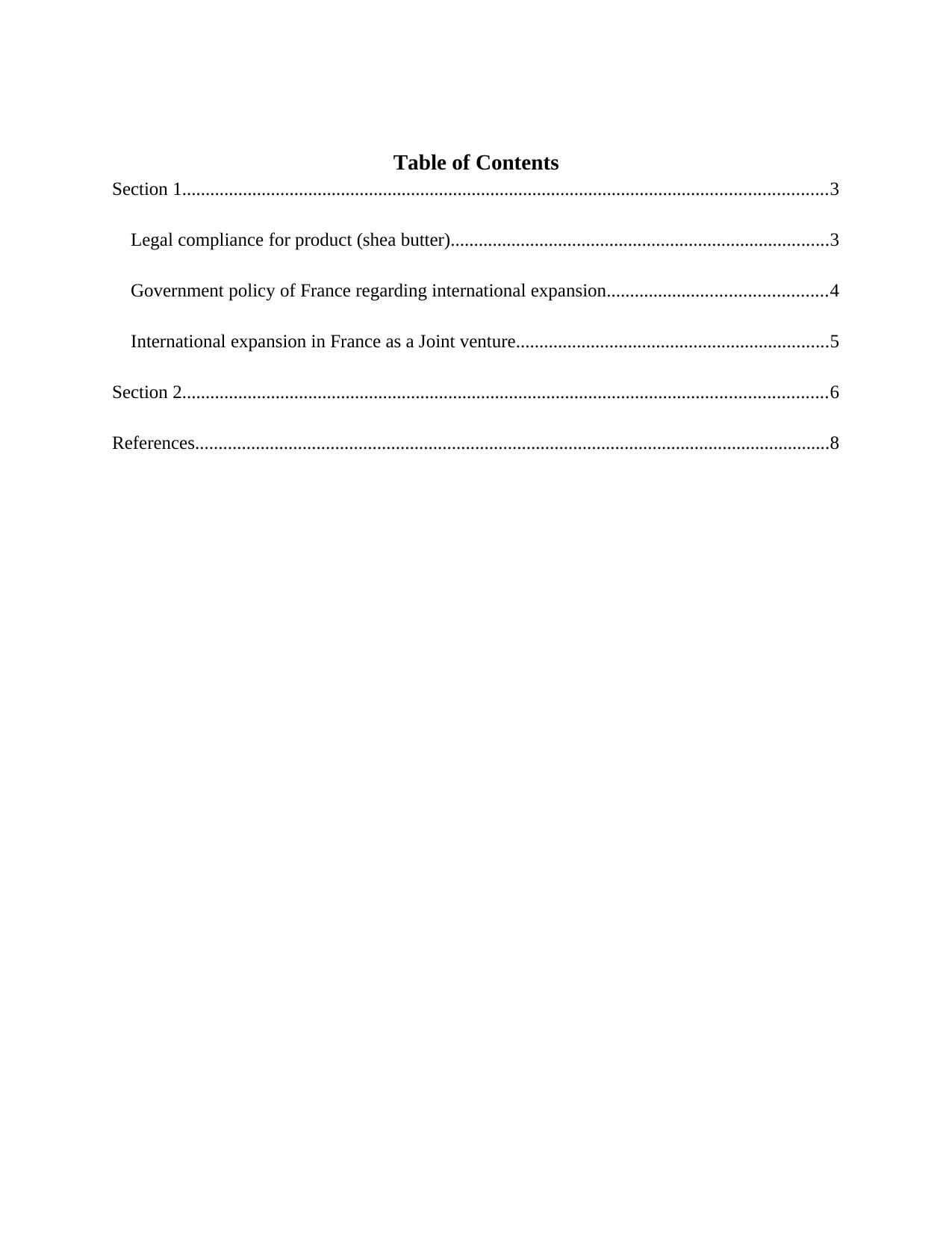
Table of Contents
Section 1..........................................................................................................................................3
Legal compliance for product (shea butter).................................................................................3
Government policy of France regarding international expansion...............................................4
International expansion in France as a Joint venture...................................................................5
Section 2..........................................................................................................................................6
References........................................................................................................................................8
Section 1..........................................................................................................................................3
Legal compliance for product (shea butter).................................................................................3
Government policy of France regarding international expansion...............................................4
International expansion in France as a Joint venture...................................................................5
Section 2..........................................................................................................................................6
References........................................................................................................................................8
SECTION 1
The present study is based on the critical evaluation for trading shea butter internationally in
France, by considering their county laws and regulations. The study will focus on product
compliance, government policy and requirements for expanding as a joint venture for
karitenature business.
Legal compliance for the product (shea butter)
International expansion in France, the company is required to comply with the county law and
regulations for business. For trading in organic shea butter, the company has to comply with the
following requirements:
The company can only do exporting of their shea butter to the European cosmetics market when
they consider compliance with the legal requirements posed for the natural ingredients for
cosmetics, these are inclusive ofviable European cosmetics legislation which comprise specified
criteria for the substantiation of claims meant for finished products, well-organized corporate as
well as company documentation for supplying buyers, Registration, Evaluation and
Authorisation of Chemicals (REACH), from which exemption of unmodified shea butter is there,
and Classification, Labelling and Packaging of chemicals (CLP)(Klaschka, 2016).
Other requirements are:
The maximum level in fats and oils for erucic acid: A maximum level in fats and oils for
erucic acid has been fixed by the European legislation; it states that the level must not
surpass 5% of the fatty acids in the composition of fats. Erucic acid should not be
contained in the unadulterated shea butter.
The present study is based on the critical evaluation for trading shea butter internationally in
France, by considering their county laws and regulations. The study will focus on product
compliance, government policy and requirements for expanding as a joint venture for
karitenature business.
Legal compliance for the product (shea butter)
International expansion in France, the company is required to comply with the county law and
regulations for business. For trading in organic shea butter, the company has to comply with the
following requirements:
The company can only do exporting of their shea butter to the European cosmetics market when
they consider compliance with the legal requirements posed for the natural ingredients for
cosmetics, these are inclusive ofviable European cosmetics legislation which comprise specified
criteria for the substantiation of claims meant for finished products, well-organized corporate as
well as company documentation for supplying buyers, Registration, Evaluation and
Authorisation of Chemicals (REACH), from which exemption of unmodified shea butter is there,
and Classification, Labelling and Packaging of chemicals (CLP)(Klaschka, 2016).
Other requirements are:
The maximum level in fats and oils for erucic acid: A maximum level in fats and oils for
erucic acid has been fixed by the European legislation; it states that the level must not
surpass 5% of the fatty acids in the composition of fats. Erucic acid should not be
contained in the unadulterated shea butter.
⊘ This is a preview!⊘
Do you want full access?
Subscribe today to unlock all pages.

Trusted by 1+ million students worldwide
Contaminants in food: Maximum levels of contaminants in food have been set out by the
European Union, inclusive of ingredients like vegetable fats. In relation with the
maximum levels for polycyclic aromatic hydrocarbons (PAHs) present in food items, the
update has been made in regulatory aspects that provide implications for shea butter
generated from smoked kernels used in edible items (Trehan et al., 2019).
Additives, flavourings and enzymes present in food: The EU has established a list of
legal requirements and flavourings for their use in food items that are meant for human
consumption which are inclusive of vegetable fats, especially reliable to food
manufacturers. Considering applicable legislation can help the business in better
understanding of requirement (Kočevar Glavač and Lunder, 2018).
If the product satisfies with the above-stated requirements, then the karitenature business will be
able to trade in France.
The government policy of France regarding international expansion
It can be stated there is no presence of specified legal concept related to the joint venture as per
the French law. There is no applicability of specific legal structures to JVs. Therefore, the
entitled rules are totally based on the legal framework selected by the parties to establish and
operate the joint venture (Priestley, 2018). In terms of contractual JVs, the applicability of
general contract laws will be there. In relation to the corporate joint venture, the applicable rules,
generally, originate from the Commercial Code and French Civil Code and are based on the
corporate type selected for the joint venture. Due to the higher extent of flexibility present in the
provisions of government applied to SASs, corporate JVs are generally built-in as SASs. As a
general rule, therefore, there are no corporate law limitations in France on a foreign enterprise
European Union, inclusive of ingredients like vegetable fats. In relation with the
maximum levels for polycyclic aromatic hydrocarbons (PAHs) present in food items, the
update has been made in regulatory aspects that provide implications for shea butter
generated from smoked kernels used in edible items (Trehan et al., 2019).
Additives, flavourings and enzymes present in food: The EU has established a list of
legal requirements and flavourings for their use in food items that are meant for human
consumption which are inclusive of vegetable fats, especially reliable to food
manufacturers. Considering applicable legislation can help the business in better
understanding of requirement (Kočevar Glavač and Lunder, 2018).
If the product satisfies with the above-stated requirements, then the karitenature business will be
able to trade in France.
The government policy of France regarding international expansion
It can be stated there is no presence of specified legal concept related to the joint venture as per
the French law. There is no applicability of specific legal structures to JVs. Therefore, the
entitled rules are totally based on the legal framework selected by the parties to establish and
operate the joint venture (Priestley, 2018). In terms of contractual JVs, the applicability of
general contract laws will be there. In relation to the corporate joint venture, the applicable rules,
generally, originate from the Commercial Code and French Civil Code and are based on the
corporate type selected for the joint venture. Due to the higher extent of flexibility present in the
provisions of government applied to SASs, corporate JVs are generally built-in as SASs. As a
general rule, therefore, there are no corporate law limitations in France on a foreign enterprise
Paraphrase This Document
Need a fresh take? Get an instant paraphrase of this document with our AI Paraphraser
holding a state, in the joint venture, though; there are some French restrictions on the capability
of foreign entities to make an investment in some French sectors(Doyle, 2018).
International expansion in France as a Joint venture
Not like the common business firms, like joint stock Company, the formation of joint ventures In
France does not lead to separate and different legal personality from the compromising parties. It
is because; joint ventures are emerged only for a specified objective and to undertake limited
aspects(Buckley and Ghauri, 2015). It can be said that a company can be opened in France as a
joint venture for one time projects. If karitenature business creates a joint venture in France, it
should be registered and authorized by the Company Registry and the French Trade. If there is
an independent operation of joint venture of its parent company, then it subjected to under
control of the French Competition Authority. In a situation where the profits of JV surpass
150,000,000 euros, then it will fall under the category of the Competition Authority.
Thus, it can be reflected that it is easy to expand internationally in France as a joint venture, as
the French government supports those company who are eligible and comply with given rules,
and their products fall into their specified criteria (Yeniyurt and Carnovale, 2017). Since there is
a growing demand for shea butter in France, and also this country also accounts for the largest
market for shea butter trading, similarly for young business it possesses a lot of opportunities and
best platform as there are fewer restrictions posed by the government to conduct international
expansion for shea butter as a joint venture.
On the basis of the above analysis, it can be concluded that France offers more opportunities for
trading this product as a joint venture. Also this country is interested in organic shea butter which
is supported by certification and government too. It can be articulated that, it is easy to enter and
of foreign entities to make an investment in some French sectors(Doyle, 2018).
International expansion in France as a Joint venture
Not like the common business firms, like joint stock Company, the formation of joint ventures In
France does not lead to separate and different legal personality from the compromising parties. It
is because; joint ventures are emerged only for a specified objective and to undertake limited
aspects(Buckley and Ghauri, 2015). It can be said that a company can be opened in France as a
joint venture for one time projects. If karitenature business creates a joint venture in France, it
should be registered and authorized by the Company Registry and the French Trade. If there is
an independent operation of joint venture of its parent company, then it subjected to under
control of the French Competition Authority. In a situation where the profits of JV surpass
150,000,000 euros, then it will fall under the category of the Competition Authority.
Thus, it can be reflected that it is easy to expand internationally in France as a joint venture, as
the French government supports those company who are eligible and comply with given rules,
and their products fall into their specified criteria (Yeniyurt and Carnovale, 2017). Since there is
a growing demand for shea butter in France, and also this country also accounts for the largest
market for shea butter trading, similarly for young business it possesses a lot of opportunities and
best platform as there are fewer restrictions posed by the government to conduct international
expansion for shea butter as a joint venture.
On the basis of the above analysis, it can be concluded that France offers more opportunities for
trading this product as a joint venture. Also this country is interested in organic shea butter which
is supported by certification and government too. It can be articulated that, it is easy to enter and
expand in France, or trading shea butter, as this product has immense demand in the French
market and there are limited rules and restriction in the country to operate as a joint venture
(Oviatt and McDougall‐Covin, 2015).
market and there are limited rules and restriction in the country to operate as a joint venture
(Oviatt and McDougall‐Covin, 2015).
⊘ This is a preview!⊘
Do you want full access?
Subscribe today to unlock all pages.
Trusted by 1+ million students worldwide
SECTION 2
Young enterprise has played a significant role in my professional and career development.
Before considering this, I thought that only financial aspects matter to the business most when
expanding internationally, but now I realized that all legal, financial and regulatory factors are
important. I got to learn that both macros as well as micro factors are significant for the
development and expansion of a business internationally.
This study had provided learning that International expansion is the most critical time for a
business willing to roll out in other markets. On the other hand, international expansion
possesses a lot of risks, especially legal as well as financial risks, further companies are required
to determine and address upstream while developing the overall strategy of expansion (Yoder,
Visich and Rustambekov, 2016).
Further, I learnt that for international expansion, it is also required to consider that the product
meets the specifications of quality, packaging, labelling and organic norms. Food business
operators are required to implement and maintain a permanent procedure on the basis legal
principles which is applicable to the food exporter in the country where business is planning to
expand(Pucciarelli and Kaplan, 2016).
In consideration with the useful learning and insights I derived from this analysis, I
acknowledged that the initially prior to expanding in a country, it is essential to consider and
analyze their county laws and regulations related to the company and product. In addition, it is
also vital to first research about all the requirements for the legal compliance for the product to
be traded in that specified country (Autio, 2017). The findings helped me in analyzing the sheer
Young enterprise has played a significant role in my professional and career development.
Before considering this, I thought that only financial aspects matter to the business most when
expanding internationally, but now I realized that all legal, financial and regulatory factors are
important. I got to learn that both macros as well as micro factors are significant for the
development and expansion of a business internationally.
This study had provided learning that International expansion is the most critical time for a
business willing to roll out in other markets. On the other hand, international expansion
possesses a lot of risks, especially legal as well as financial risks, further companies are required
to determine and address upstream while developing the overall strategy of expansion (Yoder,
Visich and Rustambekov, 2016).
Further, I learnt that for international expansion, it is also required to consider that the product
meets the specifications of quality, packaging, labelling and organic norms. Food business
operators are required to implement and maintain a permanent procedure on the basis legal
principles which is applicable to the food exporter in the country where business is planning to
expand(Pucciarelli and Kaplan, 2016).
In consideration with the useful learning and insights I derived from this analysis, I
acknowledged that the initially prior to expanding in a country, it is essential to consider and
analyze their county laws and regulations related to the company and product. In addition, it is
also vital to first research about all the requirements for the legal compliance for the product to
be traded in that specified country (Autio, 2017). The findings helped me in analyzing the sheer
Paraphrase This Document
Need a fresh take? Get an instant paraphrase of this document with our AI Paraphraser
market of France, and how this product can be traded in France, what are its legal requirements
and product compliance. I learned that for a single time project joint ventures are very
beneficial, however, as an entrepreneur, I would have considered a partnership instead of JVs
and pursued a long-term strategy for trading goods and services.
There are lots of risks to expand internationally, the most important ones from my perspective
are legal and financial ones, and by analyzing the workings of Young Enterprise, I learned that it
is vital to design an effective global expansion strategy that satisfies and meet every single
criterion. I can reflect that, Young Enterprise opts for the best product that is shea butter to
trade in France, as there is a higher demand for this, and this country comes under one of the
significant international markets of shea butter. And for manufacturing and trading product like
shea butter, requires various codes for compliance, requirements for packaging, producing
andlabelling, so proper market research plus, adhering with governance provisions and policy is
necessary (Reuber and et.al, 2018).
With the consideration towards the decision of Young Enterprise to trade shea butter in France,
in my opinion, they are the best example for any budding entrepreneur, as the business
considered various traits of innovative aspects, risk-taking, flexibility and versatility. Assessing
their expansion strategy, I can say that, I derived valuable information and knowledge in regards
to the steps and procedures to be followed to break into other markets globally. I can state that
Young Enterprise provided me with the opportunity to explore various requirements that are
needed to start or expand a business internationally; this is the best platform for me to enhance
my knowledge and experience as an entrepreneur, to take cautious and successful steps in future.
The role that is played by Young Enterprise has been very valuable in my professional life, as it
and product compliance. I learned that for a single time project joint ventures are very
beneficial, however, as an entrepreneur, I would have considered a partnership instead of JVs
and pursued a long-term strategy for trading goods and services.
There are lots of risks to expand internationally, the most important ones from my perspective
are legal and financial ones, and by analyzing the workings of Young Enterprise, I learned that it
is vital to design an effective global expansion strategy that satisfies and meet every single
criterion. I can reflect that, Young Enterprise opts for the best product that is shea butter to
trade in France, as there is a higher demand for this, and this country comes under one of the
significant international markets of shea butter. And for manufacturing and trading product like
shea butter, requires various codes for compliance, requirements for packaging, producing
andlabelling, so proper market research plus, adhering with governance provisions and policy is
necessary (Reuber and et.al, 2018).
With the consideration towards the decision of Young Enterprise to trade shea butter in France,
in my opinion, they are the best example for any budding entrepreneur, as the business
considered various traits of innovative aspects, risk-taking, flexibility and versatility. Assessing
their expansion strategy, I can say that, I derived valuable information and knowledge in regards
to the steps and procedures to be followed to break into other markets globally. I can state that
Young Enterprise provided me with the opportunity to explore various requirements that are
needed to start or expand a business internationally; this is the best platform for me to enhance
my knowledge and experience as an entrepreneur, to take cautious and successful steps in future.
The role that is played by Young Enterprise has been very valuable in my professional life, as it

helped me in gaining more insights to the global markets, an international context that will help
me in my future to become a successful entrepreneur.
me in my future to become a successful entrepreneur.
⊘ This is a preview!⊘
Do you want full access?
Subscribe today to unlock all pages.
Trusted by 1+ million students worldwide
REFERENCES
Autio, E., 2017. Strategic entrepreneurial internationalization: A normative framework. Strategic
Entrepreneurship Journal, 11(3), pp.211-227.
Buckley, P.J. and Ghauri, P. eds., 2015. International business strategy: theory and practice.
Routledge, UK.
Doyle, M.W., 2018. New thinking in international relations theory. Routledge, UK.
Klaschka, U., 2016. Natural personal care products—analysis of ingredient lists and legal
situation. Environmental Sciences Europe, 28(1), p.8.
Kočevar Glavač, N. and Lunder, M., 2018. Preservative efficacy of selected antimicrobials of
natural origin in a cosmetic emulsion. International journal of cosmetic science, 40(3), pp.276-
284.
Oviatt, B.M. and McDougall‐Covin, P., 2015. International entrepreneurship. Wiley
Encyclopedia of Management, pp.1-3.
Priestley, H.I., 2018. France overseas: a study of modern imperialism. Routledge, UK.
Pucciarelli, F. and Kaplan, A., 2016. Competition and strategy in higher education: Managing
complexity and uncertainty. Business Horizons, 59(3), pp.311-320.
Reuber, A.R., Knight, G.A., Liesch, P.W. and Zhou, L., 2018. International entrepreneurship:
The pursuit of entrepreneurial opportunities across national borders.
Autio, E., 2017. Strategic entrepreneurial internationalization: A normative framework. Strategic
Entrepreneurship Journal, 11(3), pp.211-227.
Buckley, P.J. and Ghauri, P. eds., 2015. International business strategy: theory and practice.
Routledge, UK.
Doyle, M.W., 2018. New thinking in international relations theory. Routledge, UK.
Klaschka, U., 2016. Natural personal care products—analysis of ingredient lists and legal
situation. Environmental Sciences Europe, 28(1), p.8.
Kočevar Glavač, N. and Lunder, M., 2018. Preservative efficacy of selected antimicrobials of
natural origin in a cosmetic emulsion. International journal of cosmetic science, 40(3), pp.276-
284.
Oviatt, B.M. and McDougall‐Covin, P., 2015. International entrepreneurship. Wiley
Encyclopedia of Management, pp.1-3.
Priestley, H.I., 2018. France overseas: a study of modern imperialism. Routledge, UK.
Pucciarelli, F. and Kaplan, A., 2016. Competition and strategy in higher education: Managing
complexity and uncertainty. Business Horizons, 59(3), pp.311-320.
Reuber, A.R., Knight, G.A., Liesch, P.W. and Zhou, L., 2018. International entrepreneurship:
The pursuit of entrepreneurial opportunities across national borders.
Paraphrase This Document
Need a fresh take? Get an instant paraphrase of this document with our AI Paraphraser
Trehan, S., Soskind, R., Moraes, J., Puri, V. and Michniak-Kohn, B., 2019. Natural Products and
Stem Cells and Their Commercial Aspects in Cosmetics. Cosmetic Formulation: Principles and
Practice,1(1), p.221.
Yeniyurt, S. and Carnovale, S., 2017. Global supply network embeddedness and power: An
analysis of international joint venture formations. International Business Review, 26(2), pp.203-
213.
Yoder, S., Visich, J.K. and Rustambekov, E., 2016. Lessons learned from international
expansion failures and successes. Business Horizons, 59(2), pp.233-243.
Stem Cells and Their Commercial Aspects in Cosmetics. Cosmetic Formulation: Principles and
Practice,1(1), p.221.
Yeniyurt, S. and Carnovale, S., 2017. Global supply network embeddedness and power: An
analysis of international joint venture formations. International Business Review, 26(2), pp.203-
213.
Yoder, S., Visich, J.K. and Rustambekov, E., 2016. Lessons learned from international
expansion failures and successes. Business Horizons, 59(2), pp.233-243.

⊘ This is a preview!⊘
Do you want full access?
Subscribe today to unlock all pages.
Trusted by 1+ million students worldwide

1 out of 12


Your All-in-One AI-Powered Toolkit for Academic Success.
+13062052269
info@desklib.com
Available 24*7 on WhatsApp / Email
![[object Object]](/_next/static/media/star-bottom.7253800d.svg)
Unlock your academic potential
Copyright © 2020–2026 A2Z Services. All Rights Reserved. Developed and managed by ZUCOL.