International Business Strategy: Labor, Competition, and Integration
VerifiedAdded on 2023/06/03
|12
|2871
|289
Homework Assignment
AI Summary
This assignment analyzes international business strategy through various lenses. It begins by exploring adverse selection and agency relationships in the context of a company restructuring and labor negotiations, including the "lemons" problem. The assignment then examines recruitment strategies to mitigate adverse selection. Further, it delves into agency relationships between headquarters and foreign subsidiaries, applying positive agency theory and discussing the role of bonus payments and volatility. The analysis extends to foreign acquisitions, game theory in the tobacco industry, and the application of Porter's Five Forces to the tobacco and airline industries. Finally, the assignment applies Transaction Cost Economics to a vertical integration decision and discusses key insights from organizational learning literature, covering concepts like causal ambiguity. This assignment provides a holistic overview of key strategic concepts in international business.
Running head: FOUNDATION OF INTERNATIONAL STRATEGY 1
Foundation of International Strategy
Name
Institution
Foundation of International Strategy
Name
Institution

Paraphrase This Document
Need a fresh take? Get an instant paraphrase of this document with our AI Paraphraser
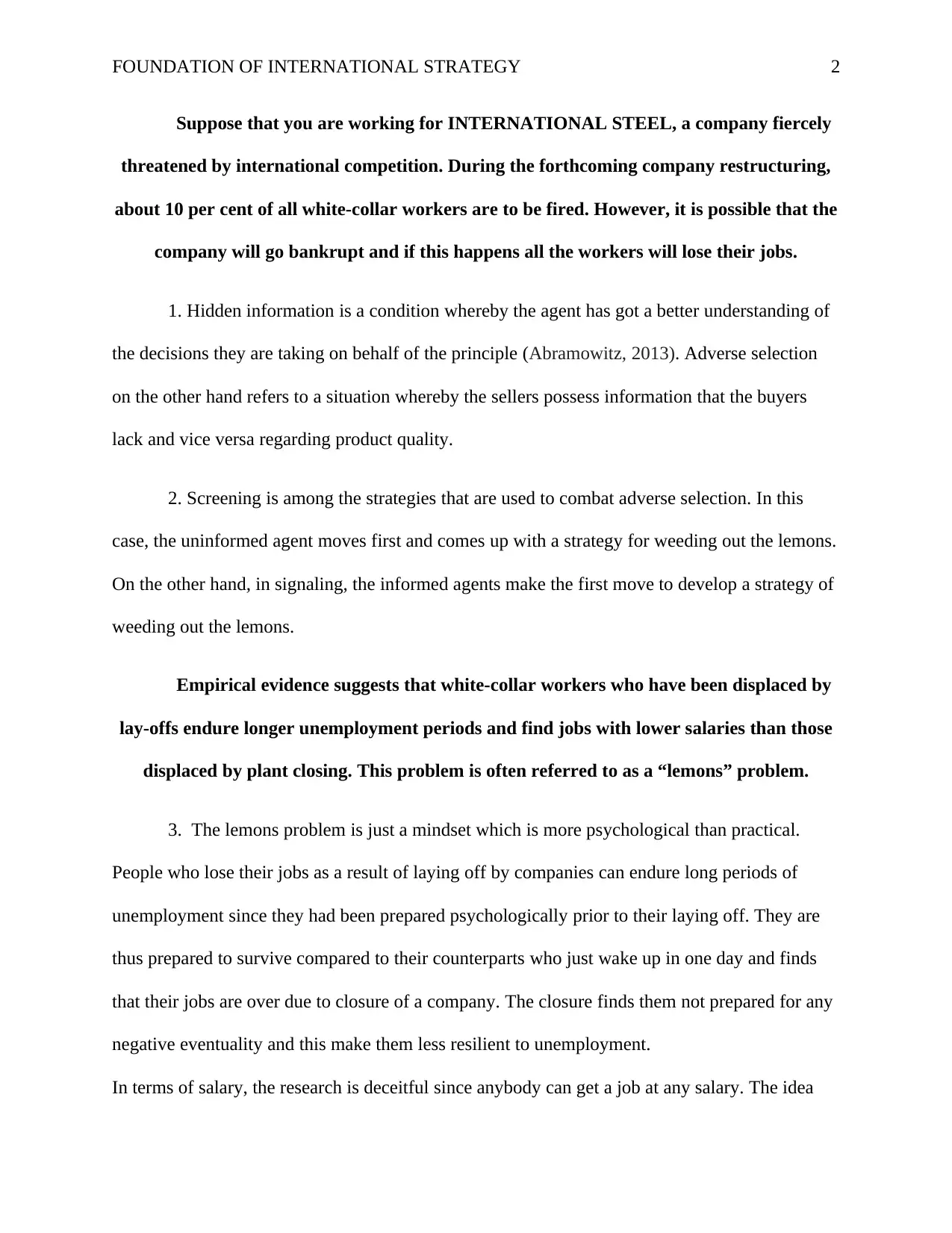
FOUNDATION OF INTERNATIONAL STRATEGY 2
Suppose that you are working for INTERNATIONAL STEEL, a company fiercely
threatened by international competition. During the forthcoming company restructuring,
about 10 per cent of all white-collar workers are to be fired. However, it is possible that the
company will go bankrupt and if this happens all the workers will lose their jobs.
1. Hidden information is a condition whereby the agent has got a better understanding of
the decisions they are taking on behalf of the principle (Abramowitz, 2013). Adverse selection
on the other hand refers to a situation whereby the sellers possess information that the buyers
lack and vice versa regarding product quality.
2. Screening is among the strategies that are used to combat adverse selection. In this
case, the uninformed agent moves first and comes up with a strategy for weeding out the lemons.
On the other hand, in signaling, the informed agents make the first move to develop a strategy of
weeding out the lemons.
Empirical evidence suggests that white-collar workers who have been displaced by
lay-offs endure longer unemployment periods and find jobs with lower salaries than those
displaced by plant closing. This problem is often referred to as a “lemons” problem.
3. The lemons problem is just a mindset which is more psychological than practical.
People who lose their jobs as a result of laying off by companies can endure long periods of
unemployment since they had been prepared psychologically prior to their laying off. They are
thus prepared to survive compared to their counterparts who just wake up in one day and finds
that their jobs are over due to closure of a company. The closure finds them not prepared for any
negative eventuality and this make them less resilient to unemployment.
In terms of salary, the research is deceitful since anybody can get a job at any salary. The idea
Suppose that you are working for INTERNATIONAL STEEL, a company fiercely
threatened by international competition. During the forthcoming company restructuring,
about 10 per cent of all white-collar workers are to be fired. However, it is possible that the
company will go bankrupt and if this happens all the workers will lose their jobs.
1. Hidden information is a condition whereby the agent has got a better understanding of
the decisions they are taking on behalf of the principle (Abramowitz, 2013). Adverse selection
on the other hand refers to a situation whereby the sellers possess information that the buyers
lack and vice versa regarding product quality.
2. Screening is among the strategies that are used to combat adverse selection. In this
case, the uninformed agent moves first and comes up with a strategy for weeding out the lemons.
On the other hand, in signaling, the informed agents make the first move to develop a strategy of
weeding out the lemons.
Empirical evidence suggests that white-collar workers who have been displaced by
lay-offs endure longer unemployment periods and find jobs with lower salaries than those
displaced by plant closing. This problem is often referred to as a “lemons” problem.
3. The lemons problem is just a mindset which is more psychological than practical.
People who lose their jobs as a result of laying off by companies can endure long periods of
unemployment since they had been prepared psychologically prior to their laying off. They are
thus prepared to survive compared to their counterparts who just wake up in one day and finds
that their jobs are over due to closure of a company. The closure finds them not prepared for any
negative eventuality and this make them less resilient to unemployment.
In terms of salary, the research is deceitful since anybody can get a job at any salary. The idea
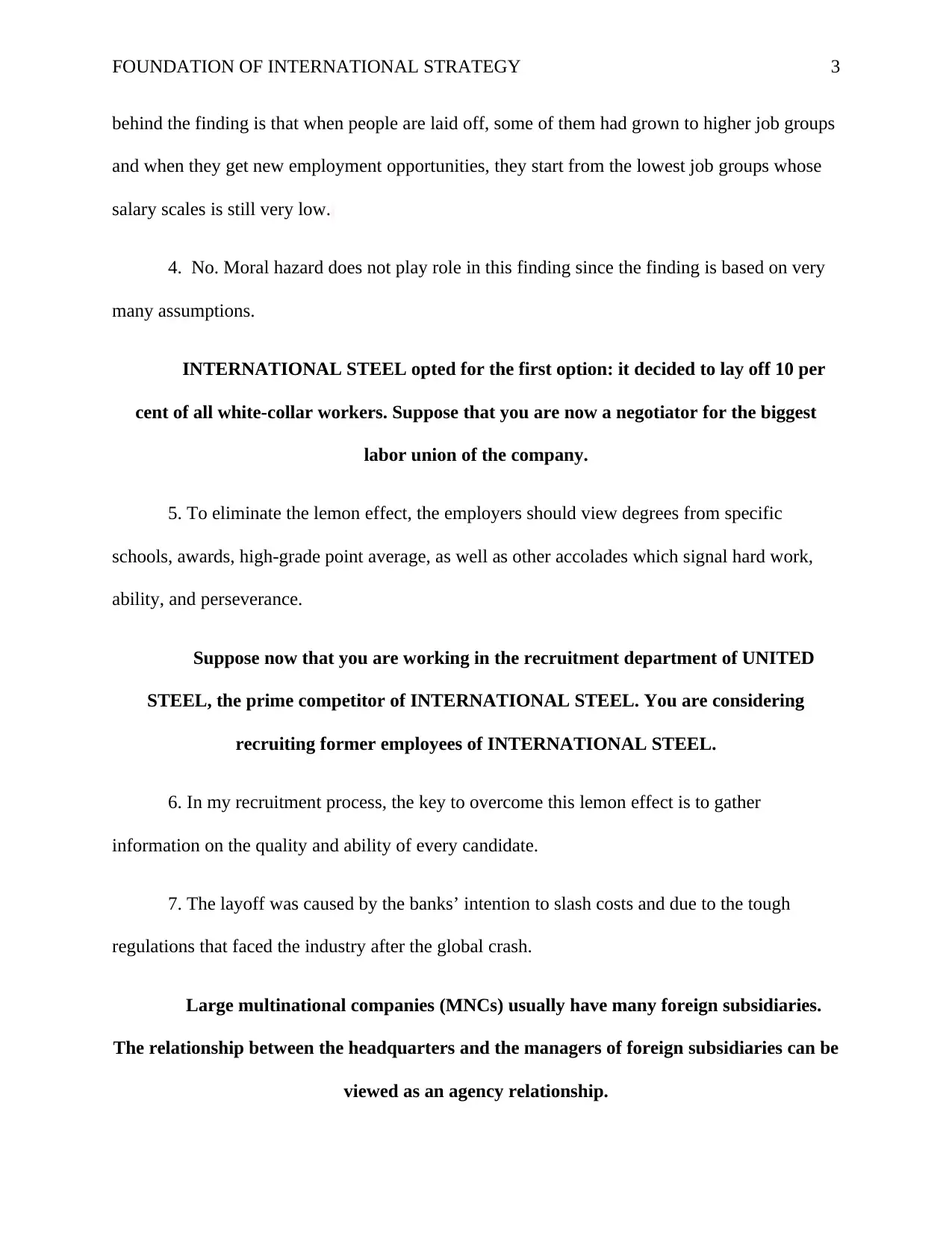
FOUNDATION OF INTERNATIONAL STRATEGY 3
behind the finding is that when people are laid off, some of them had grown to higher job groups
and when they get new employment opportunities, they start from the lowest job groups whose
salary scales is still very low.
4. No. Moral hazard does not play role in this finding since the finding is based on very
many assumptions.
INTERNATIONAL STEEL opted for the first option: it decided to lay off 10 per
cent of all white-collar workers. Suppose that you are now a negotiator for the biggest
labor union of the company.
5. To eliminate the lemon effect, the employers should view degrees from specific
schools, awards, high-grade point average, as well as other accolades which signal hard work,
ability, and perseverance.
Suppose now that you are working in the recruitment department of UNITED
STEEL, the prime competitor of INTERNATIONAL STEEL. You are considering
recruiting former employees of INTERNATIONAL STEEL.
6. In my recruitment process, the key to overcome this lemon effect is to gather
information on the quality and ability of every candidate.
7. The layoff was caused by the banks’ intention to slash costs and due to the tough
regulations that faced the industry after the global crash.
Large multinational companies (MNCs) usually have many foreign subsidiaries.
The relationship between the headquarters and the managers of foreign subsidiaries can be
viewed as an agency relationship.
behind the finding is that when people are laid off, some of them had grown to higher job groups
and when they get new employment opportunities, they start from the lowest job groups whose
salary scales is still very low.
4. No. Moral hazard does not play role in this finding since the finding is based on very
many assumptions.
INTERNATIONAL STEEL opted for the first option: it decided to lay off 10 per
cent of all white-collar workers. Suppose that you are now a negotiator for the biggest
labor union of the company.
5. To eliminate the lemon effect, the employers should view degrees from specific
schools, awards, high-grade point average, as well as other accolades which signal hard work,
ability, and perseverance.
Suppose now that you are working in the recruitment department of UNITED
STEEL, the prime competitor of INTERNATIONAL STEEL. You are considering
recruiting former employees of INTERNATIONAL STEEL.
6. In my recruitment process, the key to overcome this lemon effect is to gather
information on the quality and ability of every candidate.
7. The layoff was caused by the banks’ intention to slash costs and due to the tough
regulations that faced the industry after the global crash.
Large multinational companies (MNCs) usually have many foreign subsidiaries.
The relationship between the headquarters and the managers of foreign subsidiaries can be
viewed as an agency relationship.
⊘ This is a preview!⊘
Do you want full access?
Subscribe today to unlock all pages.

Trusted by 1+ million students worldwide
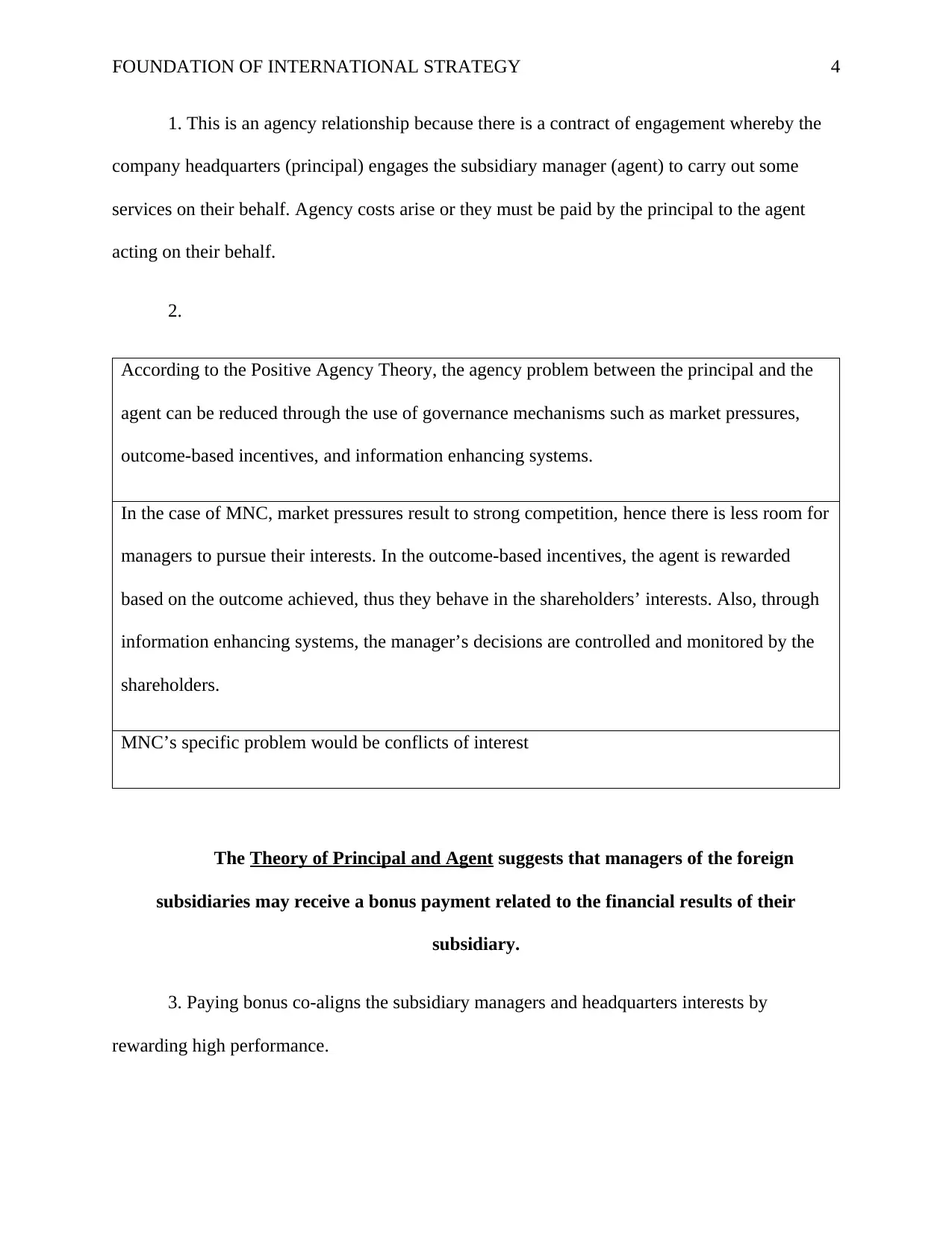
FOUNDATION OF INTERNATIONAL STRATEGY 4
1. This is an agency relationship because there is a contract of engagement whereby the
company headquarters (principal) engages the subsidiary manager (agent) to carry out some
services on their behalf. Agency costs arise or they must be paid by the principal to the agent
acting on their behalf.
2.
According to the Positive Agency Theory, the agency problem between the principal and the
agent can be reduced through the use of governance mechanisms such as market pressures,
outcome-based incentives, and information enhancing systems.
In the case of MNC, market pressures result to strong competition, hence there is less room for
managers to pursue their interests. In the outcome-based incentives, the agent is rewarded
based on the outcome achieved, thus they behave in the shareholders’ interests. Also, through
information enhancing systems, the manager’s decisions are controlled and monitored by the
shareholders.
MNC’s specific problem would be conflicts of interest
The Theory of Principal and Agent suggests that managers of the foreign
subsidiaries may receive a bonus payment related to the financial results of their
subsidiary.
3. Paying bonus co-aligns the subsidiary managers and headquarters interests by
rewarding high performance.
1. This is an agency relationship because there is a contract of engagement whereby the
company headquarters (principal) engages the subsidiary manager (agent) to carry out some
services on their behalf. Agency costs arise or they must be paid by the principal to the agent
acting on their behalf.
2.
According to the Positive Agency Theory, the agency problem between the principal and the
agent can be reduced through the use of governance mechanisms such as market pressures,
outcome-based incentives, and information enhancing systems.
In the case of MNC, market pressures result to strong competition, hence there is less room for
managers to pursue their interests. In the outcome-based incentives, the agent is rewarded
based on the outcome achieved, thus they behave in the shareholders’ interests. Also, through
information enhancing systems, the manager’s decisions are controlled and monitored by the
shareholders.
MNC’s specific problem would be conflicts of interest
The Theory of Principal and Agent suggests that managers of the foreign
subsidiaries may receive a bonus payment related to the financial results of their
subsidiary.
3. Paying bonus co-aligns the subsidiary managers and headquarters interests by
rewarding high performance.
Paraphrase This Document
Need a fresh take? Get an instant paraphrase of this document with our AI Paraphraser
FOUNDATION OF INTERNATIONAL STRATEGY 5
4. A higher volatility means that the value of the security is likely to be spread over a
wide range of values (Dobbie & Skiba, 2013). Thus, the security’s price may change drastically
over time, and this reduces the bonus paid. One way of dealing with volatility is by avoiding it
altogether.
Firms may go abroad via a variety of modes. They may expand via internal growth.
They thus set up subsidiaries in the foreign countries. This type of entry is referred to
Greenfield entries (e.g. Toyota entered the French car market by setting up a brand new
plant in Valenciennes). They may also buy a minority interest in local firms (e.g. Renault
entered the Japanese market by buying 45% of the Japanese firm Nissan) or even fully
acquire focal firms (GM entered the German market by acquiring the German carmaker
Opel).
5. High levels of information of asymmetries are involved because the acquisitions are
not at the interest of the shareholders (Manshaei, Zhu, Alpcan, Bacşar & Hubaux, 2013). They
might be in the interest of the managers. Adverse selection is common in foreign acquisition
whereby the principal cannot check the manager’s skills. Moral hazard may occur whereby the
managers make an acquisition for their own interest which is against the agreed contract.
6. The two-step entry strategy solves the information asymmetry problem by developing
agency relationships.
7. The public firms listed in the stock exchange are target more for acquisitions because
the stock markets play an important role in monitoring and revealing information.
4. A higher volatility means that the value of the security is likely to be spread over a
wide range of values (Dobbie & Skiba, 2013). Thus, the security’s price may change drastically
over time, and this reduces the bonus paid. One way of dealing with volatility is by avoiding it
altogether.
Firms may go abroad via a variety of modes. They may expand via internal growth.
They thus set up subsidiaries in the foreign countries. This type of entry is referred to
Greenfield entries (e.g. Toyota entered the French car market by setting up a brand new
plant in Valenciennes). They may also buy a minority interest in local firms (e.g. Renault
entered the Japanese market by buying 45% of the Japanese firm Nissan) or even fully
acquire focal firms (GM entered the German market by acquiring the German carmaker
Opel).
5. High levels of information of asymmetries are involved because the acquisitions are
not at the interest of the shareholders (Manshaei, Zhu, Alpcan, Bacşar & Hubaux, 2013). They
might be in the interest of the managers. Adverse selection is common in foreign acquisition
whereby the principal cannot check the manager’s skills. Moral hazard may occur whereby the
managers make an acquisition for their own interest which is against the agreed contract.
6. The two-step entry strategy solves the information asymmetry problem by developing
agency relationships.
7. The public firms listed in the stock exchange are target more for acquisitions because
the stock markets play an important role in monitoring and revealing information.
FOUNDATION OF INTERNATIONAL STRATEGY 6
The goal of this exercise is to apply game theory to analyze the competitive
interactions in the tobacco industry in the US.
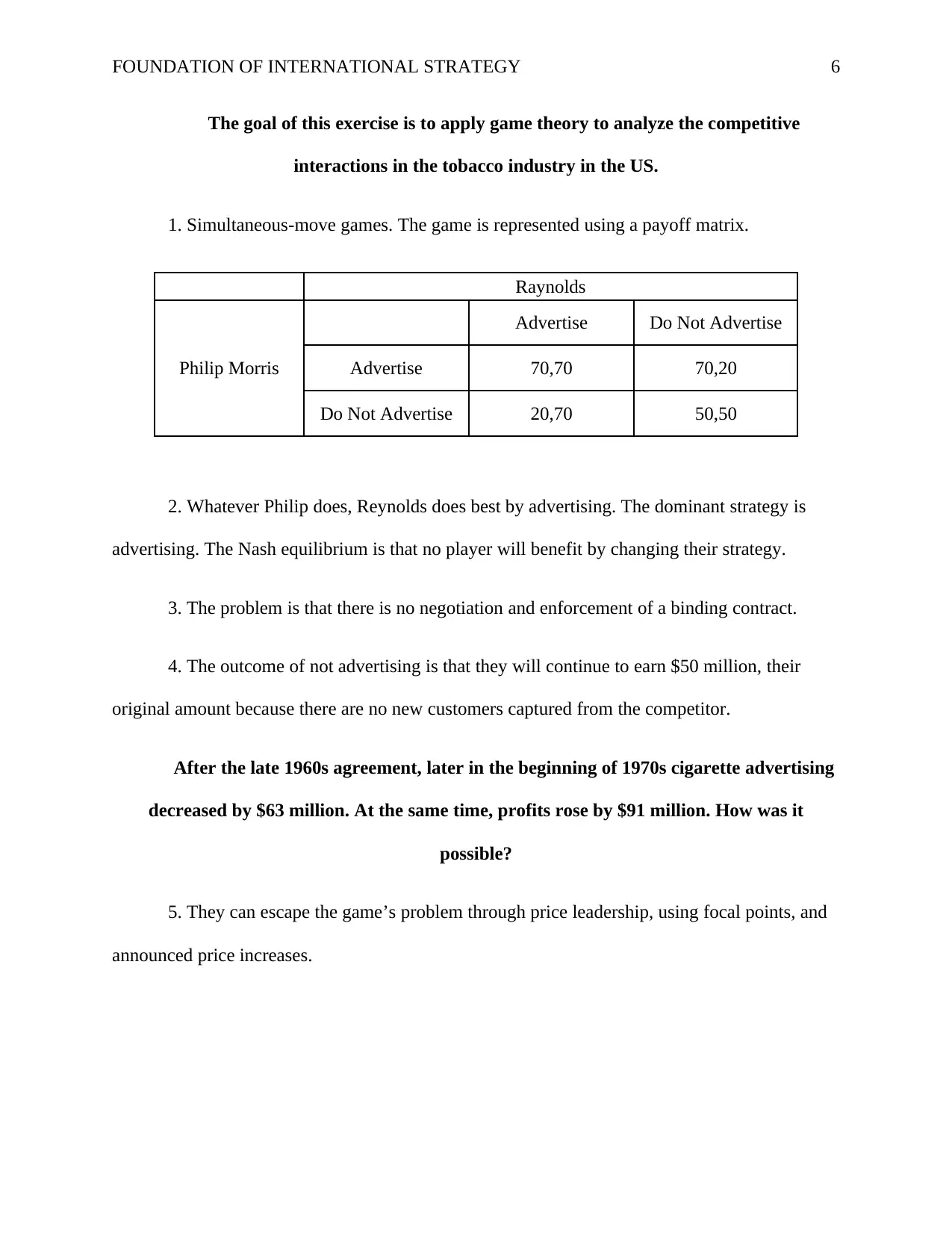
1. Simultaneous-move games. The game is represented using a payoff matrix.
Raynolds
Philip Morris
Advertise Do Not Advertise
Advertise 70,70 70,20
Do Not Advertise 20,70 50,50
2. Whatever Philip does, Reynolds does best by advertising. The dominant strategy is
advertising. The Nash equilibrium is that no player will benefit by changing their strategy.
3. The problem is that there is no negotiation and enforcement of a binding contract.
4. The outcome of not advertising is that they will continue to earn $50 million, their
original amount because there are no new customers captured from the competitor.
After the late 1960s agreement, later in the beginning of 1970s cigarette advertising
decreased by $63 million. At the same time, profits rose by $91 million. How was it
possible?
5. They can escape the game’s problem through price leadership, using focal points, and
announced price increases.
The goal of this exercise is to apply game theory to analyze the competitive
interactions in the tobacco industry in the US.
1. Simultaneous-move games. The game is represented using a payoff matrix.
Raynolds
Philip Morris
Advertise Do Not Advertise
Advertise 70,70 70,20
Do Not Advertise 20,70 50,50
2. Whatever Philip does, Reynolds does best by advertising. The dominant strategy is
advertising. The Nash equilibrium is that no player will benefit by changing their strategy.
3. The problem is that there is no negotiation and enforcement of a binding contract.
4. The outcome of not advertising is that they will continue to earn $50 million, their
original amount because there are no new customers captured from the competitor.
After the late 1960s agreement, later in the beginning of 1970s cigarette advertising
decreased by $63 million. At the same time, profits rose by $91 million. How was it
possible?
5. They can escape the game’s problem through price leadership, using focal points, and
announced price increases.
⊘ This is a preview!⊘
Do you want full access?
Subscribe today to unlock all pages.
Trusted by 1+ million students worldwide
FOUNDATION OF INTERNATIONAL STRATEGY 7
The goal of this exercise is to discuss main frameworks of Business strategy.
The profitability of different industries
1. The threat of new entrants- it defines how easy or hard it is for a rival to join the
marketplace of a particular industry.
Competitive rivalry- this refers to the nature of competition in the marketplace.
Bargaining power of suppliers- this defines to the degree of control which the supplier
has over prices.
Bargaining power of customers- the force examines the customer’s power and their
influence on quality and pricing.
The threat of substitutes- the force examines how easy it is for consumers to switch
between products.
2. For the tobacco industry, the producers have got a large market share resulting to
barriers in entry since the incumbents face difficulty in catching up with the incumbents, and the
sector is regulated by the government thus resulting to the high profits (Gillingham & Palmer,
2014). The threat of substitutes, on the other hand, has forced the airline profitability to be the
lowest.
2A. Tobacco industry
According to Five Force model, the intensity of competition is dependent on the
bargaining power of the buyers and the suppliers, threat of new entrants, threat of substitutes, and
intensity of rivalry. In the tobacco industry, there is low supplier and buyer bargaining power.
The goal of this exercise is to discuss main frameworks of Business strategy.
The profitability of different industries
1. The threat of new entrants- it defines how easy or hard it is for a rival to join the
marketplace of a particular industry.
Competitive rivalry- this refers to the nature of competition in the marketplace.
Bargaining power of suppliers- this defines to the degree of control which the supplier
has over prices.
Bargaining power of customers- the force examines the customer’s power and their
influence on quality and pricing.
The threat of substitutes- the force examines how easy it is for consumers to switch
between products.
2. For the tobacco industry, the producers have got a large market share resulting to
barriers in entry since the incumbents face difficulty in catching up with the incumbents, and the
sector is regulated by the government thus resulting to the high profits (Gillingham & Palmer,
2014). The threat of substitutes, on the other hand, has forced the airline profitability to be the
lowest.
2A. Tobacco industry
According to Five Force model, the intensity of competition is dependent on the
bargaining power of the buyers and the suppliers, threat of new entrants, threat of substitutes, and
intensity of rivalry. In the tobacco industry, there is low supplier and buyer bargaining power.
Paraphrase This Document
Need a fresh take? Get an instant paraphrase of this document with our AI Paraphraser
FOUNDATION OF INTERNATIONAL STRATEGY 8
Additionally, the rivalry in the industry is less since entering the industry is very expensive and it
is regulated by the government, translating to the high performance. Threat of new entry is less,
making it the most important force.
2B) Airline industry
According to Five Forces model, the bargaining power of the buyer are among the forces
that affect the performance of an organization. In the airline industry, the buyer has got less say
when it comes to prices. Also, the threat of new entry is faced with several barriers such as the
high costs involved to outdo the incumbents. This translates to high-performance because there is
less competition. The most important force is the threat of new entry.
3A) Strategic group in an industry involves grouping companies in a particular industry
that business models which are similar.
3 B) What strategic groups can you identify in the Airline industry? You can use
examples of companies from Dutch or European airline markets. Please explain you
answer.
Some strategic groups include KLM versus Ryanair; Albert Heijin versus Lidl. These
airlines position themselves differently by geographic, distribution channels, among other things.
The objective of this exercise is to apply the framework proposed by Transaction
Cost Economics to the decision of Cosworth to vertically integrate the casting production.
You will be asked to analyze this decision using the concepts of TCE and explain whether
or not it is in accordance with the predictions of Transaction Cost Economics.
Additionally, the rivalry in the industry is less since entering the industry is very expensive and it
is regulated by the government, translating to the high performance. Threat of new entry is less,
making it the most important force.
2B) Airline industry
According to Five Forces model, the bargaining power of the buyer are among the forces
that affect the performance of an organization. In the airline industry, the buyer has got less say
when it comes to prices. Also, the threat of new entry is faced with several barriers such as the
high costs involved to outdo the incumbents. This translates to high-performance because there is
less competition. The most important force is the threat of new entry.
3A) Strategic group in an industry involves grouping companies in a particular industry
that business models which are similar.
3 B) What strategic groups can you identify in the Airline industry? You can use
examples of companies from Dutch or European airline markets. Please explain you
answer.
Some strategic groups include KLM versus Ryanair; Albert Heijin versus Lidl. These
airlines position themselves differently by geographic, distribution channels, among other things.
The objective of this exercise is to apply the framework proposed by Transaction
Cost Economics to the decision of Cosworth to vertically integrate the casting production.
You will be asked to analyze this decision using the concepts of TCE and explain whether
or not it is in accordance with the predictions of Transaction Cost Economics.
FOUNDATION OF INTERNATIONAL STRATEGY 9
1. Asset specificity results to “hold-up” situations making the buyer have an increased
bargaining power. Thus, the supplier has to break-even their investment and accept unfair prices.
The higher the level, the more efficient the in-house production.
2. Uncertainty results to counterparts not having the right skills to perform the necessary
tasks while observing quality. The higher the level, the more efficient the in-house production.
3. Frequency exposes an organization to greater risks in the buyer-supplier relationship
and the risk of “hold-up”. The higher the level, the more efficient the in-house production.
4. Hold-up occurs in the instance where a party to a future transaction is required to make
a non-contractile future relationship-specific investments before the actual transaction (Kurlat &
Stroebel, 2015). It leads to adverse economic cost and it might result in underinvestment.
Apply the TCE concepts to the case of Cosworth
5. The buyer has got a higher bargaining power thus they dictate the price. In the case
where the asset specificity is high, Cosworth should consider producing the castings internally.
6. Transactions are highly uncertain and they include uncertain quality and quantity due
to bounded rationality as well as opportunism. The counterparts might lack the required skills to
perform the production of castings with the required level of quality. Cosworth should thus
produce castings internally.
7. Basically, a high frequency exposes organizations to higher levels of risks in the buyer-
supplier relationship. This, as a result, increases the “hold-up” risk. In the instance where the
frequency is high, Cosworth should produce the castings internally.
1. Asset specificity results to “hold-up” situations making the buyer have an increased
bargaining power. Thus, the supplier has to break-even their investment and accept unfair prices.
The higher the level, the more efficient the in-house production.
2. Uncertainty results to counterparts not having the right skills to perform the necessary
tasks while observing quality. The higher the level, the more efficient the in-house production.
3. Frequency exposes an organization to greater risks in the buyer-supplier relationship
and the risk of “hold-up”. The higher the level, the more efficient the in-house production.
4. Hold-up occurs in the instance where a party to a future transaction is required to make
a non-contractile future relationship-specific investments before the actual transaction (Kurlat &
Stroebel, 2015). It leads to adverse economic cost and it might result in underinvestment.
Apply the TCE concepts to the case of Cosworth
5. The buyer has got a higher bargaining power thus they dictate the price. In the case
where the asset specificity is high, Cosworth should consider producing the castings internally.
6. Transactions are highly uncertain and they include uncertain quality and quantity due
to bounded rationality as well as opportunism. The counterparts might lack the required skills to
perform the production of castings with the required level of quality. Cosworth should thus
produce castings internally.
7. Basically, a high frequency exposes organizations to higher levels of risks in the buyer-
supplier relationship. This, as a result, increases the “hold-up” risk. In the instance where the
frequency is high, Cosworth should produce the castings internally.
⊘ This is a preview!⊘
Do you want full access?
Subscribe today to unlock all pages.
Trusted by 1+ million students worldwide
FOUNDATION OF INTERNATIONAL STRATEGY 10
8. An example of a hold-up in the casting production business is where the time of
delivery cannot be certainly determined.
9. Cosworth’s decision to produce internally is in conformance with the TCE predictions.
This is because when the asset specificity, uncertainty, and frequency levels are high are high, it
is advisable to produce the castings internally.
Key insights from the Organizational Learning literature
1. Causal ambiguity is a situation whereby an effect happens but the exact cause of that
effect is not known. There is a relationship between a firm’s competitive advantage and its levels
of casual ambiguity. For instance, a firm benefits from being different from their competitors
since they will face less competition.
2. When the causal ambiguity involved in a given task is high, experiential learning
becomes low which reduces the firm’s performance while when the causal ambiguity is low
experiential learning has no impact on a firm’s performance.
3. Experiential is greatest when firms do similar jobs since and the participants can
learn from others after making some mistakes thereby increasing the outcomes.
4. Through trying new skills and solving real-world problems hence reducing the gap
between practice and theory.
5. When firms engage in dissimilar tasks, there will be misleading experiences which
will lead to negative returns to the firms.
8. An example of a hold-up in the casting production business is where the time of
delivery cannot be certainly determined.
9. Cosworth’s decision to produce internally is in conformance with the TCE predictions.
This is because when the asset specificity, uncertainty, and frequency levels are high are high, it
is advisable to produce the castings internally.
Key insights from the Organizational Learning literature
1. Causal ambiguity is a situation whereby an effect happens but the exact cause of that
effect is not known. There is a relationship between a firm’s competitive advantage and its levels
of casual ambiguity. For instance, a firm benefits from being different from their competitors
since they will face less competition.
2. When the causal ambiguity involved in a given task is high, experiential learning
becomes low which reduces the firm’s performance while when the causal ambiguity is low
experiential learning has no impact on a firm’s performance.
3. Experiential is greatest when firms do similar jobs since and the participants can
learn from others after making some mistakes thereby increasing the outcomes.
4. Through trying new skills and solving real-world problems hence reducing the gap
between practice and theory.
5. When firms engage in dissimilar tasks, there will be misleading experiences which
will lead to negative returns to the firms.
Paraphrase This Document
Need a fresh take? Get an instant paraphrase of this document with our AI Paraphraser
FOUNDATION OF INTERNATIONAL STRATEGY 11
Apply these insights to analyze and explain the life history of the Canadian aircraft
producer (since 1945)
6. Experience effect also applies to aircraft licensing because having a long experience in
the production of aircraft would serve as an added advantage over the rivals (Pepper & Gore,
2015). For example, Canadair terminated the production of the CL-41 since North American
Aviation was unwilling to divulge the details of its technologies.
7. Canadair did not benefit from its licensing experience accumulated with the CL-
13when it introduced the CL-30 because the sales in the second phase (656 units) were less
compared to those in the first phase (1,815).
8. Apart from exiting the market, the only other way that Canadair could compete with
North American Aviation which produced “fighter aircraft” was by acquiring the North
American Aviation’s products. This made them switch from licensed to independent design,
hoping that they had gained experience.
9. Licensing of products involves high levels of causal ambiguity. Causal ambiguity
harms experimental learning and this led to the poor performance of the independent CL-41
projects.
Apply these insights to analyze and explain the life history of the Canadian aircraft
producer (since 1945)
6. Experience effect also applies to aircraft licensing because having a long experience in
the production of aircraft would serve as an added advantage over the rivals (Pepper & Gore,
2015). For example, Canadair terminated the production of the CL-41 since North American
Aviation was unwilling to divulge the details of its technologies.
7. Canadair did not benefit from its licensing experience accumulated with the CL-
13when it introduced the CL-30 because the sales in the second phase (656 units) were less
compared to those in the first phase (1,815).
8. Apart from exiting the market, the only other way that Canadair could compete with
North American Aviation which produced “fighter aircraft” was by acquiring the North
American Aviation’s products. This made them switch from licensed to independent design,
hoping that they had gained experience.
9. Licensing of products involves high levels of causal ambiguity. Causal ambiguity
harms experimental learning and this led to the poor performance of the independent CL-41
projects.
FOUNDATION OF INTERNATIONAL STRATEGY 12
References
Abramowitz, J. S. (2013). The practice of exposure therapy: relevance of cognitive-behavioral
theory and extinction theory. Behavior therapy, 44(4), 548-558.
Dobbie, W., & Skiba, P. M. (2013). Information asymmetries in consumer credit markets:
Evidence from payday lending. American Economic Journal: Applied Economics, 5(4),
256-82.
Gillingham, K., & Palmer, K. (2014). Bridging the energy efficiency gap: Policy insights from
economic theory and empirical evidence. Review of Environmental Economics and
Policy, 8(1), 18-38.
Kurlat, P., & Stroebel, J. (2015). Testing for information asymmetries in real estate markets. The
Review of Financial Studies, 28(8), 2429-2461.
Manshaei, M. H., Zhu, Q., Alpcan, T., Bacşar, T., & Hubaux, J. P. (2013). Game theory meets
network security and privacy. ACM Computing Surveys (CSUR), 45(3), 25.
Pepper, A., & Gore, J. (2015). Behavioral agency theory: New foundations for theorizing about
executive compensation. Journal of management, 41(4), 1045-1068.
References
Abramowitz, J. S. (2013). The practice of exposure therapy: relevance of cognitive-behavioral
theory and extinction theory. Behavior therapy, 44(4), 548-558.
Dobbie, W., & Skiba, P. M. (2013). Information asymmetries in consumer credit markets:
Evidence from payday lending. American Economic Journal: Applied Economics, 5(4),
256-82.
Gillingham, K., & Palmer, K. (2014). Bridging the energy efficiency gap: Policy insights from
economic theory and empirical evidence. Review of Environmental Economics and
Policy, 8(1), 18-38.
Kurlat, P., & Stroebel, J. (2015). Testing for information asymmetries in real estate markets. The
Review of Financial Studies, 28(8), 2429-2461.
Manshaei, M. H., Zhu, Q., Alpcan, T., Bacşar, T., & Hubaux, J. P. (2013). Game theory meets
network security and privacy. ACM Computing Surveys (CSUR), 45(3), 25.
Pepper, A., & Gore, J. (2015). Behavioral agency theory: New foundations for theorizing about
executive compensation. Journal of management, 41(4), 1045-1068.
⊘ This is a preview!⊘
Do you want full access?
Subscribe today to unlock all pages.
Trusted by 1+ million students worldwide

1 out of 12


Your All-in-One AI-Powered Toolkit for Academic Success.
+13062052269
info@desklib.com
Available 24*7 on WhatsApp / Email
![[object Object]](/_next/static/media/star-bottom.7253800d.svg)
Unlock your academic potential
Copyright © 2020–2026 A2Z Services. All Rights Reserved. Developed and managed by ZUCOL.