International Business Strategy: Reflective Essay on Learning Journey

Verified

Added on  2022/08/20

|6
|1572
|22
Report
AI Summary
This assignment is a reflective report on a student's learning journey throughout an International Business Strategy module. The student explores strategic motivations for international businesses, barriers they face, and the importance of aligning strategic motives with capabilities. The report covers key concepts like stakeholder views, business life cycles, globalization patterns, competitive advantages, and the UN Global Compact principles. The student reflects on how the module enhanced their understanding of international business, globalization, and external factors, citing examples and readings to support their insights. The assignment demonstrates the student's engagement with the course material and application of key academic frameworks. The student also reflects on the impact of various environmental factors on business and how the module helped them understand the functioning of a business in a globalized world. The report highlights the evolution of the student's understanding of international business concepts and their ability to analyze them critically.
Document Page
Running Head: INTERNATIONAL BUSINESS STRATEGY
International Business Strategy
Name of the Student:
Name of the University:
Author Note:
tabler-icon-diamond-filled.svg

Paraphrase This Document

Need a fresh take? Get an instant paraphrase of this document with our AI Paraphraser
Document Page
1
INTERNATIONAL BUSINESS STRATEGY
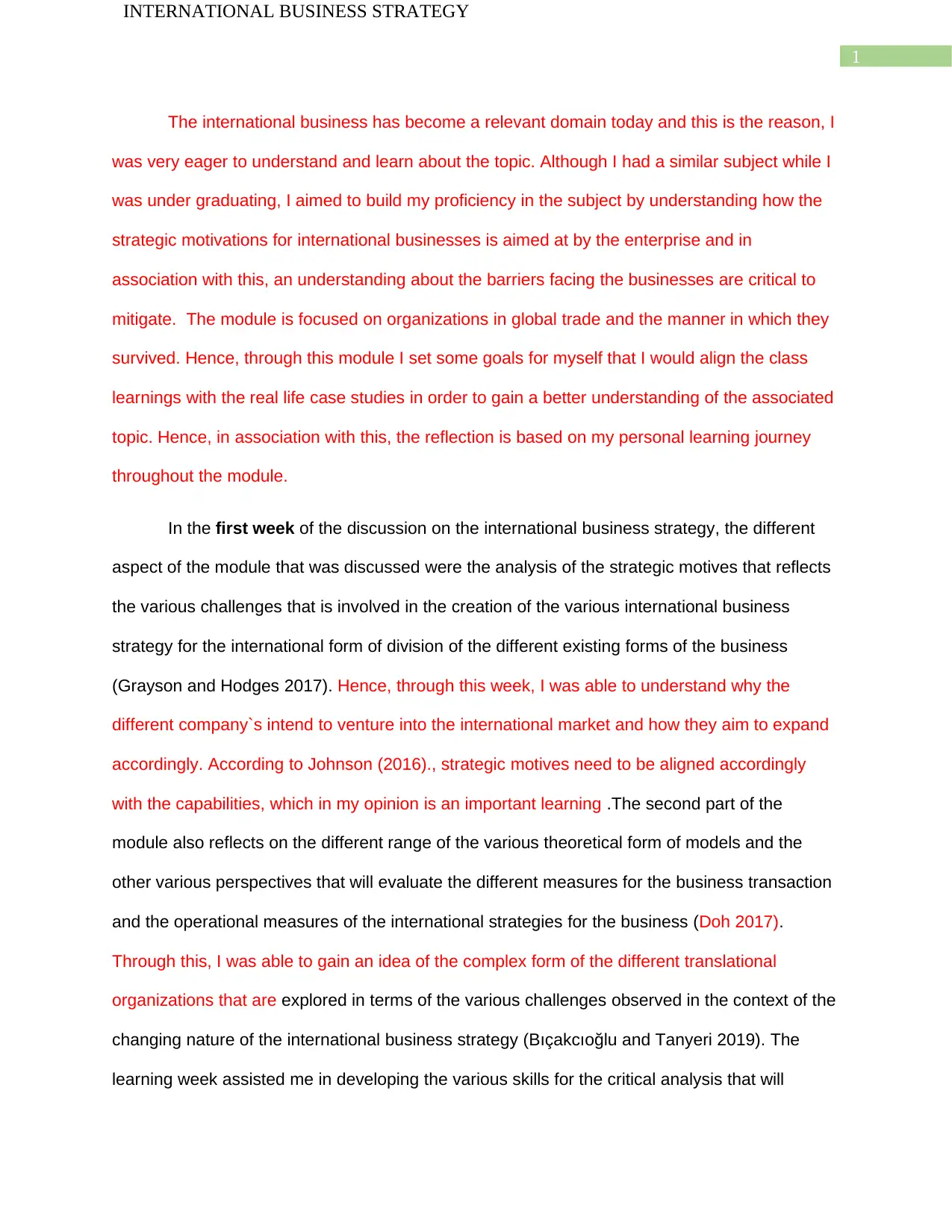
The international business has become a relevant domain today and this is the reason, I
was very eager to understand and learn about the topic. Although I had a similar subject while I
was under graduating, I aimed to build my proficiency in the subject by understanding how the
strategic motivations for international businesses is aimed at by the enterprise and in
association with this, an understanding about the barriers facing the businesses are critical to
mitigate. The module is focused on organizations in global trade and the manner in which they
survived. Hence, through this module I set some goals for myself that I would align the class
learnings with the real life case studies in order to gain a better understanding of the associated
topic. Hence, in association with this, the reflection is based on my personal learning journey
throughout the module.
In the first week of the discussion on the international business strategy, the different
aspect of the module that was discussed were the analysis of the strategic motives that reflects
the various challenges that is involved in the creation of the various international business
strategy for the international form of division of the different existing forms of the business
(Grayson and Hodges 2017). Hence, through this week, I was able to understand why the
different company`s intend to venture into the international market and how they aim to expand
accordingly. According to Johnson (2016)., strategic motives need to be aligned accordingly
with the capabilities, which in my opinion is an important learning .The second part of the
module also reflects on the different range of the various theoretical form of models and the
other various perspectives that will evaluate the different measures for the business transaction
and the operational measures of the international strategies for the business (Doh 2017).
Through this, I was able to gain an idea of the complex form of the different translational
organizations that are explored in terms of the various challenges observed in the context of the
changing nature of the international business strategy (Bıçakcıoğlu and Tanyeri 2019). The
learning week assisted me in developing the various skills for the critical analysis that will
Document Page
2
INTERNATIONAL BUSINESS STRATEGY
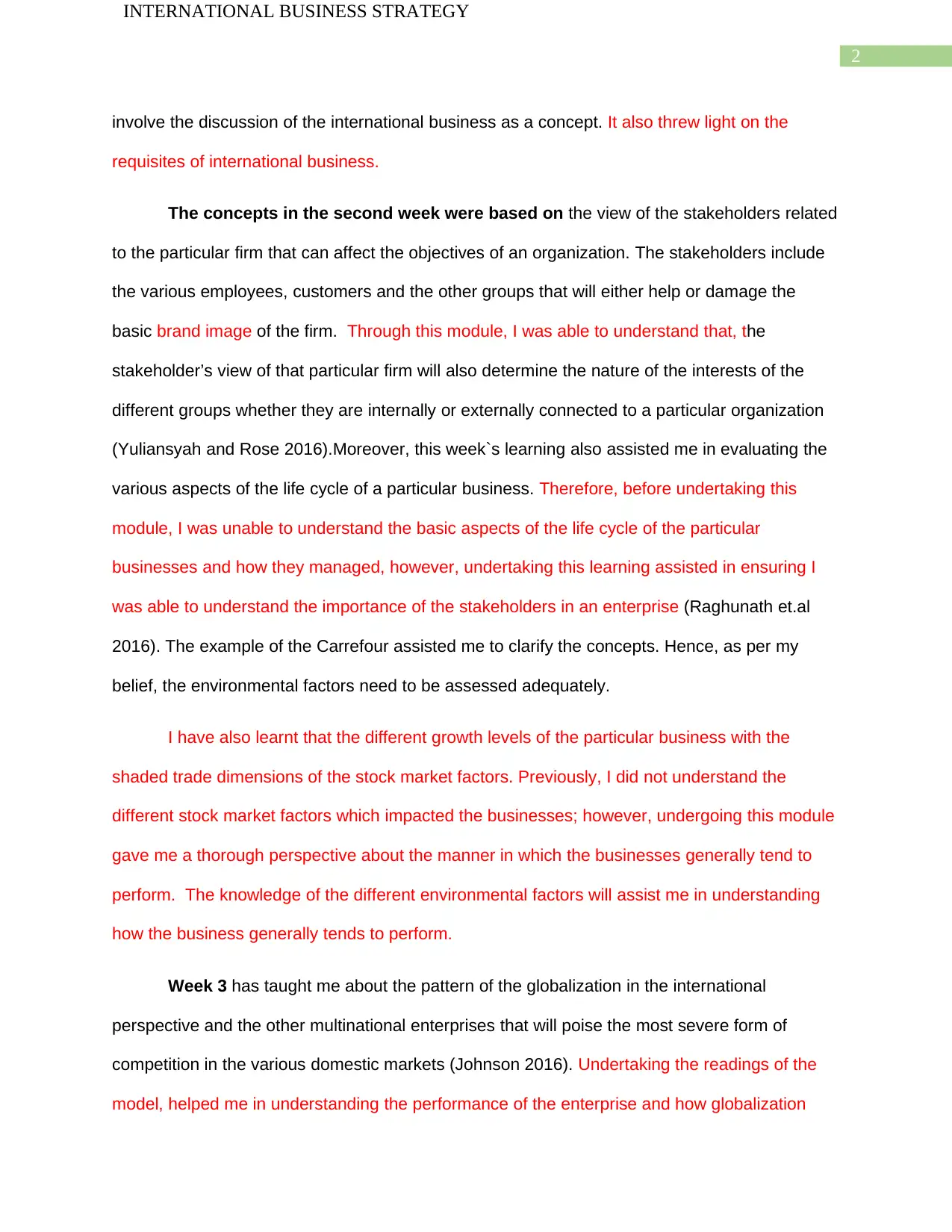
involve the discussion of the international business as a concept. It also threw light on the
requisites of international business.
The concepts in the second week were based on the view of the stakeholders related
to the particular firm that can affect the objectives of an organization. The stakeholders include
the various employees, customers and the other groups that will either help or damage the
basic brand image of the firm. Through this module, I was able to understand that, the
stakeholder’s view of that particular firm will also determine the nature of the interests of the
different groups whether they are internally or externally connected to a particular organization
(Yuliansyah and Rose 2016).Moreover, this week`s learning also assisted me in evaluating the
various aspects of the life cycle of a particular business. Therefore, before undertaking this
module, I was unable to understand the basic aspects of the life cycle of the particular
businesses and how they managed, however, undertaking this learning assisted in ensuring I
was able to understand the importance of the stakeholders in an enterprise (Raghunath et.al
2016). The example of the Carrefour assisted me to clarify the concepts. Hence, as per my
belief, the environmental factors need to be assessed adequately.
I have also learnt that the different growth levels of the particular business with the
shaded trade dimensions of the stock market factors. Previously, I did not understand the
different stock market factors which impacted the businesses; however, undergoing this module
gave me a thorough perspective about the manner in which the businesses generally tend to
perform. The knowledge of the different environmental factors will assist me in understanding
how the business generally tends to perform.
Week 3 has taught me about the pattern of the globalization in the international
perspective and the other multinational enterprises that will poise the most severe form of
competition in the various domestic markets (Johnson 2016). Undertaking the readings of the
model, helped me in understanding the performance of the enterprise and how globalization
Document Page
3
INTERNATIONAL BUSINESS STRATEGY
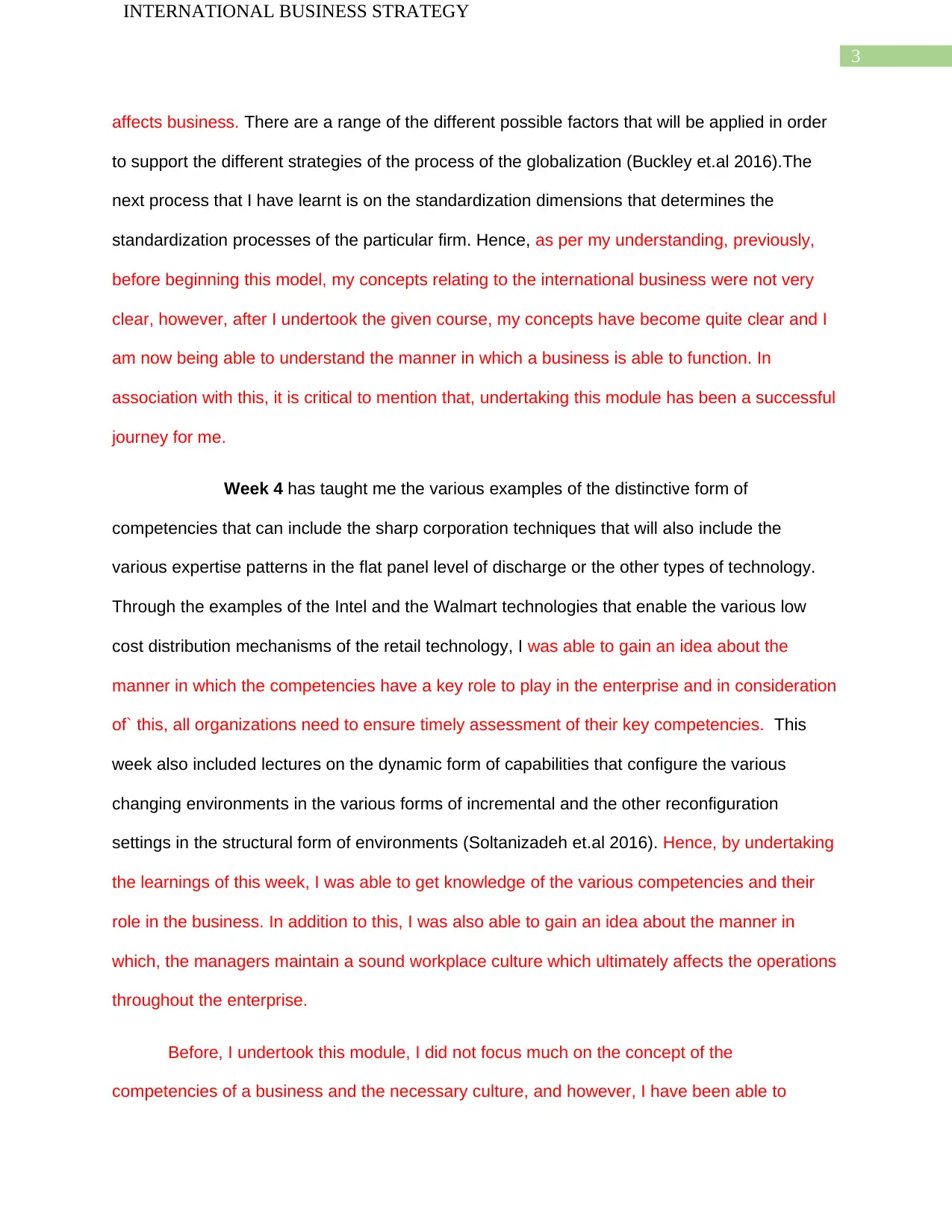
affects business. There are a range of the different possible factors that will be applied in order
to support the different strategies of the process of the globalization (Buckley et.al 2016).The
next process that I have learnt is on the standardization dimensions that determines the
standardization processes of the particular firm. Hence, as per my understanding, previously,
before beginning this model, my concepts relating to the international business were not very
clear, however, after I undertook the given course, my concepts have become quite clear and I
am now being able to understand the manner in which a business is able to function. In
association with this, it is critical to mention that, undertaking this module has been a successful
journey for me.
Week 4 has taught me the various examples of the distinctive form of
competencies that can include the sharp corporation techniques that will also include the
various expertise patterns in the flat panel level of discharge or the other types of technology.
Through the examples of the Intel and the Walmart technologies that enable the various low
cost distribution mechanisms of the retail technology, I was able to gain an idea about the
manner in which the competencies have a key role to play in the enterprise and in consideration
of` this, all organizations need to ensure timely assessment of their key competencies. This
week also included lectures on the dynamic form of capabilities that configure the various
changing environments in the various forms of incremental and the other reconfiguration
settings in the structural form of environments (Soltanizadeh et.al 2016). Hence, by undertaking
the learnings of this week, I was able to get knowledge of the various competencies and their
role in the business. In addition to this, I was also able to gain an idea about the manner in
which, the managers maintain a sound workplace culture which ultimately affects the operations
throughout the enterprise.
Before, I undertook this module, I did not focus much on the concept of the
competencies of a business and the necessary culture, and however, I have been able to
tabler-icon-diamond-filled.svg

Paraphrase This Document

Need a fresh take? Get an instant paraphrase of this document with our AI Paraphraser
Document Page
4
INTERNATIONAL BUSINESS STRATEGY
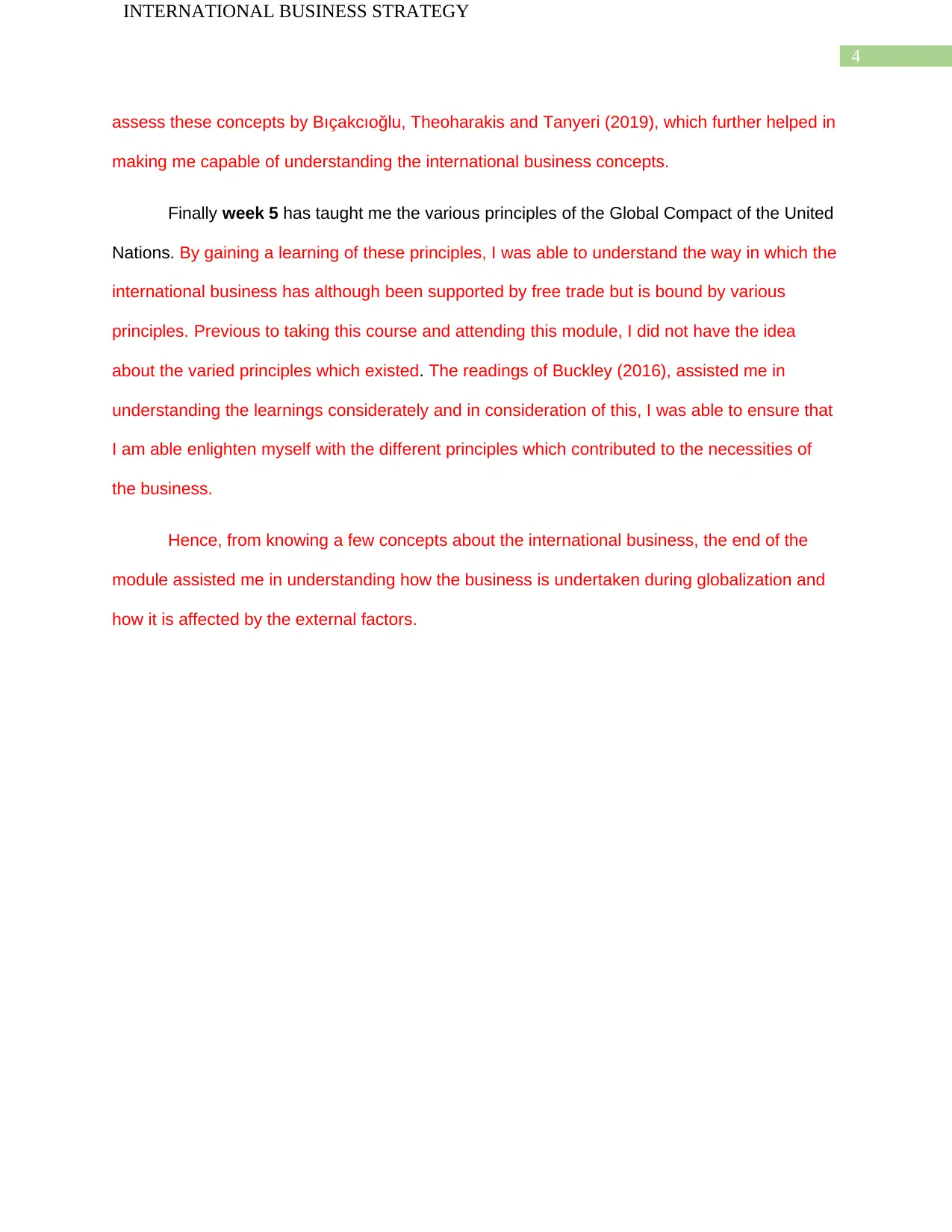
assess these concepts by Bıçakcıoğlu, Theoharakis and Tanyeri (2019), which further helped in
making me capable of understanding the international business concepts.
Finally week 5 has taught me the various principles of the Global Compact of the United
Nations. By gaining a learning of these principles, I was able to understand the way in which the
international business has although been supported by free trade but is bound by various
principles. Previous to taking this course and attending this module, I did not have the idea
about the varied principles which existed. The readings of Buckley (2016), assisted me in
understanding the learnings considerately and in consideration of this, I was able to ensure that
I am able enlighten myself with the different principles which contributed to the necessities of
the business.
Hence, from knowing a few concepts about the international business, the end of the
module assisted me in understanding how the business is undertaken during globalization and
how it is affected by the external factors.
Document Page
5
INTERNATIONAL BUSINESS STRATEGY
References
Bıçakcıoğlu, N., Theoharakis, V. and Tanyeri, M., 2019. Green business strategy and export
performance. International Marketing Review.
Buckley, P.J., Burton, F. and Mirza, H. eds., 2016. The strategy and organization of international
business. Springer.
Doh, J., Rodrigues, S., Saka-Helmhout, A. and Makhija, M., 2017. International business
responses to institutional voids.
Grayson, D. and Hodges, A., 2017. Corporate social opportunity!: Seven steps to make
corporate social responsibility work for your business. Routledge.
Johnson, G., 2016. Exploring strategy: text and cases. Pearson Education.
Raghunath, S. and Rose, E.L. eds., 2016. International Business Strategy: Perspectives on
Implementation in Emerging Markets. Springer.
Soltanizadeh, S., Rasid, S.Z.A., Golshan, N.M. and Ismail, W.K.W., 2016. Business strategy,
enterprise risk management and organizational performance. Management Research Review.
Yuliansyah, Y., Rammal, H.G. and Rose, E., 2016. Business strategy and performance in
Indonesia’s service sector. Journal of Asia Business Studies.
chevron_up_icon
1 out of 6
circle_padding
hide_on_mobile
zoom_out_icon
[object Object]