Conestoga College: Financial Crisis Faced by International Students

Verified

Added on  2023/05/29

|18
|2327
|317
Report
AI Summary
This report, prepared for a Business Research and Decision Making course, investigates the financial crisis faced by international students in Canada. The study focuses on the challenges international students encounter, particularly those from developing nations like India, who are increasingly choosing Canada for higher education. The research addresses the financial burden of tuition, accommodation, food, and other essential expenses. Data was collected through surveys and analyzed using descriptive statistics, correlation, and t-tests to evaluate the relationships between financial challenges and factors such as accommodation costs and part-time employment. The findings reveal that accommodation expenses and difficulties managing part-time jobs significantly impact financial well-being. However, the duration of stay in Canada does not significantly influence various expenditure categories and associated financial hardships. The conclusion highlights the significant financial strains faced by international students, emphasizing the need for better financial planning and support systems.
Document Page
Running head: BUSINESS RESEARCH AND DECISION MAKING
Business Research and Decision Making
Name of the Student
Name of the University
Course ID
tabler-icon-diamond-filled.svg

Paraphrase This Document

Need a fresh take? Get an instant paraphrase of this document with our AI Paraphraser
Document Page
1BUSINESS RESEARCH AND DECISION MAKING
Table of Contents
1.Introduction...................................................................................................................................2
1.1 Problem statement.................................................................................................................2
1.2 Research objective.................................................................................................................2
1.3 Hypothesis.............................................................................................................................2
2. Methodology................................................................................................................................3
3. Data analysis................................................................................................................................4
3.1 Descriptive statistics..............................................................................................................4
3.2 Correlation analysis.............................................................................................................10
3.3 t test......................................................................................................................................11
4. Conclusion.................................................................................................................................16
5. References..................................................................................................................................17
Document Page
2BUSINESS RESEARCH AND DECISION MAKING
1.Introduction
1.1 Problem statement
In today’s world there is an increasing tendency among students to study in universities
abroad. Especially students in developing nations prefer to complete their higher studies from
developed countries. It has been observed that for Indian students the final destination for
studying is Canada (Wu, Garza & Guzman, 2015) The cultural environment, lifestyle and
economic values in Canada highly attract Indian students there. The economic and cultural
environment in Canada is even better than that in Australia. Studying in foreign countries
however is not free from challenges. International students in Canada faces several financial
challenges. International students have to pay a higher fee for examination compared to their
domestic expenditure. Other expenditures include spending on accommodation, food and
stationary (Healey, 2016). The second factor concerning the students is employment. Student
come across with several difficulties to find a part time job in Canada. The problem of financial
crisis to the student further aggravated due to the fact that students are allowed to work only for
20 hours a week.
1.2 Research objective
The paper aims to find out whether international students in Canada face financial
challenges to cope with their expenses.
1.3 Hypothesis
Hypothesis 1
Document Page
3BUSINESS RESEARCH AND DECISION MAKING
Null hypothesis: Expenditure on accommodation for students living less than six months is same
with those living more than a year.
Alternative hypothesis: Expenditure on accommodation for students living less than six months
differ significantly from those living more than a year.
Hypothesis 2
Null hypothesis: Expenditure on grocery, laundry, clothing and other basic essential for students
living less than six months is same with those living more than a year.
Alternative Hypothesis: Expenditure on grocery, laundry, clothing and other basic essential for
students living less than six months differ significantly from those living more than a year.
Hypothesis 3
Null hypothesis: Expenditure on textbook and study material for students living less than six
months is same with those living more than a year.
Alternative Hypothesis: Expenditure on text book and study material for students living less than
six months differ significantly from those living more than a year.
Hypothesis 4
Null hypothesis: Managing financing by working in part time for students living less than six
months is same with those living more than a year.
Alternative Hypothesis: Managing financing by working in part time jobs for students living less
than six months differ significantly from those living more than a year.
2. Methodology
tabler-icon-diamond-filled.svg

Paraphrase This Document

Need a fresh take? Get an instant paraphrase of this document with our AI Paraphraser
Document Page
4BUSINESS RESEARCH AND DECISION MAKING
The method of quantitative data analysis has been employed to accomplish the research
objectives. The quantitative data analysis method helps to turn the raw numbers into meaningful
data by rational and critical thinking. This include calculation of frequencies of the concerned
variables, finding correlation, regression and performing other statistical tests (Smith, 2015) A
quantitative approach is used to find out evidences either supporting or rejecting the formulated
hypothesis. In this paper, primary data are collected through designing questionnaire concerning
financial challenges for international students in Canada. The responses are evaluated using
statistical techniques such as frequencies, correlation and t statistics (Creswell & Creswell,
2017). t statistics are performed to find out whether students staying less than six month faces a
greater expenditures from those who are living more than six months.
3. Data analysis
3.1 Descriptive statistics
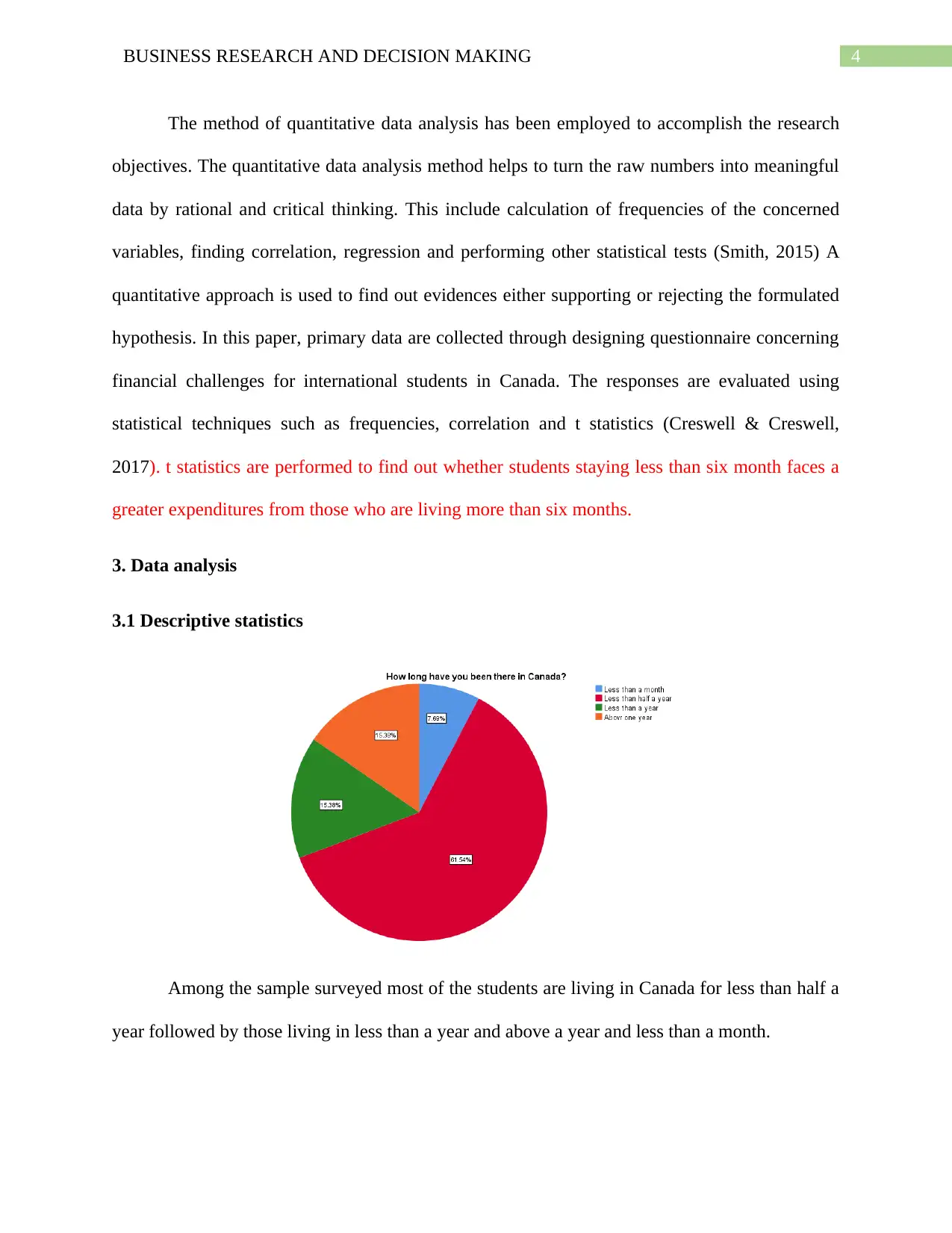
Among the sample surveyed most of the students are living in Canada for less than half a
year followed by those living in less than a year and above a year and less than a month.
Document Page
5BUSINESS RESEARCH AND DECISION MAKING
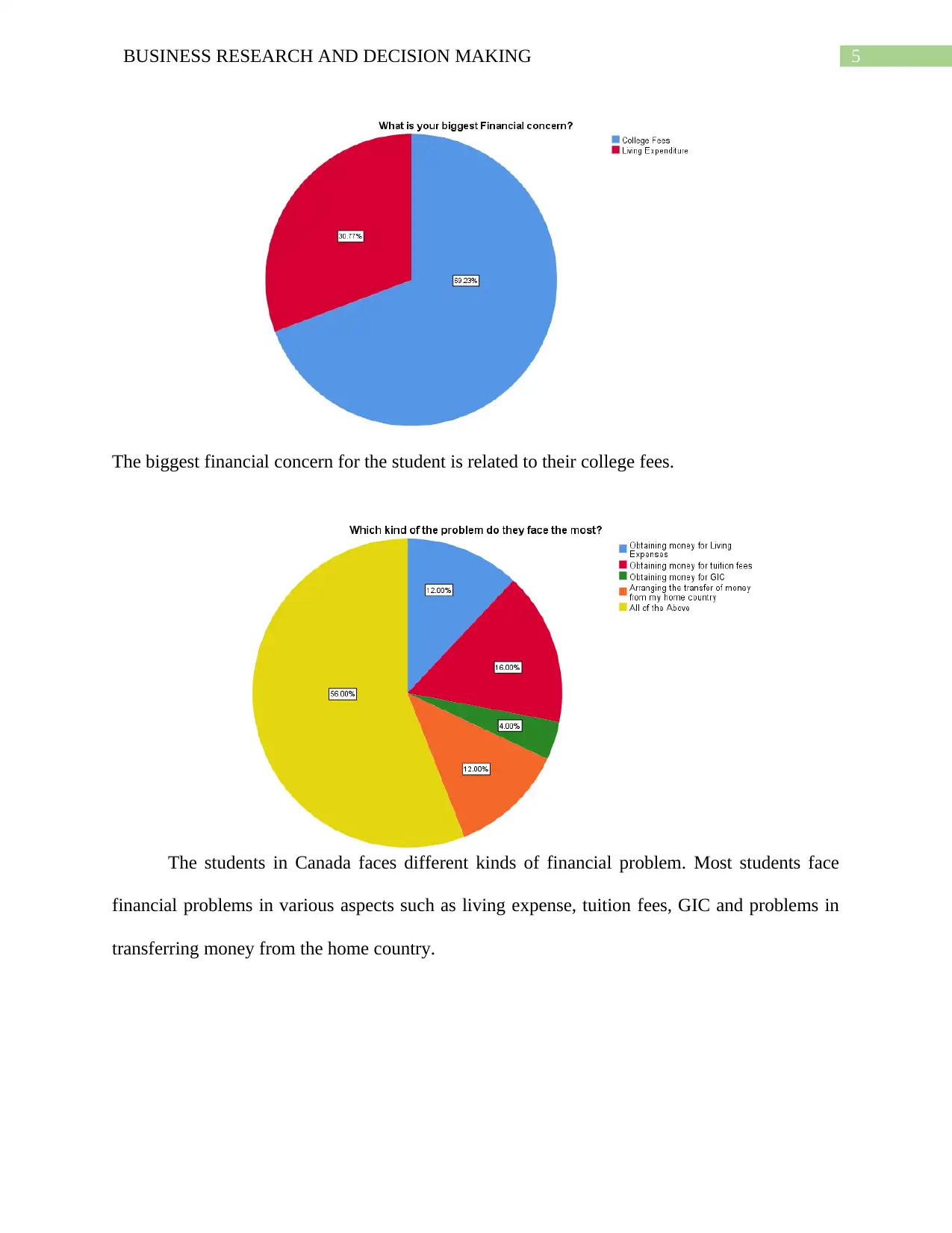
The biggest financial concern for the student is related to their college fees.
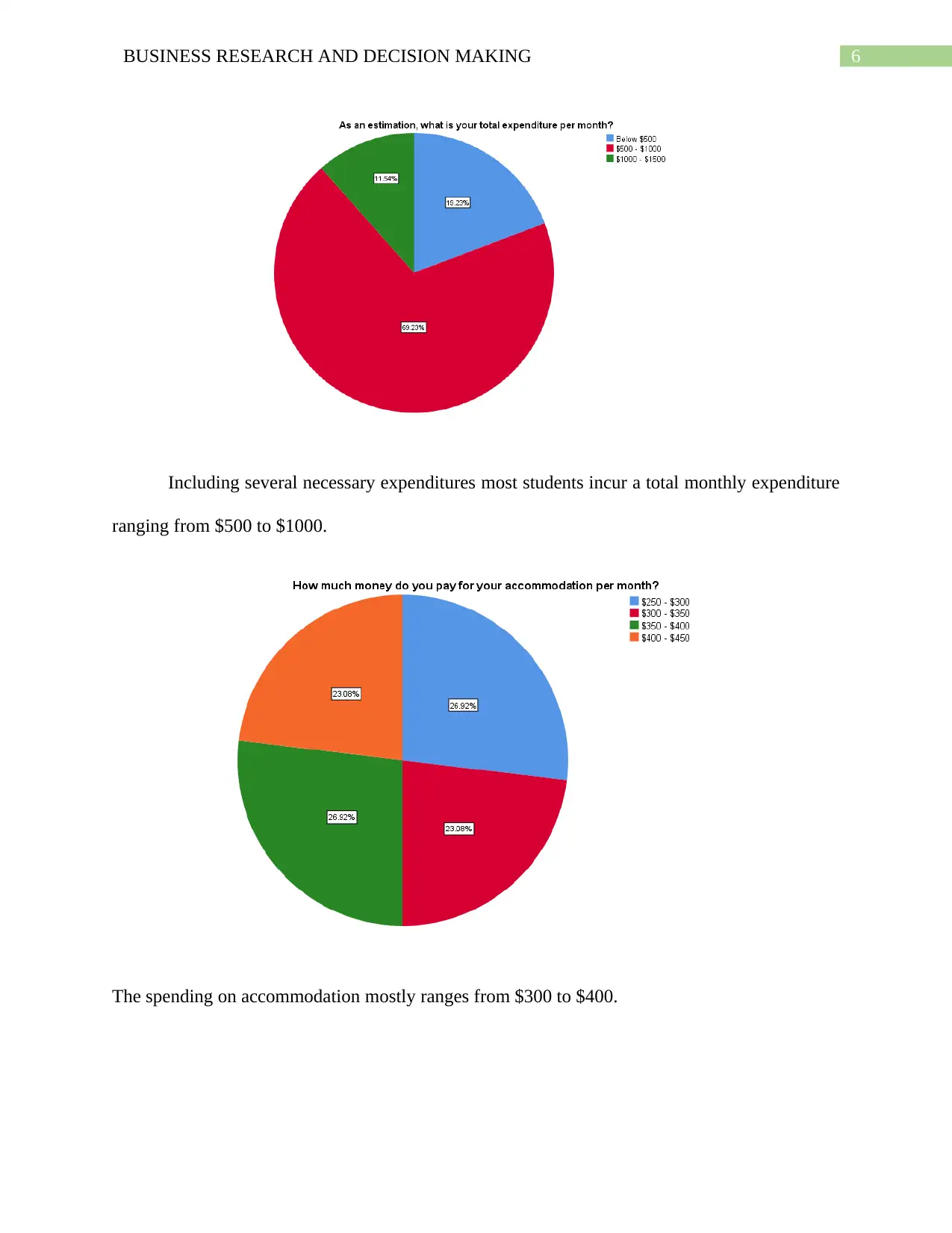
The students in Canada faces different kinds of financial problem. Most students face
financial problems in various aspects such as living expense, tuition fees, GIC and problems in
transferring money from the home country.
Document Page
6BUSINESS RESEARCH AND DECISION MAKING
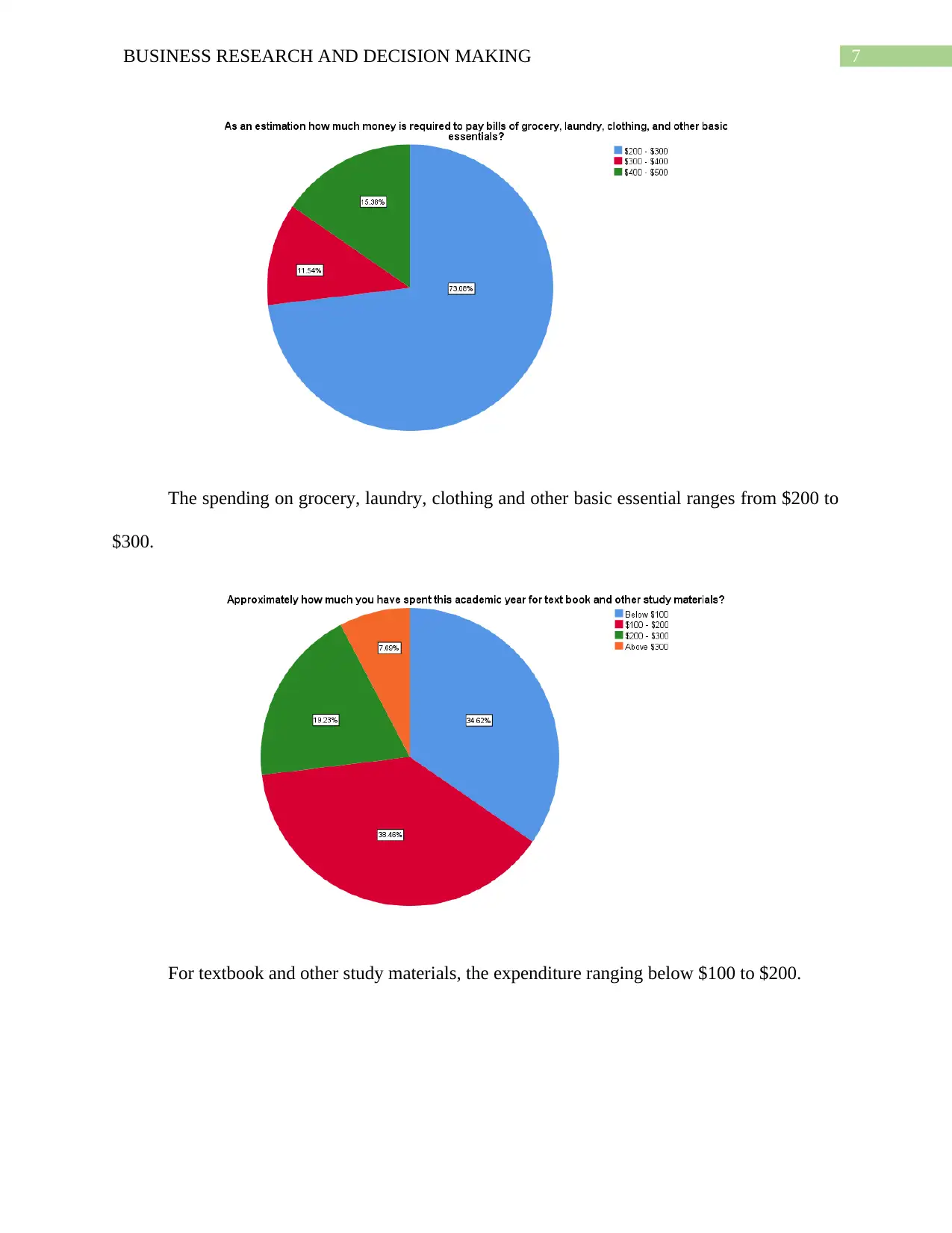
Including several necessary expenditures most students incur a total monthly expenditure
ranging from $500 to $1000.
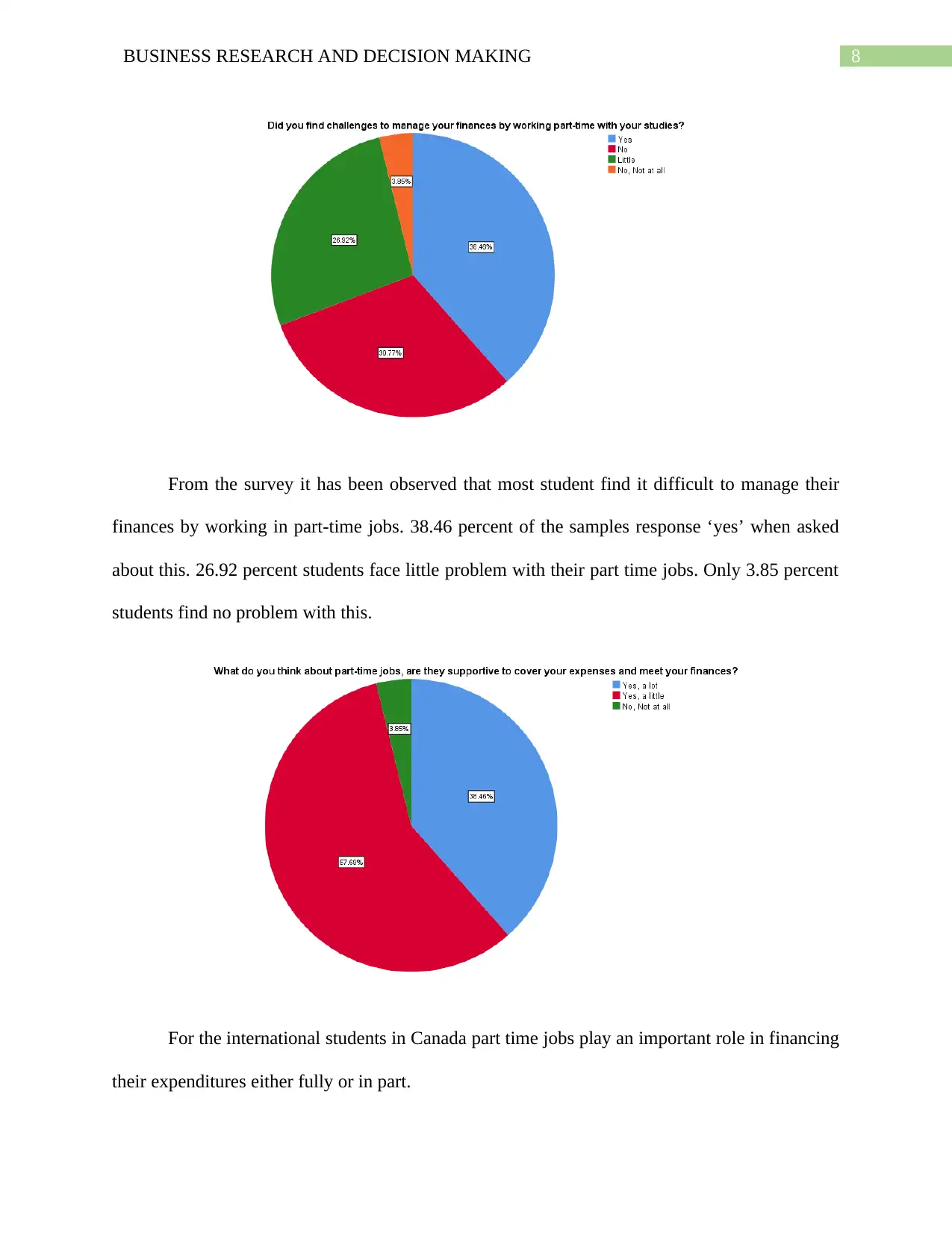
The spending on accommodation mostly ranges from $300 to $400.
tabler-icon-diamond-filled.svg

Paraphrase This Document

Need a fresh take? Get an instant paraphrase of this document with our AI Paraphraser
Document Page
7BUSINESS RESEARCH AND DECISION MAKING
The spending on grocery, laundry, clothing and other basic essential ranges from $200 to
$300.
For textbook and other study materials, the expenditure ranging below $100 to $200.
Document Page
8BUSINESS RESEARCH AND DECISION MAKING
From the survey it has been observed that most student find it difficult to manage their
finances by working in part-time jobs. 38.46 percent of the samples response ‘yes’ when asked
about this. 26.92 percent students face little problem with their part time jobs. Only 3.85 percent
students find no problem with this.
For the international students in Canada part time jobs play an important role in financing
their expenditures either fully or in part.
Document Page
9BUSINESS RESEARCH AND DECISION MAKING
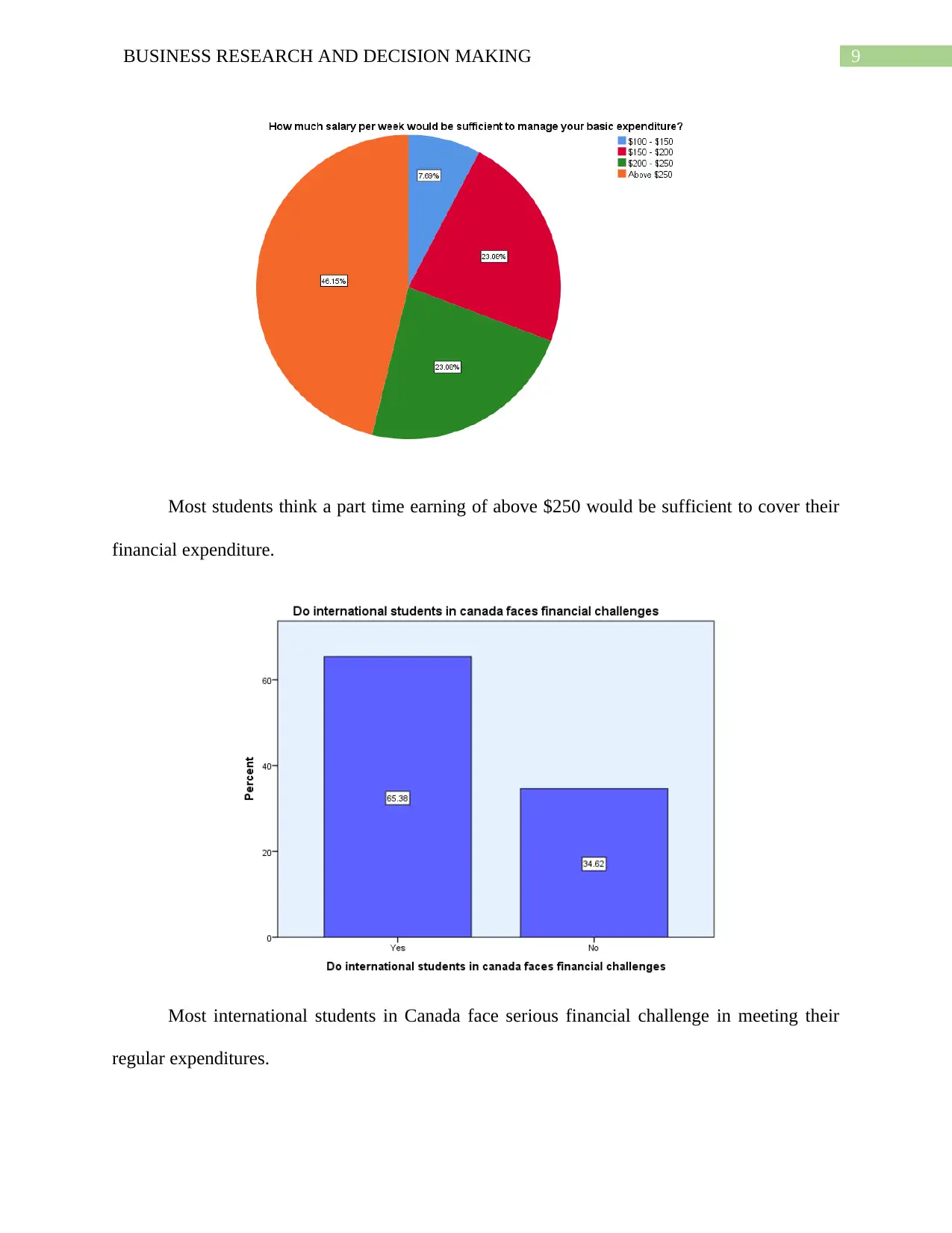
Most students think a part time earning of above $250 would be sufficient to cover their
financial expenditure.
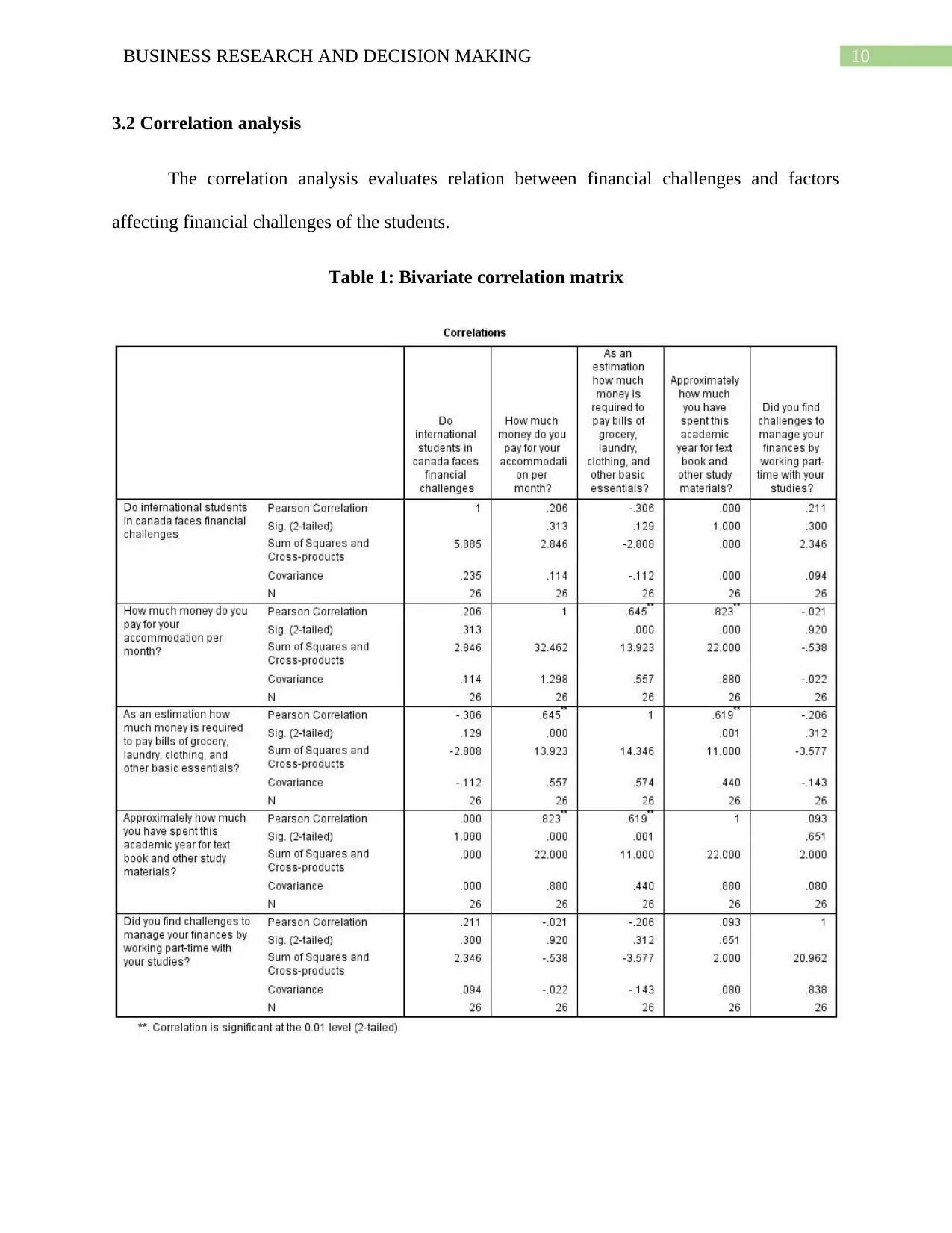
Most international students in Canada face serious financial challenge in meeting their
regular expenditures.
tabler-icon-diamond-filled.svg

Paraphrase This Document

Need a fresh take? Get an instant paraphrase of this document with our AI Paraphraser
Document Page
10BUSINESS RESEARCH AND DECISION MAKING
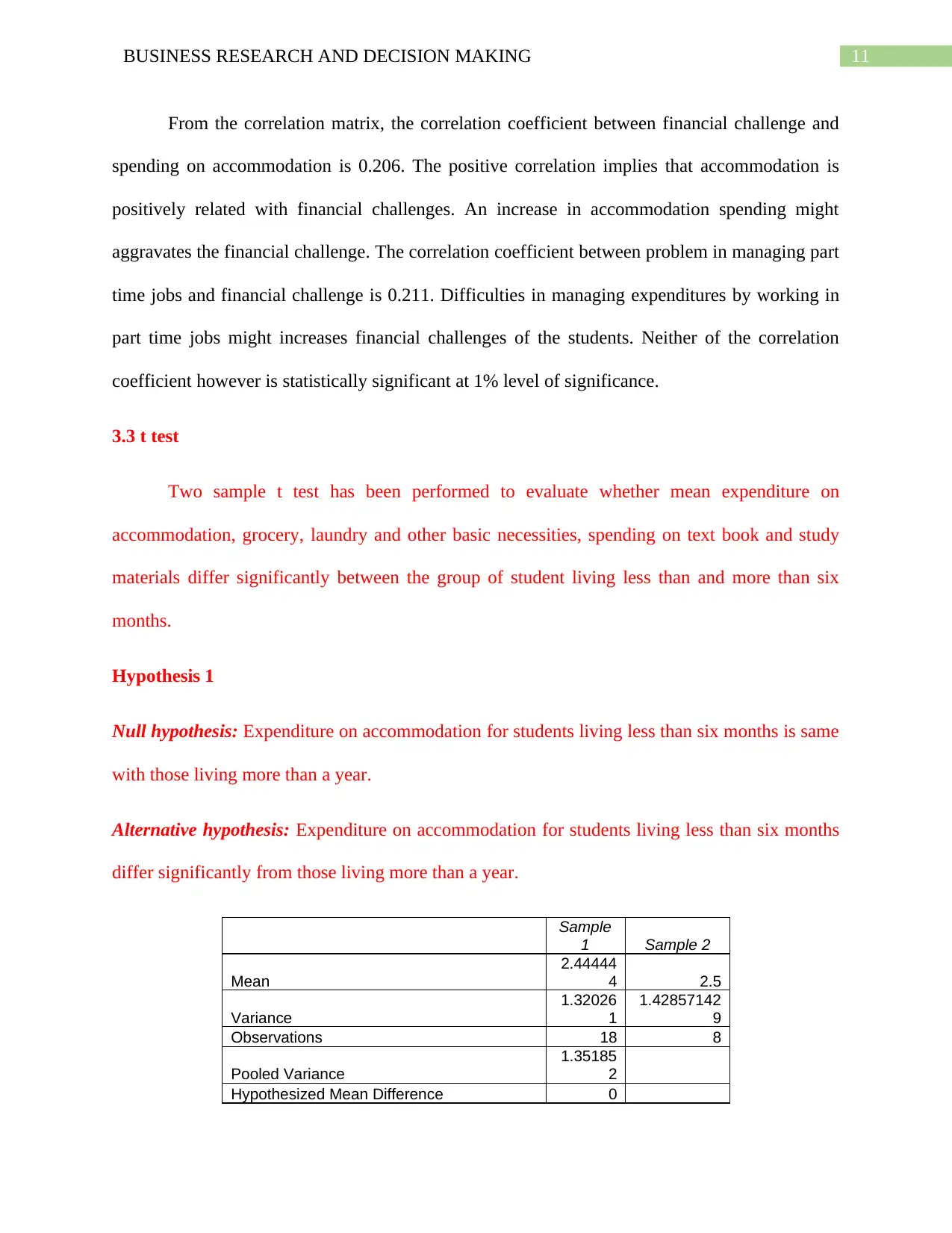
3.2 Correlation analysis
The correlation analysis evaluates relation between financial challenges and factors
affecting financial challenges of the students.
Table 1: Bivariate correlation matrix
Document Page
11BUSINESS RESEARCH AND DECISION MAKING
From the correlation matrix, the correlation coefficient between financial challenge and
spending on accommodation is 0.206. The positive correlation implies that accommodation is
positively related with financial challenges. An increase in accommodation spending might
aggravates the financial challenge. The correlation coefficient between problem in managing part
time jobs and financial challenge is 0.211. Difficulties in managing expenditures by working in
part time jobs might increases financial challenges of the students. Neither of the correlation
coefficient however is statistically significant at 1% level of significance.
3.3 t test
Two sample t test has been performed to evaluate whether mean expenditure on
accommodation, grocery, laundry and other basic necessities, spending on text book and study
materials differ significantly between the group of student living less than and more than six
months.
Hypothesis 1
Null hypothesis: Expenditure on accommodation for students living less than six months is same
with those living more than a year.
Alternative hypothesis: Expenditure on accommodation for students living less than six months
differ significantly from those living more than a year.
Sample
1 Sample 2
Mean
2.44444
4 2.5
Variance
1.32026
1
1.42857142
9
Observations 18 8
Pooled Variance
1.35185
2
Hypothesized Mean Difference 0
chevron_up_icon
1 out of 18
circle_padding
hide_on_mobile
zoom_out_icon
[object Object]