A Study on International Student Satisfaction at NMIT, New Zealand
VerifiedAdded on 2023/06/03
|60
|16606
|458
Report
AI Summary
This report investigates the satisfaction and settlement experiences of international students at Nelson Marlborough Institute of Technology (NMIT) in New Zealand. It addresses the increasing number of international students in New Zealand's tertiary institutions and explores the challenges they face, including cultural adjustment, language barriers, and support systems. The study uses a qualitative approach, employing questionnaires to gather data on student expectations, satisfaction levels, and the impact on their learning experiences. It also reviews relevant literature on intercultural management, Maslow's Hierarchy of Needs, and student adjustment to identify gaps in the existing knowledge and propose strategies for improving international student satisfaction and integration within NMIT. The research aims to provide insights for NMIT management and contribute to policies that enhance the overall experience for international students, ultimately supporting the growth of New Zealand's export education sector.
Running head: SATISFACTION AND SETTLEMENT EXPERIENCES
Expectation versus Reality: Satisfaction and Settlement Experiences of International Students at
NMIT, New Zealand.
Name
Institution
Expectation versus Reality: Satisfaction and Settlement Experiences of International Students at
NMIT, New Zealand.
Name
Institution

Paraphrase This Document
Need a fresh take? Get an instant paraphrase of this document with our AI Paraphraser
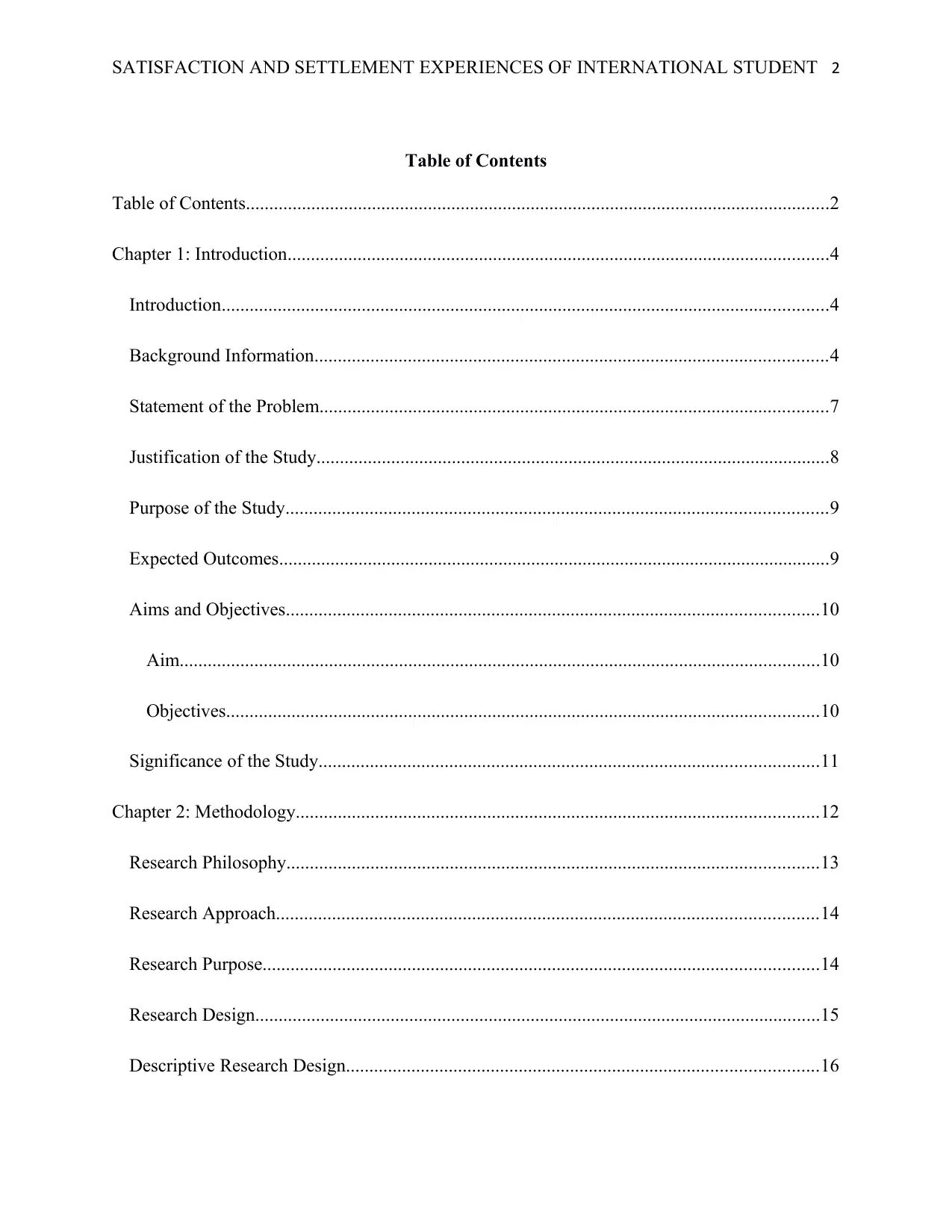
SATISFACTION AND SETTLEMENT EXPERIENCES OF INTERNATIONAL STUDENT 2
Table of Contents
Table of Contents.............................................................................................................................2
Chapter 1: Introduction....................................................................................................................4
Introduction..................................................................................................................................4
Background Information..............................................................................................................4
Statement of the Problem.............................................................................................................7
Justification of the Study..............................................................................................................8
Purpose of the Study....................................................................................................................9
Expected Outcomes......................................................................................................................9
Aims and Objectives..................................................................................................................10
Aim.........................................................................................................................................10
Objectives...............................................................................................................................10
Significance of the Study...........................................................................................................11
Chapter 2: Methodology................................................................................................................12
Research Philosophy..................................................................................................................13
Research Approach....................................................................................................................14
Research Purpose.......................................................................................................................14
Research Design.........................................................................................................................15
Descriptive Research Design.....................................................................................................16
Table of Contents
Table of Contents.............................................................................................................................2
Chapter 1: Introduction....................................................................................................................4
Introduction..................................................................................................................................4
Background Information..............................................................................................................4
Statement of the Problem.............................................................................................................7
Justification of the Study..............................................................................................................8
Purpose of the Study....................................................................................................................9
Expected Outcomes......................................................................................................................9
Aims and Objectives..................................................................................................................10
Aim.........................................................................................................................................10
Objectives...............................................................................................................................10
Significance of the Study...........................................................................................................11
Chapter 2: Methodology................................................................................................................12
Research Philosophy..................................................................................................................13
Research Approach....................................................................................................................14
Research Purpose.......................................................................................................................14
Research Design.........................................................................................................................15
Descriptive Research Design.....................................................................................................16
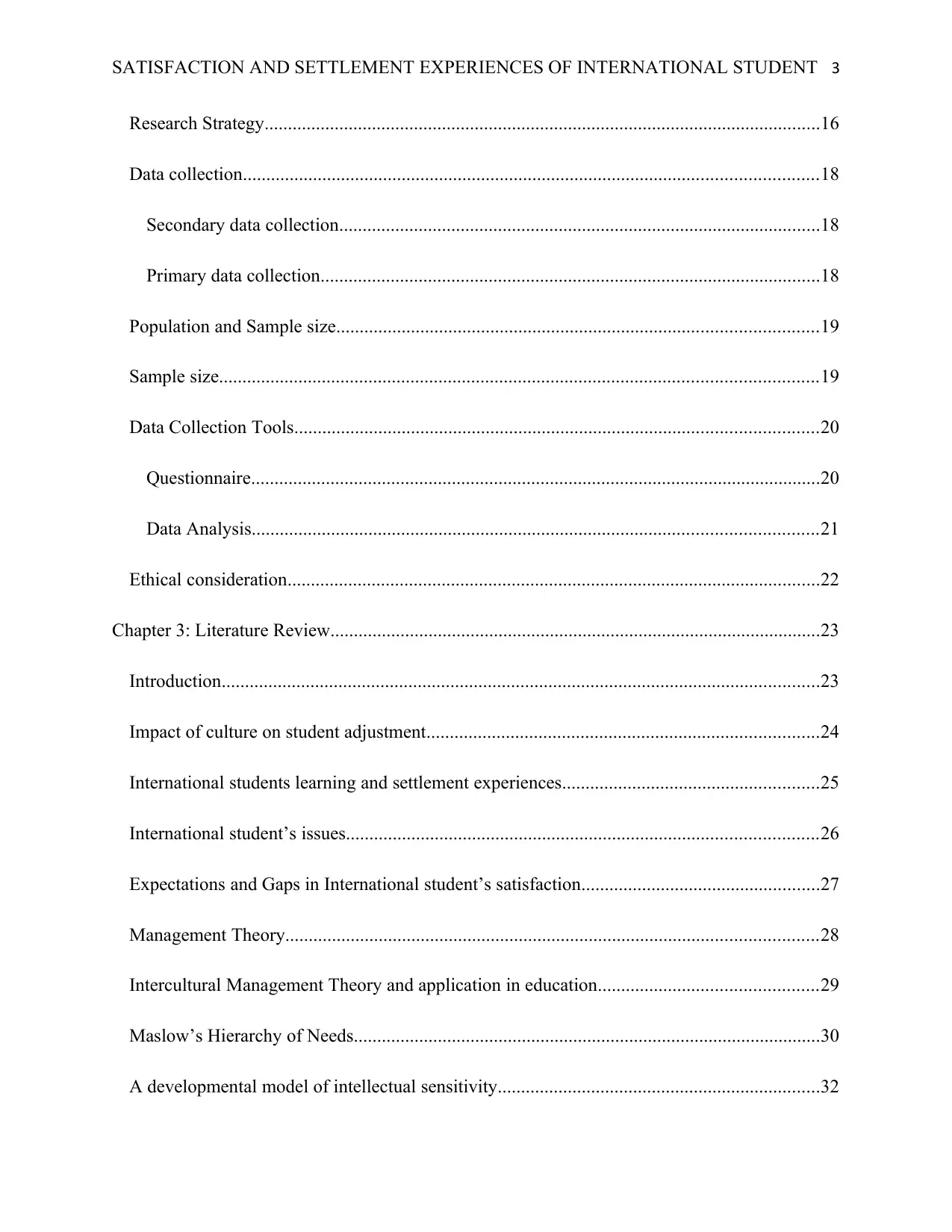
SATISFACTION AND SETTLEMENT EXPERIENCES OF INTERNATIONAL STUDENT 3
Research Strategy.......................................................................................................................16
Data collection...........................................................................................................................18
Secondary data collection.......................................................................................................18
Primary data collection...........................................................................................................18
Population and Sample size.......................................................................................................19
Sample size................................................................................................................................19
Data Collection Tools................................................................................................................20
Questionnaire..........................................................................................................................20
Data Analysis.........................................................................................................................21
Ethical consideration..................................................................................................................22
Chapter 3: Literature Review.........................................................................................................23
Introduction................................................................................................................................23
Impact of culture on student adjustment....................................................................................24
International students learning and settlement experiences.......................................................25
International student’s issues.....................................................................................................26
Expectations and Gaps in International student’s satisfaction...................................................27
Management Theory..................................................................................................................28
Intercultural Management Theory and application in education...............................................29
Maslow’s Hierarchy of Needs....................................................................................................30
A developmental model of intellectual sensitivity.....................................................................32
Research Strategy.......................................................................................................................16
Data collection...........................................................................................................................18
Secondary data collection.......................................................................................................18
Primary data collection...........................................................................................................18
Population and Sample size.......................................................................................................19
Sample size................................................................................................................................19
Data Collection Tools................................................................................................................20
Questionnaire..........................................................................................................................20
Data Analysis.........................................................................................................................21
Ethical consideration..................................................................................................................22
Chapter 3: Literature Review.........................................................................................................23
Introduction................................................................................................................................23
Impact of culture on student adjustment....................................................................................24
International students learning and settlement experiences.......................................................25
International student’s issues.....................................................................................................26
Expectations and Gaps in International student’s satisfaction...................................................27
Management Theory..................................................................................................................28
Intercultural Management Theory and application in education...............................................29
Maslow’s Hierarchy of Needs....................................................................................................30
A developmental model of intellectual sensitivity.....................................................................32
⊘ This is a preview!⊘
Do you want full access?
Subscribe today to unlock all pages.

Trusted by 1+ million students worldwide
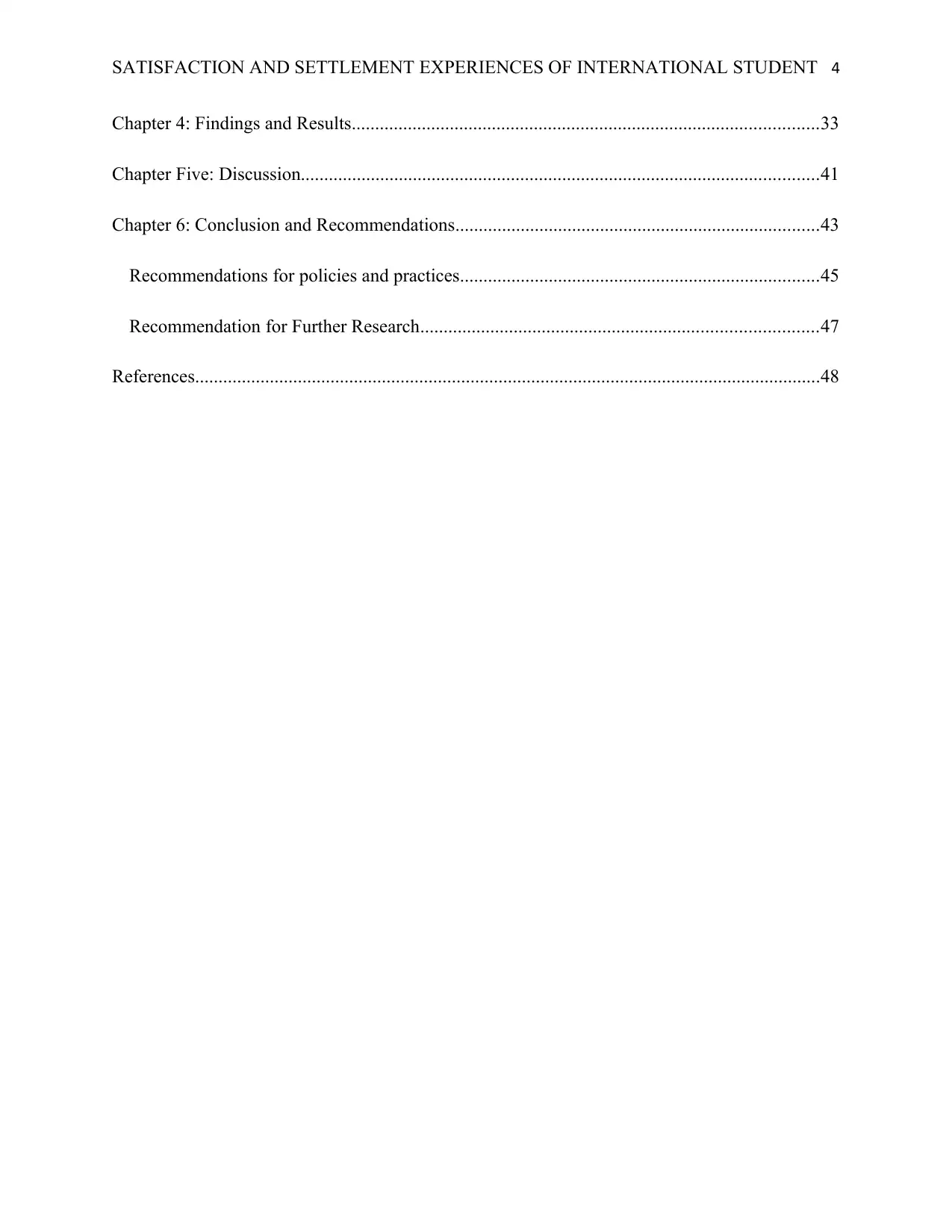
SATISFACTION AND SETTLEMENT EXPERIENCES OF INTERNATIONAL STUDENT 4
Chapter 4: Findings and Results....................................................................................................33
Chapter Five: Discussion...............................................................................................................41
Chapter 6: Conclusion and Recommendations..............................................................................43
Recommendations for policies and practices.............................................................................45
Recommendation for Further Research.....................................................................................47
References......................................................................................................................................48
Chapter 4: Findings and Results....................................................................................................33
Chapter Five: Discussion...............................................................................................................41
Chapter 6: Conclusion and Recommendations..............................................................................43
Recommendations for policies and practices.............................................................................45
Recommendation for Further Research.....................................................................................47
References......................................................................................................................................48
Paraphrase This Document
Need a fresh take? Get an instant paraphrase of this document with our AI Paraphraser
SATISFACTION AND SETTLEMENT EXPERIENCES OF INTERNATIONAL STUDENT 5
Abstract
This study emphasizes the identified problems in the statement and provides a
justification for the need for research in the area. This is then followed by the expected outcomes
where the researcher states the anticipated results that could be achieved through the study and
how they are necessary. Finally, the significance of the study is outlined. The study is focused to
further growth in the pool of knowledge, influence policies of tertiary institutions touching on
international students and impact the Ministry of Education’s regulatory framework for
universities and ITPs. Given the fact that most international students tend to find it difficult to
communicate effectively in their assignments and exams, this shows that there is a gap the
administration of NMIT needs to deal with so that this problem may not be faced in the future. In
this case, it is recommended that the administration should set clear policies and programs to
which the international students are taught the academic language intended to be used in the
process of teaching and examination.it is recommended that a follow up mechanism should be
reign forced. This can be huge step in curbing the problem of language barrier being faced by the
students.
Chapter 1: Introduction
Introduction
This section introduces the first chapter of the research proposal. The chapter begins with
the background information. This section identifies and describes a thoroughly defined research
Abstract
This study emphasizes the identified problems in the statement and provides a
justification for the need for research in the area. This is then followed by the expected outcomes
where the researcher states the anticipated results that could be achieved through the study and
how they are necessary. Finally, the significance of the study is outlined. The study is focused to
further growth in the pool of knowledge, influence policies of tertiary institutions touching on
international students and impact the Ministry of Education’s regulatory framework for
universities and ITPs. Given the fact that most international students tend to find it difficult to
communicate effectively in their assignments and exams, this shows that there is a gap the
administration of NMIT needs to deal with so that this problem may not be faced in the future. In
this case, it is recommended that the administration should set clear policies and programs to
which the international students are taught the academic language intended to be used in the
process of teaching and examination.it is recommended that a follow up mechanism should be
reign forced. This can be huge step in curbing the problem of language barrier being faced by the
students.
Chapter 1: Introduction
Introduction
This section introduces the first chapter of the research proposal. The chapter begins with
the background information. This section identifies and describes a thoroughly defined research
SATISFACTION AND SETTLEMENT EXPERIENCES OF INTERNATIONAL STUDENT 6
question: The Satisfaction and Settlement Experiences of International Students at NMIT, New
Zealand. The background outlines the problem to be studied in the research and gives context to
the research question with regard to existing scholarly work. In the introduction, what is known
about the satisfaction of international students and their settlement experiences is expounded.
Main factors that contribute to international students’ dissatisfaction are highlighted. The
statement of the problem then brings the readers’ attention to the current state of New Zealand’s
tertiary institutions with regards to international student satisfaction. A justification of the study
is then provided.
Background Information
In recent decades, New Zealand’s universities and tertiary institutions have attracted an
ever increasing number of international students. A high number of students apply to study in
New Zealand universities, most of them from the Asian countries. As at 2016, international
students represented 15% of the total number of students pursuing tertiary education in New
Zealand (Obeng-Odoom, 2012). Chinese students account for the highest number of international
students in New Zealand by nationality. The contribution of export education to the economy of
New Zealand cannot be underestimated. In 1999, export education injected $ 545 million into
New Zealand’s Gross Domestic Product (GDP). In just 2 years, this amount had doubled and
was standing at $ 1.3 billion. As at 2004, the industry’s share of the GDP had surpassed $2
billion and the value addition to the GDP attributable to export education was $2.2 billion
(Maramba, 2015). Today, export education to international students is the fifth largest income
earner for the country, raking in approximately $ 2.48 billion. The New Zealand government has
targeted to increase this figure to $5 billion by 2025. These figures speak to the importance of
international students to the economy of New Zealand as a country.
question: The Satisfaction and Settlement Experiences of International Students at NMIT, New
Zealand. The background outlines the problem to be studied in the research and gives context to
the research question with regard to existing scholarly work. In the introduction, what is known
about the satisfaction of international students and their settlement experiences is expounded.
Main factors that contribute to international students’ dissatisfaction are highlighted. The
statement of the problem then brings the readers’ attention to the current state of New Zealand’s
tertiary institutions with regards to international student satisfaction. A justification of the study
is then provided.
Background Information
In recent decades, New Zealand’s universities and tertiary institutions have attracted an
ever increasing number of international students. A high number of students apply to study in
New Zealand universities, most of them from the Asian countries. As at 2016, international
students represented 15% of the total number of students pursuing tertiary education in New
Zealand (Obeng-Odoom, 2012). Chinese students account for the highest number of international
students in New Zealand by nationality. The contribution of export education to the economy of
New Zealand cannot be underestimated. In 1999, export education injected $ 545 million into
New Zealand’s Gross Domestic Product (GDP). In just 2 years, this amount had doubled and
was standing at $ 1.3 billion. As at 2004, the industry’s share of the GDP had surpassed $2
billion and the value addition to the GDP attributable to export education was $2.2 billion
(Maramba, 2015). Today, export education to international students is the fifth largest income
earner for the country, raking in approximately $ 2.48 billion. The New Zealand government has
targeted to increase this figure to $5 billion by 2025. These figures speak to the importance of
international students to the economy of New Zealand as a country.
⊘ This is a preview!⊘
Do you want full access?
Subscribe today to unlock all pages.
Trusted by 1+ million students worldwide
SATISFACTION AND SETTLEMENT EXPERIENCES OF INTERNATIONAL STUDENT 7
What is it that is attracting such large numbers of international students to New Zealand?
New Zealand is home to some of the best universities in the Asia-Pacific and indeed in the
world. They offer competitive curricula and their graduates are competitive in the employment
market. Some of them include the University of Auckland, the University of Canterbury and the
University of Otago. Leading New Zealand’s institutes of technology and polytechnics include,
Nelson Marlborough Institute of Technology, Manukau Institute of Technology and Eastern
Institute of Technology. A study conducted in New Zealand in 2011 showed that learning
experience was the single most significant determinant of satisfaction among international
students (Paltridge, Mayson & Schapper, 2010). Besides, accommodation experience, the
support services were also important indicators of the level of satisfaction among foreign
students.
To ensure that New Zealand achieves the $5 billion in export education earnings by 2025,
it will need to attract more students to New Zealand universities. The singular most effective
means of attracting and retaining international students to tertiary institutions is by ensuring
student satisfaction and an easy settlement experience (Scott, 2015). Satisfaction of the student is
a direct determinant of whether they enjoy their stay in the institution or not. Student satisfaction
also determines their attitude towards academic work; satisfied students concentrate better and
get better grades as opposed to those who have problems settling in the foreign country.
According to a study that was conducted in 2011, 88% of international students in New
Zealand’s tertiary institutions reported that they were satisfied with their experiences (Mark,
2013). An overwhelming 90% of students of foreign nationality from Institutes of Technology
and Polytechnics (ITPs) reported satisfying experiences in New Zealand. 84 % of these said they
would recommend New Zealand’s ITPs to anyone seeking to study abroad.
What is it that is attracting such large numbers of international students to New Zealand?
New Zealand is home to some of the best universities in the Asia-Pacific and indeed in the
world. They offer competitive curricula and their graduates are competitive in the employment
market. Some of them include the University of Auckland, the University of Canterbury and the
University of Otago. Leading New Zealand’s institutes of technology and polytechnics include,
Nelson Marlborough Institute of Technology, Manukau Institute of Technology and Eastern
Institute of Technology. A study conducted in New Zealand in 2011 showed that learning
experience was the single most significant determinant of satisfaction among international
students (Paltridge, Mayson & Schapper, 2010). Besides, accommodation experience, the
support services were also important indicators of the level of satisfaction among foreign
students.
To ensure that New Zealand achieves the $5 billion in export education earnings by 2025,
it will need to attract more students to New Zealand universities. The singular most effective
means of attracting and retaining international students to tertiary institutions is by ensuring
student satisfaction and an easy settlement experience (Scott, 2015). Satisfaction of the student is
a direct determinant of whether they enjoy their stay in the institution or not. Student satisfaction
also determines their attitude towards academic work; satisfied students concentrate better and
get better grades as opposed to those who have problems settling in the foreign country.
According to a study that was conducted in 2011, 88% of international students in New
Zealand’s tertiary institutions reported that they were satisfied with their experiences (Mark,
2013). An overwhelming 90% of students of foreign nationality from Institutes of Technology
and Polytechnics (ITPs) reported satisfying experiences in New Zealand. 84 % of these said they
would recommend New Zealand’s ITPs to anyone seeking to study abroad.
Paraphrase This Document
Need a fresh take? Get an instant paraphrase of this document with our AI Paraphraser
SATISFACTION AND SETTLEMENT EXPERIENCES OF INTERNATIONAL STUDENT 8
International students come to New Zealand with a variety of expectations about the
curriculum of their study programs as well as their settlement experience. While it is fair to
assume that the curriculum of most New Zealand’s universities and ITPs satisfy student
expectations, Hsu et al (2016) submits that other aspects of foreign students’ experience must
also be interrogated. This paper seeks to escalate public discourse on international students in
New Zealand. The paper will investigate the expectation of international students coming to
Nelson Marlborough Institute of Technology, New Zealand against the reality. It will also look
into the needs of international students in terms of settling in a foreign country, their level of
satisfaction and how this impacts on their experience. There is an existing knowledge gap as is
evidenced by the scarcity of scholarly work done to explore the issues pertinent to international
students’ satisfaction and settlement experiences in New Zealand. This paper hopes to bridge that
gap by conducting a qualitative survey where questionnaires shall be used to capture the feelings
of international students regarding the research questions.
Statement of the Problem
New Zealand universities and tertiary institutions have over the last 2 decades continued
to receive an influx of international students especially from the Asia-Pacific countries. Mikulić,
Dužević & Baković (2015) submit that despite the fact that this has occasioned a major boom in
property markets around the nation’s tertiary institutions and injects a significant amount into its
GDP, serious concerns have been raised regarding how these institutions are handling the matter
of multiculturalism and inter-culturalism on campus. In 2017, the number of international
students in New Zealand declined by 7 %; this was largely occasioned by a plummeting of
registration rates by international students from India (Collins, 2016). This decline in the
enrollment of international students is attributable to the fact that the satisfaction of international
International students come to New Zealand with a variety of expectations about the
curriculum of their study programs as well as their settlement experience. While it is fair to
assume that the curriculum of most New Zealand’s universities and ITPs satisfy student
expectations, Hsu et al (2016) submits that other aspects of foreign students’ experience must
also be interrogated. This paper seeks to escalate public discourse on international students in
New Zealand. The paper will investigate the expectation of international students coming to
Nelson Marlborough Institute of Technology, New Zealand against the reality. It will also look
into the needs of international students in terms of settling in a foreign country, their level of
satisfaction and how this impacts on their experience. There is an existing knowledge gap as is
evidenced by the scarcity of scholarly work done to explore the issues pertinent to international
students’ satisfaction and settlement experiences in New Zealand. This paper hopes to bridge that
gap by conducting a qualitative survey where questionnaires shall be used to capture the feelings
of international students regarding the research questions.
Statement of the Problem
New Zealand universities and tertiary institutions have over the last 2 decades continued
to receive an influx of international students especially from the Asia-Pacific countries. Mikulić,
Dužević & Baković (2015) submit that despite the fact that this has occasioned a major boom in
property markets around the nation’s tertiary institutions and injects a significant amount into its
GDP, serious concerns have been raised regarding how these institutions are handling the matter
of multiculturalism and inter-culturalism on campus. In 2017, the number of international
students in New Zealand declined by 7 %; this was largely occasioned by a plummeting of
registration rates by international students from India (Collins, 2016). This decline in the
enrollment of international students is attributable to the fact that the satisfaction of international
SATISFACTION AND SETTLEMENT EXPERIENCES OF INTERNATIONAL STUDENT 9
students is in question. Their settlement experience is marred by cross-cultural challenges and
the international students support systems in most tertiary institutions are not sufficiently
equipped to do their function.
The above concerns seem to be lost to the government of New Zealand even as it plans to
double the nation’s earnings from the export education industry from $ 2.48 billion to $ 5 billion.
As posited by Peya et al. (2016), it appears the desire to rake in the top dollar from wealthy
internationals students is taking precedence over the core of education-to provide quality
education to international students which can only be guaranteed if their satisfaction and
settlement experience on campus is smooth. Student satisfaction is one of the most commonly
overlooked areas in tertiary education (Obeng-Odoom, 2012). Most specifically the satisfaction
of international students has not been adequately addressed in NMIT just like in several other
tertiary institutions in New Zealand. Lack of satisfaction among international students means
they are not enjoying their stay at the college. Although international students at Nelson
Marlborough Institute of Technology have achieved at par with domestic students since 2013, in
2015, a decline was recorded (Stevens, 2014). This was associated with the variations between
the expectations of international students regarding NMITs learning styles and the reality. The
issues that affect international student satisfaction, which tertiary institutions must look into
include; appropriate and relevant curricula, living arrangements, social relationships,
international students support and life satisfaction.
Justification of the Study
This segment provides justification for the existence of the research problem. As already
stated in the paper, students’ satisfaction among international students has not been given
students is in question. Their settlement experience is marred by cross-cultural challenges and
the international students support systems in most tertiary institutions are not sufficiently
equipped to do their function.
The above concerns seem to be lost to the government of New Zealand even as it plans to
double the nation’s earnings from the export education industry from $ 2.48 billion to $ 5 billion.
As posited by Peya et al. (2016), it appears the desire to rake in the top dollar from wealthy
internationals students is taking precedence over the core of education-to provide quality
education to international students which can only be guaranteed if their satisfaction and
settlement experience on campus is smooth. Student satisfaction is one of the most commonly
overlooked areas in tertiary education (Obeng-Odoom, 2012). Most specifically the satisfaction
of international students has not been adequately addressed in NMIT just like in several other
tertiary institutions in New Zealand. Lack of satisfaction among international students means
they are not enjoying their stay at the college. Although international students at Nelson
Marlborough Institute of Technology have achieved at par with domestic students since 2013, in
2015, a decline was recorded (Stevens, 2014). This was associated with the variations between
the expectations of international students regarding NMITs learning styles and the reality. The
issues that affect international student satisfaction, which tertiary institutions must look into
include; appropriate and relevant curricula, living arrangements, social relationships,
international students support and life satisfaction.
Justification of the Study
This segment provides justification for the existence of the research problem. As already
stated in the paper, students’ satisfaction among international students has not been given
⊘ This is a preview!⊘
Do you want full access?
Subscribe today to unlock all pages.
Trusted by 1+ million students worldwide
SATISFACTION AND SETTLEMENT EXPERIENCES OF INTERNATIONAL STUDENT 10
sufficient attention both by scholars and the tertiary institutions themselves. Despite the fact that
New Zealand is one of the leading education destinations for international students in the Asia-
Pacific region, the country has yet to reckon with the fact that international students’ satisfaction
has not been adequately addressed. According to Hartnett, Römcke & Yap (2014), students as
consumers in the education market, will make purchase decisions based on the way they perceive
the products and services that are on offer at tertiary institutions. It is therefore imperative that
institutions of higher learning such as NMIT identify the areas that directly and indirectly impact
on student’s satisfaction. While it can rightly be argued that the attractiveness of New Zealand’s
tertiary institutions has remained fairly stable over the years, it is only through research that the
perceptions of the international students themselves can be evaluated. If this study is not done,
the nation’s education system runs the risk of hurriedly putting qualifications in the hands of
wealthy international students whose competencies in their career areas they cannot corroborate.
Purpose of the Study
This segment responds to the question: why is the study being done? The research is
being done to investigate the level of satisfaction of international students at NMIT. It intends to
interrogate how the settlement experiences of international students affect their learning
experience (Patterson, 2014). This research is proposed in reaction to the rising need for
informed strategies on handling international students by New Zealand universities and tertiary
institutions, given the growing numbers of international students coming into the country. More
specifically, the study is designed to respond to the rising number of international students
enrolling at NMIT. As contained in Research Methods Conference Paper Abstracts (2010), this
study is being done in response to identified gaps in the body of knowledge, exemplified by
shortage of scholarly work looking into student satisfaction in international institutions. The
sufficient attention both by scholars and the tertiary institutions themselves. Despite the fact that
New Zealand is one of the leading education destinations for international students in the Asia-
Pacific region, the country has yet to reckon with the fact that international students’ satisfaction
has not been adequately addressed. According to Hartnett, Römcke & Yap (2014), students as
consumers in the education market, will make purchase decisions based on the way they perceive
the products and services that are on offer at tertiary institutions. It is therefore imperative that
institutions of higher learning such as NMIT identify the areas that directly and indirectly impact
on student’s satisfaction. While it can rightly be argued that the attractiveness of New Zealand’s
tertiary institutions has remained fairly stable over the years, it is only through research that the
perceptions of the international students themselves can be evaluated. If this study is not done,
the nation’s education system runs the risk of hurriedly putting qualifications in the hands of
wealthy international students whose competencies in their career areas they cannot corroborate.
Purpose of the Study
This segment responds to the question: why is the study being done? The research is
being done to investigate the level of satisfaction of international students at NMIT. It intends to
interrogate how the settlement experiences of international students affect their learning
experience (Patterson, 2014). This research is proposed in reaction to the rising need for
informed strategies on handling international students by New Zealand universities and tertiary
institutions, given the growing numbers of international students coming into the country. More
specifically, the study is designed to respond to the rising number of international students
enrolling at NMIT. As contained in Research Methods Conference Paper Abstracts (2010), this
study is being done in response to identified gaps in the body of knowledge, exemplified by
shortage of scholarly work looking into student satisfaction in international institutions. The
Paraphrase This Document
Need a fresh take? Get an instant paraphrase of this document with our AI Paraphraser
SATISFACTION AND SETTLEMENT EXPERIENCES OF INTERNATIONAL STUDENT 11
purpose of the study is to highlight these gaps and propose approaches and strategies for bridging
them. The study will be conducted to come up with evidence based practices in the provision of
student support programs for international students.
Expected Outcomes
This section of the research proposal identifies the anticipated outcomes of the study: the
expected results. After employing both primary and secondary data collection methods,
collecting data, analyzing and interpreting it as in (Bansal, Tima & Corley, 2011), the study
expects to come up with the trends and patterns of international students’ satisfaction at NMIT.
The study will be able to identify the correlation between the level of international students’
satisfaction and their learning outcomes as measured by their General Points Average (GPA). As
contended by Scott (2011), the results of the study will make sense of the gaps in international
students’ expectations versus the reality. Findings from this study will prove whether or not
international students have confidence in the student support services available for international
students at NMIT. The results of this study will also help the researcher to identify the issues of
concern to international students which can be improved on in order to help them maximize their
learning experiences.
Aims and Objectives
Aim
To determine the level of satisfaction and the settlement experiences of international students at
NMIT, New Zealand
purpose of the study is to highlight these gaps and propose approaches and strategies for bridging
them. The study will be conducted to come up with evidence based practices in the provision of
student support programs for international students.
Expected Outcomes
This section of the research proposal identifies the anticipated outcomes of the study: the
expected results. After employing both primary and secondary data collection methods,
collecting data, analyzing and interpreting it as in (Bansal, Tima & Corley, 2011), the study
expects to come up with the trends and patterns of international students’ satisfaction at NMIT.
The study will be able to identify the correlation between the level of international students’
satisfaction and their learning outcomes as measured by their General Points Average (GPA). As
contended by Scott (2011), the results of the study will make sense of the gaps in international
students’ expectations versus the reality. Findings from this study will prove whether or not
international students have confidence in the student support services available for international
students at NMIT. The results of this study will also help the researcher to identify the issues of
concern to international students which can be improved on in order to help them maximize their
learning experiences.
Aims and Objectives
Aim
To determine the level of satisfaction and the settlement experiences of international students at
NMIT, New Zealand
SATISFACTION AND SETTLEMENT EXPERIENCES OF INTERNATIONAL STUDENT 12
Objectives
General Objectives
To compare the international students’ expectations and the reality at NMIT, New
Zealand
To determine the effectiveness of NMIT support services to international students
To determine NMIT learning experiences and settlement services meets the needs of
international students
Specific objectives
To determine the extent of satisfaction in foreign students at NMIT
To evaluate the impact of NMIT students support services on international students’
adjustment periods
To determine the efficiency and reliability of student support services for international
students
To identify existing gaps between the expectations of students of foreign nationalities and
the reality at NMIT
To identify international students’ concerns with satisfaction and settlement at NMIT
Significance of the Study
This study is intended to make contributions to the growth of the body of knowledge in the role
of satisfaction in the academic performance of international students. It hopes to provide new
insights to the interplay between satisfaction among international students and their settlement
experiences. The study objectifies to introduce new dimensions to the role of student support
Objectives
General Objectives
To compare the international students’ expectations and the reality at NMIT, New
Zealand
To determine the effectiveness of NMIT support services to international students
To determine NMIT learning experiences and settlement services meets the needs of
international students
Specific objectives
To determine the extent of satisfaction in foreign students at NMIT
To evaluate the impact of NMIT students support services on international students’
adjustment periods
To determine the efficiency and reliability of student support services for international
students
To identify existing gaps between the expectations of students of foreign nationalities and
the reality at NMIT
To identify international students’ concerns with satisfaction and settlement at NMIT
Significance of the Study
This study is intended to make contributions to the growth of the body of knowledge in the role
of satisfaction in the academic performance of international students. It hopes to provide new
insights to the interplay between satisfaction among international students and their settlement
experiences. The study objectifies to introduce new dimensions to the role of student support
⊘ This is a preview!⊘
Do you want full access?
Subscribe today to unlock all pages.
Trusted by 1+ million students worldwide

1 out of 60


Related Documents


Your All-in-One AI-Powered Toolkit for Academic Success.
+13062052269
info@desklib.com
Available 24*7 on WhatsApp / Email
![[object Object]](/_next/static/media/star-bottom.7253800d.svg)
Unlock your academic potential
Copyright © 2020–2026 A2Z Services. All Rights Reserved. Developed and managed by ZUCOL.