Critical Analysis: International Trade, Investment, and Sovereignty
VerifiedAdded on 2023/01/16
|10
|2824
|58
Report
AI Summary
This report critically evaluates the impact of international trade and investment agreements on the sovereign control of states. It explores the role of the World Trade Organization (WTO) and various treaties in shaping international trade, highlighting both the advantages and disadvantages of such agreements. The report discusses how these agreements can limit a government's ability to protect national interests, citizens, and corporations. It examines the potential for increased unemployment, the impact on individual rights, and the restrictions placed on governmental actions. Furthermore, the report analyzes various systems like Investor-State Settlement Systems and Free Trade Agreements that aim to balance corporate and governmental rights. It also delves into the implications of foreign investment, the impact on domestic businesses, and the importance of considering both international obligations and national interests. The report concludes by discussing the UK's involvement in international treaties and their effects on the country's economy and sovereignty.
Business Law

Paraphrase This Document
Need a fresh take? Get an instant paraphrase of this document with our AI Paraphraser
Contents
INTRODUCTION...........................................................................................................................3
MAIN BODY..................................................................................................................................3
CONCLUSION................................................................................................................................8
REFERENCES................................................................................................................................9
INTRODUCTION...........................................................................................................................3
MAIN BODY..................................................................................................................................3
CONCLUSION................................................................................................................................8
REFERENCES................................................................................................................................9
INTRODUCTION
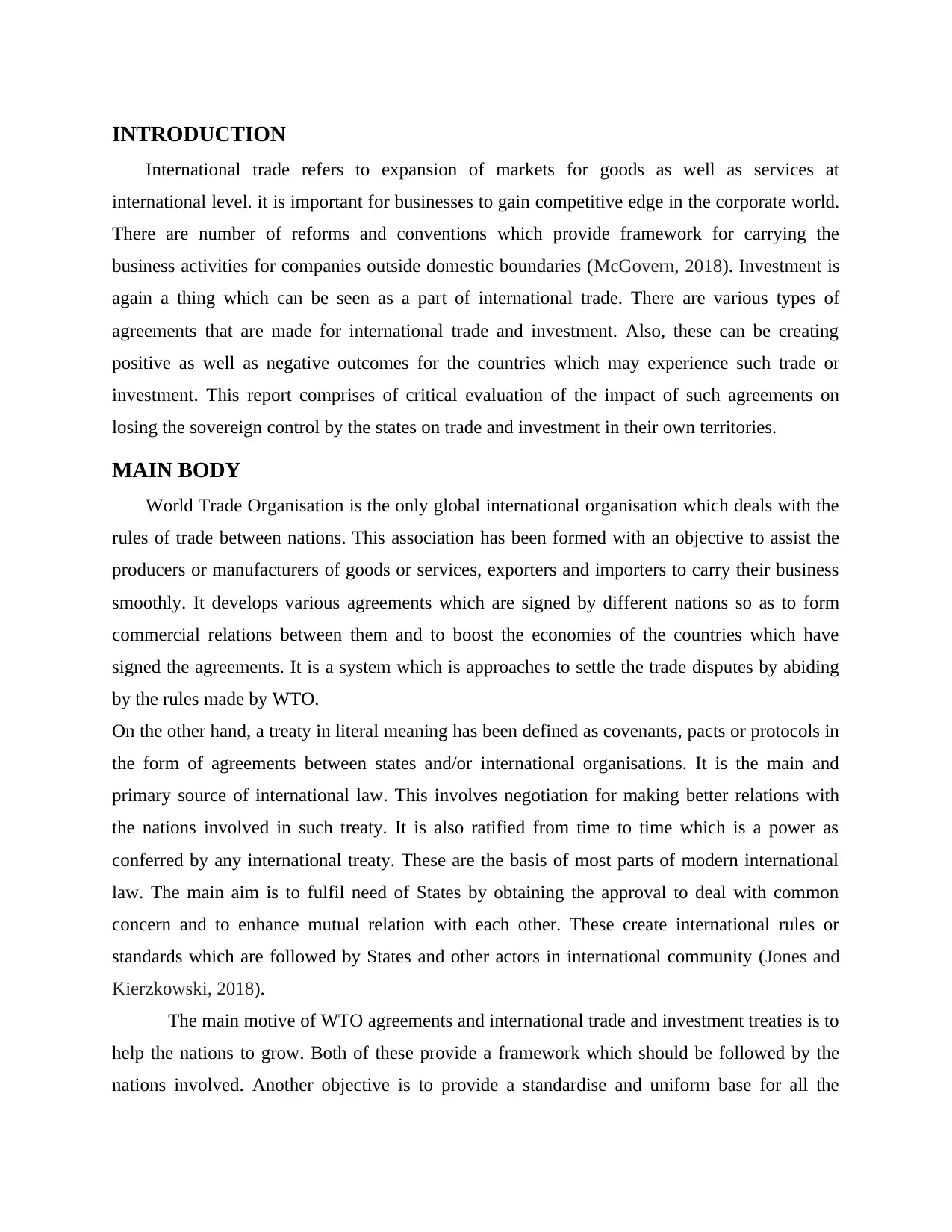
International trade refers to expansion of markets for goods as well as services at
international level. it is important for businesses to gain competitive edge in the corporate world.
There are number of reforms and conventions which provide framework for carrying the
business activities for companies outside domestic boundaries (McGovern, 2018). Investment is
again a thing which can be seen as a part of international trade. There are various types of
agreements that are made for international trade and investment. Also, these can be creating
positive as well as negative outcomes for the countries which may experience such trade or
investment. This report comprises of critical evaluation of the impact of such agreements on
losing the sovereign control by the states on trade and investment in their own territories.
MAIN BODY
World Trade Organisation is the only global international organisation which deals with the
rules of trade between nations. This association has been formed with an objective to assist the
producers or manufacturers of goods or services, exporters and importers to carry their business
smoothly. It develops various agreements which are signed by different nations so as to form
commercial relations between them and to boost the economies of the countries which have
signed the agreements. It is a system which is approaches to settle the trade disputes by abiding
by the rules made by WTO.
On the other hand, a treaty in literal meaning has been defined as covenants, pacts or protocols in
the form of agreements between states and/or international organisations. It is the main and
primary source of international law. This involves negotiation for making better relations with
the nations involved in such treaty. It is also ratified from time to time which is a power as
conferred by any international treaty. These are the basis of most parts of modern international
law. The main aim is to fulfil need of States by obtaining the approval to deal with common
concern and to enhance mutual relation with each other. These create international rules or
standards which are followed by States and other actors in international community (Jones and
Kierzkowski, 2018).
The main motive of WTO agreements and international trade and investment treaties is to
help the nations to grow. Both of these provide a framework which should be followed by the
nations involved. Another objective is to provide a standardise and uniform base for all the
International trade refers to expansion of markets for goods as well as services at
international level. it is important for businesses to gain competitive edge in the corporate world.
There are number of reforms and conventions which provide framework for carrying the
business activities for companies outside domestic boundaries (McGovern, 2018). Investment is
again a thing which can be seen as a part of international trade. There are various types of
agreements that are made for international trade and investment. Also, these can be creating
positive as well as negative outcomes for the countries which may experience such trade or
investment. This report comprises of critical evaluation of the impact of such agreements on
losing the sovereign control by the states on trade and investment in their own territories.
MAIN BODY
World Trade Organisation is the only global international organisation which deals with the
rules of trade between nations. This association has been formed with an objective to assist the
producers or manufacturers of goods or services, exporters and importers to carry their business
smoothly. It develops various agreements which are signed by different nations so as to form
commercial relations between them and to boost the economies of the countries which have
signed the agreements. It is a system which is approaches to settle the trade disputes by abiding
by the rules made by WTO.
On the other hand, a treaty in literal meaning has been defined as covenants, pacts or protocols in
the form of agreements between states and/or international organisations. It is the main and
primary source of international law. This involves negotiation for making better relations with
the nations involved in such treaty. It is also ratified from time to time which is a power as
conferred by any international treaty. These are the basis of most parts of modern international
law. The main aim is to fulfil need of States by obtaining the approval to deal with common
concern and to enhance mutual relation with each other. These create international rules or
standards which are followed by States and other actors in international community (Jones and
Kierzkowski, 2018).
The main motive of WTO agreements and international trade and investment treaties is to
help the nations to grow. Both of these provide a framework which should be followed by the
nations involved. Another objective is to provide a standardise and uniform base for all the
⊘ This is a preview!⊘
Do you want full access?
Subscribe today to unlock all pages.

Trusted by 1+ million students worldwide
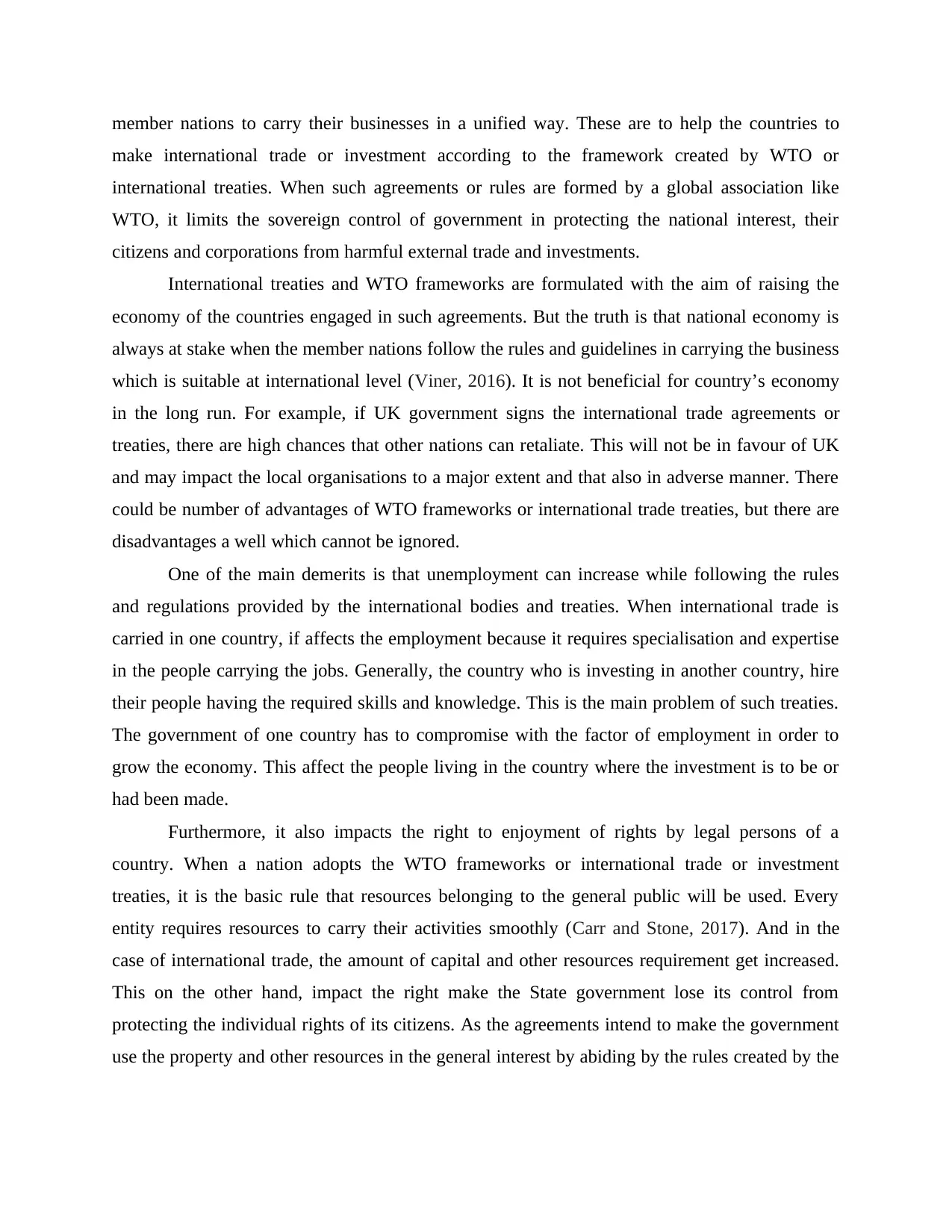
member nations to carry their businesses in a unified way. These are to help the countries to
make international trade or investment according to the framework created by WTO or
international treaties. When such agreements or rules are formed by a global association like
WTO, it limits the sovereign control of government in protecting the national interest, their
citizens and corporations from harmful external trade and investments.
International treaties and WTO frameworks are formulated with the aim of raising the
economy of the countries engaged in such agreements. But the truth is that national economy is
always at stake when the member nations follow the rules and guidelines in carrying the business
which is suitable at international level (Viner, 2016). It is not beneficial for country’s economy
in the long run. For example, if UK government signs the international trade agreements or
treaties, there are high chances that other nations can retaliate. This will not be in favour of UK
and may impact the local organisations to a major extent and that also in adverse manner. There
could be number of advantages of WTO frameworks or international trade treaties, but there are
disadvantages a well which cannot be ignored.
One of the main demerits is that unemployment can increase while following the rules
and regulations provided by the international bodies and treaties. When international trade is
carried in one country, if affects the employment because it requires specialisation and expertise
in the people carrying the jobs. Generally, the country who is investing in another country, hire
their people having the required skills and knowledge. This is the main problem of such treaties.
The government of one country has to compromise with the factor of employment in order to
grow the economy. This affect the people living in the country where the investment is to be or
had been made.
Furthermore, it also impacts the right to enjoyment of rights by legal persons of a
country. When a nation adopts the WTO frameworks or international trade or investment
treaties, it is the basic rule that resources belonging to the general public will be used. Every
entity requires resources to carry their activities smoothly (Carr and Stone, 2017). And in the
case of international trade, the amount of capital and other resources requirement get increased.
This on the other hand, impact the right make the State government lose its control from
protecting the individual rights of its citizens. As the agreements intend to make the government
use the property and other resources in the general interest by abiding by the rules created by the
make international trade or investment according to the framework created by WTO or
international treaties. When such agreements or rules are formed by a global association like
WTO, it limits the sovereign control of government in protecting the national interest, their
citizens and corporations from harmful external trade and investments.
International treaties and WTO frameworks are formulated with the aim of raising the
economy of the countries engaged in such agreements. But the truth is that national economy is
always at stake when the member nations follow the rules and guidelines in carrying the business
which is suitable at international level (Viner, 2016). It is not beneficial for country’s economy
in the long run. For example, if UK government signs the international trade agreements or
treaties, there are high chances that other nations can retaliate. This will not be in favour of UK
and may impact the local organisations to a major extent and that also in adverse manner. There
could be number of advantages of WTO frameworks or international trade treaties, but there are
disadvantages a well which cannot be ignored.
One of the main demerits is that unemployment can increase while following the rules
and regulations provided by the international bodies and treaties. When international trade is
carried in one country, if affects the employment because it requires specialisation and expertise
in the people carrying the jobs. Generally, the country who is investing in another country, hire
their people having the required skills and knowledge. This is the main problem of such treaties.
The government of one country has to compromise with the factor of employment in order to
grow the economy. This affect the people living in the country where the investment is to be or
had been made.
Furthermore, it also impacts the right to enjoyment of rights by legal persons of a
country. When a nation adopts the WTO frameworks or international trade or investment
treaties, it is the basic rule that resources belonging to the general public will be used. Every
entity requires resources to carry their activities smoothly (Carr and Stone, 2017). And in the
case of international trade, the amount of capital and other resources requirement get increased.
This on the other hand, impact the right make the State government lose its control from
protecting the individual rights of its citizens. As the agreements intend to make the government
use the property and other resources in the general interest by abiding by the rules created by the
Paraphrase This Document
Need a fresh take? Get an instant paraphrase of this document with our AI Paraphraser
WTO or international treaties. This is the adverse of the protection and promotion of individual
wealth maximization.
Another downfall being the restriction that the State government has to face while such
agreements or treaties have been implemented. There may be number of disputes related to
public interest which cannot be resolved with under the guidance of the State government. The
first rule that the government of a country has to follow is to not to take the matters in their hands
which may be against the international trade agreements. There may be different parties affecting
from international trade law or treaties and raise their voice against them, this becomes a matter
of national interest which should be avoided by the government at first. There should not be
direct participations by the government and such conflicts should be resolved under the guidance
of such agreements or frameworks (Burstein and Vogel, 2017).
However, in order to overcome this issue, there are number of systems in the form of
various agreements such as Investor- Trade Settlement System, Free Trade Agreements and
Bilateral Investment Treaties which are for the benefit of the people living in a country. These
are to assist the citizens to get their issues resolved by the government as they used to get
resolved before any such agreements and treaties. These are useful in striking a balance between
the corporate rights and rights of governments to regulate. Since, the countries have to consider
the interest of the international trade and investment agreements first before they take the matters
of national interest in their hands. The above-mentioned systems can be helpful in providing
assistance for the resolving the matters in a quick way.
The other disadvantage is that; the government has to follow rules of such agreements as
well as the rules prevailing in the country. There may be situations of disputes between the
matter of national interest which may not be in the favour of international trade laws. There can
arise which rules and guidelines to be followed. These restrict the government to develop a
system establish a system which may mitigate the adverse effect of such regulations on the
citizens and corporates of that particular country. The government has to give more importance
to international obligations as compared to national interest (Ricky, GRIFFIN and MIKE, 2019).
There are number of conventions and treaties that are entered by the UK such as Hague
Convention on the Protection of Cultural Property which provides the protocol for protecting the
properties of the UK. In the year, 1970 another convention was formed in the form of Means of
Prohibiting and Preventing the Illicit Import, Export and Transfer Ownership of Cultural
wealth maximization.
Another downfall being the restriction that the State government has to face while such
agreements or treaties have been implemented. There may be number of disputes related to
public interest which cannot be resolved with under the guidance of the State government. The
first rule that the government of a country has to follow is to not to take the matters in their hands
which may be against the international trade agreements. There may be different parties affecting
from international trade law or treaties and raise their voice against them, this becomes a matter
of national interest which should be avoided by the government at first. There should not be
direct participations by the government and such conflicts should be resolved under the guidance
of such agreements or frameworks (Burstein and Vogel, 2017).
However, in order to overcome this issue, there are number of systems in the form of
various agreements such as Investor- Trade Settlement System, Free Trade Agreements and
Bilateral Investment Treaties which are for the benefit of the people living in a country. These
are to assist the citizens to get their issues resolved by the government as they used to get
resolved before any such agreements and treaties. These are useful in striking a balance between
the corporate rights and rights of governments to regulate. Since, the countries have to consider
the interest of the international trade and investment agreements first before they take the matters
of national interest in their hands. The above-mentioned systems can be helpful in providing
assistance for the resolving the matters in a quick way.
The other disadvantage is that; the government has to follow rules of such agreements as
well as the rules prevailing in the country. There may be situations of disputes between the
matter of national interest which may not be in the favour of international trade laws. There can
arise which rules and guidelines to be followed. These restrict the government to develop a
system establish a system which may mitigate the adverse effect of such regulations on the
citizens and corporates of that particular country. The government has to give more importance
to international obligations as compared to national interest (Ricky, GRIFFIN and MIKE, 2019).
There are number of conventions and treaties that are entered by the UK such as Hague
Convention on the Protection of Cultural Property which provides the protocol for protecting the
properties of the UK. In the year, 1970 another convention was formed in the form of Means of
Prohibiting and Preventing the Illicit Import, Export and Transfer Ownership of Cultural
Property. In the year, 1972 Convention such as protection of the World Cultural and National
Heritage. There are many other treaties which have been formed by United Kingdom in order to
protect the economy of the country from any harm or damages.
Apart from this, there is the right of government to ratify the treaties after they have been
implemented within the country. The government should not exercise immediate control or take
action right after executing such rules or agreements. There is a time period given for this
purpose which should be opted in order to monitor the outcomes and incorporate the changes for
the benefit of the country. This is to fulfil the motive for which the agreements have been
executed. Furthermore, the Parliament does not hold any right to amend the treaties. The
government can only negotiate them but there is no such provision through which it can bring
modifications in the existing or new treaties (Meyer, 2017).
Treaties and WTO frameworks are generally for promoting the foreign investment which
accelerates the flow of international flow in the territory. This gives a right to the foreign party to
select the assets from the national resources and assets. This is clear dilution of the interest of the
citizens of that country in which the foreign investment has been made. There may appear the
convenience for the foreign parties to choose from the national resources which are suitable for
making the international trade successful. This impact the national properties and other resources
which lead to domestic business to lose their market share to international companies. Also, the
international treaties make the country give more importance to such treaties instead of domestic
business.
In addition to this, there may be some treaties that may provide obligations to be enforced
and fulfilled by the home investors. This makes the domestic corporate lose their rights as well
as investors feel restricted. They are attracted to make investment in foreign avenues in order to
get good return. This is one of the main reasons which may hamper the success of the
corporations carrying their business in the home country. Furthermore, the international
investment makes domestic entities to have lower competitive advantage as compared to foreign
companies. These are adverse to the benefit of the people and corporate living and operating in
the home country (Pauwelyn, Guzman and Hillman, 2016).
While most states in the world have signed and ratified at least one investment treaty, the
pattern of global foreign direct investment (FDI) flows has ensured that, until quite recently,
developing countries have almost exclusively acted as respondents in arbitration. In fact, with
Heritage. There are many other treaties which have been formed by United Kingdom in order to
protect the economy of the country from any harm or damages.
Apart from this, there is the right of government to ratify the treaties after they have been
implemented within the country. The government should not exercise immediate control or take
action right after executing such rules or agreements. There is a time period given for this
purpose which should be opted in order to monitor the outcomes and incorporate the changes for
the benefit of the country. This is to fulfil the motive for which the agreements have been
executed. Furthermore, the Parliament does not hold any right to amend the treaties. The
government can only negotiate them but there is no such provision through which it can bring
modifications in the existing or new treaties (Meyer, 2017).
Treaties and WTO frameworks are generally for promoting the foreign investment which
accelerates the flow of international flow in the territory. This gives a right to the foreign party to
select the assets from the national resources and assets. This is clear dilution of the interest of the
citizens of that country in which the foreign investment has been made. There may appear the
convenience for the foreign parties to choose from the national resources which are suitable for
making the international trade successful. This impact the national properties and other resources
which lead to domestic business to lose their market share to international companies. Also, the
international treaties make the country give more importance to such treaties instead of domestic
business.
In addition to this, there may be some treaties that may provide obligations to be enforced
and fulfilled by the home investors. This makes the domestic corporate lose their rights as well
as investors feel restricted. They are attracted to make investment in foreign avenues in order to
get good return. This is one of the main reasons which may hamper the success of the
corporations carrying their business in the home country. Furthermore, the international
investment makes domestic entities to have lower competitive advantage as compared to foreign
companies. These are adverse to the benefit of the people and corporate living and operating in
the home country (Pauwelyn, Guzman and Hillman, 2016).
While most states in the world have signed and ratified at least one investment treaty, the
pattern of global foreign direct investment (FDI) flows has ensured that, until quite recently,
developing countries have almost exclusively acted as respondents in arbitration. In fact, with
⊘ This is a preview!⊘
Do you want full access?
Subscribe today to unlock all pages.
Trusted by 1+ million students worldwide
some notable exceptions, few very wealthy or very poor nations have been taken to arbitration;
the former do not, on the whole, receive inward FDI flows that are covered by an international
investment agreement (IIA), while very low-income countries do not host very much investment
at all. Large multilateral or regional trade agreements with investment chapters, such as the
Energy Charter Treaty (ECT) and the North American Free Trade Agreement (NAFTA), depart
from this pattern somewhat, although at least with regard to the ECT, the respondents have
generally been Eastern European and Commonwealth of Independent States (CIS), with
claimants coming from Western Europe.
Of course, state actors and institutions do have an important role to play in investor-state
arbitration cases, as most disputes center on matters of domestic policy, and are triggered by
measures taken by these actors (Niepmann and Schmidt-Eisenlohr, 2017). An overview of the
domestic institutions that have taken the disputed measures can shed light on the decision-
making processes that lead to an investor-state dispute, as well as the domestic interests at the
heart of the conflict. Finally, the World Bank’s measures of control of corruption and
government effectiveness are both negatively correlated with the likelihood of a dispute,
meaning that states that experience lower levels of corruption and more effective bureaucracies
are less likely to be implicated in an investor-state dispute. However, the government
effectiveness variable did not have a statistically significant correlation with the dependent
variable, indicating that the relationship is slightly ambiguous.
The findings regarding veto players and corruption are unsurprising, and correspond with
the bulk of literature on what makes states risky locations for FDI. On the other hand, the
relationship between democracy levels and investor-state arbitration cases is less intuitive, and
suggests a possible relationship between democratic governance and the policy measures
challenged by investors. One explanation for these ambiguous findings is the heterogeneous
nature of the object of study. As will be discussed at greater length below, and as anyone familiar
with the regime is aware, investors are challenging quite a wide array of state measures, from
expropriation to contractual changes to the final rulings of environmental impact assessments.
Therefore, it is more difficult in this case to formulate causal relationships between specific
domestic institutions and the many policy measures that trigger investor-state disputes, than in
the case of studies that look only at the domestic determinants of expropriation (Moon, 2018).
the former do not, on the whole, receive inward FDI flows that are covered by an international
investment agreement (IIA), while very low-income countries do not host very much investment
at all. Large multilateral or regional trade agreements with investment chapters, such as the
Energy Charter Treaty (ECT) and the North American Free Trade Agreement (NAFTA), depart
from this pattern somewhat, although at least with regard to the ECT, the respondents have
generally been Eastern European and Commonwealth of Independent States (CIS), with
claimants coming from Western Europe.
Of course, state actors and institutions do have an important role to play in investor-state
arbitration cases, as most disputes center on matters of domestic policy, and are triggered by
measures taken by these actors (Niepmann and Schmidt-Eisenlohr, 2017). An overview of the
domestic institutions that have taken the disputed measures can shed light on the decision-
making processes that lead to an investor-state dispute, as well as the domestic interests at the
heart of the conflict. Finally, the World Bank’s measures of control of corruption and
government effectiveness are both negatively correlated with the likelihood of a dispute,
meaning that states that experience lower levels of corruption and more effective bureaucracies
are less likely to be implicated in an investor-state dispute. However, the government
effectiveness variable did not have a statistically significant correlation with the dependent
variable, indicating that the relationship is slightly ambiguous.
The findings regarding veto players and corruption are unsurprising, and correspond with
the bulk of literature on what makes states risky locations for FDI. On the other hand, the
relationship between democracy levels and investor-state arbitration cases is less intuitive, and
suggests a possible relationship between democratic governance and the policy measures
challenged by investors. One explanation for these ambiguous findings is the heterogeneous
nature of the object of study. As will be discussed at greater length below, and as anyone familiar
with the regime is aware, investors are challenging quite a wide array of state measures, from
expropriation to contractual changes to the final rulings of environmental impact assessments.
Therefore, it is more difficult in this case to formulate causal relationships between specific
domestic institutions and the many policy measures that trigger investor-state disputes, than in
the case of studies that look only at the domestic determinants of expropriation (Moon, 2018).
Paraphrase This Document
Need a fresh take? Get an instant paraphrase of this document with our AI Paraphraser
The concentration of investor-state disputes in middle-income countries is, as discussed above, at
least in part due to the historical pattern of FDI flows. However, both approaches to compliance
may offer additional explanations. For example, developing countries may have less experienced
or less effective bureaucracies and legal teams, and thus, as the managerial approach to
compliance suggests, may have more trouble interpreting IIAs and maintaining policy stability
for investors. There is some evidence to suggest that this is the case – as mentioned above,
government effectiveness and control of corruption are negatively associated with the likelihood
of an investor-state dispute (Rivera-Batiz and Rivera-Batil, 2018).
Therefore, there are circumstances where there the government lose its control over the
national interest. The above mentioned situations clearly the dilution of the power of the
government.
CONCLUSION
From the above report, it has been concluded that international trade law is for promoting
the foreign investment. Every country looks for the investment to boost the economy which
includes the betterment of the social interest. There are conventions and agreements which are
formulated for the government to follow and carry the business accordingly. Furthermore, there
is requirement to create a balance between the domestic and international trade as an outcome of
the provided rules and guidance.
least in part due to the historical pattern of FDI flows. However, both approaches to compliance
may offer additional explanations. For example, developing countries may have less experienced
or less effective bureaucracies and legal teams, and thus, as the managerial approach to
compliance suggests, may have more trouble interpreting IIAs and maintaining policy stability
for investors. There is some evidence to suggest that this is the case – as mentioned above,
government effectiveness and control of corruption are negatively associated with the likelihood
of an investor-state dispute (Rivera-Batiz and Rivera-Batil, 2018).
Therefore, there are circumstances where there the government lose its control over the
national interest. The above mentioned situations clearly the dilution of the power of the
government.
CONCLUSION
From the above report, it has been concluded that international trade law is for promoting
the foreign investment. Every country looks for the investment to boost the economy which
includes the betterment of the social interest. There are conventions and agreements which are
formulated for the government to follow and carry the business accordingly. Furthermore, there
is requirement to create a balance between the domestic and international trade as an outcome of
the provided rules and guidance.
REFERENCES
Books & Journals:
McGovern, E., 2018. International trade regulation (Vol. 1). Globefield Press.
Jones, R.W. and Kierzkowski, H., 2018. The role of services in production and international
trade: A theoretical framework. World Scientific Book Chapters, pp.233-253.
Viner, J., 2016. Studies in the theory of international trade. Routledge.
Carr, I. and Stone, P., 2017. International trade law. Routledge.
Burstein, A. and Vogel, J., 2017. International trade, technology, and the skill premium. Journal
of Political Economy. 125(5). pp.1356-1412.
Ricky, W., GRIFFIN, P. and MIKE, W., 2019. International business: A managerial perspective.
Pearson.
Meyer, F.V., 2017. International trade policy. Routledge.
Pauwelyn, J.H., Guzman, A. and Hillman, J.A., 2016. International trade law. Wolters Kluwer
Law & Business.
Niepmann, F. and Schmidt-Eisenlohr, T., 2017. International trade, risk and the role of
banks. Journal of International Economics. 107. pp.111-126.
Moon, B.E., 2018. Dilemmas of international trade. Routledge.
Rivera-Batiz, F. and Rivera-Batiz, L., 2018. International trade, capital flows and economic
development. World Scientific Publishing Co. Pte. Ltd..
Chaney, T., 2016. Networks in international trade. In The Oxford handbook of the economics of
networks.
Books & Journals:
McGovern, E., 2018. International trade regulation (Vol. 1). Globefield Press.
Jones, R.W. and Kierzkowski, H., 2018. The role of services in production and international
trade: A theoretical framework. World Scientific Book Chapters, pp.233-253.
Viner, J., 2016. Studies in the theory of international trade. Routledge.
Carr, I. and Stone, P., 2017. International trade law. Routledge.
Burstein, A. and Vogel, J., 2017. International trade, technology, and the skill premium. Journal
of Political Economy. 125(5). pp.1356-1412.
Ricky, W., GRIFFIN, P. and MIKE, W., 2019. International business: A managerial perspective.
Pearson.
Meyer, F.V., 2017. International trade policy. Routledge.
Pauwelyn, J.H., Guzman, A. and Hillman, J.A., 2016. International trade law. Wolters Kluwer
Law & Business.
Niepmann, F. and Schmidt-Eisenlohr, T., 2017. International trade, risk and the role of
banks. Journal of International Economics. 107. pp.111-126.
Moon, B.E., 2018. Dilemmas of international trade. Routledge.
Rivera-Batiz, F. and Rivera-Batiz, L., 2018. International trade, capital flows and economic
development. World Scientific Publishing Co. Pte. Ltd..
Chaney, T., 2016. Networks in international trade. In The Oxford handbook of the economics of
networks.
⊘ This is a preview!⊘
Do you want full access?
Subscribe today to unlock all pages.
Trusted by 1+ million students worldwide

1

1 out of 10


Related Documents


Your All-in-One AI-Powered Toolkit for Academic Success.
+13062052269
info@desklib.com
Available 24*7 on WhatsApp / Email
![[object Object]](/_next/static/media/star-bottom.7253800d.svg)
Unlock your academic potential
Copyright © 2020–2026 A2Z Services. All Rights Reserved. Developed and managed by ZUCOL.