Business Research Project: Analysis of Australia's International Trade

Verified

Added on  2022/12/22

|5
|1417
|92
Report
AI Summary
This business research project investigates Australia's international trade, focusing on exports and imports. The report begins with an introduction to international trade, highlighting the role of the Customs department and trade agreements. It then outlines the research methodology, which includes a literature review of relevant topics and the use of quantitative methods with expert sampling to collect financial data from companies. The study analyzes the data to identify key export and import products, along with any discrepancies in the collected information. The research experience emphasized teamwork, systematic problem-solving, and the importance of avoiding bias in the analysis. The report concludes with the major findings, references, and a reflection on the research process.
Document Page
BUSINESS RESEARCH
0
tabler-icon-diamond-filled.svg

Paraphrase This Document

Need a fresh take? Get an instant paraphrase of this document with our AI Paraphraser
Document Page
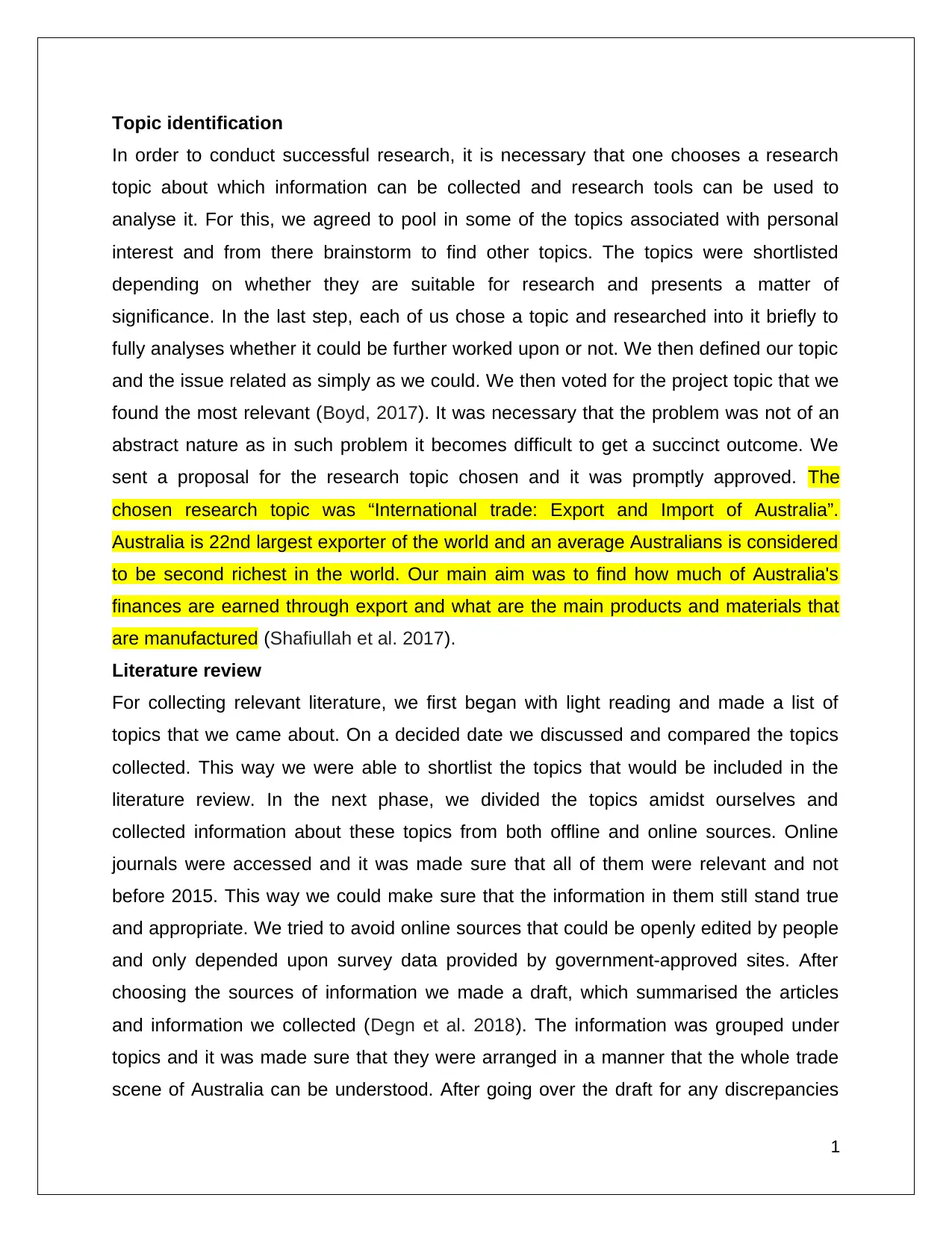
Topic identification
In order to conduct successful research, it is necessary that one chooses a research
topic about which information can be collected and research tools can be used to
analyse it. For this, we agreed to pool in some of the topics associated with personal
interest and from there brainstorm to find other topics. The topics were shortlisted
depending on whether they are suitable for research and presents a matter of
significance. In the last step, each of us chose a topic and researched into it briefly to
fully analyses whether it could be further worked upon or not. We then defined our topic
and the issue related as simply as we could. We then voted for the project topic that we
found the most relevant (Boyd, 2017). It was necessary that the problem was not of an
abstract nature as in such problem it becomes difficult to get a succinct outcome. We
sent a proposal for the research topic chosen and it was promptly approved. The
chosen research topic was “International trade: Export and Import of Australia”.
Australia is 22nd largest exporter of the world and an average Australians is considered
to be second richest in the world. Our main aim was to find how much of Australia's
finances are earned through export and what are the main products and materials that
are manufactured (Shafiullah et al. 2017).
Literature review
For collecting relevant literature, we first began with light reading and made a list of
topics that we came about. On a decided date we discussed and compared the topics
collected. This way we were able to shortlist the topics that would be included in the
literature review. In the next phase, we divided the topics amidst ourselves and
collected information about these topics from both offline and online sources. Online
journals were accessed and it was made sure that all of them were relevant and not
before 2015. This way we could make sure that the information in them still stand true
and appropriate. We tried to avoid online sources that could be openly edited by people
and only depended upon survey data provided by government-approved sites. After
choosing the sources of information we made a draft, which summarised the articles
and information we collected (Degn et al. 2018). The information was grouped under
topics and it was made sure that they were arranged in a manner that the whole trade
scene of Australia can be understood. After going over the draft for any discrepancies
1
Document Page
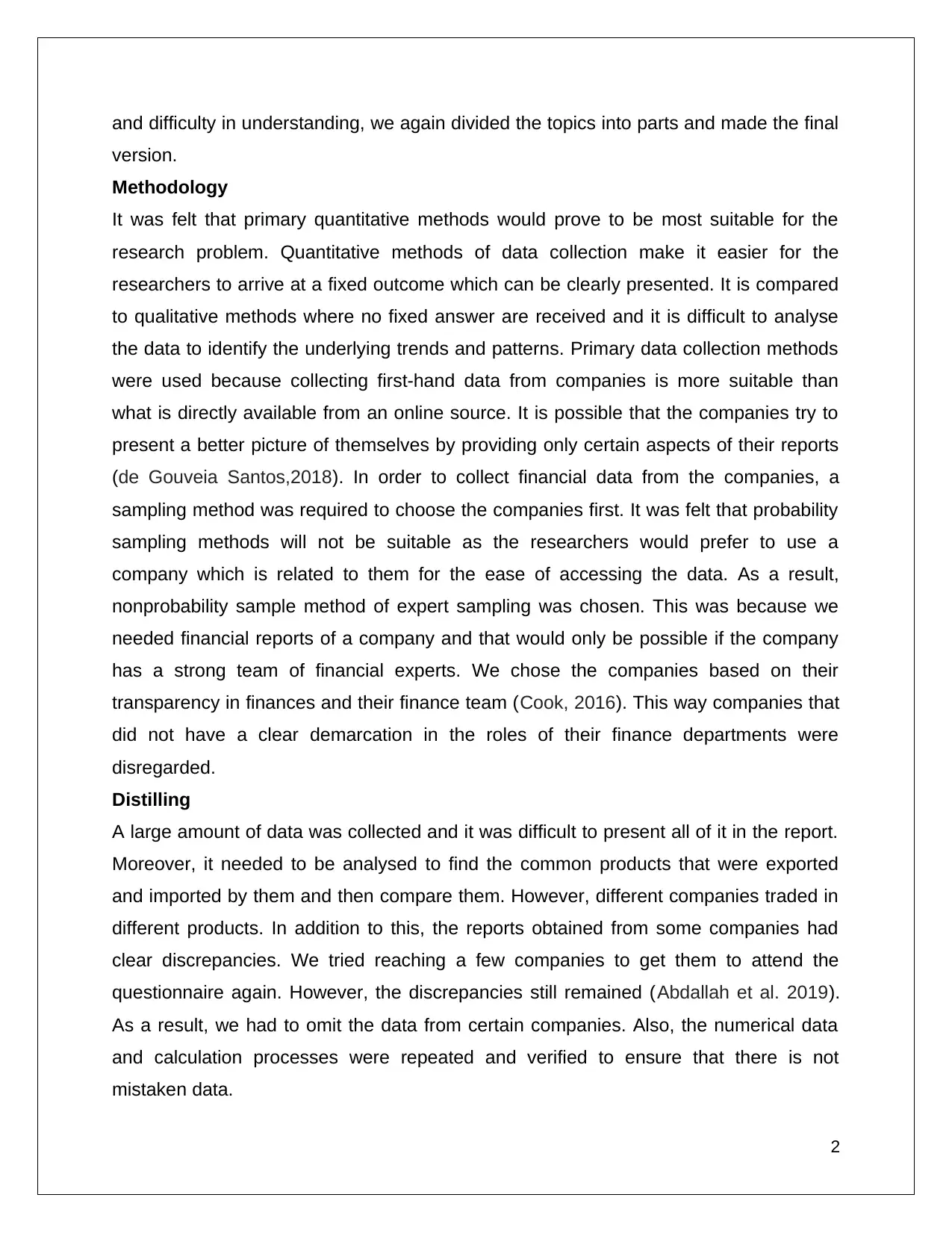
and difficulty in understanding, we again divided the topics into parts and made the final
version.
Methodology
It was felt that primary quantitative methods would prove to be most suitable for the
research problem. Quantitative methods of data collection make it easier for the
researchers to arrive at a fixed outcome which can be clearly presented. It is compared
to qualitative methods where no fixed answer are received and it is difficult to analyse
the data to identify the underlying trends and patterns. Primary data collection methods
were used because collecting first-hand data from companies is more suitable than
what is directly available from an online source. It is possible that the companies try to
present a better picture of themselves by providing only certain aspects of their reports
(de Gouveia Santos,2018). In order to collect financial data from the companies, a
sampling method was required to choose the companies first. It was felt that probability
sampling methods will not be suitable as the researchers would prefer to use a
company which is related to them for the ease of accessing the data. As a result,
nonprobability sample method of expert sampling was chosen. This was because we
needed financial reports of a company and that would only be possible if the company
has a strong team of financial experts. We chose the companies based on their
transparency in finances and their finance team (Cook, 2016). This way companies that
did not have a clear demarcation in the roles of their finance departments were
disregarded.
Distilling
A large amount of data was collected and it was difficult to present all of it in the report.
Moreover, it needed to be analysed to find the common products that were exported
and imported by them and then compare them. However, different companies traded in
different products. In addition to this, the reports obtained from some companies had
clear discrepancies. We tried reaching a few companies to get them to attend the
questionnaire again. However, the discrepancies still remained (Abdallah et al. 2019).
As a result, we had to omit the data from certain companies. Also, the numerical data
and calculation processes were repeated and verified to ensure that there is not
mistaken data.
2
Document Page
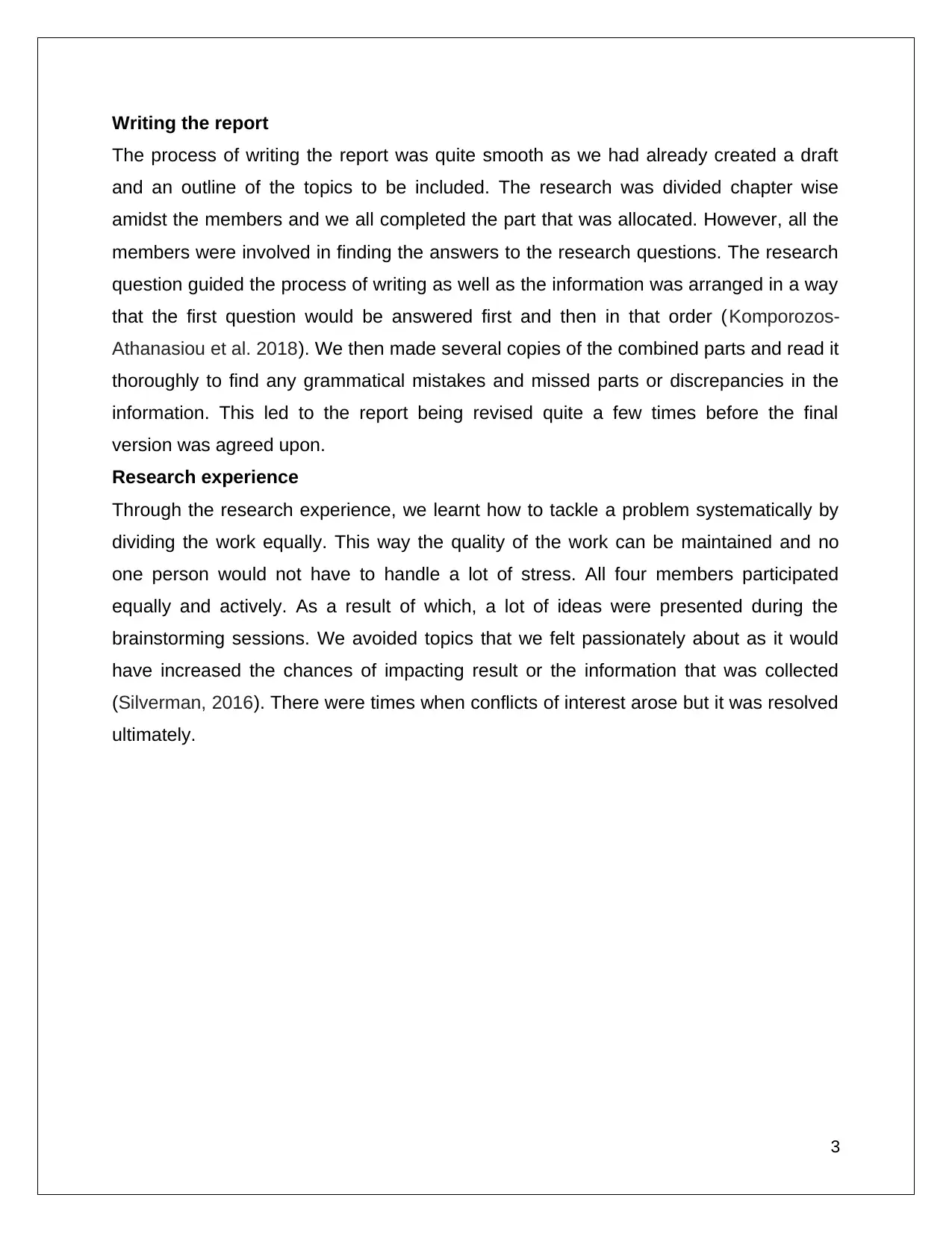
Writing the report
The process of writing the report was quite smooth as we had already created a draft
and an outline of the topics to be included. The research was divided chapter wise
amidst the members and we all completed the part that was allocated. However, all the
members were involved in finding the answers to the research questions. The research
question guided the process of writing as well as the information was arranged in a way
that the first question would be answered first and then in that order (Komporozos-
Athanasiou et al. 2018). We then made several copies of the combined parts and read it
thoroughly to find any grammatical mistakes and missed parts or discrepancies in the
information. This led to the report being revised quite a few times before the final
version was agreed upon.
Research experience
Through the research experience, we learnt how to tackle a problem systematically by
dividing the work equally. This way the quality of the work can be maintained and no
one person would not have to handle a lot of stress. All four members participated
equally and actively. As a result of which, a lot of ideas were presented during the
brainstorming sessions. We avoided topics that we felt passionately about as it would
have increased the chances of impacting result or the information that was collected
(Silverman, 2016). There were times when conflicts of interest arose but it was resolved
ultimately.
3
tabler-icon-diamond-filled.svg

Paraphrase This Document

Need a fresh take? Get an instant paraphrase of this document with our AI Paraphraser
Document Page
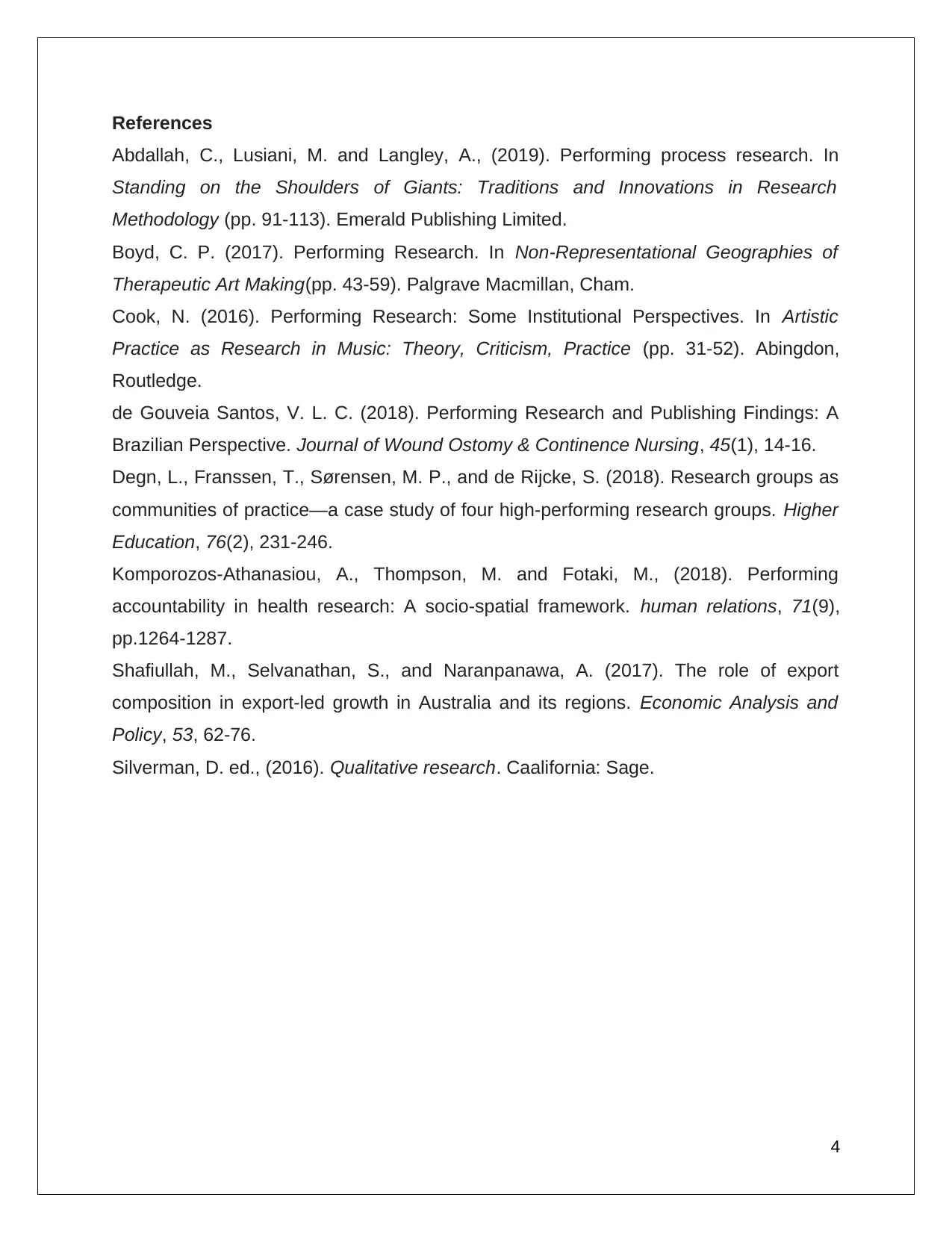
References
Abdallah, C., Lusiani, M. and Langley, A., (2019). Performing process research. In
Standing on the Shoulders of Giants: Traditions and Innovations in Research
Methodology (pp. 91-113). Emerald Publishing Limited.
Boyd, C. P. (2017). Performing Research. In Non-Representational Geographies of
Therapeutic Art Making(pp. 43-59). Palgrave Macmillan, Cham.
Cook, N. (2016). Performing Research: Some Institutional Perspectives. In Artistic
Practice as Research in Music: Theory, Criticism, Practice (pp. 31-52). Abingdon,
Routledge.
de Gouveia Santos, V. L. C. (2018). Performing Research and Publishing Findings: A
Brazilian Perspective. Journal of Wound Ostomy & Continence Nursing, 45(1), 14-16.
Degn, L., Franssen, T., Sørensen, M. P., and de Rijcke, S. (2018). Research groups as
communities of practice—a case study of four high-performing research groups. Higher
Education, 76(2), 231-246.
Komporozos-Athanasiou, A., Thompson, M. and Fotaki, M., (2018). Performing
accountability in health research: A socio-spatial framework. human relations, 71(9),
pp.1264-1287.
Shafiullah, M., Selvanathan, S., and Naranpanawa, A. (2017). The role of export
composition in export-led growth in Australia and its regions. Economic Analysis and
Policy, 53, 62-76.
Silverman, D. ed., (2016). Qualitative research. Caalifornia: Sage.
4
chevron_up_icon
1 out of 5
circle_padding
hide_on_mobile
zoom_out_icon
[object Object]