BFA603: International Trade Law - Case Study and Analysis
VerifiedAdded on 2022/07/29
|10
|2698
|24
Project
AI Summary
This assignment analyzes a complex international trade case involving a clothing company, its Japanese supplier, and an Australian buyer. The case explores various legal issues arising from the sale of goods, including breach of contract, damages, and liabilities related to shipping. The analysis delves into the application of the United Nations Convention on Contracts for the International Sale of Goods (CISG), incoterms (specifically CIP), and the Hague Rules. It examines the responsibilities of the seller, buyer, and shipping company, addressing questions of payment obligations, liability for damaged goods, and the recovery of costs. The analysis considers the impact of the incoterm CIP on the transfer of risk and the applicability of relevant international conventions. The assignment concludes by highlighting the complexities of international trade regulations and the importance of understanding how different laws and practices interact in real-world scenarios.
International Trade Regulations and Practice 1
INTERNATIONAL TRADE REGULATIONS AND PRACTICE
Student by (Name)
Professor’s (Name)
College
Course
Date
INTERNATIONAL TRADE REGULATIONS AND PRACTICE
Student by (Name)
Professor’s (Name)
College
Course
Date

Paraphrase This Document
Need a fresh take? Get an instant paraphrase of this document with our AI Paraphraser
International Trade Regulations and Practice 2
Introduction
Ali the owner of a local clothing company Alhorb Co. in Hobart Australia has decided to
sell Harajuku style clothing. He therefore has contacted Benji from Hajima Co. in Yokohama,
Japan after thorough research of possible sellers. Ali agrees to purchase 2500 pieces from Benji
whose value is at AUD 35,000 after getting into a contract incorporating incoterm CIP with the
delivery destination as the port of Melbourne.
He awaits delivery through a subsidiary shipping company of Hajima Co. that operates in
Thailand as mentioned by Benji during negotiations. While shipping there are unexpected
circumstances that interfere with the quality of 1000 pieces making them muddy in addition to
the already damaged 20 pieces. The delivery is made to port of Melbourne on time yet Ali’s
agent neglects to confirm the mouldy pieces.
Furthermore, the agent uses an extra AUD 5,000 for air service when he realizes the
order would be delayed by a day. When Ali gets hold of the pieces and a bill of AUD 40,000 he
refuses to pay the order and the agent for the air service then he sues Benji and Hajima Co. for
damages.
Issues
There are several issues involved in this case, these are: should Ali pay for the order
priced at AUD 40,000? who is responsible for damages by the shipment company? who should
pay the extra AUD 5,000 that Ali’s agent used for air service? Can Ali sue Benji and Hajima Co.
for the quality of the pieces and delay in delivery and lastly are there implications for Hajima Co.
being fully owned by an English Company?
Introduction
Ali the owner of a local clothing company Alhorb Co. in Hobart Australia has decided to
sell Harajuku style clothing. He therefore has contacted Benji from Hajima Co. in Yokohama,
Japan after thorough research of possible sellers. Ali agrees to purchase 2500 pieces from Benji
whose value is at AUD 35,000 after getting into a contract incorporating incoterm CIP with the
delivery destination as the port of Melbourne.
He awaits delivery through a subsidiary shipping company of Hajima Co. that operates in
Thailand as mentioned by Benji during negotiations. While shipping there are unexpected
circumstances that interfere with the quality of 1000 pieces making them muddy in addition to
the already damaged 20 pieces. The delivery is made to port of Melbourne on time yet Ali’s
agent neglects to confirm the mouldy pieces.
Furthermore, the agent uses an extra AUD 5,000 for air service when he realizes the
order would be delayed by a day. When Ali gets hold of the pieces and a bill of AUD 40,000 he
refuses to pay the order and the agent for the air service then he sues Benji and Hajima Co. for
damages.
Issues
There are several issues involved in this case, these are: should Ali pay for the order
priced at AUD 40,000? who is responsible for damages by the shipment company? who should
pay the extra AUD 5,000 that Ali’s agent used for air service? Can Ali sue Benji and Hajima Co.
for the quality of the pieces and delay in delivery and lastly are there implications for Hajima Co.
being fully owned by an English Company?
International Trade Regulations and Practice 3
Rules
In order to provide solutions to these critical issues, it necessary to identify some
legislations, laws and conventions that are applicable to the case of Ali. To begin with, on the
basis of these transactions taking place internationally amongst individuals of member states of
the United Nations Convention on the International Sale of Goods, this convention is applicable
in determining equality and mutual benefit of both of the parties involved (DiMatteo 2015).
The CISG defines the process of formation of contracts through general contract elements
such as offer under article 14(1) of the convention and acceptance under article 18(1) and (3) of
the convention. In order for an offer to be sufficient it should contain the quantity of the goods to
be delivered, the price of the goods and a description of the goods. This convention is important
in determining whether Ali and Benji got into a valid contract.
The seller is expected to fulfill his obligations according to article 30 and he should
guarantee that the goods conform to the agreement of the contract (article 35-44). These
obligations include, ensuring that the goods are at per with the contract description as seen in
Elder Smith Goldsbruogh Mort v McBridge Palmer [1976] and implied conditions indicating that
the seller is going to sell the goods as seen in Niblet v Confectioneers Material Co Ltd [1921]
(Kroll and Viscasillas 2015). These conditions in some cases grants buyers the right to reject
non-conforming goods that have been delivered to them.
The delivery should meet the meet these three criteria: fitness for purpose as seen in
Giriza Pte Ltd v Vista Corporation Pty Ltd and in article 35 (2)(b) of CISG, merchantability or
good quality as seen in article 35(1) and conformity to the sample pursuant to article 35(2)(c) of
the convention. The buyer can also claim damages which are a result of late deliveries as seen in
Rules
In order to provide solutions to these critical issues, it necessary to identify some
legislations, laws and conventions that are applicable to the case of Ali. To begin with, on the
basis of these transactions taking place internationally amongst individuals of member states of
the United Nations Convention on the International Sale of Goods, this convention is applicable
in determining equality and mutual benefit of both of the parties involved (DiMatteo 2015).
The CISG defines the process of formation of contracts through general contract elements
such as offer under article 14(1) of the convention and acceptance under article 18(1) and (3) of
the convention. In order for an offer to be sufficient it should contain the quantity of the goods to
be delivered, the price of the goods and a description of the goods. This convention is important
in determining whether Ali and Benji got into a valid contract.
The seller is expected to fulfill his obligations according to article 30 and he should
guarantee that the goods conform to the agreement of the contract (article 35-44). These
obligations include, ensuring that the goods are at per with the contract description as seen in
Elder Smith Goldsbruogh Mort v McBridge Palmer [1976] and implied conditions indicating that
the seller is going to sell the goods as seen in Niblet v Confectioneers Material Co Ltd [1921]
(Kroll and Viscasillas 2015). These conditions in some cases grants buyers the right to reject
non-conforming goods that have been delivered to them.
The delivery should meet the meet these three criteria: fitness for purpose as seen in
Giriza Pte Ltd v Vista Corporation Pty Ltd and in article 35 (2)(b) of CISG, merchantability or
good quality as seen in article 35(1) and conformity to the sample pursuant to article 35(2)(c) of
the convention. The buyer can also claim damages which are a result of late deliveries as seen in
⊘ This is a preview!⊘
Do you want full access?
Subscribe today to unlock all pages.

Trusted by 1+ million students worldwide
International Trade Regulations and Practice 4
the case of ContiGroup Company Inc. v Glencore AG (2004). Article 25 defines breach of
contract while article 45 to 52 indicates the remedies by the seller in the case of breach of
contract (Bridge 2017).
Ali’s contract with Benji incorporated incoterm CIP which are internationally recognized
instructions that define the responsibility, cost and risks of the two parties involved also known
as consignor and consignee (Ozturk & Emirmahmutoglu 2018). According to CIP incoterm the
seller is responsible for all the risks until the goods are taken to the first carrier, beyond that point
the risks are transferred to the buyer (Kim & Jang 2015). However, the seller is still responsible
for paying for the freight and insurance.
In the case where incoterm rules conflict with CISG rules, the incoterm rules are
preferred since they are viewed as agreements between the two parties involved to modify the
CISG rules (Nugroho 2015). Therefore, article 69 of CISG on transfer of risks and other
contradicting articles to the incoterm CIP rules become invalid in analysis of cases as seen in
Bedial SA v Paul Muggenburg and Co [1995] (López 2016).
Based on the means of transport used another important international convention
applicable to this case is International Convention for the Unification of Certain Rules of Law
Related to Bills of Handling (1924). Australia is part of this convention also known as Hague
Rules, therefore, the convention is applicable in determining the responsibilities and liability of
the carrier Hajima Co. pursuant of article 3 once the goods were left in their possession for
transport to the port of Melbourne after Benji signed the claused bill of landing (Winship 2015).
This rules are useful for determining the basis of Ali suing Hajima Co. for the damages
experienced during sea transport
the case of ContiGroup Company Inc. v Glencore AG (2004). Article 25 defines breach of
contract while article 45 to 52 indicates the remedies by the seller in the case of breach of
contract (Bridge 2017).
Ali’s contract with Benji incorporated incoterm CIP which are internationally recognized
instructions that define the responsibility, cost and risks of the two parties involved also known
as consignor and consignee (Ozturk & Emirmahmutoglu 2018). According to CIP incoterm the
seller is responsible for all the risks until the goods are taken to the first carrier, beyond that point
the risks are transferred to the buyer (Kim & Jang 2015). However, the seller is still responsible
for paying for the freight and insurance.
In the case where incoterm rules conflict with CISG rules, the incoterm rules are
preferred since they are viewed as agreements between the two parties involved to modify the
CISG rules (Nugroho 2015). Therefore, article 69 of CISG on transfer of risks and other
contradicting articles to the incoterm CIP rules become invalid in analysis of cases as seen in
Bedial SA v Paul Muggenburg and Co [1995] (López 2016).
Based on the means of transport used another important international convention
applicable to this case is International Convention for the Unification of Certain Rules of Law
Related to Bills of Handling (1924). Australia is part of this convention also known as Hague
Rules, therefore, the convention is applicable in determining the responsibilities and liability of
the carrier Hajima Co. pursuant of article 3 once the goods were left in their possession for
transport to the port of Melbourne after Benji signed the claused bill of landing (Winship 2015).
This rules are useful for determining the basis of Ali suing Hajima Co. for the damages
experienced during sea transport
Paraphrase This Document
Need a fresh take? Get an instant paraphrase of this document with our AI Paraphraser
International Trade Regulations and Practice 5
Analysis
Is A obliged to make payment of AUD 40,000?
Ali entered into a contract with Benji for the purchase of 2500 pieces of clothing. At that
time the market value was AUD 35,000 yet he has received a bill of AUD 40,000. The
comparison of previous market value to the current bill is not reason enough for him to reject the
bill considering that the contract went through the stage of offer and acceptance making it a
concluded valid contract as per article 23 of CISG.
However, there are grounds why Ali is not obliged to pay the 40,000. The main reason of
Ali failing to pay the bill amount is because of breach of contract as per article 25 of CISG. Benji
breached the contract through delivering less quantity than the agreed since Benji indicated in the
bill of landing that 20 pieces were already damaged. It should be noted that Benji is not
responsible for the 1000 pieces that became muddy since the risks transferred to Ali while they
were being transported by Hajima Co as per the incoterm CIP.
Ali is therefore not obliged to pay the AUD 40,000 since there are several remedies he
can pursue towards the seller (Benji) as per the United Nations Convention for the International
Sale of Goods from article 45 to 52. These remedies include; Ali requesting Benji to fulfill his
obligations according to the contract (article 46) Ali requesting Benji to resend compensating
clothing (article 46) and Ali adding Benji time to send the destroyed clothing (article 47).
However, Ali cannot declare the contract voidable since deliveries were already made by Benji,
this is pursuant to article 49 (2) (Calliess & Buchmann 2016).
Analysis
Is A obliged to make payment of AUD 40,000?
Ali entered into a contract with Benji for the purchase of 2500 pieces of clothing. At that
time the market value was AUD 35,000 yet he has received a bill of AUD 40,000. The
comparison of previous market value to the current bill is not reason enough for him to reject the
bill considering that the contract went through the stage of offer and acceptance making it a
concluded valid contract as per article 23 of CISG.
However, there are grounds why Ali is not obliged to pay the 40,000. The main reason of
Ali failing to pay the bill amount is because of breach of contract as per article 25 of CISG. Benji
breached the contract through delivering less quantity than the agreed since Benji indicated in the
bill of landing that 20 pieces were already damaged. It should be noted that Benji is not
responsible for the 1000 pieces that became muddy since the risks transferred to Ali while they
were being transported by Hajima Co as per the incoterm CIP.
Ali is therefore not obliged to pay the AUD 40,000 since there are several remedies he
can pursue towards the seller (Benji) as per the United Nations Convention for the International
Sale of Goods from article 45 to 52. These remedies include; Ali requesting Benji to fulfill his
obligations according to the contract (article 46) Ali requesting Benji to resend compensating
clothing (article 46) and Ali adding Benji time to send the destroyed clothing (article 47).
However, Ali cannot declare the contract voidable since deliveries were already made by Benji,
this is pursuant to article 49 (2) (Calliess & Buchmann 2016).
International Trade Regulations and Practice 6
Would A’s claim for damages be likely to be successful and which parties would be
liable, the agent or Benji or Hajima Co. or the English company or perhaps either of the
carriers?
Ali’s claim for damages is likely to be successful, however the claim is not under CISG
but according to Hague Rules (International Convention for the Unification of Certain Rules of
Law Relating to Bill of Landing (1924)). Generally, it’s the seller’s responsibility in ensuring
that the goods reach the desired destination according to United Nations Conventions on
International Multimodal Transport of Goods (1980) (Marshall 2018).
On the contrary, this law does not apply since Ali and Benji signed incoterm CPI as
mentioned above in the case of Bedial SA v Paul Muggenburg and Co. Gmbh (1995) which
means that Benji stopped being responsible for the risks of the clothing immediately he gave
them to the carriers who were the Hajima Co. As per The Hague Laws article 3 the carriers are
liable for any damages on the freight and they should not act in any way as to exclude their
responsibility or due diligence. Ali is likely to succeed as seen in the cases of Tasmam Express
Line Ltd v JI Pty Ltd (1992) and Hines Exports Pty Ltd v Mediterranean Shipping Co. (2000)
where the shipping companies compensated the other companies for negligence of duty (Smythe
2016).
The English company will not be directly responsible in the compensation for damages of
clothing of Ali despite being the full owners of Hajima company. This is because they did not
directly sign the bill of landing that indicates contract of carriage, rather the bill of landing which
signified a valid contract of carriage between Benji and Hajima Co. was signed by the
subsidiary. Therefore, the subsidiary is held responsible for the damages that occurred during
transport.
Would A’s claim for damages be likely to be successful and which parties would be
liable, the agent or Benji or Hajima Co. or the English company or perhaps either of the
carriers?
Ali’s claim for damages is likely to be successful, however the claim is not under CISG
but according to Hague Rules (International Convention for the Unification of Certain Rules of
Law Relating to Bill of Landing (1924)). Generally, it’s the seller’s responsibility in ensuring
that the goods reach the desired destination according to United Nations Conventions on
International Multimodal Transport of Goods (1980) (Marshall 2018).
On the contrary, this law does not apply since Ali and Benji signed incoterm CPI as
mentioned above in the case of Bedial SA v Paul Muggenburg and Co. Gmbh (1995) which
means that Benji stopped being responsible for the risks of the clothing immediately he gave
them to the carriers who were the Hajima Co. As per The Hague Laws article 3 the carriers are
liable for any damages on the freight and they should not act in any way as to exclude their
responsibility or due diligence. Ali is likely to succeed as seen in the cases of Tasmam Express
Line Ltd v JI Pty Ltd (1992) and Hines Exports Pty Ltd v Mediterranean Shipping Co. (2000)
where the shipping companies compensated the other companies for negligence of duty (Smythe
2016).
The English company will not be directly responsible in the compensation for damages of
clothing of Ali despite being the full owners of Hajima company. This is because they did not
directly sign the bill of landing that indicates contract of carriage, rather the bill of landing which
signified a valid contract of carriage between Benji and Hajima Co. was signed by the
subsidiary. Therefore, the subsidiary is held responsible for the damages that occurred during
transport.
⊘ This is a preview!⊘
Do you want full access?
Subscribe today to unlock all pages.
Trusted by 1+ million students worldwide
International Trade Regulations and Practice 7
There is however one defense that Hajima Co. might have against Ali which might
greatly reduce his success rate. This is the defense that the clothing was not damaged in their
possession and that there is no proof indicating that the property was damaged in their presence.
This defense is valid considering that Ali’s agent neglected to check the damages at the port of
Melbourne. Therefore, before Ali seeing the clothing personally the agent has already confirmed
that everything was okay.
Would the agent be able to recover the costs involved in arranging and paying for
the air delivery? If so from whom?
Yes, the agent would be able to recover the costs that he incurred through air services in
attempts to ensure that the goods reached on time. Ali is responsible for refunding the agent
since all the costs and risks were attached to him once the goods arrived at the port of
Melbourne. Benji and the shipping company cannot be liable since they ensured they delivered
accurately in times of time and the circumstances related to the transfer of the goods started after
the goods were offloaded at the port.
In explaining this phenomenon, it is important to understand the contractual terms of
when the liability of the seller ends and when the liability of the buyer begins. The seller is
expected to cover costs of damages, transport and tax while the products are moved to the ship
(Pathak 2016). In terms of time, the responsibility of the seller according to incoterm CIP ends
when the seller delivers the products to the ship on time alerting the buyer with proof of delivery
and loading if necessary that the goods are in transit (Huuhka 2019). Beyond that point the
responsibility falls back to the buyer who is to incur all the expenses such as transport, tax,
incense cost and any shipment costs related to moving the goods to their final destination.
There is however one defense that Hajima Co. might have against Ali which might
greatly reduce his success rate. This is the defense that the clothing was not damaged in their
possession and that there is no proof indicating that the property was damaged in their presence.
This defense is valid considering that Ali’s agent neglected to check the damages at the port of
Melbourne. Therefore, before Ali seeing the clothing personally the agent has already confirmed
that everything was okay.
Would the agent be able to recover the costs involved in arranging and paying for
the air delivery? If so from whom?
Yes, the agent would be able to recover the costs that he incurred through air services in
attempts to ensure that the goods reached on time. Ali is responsible for refunding the agent
since all the costs and risks were attached to him once the goods arrived at the port of
Melbourne. Benji and the shipping company cannot be liable since they ensured they delivered
accurately in times of time and the circumstances related to the transfer of the goods started after
the goods were offloaded at the port.
In explaining this phenomenon, it is important to understand the contractual terms of
when the liability of the seller ends and when the liability of the buyer begins. The seller is
expected to cover costs of damages, transport and tax while the products are moved to the ship
(Pathak 2016). In terms of time, the responsibility of the seller according to incoterm CIP ends
when the seller delivers the products to the ship on time alerting the buyer with proof of delivery
and loading if necessary that the goods are in transit (Huuhka 2019). Beyond that point the
responsibility falls back to the buyer who is to incur all the expenses such as transport, tax,
incense cost and any shipment costs related to moving the goods to their final destination.
Paraphrase This Document
Need a fresh take? Get an instant paraphrase of this document with our AI Paraphraser
International Trade Regulations and Practice 8
Conclusion
The case of Ali, Benji and Hajima Co. is a good example detailing aspects and
perplexities of international trade regulation and practices. It not only presents arrays of
international laws but it also presents the practicality of deciding based on analysis which laws
are applicable and understanding how they overlap in practice (Petrovic 2016).
While United Nations Convention on Contracts for the International Sale of Goods
(CISG) is widely used and referenced as a major tool in international law (Schroeter 2017). It is
important to acknowledge other laws and regulation which complement or contradict this law in
order to understand how to apply this laws alongside CISG. In the above case of Ali, on the basis
of applying incoterm CIP several sections of CISG ceased to exist especially the articles related
to transfer of risk.
Benji therefore is not liable for any risks that have occurred during transportation after
loading the goods to the ship, rather, he is only liable for the damages that occurred before or
during the process of moving the clothing to the ship. This removal of risks has exempted him
from several costs that he would have incurred otherwise such as transportation cost and costs
due to poor quality which would have been used by Ali to declare the contract void.
Conclusion
The case of Ali, Benji and Hajima Co. is a good example detailing aspects and
perplexities of international trade regulation and practices. It not only presents arrays of
international laws but it also presents the practicality of deciding based on analysis which laws
are applicable and understanding how they overlap in practice (Petrovic 2016).
While United Nations Convention on Contracts for the International Sale of Goods
(CISG) is widely used and referenced as a major tool in international law (Schroeter 2017). It is
important to acknowledge other laws and regulation which complement or contradict this law in
order to understand how to apply this laws alongside CISG. In the above case of Ali, on the basis
of applying incoterm CIP several sections of CISG ceased to exist especially the articles related
to transfer of risk.
Benji therefore is not liable for any risks that have occurred during transportation after
loading the goods to the ship, rather, he is only liable for the damages that occurred before or
during the process of moving the clothing to the ship. This removal of risks has exempted him
from several costs that he would have incurred otherwise such as transportation cost and costs
due to poor quality which would have been used by Ali to declare the contract void.
International Trade Regulations and Practice 9
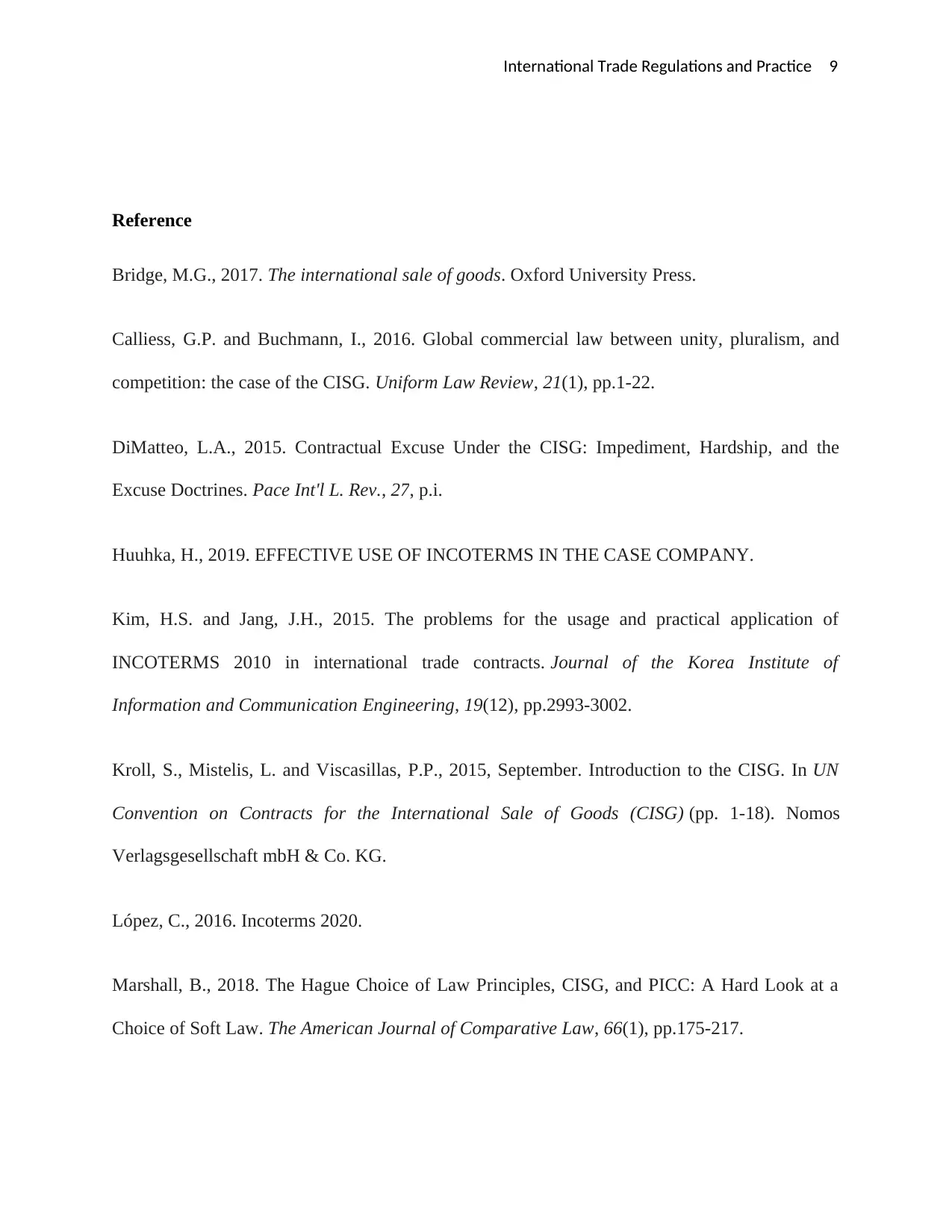
Reference
Bridge, M.G., 2017. The international sale of goods. Oxford University Press.
Calliess, G.P. and Buchmann, I., 2016. Global commercial law between unity, pluralism, and
competition: the case of the CISG. Uniform Law Review, 21(1), pp.1-22.
DiMatteo, L.A., 2015. Contractual Excuse Under the CISG: Impediment, Hardship, and the
Excuse Doctrines. Pace Int'l L. Rev., 27, p.i.
Huuhka, H., 2019. EFFECTIVE USE OF INCOTERMS IN THE CASE COMPANY.
Kim, H.S. and Jang, J.H., 2015. The problems for the usage and practical application of
INCOTERMS 2010 in international trade contracts. Journal of the Korea Institute of
Information and Communication Engineering, 19(12), pp.2993-3002.
Kroll, S., Mistelis, L. and Viscasillas, P.P., 2015, September. Introduction to the CISG. In UN
Convention on Contracts for the International Sale of Goods (CISG) (pp. 1-18). Nomos
Verlagsgesellschaft mbH & Co. KG.
López, C., 2016. Incoterms 2020.
Marshall, B., 2018. The Hague Choice of Law Principles, CISG, and PICC: A Hard Look at a
Choice of Soft Law. The American Journal of Comparative Law, 66(1), pp.175-217.
Reference
Bridge, M.G., 2017. The international sale of goods. Oxford University Press.
Calliess, G.P. and Buchmann, I., 2016. Global commercial law between unity, pluralism, and
competition: the case of the CISG. Uniform Law Review, 21(1), pp.1-22.
DiMatteo, L.A., 2015. Contractual Excuse Under the CISG: Impediment, Hardship, and the
Excuse Doctrines. Pace Int'l L. Rev., 27, p.i.
Huuhka, H., 2019. EFFECTIVE USE OF INCOTERMS IN THE CASE COMPANY.
Kim, H.S. and Jang, J.H., 2015. The problems for the usage and practical application of
INCOTERMS 2010 in international trade contracts. Journal of the Korea Institute of
Information and Communication Engineering, 19(12), pp.2993-3002.
Kroll, S., Mistelis, L. and Viscasillas, P.P., 2015, September. Introduction to the CISG. In UN
Convention on Contracts for the International Sale of Goods (CISG) (pp. 1-18). Nomos
Verlagsgesellschaft mbH & Co. KG.
López, C., 2016. Incoterms 2020.
Marshall, B., 2018. The Hague Choice of Law Principles, CISG, and PICC: A Hard Look at a
Choice of Soft Law. The American Journal of Comparative Law, 66(1), pp.175-217.
⊘ This is a preview!⊘
Do you want full access?
Subscribe today to unlock all pages.
Trusted by 1+ million students worldwide
International Trade Regulations and Practice
10
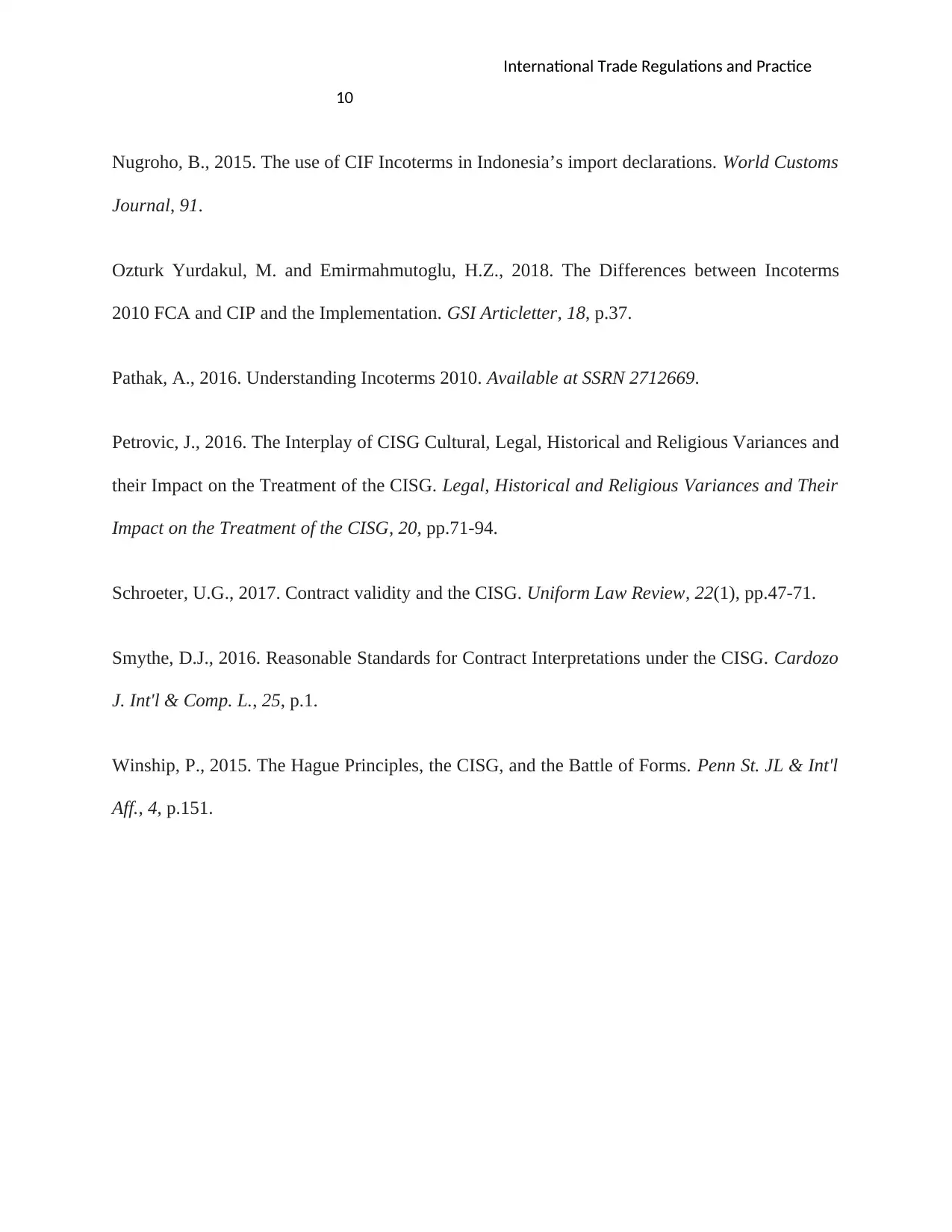
Nugroho, B., 2015. The use of CIF Incoterms in Indonesia’s import declarations. World Customs
Journal, 91.
Ozturk Yurdakul, M. and Emirmahmutoglu, H.Z., 2018. The Differences between Incoterms
2010 FCA and CIP and the Implementation. GSI Articletter, 18, p.37.
Pathak, A., 2016. Understanding Incoterms 2010. Available at SSRN 2712669.
Petrovic, J., 2016. The Interplay of CISG Cultural, Legal, Historical and Religious Variances and
their Impact on the Treatment of the CISG. Legal, Historical and Religious Variances and Their
Impact on the Treatment of the CISG, 20, pp.71-94.
Schroeter, U.G., 2017. Contract validity and the CISG. Uniform Law Review, 22(1), pp.47-71.
Smythe, D.J., 2016. Reasonable Standards for Contract Interpretations under the CISG. Cardozo
J. Int'l & Comp. L., 25, p.1.
Winship, P., 2015. The Hague Principles, the CISG, and the Battle of Forms. Penn St. JL & Int'l
Aff., 4, p.151.
10
Nugroho, B., 2015. The use of CIF Incoterms in Indonesia’s import declarations. World Customs
Journal, 91.
Ozturk Yurdakul, M. and Emirmahmutoglu, H.Z., 2018. The Differences between Incoterms
2010 FCA and CIP and the Implementation. GSI Articletter, 18, p.37.
Pathak, A., 2016. Understanding Incoterms 2010. Available at SSRN 2712669.
Petrovic, J., 2016. The Interplay of CISG Cultural, Legal, Historical and Religious Variances and
their Impact on the Treatment of the CISG. Legal, Historical and Religious Variances and Their
Impact on the Treatment of the CISG, 20, pp.71-94.
Schroeter, U.G., 2017. Contract validity and the CISG. Uniform Law Review, 22(1), pp.47-71.
Smythe, D.J., 2016. Reasonable Standards for Contract Interpretations under the CISG. Cardozo
J. Int'l & Comp. L., 25, p.1.
Winship, P., 2015. The Hague Principles, the CISG, and the Battle of Forms. Penn St. JL & Int'l
Aff., 4, p.151.

1 out of 10


Your All-in-One AI-Powered Toolkit for Academic Success.
+13062052269
info@desklib.com
Available 24*7 on WhatsApp / Email
![[object Object]](/_next/static/media/star-bottom.7253800d.svg)
Unlock your academic potential
Copyright © 2020–2026 A2Z Services. All Rights Reserved. Developed and managed by ZUCOL.