Comprehensive Analysis of International Trade Problems: Import-Export

Verified

Added on  2023/01/20

|7
|1825
|83
Homework Assignment
AI Summary
This assignment delves into the multifaceted problems encountered in international trade, specifically focusing on import and export challenges. It examines various perspectives from multiple authors, including Startz, Prebisch, Goldberg, Deresky, and Vernon, who highlight critical issues such as contractual problems due to distance, real imbalances in economic systems, trade policy frictions, cultural barriers, and challenges in product cycles. The assignment explores how factors like information costs, cultural differences, fluctuating demand, and trade policies affect the flow of goods and services between countries. It analyses the impact of these factors on developing nations, the role of cultural nuances in international business, and the importance of effective communication and adaptation in global markets. Furthermore, the assignment considers the methodological challenges of measuring trade policies and the role of trade costs, including transportation and information costs, in influencing international trade dynamics.
Document Page
PROBLEMS FACED BETWEEN
COUNTRIES IN TRADING
GOODS AND SERVICES
(IMPORT-EXPORT)
tabler-icon-diamond-filled.svg

Paraphrase This Document

Need a fresh take? Get an instant paraphrase of this document with our AI Paraphraser
Document Page
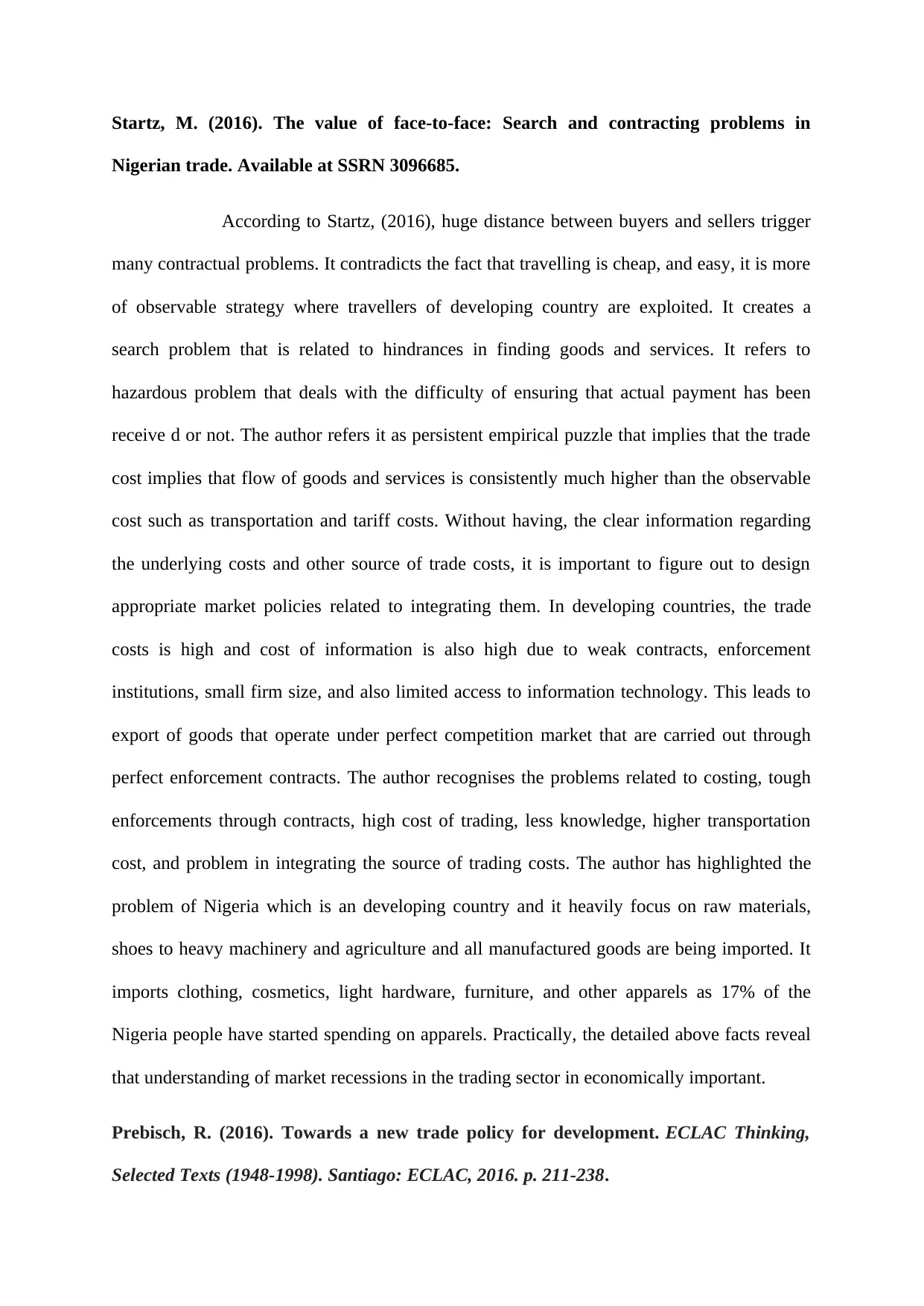
Startz, M. (2016). The value of face-to-face: Search and contracting problems in
Nigerian trade. Available at SSRN 3096685.
According to Startz, (2016), huge distance between buyers and sellers trigger
many contractual problems. It contradicts the fact that travelling is cheap, and easy, it is more
of observable strategy where travellers of developing country are exploited. It creates a
search problem that is related to hindrances in finding goods and services. It refers to
hazardous problem that deals with the difficulty of ensuring that actual payment has been
receive d or not. The author refers it as persistent empirical puzzle that implies that the trade
cost implies that flow of goods and services is consistently much higher than the observable
cost such as transportation and tariff costs. Without having, the clear information regarding
the underlying costs and other source of trade costs, it is important to figure out to design
appropriate market policies related to integrating them. In developing countries, the trade
costs is high and cost of information is also high due to weak contracts, enforcement
institutions, small firm size, and also limited access to information technology. This leads to
export of goods that operate under perfect competition market that are carried out through
perfect enforcement contracts. The author recognises the problems related to costing, tough
enforcements through contracts, high cost of trading, less knowledge, higher transportation
cost, and problem in integrating the source of trading costs. The author has highlighted the
problem of Nigeria which is an developing country and it heavily focus on raw materials,
shoes to heavy machinery and agriculture and all manufactured goods are being imported. It
imports clothing, cosmetics, light hardware, furniture, and other apparels as 17% of the
Nigeria people have started spending on apparels. Practically, the detailed above facts reveal
that understanding of market recessions in the trading sector in economically important.
Prebisch, R. (2016). Towards a new trade policy for development. ECLAC Thinking,
Selected Texts (1948-1998). Santiago: ECLAC, 2016. p. 211-238.
Document Page
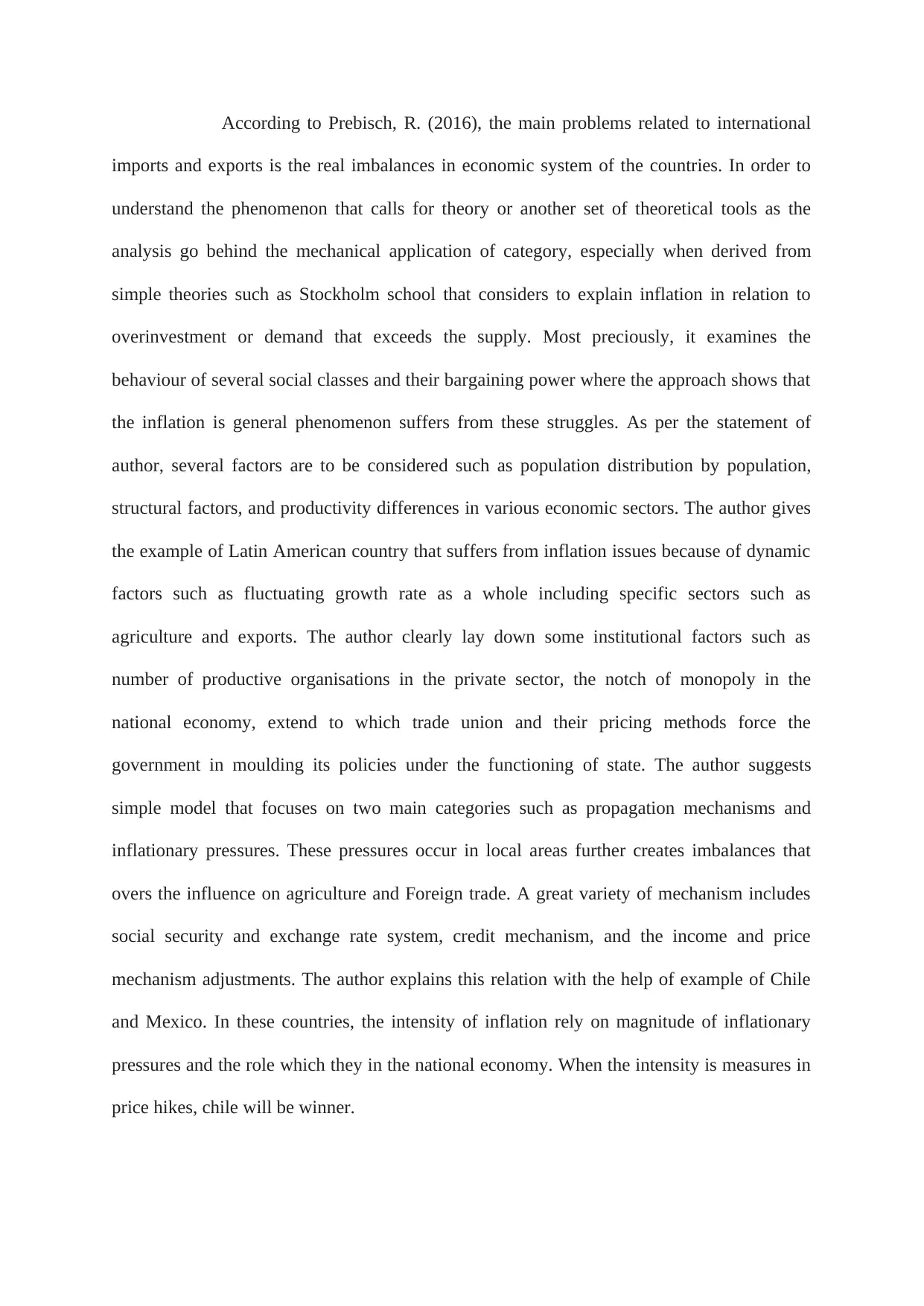
According to Prebisch, R. (2016), the main problems related to international
imports and exports is the real imbalances in economic system of the countries. In order to
understand the phenomenon that calls for theory or another set of theoretical tools as the
analysis go behind the mechanical application of category, especially when derived from
simple theories such as Stockholm school that considers to explain inflation in relation to
overinvestment or demand that exceeds the supply. Most preciously, it examines the
behaviour of several social classes and their bargaining power where the approach shows that
the inflation is general phenomenon suffers from these struggles. As per the statement of
author, several factors are to be considered such as population distribution by population,
structural factors, and productivity differences in various economic sectors. The author gives
the example of Latin American country that suffers from inflation issues because of dynamic
factors such as fluctuating growth rate as a whole including specific sectors such as
agriculture and exports. The author clearly lay down some institutional factors such as
number of productive organisations in the private sector, the notch of monopoly in the
national economy, extend to which trade union and their pricing methods force the
government in moulding its policies under the functioning of state. The author suggests
simple model that focuses on two main categories such as propagation mechanisms and
inflationary pressures. These pressures occur in local areas further creates imbalances that
overs the influence on agriculture and Foreign trade. A great variety of mechanism includes
social security and exchange rate system, credit mechanism, and the income and price
mechanism adjustments. The author explains this relation with the help of example of Chile
and Mexico. In these countries, the intensity of inflation rely on magnitude of inflationary
pressures and the role which they in the national economy. When the intensity is measures in
price hikes, chile will be winner.
Document Page
Goldberg, P. K., & Pavcnik, N. (2016). The effects of trade policy. In Handbook of
commercial policy (Vol. 1, pp. 161-206). North-Holland.
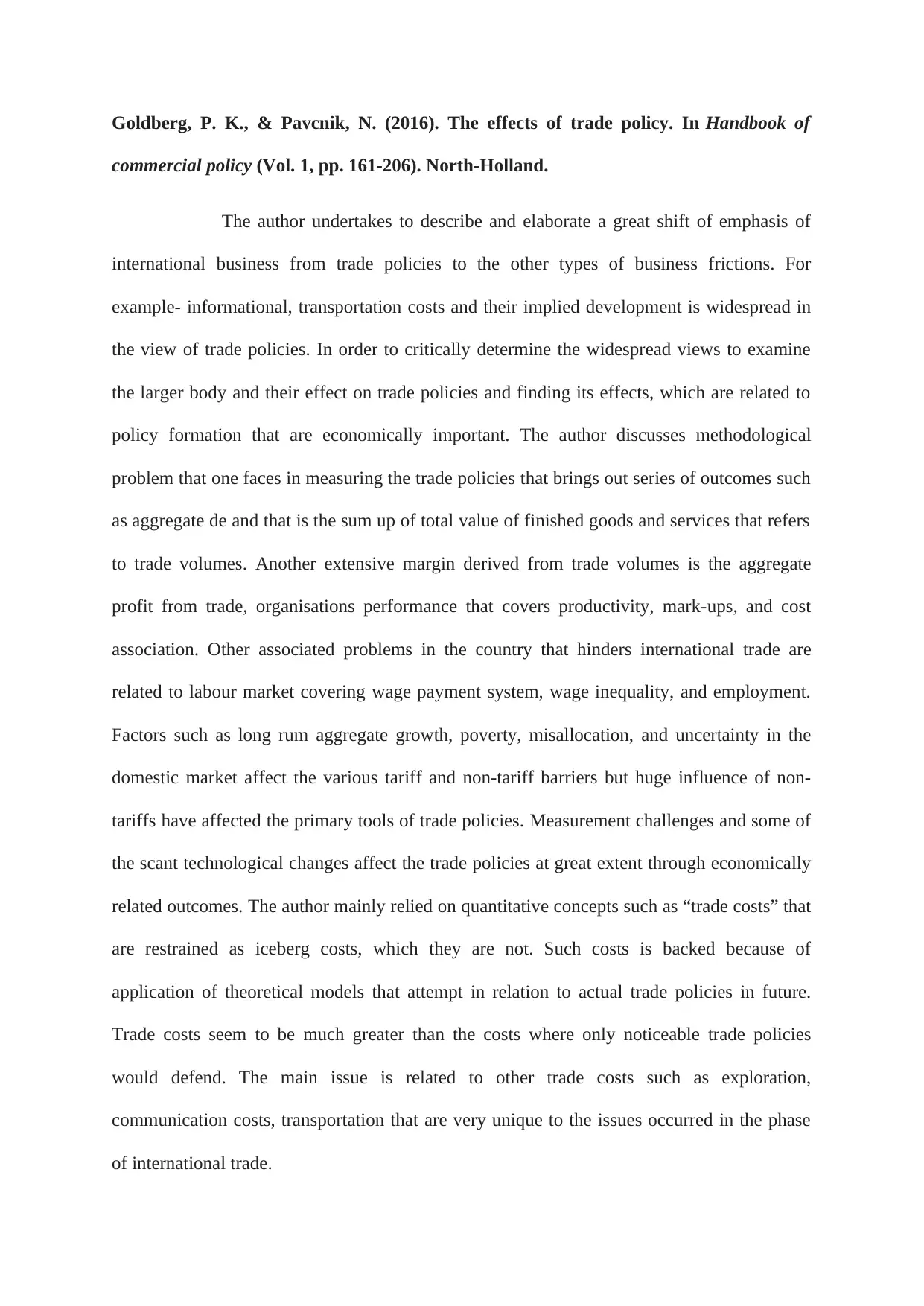
The author undertakes to describe and elaborate a great shift of emphasis of
international business from trade policies to the other types of business frictions. For
example- informational, transportation costs and their implied development is widespread in
the view of trade policies. In order to critically determine the widespread views to examine
the larger body and their effect on trade policies and finding its effects, which are related to
policy formation that are economically important. The author discusses methodological
problem that one faces in measuring the trade policies that brings out series of outcomes such
as aggregate de and that is the sum up of total value of finished goods and services that refers
to trade volumes. Another extensive margin derived from trade volumes is the aggregate
profit from trade, organisations performance that covers productivity, mark-ups, and cost
association. Other associated problems in the country that hinders international trade are
related to labour market covering wage payment system, wage inequality, and employment.
Factors such as long rum aggregate growth, poverty, misallocation, and uncertainty in the
domestic market affect the various tariff and non-tariff barriers but huge influence of non-
tariffs have affected the primary tools of trade policies. Measurement challenges and some of
the scant technological changes affect the trade policies at great extent through economically
related outcomes. The author mainly relied on quantitative concepts such as “trade costs” that
are restrained as iceberg costs, which they are not. Such costs is backed because of
application of theoretical models that attempt in relation to actual trade policies in future.
Trade costs seem to be much greater than the costs where only noticeable trade policies
would defend. The main issue is related to other trade costs such as exploration,
communication costs, transportation that are very unique to the issues occurred in the phase
of international trade.
tabler-icon-diamond-filled.svg

Paraphrase This Document

Need a fresh take? Get an instant paraphrase of this document with our AI Paraphraser
Document Page
Deresky, H. (2017). International management: Managing across borders and cultures.
Pearson Education India.
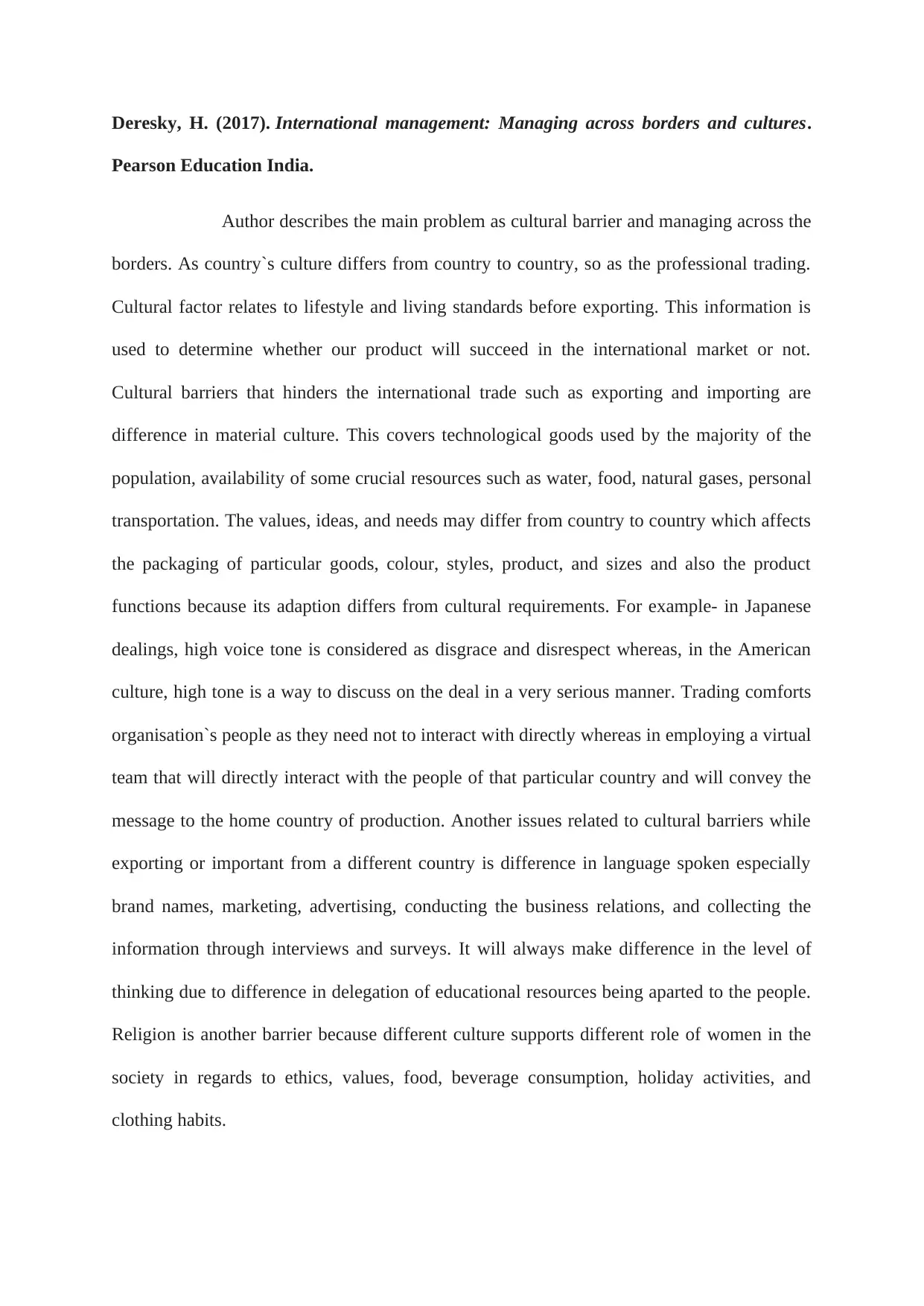
Author describes the main problem as cultural barrier and managing across the
borders. As country`s culture differs from country to country, so as the professional trading.
Cultural factor relates to lifestyle and living standards before exporting. This information is
used to determine whether our product will succeed in the international market or not.
Cultural barriers that hinders the international trade such as exporting and importing are
difference in material culture. This covers technological goods used by the majority of the
population, availability of some crucial resources such as water, food, natural gases, personal
transportation. The values, ideas, and needs may differ from country to country which affects
the packaging of particular goods, colour, styles, product, and sizes and also the product
functions because its adaption differs from cultural requirements. For example- in Japanese
dealings, high voice tone is considered as disgrace and disrespect whereas, in the American
culture, high tone is a way to discuss on the deal in a very serious manner. Trading comforts
organisation`s people as they need not to interact with directly whereas in employing a virtual
team that will directly interact with the people of that particular country and will convey the
message to the home country of production. Another issues related to cultural barriers while
exporting or important from a different country is difference in language spoken especially
brand names, marketing, advertising, conducting the business relations, and collecting the
information through interviews and surveys. It will always make difference in the level of
thinking due to difference in delegation of educational resources being aparted to the people.
Religion is another barrier because different culture supports different role of women in the
society in regards to ethics, values, food, beverage consumption, holiday activities, and
clothing habits.
Document Page
Vernon, R. (2017). International investment and international trade in the product
cycle. In International Business (pp. 99-116). Routledge.
According to Vernon, (2017), issues related to trade among different countries
in terms of import and export, in the process of introducing the new product, producers faces
number of critical and transitory conditions. Initially, producers was concerned with the grade
of liberty that was altering inputs. As long as the inputs are concerned, it cannot be fixed in
present because its pricing differs due to domestic barriers with assurance, it is important to
calculate the cost and take into consideration the all-purpose need of elasticity in any choice.
Other reason is the fluctuating price elasticity of demand for the productivity being produced
for the individual organisations are competitively low. This is followed from the
extraordinary extent of production variety and the presence of monopoly in its initial stages.
It is understood that small costing differences counting fewer while calculating the
entrepreneur, as they are expected to count. There is always a need to communicate
effectively on the part of producers to the suppliers, competitors, and customers. Effective
communication remained an issue in regards to exporting and importing of goods.
Document Page
References
Deresky, H. (2017). International management: Managing across borders and cultures.
Pearson Education India.
Goldberg, P. K., & Pavcnik, N. (2016). The effects of trade policy. In Handbook of
commercial policy (Vol. 1, pp. 161-206). North-Holland.
Prebisch, R. (2016). Towards a new trade policy for development. ECLAC Thinking, Selected
Texts (1948-1998). Santiago: ECLAC, 2016. p. 211-238.
Startz, M. (2016). The value of face-to-face: Search and contracting problems in Nigerian
trade. Available at SSRN 3096685.
Vernon, R. (2017). International investment and international trade in the product cycle.
In International Business (pp. 99-116). Routledge.
chevron_up_icon
1 out of 7
circle_padding
hide_on_mobile
zoom_out_icon
[object Object]