Analyzing International Trade Policies and Environmental Protection

Verified

Added on  2022/08/13

|9
|2529
|17
Report
AI Summary
This report analyzes the intricate relationship between international trade policies and environmental protection. It begins by highlighting the multifaceted nature of the environment and trade, including discussions on climate change and the involvement of international organizations such as the WTO, APEC, and OECD. The report emphasizes Canada's approach, which aims to ensure environmental protection and trade are mutually supportive. It then explores the contentious debates surrounding financial growth, environmental degradation, and the role of trade organizations. The study examines various challenges, including the potential for environmental regulations to be undermined in the name of free trade and the impact of policies on developed and developing nations. The report also examines the role of the GATT and WTO, including the exceptions in Article XX and the implementation of environmental protection policies. The report explores the US vs. Canada case and the policies, acts, and initiatives adopted by Canada to safeguard the environment. Finally, it concludes that international trade policies can protect the environment if trade organizations follow them and the importance of openness and transparency. The report provides a comprehensive overview of the challenges and opportunities in balancing international trade with environmental sustainability.
Document Page
Running head: INTERNATIONAL TRADE AND LAW
0
s
INTERNATIONAL TRADE AND LAW
Name of the student:
Name of the university:
Author’s note:
tabler-icon-diamond-filled.svg

Paraphrase This Document

Need a fresh take? Get an instant paraphrase of this document with our AI Paraphraser
Document Page
1INTERNATIONAL TRADE AND LAW
Introduction
The relations between the environment and trade are complex, multiple, and subject of
several plurilateral, multilateral, bilateral as well as regional negotiations and discussions. The
environment and trade issues and problems comprehend other things, international businesses,
and climate change in the world (Low, 2016). A significant policy objective of the government
of Canada in this zone has ensured that environmental protection, as well as preservation and
trade, are reciprocally supportive (Low, 2016). The global affairs of the government of Canada
have pursued the objective in collaboration with the environment of its country by incorporating
the considerations as well as obligations of such an environment in its agreements of free trade.
It has been actively engaged in the negotiations of the World Trade Organization (WTO)
regarding environment and business and with such organizations such as Asia Pacific Economic
Co-operation (APEC) and Economic Co-operation and Development (OECD) (Johnson, 2015).
The aim of this paper discusses the policies of International Trade and its effect on the protection
of the environment. The perspective of the Canadian government on the concern of environment
and trade required to be comprehended in the area of the strong dependence of economy as the
machine for development in addition to that is the mainstay of economic conduct. Canada has an
interest in guaranteeing stable and fair regulations of trading as well as operating to prevent and
dismantle barriers of no tariff and tariff that affect flows of investment and trade. Canada in the
initial phase of debates on trade and environment view the environmental issues as harmful for
the obstruction that is non-tariff and cautiously proceeding in the conversation of OECD and
WTO.
Document Page
2INTERNATIONAL TRADE AND LAW
Discussion
The consequences of International Trade and its policies on such an environment have become
one of the highest contentious elements in every worldwide argument regarding globalization
(MacDonald et al., 2015). However, it is also an anxiety that an unrestrained financial growth,
which is operated by such free business, destructs the environment by producing more
exhaustion of such natural sources and pollution. The challenges for the various trade
organizations are arising that the productions of their business as well as keep the environment
pollution free from the way of production. It is suspected that several environmental protection
laws, regulations, and policies are being deteriorated under the pretext of promoting open trade
by the governments and corporations unconcerned regarding the negative characteristic of the
environmental effects of the business and commerce (Berger et al., 2017). There are many
corporations, citizens and governments in such developing countries as well as developed
countries are eager to agree on taking a certain level of environmental destruction in exchange
for financial wellbeing. In contrast to this eagerness, it is a fear that the laws or policies
regarding environmental protection are conducts for the developed nations for preventing their
commodities from challenging fairly (Mann & Porter 2020). The policy that in framed identify
the linkage in between environment and trade which may be either negative or positive and also
avoid conflict in case possible. It is a fact that without appropriate and clear trade guidelines the
regulation concerning the environment may become unreasonable obstacles to trading as well as
the unavailability of proper environmental regulations that enhanced trade can be detrimental to
the environment. The concepts of environmental protection have derived since the first General
Agreement on Tariffs and Trade (GATT) has come into existence in the year 1947 (Wei, 2017).
However, there is no such obvious salutation of the board relation between the environment of
Document Page
3INTERNATIONAL TRADE AND LAW
the world and trade. It has only come as an exception to the basic rules of that agreement in
Article XX. In that Article of exceptions, it has allowed to the countries that they should take
necessary steps during the trade for the protection of the human being, animals as well as protect
the life of plants and health. In the last several decades, there is no further assessment of the
environment-trade association, which has made within the framework of the GATT. The policies
regarding the protection of the environment should be more effective and obeyed by trade
organizations. Several challenges have been faced in the trade that any product or the way of
production may be manipulated an adverse effect on the environment and may be harmful to the
human being as well as animals or insects. One of the foremost challenges is to produce the
product in such a method, which will not harm the environment and natural resources of the
country. There is a case law regarding this issue under the GATT, which was brought by the US
government in US vs. Canada 1988. Canada has maintained the guidelines prohibiting the sale
or exportation of the unrefined salmon and herring under the Canadian Fisheries Act 1976
(SONG et al., 2017). The United States has complained that measures have been inconsistent with
Article XI of the GATT (Srinivasan, 2019) However, the government of Canada has argued that
these restrictions of exports are part of a structure of the fishery resources management, which
has aimed to preserve the fish stocks and thus, it has been justified under Article XX (g) of the
GATT. There are several Acts have enacted by the provincial as well as federal governments for
such protection of the environment for the adverse effect of Trade such as Fisheries Act
(Provincial), Canada Agricultural Products Act, the Exports and Imports Permits Act, Prohibition
of Certain Toxic Substances Regulations and many others. There are many cases where a certain
environmental problem may be approached as a challenge by such use of a mixture of various
types of apparatuses dependent on the products. The preservation, protection and sustainable
tabler-icon-diamond-filled.svg

Paraphrase This Document

Need a fresh take? Get an instant paraphrase of this document with our AI Paraphraser
Document Page
4INTERNATIONAL TRADE AND LAW
development of the environment, as well as the growth of industrial production, are the
fundamental objective of the World Trade Organization (WTO). The world trade organization is
the overseas structure that maintains and formulates the regulations for trading between the
countries. There are three methods for the implementation of the mandate. Firstly forum is
provided by WTO for the nations to negotiate arrangements on trading. Secondly in ensuring that
all nations comply with regulations of the agreement that is existing. Thirdly assisting to settle
conflicts in between nations relating to the manner there is the execution of rules on them. Thus
in response to the action in the US in July 2019, the European Union and Canada formulate
appellate body to settle the conflicts in the occasion World Trade Organization failed to resolve.
The Marrakesh Agreement has established the WTO and complemented the objectives of it to
reduce the barriers of trade as well as eradicate the discriminatory conduct in such relation to
international trade (Sinclair, 2019). The convention relating to Biological diversity obligates the
signatories to particular actions for the preservation of natural diversity. There is the formulation
of another agreement designate as Canada Chile in thew agreement of free trade is the
arrangement on trading in between the signatories that are intended to minimize the barriers of
tariff and non-tariff and also to advance increased flows on investment and trade. Canada also
maintains restriction or prohibition action on exporting and importing protection of the
environment.Under the rules of WTO, the members or organizations can be able to adopt several
measures relating to the trade, which has aimed to protect the environment and provided several
numbers of conditions for avoiding the misappropriation of those procedures for isolationist ends
satisfied. The WTO has contributed to the preservation and protection of nature and environment
through such objectives of trade candidness, its enforcement mechanism and rules, activities of
various bodies of WTO and continuing effort of the Doha Development Agenda (Reid, 2015) This
Document Page
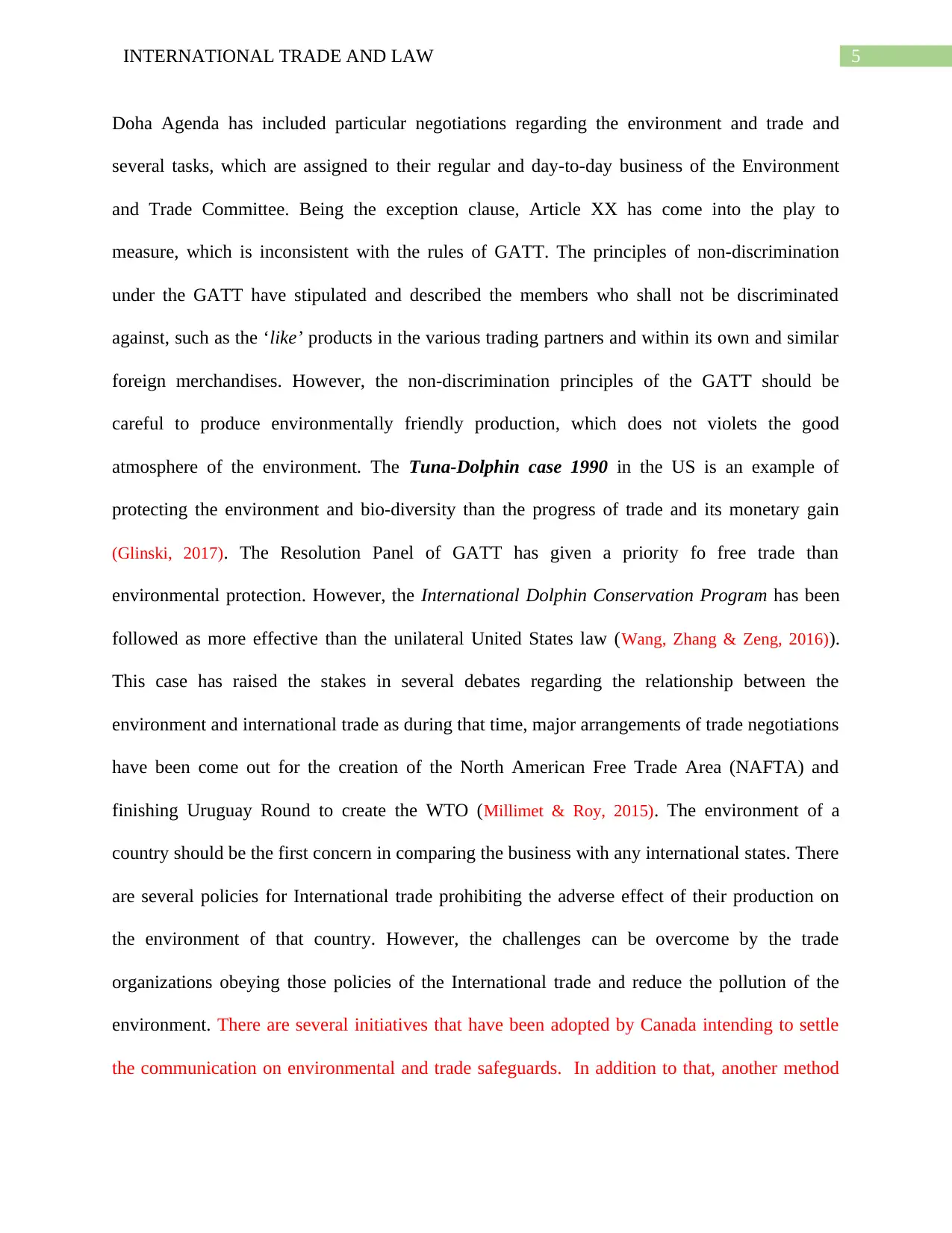
5INTERNATIONAL TRADE AND LAW
Doha Agenda has included particular negotiations regarding the environment and trade and
several tasks, which are assigned to their regular and day-to-day business of the Environment
and Trade Committee. Being the exception clause, Article XX has come into the play to
measure, which is inconsistent with the rules of GATT. The principles of non-discrimination
under the GATT have stipulated and described the members who shall not be discriminated
against, such as the ‘like’ products in the various trading partners and within its own and similar
foreign merchandises. However, the non-discrimination principles of the GATT should be
careful to produce environmentally friendly production, which does not violets the good
atmosphere of the environment. The Tuna-Dolphin case 1990 in the US is an example of
protecting the environment and bio-diversity than the progress of trade and its monetary gain
(Glinski, 2017). The Resolution Panel of GATT has given a priority fo free trade than
environmental protection. However, the International Dolphin Conservation Program has been
followed as more effective than the unilateral United States law (Wang, Zhang & Zeng, 2016)).
This case has raised the stakes in several debates regarding the relationship between the
environment and international trade as during that time, major arrangements of trade negotiations
have been come out for the creation of the North American Free Trade Area (NAFTA) and
finishing Uruguay Round to create the WTO (Millimet & Roy, 2015). The environment of a
country should be the first concern in comparing the business with any international states. There
are several policies for International trade prohibiting the adverse effect of their production on
the environment of that country. However, the challenges can be overcome by the trade
organizations obeying those policies of the International trade and reduce the pollution of the
environment. There are several initiatives that have been adopted by Canada intending to settle
the communication on environmental and trade safeguards. In addition to that, another method
Document Page
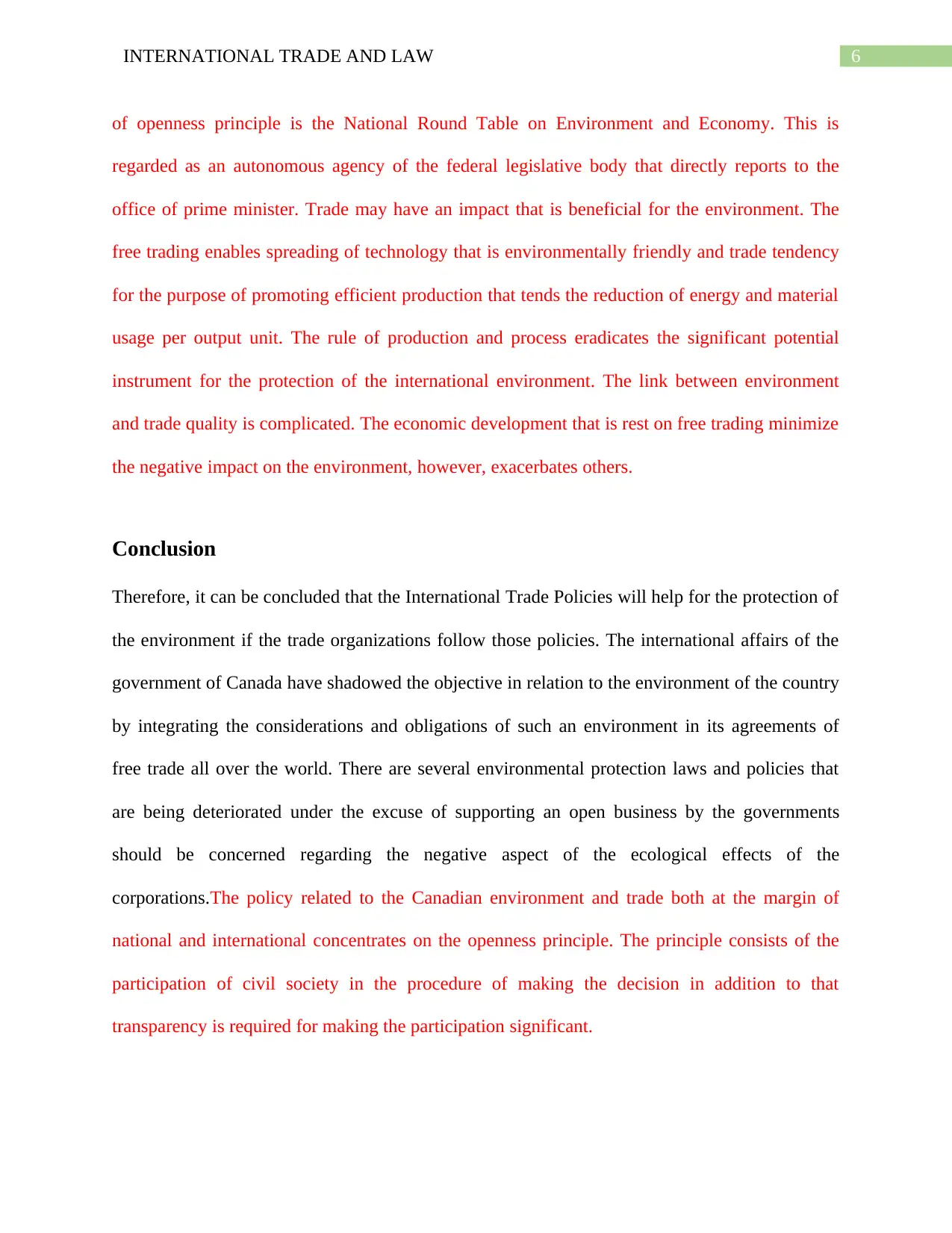
6INTERNATIONAL TRADE AND LAW
of openness principle is the National Round Table on Environment and Economy. This is
regarded as an autonomous agency of the federal legislative body that directly reports to the
office of prime minister. Trade may have an impact that is beneficial for the environment. The
free trading enables spreading of technology that is environmentally friendly and trade tendency
for the purpose of promoting efficient production that tends the reduction of energy and material
usage per output unit. The rule of production and process eradicates the significant potential
instrument for the protection of the international environment. The link between environment
and trade quality is complicated. The economic development that is rest on free trading minimize
the negative impact on the environment, however, exacerbates others.
Conclusion
Therefore, it can be concluded that the International Trade Policies will help for the protection of
the environment if the trade organizations follow those policies. The international affairs of the
government of Canada have shadowed the objective in relation to the environment of the country
by integrating the considerations and obligations of such an environment in its agreements of
free trade all over the world. There are several environmental protection laws and policies that
are being deteriorated under the excuse of supporting an open business by the governments
should be concerned regarding the negative aspect of the ecological effects of the
corporations.The policy related to the Canadian environment and trade both at the margin of
national and international concentrates on the openness principle. The principle consists of the
participation of civil society in the procedure of making the decision in addition to that
transparency is required for making the participation significant.
tabler-icon-diamond-filled.svg

Paraphrase This Document

Need a fresh take? Get an instant paraphrase of this document with our AI Paraphraser
Document Page
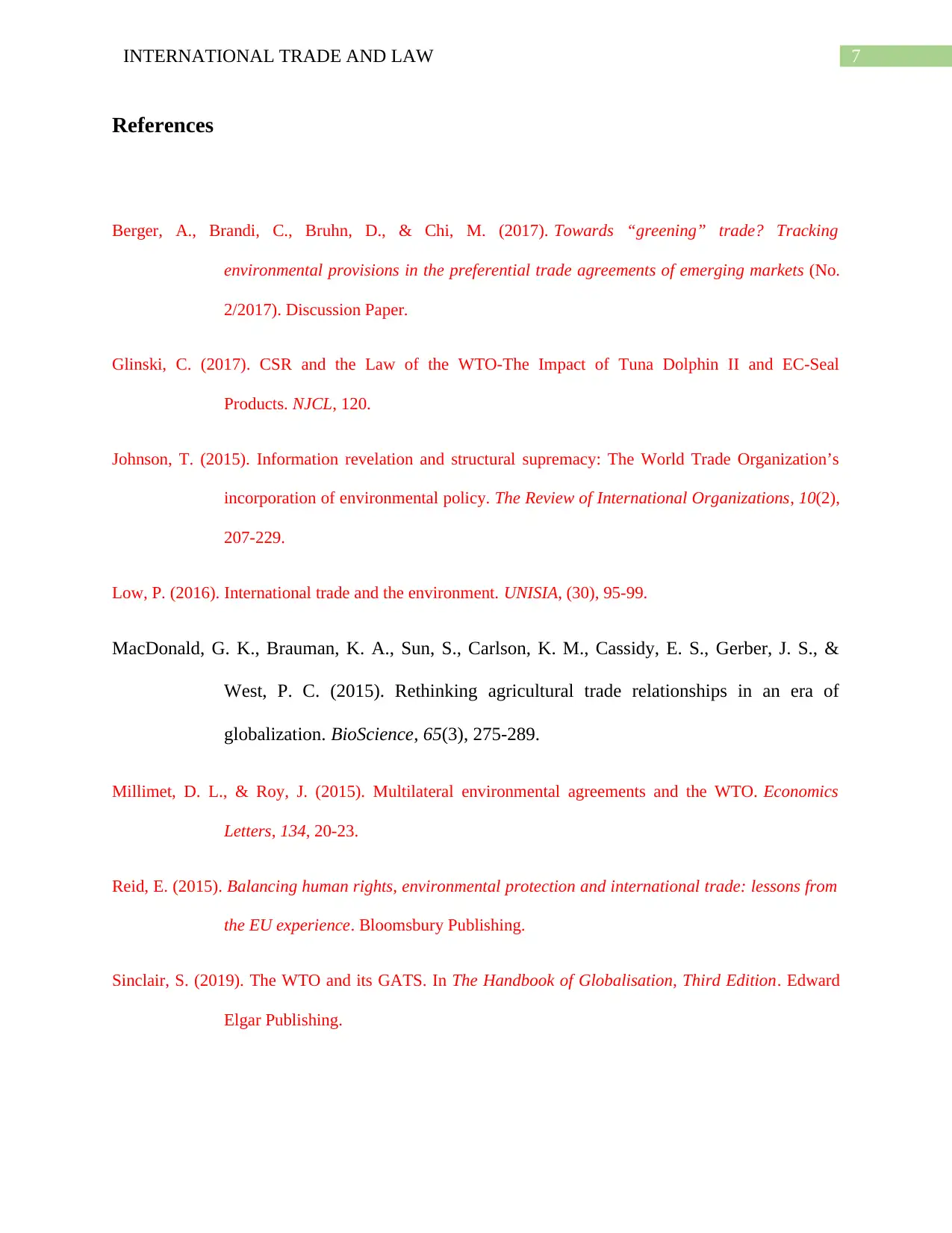
7INTERNATIONAL TRADE AND LAW
References
Berger, A., Brandi, C., Bruhn, D., & Chi, M. (2017). Towards “greening” trade? Tracking
environmental provisions in the preferential trade agreements of emerging markets (No.
2/2017). Discussion Paper.
Glinski, C. (2017). CSR and the Law of the WTO-The Impact of Tuna Dolphin II and EC-Seal
Products. NJCL, 120.
Johnson, T. (2015). Information revelation and structural supremacy: The World Trade Organization’s
incorporation of environmental policy. The Review of International Organizations, 10(2),
207-229.
Low, P. (2016). International trade and the environment. UNISIA, (30), 95-99.
MacDonald, G. K., Brauman, K. A., Sun, S., Carlson, K. M., Cassidy, E. S., Gerber, J. S., &
West, P. C. (2015). Rethinking agricultural trade relationships in an era of
globalization. BioScience, 65(3), 275-289.
Millimet, D. L., & Roy, J. (2015). Multilateral environmental agreements and the WTO. Economics
Letters, 134, 20-23.
Reid, E. (2015). Balancing human rights, environmental protection and international trade: lessons from
the EU experience. Bloomsbury Publishing.
Sinclair, S. (2019). The WTO and its GATS. In The Handbook of Globalisation, Third Edition. Edward
Elgar Publishing.
Document Page
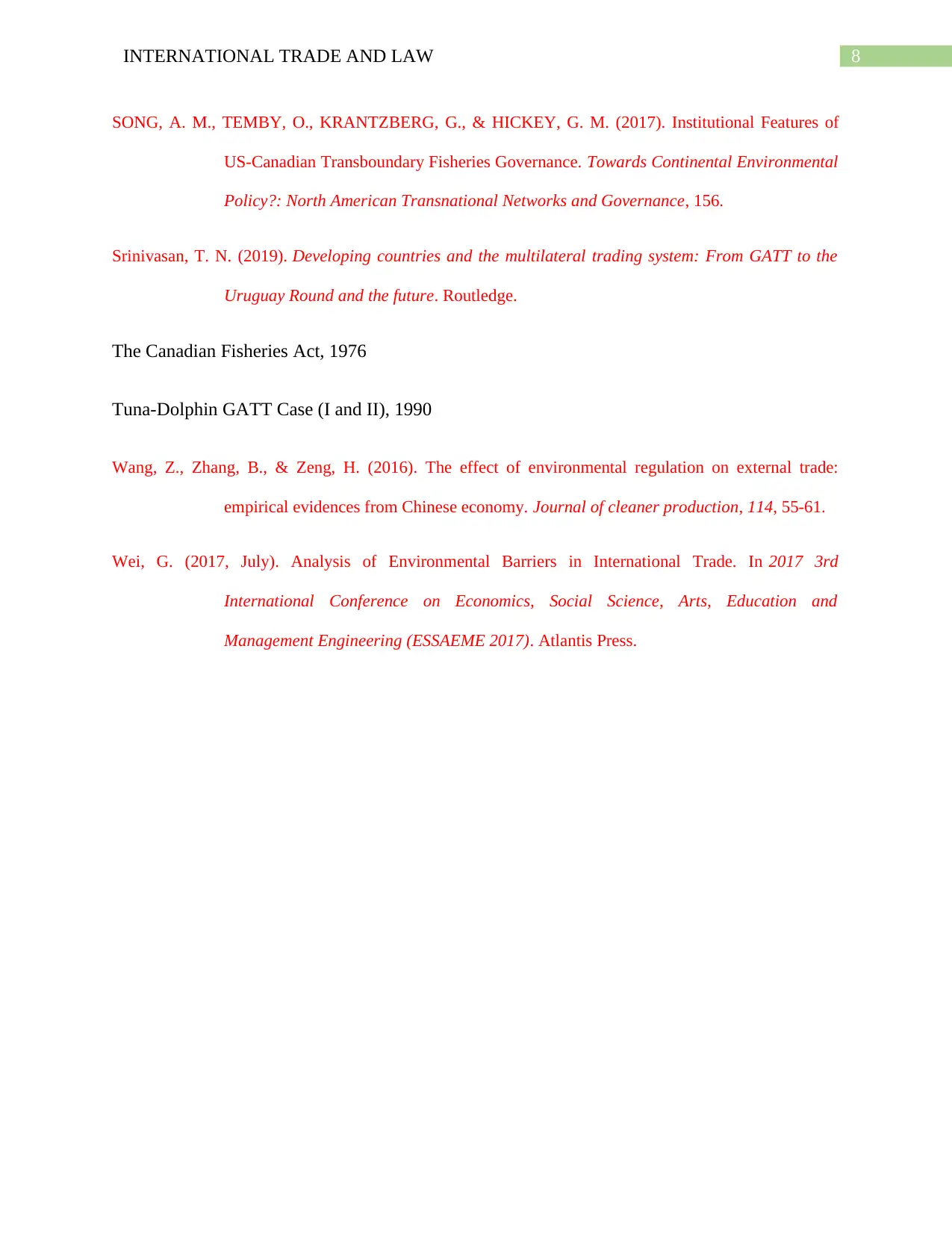
8INTERNATIONAL TRADE AND LAW
SONG, A. M., TEMBY, O., KRANTZBERG, G., & HICKEY, G. M. (2017). Institutional Features of
US-Canadian Transboundary Fisheries Governance. Towards Continental Environmental
Policy?: North American Transnational Networks and Governance, 156.
Srinivasan, T. N. (2019). Developing countries and the multilateral trading system: From GATT to the
Uruguay Round and the future. Routledge.
The Canadian Fisheries Act, 1976
Tuna-Dolphin GATT Case (I and II), 1990
Wang, Z., Zhang, B., & Zeng, H. (2016). The effect of environmental regulation on external trade:
empirical evidences from Chinese economy. Journal of cleaner production, 114, 55-61.
Wei, G. (2017, July). Analysis of Environmental Barriers in International Trade. In 2017 3rd
International Conference on Economics, Social Science, Arts, Education and
Management Engineering (ESSAEME 2017). Atlantis Press.
chevron_up_icon
1 out of 9
circle_padding
hide_on_mobile
zoom_out_icon
[object Object]