The Interplay of International Trade Law and Environmental Protection
VerifiedAdded on 2020/11/23
|18
|6627
|165
Essay
AI Summary
This essay delves into the intricate relationship between international trade law and environmental protection. It begins by providing a historical background of international trade and its evolution, followed by an examination of the direct impacts of trade on the environment, including resource extraction and its effects on sustainable development. The essay then explores the legal mechanisms for environmental protection within the framework of international trade, focusing on the approaches of the World Trade Organization (WTO), the North American Free Trade Agreement (NAFTA), and the European Union (EU), including case law analysis and multilateral environmental agreements. The impact of trade liberalization on the environment is also discussed. The essay concludes with an overview of how international trade can be conducted sustainably to minimize harm to the environment, emphasizing the role of various agreements and the importance of balancing economic growth with environmental preservation and human welfare.
International Trade Law

Paraphrase This Document
Need a fresh take? Get an instant paraphrase of this document with our AI Paraphraser
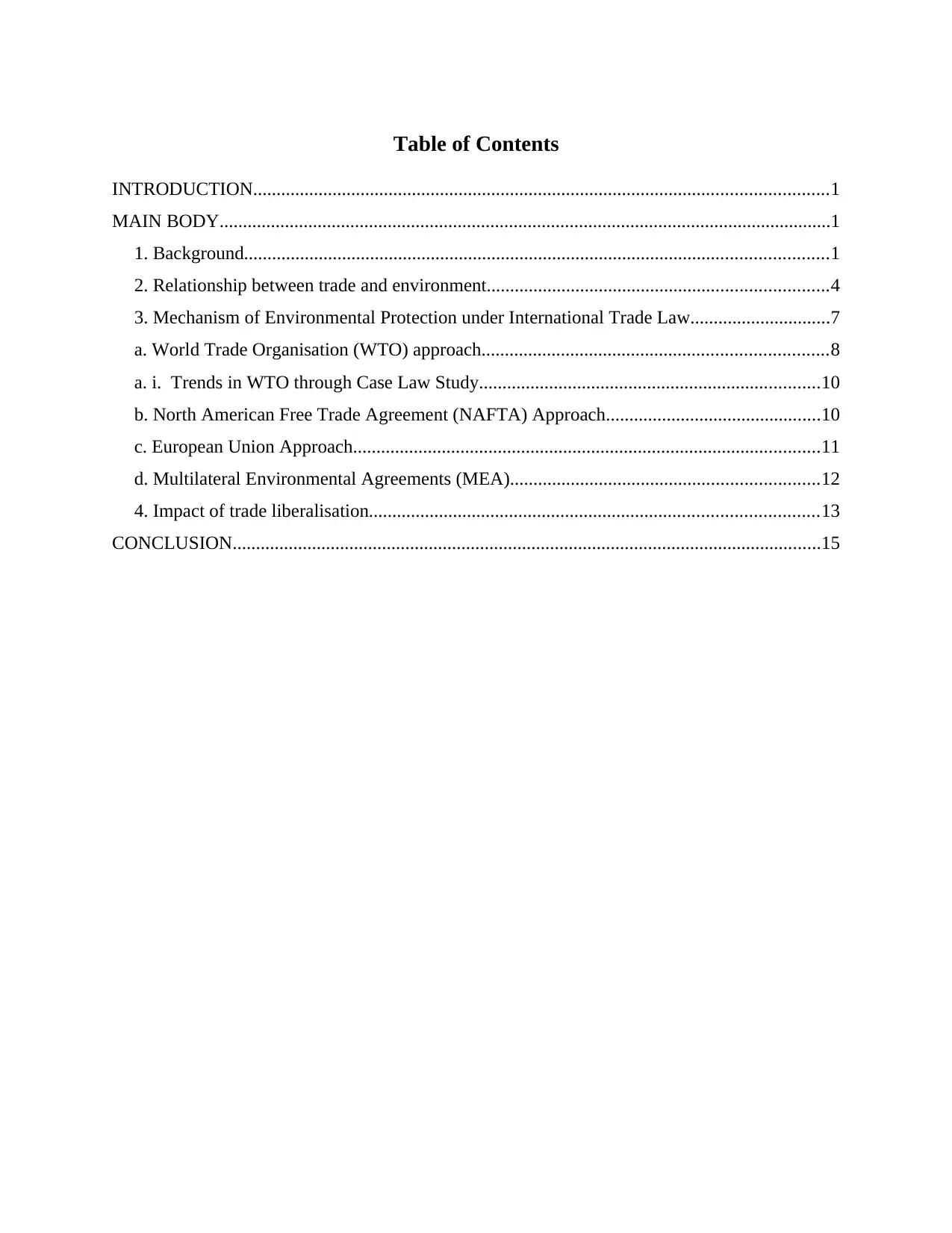
Table of Contents
INTRODUCTION...........................................................................................................................1
MAIN BODY...................................................................................................................................1
1. Background.............................................................................................................................1
2. Relationship between trade and environment.........................................................................4
3. Mechanism of Environmental Protection under International Trade Law..............................7
a. World Trade Organisation (WTO) approach..........................................................................8
a. i. Trends in WTO through Case Law Study.........................................................................10
b. North American Free Trade Agreement (NAFTA) Approach..............................................10
c. European Union Approach....................................................................................................11
d. Multilateral Environmental Agreements (MEA)..................................................................12
4. Impact of trade liberalisation................................................................................................13
CONCLUSION..............................................................................................................................15
INTRODUCTION...........................................................................................................................1
MAIN BODY...................................................................................................................................1
1. Background.............................................................................................................................1
2. Relationship between trade and environment.........................................................................4
3. Mechanism of Environmental Protection under International Trade Law..............................7
a. World Trade Organisation (WTO) approach..........................................................................8
a. i. Trends in WTO through Case Law Study.........................................................................10
b. North American Free Trade Agreement (NAFTA) Approach..............................................10
c. European Union Approach....................................................................................................11
d. Multilateral Environmental Agreements (MEA)..................................................................12
4. Impact of trade liberalisation................................................................................................13
CONCLUSION..............................................................................................................................15
INTRODUCTION
The ambit of International trade law is huge and inflating gradually. These laws are very
helpful in regulating trade and commerce across the world. Due to the expansion of business and
trade it has direct impact on environment. As the demand of goods are gradually increasing,
resources are being extracted on regular basis. Which has resulted in adverse effect on the
environment. In order to meet the demand of people resources are extricated from the earth
which has hampered the sustainable development and environment. So to balance its effect there
are certain laws which manages the adverse impact of trade on environment. It becomes
necessary to extract resources to fulfil the needs of human but by keeping principle of
sustainable development. International trade was always a part of globalization but it was
performed by certain laws .
This essay is consist of various legal issues of world trade law and environment law. Also
it explains the relation between trade and environment. WTO has initiated some laws to protect
the mechanism of environment. It includes such measures taken by WTO to administer the
protection of environment. Moreover, it is also comprise of efforts made by European Union and
NAFTA to save environment. The impact of trade liberalization on the environment has also
been discussed in this essay. It is an overview of Impact of international trade on the
environment and how it can be sustainably conducted in order to restrain the harm on
environment. This report is in context of various nations indulged in various agreements to
promote free trade with preservation of environment, human health and welfare. Functioning of
World Trade Organisation (WTO) and European Union (EU) regarding free trade policies and
protection of environment has also been discussed extensively. Conclusively this report discuss
the impact of liberalisation in trade on natural resources and surroundings, also various measures
which has been taken by governing bodies to prevent any harm done to environment.
MAIN BODY
1. Background
International laws came into existence in the late fifteenth century. It was constructed
after the result of 'Peace of Westphalia' in 1648. International trade has been part of nations from
historical period. Trade was practised between various countries. The history of trade is divided
into five parts Ancient, Middle Ages, Early Modern, Later Modern and Post-World War II. The
1
The ambit of International trade law is huge and inflating gradually. These laws are very
helpful in regulating trade and commerce across the world. Due to the expansion of business and
trade it has direct impact on environment. As the demand of goods are gradually increasing,
resources are being extracted on regular basis. Which has resulted in adverse effect on the
environment. In order to meet the demand of people resources are extricated from the earth
which has hampered the sustainable development and environment. So to balance its effect there
are certain laws which manages the adverse impact of trade on environment. It becomes
necessary to extract resources to fulfil the needs of human but by keeping principle of
sustainable development. International trade was always a part of globalization but it was
performed by certain laws .
This essay is consist of various legal issues of world trade law and environment law. Also
it explains the relation between trade and environment. WTO has initiated some laws to protect
the mechanism of environment. It includes such measures taken by WTO to administer the
protection of environment. Moreover, it is also comprise of efforts made by European Union and
NAFTA to save environment. The impact of trade liberalization on the environment has also
been discussed in this essay. It is an overview of Impact of international trade on the
environment and how it can be sustainably conducted in order to restrain the harm on
environment. This report is in context of various nations indulged in various agreements to
promote free trade with preservation of environment, human health and welfare. Functioning of
World Trade Organisation (WTO) and European Union (EU) regarding free trade policies and
protection of environment has also been discussed extensively. Conclusively this report discuss
the impact of liberalisation in trade on natural resources and surroundings, also various measures
which has been taken by governing bodies to prevent any harm done to environment.
MAIN BODY
1. Background
International laws came into existence in the late fifteenth century. It was constructed
after the result of 'Peace of Westphalia' in 1648. International trade has been part of nations from
historical period. Trade was practised between various countries. The history of trade is divided
into five parts Ancient, Middle Ages, Early Modern, Later Modern and Post-World War II. The
1
⊘ This is a preview!⊘
Do you want full access?
Subscribe today to unlock all pages.

Trusted by 1+ million students worldwide
study of ancient trade is vast and indefinite. According to the records from Historical Department
trade has been practised from 19th century BCE (Before Common Era) and even before that. The
Egyptians , Chinese, Romans, Indians etc. were involve in the ancient trade of goods. The middle
ages is some what similar to the ancient one but the only difference was, range of trading
increased immensely and laws of trade were also changed by different dynasties. Silk route was
the major path through which trade was executed. In the early modern stage Spice Route changes
from the Persian Gulf to Red Sea and certain other events happened to change the course of
world trade and commerce. Later Modern era gave rises to many treaties and policies of free
trade between the nations. In this era free trade was motivated by the different countries. In Post-
World War II gave rise to certain communities. Over 23 countries agreed to the General
Agreement on Tariffs and Trade in order to rationalize trade between several nations. The
European Free Trade Association was established in 1960 it has been developed to create a trade
bloc on the outer seven European countries who has refused to join European Economic
Community. In this era North American Free Trade Agreement came into existence
International trade is comprise of export and import. Export trade includes sale of goods
to different states whereas Import trade is includes buying goods from different countries. These
means are conclusively known as foreign trade . It is of two types bilateral and multi lateral
trade. When two countries gets into an agreement of exchanging goods and services they are
working under bilateral trade whereas in multi trade where more than one countries are involved.
Apart from import and export, countries purchases product from one place and sell it to other,
this type of trading is known as Entrepôt Trade.
International Trade Laws regulates the trading procedure between countries. The main
purpose is to form those regulations which helps in smooth trade and commerce. These laws are
implemented by World Trade Organisation . WTO is responsible for regulating internation
trade. It was initiated on 1st of January 1995 under Marrakesh Agreement. This agreement was
made in Marrakesh, Morocco and 124 other nations in April 1994. It was the result of General
Agreement on Tariffs and Trade in addition with several agreements such as trade in services,
technical barriers, sanitary and phyto-sanitary measures, etc.1 Moreover, dispute resolution
methods were also included in this agreement.
1 Marceau, G. Z., & Trachtman, J. P. (2014). A map of the world trade organization law of domestic
regulation of goods: the technical barriers to trade agreement, the sanitary and phytosanitary measures
agreement, and the general agreement on tariffs and trade. Journal of World Trade, 48(2), 351-432.
2
trade has been practised from 19th century BCE (Before Common Era) and even before that. The
Egyptians , Chinese, Romans, Indians etc. were involve in the ancient trade of goods. The middle
ages is some what similar to the ancient one but the only difference was, range of trading
increased immensely and laws of trade were also changed by different dynasties. Silk route was
the major path through which trade was executed. In the early modern stage Spice Route changes
from the Persian Gulf to Red Sea and certain other events happened to change the course of
world trade and commerce. Later Modern era gave rises to many treaties and policies of free
trade between the nations. In this era free trade was motivated by the different countries. In Post-
World War II gave rise to certain communities. Over 23 countries agreed to the General
Agreement on Tariffs and Trade in order to rationalize trade between several nations. The
European Free Trade Association was established in 1960 it has been developed to create a trade
bloc on the outer seven European countries who has refused to join European Economic
Community. In this era North American Free Trade Agreement came into existence
International trade is comprise of export and import. Export trade includes sale of goods
to different states whereas Import trade is includes buying goods from different countries. These
means are conclusively known as foreign trade . It is of two types bilateral and multi lateral
trade. When two countries gets into an agreement of exchanging goods and services they are
working under bilateral trade whereas in multi trade where more than one countries are involved.
Apart from import and export, countries purchases product from one place and sell it to other,
this type of trading is known as Entrepôt Trade.
International Trade Laws regulates the trading procedure between countries. The main
purpose is to form those regulations which helps in smooth trade and commerce. These laws are
implemented by World Trade Organisation . WTO is responsible for regulating internation
trade. It was initiated on 1st of January 1995 under Marrakesh Agreement. This agreement was
made in Marrakesh, Morocco and 124 other nations in April 1994. It was the result of General
Agreement on Tariffs and Trade in addition with several agreements such as trade in services,
technical barriers, sanitary and phyto-sanitary measures, etc.1 Moreover, dispute resolution
methods were also included in this agreement.
1 Marceau, G. Z., & Trachtman, J. P. (2014). A map of the world trade organization law of domestic
regulation of goods: the technical barriers to trade agreement, the sanitary and phytosanitary measures
agreement, and the general agreement on tariffs and trade. Journal of World Trade, 48(2), 351-432.
2
Paraphrase This Document
Need a fresh take? Get an instant paraphrase of this document with our AI Paraphraser
Free Trade Area is that arena enclosing a trade bloc. This area is comprise of such
countries who has signed a free trade agreement. In order to reduce barriers in trade and tariffs,
also to elevate trade of goods and services within these countries. Members indulged in free trade
region have a distinct quotas and customs taxes, they do not posses a unique external tariff. Also
policies are different for non-members. Rules of origin is used to stay away from tariff evasion
by the members. A certificate of origin is given to add value to the goods and those who meets
the suitable requirement are treated specially.
The North American Free Trade Agreement (NAFTA) is an agreement attested by
Canada, Mexico and the United States. This agreement forms a trilateral trade bloc in North
America. It was enforced on 1st January 1994, substitute of Canada-United Free Trade
Agreement. Another agreement between these three countries was made known as the North
American Agreement on Environmental Cooperation under which Commission for
Environmental Cooperation was established whose main objective was to ease cooperation and
public involvement in promoting safety, conservation and intensification of the North American
environment which is beneficial for sustainable development in the criteria of growing economy,
trade and service between these three countries.2
European Union is a cluster of 28 members of state. It has an internal system of trading
and marketing. Their main objective is to fortify the free movement of people, goods,capital and
services within the member countries. They have their own free trading area, legislative and
administrative organisations. EU can emphasis environment standards on its members for
performing trade according to it. This process is known as harmonization of environmental
standards. Some of the countries are made to form strict policies on environment to meet
environmental standards. It creates a conflict between countries because if one of them is
tightening their policies then it might weakens the policies of other countries.
2. Relationship between trade and environment
Trade is related to selling and buying of goods and services. It is done for generating
money as well it involves exchange or transfer of products or services this take place for money.
Manufacturer manufacture goods after then move towards the wholesaler, then to retailer and last
or final step is consumer. Trading is important because it help in satisfying human needs and
wants. Motive of doing trade is not only for generating revenue but also for providing services to
2 Villareal, M., & Fergusson, I. F. (2017). The North American Free Trade Agreement (NAFTA).
3
countries who has signed a free trade agreement. In order to reduce barriers in trade and tariffs,
also to elevate trade of goods and services within these countries. Members indulged in free trade
region have a distinct quotas and customs taxes, they do not posses a unique external tariff. Also
policies are different for non-members. Rules of origin is used to stay away from tariff evasion
by the members. A certificate of origin is given to add value to the goods and those who meets
the suitable requirement are treated specially.
The North American Free Trade Agreement (NAFTA) is an agreement attested by
Canada, Mexico and the United States. This agreement forms a trilateral trade bloc in North
America. It was enforced on 1st January 1994, substitute of Canada-United Free Trade
Agreement. Another agreement between these three countries was made known as the North
American Agreement on Environmental Cooperation under which Commission for
Environmental Cooperation was established whose main objective was to ease cooperation and
public involvement in promoting safety, conservation and intensification of the North American
environment which is beneficial for sustainable development in the criteria of growing economy,
trade and service between these three countries.2
European Union is a cluster of 28 members of state. It has an internal system of trading
and marketing. Their main objective is to fortify the free movement of people, goods,capital and
services within the member countries. They have their own free trading area, legislative and
administrative organisations. EU can emphasis environment standards on its members for
performing trade according to it. This process is known as harmonization of environmental
standards. Some of the countries are made to form strict policies on environment to meet
environmental standards. It creates a conflict between countries because if one of them is
tightening their policies then it might weakens the policies of other countries.
2. Relationship between trade and environment
Trade is related to selling and buying of goods and services. It is done for generating
money as well it involves exchange or transfer of products or services this take place for money.
Manufacturer manufacture goods after then move towards the wholesaler, then to retailer and last
or final step is consumer. Trading is important because it help in satisfying human needs and
wants. Motive of doing trade is not only for generating revenue but also for providing services to
2 Villareal, M., & Fergusson, I. F. (2017). The North American Free Trade Agreement (NAFTA).
3
consumers. Trade is started with the birth of human beings and it will continue till the existence
of human being. The same help in many ways such as in raising living standard of consumer
because with the assistance of trading they get variety of goods and services. Along with this
trade also help in development of economy by increasing import and export, living standard of
people and many others reasons are also there. Apart from this trade is divided into two types:
Internal or home or domestic trade, external or foreign or internal trade.
Internal trade also called as home trade and these take place within the geographical and
political boundaries of nation. Such trade is done at local level, regional level or national level
for instance trade between London and Leeds is known as home or internal trade. Moreover
internal trade also have its two sub parts like: wholesaler they are such people who purchase
goods in large quantity from manufacturer or producers then after they sell in small lots to
retailers so they can resale to the consumers. In simple term it can be said that wholesaler is a
link between producer and retailer as well both retailer and manufacturer are dependent on
wholesaler. Second sub part is Retail trade they are those who purchase goods from wholesaler
in small lots. Then retail sell in small quantity to consumers for meeting their day to day activity
or for some personal use also. Retailer is the last linker in chain of distribution they establish link
between wholesaler and consumer. There are small and large two types of retailer where, small
scale retailers include general stores, pedlars, hawkers and many more.
Second part of trade is external trade these are foreign trade it is related to buying and
selling between two countries as well can also tell as trading outside the geographical boundaries
of nation. Along with this, it is divided in three groups such as: export trade, import and entrepôt
trade. In export trade goods and services are sell from home country to another. Whereas, in
import home nation purchase commodities from another. Entrepôt trade is that when products are
imported in one country and the same was re-exported after doing some process as well in
general word it can be said that it is re-export process of imported goods.
Environment is the surroundings and several other things which affects organism during
their lifetime. It is sum of total water, land and air as well these all are interlinked with human
being, property and other living organism. Now a days production of goods and services are
harming environment because of the living organisation are not getting health and safety living
surroundings. Healthy surrounding is important for every living beings that can be humans or
4
of human being. The same help in many ways such as in raising living standard of consumer
because with the assistance of trading they get variety of goods and services. Along with this
trade also help in development of economy by increasing import and export, living standard of
people and many others reasons are also there. Apart from this trade is divided into two types:
Internal or home or domestic trade, external or foreign or internal trade.
Internal trade also called as home trade and these take place within the geographical and
political boundaries of nation. Such trade is done at local level, regional level or national level
for instance trade between London and Leeds is known as home or internal trade. Moreover
internal trade also have its two sub parts like: wholesaler they are such people who purchase
goods in large quantity from manufacturer or producers then after they sell in small lots to
retailers so they can resale to the consumers. In simple term it can be said that wholesaler is a
link between producer and retailer as well both retailer and manufacturer are dependent on
wholesaler. Second sub part is Retail trade they are those who purchase goods from wholesaler
in small lots. Then retail sell in small quantity to consumers for meeting their day to day activity
or for some personal use also. Retailer is the last linker in chain of distribution they establish link
between wholesaler and consumer. There are small and large two types of retailer where, small
scale retailers include general stores, pedlars, hawkers and many more.
Second part of trade is external trade these are foreign trade it is related to buying and
selling between two countries as well can also tell as trading outside the geographical boundaries
of nation. Along with this, it is divided in three groups such as: export trade, import and entrepôt
trade. In export trade goods and services are sell from home country to another. Whereas, in
import home nation purchase commodities from another. Entrepôt trade is that when products are
imported in one country and the same was re-exported after doing some process as well in
general word it can be said that it is re-export process of imported goods.
Environment is the surroundings and several other things which affects organism during
their lifetime. It is sum of total water, land and air as well these all are interlinked with human
being, property and other living organism. Now a days production of goods and services are
harming environment because of the living organisation are not getting health and safety living
surroundings. Healthy surrounding is important for every living beings that can be humans or
4
⊘ This is a preview!⊘
Do you want full access?
Subscribe today to unlock all pages.
Trusted by 1+ million students worldwide
animals both. For safety of this it is necessary for each and every company to take proper steps
which will not destroy environment.
Relationship between trade and environment- trade and environment both are interrelated
to each other as well modification in any gives impact on both. Production affect environment
and surroundings thus it gives some negative impact also like air pollution, noise pollution as
well water pollution. Main reason behind this is production of goods which is done in factories
through this smoke generate creates air pollutant, wastage after producing throw in river or
ponds which is water pollutant, machinery sound is noise for surroundings. It is not major issue
that trade is damaging environment but also some activities are doing it. Along with this trade
giving some beneficial impact on environment with the help of sharing goods and services
worldwide which results in generating more as well profit maximisation for company. Increasing
trade activity is supporting for economic growth is related to export and import , social welfare
and development.. Along with this they are contributing to the greater capacity for managing
environment more effectively because it is not possible that every nation is producing every type
of goods thus trading assist in managing whole world properly. Environmental policies and
institutional framework is required at every level local, national, regional and international level.
Thus effect of trade and trade liberalisation on nations welfare is dependent on that
environmental resources of particular nation is correctly paid or not. Every thing have its
negative and positive both impact in geographical area of country and even outside also. Same as
trade is also giving its both type of impacts. Companies who are trading have to keep in mind all
the rules and regulation related to the same and also to the environment that it will not harm.
Because healthy surrounding is needed for living beings with the assistance of trading people all
over the world consuming variety of goods and services which is raising their living standards.
World trade organisation- fundamental goals of organisation are sustainable development
, preservation and protection of environment. Marrakesh Agreement is that which was
established by WTO and they complement the objectives of same organisation for removing
barriers which occur while trading as well remove discriminatory treatment in relation to
international trading. Thus, there is no particular agreement which is dealing with the
environment, under World Trade Organisation rules members can follow trade-related measures
with motive to protect the environment supply numerous of conditions to avoid the misuse of
these kind of measures for protectionist ends are consummated. Along with this same
5
which will not destroy environment.
Relationship between trade and environment- trade and environment both are interrelated
to each other as well modification in any gives impact on both. Production affect environment
and surroundings thus it gives some negative impact also like air pollution, noise pollution as
well water pollution. Main reason behind this is production of goods which is done in factories
through this smoke generate creates air pollutant, wastage after producing throw in river or
ponds which is water pollutant, machinery sound is noise for surroundings. It is not major issue
that trade is damaging environment but also some activities are doing it. Along with this trade
giving some beneficial impact on environment with the help of sharing goods and services
worldwide which results in generating more as well profit maximisation for company. Increasing
trade activity is supporting for economic growth is related to export and import , social welfare
and development.. Along with this they are contributing to the greater capacity for managing
environment more effectively because it is not possible that every nation is producing every type
of goods thus trading assist in managing whole world properly. Environmental policies and
institutional framework is required at every level local, national, regional and international level.
Thus effect of trade and trade liberalisation on nations welfare is dependent on that
environmental resources of particular nation is correctly paid or not. Every thing have its
negative and positive both impact in geographical area of country and even outside also. Same as
trade is also giving its both type of impacts. Companies who are trading have to keep in mind all
the rules and regulation related to the same and also to the environment that it will not harm.
Because healthy surrounding is needed for living beings with the assistance of trading people all
over the world consuming variety of goods and services which is raising their living standards.
World trade organisation- fundamental goals of organisation are sustainable development
, preservation and protection of environment. Marrakesh Agreement is that which was
established by WTO and they complement the objectives of same organisation for removing
barriers which occur while trading as well remove discriminatory treatment in relation to
international trading. Thus, there is no particular agreement which is dealing with the
environment, under World Trade Organisation rules members can follow trade-related measures
with motive to protect the environment supply numerous of conditions to avoid the misuse of
these kind of measures for protectionist ends are consummated. Along with this same
5
Paraphrase This Document
Need a fresh take? Get an instant paraphrase of this document with our AI Paraphraser
organisation is contributing to protect and preserve the environment with its objectives of trade
openness, by its enforcement mechanism and rules. WTO is playing important role in saving
environment by negative impact of trading and help in sustainable development with the
assistance of trade. Since in 1995 at the time of entry of World Trade Organisation into force,
WTO dispute Settlement Body is dealing with several disputes which is related to environmental
related measures. These type of measures accomplish variety of policy objectives such as
conservation of sea turtles which is capturing in commercial fishing for saving human health
from risk which is posed by air pollution. WTO jurisprudence has affirmed that WTO regulation
do not take priority all over the environmental concerns. Apart from this in 2001, member of
WTO ban importation of asbestos so they can protect population of nations.3 TNC decisions of
15 December 1993 as read for identifying relationship between environment and trade measures
for promoting sustainable development in world. It gives proper recommendation that is their
any modification is required in provision of the multilateral trading system is needed, compatible
with the open, equitable and non-discriminatory nature of the system, as regards. Along with this
WTO is providing safeguards to environment which is important for all the living beings.
3. Mechanism of Environmental Protection under International Trade Law
As the needs of humans are increasing extraction of resources are also growing
immensely. In order to maintain economic growth nations has to develop such policies that
would help them in globalisation. Sustainable development is using of resources but to a limited
extent for preserving future. Sources are being extracted frequently and that has affected the
environment in a negative manner. To avoid such adverse effect of trade on environment various
organisation, and unions came forward to initiate preservation of habitats and nature. WTO,
European Union and various nations has played an important role and has created laws to
improve the health of humans and environment. The mechanism that these organisation follows
are based on treaties, conventions and various agreements. Agreements are used most frequently
to form regulations protecting environment, it is of three types, unilateral, bilateral and
multilateral. In a unilateral agreement, offensive TREMs is applied that is a nation enforces
terms regardless of others unlike bilateral, which is made to promote trade and investment
3 European Communities — Asbestos
<https://www.wto.org/english/tratop_e/envir_e/edis09_e.htm>
6
openness, by its enforcement mechanism and rules. WTO is playing important role in saving
environment by negative impact of trading and help in sustainable development with the
assistance of trade. Since in 1995 at the time of entry of World Trade Organisation into force,
WTO dispute Settlement Body is dealing with several disputes which is related to environmental
related measures. These type of measures accomplish variety of policy objectives such as
conservation of sea turtles which is capturing in commercial fishing for saving human health
from risk which is posed by air pollution. WTO jurisprudence has affirmed that WTO regulation
do not take priority all over the environmental concerns. Apart from this in 2001, member of
WTO ban importation of asbestos so they can protect population of nations.3 TNC decisions of
15 December 1993 as read for identifying relationship between environment and trade measures
for promoting sustainable development in world. It gives proper recommendation that is their
any modification is required in provision of the multilateral trading system is needed, compatible
with the open, equitable and non-discriminatory nature of the system, as regards. Along with this
WTO is providing safeguards to environment which is important for all the living beings.
3. Mechanism of Environmental Protection under International Trade Law
As the needs of humans are increasing extraction of resources are also growing
immensely. In order to maintain economic growth nations has to develop such policies that
would help them in globalisation. Sustainable development is using of resources but to a limited
extent for preserving future. Sources are being extracted frequently and that has affected the
environment in a negative manner. To avoid such adverse effect of trade on environment various
organisation, and unions came forward to initiate preservation of habitats and nature. WTO,
European Union and various nations has played an important role and has created laws to
improve the health of humans and environment. The mechanism that these organisation follows
are based on treaties, conventions and various agreements. Agreements are used most frequently
to form regulations protecting environment, it is of three types, unilateral, bilateral and
multilateral. In a unilateral agreement, offensive TREMs is applied that is a nation enforces
terms regardless of others unlike bilateral, which is made to promote trade and investment
3 European Communities — Asbestos
<https://www.wto.org/english/tratop_e/envir_e/edis09_e.htm>
6
between nations. A multilateral agreement is made between more than two countries to perform
trade and business. Apart from this certain laws has been implemented by WTO to safeguard
endangered species from threats caused due to commencing trade.
As per the free trade regulations, gives the basis of GATT and for the World Trade
Organisation (WTO), it has been said that countries are not entitled to restrain imports only in
few cases such as when there is a question of the safety and health of their citizens.4
Protection of environment is an essential issue. For the conservation of it certain policies
has been made and is implied internationally. These polices are consist of two major factors,
environment and policies. Environment is considered as physical confinement and policies are
the course of action to preserve it. Similar policies has been initiated by several trade conducting
organisation. It becomes conspicuous for the nation to regulate certain measures in preserving
climate and human life. Environmental standards are made to formulate the process of trade so
that it would not end up in destruction of habitats. Every nation has their own stats of
contingencies and when they imply it with others it becomes a discriminatory act. The main
reason behind it is that they contradict universal standards. environmental or natural laws is a
collective term that forms a network of treaties, statutes, regulations, common and customary
laws that addresses the impact of human activity on the nature. There is a need to regulate
international environmental laws due to the challenges facing through the individuals,
communities, private companies and government through out the world. Most of the
government, companies and civil society organizations are recognise the environmental issues
and promoting the laws to prevent the nature from outside activities. There are some main
international treaties which are concerning about the environment, such as 1972 UN Convention
on the Human Environment; 1992 United Nations Conference on Environment and Development
(UNCED), which produced the Rio Declaration; 1997 Kyoto Protocol, entered into force on
February 16, 2005;2002 World Earth Summit The laws for the environment are Preventing
Trans-boundary Environmental Crime : It covers the illegal activities against the environment
including wastes, Wildlife and illegal timber. Human Rights and the Environment – The UN and
UNEP High Commissioner identities the human rights and promote the good practices related to
the use of human rights and environmental issues. These laws has a great impact on regulating
4 Jonathan M. Harris, 'Environmental and Natural Resource Economics: A Contemporary
Approach'[2002] (1) Trade and the Environment
<http://ase.tufts.edu/gdae/education_materials/modules/Trade_and_the_Environment.pdf>
7
trade and business. Apart from this certain laws has been implemented by WTO to safeguard
endangered species from threats caused due to commencing trade.
As per the free trade regulations, gives the basis of GATT and for the World Trade
Organisation (WTO), it has been said that countries are not entitled to restrain imports only in
few cases such as when there is a question of the safety and health of their citizens.4
Protection of environment is an essential issue. For the conservation of it certain policies
has been made and is implied internationally. These polices are consist of two major factors,
environment and policies. Environment is considered as physical confinement and policies are
the course of action to preserve it. Similar policies has been initiated by several trade conducting
organisation. It becomes conspicuous for the nation to regulate certain measures in preserving
climate and human life. Environmental standards are made to formulate the process of trade so
that it would not end up in destruction of habitats. Every nation has their own stats of
contingencies and when they imply it with others it becomes a discriminatory act. The main
reason behind it is that they contradict universal standards. environmental or natural laws is a
collective term that forms a network of treaties, statutes, regulations, common and customary
laws that addresses the impact of human activity on the nature. There is a need to regulate
international environmental laws due to the challenges facing through the individuals,
communities, private companies and government through out the world. Most of the
government, companies and civil society organizations are recognise the environmental issues
and promoting the laws to prevent the nature from outside activities. There are some main
international treaties which are concerning about the environment, such as 1972 UN Convention
on the Human Environment; 1992 United Nations Conference on Environment and Development
(UNCED), which produced the Rio Declaration; 1997 Kyoto Protocol, entered into force on
February 16, 2005;2002 World Earth Summit The laws for the environment are Preventing
Trans-boundary Environmental Crime : It covers the illegal activities against the environment
including wastes, Wildlife and illegal timber. Human Rights and the Environment – The UN and
UNEP High Commissioner identities the human rights and promote the good practices related to
the use of human rights and environmental issues. These laws has a great impact on regulating
4 Jonathan M. Harris, 'Environmental and Natural Resource Economics: A Contemporary
Approach'[2002] (1) Trade and the Environment
<http://ase.tufts.edu/gdae/education_materials/modules/Trade_and_the_Environment.pdf>
7
⊘ This is a preview!⊘
Do you want full access?
Subscribe today to unlock all pages.
Trusted by 1+ million students worldwide
conservation of environment and sustainable growth. There are certain organisation like WTO,
EU and many other methods which has created a parameter up to which trade can be practised
without disturbing natural habitat and environment.
a. World Trade Organisation (WTO) approach
The issue related to conservation of environment has been a challenge for WTO. Main
motive is to ensure sustainable development. There are certain trade related environmental
measures (TREM) which regulates the capacity of a country to perform trade at certain extent.
For instance, a dispute was arose in 1990 regarding the trade of Tuna or Dolphin, where the
United States enforced a unilateral substandard environmental measure contrary to export done
by Mexico. WTO succeeded GATT in 1995 by merging European communities and 75 GATT
members. Their purpose was to liberalize trade within the merged members and to prevent
discrimination between them.5
According to the Article XX 12, enables a particular exemption which authorises a
member to perform unilateral trade but for a certain time, restrictions are made only if such
practice results in whimsical discrimination between countries where a similar trade has been
performed. Moreover protectionist measures are applicable until it becomes essential to
safeguard human, animal, vegetation and health, under Article XX (b). As per Article XX (g) a
party may enforce such measures in order to conserve exhaustible resources by restricting
domestic production .
Taking the case of Tuna/Dolphin6, imports of Mexican tuna was banned by the United
States. It was done to make them to realize about killing of Dolphins the practice of Tuna
fishing. U.S. opposed such commercial practice by enacting the ban under Marine Mammal
Protection Act (MMPA). Several countries were affected by such ban including Mexico. It was
lifted in October 1990 but Mexico was exempted from such embargo. Ban was implied to reduce
5 Jonathan M. Harris, 'Environmental and Natural Resource Economics: A Contemporary
Approach'[2002] (11-12) Trade and the Environment
<http://ase.tufts.edu/gdae/education_materials/modules/Trade_and_the_Environment.pdf>
6 Hrytzak, Dara, ‘The Impact of Trade related Environmental Measures on International Trade’
Saskatchewan Economics Journal (21-23)
<http://artsandscience.usask.ca/economics/resources/pdf/02v4The%20Impact%20of
%20Trade.pdf>
8
EU and many other methods which has created a parameter up to which trade can be practised
without disturbing natural habitat and environment.
a. World Trade Organisation (WTO) approach
The issue related to conservation of environment has been a challenge for WTO. Main
motive is to ensure sustainable development. There are certain trade related environmental
measures (TREM) which regulates the capacity of a country to perform trade at certain extent.
For instance, a dispute was arose in 1990 regarding the trade of Tuna or Dolphin, where the
United States enforced a unilateral substandard environmental measure contrary to export done
by Mexico. WTO succeeded GATT in 1995 by merging European communities and 75 GATT
members. Their purpose was to liberalize trade within the merged members and to prevent
discrimination between them.5
According to the Article XX 12, enables a particular exemption which authorises a
member to perform unilateral trade but for a certain time, restrictions are made only if such
practice results in whimsical discrimination between countries where a similar trade has been
performed. Moreover protectionist measures are applicable until it becomes essential to
safeguard human, animal, vegetation and health, under Article XX (b). As per Article XX (g) a
party may enforce such measures in order to conserve exhaustible resources by restricting
domestic production .
Taking the case of Tuna/Dolphin6, imports of Mexican tuna was banned by the United
States. It was done to make them to realize about killing of Dolphins the practice of Tuna
fishing. U.S. opposed such commercial practice by enacting the ban under Marine Mammal
Protection Act (MMPA). Several countries were affected by such ban including Mexico. It was
lifted in October 1990 but Mexico was exempted from such embargo. Ban was implied to reduce
5 Jonathan M. Harris, 'Environmental and Natural Resource Economics: A Contemporary
Approach'[2002] (11-12) Trade and the Environment
<http://ase.tufts.edu/gdae/education_materials/modules/Trade_and_the_Environment.pdf>
6 Hrytzak, Dara, ‘The Impact of Trade related Environmental Measures on International Trade’
Saskatchewan Economics Journal (21-23)
<http://artsandscience.usask.ca/economics/resources/pdf/02v4The%20Impact%20of
%20Trade.pdf>
8
Paraphrase This Document
Need a fresh take? Get an instant paraphrase of this document with our AI Paraphraser
the killing of Dolphins by commercial practice of fishing. The net which was used in fishing,
traps Tunas, but eventually end up in killing Dolphins. Ban was imposed until some measures
were taken to deduct the killing of Dolphins. The legislation which was imposed on import by
Mexico was a unilateral substandard TREM. If Mexico wants to trade in US then they have to
conduct such programmes which will ensure safety of marine mammals and the average rate of
commercial mammal harvesting should be similar of US standards. Which restricts the killing,
not more than 1.25 times that of US.
An appeal was made in GATT/WTO by Mexico in 1991 for resolving dispute regarding
trade of tuna in the US. It was claimed by Mexico that America has violated rights of trade.
Grounds laid were according to the Article XI and XIII, ban against quantitative restrictions and
discriminatory measures connected to specific geographical regions respectively. Also the eco-
labelling done by America was discriminatory under Article I and IX. It was decided that the US
has stats of scrutinised from their fishermen that is, standard made by them was not on universal
base. So Mexico has all right to sell their goods in US.
a. i. Trends in WTO through Case Law Study
TREMs are considered as significant condition for creating conflict between members of
GATT/WTO. Enormous steps has been taken by WTO to preserve natural resources and
environment. To execute such measures it has made certain barrier to limit the purpose of trade.
The trading community has taken major and minor decisions to regulate several policies
regarding environmental standards. For maintaining national environmental standards, TREMs
are useful and considered as essential tool for governing bodies. Offensive TREMs have been a
part of strategy to meet external standards with the standards of their own. Tuna trading dispute
between US and Mexico is a landmark case of the implication of offensive TREMs. WTO found
it as a discriminatory act done by the US and gave judgement in the favour of Mexico. Reason
which was concluded in this case was that the US has not meet universal standard. There stats on
Dolphin killings was based on their fishermen.
Similar trend has been followed by GATT/WTO in 1994 case of Tuna's shipment.
Embargo by the US was challenged by EU. US induces other members to change their
environmental policies which would hamper trade and can originate disputes among the
members. WTO's panel gave their decision on the basis of Article XX that a country can form
policies beyond their limits but they cannot force other members to change their environmental
9
traps Tunas, but eventually end up in killing Dolphins. Ban was imposed until some measures
were taken to deduct the killing of Dolphins. The legislation which was imposed on import by
Mexico was a unilateral substandard TREM. If Mexico wants to trade in US then they have to
conduct such programmes which will ensure safety of marine mammals and the average rate of
commercial mammal harvesting should be similar of US standards. Which restricts the killing,
not more than 1.25 times that of US.
An appeal was made in GATT/WTO by Mexico in 1991 for resolving dispute regarding
trade of tuna in the US. It was claimed by Mexico that America has violated rights of trade.
Grounds laid were according to the Article XI and XIII, ban against quantitative restrictions and
discriminatory measures connected to specific geographical regions respectively. Also the eco-
labelling done by America was discriminatory under Article I and IX. It was decided that the US
has stats of scrutinised from their fishermen that is, standard made by them was not on universal
base. So Mexico has all right to sell their goods in US.
a. i. Trends in WTO through Case Law Study
TREMs are considered as significant condition for creating conflict between members of
GATT/WTO. Enormous steps has been taken by WTO to preserve natural resources and
environment. To execute such measures it has made certain barrier to limit the purpose of trade.
The trading community has taken major and minor decisions to regulate several policies
regarding environmental standards. For maintaining national environmental standards, TREMs
are useful and considered as essential tool for governing bodies. Offensive TREMs have been a
part of strategy to meet external standards with the standards of their own. Tuna trading dispute
between US and Mexico is a landmark case of the implication of offensive TREMs. WTO found
it as a discriminatory act done by the US and gave judgement in the favour of Mexico. Reason
which was concluded in this case was that the US has not meet universal standard. There stats on
Dolphin killings was based on their fishermen.
Similar trend has been followed by GATT/WTO in 1994 case of Tuna's shipment.
Embargo by the US was challenged by EU. US induces other members to change their
environmental policies which would hamper trade and can originate disputes among the
members. WTO's panel gave their decision on the basis of Article XX that a country can form
policies beyond their limits but they cannot force other members to change their environmental
9
policies. In 1998 a Shrimp-Turtle dispute7, US applied a ban on the import of shrimps because
during fishing nets were ensnaring turtles and they have been considered as endangered species
under section 609 of Endangered Species Act. It was decided by WTO that import was justifiable
as ban was made on the process of trade not on products.
b. North American Free Trade Agreement (NAFTA) Approach
The physical changes in environment has been of greater concern by the government and
environment preserving organisation. Globalisation and trade has its impact on several regions,
local bodies and ecosystem, moreover it has an adverse impression on human health and life.
NAFTA agreement was made between three countries, United States, Mexico and Canada. Free
trade has created a huge concern about its effect on ecosystem. According to some it would
result adversely and can give birth to certain environmental issues in tariff free industrial region
along the Mexican and US border. In order to overcome this situation two agreements were
formed, one was on environmental cooperation, North American on Environmental Cooperation
and the other one was on labour co-operation(NAALC).8
The particular concern to social and environmental region of trade and commerce was
exceptional in trading agreements. NAFTA has resulted in various positive and negative impact
on cultural and environment of various regions. Illegal immigration due to opening of agriculture
sector has created conflict of views among people. Also NAFTA has both negative and positive
impact in the region of industrial pollution. Strategies has been made by Mexico to improvise
their industrial sector but it has also increased industrial waste and till now no such measures has
been taken by them to overcome this issue,
c. European Union Approach
European Union has been a significant part of conveying trade and regulating
environment related measures cause due to it. They can formulate measures to preserve
environment and to prevent environmental degradation due to trade and commerce.
7 Trebilcock, Edward Elgar,' Understanding Trade Law: Trade Policy and the Environment'
[2011](164-165) Overview of GATT/WTO case law
<http://192.168.1.18/projectfiles/internal_cust_document/Understanding_Trade_Law_141527
070457_1527927766.pdf>
8 Jonathan M. Harris, 'Environmental and Natural Resource Economics: A Contemporary
Approach'[2002] (12-13) Trade and the Environment
<http://ase.tufts.edu/gdae/education_materials/modules/Trade_and_the_Environment.pdf>
10
during fishing nets were ensnaring turtles and they have been considered as endangered species
under section 609 of Endangered Species Act. It was decided by WTO that import was justifiable
as ban was made on the process of trade not on products.
b. North American Free Trade Agreement (NAFTA) Approach
The physical changes in environment has been of greater concern by the government and
environment preserving organisation. Globalisation and trade has its impact on several regions,
local bodies and ecosystem, moreover it has an adverse impression on human health and life.
NAFTA agreement was made between three countries, United States, Mexico and Canada. Free
trade has created a huge concern about its effect on ecosystem. According to some it would
result adversely and can give birth to certain environmental issues in tariff free industrial region
along the Mexican and US border. In order to overcome this situation two agreements were
formed, one was on environmental cooperation, North American on Environmental Cooperation
and the other one was on labour co-operation(NAALC).8
The particular concern to social and environmental region of trade and commerce was
exceptional in trading agreements. NAFTA has resulted in various positive and negative impact
on cultural and environment of various regions. Illegal immigration due to opening of agriculture
sector has created conflict of views among people. Also NAFTA has both negative and positive
impact in the region of industrial pollution. Strategies has been made by Mexico to improvise
their industrial sector but it has also increased industrial waste and till now no such measures has
been taken by them to overcome this issue,
c. European Union Approach
European Union has been a significant part of conveying trade and regulating
environment related measures cause due to it. They can formulate measures to preserve
environment and to prevent environmental degradation due to trade and commerce.
7 Trebilcock, Edward Elgar,' Understanding Trade Law: Trade Policy and the Environment'
[2011](164-165) Overview of GATT/WTO case law
<http://192.168.1.18/projectfiles/internal_cust_document/Understanding_Trade_Law_141527
070457_1527927766.pdf>
8 Jonathan M. Harris, 'Environmental and Natural Resource Economics: A Contemporary
Approach'[2002] (12-13) Trade and the Environment
<http://ase.tufts.edu/gdae/education_materials/modules/Trade_and_the_Environment.pdf>
10
⊘ This is a preview!⊘
Do you want full access?
Subscribe today to unlock all pages.
Trusted by 1+ million students worldwide

1 out of 18


Related Documents


Your All-in-One AI-Powered Toolkit for Academic Success.
+13062052269
info@desklib.com
Available 24*7 on WhatsApp / Email
![[object Object]](/_next/static/media/star-bottom.7253800d.svg)
Unlock your academic potential
Copyright © 2020–2026 A2Z Services. All Rights Reserved. Developed and managed by ZUCOL.