ITECH1100: Internet of Things Impact on the Clothing Industry Report
VerifiedAdded on 2022/11/23
|10
|2374
|410
Report
AI Summary
This report comprehensively analyzes the transformative impact of the Internet of Things (IoT) on the clothing industry. It delves into the ways IoT, including technologies like Radio Frequency Identification (RFID) and smart fabrics, is changing the apparel sector. The report explores how IoT enables traceability, enhances inventory management, and facilitates data exchange, including the tracking of consumer behavior and garment manufacturing processes. It examines the potential of beacons for targeted marketing and the ethical considerations surrounding data privacy and market regulations. The report further investigates the disruption caused by IoT across various business processes, such as research and development, design, procurement, and manufacturing, highlighting how it can lead to cost reductions and automation. Finally, it addresses the changes in operational costs and human resources that may arise from the implementation of IoT, providing a detailed overview of its effects on the clothing industry.
Running head: INTERNET OF THINGS IN CLOTHING INDUSTRY 1
The Potential Impacts of Internet of Things on Clothing Industry
Student
Institutional Affiliations
Tutor
Date
The Potential Impacts of Internet of Things on Clothing Industry
Student
Institutional Affiliations
Tutor
Date

Paraphrase This Document
Need a fresh take? Get an instant paraphrase of this document with our AI Paraphraser
INTERNET OF THINGS IN CLOTHING INDUSTRY 2
The Potential Impacts of Internet of Things on Clothing Industry
The technology is becoming pervasive in the current world; it is all around us and is
almost becoming part of us. The innovation of the Internet of Things IoT promise a considerable
impact in the clothing industry (Majeed & Rupasinghe, 2017). The clothing industry is on its
way to harness the full potential of the Internet of Things. With the consistent implementation of
the evolving technology in the industry, it can be seen that the relation between fashion and
technology is not likely to fade away any soon.
The internet of things
In this technology ubiquitous world, internet of things and its ramifications is
experienced almost everywhere and, in some businesses, it is the most significant factor that
determines success of the business. The IoT has enormously contributed to a wide ranging
technology globally and the clothing industry is one of the new segment where it is promising to
bring innovation. Smart devices including phones and computers among other devices had lead
the way and fashion and design is the next in the line. Smart clothing promise a considerable
impact traceability as well as automated material sorting apparel (Balaji & Roy, 2017). This
minimizes the chances of loss of garments as well as effective inventory management through
tracking among other advantages.
Clothing industry
The apparel industry is experiencing an unimaginable growth. This growth is mainly
driven by the technology innovation. The industry is currently dominated by the fitness products,
smart watches, smart belts, smart bras that measure the rate of heart beat as well as smart jackets
The Potential Impacts of Internet of Things on Clothing Industry
The technology is becoming pervasive in the current world; it is all around us and is
almost becoming part of us. The innovation of the Internet of Things IoT promise a considerable
impact in the clothing industry (Majeed & Rupasinghe, 2017). The clothing industry is on its
way to harness the full potential of the Internet of Things. With the consistent implementation of
the evolving technology in the industry, it can be seen that the relation between fashion and
technology is not likely to fade away any soon.
The internet of things
In this technology ubiquitous world, internet of things and its ramifications is
experienced almost everywhere and, in some businesses, it is the most significant factor that
determines success of the business. The IoT has enormously contributed to a wide ranging
technology globally and the clothing industry is one of the new segment where it is promising to
bring innovation. Smart devices including phones and computers among other devices had lead
the way and fashion and design is the next in the line. Smart clothing promise a considerable
impact traceability as well as automated material sorting apparel (Balaji & Roy, 2017). This
minimizes the chances of loss of garments as well as effective inventory management through
tracking among other advantages.
Clothing industry
The apparel industry is experiencing an unimaginable growth. This growth is mainly
driven by the technology innovation. The industry is currently dominated by the fitness products,
smart watches, smart belts, smart bras that measure the rate of heart beat as well as smart jackets
INTERNET OF THINGS IN CLOTHING INDUSTRY 3
that shows the GPS direction by a vibration (Caridi, Perego & Tumino, 2013). It is undoubtable
that the smart clothing, fabric in particular, is the future step.
Ways Internet of Things may change the clothing industry
The technology is set to change the industry in various ways, some of which are stated below:
Radio frequency identification enabled by the internet of things promise to not only
transform operations in the apparel industry but also enable communication using garments. The
internet of things is involved with the exchange of data between various devices (Hwang, Kim,
& Rho, 2016; Mattern & Floerkemeier, 2010). The radio frequency identification technology is
one of the technologies that help in transmission of data. This technology enables and easy
tracking of goods in production stages, it also utilized in labeling the goods. The IoT architecture
involves various layers where the top most layer is the application layer, followed by the network
layer then lastly perception layer. The data collection take place at the perception layers where
the RFID and other data collection enablers operates within a physical environment. Once the
data is collected, the transmission occur at the network layer also called the transport layer. The
application layer, on the other hand is a layer through which the users will be able to interact
with the users interface in the application.
Additionally, through sensors enabled by the internet of things devices, products
including cloths are becoming traceable on the off chance that any loss occur. It is also going to
enable tracking of information from consumers, identify the consumers’ behavior as well as the
workers and staff movement in the garment manufacturing industries (Shang, Su, Liu, Xiong, &
You, 2014). This will not be felt the movement within the industry but also the garment; the
that shows the GPS direction by a vibration (Caridi, Perego & Tumino, 2013). It is undoubtable
that the smart clothing, fabric in particular, is the future step.
Ways Internet of Things may change the clothing industry
The technology is set to change the industry in various ways, some of which are stated below:
Radio frequency identification enabled by the internet of things promise to not only
transform operations in the apparel industry but also enable communication using garments. The
internet of things is involved with the exchange of data between various devices (Hwang, Kim,
& Rho, 2016; Mattern & Floerkemeier, 2010). The radio frequency identification technology is
one of the technologies that help in transmission of data. This technology enables and easy
tracking of goods in production stages, it also utilized in labeling the goods. The IoT architecture
involves various layers where the top most layer is the application layer, followed by the network
layer then lastly perception layer. The data collection take place at the perception layers where
the RFID and other data collection enablers operates within a physical environment. Once the
data is collected, the transmission occur at the network layer also called the transport layer. The
application layer, on the other hand is a layer through which the users will be able to interact
with the users interface in the application.
Additionally, through sensors enabled by the internet of things devices, products
including cloths are becoming traceable on the off chance that any loss occur. It is also going to
enable tracking of information from consumers, identify the consumers’ behavior as well as the
workers and staff movement in the garment manufacturing industries (Shang, Su, Liu, Xiong, &
You, 2014). This will not be felt the movement within the industry but also the garment; the
⊘ This is a preview!⊘
Do you want full access?
Subscribe today to unlock all pages.

Trusted by 1+ million students worldwide
INTERNET OF THINGS IN CLOTHING INDUSTRY 4
garments with sensors will be able to record things like heart rates, body temperatures by use of
the sensor technologies enabled by the internet of things.
The beacons enabled by the technology will greatly impact the industry in various ways.
The beacons are the devices which can use wireless networks including Bluetooth among others
to send notifications to devices. This technology will be exploited by the cloth manufacturing
industries as well as retailers send alerts to their customers in order to trigger them to purchase
garments.
Regulations and ethics
The above potential technology changes may be limited by ethics regarding the internet
of things. This section explore the ethics that may impact the radio frequency enabled back and
forth transfer of data from the consumers to apparel industries through internet of things. These
ethics are discussed in light of Lawrence Lessing’s regulations.
Lessing provide a description of the four distinct independent regulations that regulates
the way people behave in the physical world. These constrains involve norms, architecture,
market and law. However, this section focus on the first three restrictions for the technological
impacts in the industry selected.
Norms constrain as far as the internet of things is concerned involves the cyber space
social custom and etiquette. Constrain that might limit the data transfer would be the protection
of people’s privacy.
The market norms, on the other hand focus on the pricing policies. The use of this
technology is restricted by the market norm.
garments with sensors will be able to record things like heart rates, body temperatures by use of
the sensor technologies enabled by the internet of things.
The beacons enabled by the technology will greatly impact the industry in various ways.
The beacons are the devices which can use wireless networks including Bluetooth among others
to send notifications to devices. This technology will be exploited by the cloth manufacturing
industries as well as retailers send alerts to their customers in order to trigger them to purchase
garments.
Regulations and ethics
The above potential technology changes may be limited by ethics regarding the internet
of things. This section explore the ethics that may impact the radio frequency enabled back and
forth transfer of data from the consumers to apparel industries through internet of things. These
ethics are discussed in light of Lawrence Lessing’s regulations.
Lessing provide a description of the four distinct independent regulations that regulates
the way people behave in the physical world. These constrains involve norms, architecture,
market and law. However, this section focus on the first three restrictions for the technological
impacts in the industry selected.
Norms constrain as far as the internet of things is concerned involves the cyber space
social custom and etiquette. Constrain that might limit the data transfer would be the protection
of people’s privacy.
The market norms, on the other hand focus on the pricing policies. The use of this
technology is restricted by the market norm.
Paraphrase This Document
Need a fresh take? Get an instant paraphrase of this document with our AI Paraphraser
INTERNET OF THINGS IN CLOTHING INDUSTRY 5
The architecture constraint, however, include the regulations for technology that
determines the shape of the environment. The regulations that restrict this technology are: how
the resource access as well as network would be prioritized, cloud computing regulations and
what the IoT devices should be given access network as well as the controls that needs to be put
into place to regulated the access.
Disruption
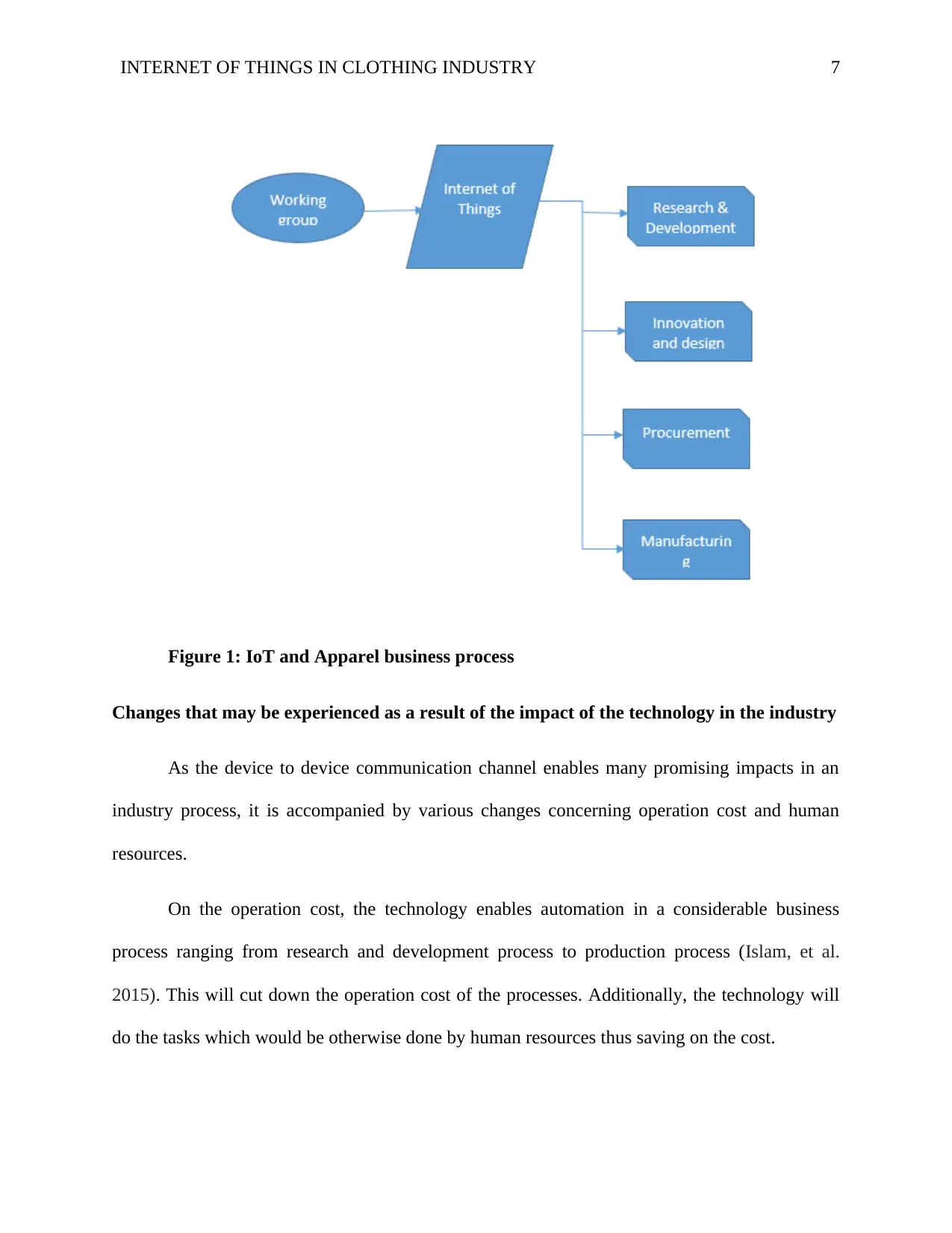
The internet of things will play a significant role in the apparel industry business process.
The business process in the apparel industry involves various activities including research,
development, acquisitions, innovation, development, procurements, designing, and
manufacturing.
The research and development phase in the industry involves venturing into the market
and finding out the trending designs. This approach is quite cumbersome as it involves physical
walk into the market. It also incur expenses. However, the chosen IoT impact in the above
sections will make this process easy and cost effective. The radiofrequency identification
communication enabler in the internet of things will enable transmission of data (Qun, 2010).
This technology can be utilized in the industry to enable access to the audience. It will make it
easy and cost effective to navigate the market and find the trending design in the industry.
In the innovation and design process, this process involves coming up with new product
designs and brands so as to improve on the existing products. This project can be improved by
the technological impact stated in the previous section. The industry can utilize the radio
frequency communication through applications in order to enquire feedback from the customers.
They will intern use this feedback to improve the currently existing product.
The architecture constraint, however, include the regulations for technology that
determines the shape of the environment. The regulations that restrict this technology are: how
the resource access as well as network would be prioritized, cloud computing regulations and
what the IoT devices should be given access network as well as the controls that needs to be put
into place to regulated the access.
Disruption
The internet of things will play a significant role in the apparel industry business process.
The business process in the apparel industry involves various activities including research,
development, acquisitions, innovation, development, procurements, designing, and
manufacturing.
The research and development phase in the industry involves venturing into the market
and finding out the trending designs. This approach is quite cumbersome as it involves physical
walk into the market. It also incur expenses. However, the chosen IoT impact in the above
sections will make this process easy and cost effective. The radiofrequency identification
communication enabler in the internet of things will enable transmission of data (Qun, 2010).
This technology can be utilized in the industry to enable access to the audience. It will make it
easy and cost effective to navigate the market and find the trending design in the industry.
In the innovation and design process, this process involves coming up with new product
designs and brands so as to improve on the existing products. This project can be improved by
the technological impact stated in the previous section. The industry can utilize the radio
frequency communication through applications in order to enquire feedback from the customers.
They will intern use this feedback to improve the currently existing product.
INTERNET OF THINGS IN CLOTHING INDUSTRY 6
The procurement staff, on the other hand are tasked with looking for the best materials
that are used by the industries to make the suggested design of cloths/apparels by customers. The
procurement team are responsible to select the best suppliers and contractors of the best materials
that will suit the needs of the customers and ensure that the organization get the best deal through
bargaining for better prices by suppliers and contractors. The procurement department can as
well be relieved by utilizing the power of internet of things, particularly the radio frequency
identification communication through smart devices to communicate with the suppliers and
contractors, this technology can as well enable detection of the poor quality raw materials
(Domenech et al. 2016; Giusto, Iera, Morabito & Atzori, 2010). Moreover, it also enables smart
contract which enhances trust between the procurement team and the contractors.
In the last processes, manufacturing stages involve the actual processing of the product,
garments in particular. The manufacturing can be impacted by the internet of things technology
selected in the previous section in various ways (Jayatilake & Withanaarachchi, 2016). The radio
frequency identification can be used in machine to machine M2M communication during
manufacturing, this leads to automation which ultimately result to a cost effective process. In
addition, the technology will enable operations including sorting the manufactured apparels, the
radio frequency identification and radiation will also enable tracking the product in case any loss
occur in the manufacturing process.
The procurement staff, on the other hand are tasked with looking for the best materials
that are used by the industries to make the suggested design of cloths/apparels by customers. The
procurement team are responsible to select the best suppliers and contractors of the best materials
that will suit the needs of the customers and ensure that the organization get the best deal through
bargaining for better prices by suppliers and contractors. The procurement department can as
well be relieved by utilizing the power of internet of things, particularly the radio frequency
identification communication through smart devices to communicate with the suppliers and
contractors, this technology can as well enable detection of the poor quality raw materials
(Domenech et al. 2016; Giusto, Iera, Morabito & Atzori, 2010). Moreover, it also enables smart
contract which enhances trust between the procurement team and the contractors.
In the last processes, manufacturing stages involve the actual processing of the product,
garments in particular. The manufacturing can be impacted by the internet of things technology
selected in the previous section in various ways (Jayatilake & Withanaarachchi, 2016). The radio
frequency identification can be used in machine to machine M2M communication during
manufacturing, this leads to automation which ultimately result to a cost effective process. In
addition, the technology will enable operations including sorting the manufactured apparels, the
radio frequency identification and radiation will also enable tracking the product in case any loss
occur in the manufacturing process.
⊘ This is a preview!⊘
Do you want full access?
Subscribe today to unlock all pages.
Trusted by 1+ million students worldwide
INTERNET OF THINGS IN CLOTHING INDUSTRY 7
Figure 1: IoT and Apparel business process
Changes that may be experienced as a result of the impact of the technology in the industry
As the device to device communication channel enables many promising impacts in an
industry process, it is accompanied by various changes concerning operation cost and human
resources.
On the operation cost, the technology enables automation in a considerable business
process ranging from research and development process to production process (Islam, et al.
2015). This will cut down the operation cost of the processes. Additionally, the technology will
do the tasks which would be otherwise done by human resources thus saving on the cost.
Figure 1: IoT and Apparel business process
Changes that may be experienced as a result of the impact of the technology in the industry
As the device to device communication channel enables many promising impacts in an
industry process, it is accompanied by various changes concerning operation cost and human
resources.
On the operation cost, the technology enables automation in a considerable business
process ranging from research and development process to production process (Islam, et al.
2015). This will cut down the operation cost of the processes. Additionally, the technology will
do the tasks which would be otherwise done by human resources thus saving on the cost.
Paraphrase This Document
Need a fresh take? Get an instant paraphrase of this document with our AI Paraphraser
INTERNET OF THINGS IN CLOTHING INDUSTRY 8
Another area that may experience change in the industry is the human resource sector.
Jobs is one of the greatest fears that is cited by the industry when the internet of things
technology is implemented (Kshetri, 2017). As a good number of jobs has to be eliminated by
application of the technology, as a consequence, quite a number of jobs are also likely to emerge
thus leading to change in the industry’s human resources sector.
In conclusion, this document has provided a review on the impact of internet of things in
clothing/apparel industry, we have explored the internet of things and clothing industry. The
article has also presented various ways through which the internet of things can change the
clothing industry as well as regulations and ethics that impact the implementation of the process.
Marketing process is also reviewed as well as the potential changes the technology can impose in
the industry. In summary, it can be concluded that the internet of things have considerable
impacts on clothing industry, it also lead to changes in the organization operation as well as HR
sector.
References
Another area that may experience change in the industry is the human resource sector.
Jobs is one of the greatest fears that is cited by the industry when the internet of things
technology is implemented (Kshetri, 2017). As a good number of jobs has to be eliminated by
application of the technology, as a consequence, quite a number of jobs are also likely to emerge
thus leading to change in the industry’s human resources sector.
In conclusion, this document has provided a review on the impact of internet of things in
clothing/apparel industry, we have explored the internet of things and clothing industry. The
article has also presented various ways through which the internet of things can change the
clothing industry as well as regulations and ethics that impact the implementation of the process.
Marketing process is also reviewed as well as the potential changes the technology can impose in
the industry. In summary, it can be concluded that the internet of things have considerable
impacts on clothing industry, it also lead to changes in the organization operation as well as HR
sector.
References
INTERNET OF THINGS IN CLOTHING INDUSTRY 9
Balaji, M. S., & Roy, S. K. (2017). Value co-creation with Internet of things technology in the
retail industry. Journal of Marketing Management, 33(1-2), 7-31.
Caridi, M., Perego, A., & Tumino, A. (2013). Measuring supply chain visibility in the apparel
industry. Benchmarking: An International Journal, 20(1), 25-44.
Domenech, M. C., Rauta, L. P., Lopes, M. D., Da Silva, P. H., Da Silva, R. C., Mezger, B. W., &
Wangham, M. S. (2016, June). Providing a smart industrial environment with the web of
things and cloud computing. In 2016 IEEE International Conference on Services
Computing (SCC) (pp. 641-648). IEEE.
Giusto, D., Iera, A., Morabito, G., & Atzori, L. (Eds.). (2010). The internet of things: 20th
Tyrrhenian workshop on digital communications. Springer Science & Business Media.
Hwang, Y. M., Kim, M. G., & Rho, J. J. (2016). Understanding Internet of Things (IoT)
diffusion: Focusing on value configuration of RFID and sensors in business cases (2008–
2012). Information Development, 32(4), 969-985.
Islam, S. R., Kwak, D., Kabir, M. H., Hossain, M., & Kwak, K. S. (2015). The internet of things
for health care: a comprehensive survey. IEEE Access, 3, 678-708.
Jayatilake, H., & Withanaarachchi, A. S. (2016). Industry 4.0 in the apparel-manufacturing
sector: Opportunities for Sri Lanka.
Kshetri, N. (2017). The evolution of the internet of things industry and market in China: An
interplay of institutions, demands and supply. Telecommunications Policy, 41(1), 49-67.
Balaji, M. S., & Roy, S. K. (2017). Value co-creation with Internet of things technology in the
retail industry. Journal of Marketing Management, 33(1-2), 7-31.
Caridi, M., Perego, A., & Tumino, A. (2013). Measuring supply chain visibility in the apparel
industry. Benchmarking: An International Journal, 20(1), 25-44.
Domenech, M. C., Rauta, L. P., Lopes, M. D., Da Silva, P. H., Da Silva, R. C., Mezger, B. W., &
Wangham, M. S. (2016, June). Providing a smart industrial environment with the web of
things and cloud computing. In 2016 IEEE International Conference on Services
Computing (SCC) (pp. 641-648). IEEE.
Giusto, D., Iera, A., Morabito, G., & Atzori, L. (Eds.). (2010). The internet of things: 20th
Tyrrhenian workshop on digital communications. Springer Science & Business Media.
Hwang, Y. M., Kim, M. G., & Rho, J. J. (2016). Understanding Internet of Things (IoT)
diffusion: Focusing on value configuration of RFID and sensors in business cases (2008–
2012). Information Development, 32(4), 969-985.
Islam, S. R., Kwak, D., Kabir, M. H., Hossain, M., & Kwak, K. S. (2015). The internet of things
for health care: a comprehensive survey. IEEE Access, 3, 678-708.
Jayatilake, H., & Withanaarachchi, A. S. (2016). Industry 4.0 in the apparel-manufacturing
sector: Opportunities for Sri Lanka.
Kshetri, N. (2017). The evolution of the internet of things industry and market in China: An
interplay of institutions, demands and supply. Telecommunications Policy, 41(1), 49-67.
⊘ This is a preview!⊘
Do you want full access?
Subscribe today to unlock all pages.
Trusted by 1+ million students worldwide
INTERNET OF THINGS IN CLOTHING INDUSTRY
10
Majeed, A. A., & Rupasinghe, T. D. (2017). Internet of things (IoT) embedded future supply
chains for industry 4.0: An assessment from an ERP-based fashion apparel and footwear
industry. International Journal of Supply Chain Management, 6(1), 25-40.
Mattern, F., & Floerkemeier, C. (2010). From the Internet of Computers to the Internet of
Things. In From active data management to event-based systems and more (pp. 242-
259). Springer, Berlin, Heidelberg.
Qun, W. (2010). Research on architecture of Internet of Things and construction of its simulation
experiment platform [J]. Experimental Technology and Management, 10.
Shang, X., Su, B., Liu, X., Xiong, G., & You, Z. (2014, June). Social manufacture cloud mode in
high-end apparel, footwear and hats. In Proceeding of the 11th World Congress on
Intelligent Control and Automation (pp. 5264-5269). IEEE.
10
Majeed, A. A., & Rupasinghe, T. D. (2017). Internet of things (IoT) embedded future supply
chains for industry 4.0: An assessment from an ERP-based fashion apparel and footwear
industry. International Journal of Supply Chain Management, 6(1), 25-40.
Mattern, F., & Floerkemeier, C. (2010). From the Internet of Computers to the Internet of
Things. In From active data management to event-based systems and more (pp. 242-
259). Springer, Berlin, Heidelberg.
Qun, W. (2010). Research on architecture of Internet of Things and construction of its simulation
experiment platform [J]. Experimental Technology and Management, 10.
Shang, X., Su, B., Liu, X., Xiong, G., & You, Z. (2014, June). Social manufacture cloud mode in
high-end apparel, footwear and hats. In Proceeding of the 11th World Congress on
Intelligent Control and Automation (pp. 5264-5269). IEEE.

1 out of 10


Related Documents


Your All-in-One AI-Powered Toolkit for Academic Success.
+13062052269
info@desklib.com
Available 24*7 on WhatsApp / Email
![[object Object]](/_next/static/media/star-bottom.7253800d.svg)
Unlock your academic potential
Copyright © 2020–2026 A2Z Services. All Rights Reserved. Developed and managed by ZUCOL.