Literature Synthesis: IOT Technologies and Smart Cities - ITECH 5500

Verified

Added on  2022/10/11

|4
|756
|22
Report
AI Summary
This report provides an overview of the Internet of Things (IoT) technologies and their application in smart city initiatives. It begins by outlining the widespread deployment of IoT devices in urban environments and highlights the potential benefits, such as increased efficiency and improved services, while also acknowledging the associated risks, particularly concerning privacy. The report then delves into current and future trends, exploring the interaction between smart cities and IoT. It also explains the drivers behind the development and evolution of both. The report includes a synthesis matrix that summarizes key ideas from research papers on the topic. The synthesis matrix examines the seamless integration of diverse systems within IoT, the challenges in building a general architecture for IoT, and the role of IoT in supporting the sustainable development of smart cities. The document also references several research papers which explore various aspects of IoT in smart city contexts. The report aims to provide a comprehensive understanding of the current state and future prospects of IoT in the development of smart cities.

Document Page
Running head: INTERNET OF THINGS (IOT) on SMART CITIES
INTERNET OF THINGS (IOT) on SMART CITIES
Name of the Student
Name of the Organization
Author Note
tabler-icon-diamond-filled.svg

Paraphrase This Document

Need a fresh take? Get an instant paraphrase of this document with our AI Paraphraser
Document Page
1
INTERNET OF THINGS (IOT) on SMART CITIES
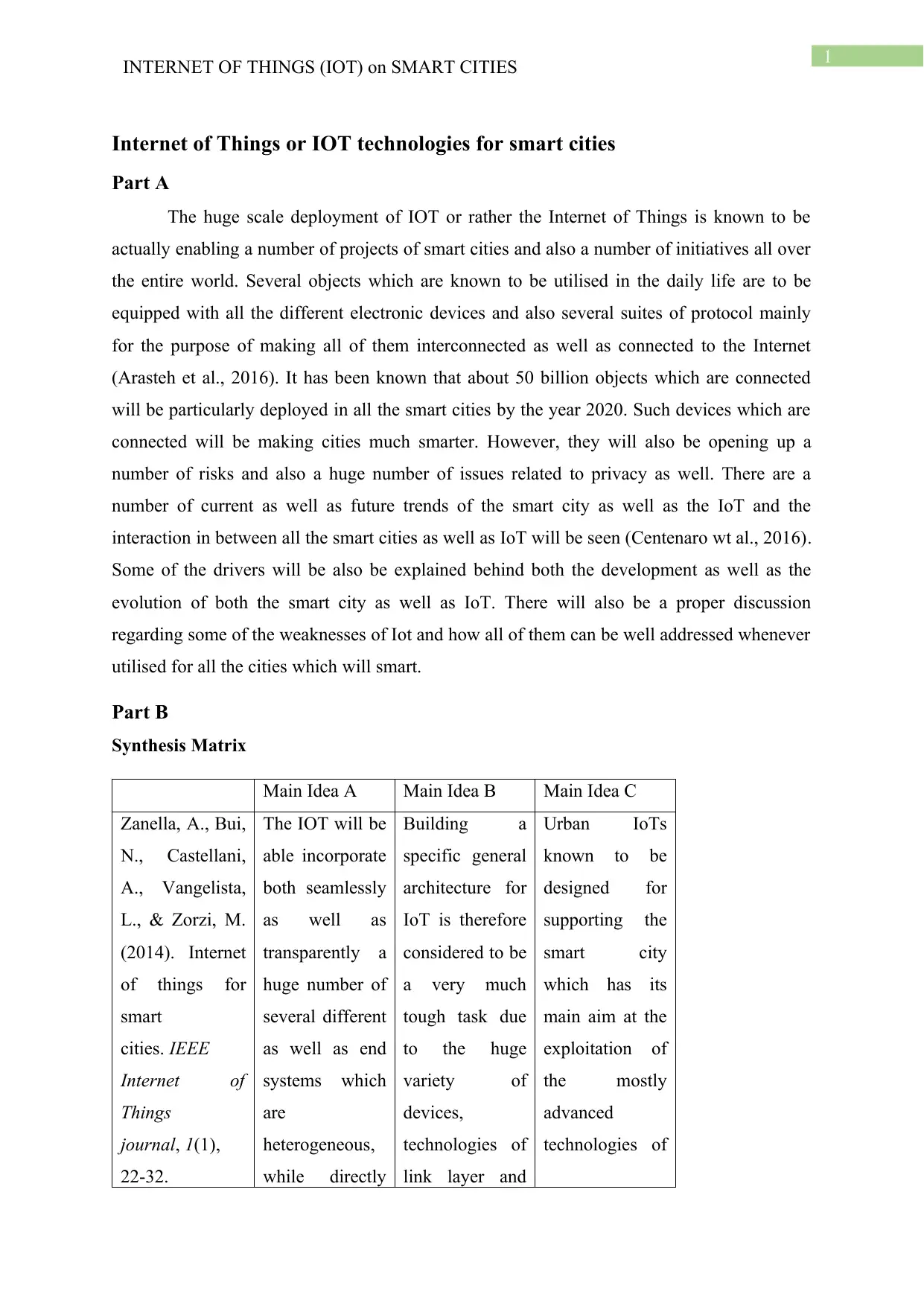
Internet of Things or IOT technologies for smart cities
Part A
The huge scale deployment of IOT or rather the Internet of Things is known to be
actually enabling a number of projects of smart cities and also a number of initiatives all over
the entire world. Several objects which are known to be utilised in the daily life are to be
equipped with all the different electronic devices and also several suites of protocol mainly
for the purpose of making all of them interconnected as well as connected to the Internet
(Arasteh et al., 2016). It has been known that about 50 billion objects which are connected
will be particularly deployed in all the smart cities by the year 2020. Such devices which are
connected will be making cities much smarter. However, they will also be opening up a
number of risks and also a huge number of issues related to privacy as well. There are a
number of current as well as future trends of the smart city as well as the IoT and the
interaction in between all the smart cities as well as IoT will be seen (Centenaro wt al., 2016).
Some of the drivers will be also be explained behind both the development as well as the
evolution of both the smart city as well as IoT. There will also be a proper discussion
regarding some of the weaknesses of Iot and how all of them can be well addressed whenever
utilised for all the cities which will smart.
Part B
Synthesis Matrix
Main Idea A Main Idea B Main Idea C
Zanella, A., Bui,
N., Castellani,
A., Vangelista,
L., & Zorzi, M.
(2014). Internet
of things for
smart
cities. IEEE
Internet of
Things
journal, 1(1),
22-32.
The IOT will be
able incorporate
both seamlessly
as well as
transparently a
huge number of
several different
as well as end
systems which
are
heterogeneous,
while directly
Building a
specific general
architecture for
IoT is therefore
considered to be
a very much
tough task due
to the huge
variety of
devices,
technologies of
link layer and
Urban IoTs
known to be
designed for
supporting the
smart city
which has its
main aim at the
exploitation of
the mostly
advanced
technologies of
Document Page
2
INTERNET OF THINGS (IOT) on SMART CITIES
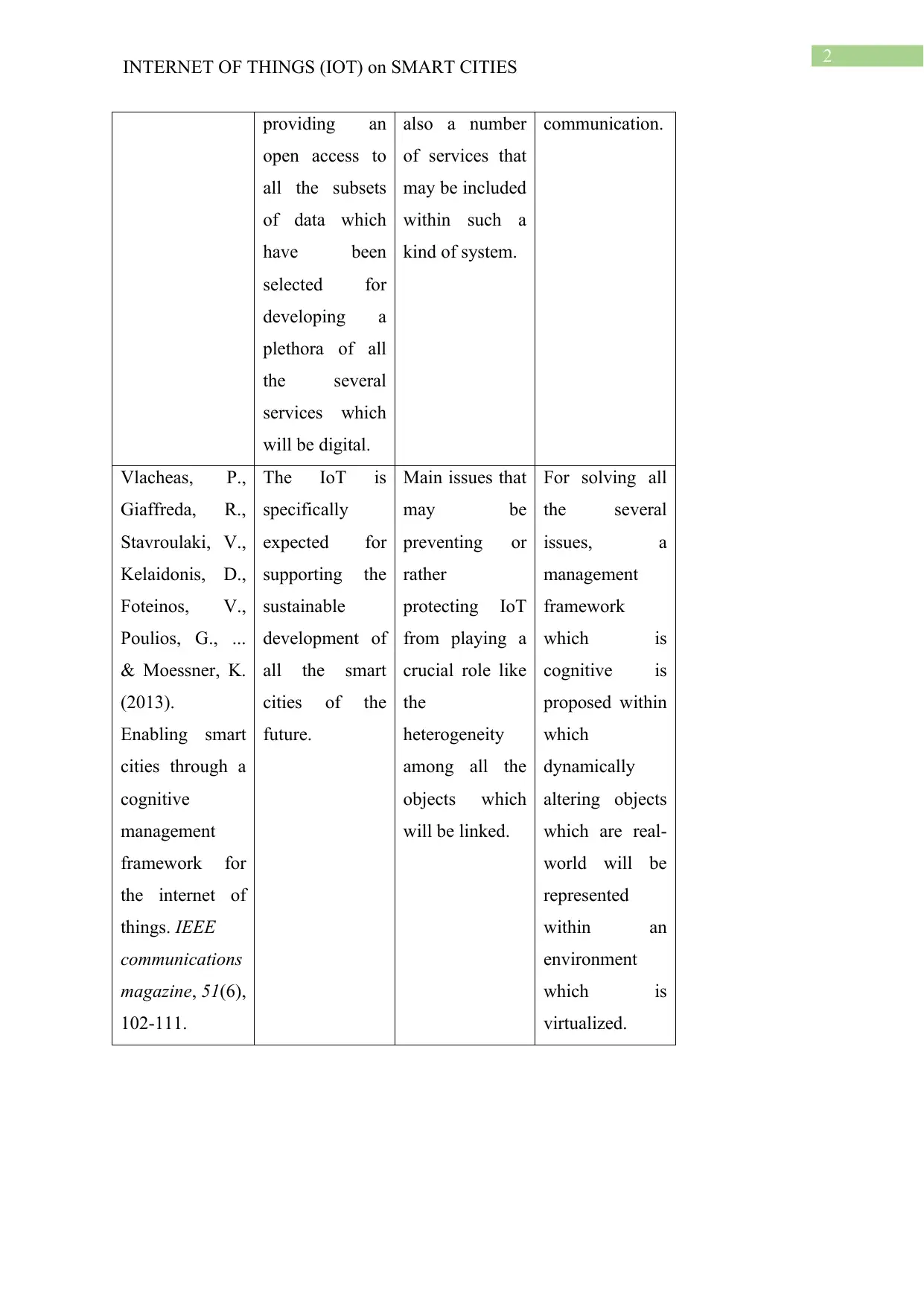
providing an
open access to
all the subsets
of data which
have been
selected for
developing a
plethora of all
the several
services which
will be digital.
also a number
of services that
may be included
within such a
kind of system.
communication.
Vlacheas, P.,
Giaffreda, R.,
Stavroulaki, V.,
Kelaidonis, D.,
Foteinos, V.,
Poulios, G., ...
& Moessner, K.
(2013).
Enabling smart
cities through a
cognitive
management
framework for
the internet of
things. IEEE
communications
magazine, 51(6),
102-111.
The IoT is
specifically
expected for
supporting the
sustainable
development of
all the smart
cities of the
future.
Main issues that
may be
preventing or
rather
protecting IoT
from playing a
crucial role like
the
heterogeneity
among all the
objects which
will be linked.
For solving all
the several
issues, a
management
framework
which is
cognitive is
proposed within
which
dynamically
altering objects
which are real-
world will be
represented
within an
environment
which is
virtualized.
Document Page
3
INTERNET OF THINGS (IOT) on SMART CITIES
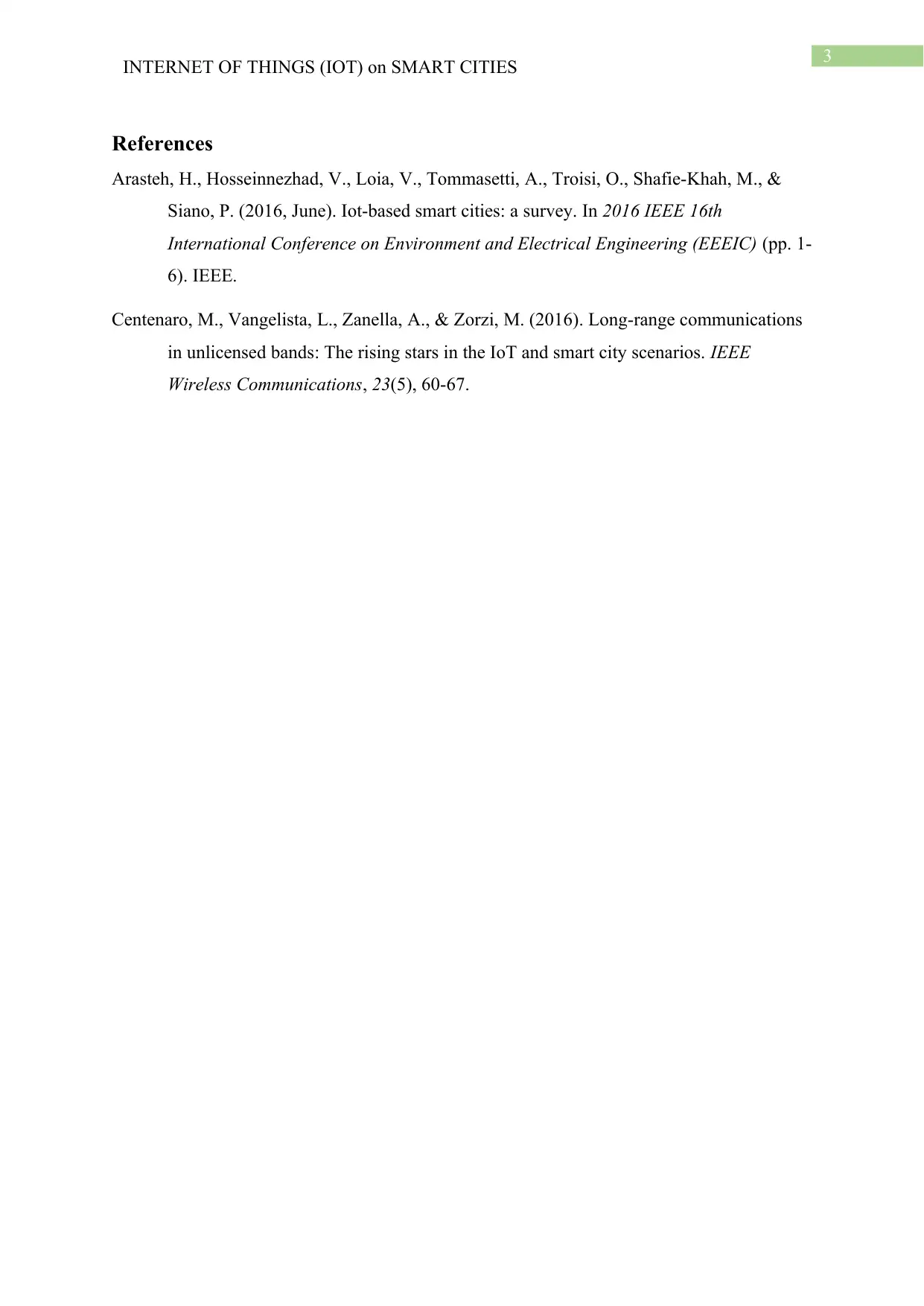
References
Arasteh, H., Hosseinnezhad, V., Loia, V., Tommasetti, A., Troisi, O., Shafie-Khah, M., &
Siano, P. (2016, June). Iot-based smart cities: a survey. In 2016 IEEE 16th
International Conference on Environment and Electrical Engineering (EEEIC) (pp. 1-
6). IEEE.
Centenaro, M., Vangelista, L., Zanella, A., & Zorzi, M. (2016). Long-range communications
in unlicensed bands: The rising stars in the IoT and smart city scenarios. IEEE
Wireless Communications, 23(5), 60-67.
chevron_up_icon
1 out of 4
circle_padding
hide_on_mobile
zoom_out_icon
[object Object]