Interpersonal Communication: Challenges and Strategies in Nursing
VerifiedAdded on 2019/12/17
|7
|1649
|186
Report
AI Summary
This report analyzes the significance of interpersonal communication in nursing, drawing on research articles to explore its effectiveness and challenges. It begins by highlighting the importance of effective communication for nurses, emphasizing its impact on patient care, well-being, and the reduction of stress. The report then delves into internal and external factors influencing communication, referencing Maslow’s hierarchy of needs to illustrate the connection between effective communication and fulfilling patients' needs for safety, belonging, and self-esteem. The report also examines intercultural communication challenges, including prejudices, lack of familiarity, stereotyping, and language barriers, and discusses strategies to overcome these obstacles. Additionally, the report addresses communication difficulties during patient transitions between nursing homes and hospitals, emphasizing the need for enhanced coordination and clear communication to ensure optimal patient care. The author, a nursing student, reflects on the importance of interpersonal relationship building, empathy, and proactive communication to address cultural differences and improve patient outcomes.
Interpersonal communication: effectiveness and coordination 1
Interpersonal communication: effectiveness and coordination
Student's Name:
Instructor's Name:
Date:
Interpersonal communication: effectiveness and coordination
Student's Name:
Instructor's Name:
Date:
Paraphrase This Document
Need a fresh take? Get an instant paraphrase of this document with our AI Paraphraser

Interpersonal communication: effectiveness and coordination 2
Interpersonal communication: effectiveness and coordination
Part A
Vertino, K. (2014). “Effective Interpersonal Communication: A Practical Guide To
Improve Your Life.” OJIN: The Online Journal of Issues in Nursing, Vol.19, No.3,
Manuscript 1
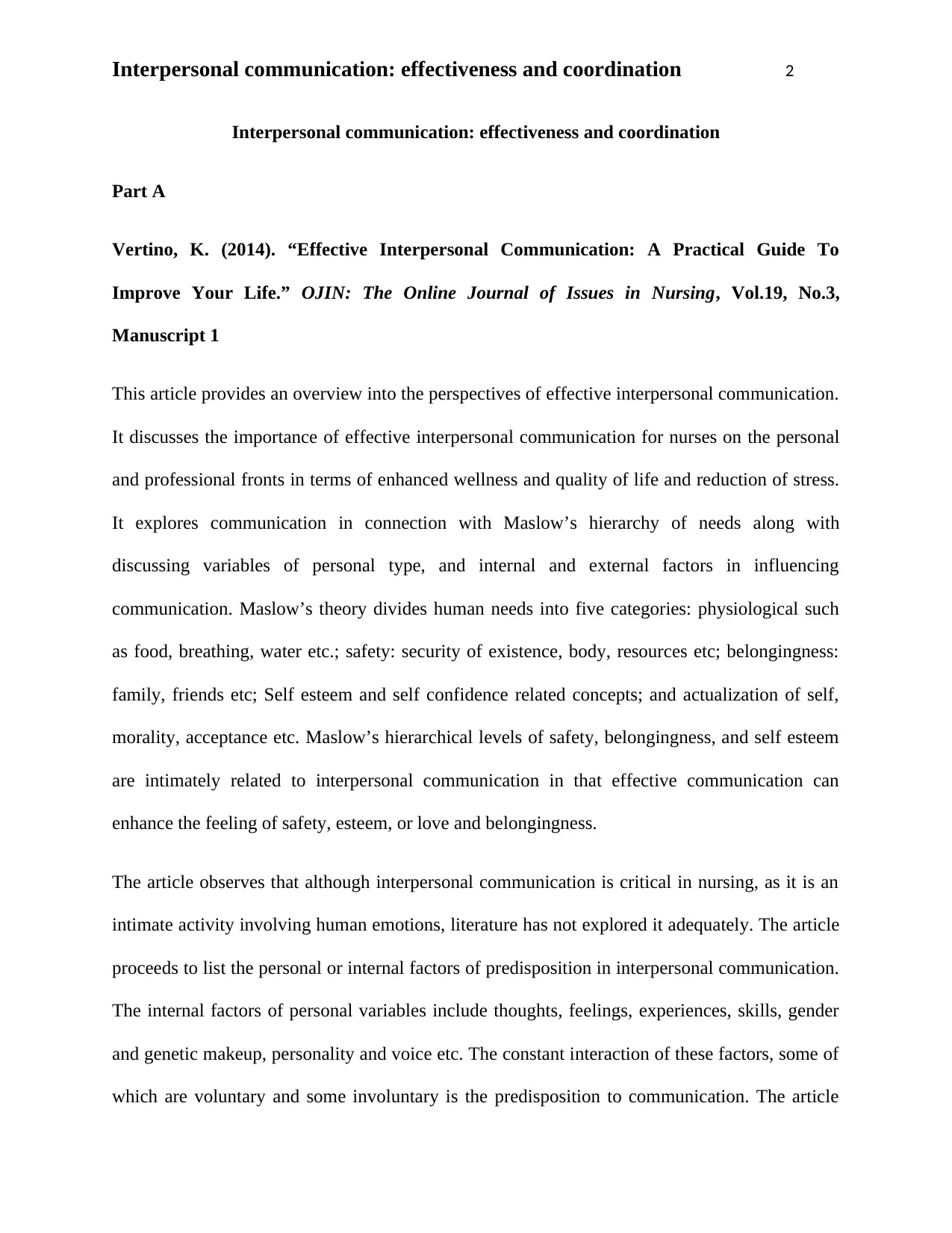
This article provides an overview into the perspectives of effective interpersonal communication.
It discusses the importance of effective interpersonal communication for nurses on the personal
and professional fronts in terms of enhanced wellness and quality of life and reduction of stress.
It explores communication in connection with Maslow’s hierarchy of needs along with
discussing variables of personal type, and internal and external factors in influencing
communication. Maslow’s theory divides human needs into five categories: physiological such
as food, breathing, water etc.; safety: security of existence, body, resources etc; belongingness:
family, friends etc; Self esteem and self confidence related concepts; and actualization of self,
morality, acceptance etc. Maslow’s hierarchical levels of safety, belongingness, and self esteem
are intimately related to interpersonal communication in that effective communication can
enhance the feeling of safety, esteem, or love and belongingness.
The article observes that although interpersonal communication is critical in nursing, as it is an
intimate activity involving human emotions, literature has not explored it adequately. The article
proceeds to list the personal or internal factors of predisposition in interpersonal communication.
The internal factors of personal variables include thoughts, feelings, experiences, skills, gender
and genetic makeup, personality and voice etc. The constant interaction of these factors, some of
which are voluntary and some involuntary is the predisposition to communication. The article
Interpersonal communication: effectiveness and coordination
Part A
Vertino, K. (2014). “Effective Interpersonal Communication: A Practical Guide To
Improve Your Life.” OJIN: The Online Journal of Issues in Nursing, Vol.19, No.3,
Manuscript 1
This article provides an overview into the perspectives of effective interpersonal communication.
It discusses the importance of effective interpersonal communication for nurses on the personal
and professional fronts in terms of enhanced wellness and quality of life and reduction of stress.
It explores communication in connection with Maslow’s hierarchy of needs along with
discussing variables of personal type, and internal and external factors in influencing
communication. Maslow’s theory divides human needs into five categories: physiological such
as food, breathing, water etc.; safety: security of existence, body, resources etc; belongingness:
family, friends etc; Self esteem and self confidence related concepts; and actualization of self,
morality, acceptance etc. Maslow’s hierarchical levels of safety, belongingness, and self esteem
are intimately related to interpersonal communication in that effective communication can
enhance the feeling of safety, esteem, or love and belongingness.
The article observes that although interpersonal communication is critical in nursing, as it is an
intimate activity involving human emotions, literature has not explored it adequately. The article
proceeds to list the personal or internal factors of predisposition in interpersonal communication.
The internal factors of personal variables include thoughts, feelings, experiences, skills, gender
and genetic makeup, personality and voice etc. The constant interaction of these factors, some of
which are voluntary and some involuntary is the predisposition to communication. The article

Interpersonal communication: effectiveness and coordination 3
goes on to tabulate and analyzes various probable causes for ineffective communication and the
plausible consequences, strategies to overcome them along with elucidations in normal context.
Henderson, S., Barker, M., and Mak, A. (2015). “Strategies used by nurses, academics, and
students to overcome intercultural communication challenges.” Nurse Education in
Practice, 71-78.
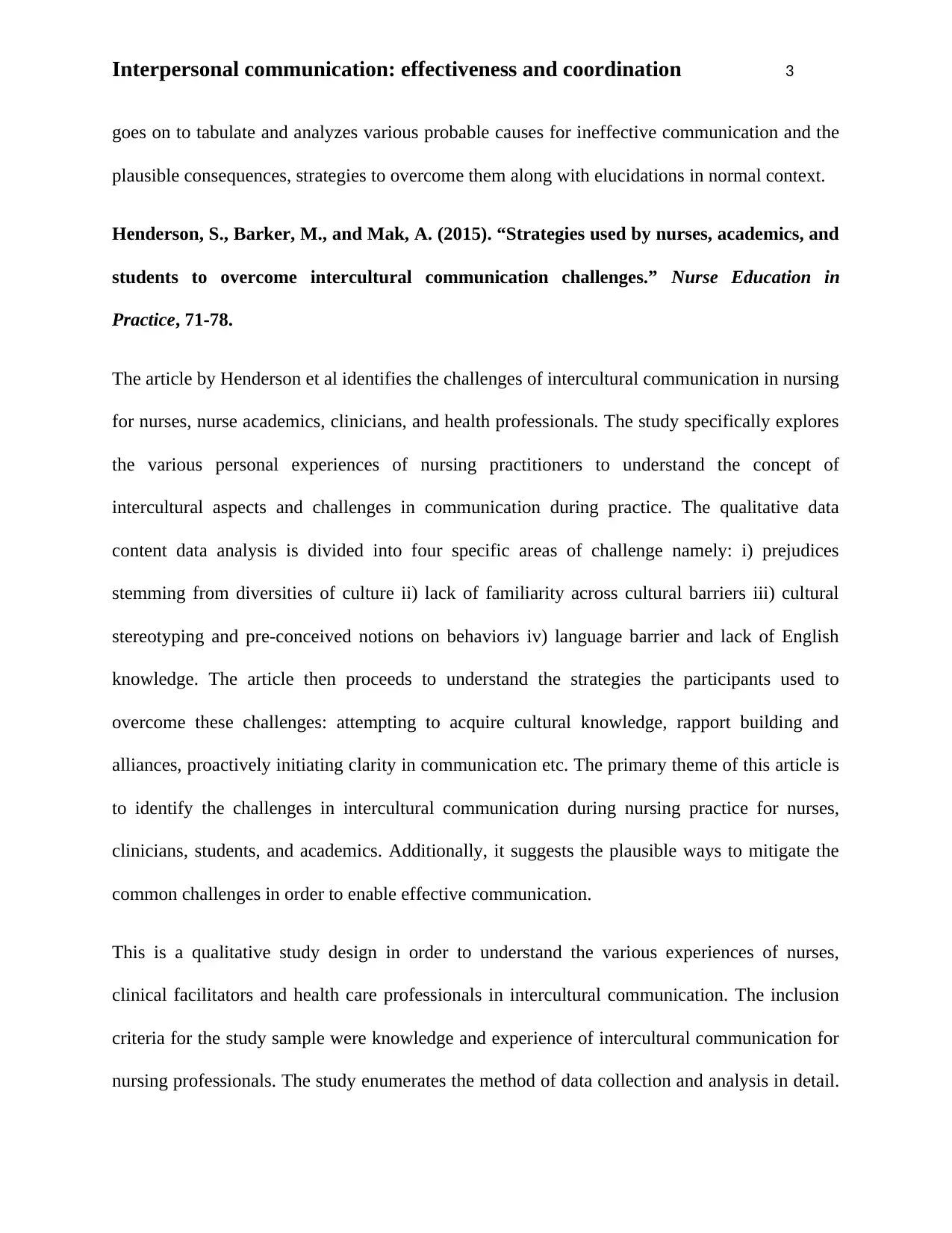
The article by Henderson et al identifies the challenges of intercultural communication in nursing
for nurses, nurse academics, clinicians, and health professionals. The study specifically explores
the various personal experiences of nursing practitioners to understand the concept of
intercultural aspects and challenges in communication during practice. The qualitative data
content data analysis is divided into four specific areas of challenge namely: i) prejudices
stemming from diversities of culture ii) lack of familiarity across cultural barriers iii) cultural
stereotyping and pre-conceived notions on behaviors iv) language barrier and lack of English
knowledge. The article then proceeds to understand the strategies the participants used to
overcome these challenges: attempting to acquire cultural knowledge, rapport building and
alliances, proactively initiating clarity in communication etc. The primary theme of this article is
to identify the challenges in intercultural communication during nursing practice for nurses,
clinicians, students, and academics. Additionally, it suggests the plausible ways to mitigate the
common challenges in order to enable effective communication.
This is a qualitative study design in order to understand the various experiences of nurses,
clinical facilitators and health care professionals in intercultural communication. The inclusion
criteria for the study sample were knowledge and experience of intercultural communication for
nursing professionals. The study enumerates the method of data collection and analysis in detail.
goes on to tabulate and analyzes various probable causes for ineffective communication and the
plausible consequences, strategies to overcome them along with elucidations in normal context.
Henderson, S., Barker, M., and Mak, A. (2015). “Strategies used by nurses, academics, and
students to overcome intercultural communication challenges.” Nurse Education in
Practice, 71-78.
The article by Henderson et al identifies the challenges of intercultural communication in nursing
for nurses, nurse academics, clinicians, and health professionals. The study specifically explores
the various personal experiences of nursing practitioners to understand the concept of
intercultural aspects and challenges in communication during practice. The qualitative data
content data analysis is divided into four specific areas of challenge namely: i) prejudices
stemming from diversities of culture ii) lack of familiarity across cultural barriers iii) cultural
stereotyping and pre-conceived notions on behaviors iv) language barrier and lack of English
knowledge. The article then proceeds to understand the strategies the participants used to
overcome these challenges: attempting to acquire cultural knowledge, rapport building and
alliances, proactively initiating clarity in communication etc. The primary theme of this article is
to identify the challenges in intercultural communication during nursing practice for nurses,
clinicians, students, and academics. Additionally, it suggests the plausible ways to mitigate the
common challenges in order to enable effective communication.
This is a qualitative study design in order to understand the various experiences of nurses,
clinical facilitators and health care professionals in intercultural communication. The inclusion
criteria for the study sample were knowledge and experience of intercultural communication for
nursing professionals. The study enumerates the method of data collection and analysis in detail.
⊘ This is a preview!⊘
Do you want full access?
Subscribe today to unlock all pages.

Trusted by 1+ million students worldwide

Interpersonal communication: effectiveness and coordination 4
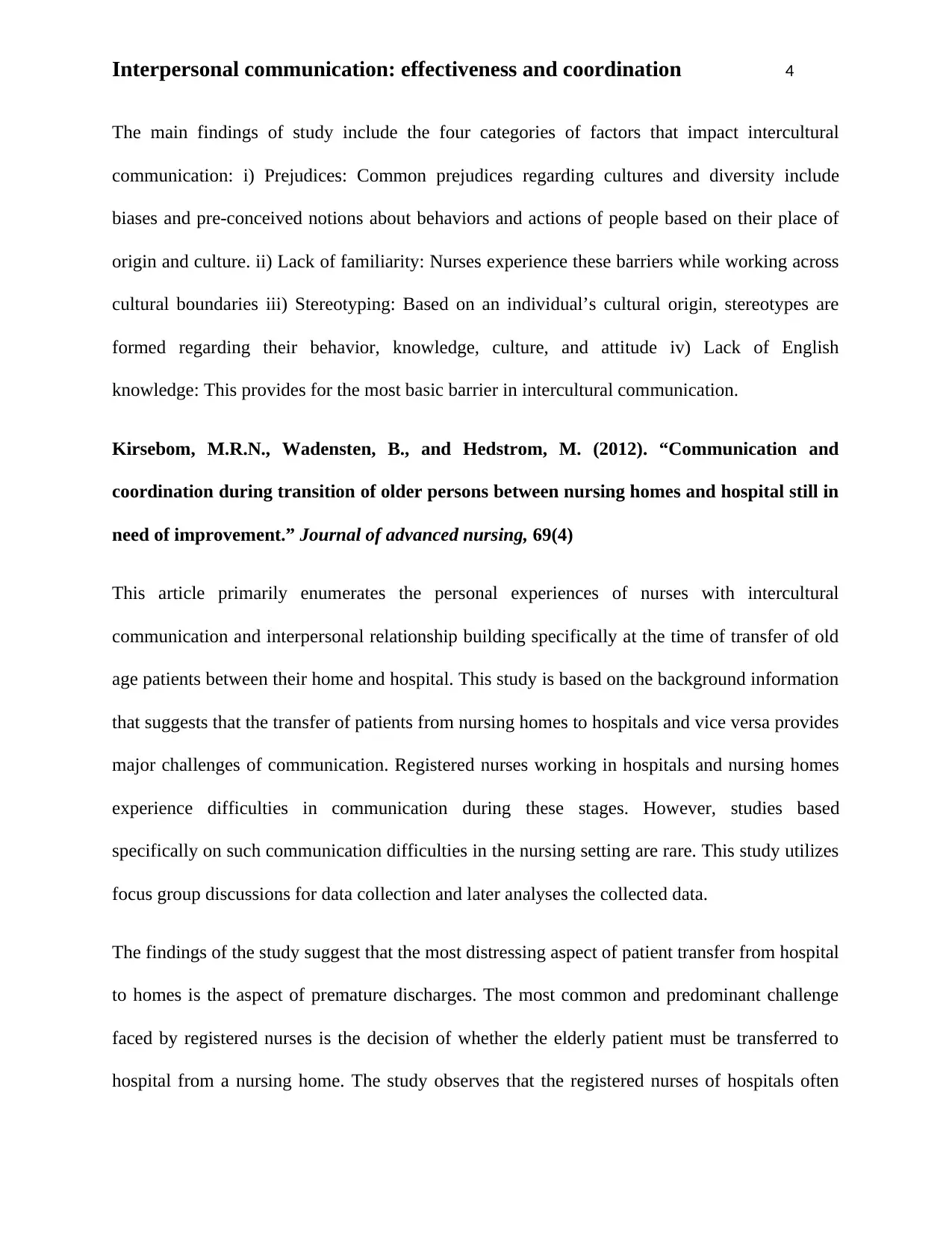
The main findings of study include the four categories of factors that impact intercultural
communication: i) Prejudices: Common prejudices regarding cultures and diversity include
biases and pre-conceived notions about behaviors and actions of people based on their place of
origin and culture. ii) Lack of familiarity: Nurses experience these barriers while working across
cultural boundaries iii) Stereotyping: Based on an individual’s cultural origin, stereotypes are
formed regarding their behavior, knowledge, culture, and attitude iv) Lack of English
knowledge: This provides for the most basic barrier in intercultural communication.
Kirsebom, M.R.N., Wadensten, B., and Hedstrom, M. (2012). “Communication and
coordination during transition of older persons between nursing homes and hospital still in
need of improvement.” Journal of advanced nursing, 69(4)
This article primarily enumerates the personal experiences of nurses with intercultural
communication and interpersonal relationship building specifically at the time of transfer of old
age patients between their home and hospital. This study is based on the background information
that suggests that the transfer of patients from nursing homes to hospitals and vice versa provides
major challenges of communication. Registered nurses working in hospitals and nursing homes
experience difficulties in communication during these stages. However, studies based
specifically on such communication difficulties in the nursing setting are rare. This study utilizes
focus group discussions for data collection and later analyses the collected data.
The findings of the study suggest that the most distressing aspect of patient transfer from hospital
to homes is the aspect of premature discharges. The most common and predominant challenge
faced by registered nurses is the decision of whether the elderly patient must be transferred to
hospital from a nursing home. The study observes that the registered nurses of hospitals often
The main findings of study include the four categories of factors that impact intercultural
communication: i) Prejudices: Common prejudices regarding cultures and diversity include
biases and pre-conceived notions about behaviors and actions of people based on their place of
origin and culture. ii) Lack of familiarity: Nurses experience these barriers while working across
cultural boundaries iii) Stereotyping: Based on an individual’s cultural origin, stereotypes are
formed regarding their behavior, knowledge, culture, and attitude iv) Lack of English
knowledge: This provides for the most basic barrier in intercultural communication.
Kirsebom, M.R.N., Wadensten, B., and Hedstrom, M. (2012). “Communication and
coordination during transition of older persons between nursing homes and hospital still in
need of improvement.” Journal of advanced nursing, 69(4)
This article primarily enumerates the personal experiences of nurses with intercultural
communication and interpersonal relationship building specifically at the time of transfer of old
age patients between their home and hospital. This study is based on the background information
that suggests that the transfer of patients from nursing homes to hospitals and vice versa provides
major challenges of communication. Registered nurses working in hospitals and nursing homes
experience difficulties in communication during these stages. However, studies based
specifically on such communication difficulties in the nursing setting are rare. This study utilizes
focus group discussions for data collection and later analyses the collected data.
The findings of the study suggest that the most distressing aspect of patient transfer from hospital
to homes is the aspect of premature discharges. The most common and predominant challenge
faced by registered nurses is the decision of whether the elderly patient must be transferred to
hospital from a nursing home. The study observes that the registered nurses of hospitals often
Paraphrase This Document
Need a fresh take? Get an instant paraphrase of this document with our AI Paraphraser

Interpersonal communication: effectiveness and coordination 5
attempt to avoid premature discharges or are often forced to carry out discharges without full
preparation. The study observes that registered nurses in both hospitals and nursing homes
suggest a consensus that in order to understand the situation of work in both cases much better,
an enhanced collaboration between them is essential. The study indicates in conclusion that the
coordination between the nurses of nursing homes and hospitals needs to be enhanced greatly
and suggests a regular and diligent update of the medical care plan to reduce the risk of
unnecessary admission and non-adept treatment or medical interventions inappropriate for the
patient.
Part B
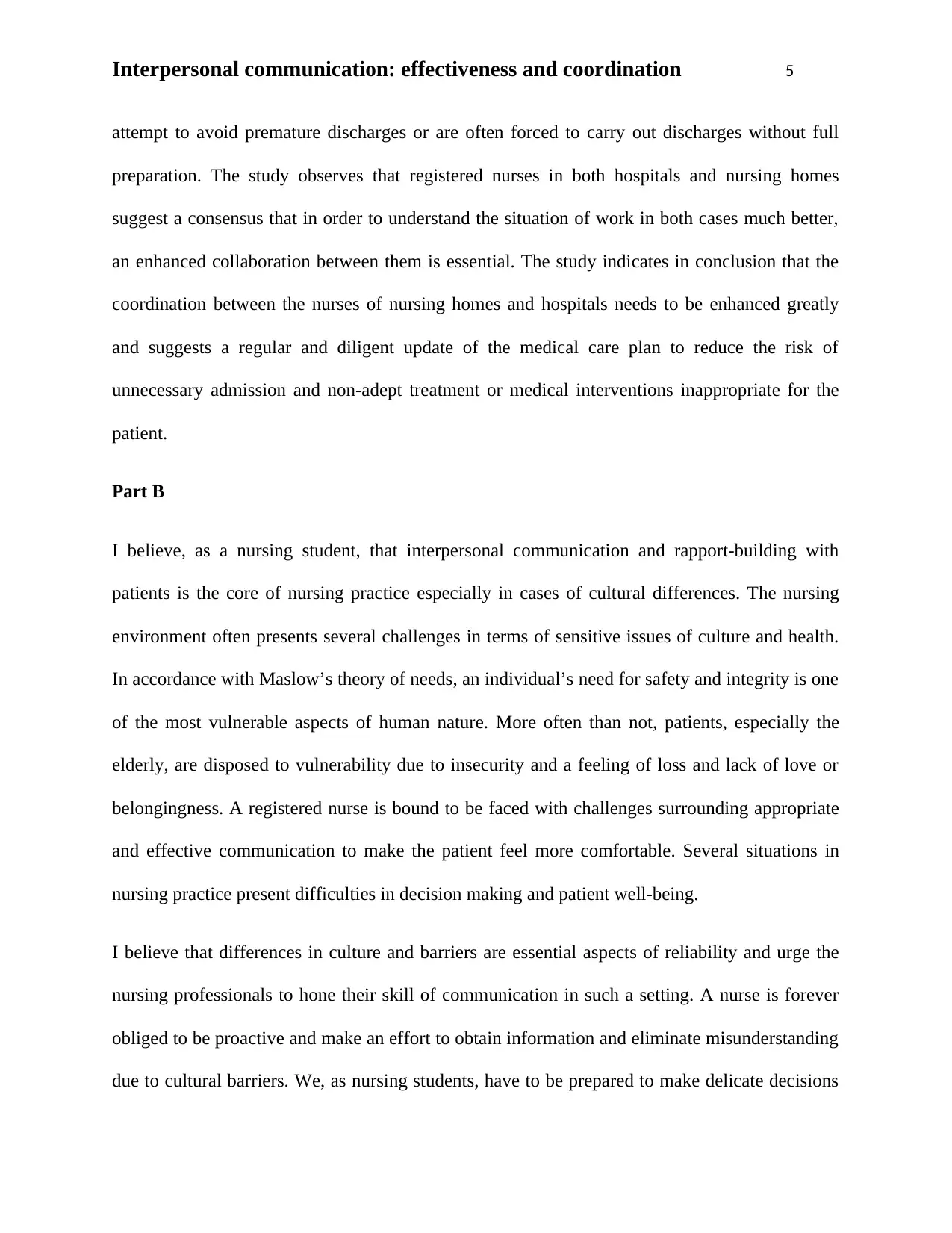
I believe, as a nursing student, that interpersonal communication and rapport-building with
patients is the core of nursing practice especially in cases of cultural differences. The nursing
environment often presents several challenges in terms of sensitive issues of culture and health.
In accordance with Maslow’s theory of needs, an individual’s need for safety and integrity is one
of the most vulnerable aspects of human nature. More often than not, patients, especially the
elderly, are disposed to vulnerability due to insecurity and a feeling of loss and lack of love or
belongingness. A registered nurse is bound to be faced with challenges surrounding appropriate
and effective communication to make the patient feel more comfortable. Several situations in
nursing practice present difficulties in decision making and patient well-being.
I believe that differences in culture and barriers are essential aspects of reliability and urge the
nursing professionals to hone their skill of communication in such a setting. A nurse is forever
obliged to be proactive and make an effort to obtain information and eliminate misunderstanding
due to cultural barriers. We, as nursing students, have to be prepared to make delicate decisions
attempt to avoid premature discharges or are often forced to carry out discharges without full
preparation. The study observes that registered nurses in both hospitals and nursing homes
suggest a consensus that in order to understand the situation of work in both cases much better,
an enhanced collaboration between them is essential. The study indicates in conclusion that the
coordination between the nurses of nursing homes and hospitals needs to be enhanced greatly
and suggests a regular and diligent update of the medical care plan to reduce the risk of
unnecessary admission and non-adept treatment or medical interventions inappropriate for the
patient.
Part B
I believe, as a nursing student, that interpersonal communication and rapport-building with
patients is the core of nursing practice especially in cases of cultural differences. The nursing
environment often presents several challenges in terms of sensitive issues of culture and health.
In accordance with Maslow’s theory of needs, an individual’s need for safety and integrity is one
of the most vulnerable aspects of human nature. More often than not, patients, especially the
elderly, are disposed to vulnerability due to insecurity and a feeling of loss and lack of love or
belongingness. A registered nurse is bound to be faced with challenges surrounding appropriate
and effective communication to make the patient feel more comfortable. Several situations in
nursing practice present difficulties in decision making and patient well-being.
I believe that differences in culture and barriers are essential aspects of reliability and urge the
nursing professionals to hone their skill of communication in such a setting. A nurse is forever
obliged to be proactive and make an effort to obtain information and eliminate misunderstanding
due to cultural barriers. We, as nursing students, have to be prepared to make delicate decisions

Interpersonal communication: effectiveness and coordination 6
with firmness and affirmation. It is a major challenge to obtain clarity in several in situations
where there may be an elementary language barrier. I believe the core of nursing practice is the
understanding of interpersonal relationship building along providing a trusting and empathetic
equation with the patients in concern.
Another situation that provides utmost difficulties to registered nurses is the decision of
transferring elderly patients between nursing homes and hospitals. Most often, the decision of
premature discharge of patients poses a massive challenge to nurses. Communication is often the
primary challenge in these situations and the lack of effective communication causes several
problems after discharge. Patient care and transfer are important situations where effective
interpersonal communication is a demand of the hour.
I believe that as nurses, we need to develop the basic skill of communication in an effective and
appropriate manner. To me, the analysis of the specific possible ineffectiveness and barriers
during communication as done by Henderson et al in the afore-discussed study is of particular
importance. I tend to agree with the possible remedies to such ineffective communication
examples as stated by them. We need to amass knowledge with experience and each specific
experience changes the perspectives of nurses in due course; however, to develop knowledge and
mindfulness about effective interpersonal communication is essential for nursing students,
academics, and nursing professionals associated with nursing practice.
References:
with firmness and affirmation. It is a major challenge to obtain clarity in several in situations
where there may be an elementary language barrier. I believe the core of nursing practice is the
understanding of interpersonal relationship building along providing a trusting and empathetic
equation with the patients in concern.
Another situation that provides utmost difficulties to registered nurses is the decision of
transferring elderly patients between nursing homes and hospitals. Most often, the decision of
premature discharge of patients poses a massive challenge to nurses. Communication is often the
primary challenge in these situations and the lack of effective communication causes several
problems after discharge. Patient care and transfer are important situations where effective
interpersonal communication is a demand of the hour.
I believe that as nurses, we need to develop the basic skill of communication in an effective and
appropriate manner. To me, the analysis of the specific possible ineffectiveness and barriers
during communication as done by Henderson et al in the afore-discussed study is of particular
importance. I tend to agree with the possible remedies to such ineffective communication
examples as stated by them. We need to amass knowledge with experience and each specific
experience changes the perspectives of nurses in due course; however, to develop knowledge and
mindfulness about effective interpersonal communication is essential for nursing students,
academics, and nursing professionals associated with nursing practice.
References:
⊘ This is a preview!⊘
Do you want full access?
Subscribe today to unlock all pages.

Trusted by 1+ million students worldwide

Interpersonal communication: effectiveness and coordination 7
1. Vertino, K. (2014). “Effective Interpersonal Communication: A Practical Guide To Improve
Your Life.” OJIN: The Online Journal of Issues in Nursing, 19(3), Manuscript 1
2. Henderson, S., Barker, M., and Mak, A. (2015). “Strategies used by nurses, academics, and
students to overcome intercultural communication challenges.” Nurse Education in Practice, 71-
78.
3. Kirsebom, M.R.N., Wadensten, B., and Hedstrom, M. (2012). “Communication and
coordination during transition of older persons between nursing homes and hospital still in need
of improvement.” Journal of advanced nursing, 69(4)
1. Vertino, K. (2014). “Effective Interpersonal Communication: A Practical Guide To Improve
Your Life.” OJIN: The Online Journal of Issues in Nursing, 19(3), Manuscript 1
2. Henderson, S., Barker, M., and Mak, A. (2015). “Strategies used by nurses, academics, and
students to overcome intercultural communication challenges.” Nurse Education in Practice, 71-
78.
3. Kirsebom, M.R.N., Wadensten, B., and Hedstrom, M. (2012). “Communication and
coordination during transition of older persons between nursing homes and hospital still in need
of improvement.” Journal of advanced nursing, 69(4)
1 out of 7
Your All-in-One AI-Powered Toolkit for Academic Success.
+13062052269
info@desklib.com
Available 24*7 on WhatsApp / Email
Unlock your academic potential
Copyright © 2020–2025 A2Z Services. All Rights Reserved. Developed and managed by ZUCOL.