Diploma of Interpreting Assignment: Requirements, Factors, and Tasks
VerifiedAdded on 2023/01/10
|46
|12647
|1
Homework Assignment
AI Summary
This assignment, designed for a Diploma of Interpreting course, delves into the core aspects of effective interpretation. It begins by establishing client requirements and identifying factors that can compromise an interpreter's effectiveness, including elements like clear communication, accuracy, and language proficiency. The assignment progresses through multiple-choice questions based on an interpreting booking form, assessing the student's ability to identify key assignment details such as purpose, mode, and duration. Short answer questions explore ideal seating arrangements for interviews and the importance of active listening. The assignment then transitions to communication techniques, requiring students to match responses to scenarios and answer short-answer questions on mental states during active listening and techniques to extend interactions. Students engage in role-play exercises to practice communication skills and seek/offer information, and are asked to analyze how to ask for clarification and identify resources for supporting high-quality interpreting services. Finally, the assignment covers conversational topics, including workplace events and business matters, and concludes with a case analysis where students must determine how to respond in an interpreting situation. This assignment provides a well-rounded exploration of the practical and theoretical aspects of interpreting, emphasizing effective communication and problem-solving skills.


Paraphrase This Document
Need a fresh take? Get an instant paraphrase of this document with our AI Paraphraser
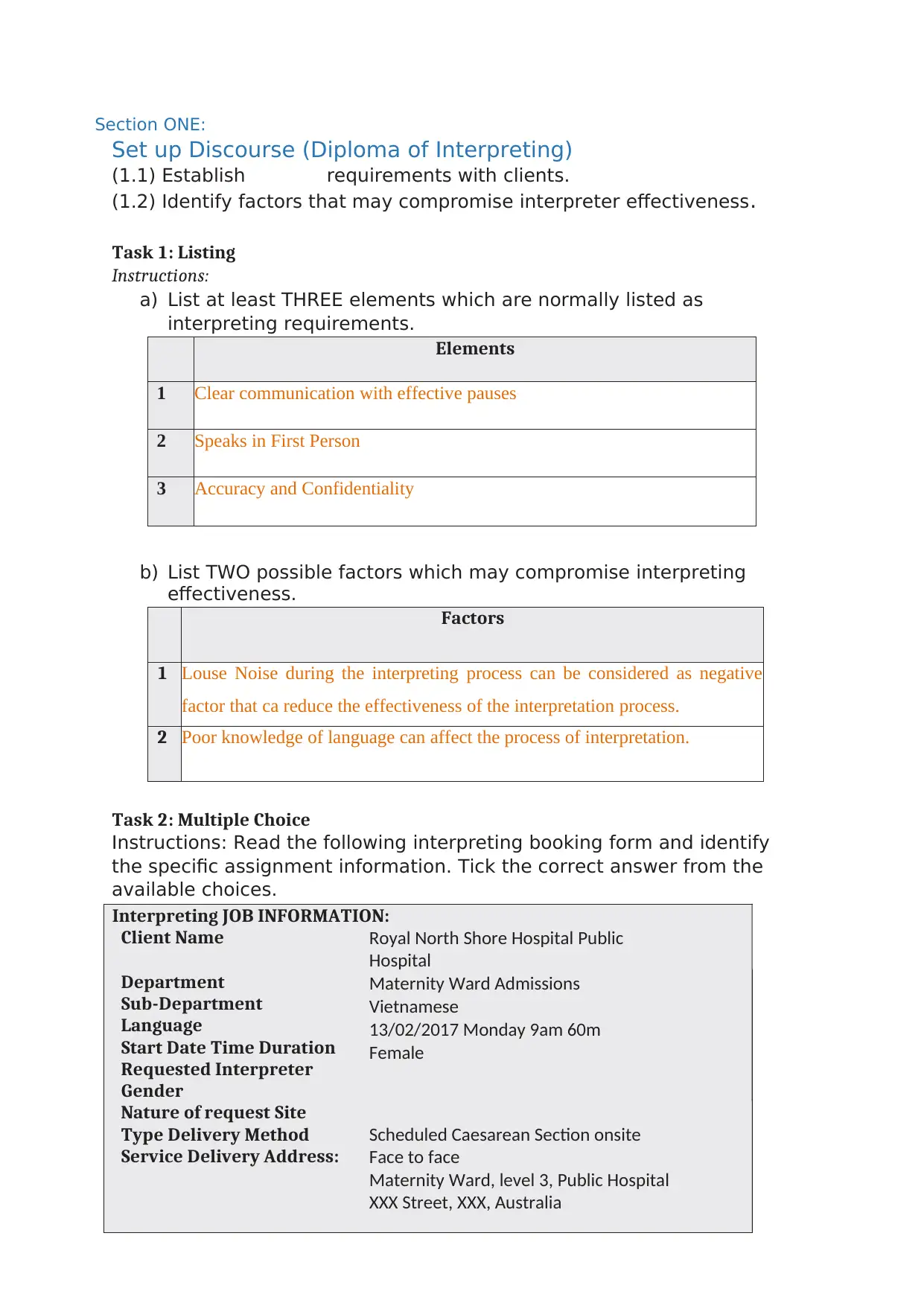
Section ONE:
Set up Discourse (Diploma of Interpreting)
(1.1) Establish requirements with clients.
(1.2) Identify factors that may compromise interpreter effectiveness.
Task 1: Listing
Instructions:
a) List at least THREE elements which are normally listed as
interpreting requirements.
Elements
1 Clear communication with effective pauses
2 Speaks in First Person
3 Accuracy and Confidentiality
b) List TWO possible factors which may compromise interpreting
effectiveness.
Factors
1 Louse Noise during the interpreting process can be considered as negative
factor that ca reduce the effectiveness of the interpretation process.
2 Poor knowledge of language can affect the process of interpretation.
Task 2: Multiple Choice
Instructions: Read the following interpreting booking form and identify
the specific assignment information. Tick the correct answer from the
available choices.
Interpreting JOB INFORMATION:
Client Name
Department
Sub-Department
Language
Start Date Time Duration
Requested Interpreter
Gender
Nature of request Site
Type Delivery Method
Service Delivery Address:
Royal North Shore Hospital Public
Hospital
Maternity Ward Admissions
Vietnamese
13/02/2017 Monday 9am 60m
Female
Scheduled Caesarean Section onsite
Face to face
Maternity Ward, level 3, Public Hospital
XXX Street, XXX, Australia
Set up Discourse (Diploma of Interpreting)
(1.1) Establish requirements with clients.
(1.2) Identify factors that may compromise interpreter effectiveness.
Task 1: Listing
Instructions:
a) List at least THREE elements which are normally listed as
interpreting requirements.
Elements
1 Clear communication with effective pauses
2 Speaks in First Person
3 Accuracy and Confidentiality
b) List TWO possible factors which may compromise interpreting
effectiveness.
Factors
1 Louse Noise during the interpreting process can be considered as negative
factor that ca reduce the effectiveness of the interpretation process.
2 Poor knowledge of language can affect the process of interpretation.
Task 2: Multiple Choice
Instructions: Read the following interpreting booking form and identify
the specific assignment information. Tick the correct answer from the
available choices.
Interpreting JOB INFORMATION:
Client Name
Department
Sub-Department
Language
Start Date Time Duration
Requested Interpreter
Gender
Nature of request Site
Type Delivery Method
Service Delivery Address:
Royal North Shore Hospital Public
Hospital
Maternity Ward Admissions
Vietnamese
13/02/2017 Monday 9am 60m
Female
Scheduled Caesarean Section onsite
Face to face
Maternity Ward, level 3, Public Hospital
XXX Street, XXX, Australia
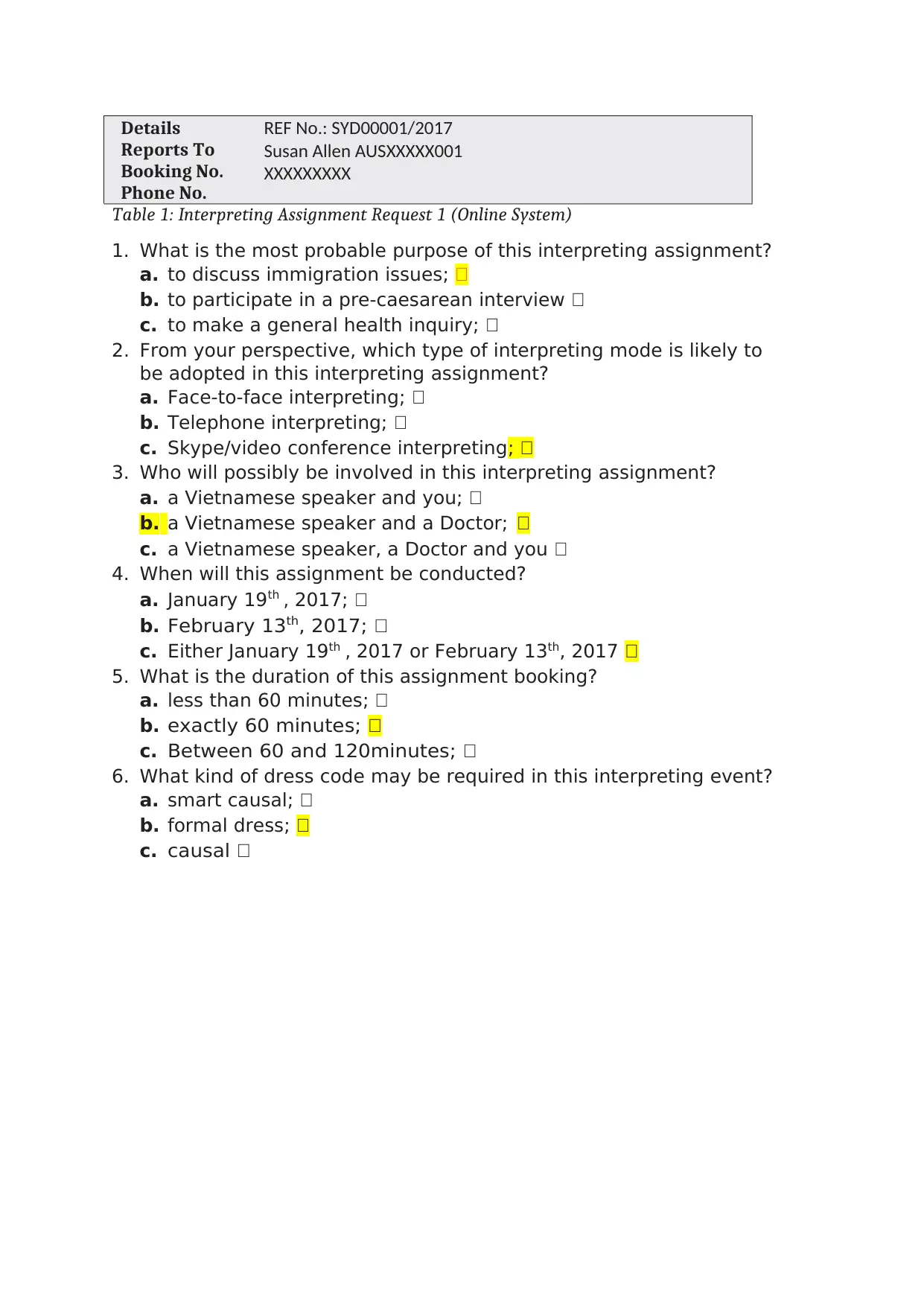
Table 1: Interpreting Assignment Request 1 (Online System)
1. What is the most probable purpose of this interpreting assignment?
a. to discuss immigration issues;
b. to participate in a pre-caesarean interview
c. to make a general health inquiry;
2. From your perspective, which type of interpreting mode is likely to
be adopted in this interpreting assignment?
a. Face-to-face interpreting;
b. Telephone interpreting;
c. Skype/video conference interpreting;
3. Who will possibly be involved in this interpreting assignment?
a. a Vietnamese speaker and you;
b. a Vietnamese speaker and a Doctor;
c. a Vietnamese speaker, a Doctor and you
4. When will this assignment be conducted?
a. January 19th , 2017;
b. February 13 th , 2017;
c. Either January 19th , 2017 or February 13th, 2017
5. What is the duration of this assignment booking?
a. less than 60 minutes;
b. exactly 60 minutes;
c. Between 60 and 120minutes;
6. What kind of dress code may be required in this interpreting event?
a. smart causal;
b. formal dress;
c. causal
Details
Reports To
Booking No.
Phone No.
REF No.: SYD00001/2017
Susan Allen AUSXXXXX001
XXXXXXXXX
1. What is the most probable purpose of this interpreting assignment?
a. to discuss immigration issues;
b. to participate in a pre-caesarean interview
c. to make a general health inquiry;
2. From your perspective, which type of interpreting mode is likely to
be adopted in this interpreting assignment?
a. Face-to-face interpreting;
b. Telephone interpreting;
c. Skype/video conference interpreting;
3. Who will possibly be involved in this interpreting assignment?
a. a Vietnamese speaker and you;
b. a Vietnamese speaker and a Doctor;
c. a Vietnamese speaker, a Doctor and you
4. When will this assignment be conducted?
a. January 19th , 2017;
b. February 13 th , 2017;
c. Either January 19th , 2017 or February 13th, 2017
5. What is the duration of this assignment booking?
a. less than 60 minutes;
b. exactly 60 minutes;
c. Between 60 and 120minutes;
6. What kind of dress code may be required in this interpreting event?
a. smart causal;
b. formal dress;
c. causal
Details
Reports To
Booking No.
Phone No.
REF No.: SYD00001/2017
Susan Allen AUSXXXXX001
XXXXXXXXX
⊘ This is a preview!⊘
Do you want full access?
Subscribe today to unlock all pages.

Trusted by 1+ million students worldwide
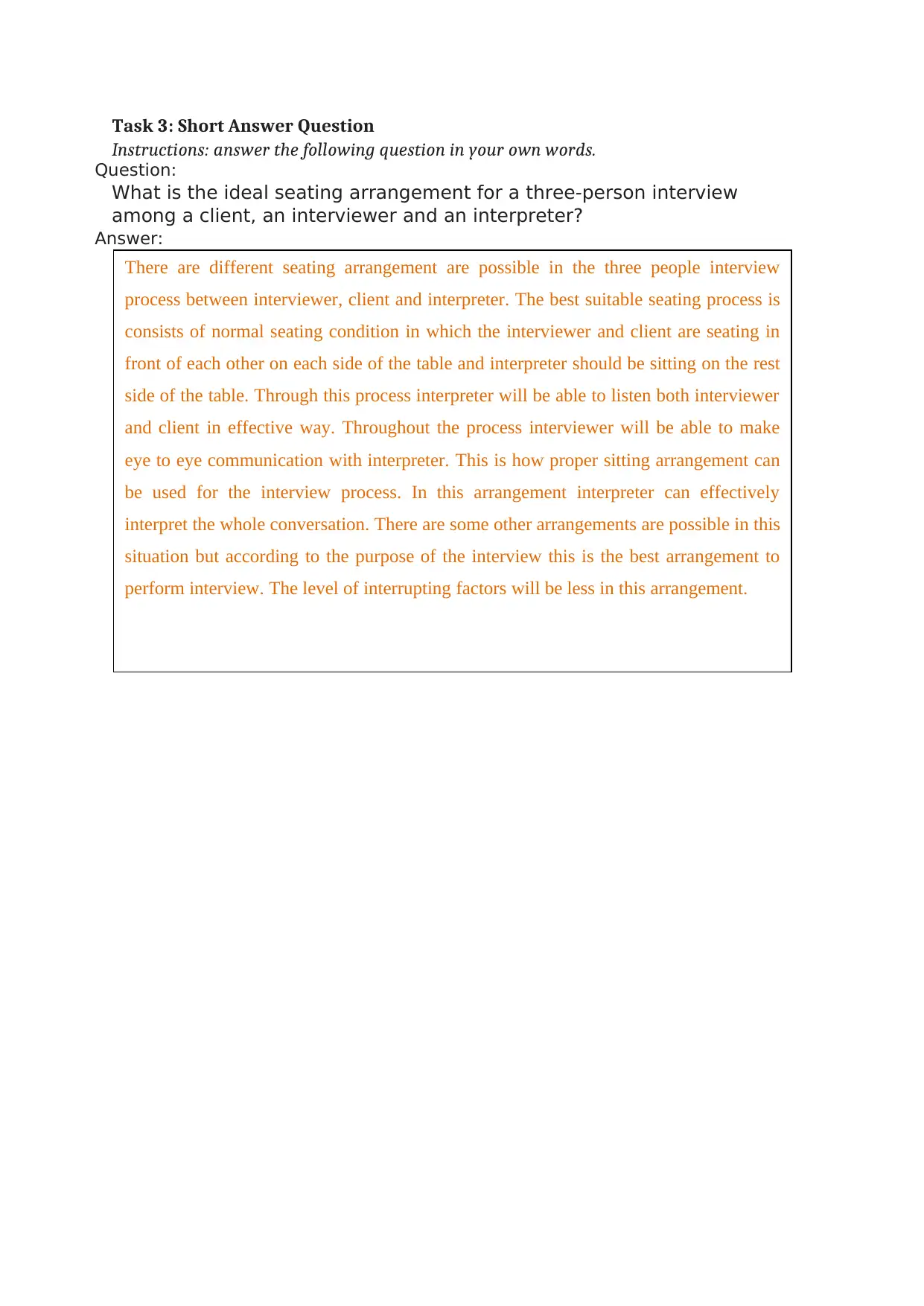
Task 3: Short Answer Question
Instructions: answer the following question in your own words.
Question:
What is the ideal seating arrangement for a three-person interview
among a client, an interviewer and an interpreter?
Answer:
There are different seating arrangement are possible in the three people interview
process between interviewer, client and interpreter. The best suitable seating process is
consists of normal seating condition in which the interviewer and client are seating in
front of each other on each side of the table and interpreter should be sitting on the rest
side of the table. Through this process interpreter will be able to listen both interviewer
and client in effective way. Throughout the process interviewer will be able to make
eye to eye communication with interpreter. This is how proper sitting arrangement can
be used for the interview process. In this arrangement interpreter can effectively
interpret the whole conversation. There are some other arrangements are possible in this
situation but according to the purpose of the interview this is the best arrangement to
perform interview. The level of interrupting factors will be less in this arrangement.
Instructions: answer the following question in your own words.
Question:
What is the ideal seating arrangement for a three-person interview
among a client, an interviewer and an interpreter?
Answer:
There are different seating arrangement are possible in the three people interview
process between interviewer, client and interpreter. The best suitable seating process is
consists of normal seating condition in which the interviewer and client are seating in
front of each other on each side of the table and interpreter should be sitting on the rest
side of the table. Through this process interpreter will be able to listen both interviewer
and client in effective way. Throughout the process interviewer will be able to make
eye to eye communication with interpreter. This is how proper sitting arrangement can
be used for the interview process. In this arrangement interpreter can effectively
interpret the whole conversation. There are some other arrangements are possible in this
situation but according to the purpose of the interview this is the best arrangement to
perform interview. The level of interrupting factors will be less in this arrangement.
Paraphrase This Document
Need a fresh take? Get an instant paraphrase of this document with our AI Paraphraser
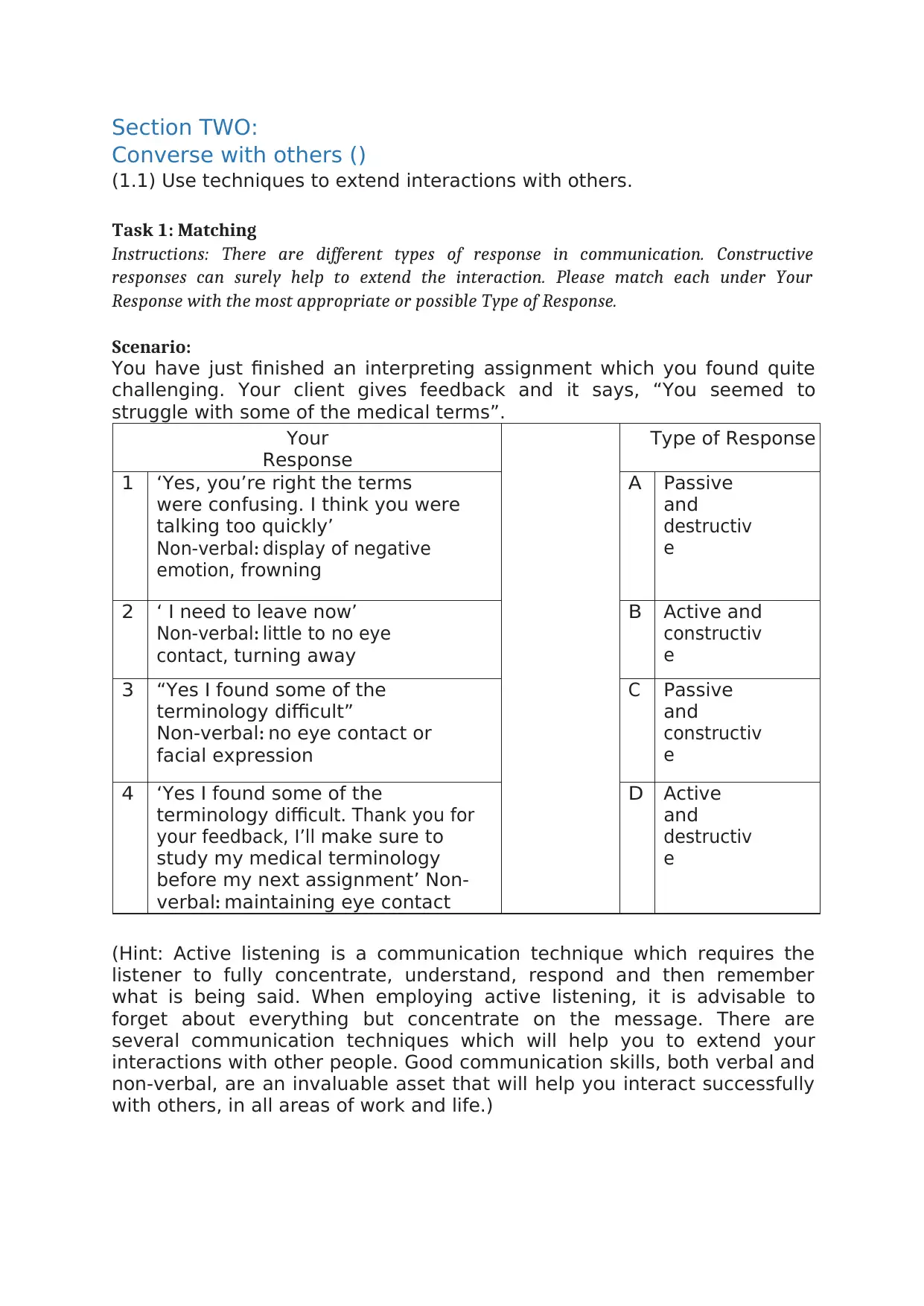
Section TWO:
Converse with others ()
(1.1) Use techniques to extend interactions with others.
Task 1: Matching
Instructions: There are different types of response in communication. Constructive
responses can surely help to extend the interaction. Please match each under Your
Response with the most appropriate or possible Type of Response.
Scenario:
You have just finished an interpreting assignment which you found quite
challenging. Your client gives feedback and it says, “You seemed to
struggle with some of the medical terms”.
Your
Response
Type of Response
1 ‘Yes, you’re right the terms
were confusing. I think you were
talking too quickly’
Non-verbal: display of negative
emotion, frowning
A Passive
and
destructiv
e
2 ‘ I need to leave now’
Non-verbal: little to no eye
contact, turning away
B Active and
constructiv
e
3 “Yes I found some of the
terminology difficult”
Non-verbal: no eye contact or
facial expression
C Passive
and
constructiv
e
4 ‘Yes I found some of the
terminology difficult. Thank you for
your feedback, I’ll make sure to
study my medical terminology
before my next assignment’ Non-
verbal: maintaining eye contact
D Active
and
destructiv
e
(Hint: Active listening is a communication technique which requires the
listener to fully concentrate, understand, respond and then remember
what is being said. When employing active listening, it is advisable to
forget about everything but concentrate on the message. There are
several communication techniques which will help you to extend your
interactions with other people. Good communication skills, both verbal and
non-verbal, are an invaluable asset that will help you interact successfully
with others, in all areas of work and life.)
Converse with others ()
(1.1) Use techniques to extend interactions with others.
Task 1: Matching
Instructions: There are different types of response in communication. Constructive
responses can surely help to extend the interaction. Please match each under Your
Response with the most appropriate or possible Type of Response.
Scenario:
You have just finished an interpreting assignment which you found quite
challenging. Your client gives feedback and it says, “You seemed to
struggle with some of the medical terms”.
Your
Response
Type of Response
1 ‘Yes, you’re right the terms
were confusing. I think you were
talking too quickly’
Non-verbal: display of negative
emotion, frowning
A Passive
and
destructiv
e
2 ‘ I need to leave now’
Non-verbal: little to no eye
contact, turning away
B Active and
constructiv
e
3 “Yes I found some of the
terminology difficult”
Non-verbal: no eye contact or
facial expression
C Passive
and
constructiv
e
4 ‘Yes I found some of the
terminology difficult. Thank you for
your feedback, I’ll make sure to
study my medical terminology
before my next assignment’ Non-
verbal: maintaining eye contact
D Active
and
destructiv
e
(Hint: Active listening is a communication technique which requires the
listener to fully concentrate, understand, respond and then remember
what is being said. When employing active listening, it is advisable to
forget about everything but concentrate on the message. There are
several communication techniques which will help you to extend your
interactions with other people. Good communication skills, both verbal and
non-verbal, are an invaluable asset that will help you interact successfully
with others, in all areas of work and life.)
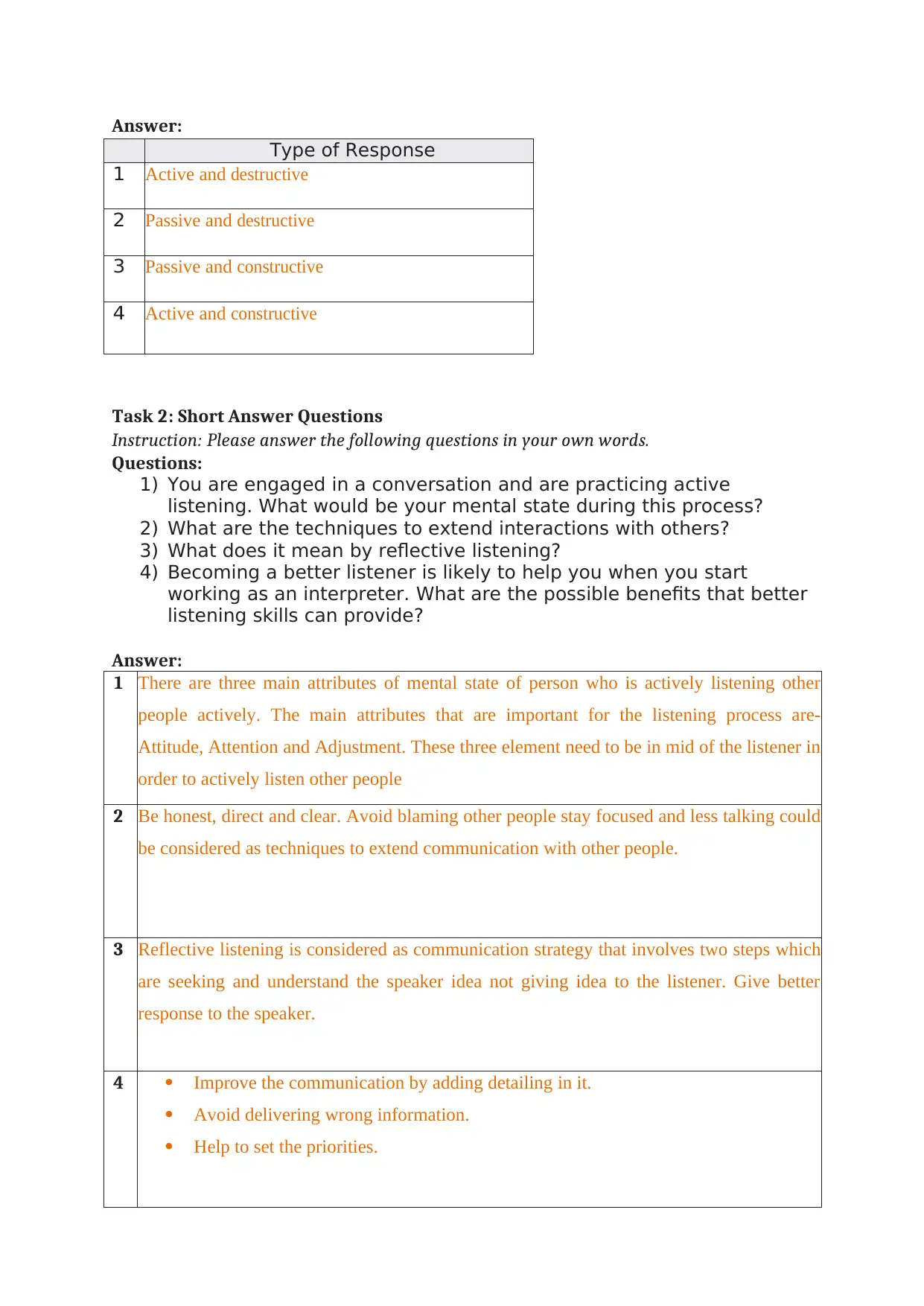
Answer:
Type of Response
1 Active and destructive
2 Passive and destructive
3 Passive and constructive
4 Active and constructive
Task 2: Short Answer Questions
Instruction: Please answer the following questions in your own words.
Questions:
1) You are engaged in a conversation and are practicing active
listening. What would be your mental state during this process?
2) What are the techniques to extend interactions with others?
3) What does it mean by reflective listening?
4) Becoming a better listener is likely to help you when you start
working as an interpreter. What are the possible benefits that better
listening skills can provide?
Answer:
1 There are three main attributes of mental state of person who is actively listening other
people actively. The main attributes that are important for the listening process are-
Attitude, Attention and Adjustment. These three element need to be in mid of the listener in
order to actively listen other people
2 Be honest, direct and clear. Avoid blaming other people stay focused and less talking could
be considered as techniques to extend communication with other people.
3 Reflective listening is considered as communication strategy that involves two steps which
are seeking and understand the speaker idea not giving idea to the listener. Give better
response to the speaker.
4 Improve the communication by adding detailing in it.
Avoid delivering wrong information.
Help to set the priorities.
Type of Response
1 Active and destructive
2 Passive and destructive
3 Passive and constructive
4 Active and constructive
Task 2: Short Answer Questions
Instruction: Please answer the following questions in your own words.
Questions:
1) You are engaged in a conversation and are practicing active
listening. What would be your mental state during this process?
2) What are the techniques to extend interactions with others?
3) What does it mean by reflective listening?
4) Becoming a better listener is likely to help you when you start
working as an interpreter. What are the possible benefits that better
listening skills can provide?
Answer:
1 There are three main attributes of mental state of person who is actively listening other
people actively. The main attributes that are important for the listening process are-
Attitude, Attention and Adjustment. These three element need to be in mid of the listener in
order to actively listen other people
2 Be honest, direct and clear. Avoid blaming other people stay focused and less talking could
be considered as techniques to extend communication with other people.
3 Reflective listening is considered as communication strategy that involves two steps which
are seeking and understand the speaker idea not giving idea to the listener. Give better
response to the speaker.
4 Improve the communication by adding detailing in it.
Avoid delivering wrong information.
Help to set the priorities.
⊘ This is a preview!⊘
Do you want full access?
Subscribe today to unlock all pages.
Trusted by 1+ million students worldwide
Task 3: Listing
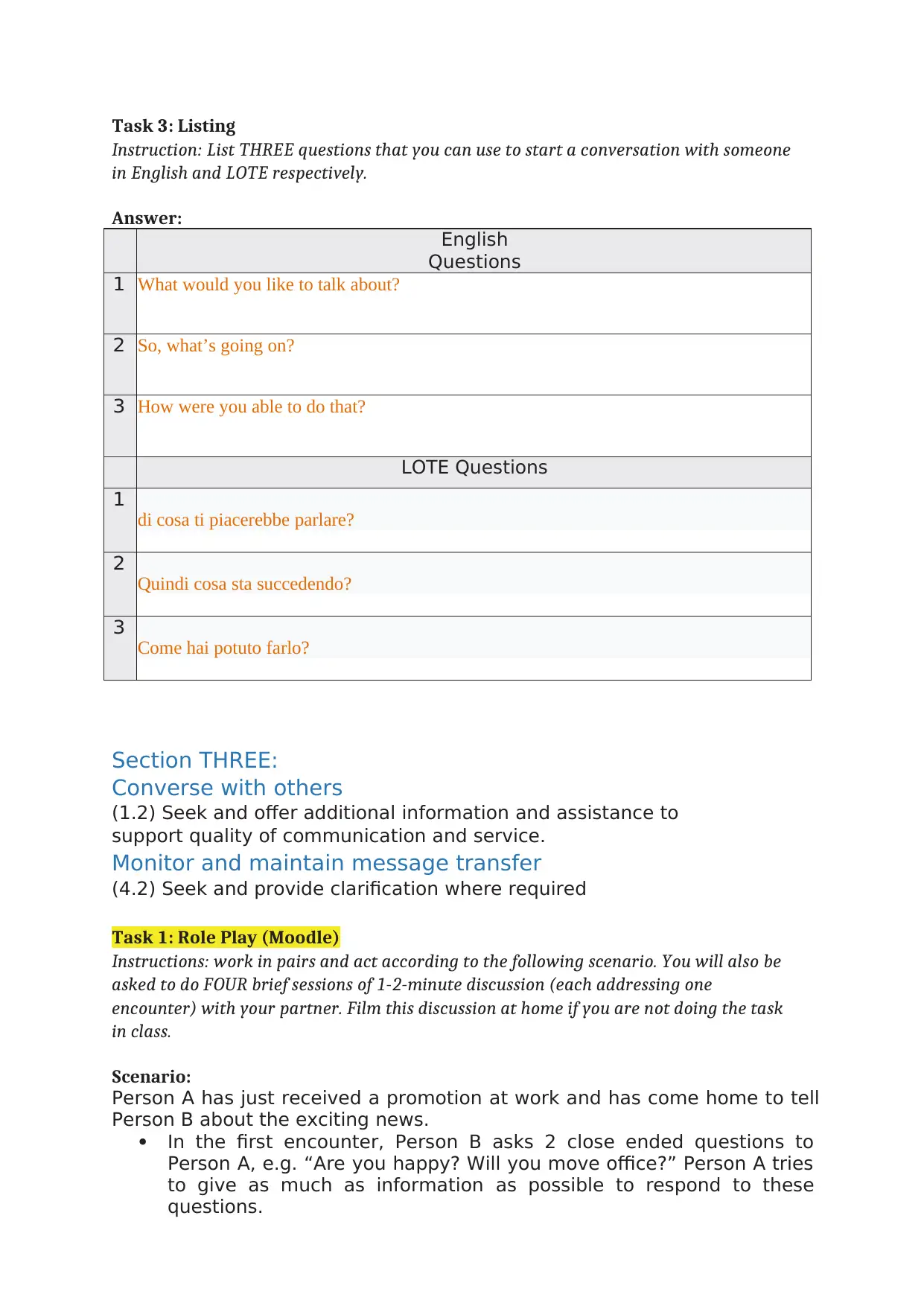
Instruction: List THREE questions that you can use to start a conversation with someone
in English and LOTE respectively.
Answer:
English
Questions
1 What would you like to talk about?
2 So, what’s going on?
3 How were you able to do that?
LOTE Questions
1
di cosa ti piacerebbe parlare?
2
Quindi cosa sta succedendo?
3
Come hai potuto farlo?
Section THREE:
Converse with others
(1.2) Seek and offer additional information and assistance to
support quality of communication and service.
Monitor and maintain message transfer
(4.2) Seek and provide clarification where required
Task 1: Role Play (Moodle)
Instructions: work in pairs and act according to the following scenario. You will also be
asked to do FOUR brief sessions of 1-2-minute discussion (each addressing one
encounter) with your partner. Film this discussion at home if you are not doing the task
in class.
Scenario:
Person A has just received a promotion at work and has come home to tell
Person B about the exciting news.
In the first encounter, Person B asks 2 close ended questions to
Person A, e.g. “Are you happy? Will you move office?” Person A tries
to give as much as information as possible to respond to these
questions.
Instruction: List THREE questions that you can use to start a conversation with someone
in English and LOTE respectively.
Answer:
English
Questions
1 What would you like to talk about?
2 So, what’s going on?
3 How were you able to do that?
LOTE Questions
1
di cosa ti piacerebbe parlare?
2
Quindi cosa sta succedendo?
3
Come hai potuto farlo?
Section THREE:
Converse with others
(1.2) Seek and offer additional information and assistance to
support quality of communication and service.
Monitor and maintain message transfer
(4.2) Seek and provide clarification where required
Task 1: Role Play (Moodle)
Instructions: work in pairs and act according to the following scenario. You will also be
asked to do FOUR brief sessions of 1-2-minute discussion (each addressing one
encounter) with your partner. Film this discussion at home if you are not doing the task
in class.
Scenario:
Person A has just received a promotion at work and has come home to tell
Person B about the exciting news.
In the first encounter, Person B asks 2 close ended questions to
Person A, e.g. “Are you happy? Will you move office?” Person A tries
to give as much as information as possible to respond to these
questions.
Paraphrase This Document
Need a fresh take? Get an instant paraphrase of this document with our AI Paraphraser
In the second encounter, Person B asks 2 open ended questions to
Person A, e.g. “How do you feel about this promotion? What things
will you do in your new role?” Person A tries to give as much as
information as possible to respond to these questions.
For the third and fourth encounters, Person A and Person B switch
roles and start the conversations over.
Discussion:
After the role play, please discuss with your partner on how you feel after
each encounter and the reasons why you feel this way.
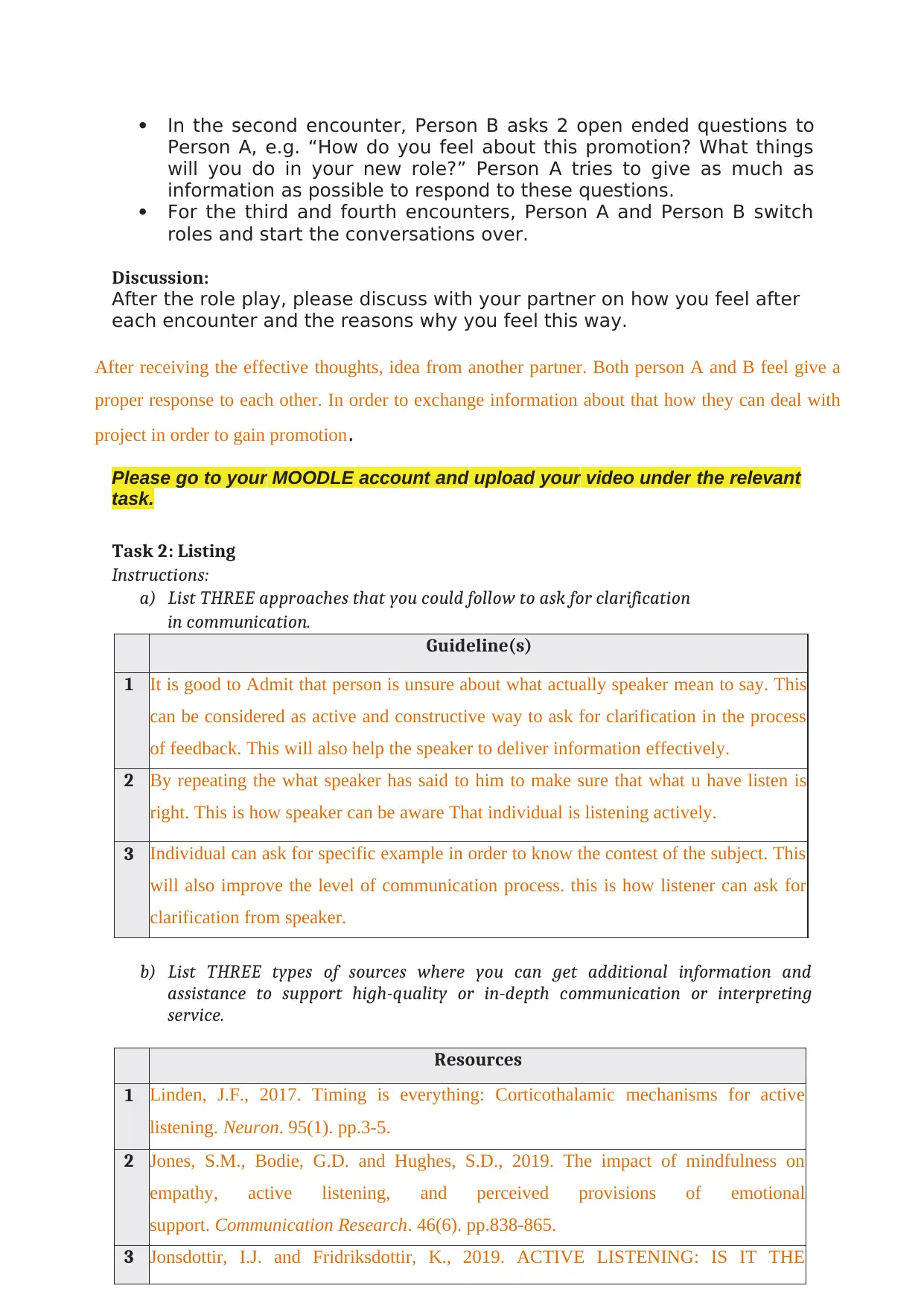
After receiving the effective thoughts, idea from another partner. Both person A and B feel give a
proper response to each other. In order to exchange information about that how they can deal with
project in order to gain promotion.
Please go to your MOODLE account and upload your video under the relevant
task.
Task 2: Listing
Instructions:
a) List THREE approaches that you could follow to ask for clarification
in communication.
Guideline(s)
1 It is good to Admit that person is unsure about what actually speaker mean to say. This
can be considered as active and constructive way to ask for clarification in the process
of feedback. This will also help the speaker to deliver information effectively.
2 By repeating the what speaker has said to him to make sure that what u have listen is
right. This is how speaker can be aware That individual is listening actively.
3 Individual can ask for specific example in order to know the contest of the subject. This
will also improve the level of communication process. this is how listener can ask for
clarification from speaker.
b) List THREE types of sources where you can get additional information and
assistance to support high-quality or in-depth communication or interpreting
service.
Resources
1 Linden, J.F., 2017. Timing is everything: Corticothalamic mechanisms for active
listening. Neuron. 95(1). pp.3-5.
2 Jones, S.M., Bodie, G.D. and Hughes, S.D., 2019. The impact of mindfulness on
empathy, active listening, and perceived provisions of emotional
support. Communication Research. 46(6). pp.838-865.
3 Jonsdottir, I.J. and Fridriksdottir, K., 2019. ACTIVE LISTENING: IS IT THE
Person A, e.g. “How do you feel about this promotion? What things
will you do in your new role?” Person A tries to give as much as
information as possible to respond to these questions.
For the third and fourth encounters, Person A and Person B switch
roles and start the conversations over.
Discussion:
After the role play, please discuss with your partner on how you feel after
each encounter and the reasons why you feel this way.
After receiving the effective thoughts, idea from another partner. Both person A and B feel give a
proper response to each other. In order to exchange information about that how they can deal with
project in order to gain promotion.
Please go to your MOODLE account and upload your video under the relevant
task.
Task 2: Listing
Instructions:
a) List THREE approaches that you could follow to ask for clarification
in communication.
Guideline(s)
1 It is good to Admit that person is unsure about what actually speaker mean to say. This
can be considered as active and constructive way to ask for clarification in the process
of feedback. This will also help the speaker to deliver information effectively.
2 By repeating the what speaker has said to him to make sure that what u have listen is
right. This is how speaker can be aware That individual is listening actively.
3 Individual can ask for specific example in order to know the contest of the subject. This
will also improve the level of communication process. this is how listener can ask for
clarification from speaker.
b) List THREE types of sources where you can get additional information and
assistance to support high-quality or in-depth communication or interpreting
service.
Resources
1 Linden, J.F., 2017. Timing is everything: Corticothalamic mechanisms for active
listening. Neuron. 95(1). pp.3-5.
2 Jones, S.M., Bodie, G.D. and Hughes, S.D., 2019. The impact of mindfulness on
empathy, active listening, and perceived provisions of emotional
support. Communication Research. 46(6). pp.838-865.
3 Jonsdottir, I.J. and Fridriksdottir, K., 2019. ACTIVE LISTENING: IS IT THE

FORGOTTEN DIMENSION IN MANAGERIAL
COMMUNICATION?. International Journal of Listening, pp.1-11.
COMMUNICATION?. International Journal of Listening, pp.1-11.
⊘ This is a preview!⊘
Do you want full access?
Subscribe today to unlock all pages.
Trusted by 1+ million students worldwide
Task 3: Case Analysis
Instruction: answer the following question according to the given scenario.
Scenario:
Abbe is interpreting in Cantonese for an elderly woman in a Newcastle
nursing home. Doctor asks the elderly lady two questions: “How do the
nurses and other staff treat you? and “Do you have enough food to eat each
day”? The elderly woman replies in Cantonese, “the nurses speak in English
or Filipino I think, so I’m not sure what they say but they are kind to me.
When I was a little girl, I was always very hungry each day. The food
shortage…”
Question:
How should Abbe respond to this reply as an interpreter? Specifically,
what should Abbe say to the lady and the doctor?
Answer:
Section FOUR:
Converse with others
(1.3) Support communication with comments on topical familiar
matters, workplace business and events.
Task 1: Short Answer Questions
Instructions: answer the following questions in your own words.
Questions:
1) What are some possible topics considered as topical familiar
matters, or workplace and business events?
2) What are some of the key words or phrases you can use to start
your comments on a particular topic?
Answer:
1 Some of the topics that can be used for general discussion are topics that are related to
politics and current affairs. This are most common topics that are considered by people
for conversation. Some other topics that can be considered in this situations should be
something related to adventures.
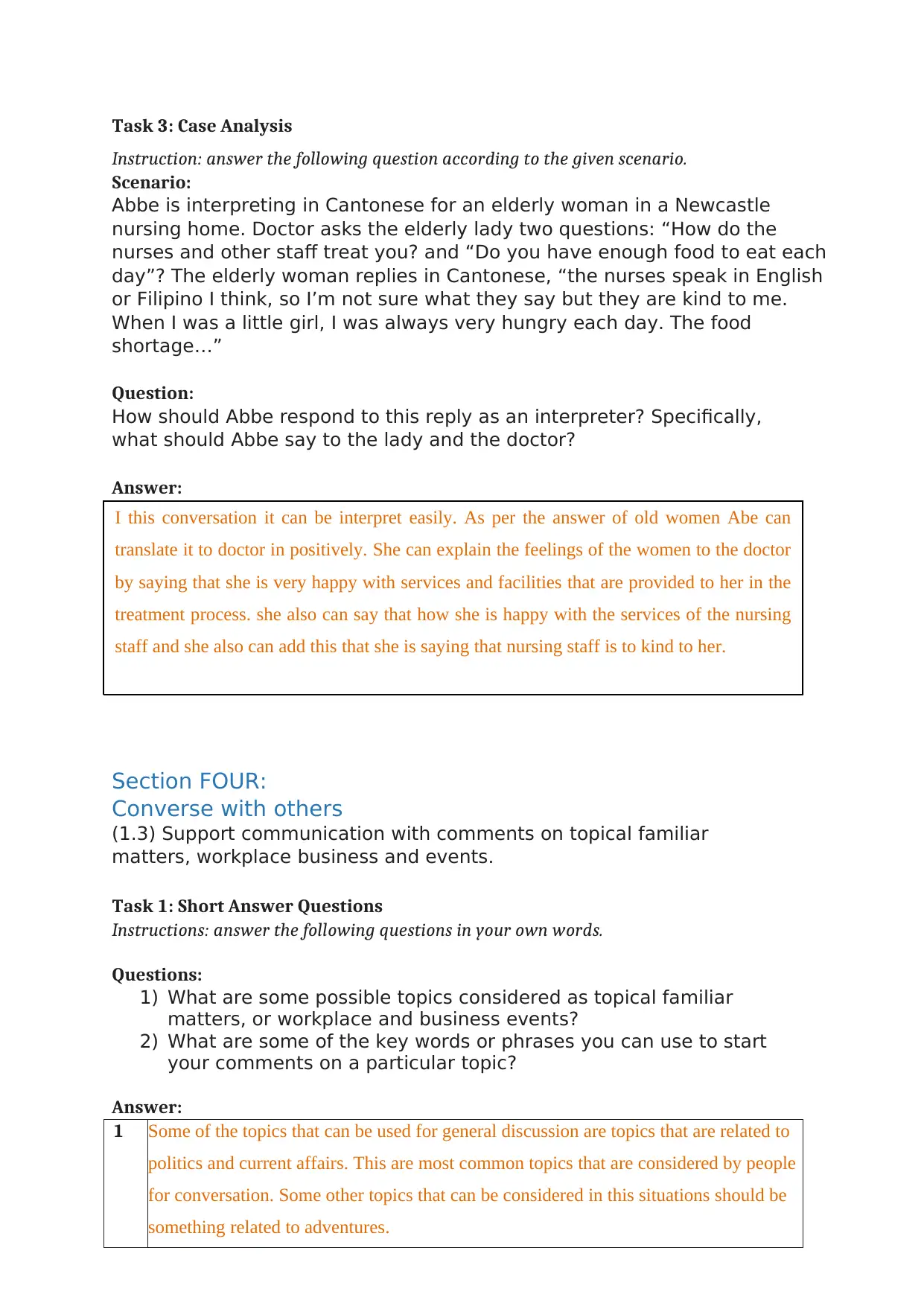
I this conversation it can be interpret easily. As per the answer of old women Abe can
translate it to doctor in positively. She can explain the feelings of the women to the doctor
by saying that she is very happy with services and facilities that are provided to her in the
treatment process. she also can say that how she is happy with the services of the nursing
staff and she also can add this that she is saying that nursing staff is to kind to her.
Instruction: answer the following question according to the given scenario.
Scenario:
Abbe is interpreting in Cantonese for an elderly woman in a Newcastle
nursing home. Doctor asks the elderly lady two questions: “How do the
nurses and other staff treat you? and “Do you have enough food to eat each
day”? The elderly woman replies in Cantonese, “the nurses speak in English
or Filipino I think, so I’m not sure what they say but they are kind to me.
When I was a little girl, I was always very hungry each day. The food
shortage…”
Question:
How should Abbe respond to this reply as an interpreter? Specifically,
what should Abbe say to the lady and the doctor?
Answer:
Section FOUR:
Converse with others
(1.3) Support communication with comments on topical familiar
matters, workplace business and events.
Task 1: Short Answer Questions
Instructions: answer the following questions in your own words.
Questions:
1) What are some possible topics considered as topical familiar
matters, or workplace and business events?
2) What are some of the key words or phrases you can use to start
your comments on a particular topic?
Answer:
1 Some of the topics that can be used for general discussion are topics that are related to
politics and current affairs. This are most common topics that are considered by people
for conversation. Some other topics that can be considered in this situations should be
something related to adventures.
I this conversation it can be interpret easily. As per the answer of old women Abe can
translate it to doctor in positively. She can explain the feelings of the women to the doctor
by saying that she is very happy with services and facilities that are provided to her in the
treatment process. she also can say that how she is happy with the services of the nursing
staff and she also can add this that she is saying that nursing staff is to kind to her.
Paraphrase This Document
Need a fresh take? Get an instant paraphrase of this document with our AI Paraphraser
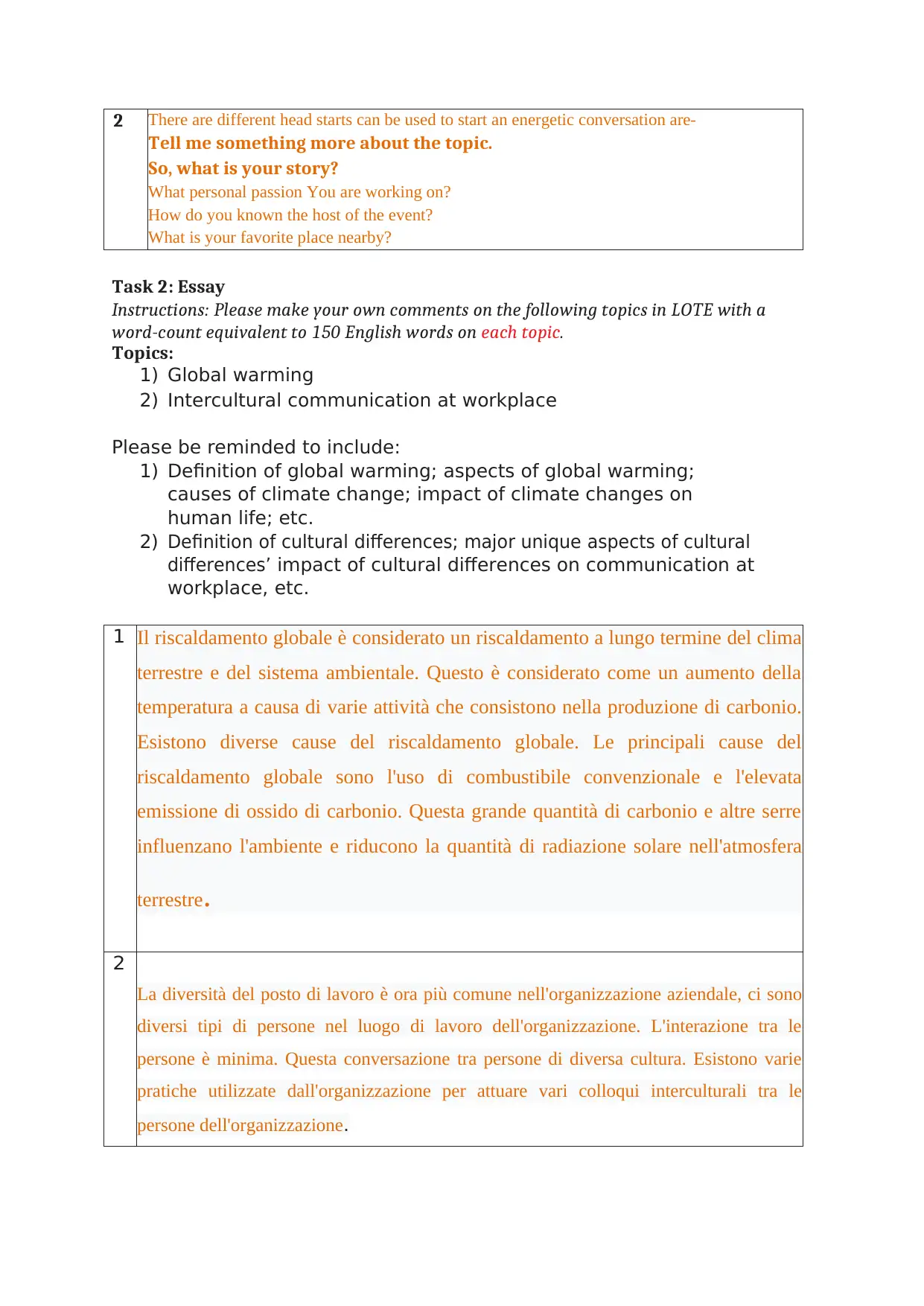
2 There are different head starts can be used to start an energetic conversation are-
Tell me something more about the topic.
So, what is your story?
What personal passion You are working on?
How do you known the host of the event?
What is your favorite place nearby?
Task 2: Essay
Instructions: Please make your own comments on the following topics in LOTE with a
word-count equivalent to 150 English words on each topic.
Topics:
1) Global warming
2) Intercultural communication at workplace
Please be reminded to include:
1) Definition of global warming; aspects of global warming;
causes of climate change; impact of climate changes on
human life; etc.
2) Definition of cultural differences; major unique aspects of cultural
differences’ impact of cultural differences on communication at
workplace, etc.
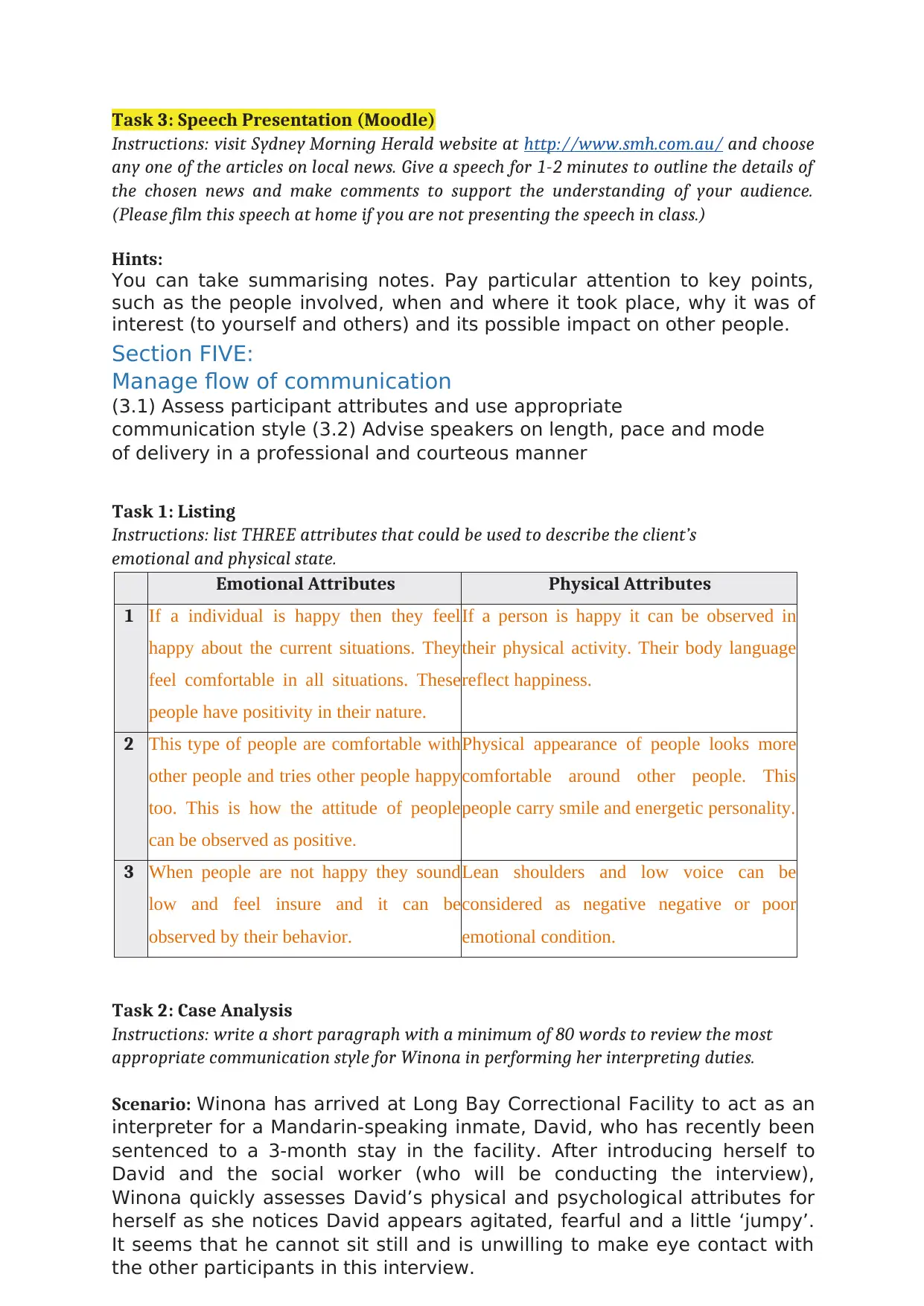
1 Il riscaldamento globale è considerato un riscaldamento a lungo termine del clima
terrestre e del sistema ambientale. Questo è considerato come un aumento della
temperatura a causa di varie attività che consistono nella produzione di carbonio.
Esistono diverse cause del riscaldamento globale. Le principali cause del
riscaldamento globale sono l'uso di combustibile convenzionale e l'elevata
emissione di ossido di carbonio. Questa grande quantità di carbonio e altre serre
influenzano l'ambiente e riducono la quantità di radiazione solare nell'atmosfera
terrestre.
2
La diversità del posto di lavoro è ora più comune nell'organizzazione aziendale, ci sono
diversi tipi di persone nel luogo di lavoro dell'organizzazione. L'interazione tra le
persone è minima. Questa conversazione tra persone di diversa cultura. Esistono varie
pratiche utilizzate dall'organizzazione per attuare vari colloqui interculturali tra le
persone dell'organizzazione.
Tell me something more about the topic.
So, what is your story?
What personal passion You are working on?
How do you known the host of the event?
What is your favorite place nearby?
Task 2: Essay
Instructions: Please make your own comments on the following topics in LOTE with a
word-count equivalent to 150 English words on each topic.
Topics:
1) Global warming
2) Intercultural communication at workplace
Please be reminded to include:
1) Definition of global warming; aspects of global warming;
causes of climate change; impact of climate changes on
human life; etc.
2) Definition of cultural differences; major unique aspects of cultural
differences’ impact of cultural differences on communication at
workplace, etc.
1 Il riscaldamento globale è considerato un riscaldamento a lungo termine del clima
terrestre e del sistema ambientale. Questo è considerato come un aumento della
temperatura a causa di varie attività che consistono nella produzione di carbonio.
Esistono diverse cause del riscaldamento globale. Le principali cause del
riscaldamento globale sono l'uso di combustibile convenzionale e l'elevata
emissione di ossido di carbonio. Questa grande quantità di carbonio e altre serre
influenzano l'ambiente e riducono la quantità di radiazione solare nell'atmosfera
terrestre.
2
La diversità del posto di lavoro è ora più comune nell'organizzazione aziendale, ci sono
diversi tipi di persone nel luogo di lavoro dell'organizzazione. L'interazione tra le
persone è minima. Questa conversazione tra persone di diversa cultura. Esistono varie
pratiche utilizzate dall'organizzazione per attuare vari colloqui interculturali tra le
persone dell'organizzazione.
Task 3: Speech Presentation (Moodle)
Instructions: visit Sydney Morning Herald website at http://www.smh.com.au/ and choose
any one of the articles on local news. Give a speech for 1-2 minutes to outline the details of
the chosen news and make comments to support the understanding of your audience.
(Please film this speech at home if you are not presenting the speech in class.)
Hints:
You can take summarising notes. Pay particular attention to key points,
such as the people involved, when and where it took place, why it was of
interest (to yourself and others) and its possible impact on other people.
Section FIVE:
Manage flow of communication
(3.1) Assess participant attributes and use appropriate
communication style (3.2) Advise speakers on length, pace and mode
of delivery in a professional and courteous manner
Task 1: Listing
Instructions: list THREE attributes that could be used to describe the client’s
emotional and physical state.
Emotional Attributes Physical Attributes
1 If a individual is happy then they feel
happy about the current situations. They
feel comfortable in all situations. These
people have positivity in their nature.
If a person is happy it can be observed in
their physical activity. Their body language
reflect happiness.
2 This type of people are comfortable with
other people and tries other people happy
too. This is how the attitude of people
can be observed as positive.
Physical appearance of people looks more
comfortable around other people. This
people carry smile and energetic personality.
3 When people are not happy they sound
low and feel insure and it can be
observed by their behavior.
Lean shoulders and low voice can be
considered as negative negative or poor
emotional condition.
Task 2: Case Analysis
Instructions: write a short paragraph with a minimum of 80 words to review the most
appropriate communication style for Winona in performing her interpreting duties.
Scenario: Winona has arrived at Long Bay Correctional Facility to act as an
interpreter for a Mandarin-speaking inmate, David, who has recently been
sentenced to a 3-month stay in the facility. After introducing herself to
David and the social worker (who will be conducting the interview),
Winona quickly assesses David’s physical and psychological attributes for
herself as she notices David appears agitated, fearful and a little ‘jumpy’.
It seems that he cannot sit still and is unwilling to make eye contact with
the other participants in this interview.
Instructions: visit Sydney Morning Herald website at http://www.smh.com.au/ and choose
any one of the articles on local news. Give a speech for 1-2 minutes to outline the details of
the chosen news and make comments to support the understanding of your audience.
(Please film this speech at home if you are not presenting the speech in class.)
Hints:
You can take summarising notes. Pay particular attention to key points,
such as the people involved, when and where it took place, why it was of
interest (to yourself and others) and its possible impact on other people.
Section FIVE:
Manage flow of communication
(3.1) Assess participant attributes and use appropriate
communication style (3.2) Advise speakers on length, pace and mode
of delivery in a professional and courteous manner
Task 1: Listing
Instructions: list THREE attributes that could be used to describe the client’s
emotional and physical state.
Emotional Attributes Physical Attributes
1 If a individual is happy then they feel
happy about the current situations. They
feel comfortable in all situations. These
people have positivity in their nature.
If a person is happy it can be observed in
their physical activity. Their body language
reflect happiness.
2 This type of people are comfortable with
other people and tries other people happy
too. This is how the attitude of people
can be observed as positive.
Physical appearance of people looks more
comfortable around other people. This
people carry smile and energetic personality.
3 When people are not happy they sound
low and feel insure and it can be
observed by their behavior.
Lean shoulders and low voice can be
considered as negative negative or poor
emotional condition.
Task 2: Case Analysis
Instructions: write a short paragraph with a minimum of 80 words to review the most
appropriate communication style for Winona in performing her interpreting duties.
Scenario: Winona has arrived at Long Bay Correctional Facility to act as an
interpreter for a Mandarin-speaking inmate, David, who has recently been
sentenced to a 3-month stay in the facility. After introducing herself to
David and the social worker (who will be conducting the interview),
Winona quickly assesses David’s physical and psychological attributes for
herself as she notices David appears agitated, fearful and a little ‘jumpy’.
It seems that he cannot sit still and is unwilling to make eye contact with
the other participants in this interview.
⊘ This is a preview!⊘
Do you want full access?
Subscribe today to unlock all pages.
Trusted by 1+ million students worldwide

1 out of 46


Your All-in-One AI-Powered Toolkit for Academic Success.
+13062052269
info@desklib.com
Available 24*7 on WhatsApp / Email
![[object Object]](/_next/static/media/star-bottom.7253800d.svg)
Unlock your academic potential
Copyright © 2020–2026 A2Z Services. All Rights Reserved. Developed and managed by ZUCOL.