Nursing Diploma: Interprofessional Practice Evaluation and Report

Verified

Added on  2020/04/01

|6
|1390
|202
Report
AI Summary
This report delves into the critical concept of Interprofessional Practice (IPP) within the nursing field, emphasizing the collaborative efforts of healthcare workers, professionals from various disciplines, patients, and their families. It highlights the importance of teamwork in improving healthcare quality and addressing pertinent issues. The report underscores the necessity of collaboration for effective patient care, including the utilization of diverse skills and coordinated care strategies. It examines various aspects of collaboration, such as Interprofessional care and education, and the significance of effective communication and teamwork. The document also references studies that showcase the adverse effects of poor interprofessional practice and the importance of mutual respect and shared values among healthcare professionals. The report concludes by emphasizing the crucial role of IPP in enhancing health outcomes through combined expertise and cooperative efforts, ultimately leading to better healthcare services. The report includes several references to support the claims and arguments made within the document.

Document Page
1
Running Head: Nursing Diploma
Nursing diploma
Institution
Lecturer
Student
Course
Date
tabler-icon-diamond-filled.svg

Paraphrase This Document

Need a fresh take? Get an instant paraphrase of this document with our AI Paraphraser
Document Page
2
Running Head: Nursing Diploma
Introduction
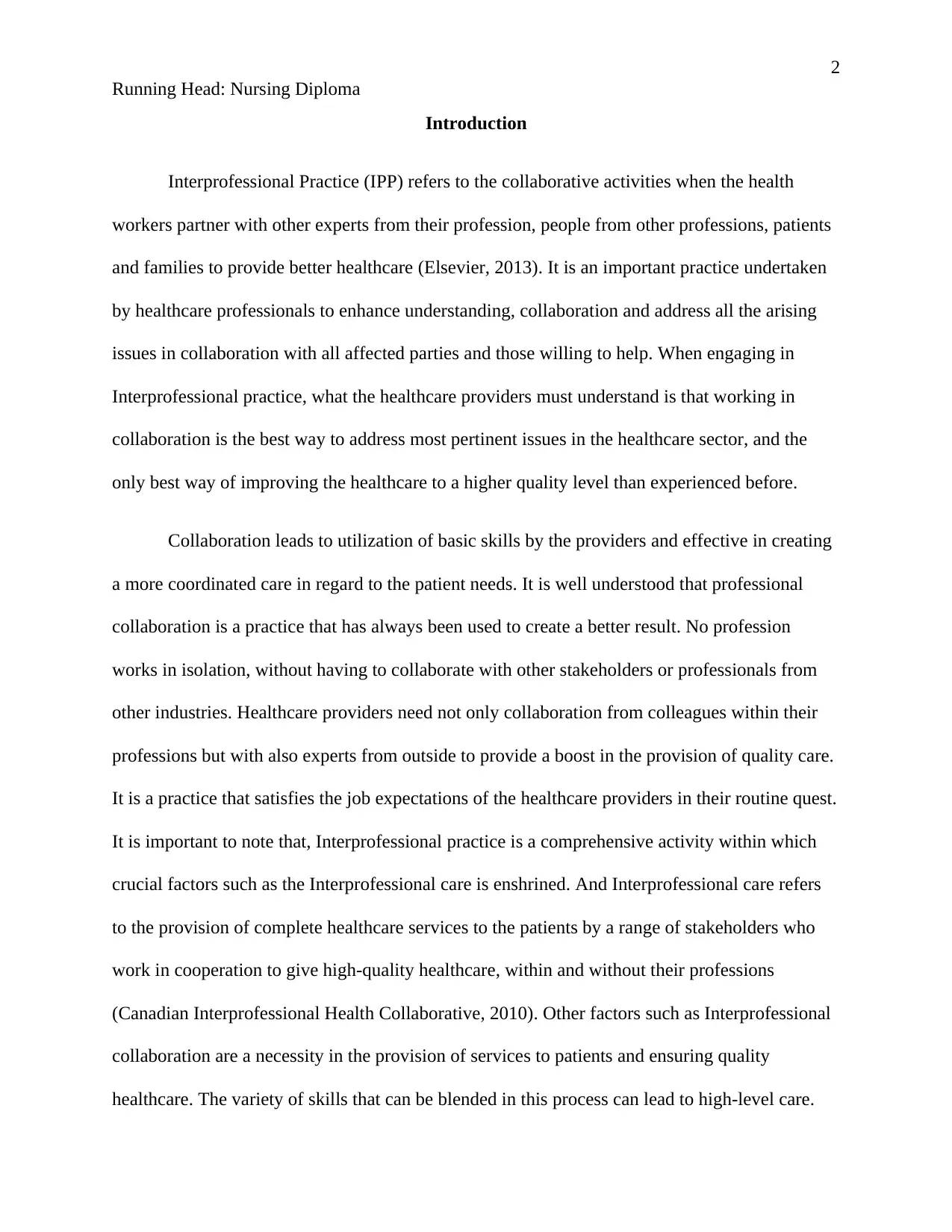
Interprofessional Practice (IPP) refers to the collaborative activities when the health
workers partner with other experts from their profession, people from other professions, patients
and families to provide better healthcare (Elsevier, 2013). It is an important practice undertaken
by healthcare professionals to enhance understanding, collaboration and address all the arising
issues in collaboration with all affected parties and those willing to help. When engaging in
Interprofessional practice, what the healthcare providers must understand is that working in
collaboration is the best way to address most pertinent issues in the healthcare sector, and the
only best way of improving the healthcare to a higher quality level than experienced before.
Collaboration leads to utilization of basic skills by the providers and effective in creating
a more coordinated care in regard to the patient needs. It is well understood that professional
collaboration is a practice that has always been used to create a better result. No profession
works in isolation, without having to collaborate with other stakeholders or professionals from
other industries. Healthcare providers need not only collaboration from colleagues within their
professions but with also experts from outside to provide a boost in the provision of quality care.
It is a practice that satisfies the job expectations of the healthcare providers in their routine quest.
It is important to note that, Interprofessional practice is a comprehensive activity within which
crucial factors such as the Interprofessional care is enshrined. And Interprofessional care refers
to the provision of complete healthcare services to the patients by a range of stakeholders who
work in cooperation to give high-quality healthcare, within and without their professions
(Canadian Interprofessional Health Collaborative, 2010). Other factors such as Interprofessional
collaboration are a necessity in the provision of services to patients and ensuring quality
healthcare. The variety of skills that can be blended in this process can lead to high-level care.
Document Page
3
Running Head: Nursing Diploma
The Collaboration Practices
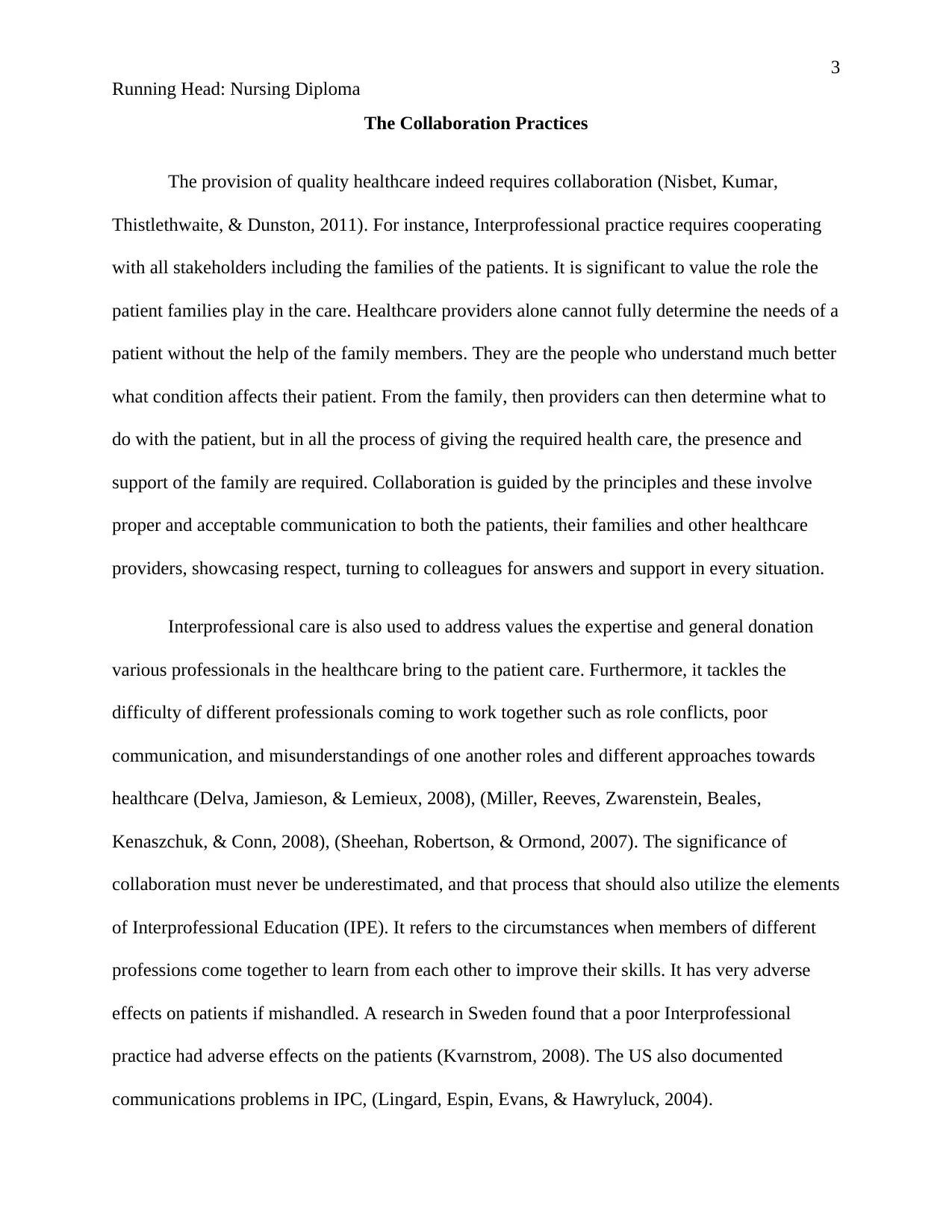
The provision of quality healthcare indeed requires collaboration (Nisbet, Kumar,
Thistlethwaite, & Dunston, 2011). For instance, Interprofessional practice requires cooperating
with all stakeholders including the families of the patients. It is significant to value the role the
patient families play in the care. Healthcare providers alone cannot fully determine the needs of a
patient without the help of the family members. They are the people who understand much better
what condition affects their patient. From the family, then providers can then determine what to
do with the patient, but in all the process of giving the required health care, the presence and
support of the family are required. Collaboration is guided by the principles and these involve
proper and acceptable communication to both the patients, their families and other healthcare
providers, showcasing respect, turning to colleagues for answers and support in every situation.
Interprofessional care is also used to address values the expertise and general donation
various professionals in the healthcare bring to the patient care. Furthermore, it tackles the
difficulty of different professionals coming to work together such as role conflicts, poor
communication, and misunderstandings of one another roles and different approaches towards
healthcare (Delva, Jamieson, & Lemieux, 2008), (Miller, Reeves, Zwarenstein, Beales,
Kenaszchuk, & Conn, 2008), (Sheehan, Robertson, & Ormond, 2007). The significance of
collaboration must never be underestimated, and that process that should also utilize the elements
of Interprofessional Education (IPE). It refers to the circumstances when members of different
professions come together to learn from each other to improve their skills. It has very adverse
effects on patients if mishandled. A research in Sweden found that a poor Interprofessional
practice had adverse effects on the patients (Kvarnstrom, 2008). The US also documented
communications problems in IPC, (Lingard, Espin, Evans, & Hawryluck, 2004).
Document Page
4
Running Head: Nursing Diploma
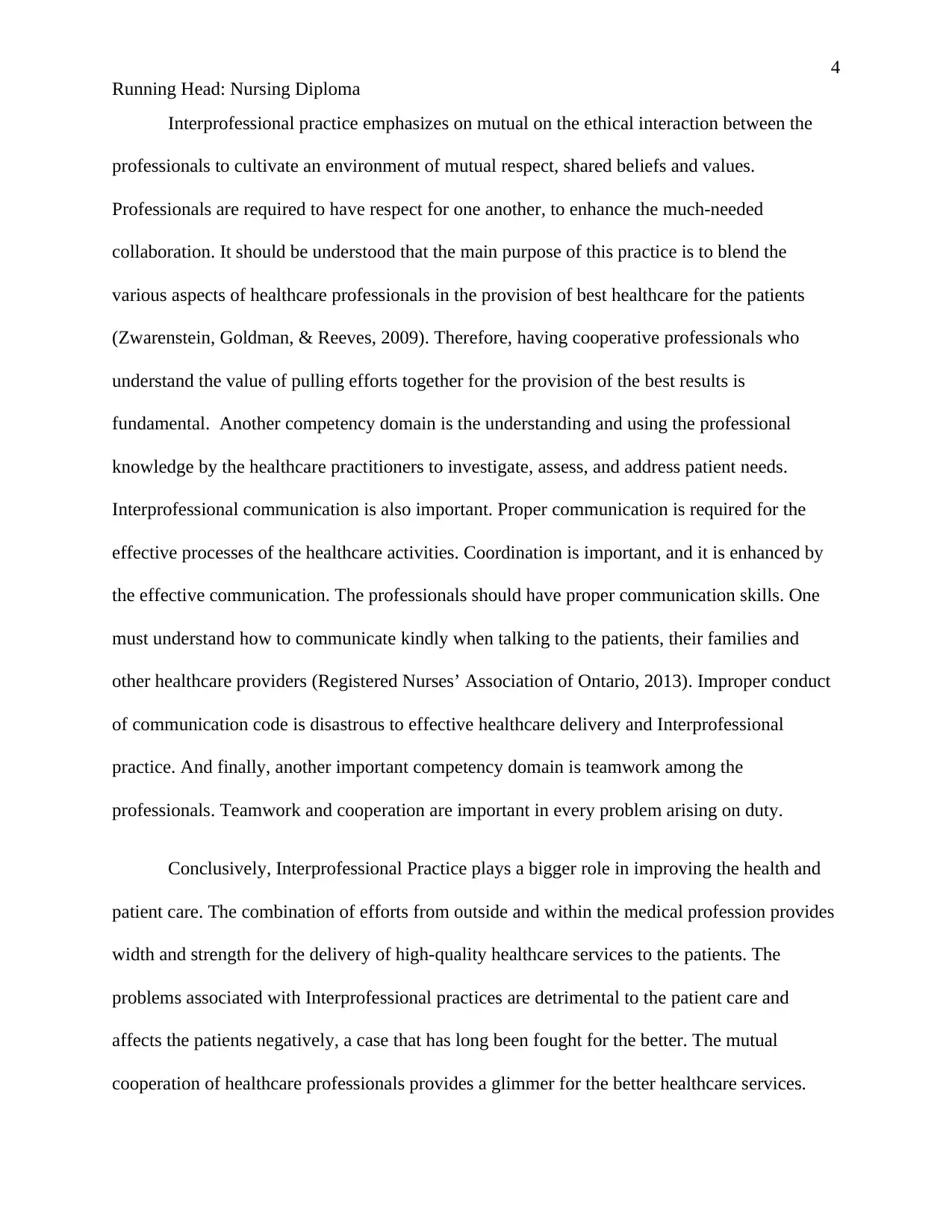
Interprofessional practice emphasizes on mutual on the ethical interaction between the
professionals to cultivate an environment of mutual respect, shared beliefs and values.
Professionals are required to have respect for one another, to enhance the much-needed
collaboration. It should be understood that the main purpose of this practice is to blend the
various aspects of healthcare professionals in the provision of best healthcare for the patients
(Zwarenstein, Goldman, & Reeves, 2009). Therefore, having cooperative professionals who
understand the value of pulling efforts together for the provision of the best results is
fundamental. Another competency domain is the understanding and using the professional
knowledge by the healthcare practitioners to investigate, assess, and address patient needs.
Interprofessional communication is also important. Proper communication is required for the
effective processes of the healthcare activities. Coordination is important, and it is enhanced by
the effective communication. The professionals should have proper communication skills. One
must understand how to communicate kindly when talking to the patients, their families and
other healthcare providers (Registered Nurses’ Association of Ontario, 2013). Improper conduct
of communication code is disastrous to effective healthcare delivery and Interprofessional
practice. And finally, another important competency domain is teamwork among the
professionals. Teamwork and cooperation are important in every problem arising on duty.
Conclusively, Interprofessional Practice plays a bigger role in improving the health and
patient care. The combination of efforts from outside and within the medical profession provides
width and strength for the delivery of high-quality healthcare services to the patients. The
problems associated with Interprofessional practices are detrimental to the patient care and
affects the patients negatively, a case that has long been fought for the better. The mutual
cooperation of healthcare professionals provides a glimmer for the better healthcare services.
tabler-icon-diamond-filled.svg

Paraphrase This Document

Need a fresh take? Get an instant paraphrase of this document with our AI Paraphraser
Document Page
5
Running Head: Nursing Diploma
References
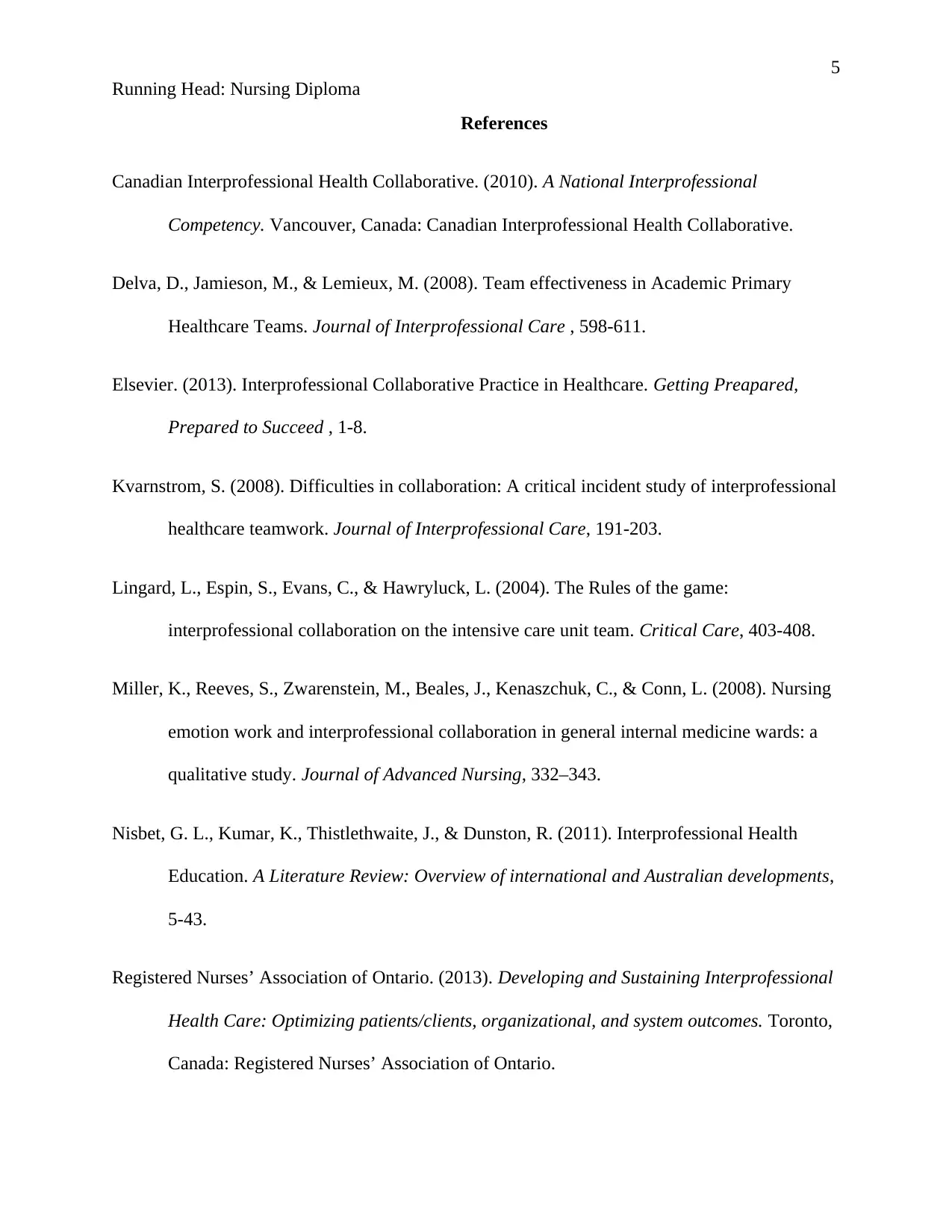
Canadian Interprofessional Health Collaborative. (2010). A National Interprofessional
Competency. Vancouver, Canada: Canadian Interprofessional Health Collaborative.
Delva, D., Jamieson, M., & Lemieux, M. (2008). Team effectiveness in Academic Primary
Healthcare Teams. Journal of Interprofessional Care , 598-611.
Elsevier. (2013). Interprofessional Collaborative Practice in Healthcare. Getting Preapared,
Prepared to Succeed , 1-8.
Kvarnstrom, S. (2008). Difficulties in collaboration: A critical incident study of interprofessional
healthcare teamwork. Journal of Interprofessional Care, 191-203.
Lingard, L., Espin, S., Evans, C., & Hawryluck, L. (2004). The Rules of the game:
interprofessional collaboration on the intensive care unit team. Critical Care, 403-408.
Miller, K., Reeves, S., Zwarenstein, M., Beales, J., Kenaszchuk, C., & Conn, L. (2008). Nursing
emotion work and interprofessional collaboration in general internal medicine wards: a
qualitative study. Journal of Advanced Nursing, 332–343.
Nisbet, G. L., Kumar, K., Thistlethwaite, J., & Dunston, R. (2011). Interprofessional Health
Education. A Literature Review: Overview of international and Australian developments,
5-43.
Registered Nurses’ Association of Ontario. (2013). Developing and Sustaining Interprofessional
Health Care: Optimizing patients/clients, organizational, and system outcomes. Toronto,
Canada: Registered Nurses’ Association of Ontario.
Document Page
6
Running Head: Nursing Diploma
Sheehan, D., Robertson, L., & Ormond, T. (2007). Comparison of language used and patterns of
communication in interprofessional and multidisciplinary teams. Journal of
Interprofessional Care, 17-30.
Zwarenstein, M., Goldman, J., & Reeves, S. (2009). Interprofessional collaboration: effects of
practice-based interventions on professional practice and healthcare outcomes. Cochrane
Database of Systematic Reviews, 1-31.
chevron_up_icon
1 out of 6
circle_padding
hide_on_mobile
zoom_out_icon
[object Object]