Research Project 1: Detailed Analysis of Interview Data and Themes

Verified

Added on  2020/02/24

|7
|1676
|622
Report
AI Summary
This report presents an analysis of a research project focused on qualitative interviews. The study explores themes such as curiosity, detailed inquiry, and consistency, demonstrating how these elements shaped the interview process. The methodology section highlights the use of typology and constant comparison in data analysis, emphasizing how these methods helped in understanding the different perspectives of the interviewees. The results section discusses the effectiveness of the data acquisition methods, the importance of flexible and straightforward questions, and the impact of different questioning strategies on gathering credible information. The report also discusses the impact of interviewer's approach on the interviewees' responses and the observations regarding how individuals interpret information differently, as well as the role of knowledge in the process. The bibliography includes various sources related to qualitative data analysis and research methodology.
Document Page
RESEARCH PROJECT 1
RESEARCH PROJECT
Student’s Name
Professor’s Name
Institution
Course
City
Date
tabler-icon-diamond-filled.svg

Paraphrase This Document

Need a fresh take? Get an instant paraphrase of this document with our AI Paraphraser
Document Page
RESEARCH PROJECT 2
Themes
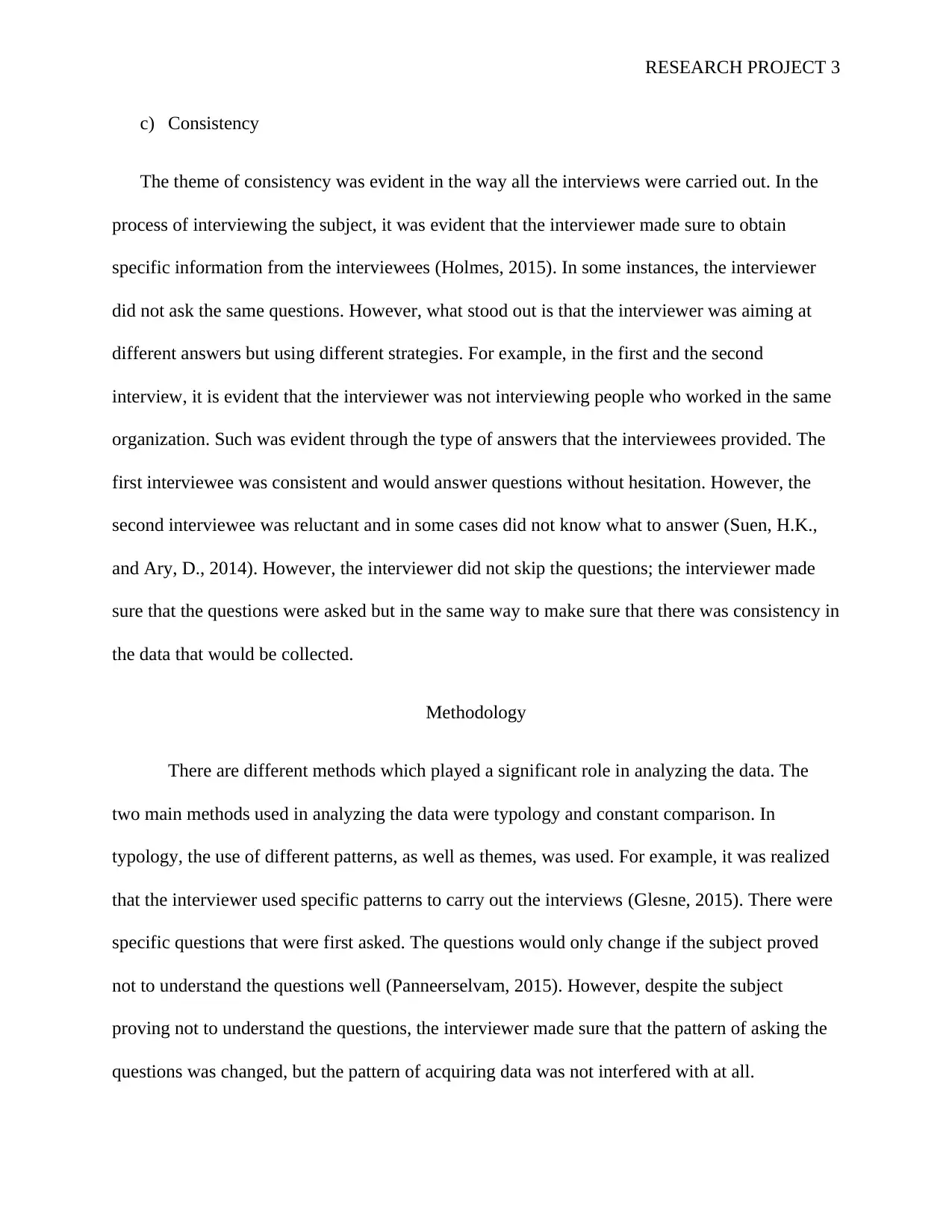
The interviews contained numerous themes. All the themes were in place in different instances,
and they all played a significant role in shaping the whole interview.
a) Curiosity
The theme of curiosity was primary in the whole interview. It is apparent that the same
questionnaires were not used in the whole interview (Panneerselvam, 2015). Such is apparent in
the way the questions were put across. When the interviewer is curious, he or she tries all he or
she can so as to retrieve detailed information from the subjects. Such can be demonstrated by
changing the questions into a way that they fit the type of the subject but provide the same
results. The theme of Curiosity commanded the whole process and led to detailed inquiry and
consistency.
b) Detailed enquiry
The detailed inquiry was evident in the process of asking questions to the interviewees. The
best way to know if an interviewer is interested in detailed information, he or she does not leave
any information out (Liamputtong, 2013). For example, in the process of interviewing, it was
evident that some interviewees either did not understand the interviewee or did not have the
answers to the questions. However, since the interviewer needed detailed information, the
interviewer made sure that the interviewee understood the questions so as to answer them
correctly (Smith, 2015). If the interviewer were not interested in detailed information, he or she
would not have been so keen on the information provided; whenever the interviewee proved not
to understand a question, the interviewer would have just moved on to the next question.
Document Page
RESEARCH PROJECT 3
c) Consistency
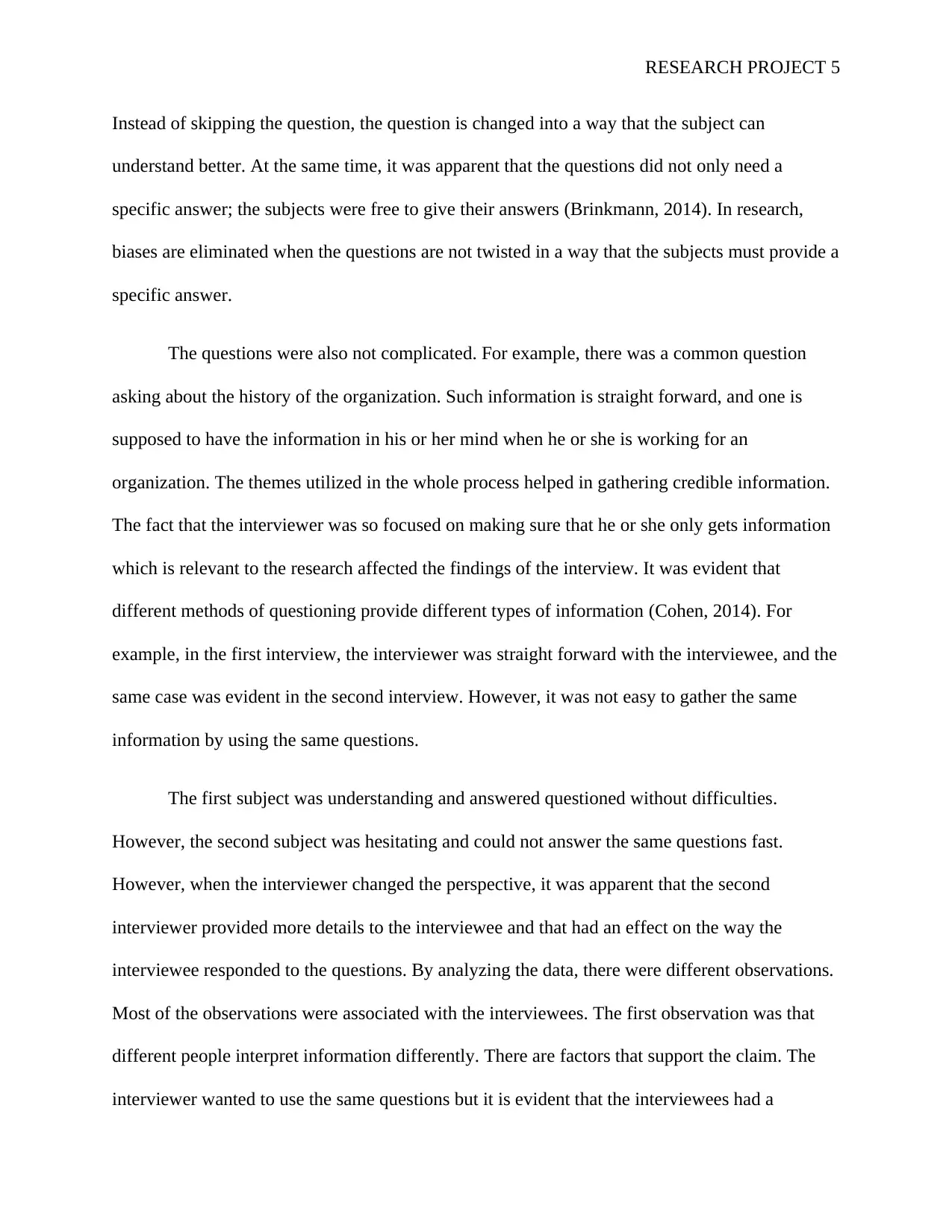
The theme of consistency was evident in the way all the interviews were carried out. In the
process of interviewing the subject, it was evident that the interviewer made sure to obtain
specific information from the interviewees (Holmes, 2015). In some instances, the interviewer
did not ask the same questions. However, what stood out is that the interviewer was aiming at
different answers but using different strategies. For example, in the first and the second
interview, it is evident that the interviewer was not interviewing people who worked in the same
organization. Such was evident through the type of answers that the interviewees provided. The
first interviewee was consistent and would answer questions without hesitation. However, the
second interviewee was reluctant and in some cases did not know what to answer (Suen, H.K.,
and Ary, D., 2014). However, the interviewer did not skip the questions; the interviewer made
sure that the questions were asked but in the same way to make sure that there was consistency in
the data that would be collected.
Methodology
There are different methods which played a significant role in analyzing the data. The
two main methods used in analyzing the data were typology and constant comparison. In
typology, the use of different patterns, as well as themes, was used. For example, it was realized
that the interviewer used specific patterns to carry out the interviews (Glesne, 2015). There were
specific questions that were first asked. The questions would only change if the subject proved
not to understand the questions well (Panneerselvam, 2015). However, despite the subject
proving not to understand the questions, the interviewer made sure that the pattern of asking the
questions was changed, but the pattern of acquiring data was not interfered with at all.
Document Page
RESEARCH PROJECT 4
The constant comparison came in place to analyze the questions as well as the answers.
The method was utilized in the following way. The data provided by the subjects was taken and
compared with the data that was provided by other subjects. For example, the data of the first
subject would be compared with the data of the second subject (Flick, 2015). Such led to
knowing the different and understanding the data well. At the same time, the questions asked to
the first subject were taken and compared with the questions that were asked to the second
subject. Comparison helped in knowing the type of data that would be reliable and such would
be known through the questions asked as well as the way the questions were answers. By looking
at the different interviews, it is apparent that there was a lot to be compared. There are
advantages that came with comparing the data. The first advantage was looking at the interview
that was conducted in a more thorough way. By having such information, it was easy to know if
there were biases in the whole process or not. At the same time, comparison was used in the
process of looking at the response of the interviewees. It is evident that different interviewees
provided different information. However, such was due to different approaches. The interviewer
can however not be blamed for that because the interviewees proved that their level of
processing information was different.
Results
It is evident that there were no specific research questions; however, there are many
points to learn and observe from the whole process. One of the points is the fact that the method
which was used in acquiring the data was effective. The reason why it was effective is that it was
enduring, flexible, and straight forward. As far as the issue of enduring is concerned, the
questions proved that they would give the subjects a margin of error (Bernard, H.R., Wutich, A.
and Ryan, G.W, 2016). A good example is seen when a subject does not have a definite answer.
tabler-icon-diamond-filled.svg

Paraphrase This Document

Need a fresh take? Get an instant paraphrase of this document with our AI Paraphraser
Document Page
RESEARCH PROJECT 5
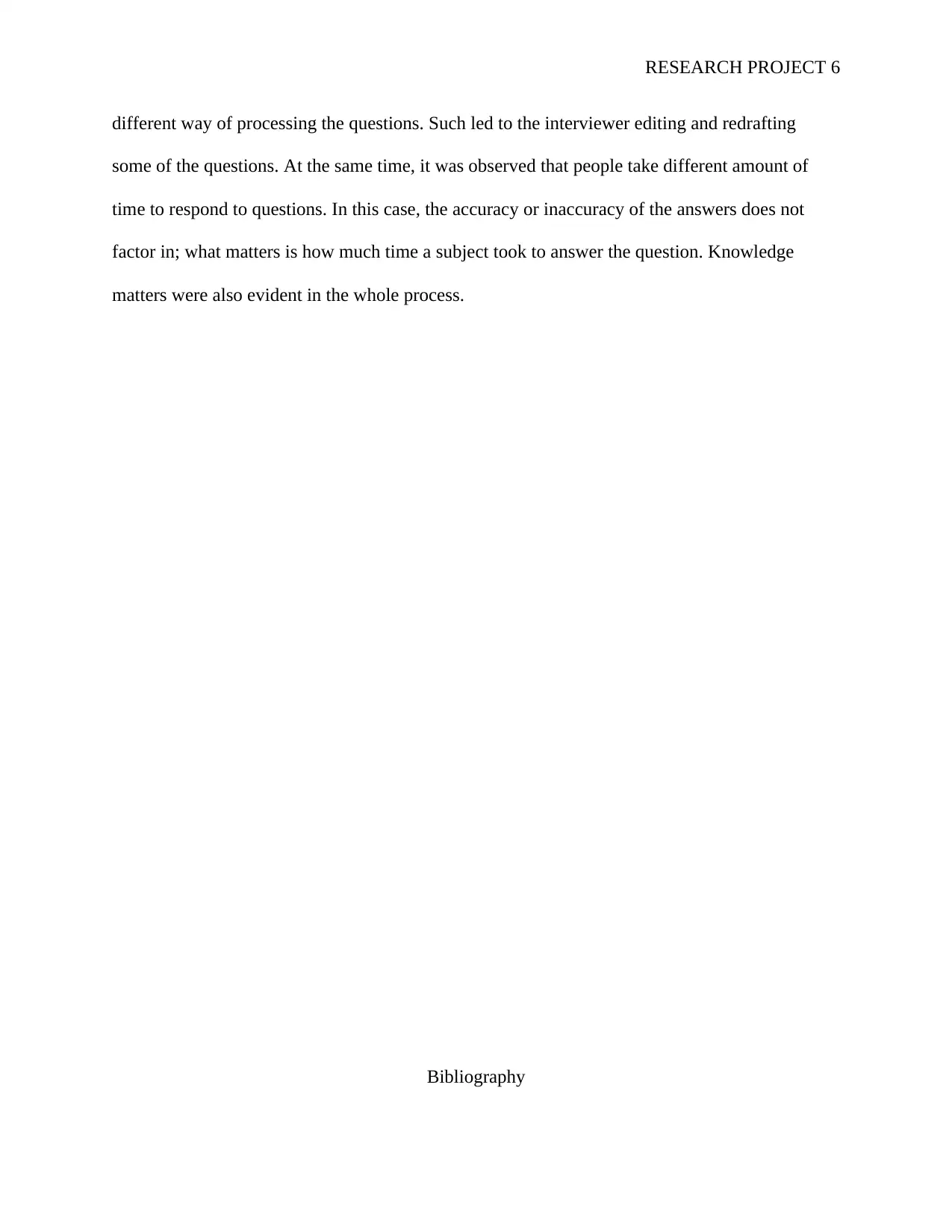
Instead of skipping the question, the question is changed into a way that the subject can
understand better. At the same time, it was apparent that the questions did not only need a
specific answer; the subjects were free to give their answers (Brinkmann, 2014). In research,
biases are eliminated when the questions are not twisted in a way that the subjects must provide a
specific answer.
The questions were also not complicated. For example, there was a common question
asking about the history of the organization. Such information is straight forward, and one is
supposed to have the information in his or her mind when he or she is working for an
organization. The themes utilized in the whole process helped in gathering credible information.
The fact that the interviewer was so focused on making sure that he or she only gets information
which is relevant to the research affected the findings of the interview. It was evident that
different methods of questioning provide different types of information (Cohen, 2014). For
example, in the first interview, the interviewer was straight forward with the interviewee, and the
same case was evident in the second interview. However, it was not easy to gather the same
information by using the same questions.
The first subject was understanding and answered questioned without difficulties.
However, the second subject was hesitating and could not answer the same questions fast.
However, when the interviewer changed the perspective, it was apparent that the second
interviewer provided more details to the interviewee and that had an effect on the way the
interviewee responded to the questions. By analyzing the data, there were different observations.
Most of the observations were associated with the interviewees. The first observation was that
different people interpret information differently. There are factors that support the claim. The
interviewer wanted to use the same questions but it is evident that the interviewees had a
Document Page
RESEARCH PROJECT 6
different way of processing the questions. Such led to the interviewer editing and redrafting
some of the questions. At the same time, it was observed that people take different amount of
time to respond to questions. In this case, the accuracy or inaccuracy of the answers does not
factor in; what matters is how much time a subject took to answer the question. Knowledge
matters were also evident in the whole process.
Bibliography
Document Page
RESEARCH PROJECT 7
Bernard, H.R., Wutich, A., and Ryan, G.W, 2016. Analyzing qualitative data: Systematic
approaches. Boston: SAGE publication.
Brinkmann, S., 2014. Interview. In Encyclopedia of Critical Psychology, pp.1008-10.
Cohen, M., 2014. Analyzing neural time series data: theory and practice. London: MIT Press.
Flick, U., 2015. Introducing research methodology: A beginner's guide to doing a research
project. Boston: SAGE.
Glesne, C., 2015. Becoming qualitative researchers: An introduction. New York: Pearson.
Holmes, J., 2015. Reverie and research interviews: a theoretical and empirical investigation.
Essex: Doctoral dissertation, University of Essex.
Liamputtong, P., 2013. Qualitative research methods.
Panneerselvam, R., 2015. Research Methodology. Athens: PHI Learning Pvt. Ltd.
Smith, J., 2015. Qualitative psychology: A practical guide to research methods. Boston: SAGE.
Suen, H.K., and Ary, D., 2014. Analyzing quantitative behavioral observation data. New York:
Psychology Press.
chevron_up_icon
1 out of 7
circle_padding
hide_on_mobile
zoom_out_icon
[object Object]