Interviewing Techniques Essay: Mistakes and Generations
VerifiedAdded on 2023/06/08
|11
|3960
|459
Essay
AI Summary
This essay delves into the critical aspects of interviewing techniques, focusing on the common pitfalls made by interviewers and how generational differences influence the process. The essay begins by defining interviewing as a selection process and highlights the importance of the interviewer's role in identifying the right candidate. It then meticulously outlines several common mistakes, including failing to introduce team members, not clearly defining job requirements, stereotyping candidates, lack of preparation, monopolizing the conversation, and rushing the hiring process. The essay further explores the importance of avoiding biases and offering practical solutions for interviewers. It then provides a comparative analysis of different generations (X, Y, Z, and Baby Boomers), highlighting the similarities and differences between Millennials and Generation Z, particularly in their approach to careers, technology, and work-life balance. The essay concludes by emphasizing the need for interviewers to be well-prepared, open-minded, and attentive to avoid biases, thereby ensuring a fair and effective selection process.
Running Head: Interviewing Techniques
Interviewing Techniques
Essay
System04104
8/30/2018
Interviewing Techniques
Essay
System04104
8/30/2018

Paraphrase This Document
Need a fresh take? Get an instant paraphrase of this document with our AI Paraphraser
Interviewing Techniques
1
Answer-1(a)
Interviewing is a process of selection through which an interviewer or a group of interviewers
determine that the candidate is suitable for a certain position offered by the organisation.
Another purpose of conducting interviews is to gather relevant information from the
candidate. However, there are various types of interviews such as corporate, research and
leadership role interviewing. Therefore, the role of interviewer in conducting an interview is
so essential because it determines the way of interview and its success or failure in order to
select the right and eligible candidate for the job. Any mistake in hiring people for the job is
the result of the huge loss for the organisation in terms of both money and resource. The
mistakes of interviewer cause failure of the selection purpose. These are the common
mistakes committed by the interviewer during the selection process:
Not address the interviewer team members
It is essentials before starting the interview is to introduce your name and briefly introduce
the name of other team members with their designation followed by the purpose of
conducting the interview. Sometimes the interviewer misses the friendly introduction that
causes the candidate to feel uncomfortable during the interview (Chait, 2017). A friendly
environment in the interview allows the candidate to calm his/her nerves and feel comfortable
during the interview. People from Generation Z (younger generation group people) are more
committed these mistakes in comparison to older generation people (Generation Y) because
they are faster and forward in their thoughts and presume that it does not matter.
Real World Ex: One of my friends who appeared in an interview and he was not aware of
any member of the team because they did not introduce themselves. The head interviewer
was in such a hurry to finish the interview, but not introduce their member and he was so
young in the team. The implication of that mistake was that my friend feels so unfamiliar
with that interviewee and still told us that to whom he faced in the interview he does not
know.
Not defining the job clearly
Many interviewers starting the job interview without defining the job purpose and duties of
candidate and requirements needed to succeed in the job. This mistake of interviewer
increases the risk of hiring the wrong person for the job. A thorough job description explains
1
Answer-1(a)
Interviewing is a process of selection through which an interviewer or a group of interviewers
determine that the candidate is suitable for a certain position offered by the organisation.
Another purpose of conducting interviews is to gather relevant information from the
candidate. However, there are various types of interviews such as corporate, research and
leadership role interviewing. Therefore, the role of interviewer in conducting an interview is
so essential because it determines the way of interview and its success or failure in order to
select the right and eligible candidate for the job. Any mistake in hiring people for the job is
the result of the huge loss for the organisation in terms of both money and resource. The
mistakes of interviewer cause failure of the selection purpose. These are the common
mistakes committed by the interviewer during the selection process:
Not address the interviewer team members
It is essentials before starting the interview is to introduce your name and briefly introduce
the name of other team members with their designation followed by the purpose of
conducting the interview. Sometimes the interviewer misses the friendly introduction that
causes the candidate to feel uncomfortable during the interview (Chait, 2017). A friendly
environment in the interview allows the candidate to calm his/her nerves and feel comfortable
during the interview. People from Generation Z (younger generation group people) are more
committed these mistakes in comparison to older generation people (Generation Y) because
they are faster and forward in their thoughts and presume that it does not matter.
Real World Ex: One of my friends who appeared in an interview and he was not aware of
any member of the team because they did not introduce themselves. The head interviewer
was in such a hurry to finish the interview, but not introduce their member and he was so
young in the team. The implication of that mistake was that my friend feels so unfamiliar
with that interviewee and still told us that to whom he faced in the interview he does not
know.
Not defining the job clearly
Many interviewers starting the job interview without defining the job purpose and duties of
candidate and requirements needed to succeed in the job. This mistake of interviewer
increases the risk of hiring the wrong person for the job. A thorough job description explains
Interviewing Techniques
2
the duties and responsibilities and helpful in identifying technical skills, professional
qualifications and personal qualities such as interpersonal skills of the candidate. A well-
written interview helps in conducting structured interview questions that evaluate applicant's
fitness for the job.
Stereotyping
When the interviewer is a stereotype of person and judge people on their past thinking and
experience, or candidate's background, or personal circumstances, the interviewer is not able
to assess candidate's ability for the job. This type of interviewer general asks the question of
their stereotype thinking (DeZube, 2016).
Real world Ex: He was a football player in the college; he must be aggressive.
She is wearing casual clothing; she may be too phlegmatic for our organisation.
She has two children; it is impossible for her to work overtime.
Such types of mistakes committed by generation ‘X' and millennial age group people,
because they have a tendency to judge the candidate on their experiences. Such stereotype
assumptions cause interviewer missing-out on well deserves and qualified candidates for the
job and as well as he/she maybe be suspect for discrimination (Cheng, 2011).
Not preparing interview questions in advance:
Normally, the interviewer forgets to prepare questions for the interview in advance that
causes a problem by taking the interview and lead to an unstructured interview having no
sense. A well expert and effective interviewer always prepare himself for preparing to
interview questions in advance. It helps in to seek out the relevant information about the
candidate. If you are asking the same question from each candidate, it will be helpful in
comparing the candidates with each other easily (Derous, Ryan, and Nguyen, 2011). For this
interviewer should keep a notepad with him and not the answer of all candidates in a
sequence that will be helpful to compare and analyse the skills of the candidate and select the
best candidate for the job. People from generation Z committed such types of mistakes
because they believe in technological aspects and not believe in pen and paperwork and they
have a tendency to prepare themselves for the right movement.
2
the duties and responsibilities and helpful in identifying technical skills, professional
qualifications and personal qualities such as interpersonal skills of the candidate. A well-
written interview helps in conducting structured interview questions that evaluate applicant's
fitness for the job.
Stereotyping
When the interviewer is a stereotype of person and judge people on their past thinking and
experience, or candidate's background, or personal circumstances, the interviewer is not able
to assess candidate's ability for the job. This type of interviewer general asks the question of
their stereotype thinking (DeZube, 2016).
Real world Ex: He was a football player in the college; he must be aggressive.
She is wearing casual clothing; she may be too phlegmatic for our organisation.
She has two children; it is impossible for her to work overtime.
Such types of mistakes committed by generation ‘X' and millennial age group people,
because they have a tendency to judge the candidate on their experiences. Such stereotype
assumptions cause interviewer missing-out on well deserves and qualified candidates for the
job and as well as he/she maybe be suspect for discrimination (Cheng, 2011).
Not preparing interview questions in advance:
Normally, the interviewer forgets to prepare questions for the interview in advance that
causes a problem by taking the interview and lead to an unstructured interview having no
sense. A well expert and effective interviewer always prepare himself for preparing to
interview questions in advance. It helps in to seek out the relevant information about the
candidate. If you are asking the same question from each candidate, it will be helpful in
comparing the candidates with each other easily (Derous, Ryan, and Nguyen, 2011). For this
interviewer should keep a notepad with him and not the answer of all candidates in a
sequence that will be helpful to compare and analyse the skills of the candidate and select the
best candidate for the job. People from generation Z committed such types of mistakes
because they believe in technological aspects and not believe in pen and paperwork and they
have a tendency to prepare themselves for the right movement.
⊘ This is a preview!⊘
Do you want full access?
Subscribe today to unlock all pages.

Trusted by 1+ million students worldwide
Interviewing Techniques
3
Give chance others to speak:
It has been seen that when the interviewer is more talkative and not give chance to others. My
friend Mr Richard, who felt this pain first time when during an interview, his colleague
continuously monologues for 20 minutes non-stop. After this, the hiring manager eventually
put his finger on his mouth and politely said to him " shhh” and told the candidate that I
would like to talk with you now.” These mistakes lead to waste of time in the interview and
people failed to assess candidates within the time and at the end, the interview will end in a
rush because of expanse such precious time of interview session. It also leaves a bad
impression on the candidate and a poor image of the company. Usually, such type of mistakes
committed by generation Z because they are tends to be more talkative (Gorham, 2018).
Rushing to hire:
Hiring a suitable candidate for the job is not a one-minute process rather it takes time to
conduct the interview process and hire candidates based on the quality. When interviewer
rush for the interview, it might be possible that he/she fails in analysing and judging the best
traits in the candidate. Normally these mistakes are done by generation ‘Z' who tend to be
more focused on doing things in a speedy manner and want to interview more and more
candidates in quick time (Schulz, 2008).
Answer-1(b)
Before conducting interviews, the interviewer must focus on certain measures that help in
avoiding such types of mistakes and avoid biases during the interview. These measures are as
follow:
Introduce the interviewing team members:
The interviewer must introduce himself to the candidate and other members of the team with
their designation. It helps the candidate to come in a comfortable zone and allow the
candidate to calm his/her nerves and feel comfortable during the interview. This creates a
friendly environment in the interview session and helps the interviewer to analyse candidate
for the jobs (Guion, Diehl, and McDonald, 2011).
Observe and avoid assumptions:
Keep an open mind and avoid stereotype thinking is the valuable traits of an interviewer.
Thus, such assumption like “he belongs to a middle-class family; so how he can handle the
3
Give chance others to speak:
It has been seen that when the interviewer is more talkative and not give chance to others. My
friend Mr Richard, who felt this pain first time when during an interview, his colleague
continuously monologues for 20 minutes non-stop. After this, the hiring manager eventually
put his finger on his mouth and politely said to him " shhh” and told the candidate that I
would like to talk with you now.” These mistakes lead to waste of time in the interview and
people failed to assess candidates within the time and at the end, the interview will end in a
rush because of expanse such precious time of interview session. It also leaves a bad
impression on the candidate and a poor image of the company. Usually, such type of mistakes
committed by generation Z because they are tends to be more talkative (Gorham, 2018).
Rushing to hire:
Hiring a suitable candidate for the job is not a one-minute process rather it takes time to
conduct the interview process and hire candidates based on the quality. When interviewer
rush for the interview, it might be possible that he/she fails in analysing and judging the best
traits in the candidate. Normally these mistakes are done by generation ‘Z' who tend to be
more focused on doing things in a speedy manner and want to interview more and more
candidates in quick time (Schulz, 2008).
Answer-1(b)
Before conducting interviews, the interviewer must focus on certain measures that help in
avoiding such types of mistakes and avoid biases during the interview. These measures are as
follow:
Introduce the interviewing team members:
The interviewer must introduce himself to the candidate and other members of the team with
their designation. It helps the candidate to come in a comfortable zone and allow the
candidate to calm his/her nerves and feel comfortable during the interview. This creates a
friendly environment in the interview session and helps the interviewer to analyse candidate
for the jobs (Guion, Diehl, and McDonald, 2011).
Observe and avoid assumptions:
Keep an open mind and avoid stereotype thinking is the valuable traits of an interviewer.
Thus, such assumption like “he belongs to a middle-class family; so how he can handle the
Paraphrase This Document
Need a fresh take? Get an instant paraphrase of this document with our AI Paraphraser
Interviewing Techniques
4
corporate professional life.” or “he/she was a football player in college; then he will be
aggressive” should be avoided during interviews. Some people judge candidates through their
dressing styles and their face, it is so worst for the interviewing process and never helpful in
selecting the best candidates for the job.
Ex. An interviewer presumed in the interview process about an individual candidate to be
strong and athletic because he was African-American. He was inevitably decided to give the
place of the head of the physical education department.
Prepare questions in advance and Note Taking:
Mr David forget to prepare questions for conducting interviews and next day when he takes
interview of candidates for the company's job, he misses the main agenda and skills on which
he has to select candidates for the job offered. He was also unable to note the skills and
qualification of candidates on a notebook that also create difficulties when he compares
candidates with each other in order to select superior quality candidates for selection of best.
Taking note during the interview is requiring to record down all the relevant information
about the candidate. This also helps in further discussion about the candidates because it was
very less time between the candidate for discussion and evaluation. The interviewer can also
use structured recording tools for the recording of specific experiences and skills like
communication and teamwork abilities (Kacperck, 2014).
Open-minded and Aware:
Keep an open mind is definitely an essential characteristic of an interviewer during the
selection process. Because it brings that crucial information about the candidate that was,
uncover during the interview process. This is because predetermined and stereotype
judgement could act as barriers to an open communication. Being attentive to own prejudices
and bring them to a cognisant level would allow one to overwhelm those prejudices and reach
an unbiased decision. Thus, it is necessary to being aware of your own biases and being
aware and being aware of the information retrieved from the interview process (Miller and
Rollnick, 2013).
Be well-rested and stay focused
It was found that the biases and stereotype thinking of interview positively related to the huge
amount of cognitive load. It means, when the interviewer is facing high mental pressure,
there would be an increased tendency to categorizing candidates on stereotype and partialities
4
corporate professional life.” or “he/she was a football player in college; then he will be
aggressive” should be avoided during interviews. Some people judge candidates through their
dressing styles and their face, it is so worst for the interviewing process and never helpful in
selecting the best candidates for the job.
Ex. An interviewer presumed in the interview process about an individual candidate to be
strong and athletic because he was African-American. He was inevitably decided to give the
place of the head of the physical education department.
Prepare questions in advance and Note Taking:
Mr David forget to prepare questions for conducting interviews and next day when he takes
interview of candidates for the company's job, he misses the main agenda and skills on which
he has to select candidates for the job offered. He was also unable to note the skills and
qualification of candidates on a notebook that also create difficulties when he compares
candidates with each other in order to select superior quality candidates for selection of best.
Taking note during the interview is requiring to record down all the relevant information
about the candidate. This also helps in further discussion about the candidates because it was
very less time between the candidate for discussion and evaluation. The interviewer can also
use structured recording tools for the recording of specific experiences and skills like
communication and teamwork abilities (Kacperck, 2014).
Open-minded and Aware:
Keep an open mind is definitely an essential characteristic of an interviewer during the
selection process. Because it brings that crucial information about the candidate that was,
uncover during the interview process. This is because predetermined and stereotype
judgement could act as barriers to an open communication. Being attentive to own prejudices
and bring them to a cognisant level would allow one to overwhelm those prejudices and reach
an unbiased decision. Thus, it is necessary to being aware of your own biases and being
aware and being aware of the information retrieved from the interview process (Miller and
Rollnick, 2013).
Be well-rested and stay focused
It was found that the biases and stereotype thinking of interview positively related to the huge
amount of cognitive load. It means, when the interviewer is facing high mental pressure,
there would be an increased tendency to categorizing candidates on stereotype and partialities
Interviewing Techniques
5
to aid in decision-making. Therefore, it is necessary that the interviewing process should be
adequately spaced out in such a way that it could not cause mental pressure or cognitive load
on the interviewer (Macan and Merritt, 2011). If an interviewer is not well focused towards
the interview, activities he might be remembered only one candidate out of the several
interviewees and if the interviewer has gone through in one day, the interviewer seems to
only remember and favour the first applicant (Robles, 2012).
Do not rush for the interview process:
If the interviewer has gone through in one day, the interviewer seems to only remember and
favour the first applicant because it is impossible to remember everything that happened in
the whole interview process. This creates biases with other candidates and may result in
selecting a wrong person for the job and avoiding others who deserve for the same job (Ullah,
2010).
Therefore, it is necessary to consider these measures to avoid the above mistakes, which is
done by numerous interviewers during the interview process.
Answer-2
A generation is normally a group of people born in the same era and raised around the same
place. People in this "birth cohort" exhibit similar nature, preferences, behaviour,
characteristics, and values over their lifetimes. There are four generation called Generation X,
Generation Y, or Millennial, Generation Z, and Baby boomers. These generations are
categorized on the following basis:
a. Generation X: Those people who were born in between 1965 to 1976. They came
before millennial.
b. Generation Y or Millennial: These people are born after generation X, it means in
between 1976 to 1996.
c. Generation Z: These people are born after the millennial generation, it means after
1996 and later.
d. Baby Boomers: These peoples are born after the Second World War (1946-1964) that
is why they called baby boomers.
5
to aid in decision-making. Therefore, it is necessary that the interviewing process should be
adequately spaced out in such a way that it could not cause mental pressure or cognitive load
on the interviewer (Macan and Merritt, 2011). If an interviewer is not well focused towards
the interview, activities he might be remembered only one candidate out of the several
interviewees and if the interviewer has gone through in one day, the interviewer seems to
only remember and favour the first applicant (Robles, 2012).
Do not rush for the interview process:
If the interviewer has gone through in one day, the interviewer seems to only remember and
favour the first applicant because it is impossible to remember everything that happened in
the whole interview process. This creates biases with other candidates and may result in
selecting a wrong person for the job and avoiding others who deserve for the same job (Ullah,
2010).
Therefore, it is necessary to consider these measures to avoid the above mistakes, which is
done by numerous interviewers during the interview process.
Answer-2
A generation is normally a group of people born in the same era and raised around the same
place. People in this "birth cohort" exhibit similar nature, preferences, behaviour,
characteristics, and values over their lifetimes. There are four generation called Generation X,
Generation Y, or Millennial, Generation Z, and Baby boomers. These generations are
categorized on the following basis:
a. Generation X: Those people who were born in between 1965 to 1976. They came
before millennial.
b. Generation Y or Millennial: These people are born after generation X, it means in
between 1976 to 1996.
c. Generation Z: These people are born after the millennial generation, it means after
1996 and later.
d. Baby Boomers: These peoples are born after the Second World War (1946-1964) that
is why they called baby boomers.
⊘ This is a preview!⊘
Do you want full access?
Subscribe today to unlock all pages.
Trusted by 1+ million students worldwide
Interviewing Techniques
6
Key Similarities between Millennial generation and generation Z
a. Both agreeing on short tenure: Both generation people think that approximately 3
year of a period is enough for spending time during the first job. 83% of generation Z
and 91% of millennials expect to stay in a job less than 3 years.
b. Customization of careers: Millennial grew up in the era of customization where
profile pages, cars, bike, phones, and even t-shirt could be customized based on
individual liking. It is also happening with generation Z and they are sharing the same
millennial attraction for customization (Waldherr, and Muck, 2011).
c. Motivated by meaning: Millennial are searching for more logic behind any work.
Most of the people who belong to generation Z believe that the impact of the
company on society affects their decision to work there, thus they will be looking for
more meaning at work.
d. Technological addiction or Tech Savvy: Both Millennial and generation Z people
are attracted towards technology, although generation Z people are more addicted
than millennial.
e. Open minded and idealistic: People belong to both generations are more idealistic
and open-minded.
Key Differences between Millennial generation and generation Z
a. The difference between Millennial and generation Z is that generation Z people are
less Focused than millennial because they born in the era of advanced technology
(such as Facebook, Twitter, Snapchat, and Whatsapp). Thus, they are normally less
focused than millennial (Ahmad, 2018).
b. Though Generation Z people can be less focused than millennial, they do multiple
tasks at the same time such as doing schoolwork and watching TV at the same time,
watching TV during eating and studying, playing games and operating their social
media at the same time. While generation Z quickly shifts from one task to other.
c. Generation Z has a higher expectation than millennials.
d. The generation Z people are more adaptable in compare to millennial generations'
people (Beall, 2017).
e. Generation Z people are less patiently than the millennial generation and even people
are more short-tempered who born in the period of generation Z.
6
Key Similarities between Millennial generation and generation Z
a. Both agreeing on short tenure: Both generation people think that approximately 3
year of a period is enough for spending time during the first job. 83% of generation Z
and 91% of millennials expect to stay in a job less than 3 years.
b. Customization of careers: Millennial grew up in the era of customization where
profile pages, cars, bike, phones, and even t-shirt could be customized based on
individual liking. It is also happening with generation Z and they are sharing the same
millennial attraction for customization (Waldherr, and Muck, 2011).
c. Motivated by meaning: Millennial are searching for more logic behind any work.
Most of the people who belong to generation Z believe that the impact of the
company on society affects their decision to work there, thus they will be looking for
more meaning at work.
d. Technological addiction or Tech Savvy: Both Millennial and generation Z people
are attracted towards technology, although generation Z people are more addicted
than millennial.
e. Open minded and idealistic: People belong to both generations are more idealistic
and open-minded.
Key Differences between Millennial generation and generation Z
a. The difference between Millennial and generation Z is that generation Z people are
less Focused than millennial because they born in the era of advanced technology
(such as Facebook, Twitter, Snapchat, and Whatsapp). Thus, they are normally less
focused than millennial (Ahmad, 2018).
b. Though Generation Z people can be less focused than millennial, they do multiple
tasks at the same time such as doing schoolwork and watching TV at the same time,
watching TV during eating and studying, playing games and operating their social
media at the same time. While generation Z quickly shifts from one task to other.
c. Generation Z has a higher expectation than millennials.
d. The generation Z people are more adaptable in compare to millennial generations'
people (Beall, 2017).
e. Generation Z people are less patiently than the millennial generation and even people
are more short-tempered who born in the period of generation Z.
Paraphrase This Document
Need a fresh take? Get an instant paraphrase of this document with our AI Paraphraser
Interviewing Techniques
7
Interviewing a candidate from Generation Z
It is necessary for an interviewer to understand the traits of generation Z people. It is also
essential to understand what makes this generation so incredibly different anyone that came
before them into the workforce. The unique characteristics and nature may frustrate, surprise,
and even inspire an interviewer when he/she take interview of these generation people.
a. Most of the Generation Z candidates are rank career opportunity as their
primary consideration: Generation Z candidates may not take the job if it does not
provide career opportunities. Their opinions are career oriented and they won't see
themselves at a certain place after some time (Miller and Moyers, 2008). Rather than
thinking that how they can apply their skills and knowledge to help the company they
think about how the company help them to meet their future goals. An interviewer
should know this motive and must ask them “what are their long-term goals” and
“how they think that this organisation can help them to get their desired goal.”
b. Re-assess authenticity: Authenticity is the major factor attached to generation Z for
their working relationship with a company. They search lots of information about the
company before the interview, and then they want to know if the company is real or
not. Therefore, it is necessary for an interviewer to equip himself/herself with the full
information about the company and its operations (Ng, Schweitzer, and Lyons, 2010).
c. Growth is the primary agenda than Salary: it as earlier discussed that career
opportunities are the primary concern for generation Z candidates and after that, they
consider the salary. Therefore, it is important for the interviewer to tell them about
first about the growth opportunities and then after he/she must explain the pay
structure. The one reason behind this these candidates born in the era of economic
crisis and economically shaken era. Many of them see their family in through
financial hardships that cause they want to establish in their career in such a condition
that again they will not suffer from the same problem (Weger, Castle, and Emmett,
2010).
d. Socially conscious: when the interviewer takes interviews of a generation Z candidate
he/she must highlight some of the social activities their company do for the
community in which it operates. Most of the people who belong to generation Z
believed that the impact of the company on society affects their decision to work
there, thus they will be more attracted to work in the organisation.
7
Interviewing a candidate from Generation Z
It is necessary for an interviewer to understand the traits of generation Z people. It is also
essential to understand what makes this generation so incredibly different anyone that came
before them into the workforce. The unique characteristics and nature may frustrate, surprise,
and even inspire an interviewer when he/she take interview of these generation people.
a. Most of the Generation Z candidates are rank career opportunity as their
primary consideration: Generation Z candidates may not take the job if it does not
provide career opportunities. Their opinions are career oriented and they won't see
themselves at a certain place after some time (Miller and Moyers, 2008). Rather than
thinking that how they can apply their skills and knowledge to help the company they
think about how the company help them to meet their future goals. An interviewer
should know this motive and must ask them “what are their long-term goals” and
“how they think that this organisation can help them to get their desired goal.”
b. Re-assess authenticity: Authenticity is the major factor attached to generation Z for
their working relationship with a company. They search lots of information about the
company before the interview, and then they want to know if the company is real or
not. Therefore, it is necessary for an interviewer to equip himself/herself with the full
information about the company and its operations (Ng, Schweitzer, and Lyons, 2010).
c. Growth is the primary agenda than Salary: it as earlier discussed that career
opportunities are the primary concern for generation Z candidates and after that, they
consider the salary. Therefore, it is important for the interviewer to tell them about
first about the growth opportunities and then after he/she must explain the pay
structure. The one reason behind this these candidates born in the era of economic
crisis and economically shaken era. Many of them see their family in through
financial hardships that cause they want to establish in their career in such a condition
that again they will not suffer from the same problem (Weger, Castle, and Emmett,
2010).
d. Socially conscious: when the interviewer takes interviews of a generation Z candidate
he/she must highlight some of the social activities their company do for the
community in which it operates. Most of the people who belong to generation Z
believed that the impact of the company on society affects their decision to work
there, thus they will be more attracted to work in the organisation.
Interviewing Techniques
8
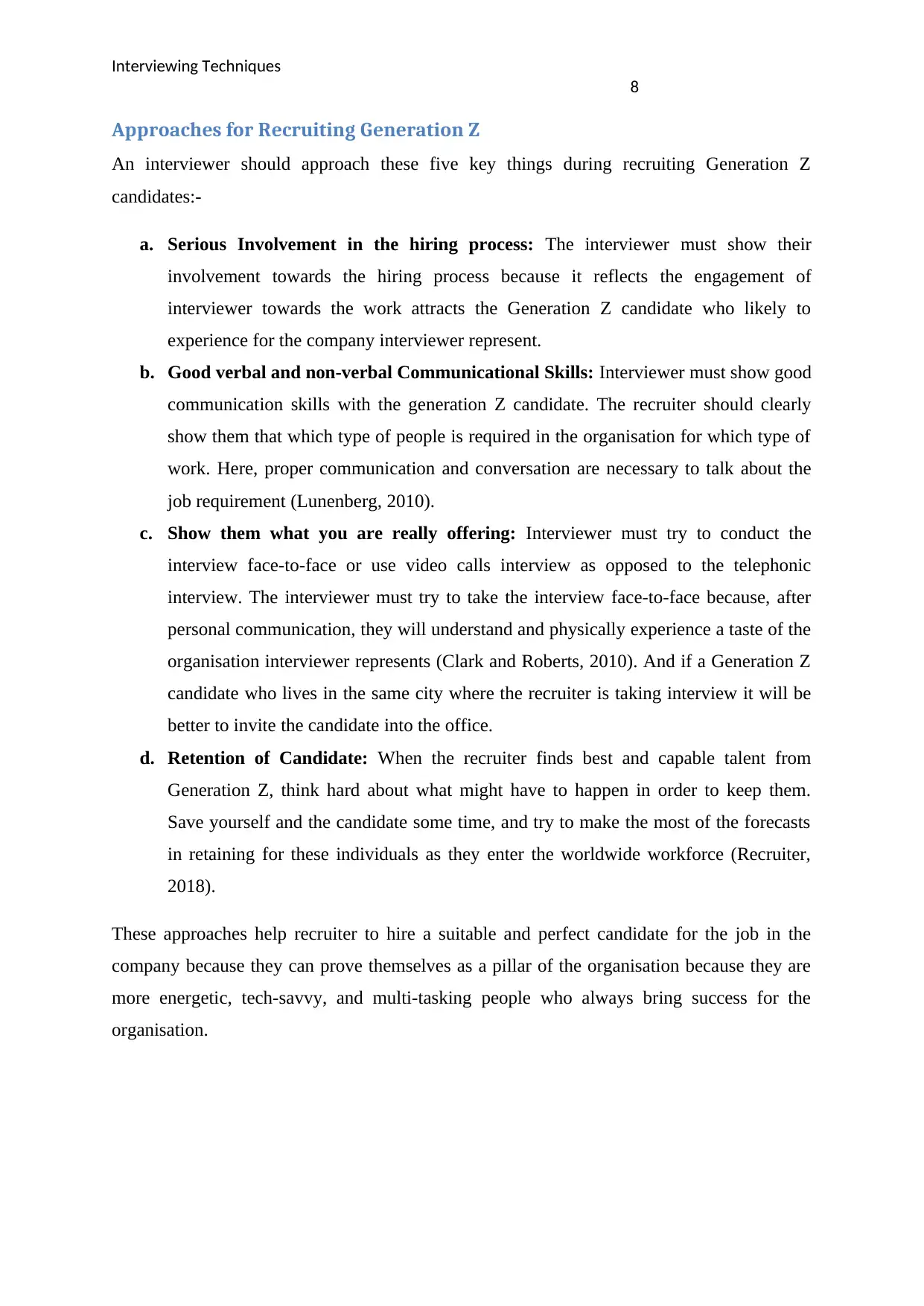
Approaches for Recruiting Generation Z
An interviewer should approach these five key things during recruiting Generation Z
candidates:-
a. Serious Involvement in the hiring process: The interviewer must show their
involvement towards the hiring process because it reflects the engagement of
interviewer towards the work attracts the Generation Z candidate who likely to
experience for the company interviewer represent.
b. Good verbal and non-verbal Communicational Skills: Interviewer must show good
communication skills with the generation Z candidate. The recruiter should clearly
show them that which type of people is required in the organisation for which type of
work. Here, proper communication and conversation are necessary to talk about the
job requirement (Lunenberg, 2010).
c. Show them what you are really offering: Interviewer must try to conduct the
interview face-to-face or use video calls interview as opposed to the telephonic
interview. The interviewer must try to take the interview face-to-face because, after
personal communication, they will understand and physically experience a taste of the
organisation interviewer represents (Clark and Roberts, 2010). And if a Generation Z
candidate who lives in the same city where the recruiter is taking interview it will be
better to invite the candidate into the office.
d. Retention of Candidate: When the recruiter finds best and capable talent from
Generation Z, think hard about what might have to happen in order to keep them.
Save yourself and the candidate some time, and try to make the most of the forecasts
in retaining for these individuals as they enter the worldwide workforce (Recruiter,
2018).
These approaches help recruiter to hire a suitable and perfect candidate for the job in the
company because they can prove themselves as a pillar of the organisation because they are
more energetic, tech-savvy, and multi-tasking people who always bring success for the
organisation.
8
Approaches for Recruiting Generation Z
An interviewer should approach these five key things during recruiting Generation Z
candidates:-
a. Serious Involvement in the hiring process: The interviewer must show their
involvement towards the hiring process because it reflects the engagement of
interviewer towards the work attracts the Generation Z candidate who likely to
experience for the company interviewer represent.
b. Good verbal and non-verbal Communicational Skills: Interviewer must show good
communication skills with the generation Z candidate. The recruiter should clearly
show them that which type of people is required in the organisation for which type of
work. Here, proper communication and conversation are necessary to talk about the
job requirement (Lunenberg, 2010).
c. Show them what you are really offering: Interviewer must try to conduct the
interview face-to-face or use video calls interview as opposed to the telephonic
interview. The interviewer must try to take the interview face-to-face because, after
personal communication, they will understand and physically experience a taste of the
organisation interviewer represents (Clark and Roberts, 2010). And if a Generation Z
candidate who lives in the same city where the recruiter is taking interview it will be
better to invite the candidate into the office.
d. Retention of Candidate: When the recruiter finds best and capable talent from
Generation Z, think hard about what might have to happen in order to keep them.
Save yourself and the candidate some time, and try to make the most of the forecasts
in retaining for these individuals as they enter the worldwide workforce (Recruiter,
2018).
These approaches help recruiter to hire a suitable and perfect candidate for the job in the
company because they can prove themselves as a pillar of the organisation because they are
more energetic, tech-savvy, and multi-tasking people who always bring success for the
organisation.
⊘ This is a preview!⊘
Do you want full access?
Subscribe today to unlock all pages.
Trusted by 1+ million students worldwide
Interviewing Techniques
9
References
Ahmad, I. (2018) comparing The Differences Between Generation Z and Millennials [online].
Available from: https://www.socialmediatoday.com/news/comparing-the-differences-
between-generation-z-and-millennials-infographic/517903/ [Accessed: 30/08/2018].
Beall, G. (2017) 8 keys difference between Gen Z and Millennials [online]. Available from:
https://www.huffingtonpost.com/george-beall/8-key-differences-between_b_12814200.html
[Accessed: 30/08/2018].
Chait, D. (2017) The most Common interviewing Mistake and How to Fix it [online].
Available from: http://www.greenhouse.io/blog/the-most-common-interviewing-mistake-and-
how-to-fix-it [Accessed: 30/08/2018].
Cheng, W.H. (2011) Cognitive Biases in Selection Decisions [online]. Available from:
https://www.cscollege.gov.sg/Knowledge/Pages/CognitiveBiases-in-Selection-
Decisions.aspx [Accessed: 30/08/2018].
Clark, L. A., and Roberts, S. J. (2010) Employer’s use of social network sites: A socially
irresponsible practice. Journal of Business Ethics, 95, pp. 507-525.
Derous, E., Ryan, A. M., and Nguyen, H. D. (2011) Multiple categorizations in resume
screening: Examining effects on hiring discrimination against Arab applicants in field and lab
settings. Journal of Organizational Behaviour, 33(4), pp. 544-570.
DeZube, D. (2016) The Top Ten Interview Questions to ask Millennials [online]. Available
from https://hiring.monster.com/hr/ CG-11 HRM375 Course Guide
hr-best-practices/recruiting-hiring-advice/interviewing-candidates/how-tointerview-gen-
y.aspx [Accessed: 29/08/2018].
Gorham, K. (2018) Interview Mistakes, and How to overcome them [online]. Available from:
http://www.thestaffingstream.com/2015/03/24/interviewer-mistakes-and-how-to-overcome-
them/ [Accessed: 30/08/2018].
Guion, L. A., Diehl, D. C., and McDonald, D. (2011) Conducting an in-depth interview.
USA: University of Florida.
9
References
Ahmad, I. (2018) comparing The Differences Between Generation Z and Millennials [online].
Available from: https://www.socialmediatoday.com/news/comparing-the-differences-
between-generation-z-and-millennials-infographic/517903/ [Accessed: 30/08/2018].
Beall, G. (2017) 8 keys difference between Gen Z and Millennials [online]. Available from:
https://www.huffingtonpost.com/george-beall/8-key-differences-between_b_12814200.html
[Accessed: 30/08/2018].
Chait, D. (2017) The most Common interviewing Mistake and How to Fix it [online].
Available from: http://www.greenhouse.io/blog/the-most-common-interviewing-mistake-and-
how-to-fix-it [Accessed: 30/08/2018].
Cheng, W.H. (2011) Cognitive Biases in Selection Decisions [online]. Available from:
https://www.cscollege.gov.sg/Knowledge/Pages/CognitiveBiases-in-Selection-
Decisions.aspx [Accessed: 30/08/2018].
Clark, L. A., and Roberts, S. J. (2010) Employer’s use of social network sites: A socially
irresponsible practice. Journal of Business Ethics, 95, pp. 507-525.
Derous, E., Ryan, A. M., and Nguyen, H. D. (2011) Multiple categorizations in resume
screening: Examining effects on hiring discrimination against Arab applicants in field and lab
settings. Journal of Organizational Behaviour, 33(4), pp. 544-570.
DeZube, D. (2016) The Top Ten Interview Questions to ask Millennials [online]. Available
from https://hiring.monster.com/hr/ CG-11 HRM375 Course Guide
hr-best-practices/recruiting-hiring-advice/interviewing-candidates/how-tointerview-gen-
y.aspx [Accessed: 29/08/2018].
Gorham, K. (2018) Interview Mistakes, and How to overcome them [online]. Available from:
http://www.thestaffingstream.com/2015/03/24/interviewer-mistakes-and-how-to-overcome-
them/ [Accessed: 30/08/2018].
Guion, L. A., Diehl, D. C., and McDonald, D. (2011) Conducting an in-depth interview.
USA: University of Florida.
Paraphrase This Document
Need a fresh take? Get an instant paraphrase of this document with our AI Paraphraser
Interviewing Techniques
10
Kacperck, L. (2014) Non-verbal communication: The importance of listening [online].
Available from: https://doi.org/10.12968/bjon.1997.6.5.275 [Accessed: 30/08/2018].
Lunenberg, F. C. (2010) Communication: The process, barriers, and improving effectiveness.
Schooling, 1(1), pp. 1-11.
Macan, T. and Merritt, S. (2011) Actions Speak Too: Uncovering Possible Implicit and
Explicit Discrimination in the Employment Interview Process, USA: John Wiley & Sons Ltd.
Miller, W. R., and Moyers, T. B. (2008) Eight stages in learning motivational interviewing.
Journal of Teaching in the Addictions, 5(1), pp. 3-17.
Miller, W. R., and Rollnick, S. (2013) Motivational interviewing: Helping people change. 3rd
ed. New York: The Guilford Press.
Ng, E. S. W., Schweitzer, L., and Lyons, S. T. (2010) New generation, great expectations: A
field study of the millennial generation. Journal of Business and Psychology, 25(2), pp. 281-
292.
Recruiter (2018) 6 ways to prepare Generation Z for an Interview [online]. Available from:
https://theundercoverrecruiter.com/gen-z-interview-tips/ [Accessed: 30/08/2018].
Robles, M. (2012) Executive perceptions of the top 10 soft skills needed in today’s
workplace. Business and Professional Communication Quarterly, 75(4), pp. 453-465.
Schulz, B. (2008) The importance of soft skills: Education beyond academic knowledge.
Namibia: University of Science and Technology.
Ullah, M. M. (2010) A systematic approach of conducting employee selection interview.
International Journal of Business and Management, 5(6), pp. 106-112.
Waldherr, A., and Muck, P. M. (2011) Towards an integrative approach to communication
styles: The interpersonal circumplex and the five-factor theory of personality as frames of
reference. Communications, 36 (5), pp. 1-27.
Weger, H., Castle, G. R., and Emmett, M. C. (2010) Active listening in peer interviews: The
influence of message paraphrasing on perceptions of listening skill. International Journal of
Listening, 24(1), pp. 34-49.
10
Kacperck, L. (2014) Non-verbal communication: The importance of listening [online].
Available from: https://doi.org/10.12968/bjon.1997.6.5.275 [Accessed: 30/08/2018].
Lunenberg, F. C. (2010) Communication: The process, barriers, and improving effectiveness.
Schooling, 1(1), pp. 1-11.
Macan, T. and Merritt, S. (2011) Actions Speak Too: Uncovering Possible Implicit and
Explicit Discrimination in the Employment Interview Process, USA: John Wiley & Sons Ltd.
Miller, W. R., and Moyers, T. B. (2008) Eight stages in learning motivational interviewing.
Journal of Teaching in the Addictions, 5(1), pp. 3-17.
Miller, W. R., and Rollnick, S. (2013) Motivational interviewing: Helping people change. 3rd
ed. New York: The Guilford Press.
Ng, E. S. W., Schweitzer, L., and Lyons, S. T. (2010) New generation, great expectations: A
field study of the millennial generation. Journal of Business and Psychology, 25(2), pp. 281-
292.
Recruiter (2018) 6 ways to prepare Generation Z for an Interview [online]. Available from:
https://theundercoverrecruiter.com/gen-z-interview-tips/ [Accessed: 30/08/2018].
Robles, M. (2012) Executive perceptions of the top 10 soft skills needed in today’s
workplace. Business and Professional Communication Quarterly, 75(4), pp. 453-465.
Schulz, B. (2008) The importance of soft skills: Education beyond academic knowledge.
Namibia: University of Science and Technology.
Ullah, M. M. (2010) A systematic approach of conducting employee selection interview.
International Journal of Business and Management, 5(6), pp. 106-112.
Waldherr, A., and Muck, P. M. (2011) Towards an integrative approach to communication
styles: The interpersonal circumplex and the five-factor theory of personality as frames of
reference. Communications, 36 (5), pp. 1-27.
Weger, H., Castle, G. R., and Emmett, M. C. (2010) Active listening in peer interviews: The
influence of message paraphrasing on perceptions of listening skill. International Journal of
Listening, 24(1), pp. 34-49.

1 out of 11


Related Documents


Your All-in-One AI-Powered Toolkit for Academic Success.
+13062052269
info@desklib.com
Available 24*7 on WhatsApp / Email
![[object Object]](/_next/static/media/star-bottom.7253800d.svg)
Unlock your academic potential
Copyright © 2020–2026 A2Z Services. All Rights Reserved. Developed and managed by ZUCOL.