How Intrinsic Motivation Positively Affects Boys' Classroom Behavior
VerifiedAdded on 2022/12/30
|9
|2995
|53
Report
AI Summary
This report provides a critical review of the impact of intrinsic motivation on the behavior and achievement of boys in the classroom. It begins with an introduction to literature reviews, highlighting their importance in research. The main body delves into the significance of motivation, particularly intrinsic motivation, in student performance, emphasizing that it drives students to engage in activities for their own enjoyment and interest. The report explores the classroom environment, discussing how teachers can foster curiosity and value questions over answers. It then examines various learning theories, including behaviorism, cognitive learning, constructivism, humanism, and connectivism, and how these theories can be applied in classroom settings to enhance student learning and engagement. The report emphasizes that intrinsic motivation is an inner drive that encourages students to pursue their goals and interests, leading to improved behavior and academic outcomes. It concludes by discussing strategies to increase intrinsic motivation in the classroom, such as providing challenges, offering feedback, and fostering a sense of autonomy, highlighting the importance of curiosity and challenge in promoting student learning. The assignment provides insights into how intrinsic motivation can positively influence boys' behavior in the classroom and improve their academic achievement.
A Critical Review of How Developing Intrinsic Motivation in
Boys Can Positively Impact Their Behaviour in the
Classroom thus Raising their Achievement
1
Boys Can Positively Impact Their Behaviour in the
Classroom thus Raising their Achievement
1

Paraphrase This Document
Need a fresh take? Get an instant paraphrase of this document with our AI Paraphraser
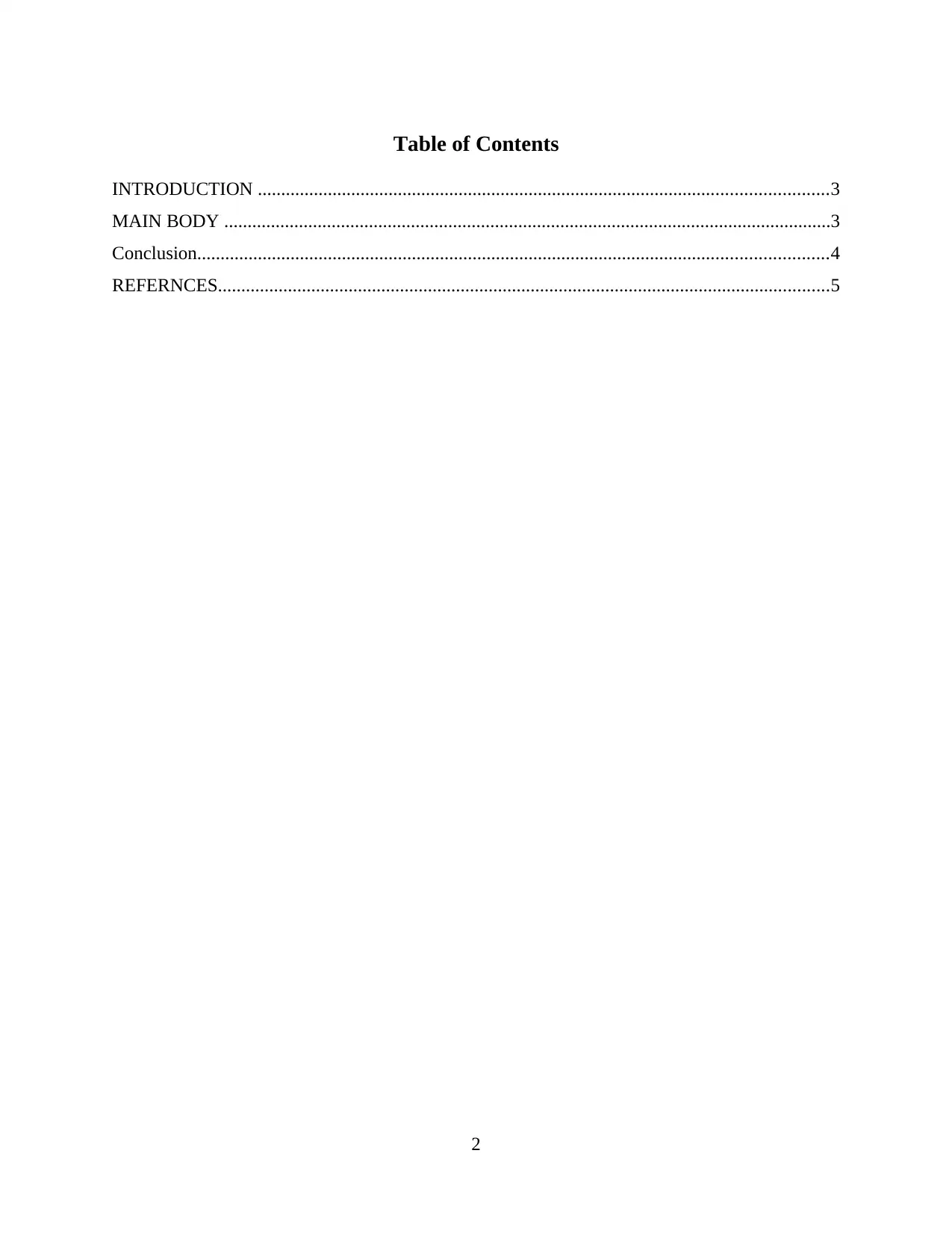
Table of Contents
INTRODUCTION ..........................................................................................................................3
MAIN BODY ..................................................................................................................................3
Conclusion.......................................................................................................................................4
REFERNCES...................................................................................................................................5
2
INTRODUCTION ..........................................................................................................................3
MAIN BODY ..................................................................................................................................3
Conclusion.......................................................................................................................................4
REFERNCES...................................................................................................................................5
2
INTRODUCTION
Literature review is basically the search and evaluation of the topic according to the
choice of the student that is on the chosen topic area (Beinicke and Bipp, 2018). It is the
documents that describes the topic that it deeply describe the subject with the motive to provide
full information and knowledge to the readers. In other words literature review is the body of
data which describes credibility of the work completed by the student. Moreover it is blueprint
which summarises prior research and establishes the link between the project work and the
research. This report is based on the literature review that how developing intrinsic motivation
have positive impact on the behaviour of boys in the class room environment.
MAIN BODY
In an environment there exists different type of students that is some are poor I studies or
some are excellent where some are average students. The poor students require more attention as
they lack in motivation as it plays crucial role in the life of people. Students who are not able to
retain subject matter for long period of time are very often unmotivated due to continuous
failure. Motivation is that factor which affect every aspect in the school time period as students
have to be attentive as they have to manage academic performance and the extra-curricular
activities (García and Kleyn, 2016). Many times student get pressured due to the class learning
and the extra curricular activities which lead into demotivation and the performance of students
decreases. Intrinsic motivation is the best type of motivation which helps in driving effective
results to individuals. In this type of motivation the focus is to guide people to perform or pursue
activity not just for external rewards but for their own happiness and enjoyment. In context of the
students when they are highly motivated they would carry out activities with full interest and
curiosity which make their learning simple and efficient as they would enjoy want they are doing
and it is based upon intrinsic motivation. Intrinsic motivation provides effective results to
students as they are performing activities by their own choice without external force.
Learning environment
This can be defined as the physical locations and all contexts and cultures in which
students are sitting and learning. This whole surroundings is impacting the learning process of
students in huge manner. Students can learn from a variety of options and sources from where
they can gain learning. Examples of these locations are outside schools and also other outdoor
3
Literature review is basically the search and evaluation of the topic according to the
choice of the student that is on the chosen topic area (Beinicke and Bipp, 2018). It is the
documents that describes the topic that it deeply describe the subject with the motive to provide
full information and knowledge to the readers. In other words literature review is the body of
data which describes credibility of the work completed by the student. Moreover it is blueprint
which summarises prior research and establishes the link between the project work and the
research. This report is based on the literature review that how developing intrinsic motivation
have positive impact on the behaviour of boys in the class room environment.
MAIN BODY
In an environment there exists different type of students that is some are poor I studies or
some are excellent where some are average students. The poor students require more attention as
they lack in motivation as it plays crucial role in the life of people. Students who are not able to
retain subject matter for long period of time are very often unmotivated due to continuous
failure. Motivation is that factor which affect every aspect in the school time period as students
have to be attentive as they have to manage academic performance and the extra-curricular
activities (García and Kleyn, 2016). Many times student get pressured due to the class learning
and the extra curricular activities which lead into demotivation and the performance of students
decreases. Intrinsic motivation is the best type of motivation which helps in driving effective
results to individuals. In this type of motivation the focus is to guide people to perform or pursue
activity not just for external rewards but for their own happiness and enjoyment. In context of the
students when they are highly motivated they would carry out activities with full interest and
curiosity which make their learning simple and efficient as they would enjoy want they are doing
and it is based upon intrinsic motivation. Intrinsic motivation provides effective results to
students as they are performing activities by their own choice without external force.
Learning environment
This can be defined as the physical locations and all contexts and cultures in which
students are sitting and learning. This whole surroundings is impacting the learning process of
students in huge manner. Students can learn from a variety of options and sources from where
they can gain learning. Examples of these locations are outside schools and also other outdoor
3
⊘ This is a preview!⊘
Do you want full access?
Subscribe today to unlock all pages.

Trusted by 1+ million students worldwide
environments. This term can be used as the more accurate or preferred alternative of classroom.
Therefore, it becomes important that educationalist are attempting to develop an effective
learning environment for students. There are certain features of a highly effective learning
environment which are explained below:
Raising of questions: In a environment of class, teachers should promote an idea of
curiosity in everything that has been taught in the classroom. Many teachers force
students to ask questions at the outset of units or lessons, often to no avail. Cliché
questions that reflect little understanding of the content can discourage teachers from
‘allowing’ them. But the fact remains—if students can’t ask great questions—even as
young as elementary school—something, somewhere is unplugged. This will mean that
students will be learn in better effective manner (Kanfer, Frese and Johnson, 2017).
Questions are more valued than answers: According to common notion, it is a well
known fact that questions are more important than the answers. It is to be noted that good
questions lead to better learning process. If better questions are asked, it may lead to
brain storming to other students as well. Through this, creativity and learning both will
increase and improve.
Ideas come from a divergent sources: Ideas for lessons, reading, tests, and projects—
the fibre of formal learning—should come from a variety of sources. If they all come
from narrow slivers of resources, you’re at risk of being pulled way off in one direction
(that may or may not be good). An alternative? Consider sources like professional and
cultural mentors, the community, content experts outside of education, and even the
students themselves. Huge shift in credibility. And when these sources disagree with one
another, use that as an endlessly ‘teachable moment,’ because that’s what the real world
is like.
Theories of learning
Learning is the one of the most important activity which helps in the individual growth as
a results helps in accomplishing the desire goals and objectives (Rheinberg and Engeser, 2018).
Behaviorism- The behaviorism learning theory determines the student behaviour on the
based of the their interaction with the environment they are dealing with. According to this
learning model it is suggested that external factors play great role in influencing the behaviour of
4
Therefore, it becomes important that educationalist are attempting to develop an effective
learning environment for students. There are certain features of a highly effective learning
environment which are explained below:
Raising of questions: In a environment of class, teachers should promote an idea of
curiosity in everything that has been taught in the classroom. Many teachers force
students to ask questions at the outset of units or lessons, often to no avail. Cliché
questions that reflect little understanding of the content can discourage teachers from
‘allowing’ them. But the fact remains—if students can’t ask great questions—even as
young as elementary school—something, somewhere is unplugged. This will mean that
students will be learn in better effective manner (Kanfer, Frese and Johnson, 2017).
Questions are more valued than answers: According to common notion, it is a well
known fact that questions are more important than the answers. It is to be noted that good
questions lead to better learning process. If better questions are asked, it may lead to
brain storming to other students as well. Through this, creativity and learning both will
increase and improve.
Ideas come from a divergent sources: Ideas for lessons, reading, tests, and projects—
the fibre of formal learning—should come from a variety of sources. If they all come
from narrow slivers of resources, you’re at risk of being pulled way off in one direction
(that may or may not be good). An alternative? Consider sources like professional and
cultural mentors, the community, content experts outside of education, and even the
students themselves. Huge shift in credibility. And when these sources disagree with one
another, use that as an endlessly ‘teachable moment,’ because that’s what the real world
is like.
Theories of learning
Learning is the one of the most important activity which helps in the individual growth as
a results helps in accomplishing the desire goals and objectives (Rheinberg and Engeser, 2018).
Behaviorism- The behaviorism learning theory determines the student behaviour on the
based of the their interaction with the environment they are dealing with. According to this
learning model it is suggested that external factors play great role in influencing the behaviour of
4
Paraphrase This Document
Need a fresh take? Get an instant paraphrase of this document with our AI Paraphraser
students in comparison to internal factors. In classroom training or learning this factor helps in
providing positive impact on the students so that they would able to improve their performance.
Cognitive learning theory- This theory is based on the view point and the way of thinking
of the individuals. Thinking and mental state play important role in learning where the individual
is influence by both internal and external elements. This theory results in overthinking and
outburst as it lead to many problems and in context of student it has negative impact on the
learnings as they are not able to focus on their studies.
Constructivism learning theory- It is the leaning theory where students are more focused
to create their own learning based according to the experience they hold. Basically on the bases
on their previous expedience they are able to develop effective learning and able to accomplish
their desire goals and objectives. This method is used by teachers in the class room learning
where with the help of the past learning of students they tries to make them understand things in
most effective manner which help in enhancing their career. It help the students to create their
own process and reality based on their own past.
Humanism learning theory
This theory of learning is linked to constructivism theory as this theory is designed on the
viewpoint that it connects to the self actualization activities (Bellemare and et.al., 2016). Self
actualization comes on the top in the hierarchy of need that is where person is able to satisfy its
needs and able to bring its best version. In context of the classroom environment this theory help
the students to get closer to their self actualization. The focus of the teacher is to help the
students in fulfilling their emotional and physical needs so that they become comfortable with
the learning and able to get success in the life.
Connectivism learning theory
This is one of the new method in the learning and education sector where it has been
identified that people enhance their skills and knowledge with the people around them or from
where they from connections (Hennessey and et.al., 2015). Furthermore with the help of hobbies,
goals and many other factors people are influenced and this helps in enhancing learning. In
context of classroom environment the focus of teacher is to establish the connection with
students and also help them in connecting with other things so that they would be able to learn
something new from them. Moreover teachers can use digital ways as it helps in brining positive
impact on students and also helps in quick and effective learning. It also helps in creating
5
providing positive impact on the students so that they would able to improve their performance.
Cognitive learning theory- This theory is based on the view point and the way of thinking
of the individuals. Thinking and mental state play important role in learning where the individual
is influence by both internal and external elements. This theory results in overthinking and
outburst as it lead to many problems and in context of student it has negative impact on the
learnings as they are not able to focus on their studies.
Constructivism learning theory- It is the leaning theory where students are more focused
to create their own learning based according to the experience they hold. Basically on the bases
on their previous expedience they are able to develop effective learning and able to accomplish
their desire goals and objectives. This method is used by teachers in the class room learning
where with the help of the past learning of students they tries to make them understand things in
most effective manner which help in enhancing their career. It help the students to create their
own process and reality based on their own past.
Humanism learning theory
This theory of learning is linked to constructivism theory as this theory is designed on the
viewpoint that it connects to the self actualization activities (Bellemare and et.al., 2016). Self
actualization comes on the top in the hierarchy of need that is where person is able to satisfy its
needs and able to bring its best version. In context of the classroom environment this theory help
the students to get closer to their self actualization. The focus of the teacher is to help the
students in fulfilling their emotional and physical needs so that they become comfortable with
the learning and able to get success in the life.
Connectivism learning theory
This is one of the new method in the learning and education sector where it has been
identified that people enhance their skills and knowledge with the people around them or from
where they from connections (Hennessey and et.al., 2015). Furthermore with the help of hobbies,
goals and many other factors people are influenced and this helps in enhancing learning. In
context of classroom environment the focus of teacher is to establish the connection with
students and also help them in connecting with other things so that they would be able to learn
something new from them. Moreover teachers can use digital ways as it helps in brining positive
impact on students and also helps in quick and effective learning. It also helps in creating
5
connection and relationship with the students and their groups with the objective to make the
students feel motivated so that they focus on effective learning.
Teachers in the classroom environment need to focus on specific strategies and
techniques in order to apply these learning theories in order to help the students in effective
learning (Steg, 2016). Teachers have provided proper and effective training to understand the
behaviour of students and accordingly take steps in order to help them in learning and enhancing
their skills.
Intrinsic motivation is the motivation known as the inner motivation, means enjoying your own
company with personal satisfaction. It is the inner drive that explore a person to complete an
activity, it is not an external reward but as this process is self action, it is enjoyable. In the school
times, teacher motivate the students to pursue themselves. There are two type of motivation are
included intrinsic and extrinsic motivation. Extrinsic motivation is the process where the reward
are some outcome such as earning a reward or avoiding punishment. And intrinsic motivation
make the attitude and goals that give a rise to the human behaviour. For example if a teacher use
the intrinsic motivation in the students than this thing create the curiosity and motivation for
study hard in the class and they try to make the better score. As if the student start enjoying in a
particular subject than that student must start enjoy the learning this is known as intrinsic
motivation. However student learn because they want to get permission from their parents and
avoid to get the bad marks than it is known as extrinsic motivation. So this is how intrinsic
motivation is good in the school level students (Kulkarni and et.al., 2016).
Boys are very notorious, so they needed to be get the intrinsic motivation by the teachers.
As if the teacher motivate the whole class by the intrinsic motivation than they become serious
about the study and the new way of learning provide them a new view for them to learn a subject
which is not as much enjoyable in the class. This intrinsic motivation is successful in the
classroom learning specially in boys. As this motivation is successful as it give better result than
extrinsic motivation. At the same time this motivation technique is more committed as here the
students have the strong personal commitment. This type of motivation is perform more
persistently and it is less likely to quit the commitment when the student face the difficulties in
the commitment. In last this type of motivation is more creative and innovation. Here the teacher
can use various activities like if a student complete the task, they can go for reading a novel, the
6
students feel motivated so that they focus on effective learning.
Teachers in the classroom environment need to focus on specific strategies and
techniques in order to apply these learning theories in order to help the students in effective
learning (Steg, 2016). Teachers have provided proper and effective training to understand the
behaviour of students and accordingly take steps in order to help them in learning and enhancing
their skills.
Intrinsic motivation is the motivation known as the inner motivation, means enjoying your own
company with personal satisfaction. It is the inner drive that explore a person to complete an
activity, it is not an external reward but as this process is self action, it is enjoyable. In the school
times, teacher motivate the students to pursue themselves. There are two type of motivation are
included intrinsic and extrinsic motivation. Extrinsic motivation is the process where the reward
are some outcome such as earning a reward or avoiding punishment. And intrinsic motivation
make the attitude and goals that give a rise to the human behaviour. For example if a teacher use
the intrinsic motivation in the students than this thing create the curiosity and motivation for
study hard in the class and they try to make the better score. As if the student start enjoying in a
particular subject than that student must start enjoy the learning this is known as intrinsic
motivation. However student learn because they want to get permission from their parents and
avoid to get the bad marks than it is known as extrinsic motivation. So this is how intrinsic
motivation is good in the school level students (Kulkarni and et.al., 2016).
Boys are very notorious, so they needed to be get the intrinsic motivation by the teachers.
As if the teacher motivate the whole class by the intrinsic motivation than they become serious
about the study and the new way of learning provide them a new view for them to learn a subject
which is not as much enjoyable in the class. This intrinsic motivation is successful in the
classroom learning specially in boys. As this motivation is successful as it give better result than
extrinsic motivation. At the same time this motivation technique is more committed as here the
students have the strong personal commitment. This type of motivation is perform more
persistently and it is less likely to quit the commitment when the student face the difficulties in
the commitment. In last this type of motivation is more creative and innovation. Here the teacher
can use various activities like if a student complete the task, they can go for reading a novel, the
6
⊘ This is a preview!⊘
Do you want full access?
Subscribe today to unlock all pages.
Trusted by 1+ million students worldwide
whole class can play a sports, doing a puzzle and voluntary activities. There are the most creative
activities which are design by the teachers in according with the class.
There are various ways which can be effective increase in the intrinsic motivation in the
class. It can be influencing if the teacher make the intrinsic activity which are enjoy by the
student not to get bored from that (Auger and Woodman, 2016). Another way is accept the
challenge which is not as such easy or not so tough to complete the work. Always try to get a
feedback from the other in regard to complete the task. Do the task for your own self, not for
others as this drivers are exist only when student can decide freely whether to engage or not. If
the task is not completed by individually than teacher should provide them a team or a buddy
who can help to pursue their work.
Researchers has done research that giving rewards also influenced the intrinsic motivation . As
they found that giving appreciation for the efforts includes more motivations and interest of the
boys. They complete their work on time. By understanding the factors that promote intrinsic
motivations can help in benefits. These factors are:
Curiosity- that means it pushes the students in learning and mastering in the classroom. As this
helps the boys in increasing their knowledge and learning them new things. This creates
opportunity for the students to learn and explore more. Then next is challenge- challenges helps
the boys in working continuously at the optimum level and works towards the meaning goals.
This helps them in challenging themselves with the other boys and other classmates.
Controlling- controlling is the measurements of work and evaluation of work and make desire to
control what is going wrong. This helps the boys in making appropriate decisions and control the
deviations that are coming in between.
Recognition- appreciation should be given to the students for their better work. This encourage
them and they works with full motivation. Boys in classrooms should be appreciate for their
better performance. This will increase their motivation and work more focus on their goal.
Cooperation- Cooperation play very important role as it helps the students in establishing strong
relation with other classmates so that they would able to perform the group activities and tasks in
most effective and efficient manner. Whiling working in group students would able to develop
their skills as they come to know about the viewpoints of others and their way of doing business
operations. This helps them in knowing the areas where they need to focus and improve and also
helps in enhancing and developing new skills.
7
activities which are design by the teachers in according with the class.
There are various ways which can be effective increase in the intrinsic motivation in the
class. It can be influencing if the teacher make the intrinsic activity which are enjoy by the
student not to get bored from that (Auger and Woodman, 2016). Another way is accept the
challenge which is not as such easy or not so tough to complete the work. Always try to get a
feedback from the other in regard to complete the task. Do the task for your own self, not for
others as this drivers are exist only when student can decide freely whether to engage or not. If
the task is not completed by individually than teacher should provide them a team or a buddy
who can help to pursue their work.
Researchers has done research that giving rewards also influenced the intrinsic motivation . As
they found that giving appreciation for the efforts includes more motivations and interest of the
boys. They complete their work on time. By understanding the factors that promote intrinsic
motivations can help in benefits. These factors are:
Curiosity- that means it pushes the students in learning and mastering in the classroom. As this
helps the boys in increasing their knowledge and learning them new things. This creates
opportunity for the students to learn and explore more. Then next is challenge- challenges helps
the boys in working continuously at the optimum level and works towards the meaning goals.
This helps them in challenging themselves with the other boys and other classmates.
Controlling- controlling is the measurements of work and evaluation of work and make desire to
control what is going wrong. This helps the boys in making appropriate decisions and control the
deviations that are coming in between.
Recognition- appreciation should be given to the students for their better work. This encourage
them and they works with full motivation. Boys in classrooms should be appreciate for their
better performance. This will increase their motivation and work more focus on their goal.
Cooperation- Cooperation play very important role as it helps the students in establishing strong
relation with other classmates so that they would able to perform the group activities and tasks in
most effective and efficient manner. Whiling working in group students would able to develop
their skills as they come to know about the viewpoints of others and their way of doing business
operations. This helps them in knowing the areas where they need to focus and improve and also
helps in enhancing and developing new skills.
7
Paraphrase This Document
Need a fresh take? Get an instant paraphrase of this document with our AI Paraphraser
Competition- It is that factor which helps the students to become skilled in order to achieve the
desire results. It is one of the most challenging activity which leads in good results.
Intrinsic motivation helps the students in improving their performance so that they would
able to achieve their desire results and academic performance. It helps in acquiring better results
as one able to develop effective learning and writing skills which are helpful in professional
career.
Learning is the continuous process which helps the individual in learning the new things
so that they would able to develop their personality in the most effective and efficient manner. In
this changing environment where new things are taking place due to up-gradation in technology
it helps individuals in analysing the opportunities which helps them in accomplishing their desire
goal and success in the life.
Key Characteristics of Learning Process are listed as:
It simple language it cam be described as an incident of acquiring the knowledge process.
It can be defined as a process of acquiring, retaining and modification of experience in
complex words.
It renews the relation between the stimulus and the response.
It is a method concerned with solving problems and making adjustments with respect to
the environment.
This process is concerned for acquisition of experience, its retention and development in
step by step manner.
It is related to perception, expression and affective aspects.
Conclusion
From the above report it is concluded that the intrinsic motivation in the classroom are
very important. As this type of motivation are provided the internal belief, and increase the
strength of the individual student. There are every type of students are available in the classroom,
which are handled by the teacher in different way. As all the class and their student is not same
so they are using different intrinsic motivational theory to solve the issue related to the classroom
behaviour. There are extrinsic motivation are also used but this is not used mostly by the teachers
as intrinsic motivation are more popular than other one.
REFERNCES
8
desire results. It is one of the most challenging activity which leads in good results.
Intrinsic motivation helps the students in improving their performance so that they would
able to achieve their desire results and academic performance. It helps in acquiring better results
as one able to develop effective learning and writing skills which are helpful in professional
career.
Learning is the continuous process which helps the individual in learning the new things
so that they would able to develop their personality in the most effective and efficient manner. In
this changing environment where new things are taking place due to up-gradation in technology
it helps individuals in analysing the opportunities which helps them in accomplishing their desire
goal and success in the life.
Key Characteristics of Learning Process are listed as:
It simple language it cam be described as an incident of acquiring the knowledge process.
It can be defined as a process of acquiring, retaining and modification of experience in
complex words.
It renews the relation between the stimulus and the response.
It is a method concerned with solving problems and making adjustments with respect to
the environment.
This process is concerned for acquisition of experience, its retention and development in
step by step manner.
It is related to perception, expression and affective aspects.
Conclusion
From the above report it is concluded that the intrinsic motivation in the classroom are
very important. As this type of motivation are provided the internal belief, and increase the
strength of the individual student. There are every type of students are available in the classroom,
which are handled by the teacher in different way. As all the class and their student is not same
so they are using different intrinsic motivational theory to solve the issue related to the classroom
behaviour. There are extrinsic motivation are also used but this is not used mostly by the teachers
as intrinsic motivation are more popular than other one.
REFERNCES
8
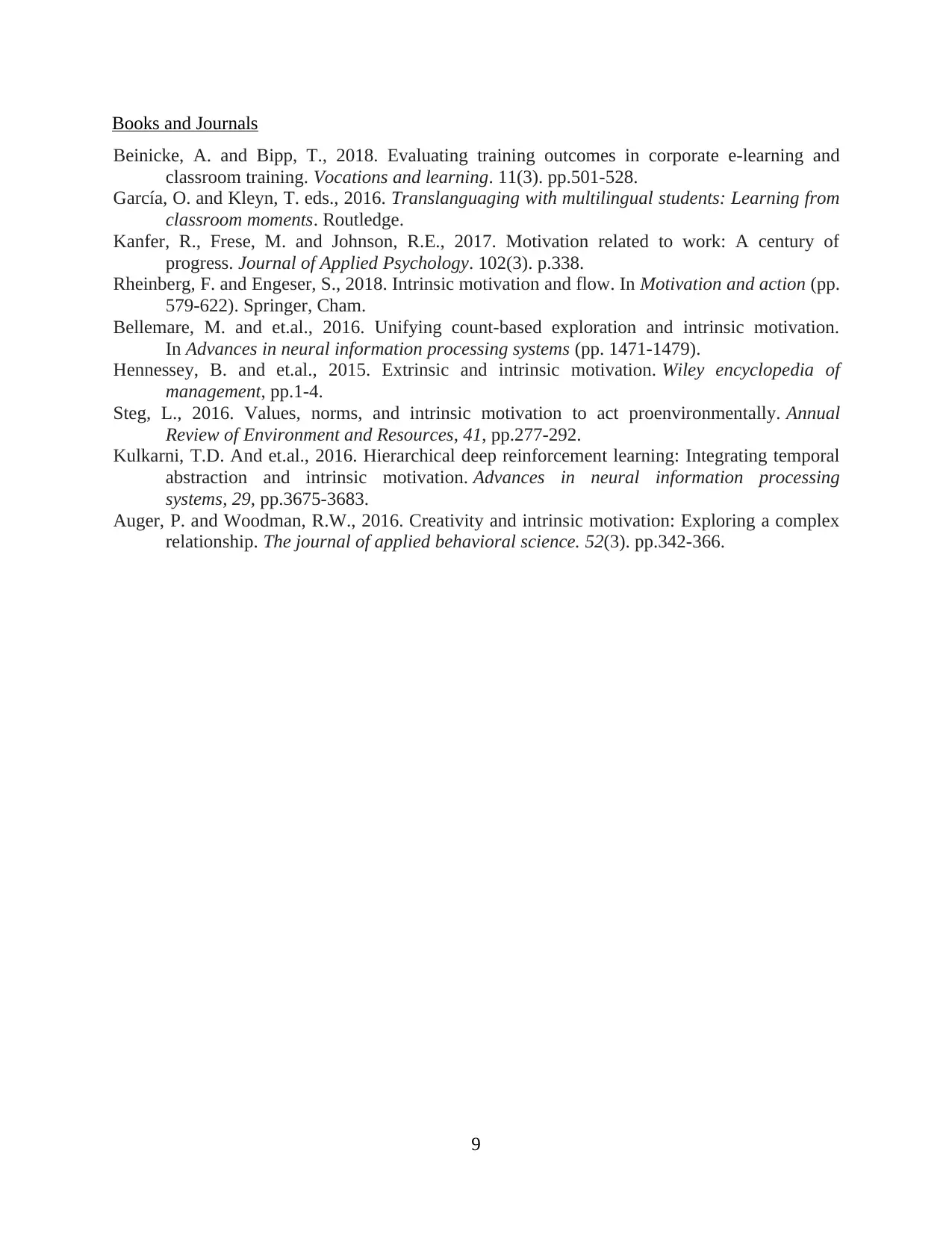
Books and Journals
Beinicke, A. and Bipp, T., 2018. Evaluating training outcomes in corporate e-learning and
classroom training. Vocations and learning. 11(3). pp.501-528.
García, O. and Kleyn, T. eds., 2016. Translanguaging with multilingual students: Learning from
classroom moments. Routledge.
Kanfer, R., Frese, M. and Johnson, R.E., 2017. Motivation related to work: A century of
progress. Journal of Applied Psychology. 102(3). p.338.
Rheinberg, F. and Engeser, S., 2018. Intrinsic motivation and flow. In Motivation and action (pp.
579-622). Springer, Cham.
Bellemare, M. and et.al., 2016. Unifying count-based exploration and intrinsic motivation.
In Advances in neural information processing systems (pp. 1471-1479).
Hennessey, B. and et.al., 2015. Extrinsic and intrinsic motivation. Wiley encyclopedia of
management, pp.1-4.
Steg, L., 2016. Values, norms, and intrinsic motivation to act proenvironmentally. Annual
Review of Environment and Resources, 41, pp.277-292.
Kulkarni, T.D. And et.al., 2016. Hierarchical deep reinforcement learning: Integrating temporal
abstraction and intrinsic motivation. Advances in neural information processing
systems, 29, pp.3675-3683.
Auger, P. and Woodman, R.W., 2016. Creativity and intrinsic motivation: Exploring a complex
relationship. The journal of applied behavioral science. 52(3). pp.342-366.
9
Beinicke, A. and Bipp, T., 2018. Evaluating training outcomes in corporate e-learning and
classroom training. Vocations and learning. 11(3). pp.501-528.
García, O. and Kleyn, T. eds., 2016. Translanguaging with multilingual students: Learning from
classroom moments. Routledge.
Kanfer, R., Frese, M. and Johnson, R.E., 2017. Motivation related to work: A century of
progress. Journal of Applied Psychology. 102(3). p.338.
Rheinberg, F. and Engeser, S., 2018. Intrinsic motivation and flow. In Motivation and action (pp.
579-622). Springer, Cham.
Bellemare, M. and et.al., 2016. Unifying count-based exploration and intrinsic motivation.
In Advances in neural information processing systems (pp. 1471-1479).
Hennessey, B. and et.al., 2015. Extrinsic and intrinsic motivation. Wiley encyclopedia of
management, pp.1-4.
Steg, L., 2016. Values, norms, and intrinsic motivation to act proenvironmentally. Annual
Review of Environment and Resources, 41, pp.277-292.
Kulkarni, T.D. And et.al., 2016. Hierarchical deep reinforcement learning: Integrating temporal
abstraction and intrinsic motivation. Advances in neural information processing
systems, 29, pp.3675-3683.
Auger, P. and Woodman, R.W., 2016. Creativity and intrinsic motivation: Exploring a complex
relationship. The journal of applied behavioral science. 52(3). pp.342-366.
9
⊘ This is a preview!⊘
Do you want full access?
Subscribe today to unlock all pages.
Trusted by 1+ million students worldwide

1 out of 9


Related Documents


Your All-in-One AI-Powered Toolkit for Academic Success.
+13062052269
info@desklib.com
Available 24*7 on WhatsApp / Email
![[object Object]](/_next/static/media/star-bottom.7253800d.svg)
Unlock your academic potential
Copyright © 2020–2026 A2Z Services. All Rights Reserved. Developed and managed by ZUCOL.