Introduction to Business Studies: Business Types, Roles, Finance
VerifiedAdded on 2022/12/30
|9
|2052
|386
Report
AI Summary
This report provides an introduction to business studies, covering various types of businesses, including sole proprietorships, partnerships, private limited companies, and public limited companies. It details the roles and responsibilities of HR, marketing, and finance departments within an organization, emphasizing their importance for business success. The report also explores the significance of groups and teams in business, organizational culture, and the role of financial management in both business ownership and documentation. Financial management's key aspects, such as financial reporting, investment, and planning for long-term goals, are discussed. The report highlights the benefits of smart record-keeping and its importance in maintaining a company's financial health and ensuring compliance with legal requirements, using Sainsbury's as a case study.
Introduction to Business
Studies
Studies

Paraphrase This Document
Need a fresh take? Get an instant paraphrase of this document with our AI Paraphraser
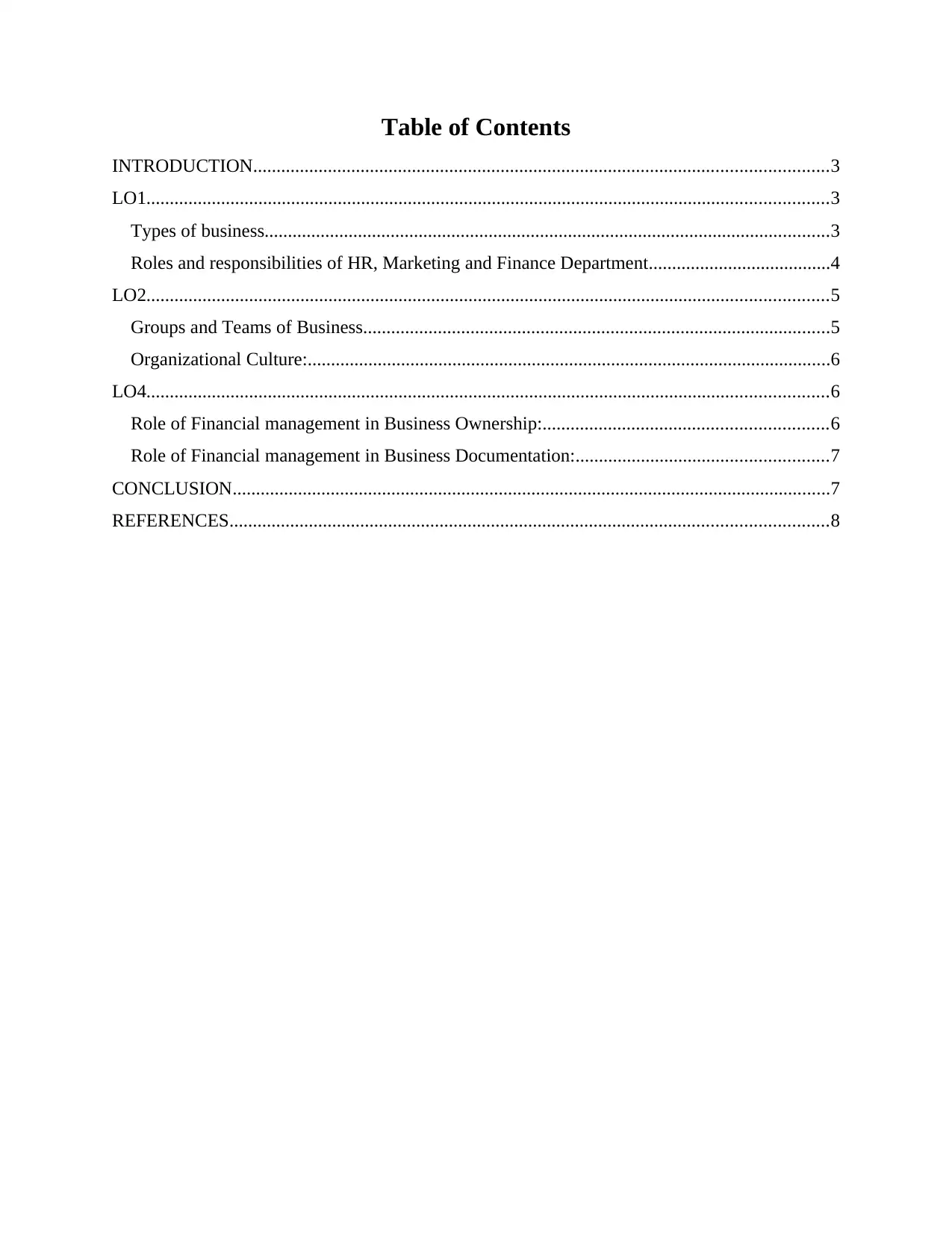
Table of Contents
INTRODUCTION...........................................................................................................................3
LO1..................................................................................................................................................3
Types of business.........................................................................................................................3
Roles and responsibilities of HR, Marketing and Finance Department.......................................4
LO2..................................................................................................................................................5
Groups and Teams of Business....................................................................................................5
Organizational Culture:................................................................................................................6
LO4..................................................................................................................................................6
Role of Financial management in Business Ownership:.............................................................6
Role of Financial management in Business Documentation:......................................................7
CONCLUSION................................................................................................................................7
REFERENCES................................................................................................................................8
INTRODUCTION...........................................................................................................................3
LO1..................................................................................................................................................3
Types of business.........................................................................................................................3
Roles and responsibilities of HR, Marketing and Finance Department.......................................4
LO2..................................................................................................................................................5
Groups and Teams of Business....................................................................................................5
Organizational Culture:................................................................................................................6
LO4..................................................................................................................................................6
Role of Financial management in Business Ownership:.............................................................6
Role of Financial management in Business Documentation:......................................................7
CONCLUSION................................................................................................................................7
REFERENCES................................................................................................................................8
INTRODUCTION
A Business department is the process in an organization which link production to buying and
selling of product or service. It maintains productivity to generate constant profit. This report
will give an introduction to all types of business, roles and responsibilities of all department such
as HR, finance, marketing and develop understanding for collaborative working strategies like
organization environment this will also present knowledge of the role of financial management.
LO1
Types of business
If a person thinks to start-up a business, one of the first things must do decide is which type of
business structure to operate. There are 4 major business types:
Sole protectorship
Partnership
Private limited company or LTD
Public limited company
Which type of business will choose by owner is depended on different factor such as liability,
taxation, control, rising capital, etc.
Sole Protectorship:
It is most common form of business. It is not a legal organization. In this person conduct a
business for themselves. It is the least complex form of business (Kapur, 2016). This business is
easy and inexpensive to start. This business does not have to register as a business organization.
Example: T & A Dixon Accountancy Services is UK based sole protectorship business which
provide accountancy services for small and medium business.
A Business department is the process in an organization which link production to buying and
selling of product or service. It maintains productivity to generate constant profit. This report
will give an introduction to all types of business, roles and responsibilities of all department such
as HR, finance, marketing and develop understanding for collaborative working strategies like
organization environment this will also present knowledge of the role of financial management.
LO1
Types of business
If a person thinks to start-up a business, one of the first things must do decide is which type of
business structure to operate. There are 4 major business types:
Sole protectorship
Partnership
Private limited company or LTD
Public limited company
Which type of business will choose by owner is depended on different factor such as liability,
taxation, control, rising capital, etc.
Sole Protectorship:
It is most common form of business. It is not a legal organization. In this person conduct a
business for themselves. It is the least complex form of business (Kapur, 2016). This business is
easy and inexpensive to start. This business does not have to register as a business organization.
Example: T & A Dixon Accountancy Services is UK based sole protectorship business which
provide accountancy services for small and medium business.
⊘ This is a preview!⊘
Do you want full access?
Subscribe today to unlock all pages.

Trusted by 1+ million students worldwide
Partnership:
If two or more than two people agree to do a business together then partnership formed. This
kind of business commonly found in organizations or professional business like, doctors,
accountant, solicitors, etc. In this business owners have unlimited liability.
Example: Levi's and Pinterest are partnership business on personal styling tool that generates a
custom inspiration.
Private Limited Company or LTD
It is a type of small private business organization. In this business owner have limited shares of
their liability. In this business type company cannot raise money by selling shares to investors to
the close earnings, banks, and funds (Sirashki, and Begolli, 2019). It has more flexibility in how
to operate company. Private business can change their business from private to public by selling
shares.
Example: JCB is private limited company which manufacture of construction equipment.
Public Limited Company:
It is a separate legal business company which give its shares for trading on stock market to the
public. According to corporate law making, this company has to mandatory to present its
financial status and position policy to maintain good relationship with public.
Example: Sainsbury is public limited company from UK which lead in retail stores.
Roles and responsibilities of HR, Marketing and Finance Department
Roles and Responsibilities of HR Department:
In every organization HR Department play vital role. In Sainsbury also HR department are
playing essential role. HR employees are most important resource for successful business if
employees are not motivated and only doing minimum work that is required then Sainsbury
never be make their business successful(Salter, Swanwick, and Pearson, 2017). To trained and
keep motivate employee HR department conduct training for Sainsbury's growth and profit.
In Sainsbury's company HR department roles and responsibilities are Recruitment and dismissal
of staff, Training and promotion and Health and Safety etc.
Roles and Responsibilities of Marketing Department:
If two or more than two people agree to do a business together then partnership formed. This
kind of business commonly found in organizations or professional business like, doctors,
accountant, solicitors, etc. In this business owners have unlimited liability.
Example: Levi's and Pinterest are partnership business on personal styling tool that generates a
custom inspiration.
Private Limited Company or LTD
It is a type of small private business organization. In this business owner have limited shares of
their liability. In this business type company cannot raise money by selling shares to investors to
the close earnings, banks, and funds (Sirashki, and Begolli, 2019). It has more flexibility in how
to operate company. Private business can change their business from private to public by selling
shares.
Example: JCB is private limited company which manufacture of construction equipment.
Public Limited Company:
It is a separate legal business company which give its shares for trading on stock market to the
public. According to corporate law making, this company has to mandatory to present its
financial status and position policy to maintain good relationship with public.
Example: Sainsbury is public limited company from UK which lead in retail stores.
Roles and responsibilities of HR, Marketing and Finance Department
Roles and Responsibilities of HR Department:
In every organization HR Department play vital role. In Sainsbury also HR department are
playing essential role. HR employees are most important resource for successful business if
employees are not motivated and only doing minimum work that is required then Sainsbury
never be make their business successful(Salter, Swanwick, and Pearson, 2017). To trained and
keep motivate employee HR department conduct training for Sainsbury's growth and profit.
In Sainsbury's company HR department roles and responsibilities are Recruitment and dismissal
of staff, Training and promotion and Health and Safety etc.
Roles and Responsibilities of Marketing Department:
Paraphrase This Document
Need a fresh take? Get an instant paraphrase of this document with our AI Paraphraser
Marketing department is important for company for selling and buying product or service. Since
1869 Sainsbury's marketing department playing important role in its growth and profit. The main
marketing strategies used by Sainsbury are market segmentation. It refers to market department
into different sets according to individual product. Sainsbury has used segmented in almost
variables. Market partition has become very valuable for Sainsbury's. Some other marketing
department roles and responsibilities are Product or service promotion, market research etc.
Roles and Responsibilities of Finance Department:
Some roles and responsibilities of finance department in Sainsbury's are as followed:
Finance Administrator: They are help Sainsbury's to plan, perform and manage a broad range of
financial, accounting and budgetary functions.
Finance Lawyer: They focus on legal aspects such as investments, taxation, and other related
field.
Finance Manager: They play key role in finance department. They always think about
Sainsbury's financial position (Duncan, and Cabral, 2020).
Budget Analyst: They prepare budget report to helping companies for monitor spending cost and
balance their financial position.
Bookkeeper: They play important role in finance department. They examine, validate and record
financial documents such as invoice, bills etc.
LO2
Groups and Teams of Business
Groups : A group is gathering of persons who work, interact and collaborate with each other.
The group member share information and resources with other members. In Sainsbury's the
group are made on the basis of common work, interest, experience in common field.
There are Two types of groups:
Formal Group: This group is created and managed by Sainsbury's for performing specific task.
Informal Group: This group creates by employee for social and informal communication.
Teams: A group of people who are connected because for achieving common goal or objective
for some time or period is known as team. Team member share information and responsibility
1869 Sainsbury's marketing department playing important role in its growth and profit. The main
marketing strategies used by Sainsbury are market segmentation. It refers to market department
into different sets according to individual product. Sainsbury has used segmented in almost
variables. Market partition has become very valuable for Sainsbury's. Some other marketing
department roles and responsibilities are Product or service promotion, market research etc.
Roles and Responsibilities of Finance Department:
Some roles and responsibilities of finance department in Sainsbury's are as followed:
Finance Administrator: They are help Sainsbury's to plan, perform and manage a broad range of
financial, accounting and budgetary functions.
Finance Lawyer: They focus on legal aspects such as investments, taxation, and other related
field.
Finance Manager: They play key role in finance department. They always think about
Sainsbury's financial position (Duncan, and Cabral, 2020).
Budget Analyst: They prepare budget report to helping companies for monitor spending cost and
balance their financial position.
Bookkeeper: They play important role in finance department. They examine, validate and record
financial documents such as invoice, bills etc.
LO2
Groups and Teams of Business
Groups : A group is gathering of persons who work, interact and collaborate with each other.
The group member share information and resources with other members. In Sainsbury's the
group are made on the basis of common work, interest, experience in common field.
There are Two types of groups:
Formal Group: This group is created and managed by Sainsbury's for performing specific task.
Informal Group: This group creates by employee for social and informal communication.
Teams: A group of people who are connected because for achieving common goal or objective
for some time or period is known as team. Team member share information and responsibility
for particular task. All team member is always responsible for outcome. Sainsbury's Create teams
to achieve particular tasks in different- different department. Company creates a team then the
team member's must do work with mutual understanding. Most important feature of team is
collaboration.
Organizational Culture
Organizational culture developed in the 1990s. This term used to describe the character of
company. It refers to the behaviour and environment that explain company's employees and
management interaction. Sainsbury's culture will be reflected in its business hours, office setup,
dress code, employee benefits, customers satisfaction and other behavioural aspect. Sainsbury's
is known for its employee-friendly environment. It offers perks for its employees such as free
lunch, incentive in salary, etc. (Ferracuti, and Stubben, 2019). Sainsbury also offer online
services. There are different terms related to Sainsbury that affected by various culture,
especially in the result of globalization and increased worldwide interaction of today's business
culture. Cross culture refers the interaction with people of different business prospect. To create
positive cross culture and productive company environment Sainsbury conduct trainings for
employees to improving there overall business interactions.
LO4
Role of Financial management in Business Ownership
Financial management is responsible for the financial health of organization. They manage
financial reports, direct investment, activities and plans for long-term goals and objective of
Sainsbury. Financial management is coordination of decision-making process with different
finance terms like business, management and corporate finance. They must plan to pay its taxes
on timely. It is essential skill for every business owner or manger either for small business or
large business (Kosmidou, and Negkakis, 2020).
Role of Financial Management in Sainsbury:
In liquidity forecasting cash flows, raising funds and mange the flow of internal funds.
In profitability cost control, pricing, plans for future profits and measuring cost of capital.
In management mange the long term and short term funds.
Monitor financial details to confirm all legal requirements.
Study market new trends to find opportunities for profit in financial position.
to achieve particular tasks in different- different department. Company creates a team then the
team member's must do work with mutual understanding. Most important feature of team is
collaboration.
Organizational Culture
Organizational culture developed in the 1990s. This term used to describe the character of
company. It refers to the behaviour and environment that explain company's employees and
management interaction. Sainsbury's culture will be reflected in its business hours, office setup,
dress code, employee benefits, customers satisfaction and other behavioural aspect. Sainsbury's
is known for its employee-friendly environment. It offers perks for its employees such as free
lunch, incentive in salary, etc. (Ferracuti, and Stubben, 2019). Sainsbury also offer online
services. There are different terms related to Sainsbury that affected by various culture,
especially in the result of globalization and increased worldwide interaction of today's business
culture. Cross culture refers the interaction with people of different business prospect. To create
positive cross culture and productive company environment Sainsbury conduct trainings for
employees to improving there overall business interactions.
LO4
Role of Financial management in Business Ownership
Financial management is responsible for the financial health of organization. They manage
financial reports, direct investment, activities and plans for long-term goals and objective of
Sainsbury. Financial management is coordination of decision-making process with different
finance terms like business, management and corporate finance. They must plan to pay its taxes
on timely. It is essential skill for every business owner or manger either for small business or
large business (Kosmidou, and Negkakis, 2020).
Role of Financial Management in Sainsbury:
In liquidity forecasting cash flows, raising funds and mange the flow of internal funds.
In profitability cost control, pricing, plans for future profits and measuring cost of capital.
In management mange the long term and short term funds.
Monitor financial details to confirm all legal requirements.
Study market new trends to find opportunities for profit in financial position.
⊘ This is a preview!⊘
Do you want full access?
Subscribe today to unlock all pages.
Trusted by 1+ million students worldwide
Role of Financial management in Business Documentation
Financial management is also played important role in business documentation. They ensure the
financial health of company through all investment's data sheets and documents.
Managing the finance of any business can be challenging to surviving in market organization
must earn profit. For managing finance Sainsbury must separate all financial statement and
records. Smart record keeping is important to maintain the regular flow of Sainsbury activities.
Benefits of Smart recording strategy are Sainsbury can monitor the overall growth of company, it
helps to identify income source & track debited expenses, it also provides high work efficiency,
It protects high status records. Records and documentation are the elementary backbones of any
organization it is very important to store records of financial management.
Roles of Financial Management in business documents:
Be a watchdog of company activities: Physical records like financial statements, sales and
purchase record book, etc. are show that business growing rate. It also provides authentic
verification.
Prepare Authentic Financial statement: A solid document management ensures the complete
availability of different commercial records such as profit and loss statements, balance sheet and
more.
Proper identification of income source: Documentation help to identify and verify the income
source with the highest accuracy (Jung, and Yang, 2020). This income source information is
required to separate business expenses and non-business expenses.
Tracing organization debited expenses: Organized file management can help organization to
trace their each and every expense that they invested in business. If business not record their
expenses in proper way, they may get lose in business and that create multiples problems.
Properly file company's Tax returns: Company need smart and efficient record management
which can conform records related to company income, expenses and investments. These are the
same record as company prepare for financial statements and it is also important to prepare and
file solid tax returns.
Financial management is also played important role in business documentation. They ensure the
financial health of company through all investment's data sheets and documents.
Managing the finance of any business can be challenging to surviving in market organization
must earn profit. For managing finance Sainsbury must separate all financial statement and
records. Smart record keeping is important to maintain the regular flow of Sainsbury activities.
Benefits of Smart recording strategy are Sainsbury can monitor the overall growth of company, it
helps to identify income source & track debited expenses, it also provides high work efficiency,
It protects high status records. Records and documentation are the elementary backbones of any
organization it is very important to store records of financial management.
Roles of Financial Management in business documents:
Be a watchdog of company activities: Physical records like financial statements, sales and
purchase record book, etc. are show that business growing rate. It also provides authentic
verification.
Prepare Authentic Financial statement: A solid document management ensures the complete
availability of different commercial records such as profit and loss statements, balance sheet and
more.
Proper identification of income source: Documentation help to identify and verify the income
source with the highest accuracy (Jung, and Yang, 2020). This income source information is
required to separate business expenses and non-business expenses.
Tracing organization debited expenses: Organized file management can help organization to
trace their each and every expense that they invested in business. If business not record their
expenses in proper way, they may get lose in business and that create multiples problems.
Properly file company's Tax returns: Company need smart and efficient record management
which can conform records related to company income, expenses and investments. These are the
same record as company prepare for financial statements and it is also important to prepare and
file solid tax returns.
Paraphrase This Document
Need a fresh take? Get an instant paraphrase of this document with our AI Paraphraser
CONCLUSION
This report help us to understand types of business, roles and responsibilities of all department
like HR department, finance department, marketing department and create understanding for
cooperative working activities like groups and teams fore organizational culture, It also presents
the role of financial management in business ownership and business documentation of
Sainsbury.
This report help us to understand types of business, roles and responsibilities of all department
like HR department, finance department, marketing department and create understanding for
cooperative working activities like groups and teams fore organizational culture, It also presents
the role of financial management in business ownership and business documentation of
Sainsbury.
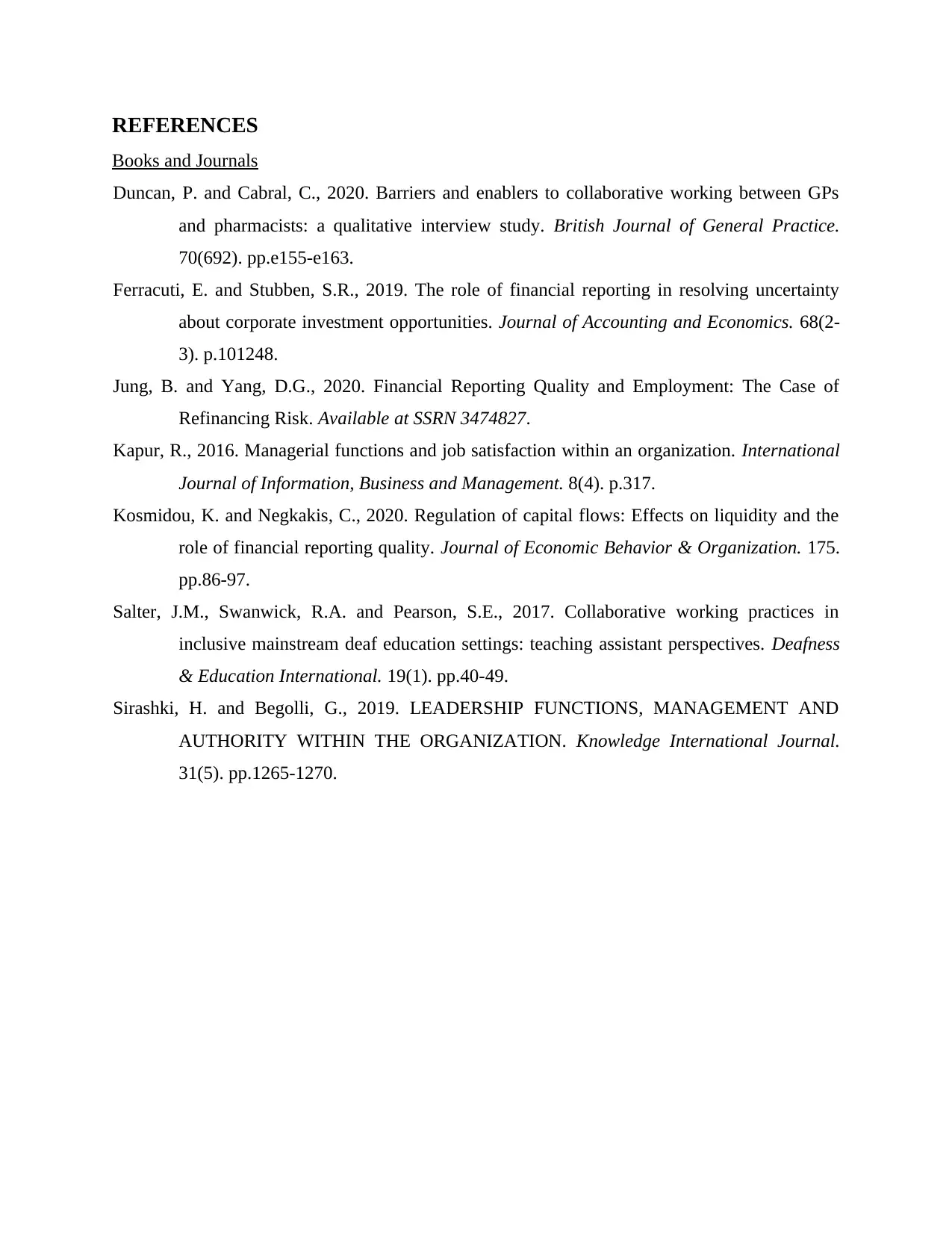
REFERENCES
Books and Journals
Duncan, P. and Cabral, C., 2020. Barriers and enablers to collaborative working between GPs
and pharmacists: a qualitative interview study. British Journal of General Practice.
70(692). pp.e155-e163.
Ferracuti, E. and Stubben, S.R., 2019. The role of financial reporting in resolving uncertainty
about corporate investment opportunities. Journal of Accounting and Economics. 68(2-
3). p.101248.
Jung, B. and Yang, D.G., 2020. Financial Reporting Quality and Employment: The Case of
Refinancing Risk. Available at SSRN 3474827.
Kapur, R., 2016. Managerial functions and job satisfaction within an organization. International
Journal of Information, Business and Management. 8(4). p.317.
Kosmidou, K. and Negkakis, C., 2020. Regulation of capital flows: Effects on liquidity and the
role of financial reporting quality. Journal of Economic Behavior & Organization. 175.
pp.86-97.
Salter, J.M., Swanwick, R.A. and Pearson, S.E., 2017. Collaborative working practices in
inclusive mainstream deaf education settings: teaching assistant perspectives. Deafness
& Education International. 19(1). pp.40-49.
Sirashki, H. and Begolli, G., 2019. LEADERSHIP FUNCTIONS, MANAGEMENT AND
AUTHORITY WITHIN THE ORGANIZATION. Knowledge International Journal.
31(5). pp.1265-1270.
Books and Journals
Duncan, P. and Cabral, C., 2020. Barriers and enablers to collaborative working between GPs
and pharmacists: a qualitative interview study. British Journal of General Practice.
70(692). pp.e155-e163.
Ferracuti, E. and Stubben, S.R., 2019. The role of financial reporting in resolving uncertainty
about corporate investment opportunities. Journal of Accounting and Economics. 68(2-
3). p.101248.
Jung, B. and Yang, D.G., 2020. Financial Reporting Quality and Employment: The Case of
Refinancing Risk. Available at SSRN 3474827.
Kapur, R., 2016. Managerial functions and job satisfaction within an organization. International
Journal of Information, Business and Management. 8(4). p.317.
Kosmidou, K. and Negkakis, C., 2020. Regulation of capital flows: Effects on liquidity and the
role of financial reporting quality. Journal of Economic Behavior & Organization. 175.
pp.86-97.
Salter, J.M., Swanwick, R.A. and Pearson, S.E., 2017. Collaborative working practices in
inclusive mainstream deaf education settings: teaching assistant perspectives. Deafness
& Education International. 19(1). pp.40-49.
Sirashki, H. and Begolli, G., 2019. LEADERSHIP FUNCTIONS, MANAGEMENT AND
AUTHORITY WITHIN THE ORGANIZATION. Knowledge International Journal.
31(5). pp.1265-1270.
⊘ This is a preview!⊘
Do you want full access?
Subscribe today to unlock all pages.
Trusted by 1+ million students worldwide

1 out of 9


Related Documents


Your All-in-One AI-Powered Toolkit for Academic Success.
+13062052269
info@desklib.com
Available 24*7 on WhatsApp / Email
![[object Object]](/_next/static/media/star-bottom.7253800d.svg)
Unlock your academic potential
Copyright © 2020–2026 A2Z Services. All Rights Reserved. Developed and managed by ZUCOL.