Introduction to IT: HSBC's Use of Technology in Business Operations
VerifiedAdded on 2022/12/28
|11
|3178
|1
Report
AI Summary
This report examines the application of Information Technology (IT) within HSBC, a leading international investment banking company. It explores IT's impact on business success and failure, covering decision-making, marketing, business growth, and customer support. The report delves into ethical and social issues like privacy, security, and copyright in the IT sector. It differentiates between various networking technologies (LAN, MAN, WAN) and discusses the importance of social media for HSBC's business, including attention-gaining, communication, engagement, and cost-effectiveness. The report further outlines the stages of the Software Development Life Cycle (SDLC), from planning to operations and maintenance, and concludes with an analysis and discussion of the findings. The report is a comprehensive overview of IT's role in HSBC's operations.
Introduction to
Information
Technology
Information
Technology

Paraphrase This Document
Need a fresh take? Get an instant paraphrase of this document with our AI Paraphraser
Table of Contents
INTRODUCTION...........................................................................................................................1
MAIN BODY...................................................................................................................................1
Literature review.........................................................................................................................1
Analysis and discussion..............................................................................................................7
CONCLUSION................................................................................................................................8
References:.......................................................................................................................................9
INTRODUCTION...........................................................................................................................1
MAIN BODY...................................................................................................................................1
Literature review.........................................................................................................................1
Analysis and discussion..............................................................................................................7
CONCLUSION................................................................................................................................8
References:.......................................................................................................................................9
INTRODUCTION
Information technology can be defined as the usage of technical devices in order to work
technically in a business in terms of networking, internet connection, software and hardware and
many more. Business uses technology to innovate, improve and enhance it's operations,
management and products or services. Using of technology can leads to success and misusing
can result in failure of a business (Rajaraman, 2018). Organization chosen here is the HSBC, it is
one of the leading international investment banking company based in UK in 1865. It provides
services like credit cards, NRI services, saving and deposits and many more. The following
discussions are made on the role of IT in the success or failure of a business, ethical and social
issues associated with running business in IT sector, differentiation of types of networking
technologies, importance of social media in a business, stages of software development life
cycle, analysis and discussions with proper findings and conclusion in context of HSBC.
MAIN BODY
Literature review
Role of IT in the success or failure of a business
Decision making
Information technology supports the company in decision making process because there
are various IT software and information systems which effectively works for an organization to
enhance it's operations and management by assisting the company in making the decisions
efficiently and potentially. Such information systems are management information systems,
transaction processing systems, decision support systems, online analytical processing and many
more can be used in a business for decision making process in an appropriate manner.
Marketing
Information technology supports an organization in sales and marketing process as well.
Because marketing requires innovation and creativity in representing the products and services in
front of the market and this can be attained by using technology by marketing team in the
company. IT provides data interpretation and analytics function which is highly needed by an
organization to target the specific market which assist in loyalty among customers (D'Attoma
and Ieva, 2020).
Business growth
1
Information technology can be defined as the usage of technical devices in order to work
technically in a business in terms of networking, internet connection, software and hardware and
many more. Business uses technology to innovate, improve and enhance it's operations,
management and products or services. Using of technology can leads to success and misusing
can result in failure of a business (Rajaraman, 2018). Organization chosen here is the HSBC, it is
one of the leading international investment banking company based in UK in 1865. It provides
services like credit cards, NRI services, saving and deposits and many more. The following
discussions are made on the role of IT in the success or failure of a business, ethical and social
issues associated with running business in IT sector, differentiation of types of networking
technologies, importance of social media in a business, stages of software development life
cycle, analysis and discussions with proper findings and conclusion in context of HSBC.
MAIN BODY
Literature review
Role of IT in the success or failure of a business
Decision making
Information technology supports the company in decision making process because there
are various IT software and information systems which effectively works for an organization to
enhance it's operations and management by assisting the company in making the decisions
efficiently and potentially. Such information systems are management information systems,
transaction processing systems, decision support systems, online analytical processing and many
more can be used in a business for decision making process in an appropriate manner.
Marketing
Information technology supports an organization in sales and marketing process as well.
Because marketing requires innovation and creativity in representing the products and services in
front of the market and this can be attained by using technology by marketing team in the
company. IT provides data interpretation and analytics function which is highly needed by an
organization to target the specific market which assist in loyalty among customers (D'Attoma
and Ieva, 2020).
Business growth
1
⊘ This is a preview!⊘
Do you want full access?
Subscribe today to unlock all pages.

Trusted by 1+ million students worldwide
Information technology is highly used by the research and development department of an
organization to invent something new for their customers so that customers attract towards the
company which accelerates the business growth and development for the firm. The reason
behind this is that there are various software which are responsible for the enhancement and
improvement of the business which ultimately leads to the growth in business.
Customer support and satisfaction
Information technology is accountable for the better and improved customer experience
throughout the company. This is done by providing services to the customers in a more digitized
and accurate manner. Therefore, IT supports an organization in customer support and overall
satisfaction with the services provided by the firm (Furunes and Mkono, 2019).
Resource management
Information technology helps the company in managing it's resources such as data
management, human resource management, finance management, marketing management,
operations management and many more important resources are integrated and allocated by the
firm in order to handle and manage through software and information systems effectively and
efficiently.
Ethical and social issues associated with running businesses in technology
Privacy
Disclosure of data or any information and violating the privacy of an individuals leads to
privacy issue in IT. A company HSBC has a highly secured banking service and IT structure.
The bank provides online banking service all over the world with a special security to them.
HSBC have fixed privacy policy to be sustained by customers.
Access rights
Unauthorized access to network during the e-payments,e- commerce has become a ethical
issue in IT. It is vital to have a strong data accessing procedure for customer to access a data in
HSBC customer can access a data through the mail from the HSBC. So HSCB has good
censorship policy to protect their customer from exploitation (Dierksmeier and Seele, 2018).
Securities
Money security is the prime concern of a customer to deposit their money in bank. HSBC
has millions of customers all over the globe and security to their money is their first
2
organization to invent something new for their customers so that customers attract towards the
company which accelerates the business growth and development for the firm. The reason
behind this is that there are various software which are responsible for the enhancement and
improvement of the business which ultimately leads to the growth in business.
Customer support and satisfaction
Information technology is accountable for the better and improved customer experience
throughout the company. This is done by providing services to the customers in a more digitized
and accurate manner. Therefore, IT supports an organization in customer support and overall
satisfaction with the services provided by the firm (Furunes and Mkono, 2019).
Resource management
Information technology helps the company in managing it's resources such as data
management, human resource management, finance management, marketing management,
operations management and many more important resources are integrated and allocated by the
firm in order to handle and manage through software and information systems effectively and
efficiently.
Ethical and social issues associated with running businesses in technology
Privacy
Disclosure of data or any information and violating the privacy of an individuals leads to
privacy issue in IT. A company HSBC has a highly secured banking service and IT structure.
The bank provides online banking service all over the world with a special security to them.
HSBC have fixed privacy policy to be sustained by customers.
Access rights
Unauthorized access to network during the e-payments,e- commerce has become a ethical
issue in IT. It is vital to have a strong data accessing procedure for customer to access a data in
HSBC customer can access a data through the mail from the HSBC. So HSCB has good
censorship policy to protect their customer from exploitation (Dierksmeier and Seele, 2018).
Securities
Money security is the prime concern of a customer to deposit their money in bank. HSBC
has millions of customers all over the globe and security to their money is their first
2
Paraphrase This Document
Need a fresh take? Get an instant paraphrase of this document with our AI Paraphraser
responsibility. Making a customer feel secure towards their money is the duty of a bank. Hence,
HBSC maintains the trust of the customers.
Copyright
With the protection of money personal information of clients are also need be secured in
the computer software avoiding any risk of copyright. HSBC ensures there clients the full
protection of there information and documents .This believe of client in HSBC protect them
from ethical issues like copyright (Stahl and et.al., 2019).
Liability
Everything you speak or guarantee should be in legal written format as a liability to the
customer . Doing any relevant activity a person and HSBC should be aware of the legal rights to
make ethical decisions. HSBC must have all the warranty documents of customer as the liability.
Piracy
A ethical issue where a illegal copies of a personal software of any firm are created.
HSCB has a law and regulations regarding privacy of any software or personal data of a firm . A
software owner has a decision of making a copies or not any illegal activity regarding this drive
the customer as well as HSCB in bad position (Trevino and Nelson, 2021).
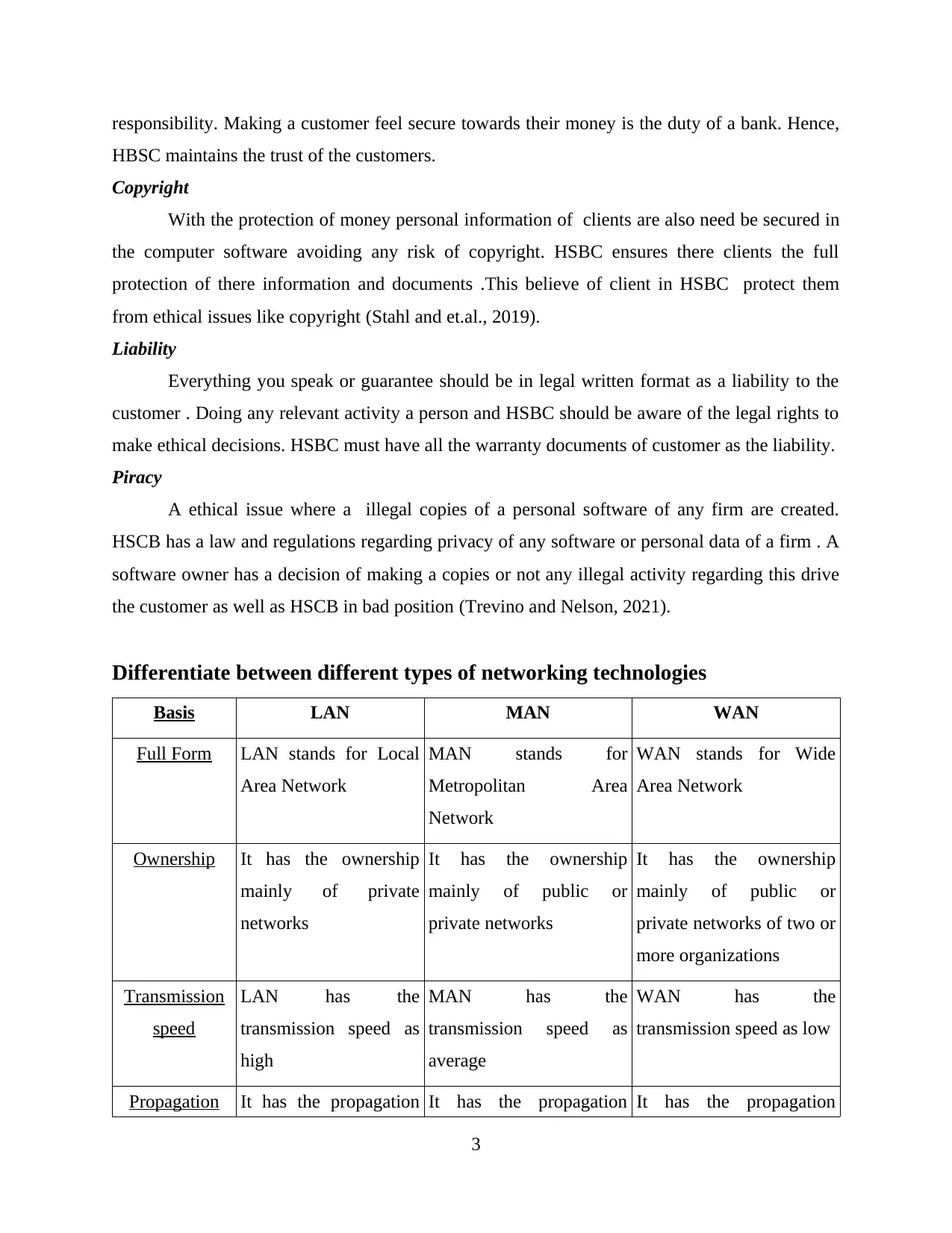
Differentiate between different types of networking technologies
Basis LAN MAN WAN
Full Form LAN stands for Local
Area Network
MAN stands for
Metropolitan Area
Network
WAN stands for Wide
Area Network
Ownership It has the ownership
mainly of private
networks
It has the ownership
mainly of public or
private networks
It has the ownership
mainly of public or
private networks of two or
more organizations
Transmission
speed
LAN has the
transmission speed as
high
MAN has the
transmission speed as
average
WAN has the
transmission speed as low
Propagation It has the propagation It has the propagation It has the propagation
3
HBSC maintains the trust of the customers.
Copyright
With the protection of money personal information of clients are also need be secured in
the computer software avoiding any risk of copyright. HSBC ensures there clients the full
protection of there information and documents .This believe of client in HSBC protect them
from ethical issues like copyright (Stahl and et.al., 2019).
Liability
Everything you speak or guarantee should be in legal written format as a liability to the
customer . Doing any relevant activity a person and HSBC should be aware of the legal rights to
make ethical decisions. HSBC must have all the warranty documents of customer as the liability.
Piracy
A ethical issue where a illegal copies of a personal software of any firm are created.
HSCB has a law and regulations regarding privacy of any software or personal data of a firm . A
software owner has a decision of making a copies or not any illegal activity regarding this drive
the customer as well as HSCB in bad position (Trevino and Nelson, 2021).
Differentiate between different types of networking technologies
Basis LAN MAN WAN
Full Form LAN stands for Local
Area Network
MAN stands for
Metropolitan Area
Network
WAN stands for Wide
Area Network
Ownership It has the ownership
mainly of private
networks
It has the ownership
mainly of public or
private networks
It has the ownership
mainly of public or
private networks of two or
more organizations
Transmission
speed
LAN has the
transmission speed as
high
MAN has the
transmission speed as
average
WAN has the
transmission speed as low
Propagation It has the propagation It has the propagation It has the propagation
3
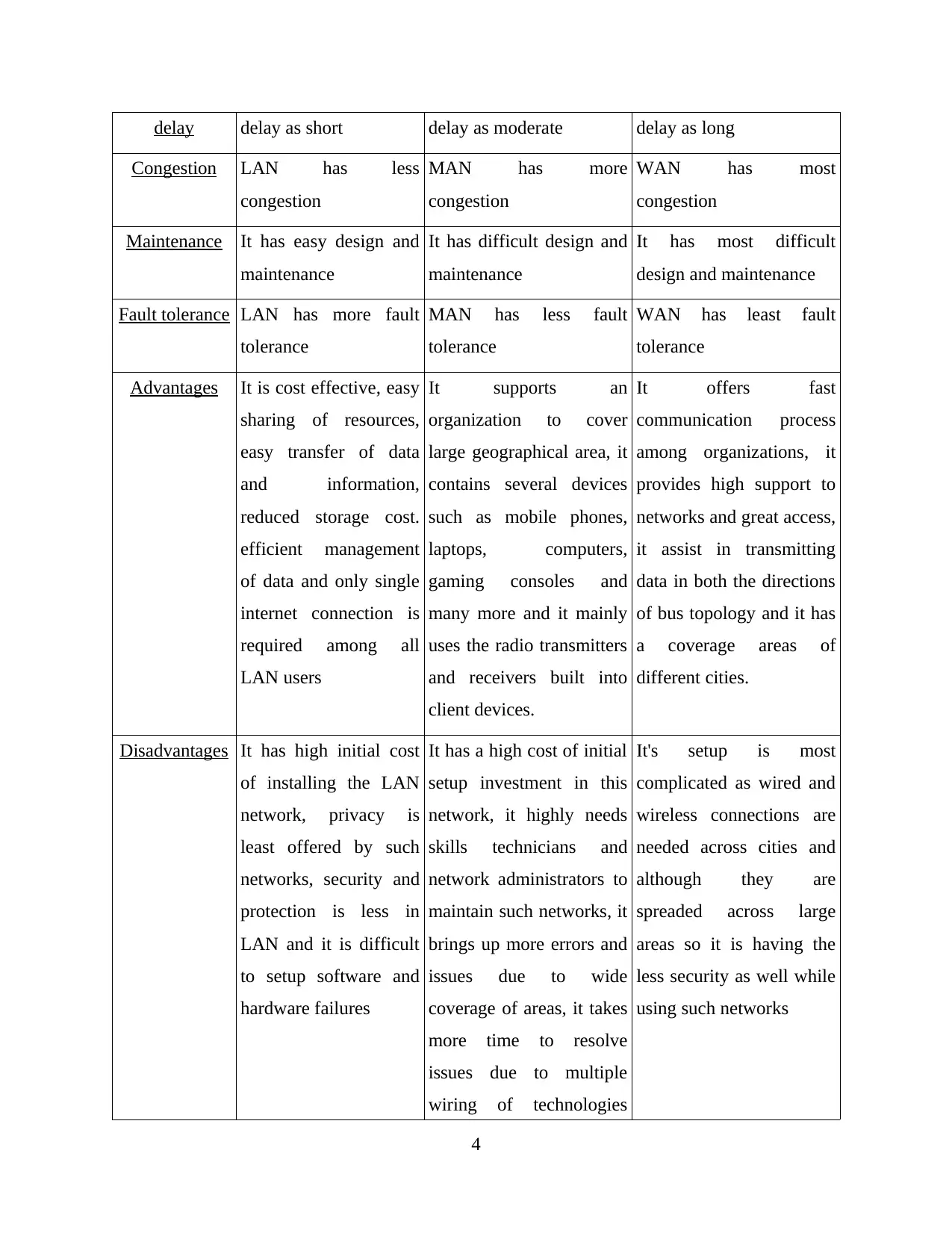
delay delay as short delay as moderate delay as long
Congestion LAN has less
congestion
MAN has more
congestion
WAN has most
congestion
Maintenance It has easy design and
maintenance
It has difficult design and
maintenance
It has most difficult
design and maintenance
Fault tolerance LAN has more fault
tolerance
MAN has less fault
tolerance
WAN has least fault
tolerance
Advantages It is cost effective, easy
sharing of resources,
easy transfer of data
and information,
reduced storage cost.
efficient management
of data and only single
internet connection is
required among all
LAN users
It supports an
organization to cover
large geographical area, it
contains several devices
such as mobile phones,
laptops, computers,
gaming consoles and
many more and it mainly
uses the radio transmitters
and receivers built into
client devices.
It offers fast
communication process
among organizations, it
provides high support to
networks and great access,
it assist in transmitting
data in both the directions
of bus topology and it has
a coverage areas of
different cities.
Disadvantages It has high initial cost
of installing the LAN
network, privacy is
least offered by such
networks, security and
protection is less in
LAN and it is difficult
to setup software and
hardware failures
It has a high cost of initial
setup investment in this
network, it highly needs
skills technicians and
network administrators to
maintain such networks, it
brings up more errors and
issues due to wide
coverage of areas, it takes
more time to resolve
issues due to multiple
wiring of technologies
It's setup is most
complicated as wired and
wireless connections are
needed across cities and
although they are
spreaded across large
areas so it is having the
less security as well while
using such networks
4
Congestion LAN has less
congestion
MAN has more
congestion
WAN has most
congestion
Maintenance It has easy design and
maintenance
It has difficult design and
maintenance
It has most difficult
design and maintenance
Fault tolerance LAN has more fault
tolerance
MAN has less fault
tolerance
WAN has least fault
tolerance
Advantages It is cost effective, easy
sharing of resources,
easy transfer of data
and information,
reduced storage cost.
efficient management
of data and only single
internet connection is
required among all
LAN users
It supports an
organization to cover
large geographical area, it
contains several devices
such as mobile phones,
laptops, computers,
gaming consoles and
many more and it mainly
uses the radio transmitters
and receivers built into
client devices.
It offers fast
communication process
among organizations, it
provides high support to
networks and great access,
it assist in transmitting
data in both the directions
of bus topology and it has
a coverage areas of
different cities.
Disadvantages It has high initial cost
of installing the LAN
network, privacy is
least offered by such
networks, security and
protection is less in
LAN and it is difficult
to setup software and
hardware failures
It has a high cost of initial
setup investment in this
network, it highly needs
skills technicians and
network administrators to
maintain such networks, it
brings up more errors and
issues due to wide
coverage of areas, it takes
more time to resolve
issues due to multiple
wiring of technologies
It's setup is most
complicated as wired and
wireless connections are
needed across cities and
although they are
spreaded across large
areas so it is having the
less security as well while
using such networks
4
⊘ This is a preview!⊘
Do you want full access?
Subscribe today to unlock all pages.
Trusted by 1+ million students worldwide
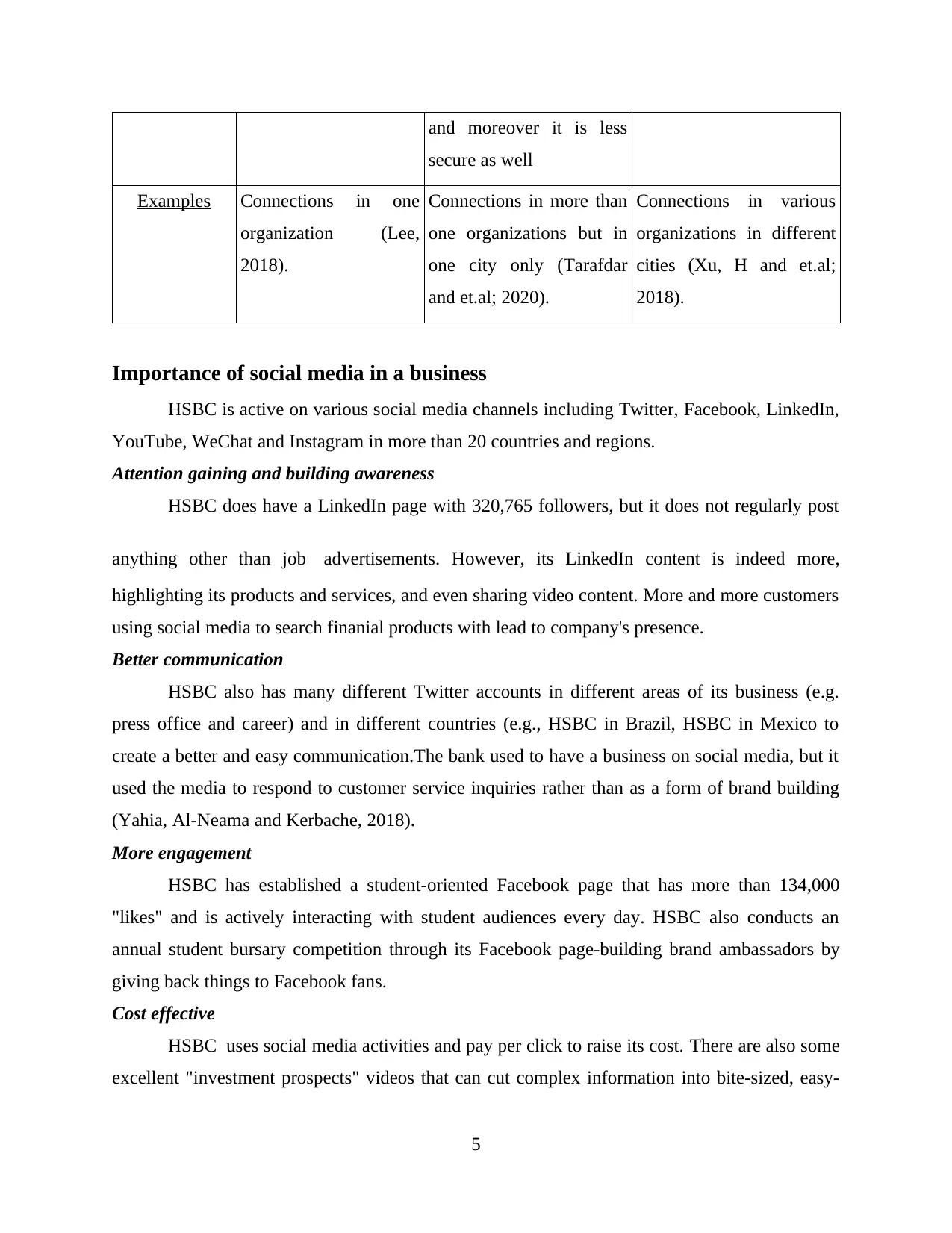
and moreover it is less
secure as well
Examples Connections in one
organization (Lee,
2018).
Connections in more than
one organizations but in
one city only (Tarafdar
and et.al; 2020).
Connections in various
organizations in different
cities (Xu, H and et.al;
2018).
Importance of social media in a business
HSBC is active on various social media channels including Twitter, Facebook, LinkedIn,
YouTube, WeChat and Instagram in more than 20 countries and regions.
Attention gaining and building awareness
HSBC does have a LinkedIn page with 320,765 followers, but it does not regularly post
anything other than job advertisements. However, its LinkedIn content is indeed more,
highlighting its products and services, and even sharing video content. More and more customers
using social media to search finanial products with lead to company's presence.
Better communication
HSBC also has many different Twitter accounts in different areas of its business (e.g.
press office and career) and in different countries (e.g., HSBC in Brazil, HSBC in Mexico to
create a better and easy communication.The bank used to have a business on social media, but it
used the media to respond to customer service inquiries rather than as a form of brand building
(Yahia, Al-Neama and Kerbache, 2018).
More engagement
HSBC has established a student-oriented Facebook page that has more than 134,000
"likes" and is actively interacting with student audiences every day. HSBC also conducts an
annual student bursary competition through its Facebook page-building brand ambassadors by
giving back things to Facebook fans.
Cost effective
HSBC uses social media activities and pay per click to raise its cost. There are also some
excellent "investment prospects" videos that can cut complex information into bite-sized, easy-
5
secure as well
Examples Connections in one
organization (Lee,
2018).
Connections in more than
one organizations but in
one city only (Tarafdar
and et.al; 2020).
Connections in various
organizations in different
cities (Xu, H and et.al;
2018).
Importance of social media in a business
HSBC is active on various social media channels including Twitter, Facebook, LinkedIn,
YouTube, WeChat and Instagram in more than 20 countries and regions.
Attention gaining and building awareness
HSBC does have a LinkedIn page with 320,765 followers, but it does not regularly post
anything other than job advertisements. However, its LinkedIn content is indeed more,
highlighting its products and services, and even sharing video content. More and more customers
using social media to search finanial products with lead to company's presence.
Better communication
HSBC also has many different Twitter accounts in different areas of its business (e.g.
press office and career) and in different countries (e.g., HSBC in Brazil, HSBC in Mexico to
create a better and easy communication.The bank used to have a business on social media, but it
used the media to respond to customer service inquiries rather than as a form of brand building
(Yahia, Al-Neama and Kerbache, 2018).
More engagement
HSBC has established a student-oriented Facebook page that has more than 134,000
"likes" and is actively interacting with student audiences every day. HSBC also conducts an
annual student bursary competition through its Facebook page-building brand ambassadors by
giving back things to Facebook fans.
Cost effective
HSBC uses social media activities and pay per click to raise its cost. There are also some
excellent "investment prospects" videos that can cut complex information into bite-sized, easy-
5
Paraphrase This Document
Need a fresh take? Get an instant paraphrase of this document with our AI Paraphraser
to-understand.Social media comments during the campaign were "90% positive," and many
people participated in the campaign emotionally.
Global reach
HSBC Commercial Bank today launched the "HSBC Contact Hub"; a digital platform
designed to enable corporate customers to use HSBC's global network to establish connections
with trusted buyers and sellers around the world. The HSBC Group, also provide companies with
access to a geographic network covering more than 90% of the world’s global trade and capital
flows (Archer-Brown, and Kietzmann, 2018).
Sales and marketing
In the UK, HSBC promotes its official customer service Twitter feed on its website as a
way for customers to connect with banks.Social media activities are the modern stage of HSBC's
marketing activities. The product is aimed at people between the ages of 25 and 40, who he calls
the "emerging affluent," who are digital-savvy, far-sighted, and have higher-than-average
incomes.
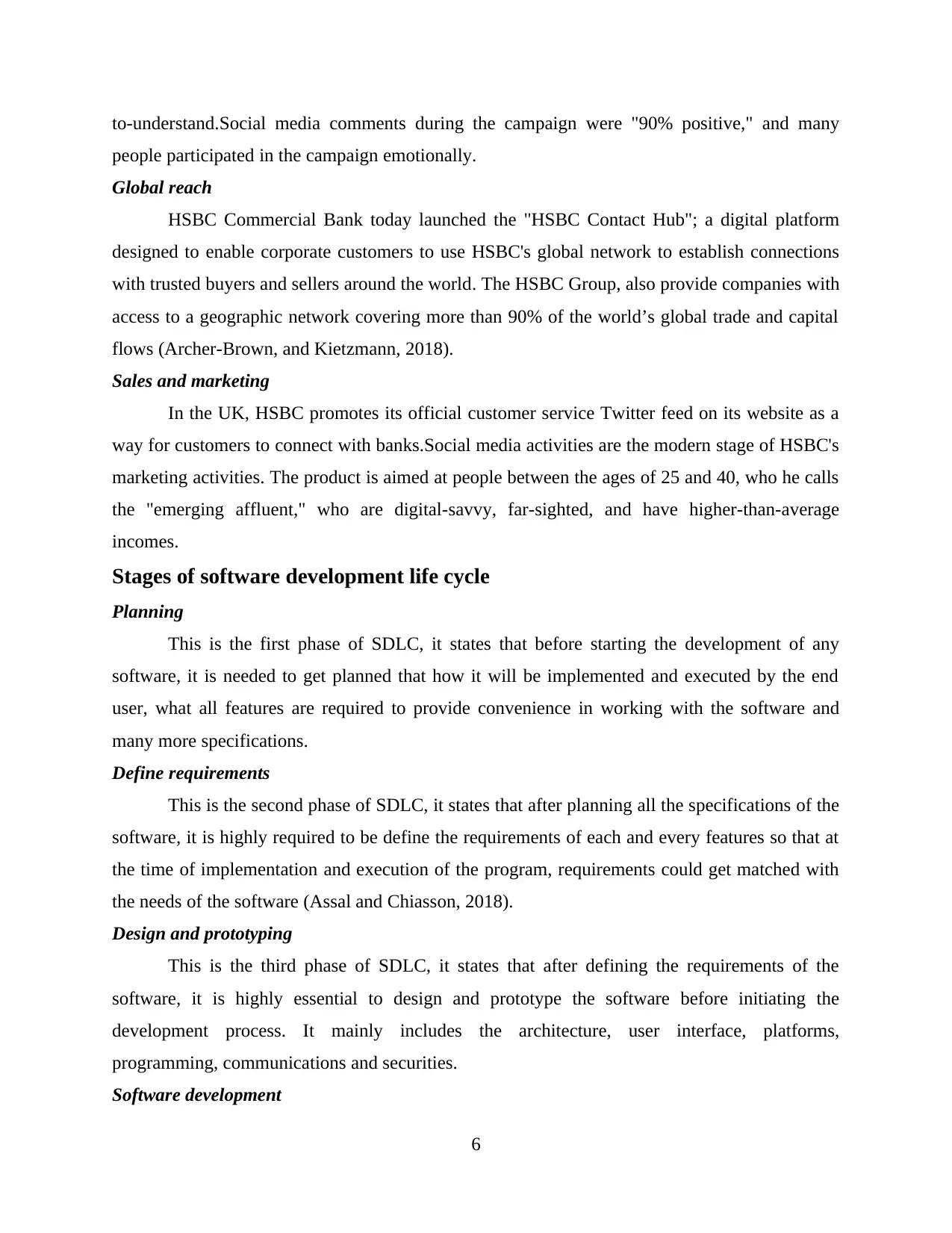
Stages of software development life cycle
Planning
This is the first phase of SDLC, it states that before starting the development of any
software, it is needed to get planned that how it will be implemented and executed by the end
user, what all features are required to provide convenience in working with the software and
many more specifications.
Define requirements
This is the second phase of SDLC, it states that after planning all the specifications of the
software, it is highly required to be define the requirements of each and every features so that at
the time of implementation and execution of the program, requirements could get matched with
the needs of the software (Assal and Chiasson, 2018).
Design and prototyping
This is the third phase of SDLC, it states that after defining the requirements of the
software, it is highly essential to design and prototype the software before initiating the
development process. It mainly includes the architecture, user interface, platforms,
programming, communications and securities.
Software development
6
people participated in the campaign emotionally.
Global reach
HSBC Commercial Bank today launched the "HSBC Contact Hub"; a digital platform
designed to enable corporate customers to use HSBC's global network to establish connections
with trusted buyers and sellers around the world. The HSBC Group, also provide companies with
access to a geographic network covering more than 90% of the world’s global trade and capital
flows (Archer-Brown, and Kietzmann, 2018).
Sales and marketing
In the UK, HSBC promotes its official customer service Twitter feed on its website as a
way for customers to connect with banks.Social media activities are the modern stage of HSBC's
marketing activities. The product is aimed at people between the ages of 25 and 40, who he calls
the "emerging affluent," who are digital-savvy, far-sighted, and have higher-than-average
incomes.
Stages of software development life cycle
Planning
This is the first phase of SDLC, it states that before starting the development of any
software, it is needed to get planned that how it will be implemented and executed by the end
user, what all features are required to provide convenience in working with the software and
many more specifications.
Define requirements
This is the second phase of SDLC, it states that after planning all the specifications of the
software, it is highly required to be define the requirements of each and every features so that at
the time of implementation and execution of the program, requirements could get matched with
the needs of the software (Assal and Chiasson, 2018).
Design and prototyping
This is the third phase of SDLC, it states that after defining the requirements of the
software, it is highly essential to design and prototype the software before initiating the
development process. It mainly includes the architecture, user interface, platforms,
programming, communications and securities.
Software development
6
This is the fourth phase of SDLC, it states the final development of the software which
consist coding, programming, quantitative approaches, applying models and practical mindset
(Grenci and Hull, 2020).
Testing
This is the fifth phase of SDLC, it states that after development of the software, it is
significant to test the software from a person who don't have any knowledge about the
programming and coding so that any errors or bugs can easily be find out to rectify such issues.
Deployment
This is the sixth phase of SDLC, it states that deployment is the process where software
or program is made available to the end users either it can be a specific client or can be on the
particular website in paid software form (Pereira and de FSM Russo, 2018).
Operations and maintenance
This is the seventh phase of SDLC, it states that technology is a thing which is needed to
be updated from time to time in order to keep working with it in an efficient manner. Which
means it does not loose it's effectiveness and maintains the smooth functioning for the user.
Therefore, it is important to maintain the software by upgrading it on a frequent basis.
Analysis and discussion
It is analysed that there is a great role of information technology in success of a business
by supporting it to be advanced in technology from both the points such as from the business
perspective and from the consumers perspective as well such as in decision making, marketing,
business growth, customer support and satisfaction and resource management. There are various
social and ethical issues which are related with the IT sector in service industry which is highly
required to cope up with such as privacy, access rights, securities, copyright, liability and piracy.
There are several types of networking technologies available with the company through which an
organization can set up the network as per the needs and requirements of the business such as
LAN, WAN and MAN. There is a great importance of social media in businesses in order to
better maintain it's stability in a market place such as attention gaining and building awareness,
better communication, more engagement, cost effective, global reach and sales and marketing.
There are various stages available in software development life cycle to follow because it helps
the company in developing the software in an accurate format with effective functioning of it.
Therefore, it is evaluated that information technology in terms of it's role in business, social and
7
consist coding, programming, quantitative approaches, applying models and practical mindset
(Grenci and Hull, 2020).
Testing
This is the fifth phase of SDLC, it states that after development of the software, it is
significant to test the software from a person who don't have any knowledge about the
programming and coding so that any errors or bugs can easily be find out to rectify such issues.
Deployment
This is the sixth phase of SDLC, it states that deployment is the process where software
or program is made available to the end users either it can be a specific client or can be on the
particular website in paid software form (Pereira and de FSM Russo, 2018).
Operations and maintenance
This is the seventh phase of SDLC, it states that technology is a thing which is needed to
be updated from time to time in order to keep working with it in an efficient manner. Which
means it does not loose it's effectiveness and maintains the smooth functioning for the user.
Therefore, it is important to maintain the software by upgrading it on a frequent basis.
Analysis and discussion
It is analysed that there is a great role of information technology in success of a business
by supporting it to be advanced in technology from both the points such as from the business
perspective and from the consumers perspective as well such as in decision making, marketing,
business growth, customer support and satisfaction and resource management. There are various
social and ethical issues which are related with the IT sector in service industry which is highly
required to cope up with such as privacy, access rights, securities, copyright, liability and piracy.
There are several types of networking technologies available with the company through which an
organization can set up the network as per the needs and requirements of the business such as
LAN, WAN and MAN. There is a great importance of social media in businesses in order to
better maintain it's stability in a market place such as attention gaining and building awareness,
better communication, more engagement, cost effective, global reach and sales and marketing.
There are various stages available in software development life cycle to follow because it helps
the company in developing the software in an accurate format with effective functioning of it.
Therefore, it is evaluated that information technology in terms of it's role in business, social and
7
⊘ This is a preview!⊘
Do you want full access?
Subscribe today to unlock all pages.
Trusted by 1+ million students worldwide
ethical issues, differentiating networking technologies, importance of social media and SDLC
has great values in the field of IT in a business in order to expand and gain productivity for the
firm for better sales and revenue generations.
CONCLUSION
It is concluded that information technology is an important part to study about in an
organization for better accelerated growth of a business in a market place. Therefore, it is
important to analyse the various roles of information technology in success or failure of a
business, it is essential to examine the ethical and social issues related to an IT sector while
running the business, it is necessary to determine the several types of networking technologies
and how they differ from each other, it is significant to identify the value or importance of social
media in a business, it is essential to study about the various and different stages available in the
software development life cycle in an organization and it is necessary to investigate the analysis
and discussions associated with each and every topic covered in the report. Hence, this report
covers all such areas which are significant to observe from the view point of business in order to
implement learnings and gained knowledge in a real time business growth and development.
8
has great values in the field of IT in a business in order to expand and gain productivity for the
firm for better sales and revenue generations.
CONCLUSION
It is concluded that information technology is an important part to study about in an
organization for better accelerated growth of a business in a market place. Therefore, it is
important to analyse the various roles of information technology in success or failure of a
business, it is essential to examine the ethical and social issues related to an IT sector while
running the business, it is necessary to determine the several types of networking technologies
and how they differ from each other, it is significant to identify the value or importance of social
media in a business, it is essential to study about the various and different stages available in the
software development life cycle in an organization and it is necessary to investigate the analysis
and discussions associated with each and every topic covered in the report. Hence, this report
covers all such areas which are significant to observe from the view point of business in order to
implement learnings and gained knowledge in a real time business growth and development.
8
Paraphrase This Document
Need a fresh take? Get an instant paraphrase of this document with our AI Paraphraser
References:
Books and Journals
Archer-Brown, C. and Kietzmann, J., 2018. Strategic knowledge management and enterprise
social media. Journal of knowledge management.
Assal, H. and Chiasson, S., 2018. Security in the software development lifecycle. In Fourteenth
Symposium on Usable Privacy and Security ({SOUPS} 2018) (pp. 281-296).
D'Attoma, I. and Ieva, M., 2020. Determinants of technological innovation success and failure:
Does marketing innovation matter?. Industrial Marketing Management. 91. pp.64-81.
Dierksmeier, C. and Seele, P., 2018. Cryptocurrencies and business ethics. Journal of Business
Ethics. 152(1). pp.1-14.
Furunes, T. and Mkono, M., 2019. Service-delivery success and failure under the sharing
economy. International Journal of Contemporary Hospitality Management.
Grenci, R.T. and Hull, B.Z., 2020. New dog, old tricks: ERP and the systems development life
cycle. Journal of Information Systems Education. 15(3). p.7.
Lee, I., 2018. Social media analytics for enterprises: Typology, methods, and processes. Business
Horizons. 61(2). pp.199-210.
Pereira, J.C. and de FSM Russo, R., 2018. Design thinking integrated in agile software
development: A systematic literature review. Procedia computer science. 138. pp.775-
782.
Rajaraman, V., 2018. Introduction to information technology. PHI Learning Pvt. Ltd.
Stahl, B.C. and et.al., 2019. Ethics in corporate research and development: can responsible
research and innovation approaches aid sustainability?. Journal of Cleaner
Production. 239. p.118044.
Tarafdar and et.al; 2020. Explaining the link between technostress and technology addiction for
social networking sites: A study of distraction as a coping behavior. information systems
journal. 30(1). pp.96-124.
Trevino, L.K. and Nelson, K.A., 2021. Managing business ethics: Straight talk about how to do
it right. John Wiley & Sons.
Xu, H and et.al; 2018. A survey on industrial Internet of Things: A cyber-physical systems
perspective. IEEE Access. 6. pp.78238-78259.
Yahia, I.B., Al-Neama, N. and Kerbache, L., 2018. Investigating the drivers for social commerce
in social media platforms: Importance of trust, social support and the platform perceived
usage. Journal of Retailing and Consumer Services. 41. pp.11-19.\
9
Books and Journals
Archer-Brown, C. and Kietzmann, J., 2018. Strategic knowledge management and enterprise
social media. Journal of knowledge management.
Assal, H. and Chiasson, S., 2018. Security in the software development lifecycle. In Fourteenth
Symposium on Usable Privacy and Security ({SOUPS} 2018) (pp. 281-296).
D'Attoma, I. and Ieva, M., 2020. Determinants of technological innovation success and failure:
Does marketing innovation matter?. Industrial Marketing Management. 91. pp.64-81.
Dierksmeier, C. and Seele, P., 2018. Cryptocurrencies and business ethics. Journal of Business
Ethics. 152(1). pp.1-14.
Furunes, T. and Mkono, M., 2019. Service-delivery success and failure under the sharing
economy. International Journal of Contemporary Hospitality Management.
Grenci, R.T. and Hull, B.Z., 2020. New dog, old tricks: ERP and the systems development life
cycle. Journal of Information Systems Education. 15(3). p.7.
Lee, I., 2018. Social media analytics for enterprises: Typology, methods, and processes. Business
Horizons. 61(2). pp.199-210.
Pereira, J.C. and de FSM Russo, R., 2018. Design thinking integrated in agile software
development: A systematic literature review. Procedia computer science. 138. pp.775-
782.
Rajaraman, V., 2018. Introduction to information technology. PHI Learning Pvt. Ltd.
Stahl, B.C. and et.al., 2019. Ethics in corporate research and development: can responsible
research and innovation approaches aid sustainability?. Journal of Cleaner
Production. 239. p.118044.
Tarafdar and et.al; 2020. Explaining the link between technostress and technology addiction for
social networking sites: A study of distraction as a coping behavior. information systems
journal. 30(1). pp.96-124.
Trevino, L.K. and Nelson, K.A., 2021. Managing business ethics: Straight talk about how to do
it right. John Wiley & Sons.
Xu, H and et.al; 2018. A survey on industrial Internet of Things: A cyber-physical systems
perspective. IEEE Access. 6. pp.78238-78259.
Yahia, I.B., Al-Neama, N. and Kerbache, L., 2018. Investigating the drivers for social commerce
in social media platforms: Importance of trust, social support and the platform perceived
usage. Journal of Retailing and Consumer Services. 41. pp.11-19.\
9

1 out of 11


Related Documents


Your All-in-One AI-Powered Toolkit for Academic Success.
+13062052269
info@desklib.com
Available 24*7 on WhatsApp / Email
![[object Object]](/_next/static/media/star-bottom.7253800d.svg)
Unlock your academic potential
Copyright © 2020–2026 A2Z Services. All Rights Reserved. Developed and managed by ZUCOL.