Introduction to Managing and Leading People: Leadership Analysis
VerifiedAdded on 2021/01/03
|11
|3528
|340
Report
AI Summary
This report provides an overview of leadership, defining it as the process of influencing followers to achieve specific goals through effective communication. The report delves into the importance of leadership in attracting individuals to complete tasks and achieve targets within organizations. It examines various leadership approaches, including trait, situational, and behavioral approaches, highlighting their impact on employee satisfaction and organizational goal attainment. The trait approach focuses on leader qualities, the situational approach considers the context, and the behavioral approach emphasizes leader actions. The report provides examples, advantages, and disadvantages of each approach, offering insights into how leadership influences organizational structure, communication, and employee motivation. It stresses the importance of effective time management, work delegation, and empowerment in achieving organizational objectives.
The Introduction to
Managing and Leading
People
Managing and Leading
People

Paraphrase This Document
Need a fresh take? Get an instant paraphrase of this document with our AI Paraphraser
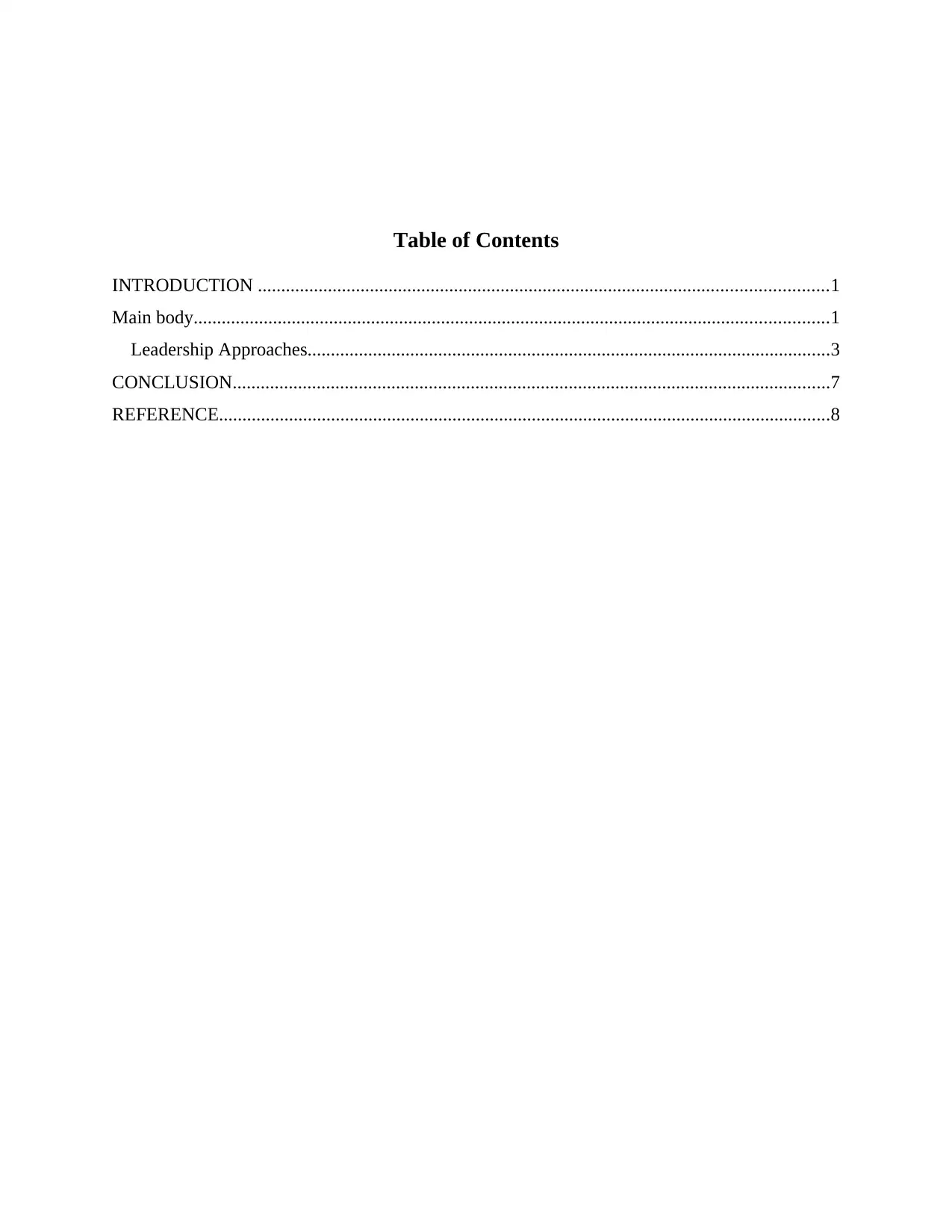
Table of Contents
INTRODUCTION ..........................................................................................................................1
Main body........................................................................................................................................1
Leadership Approaches................................................................................................................3
CONCLUSION................................................................................................................................7
REFERENCE...................................................................................................................................8
INTRODUCTION ..........................................................................................................................1
Main body........................................................................................................................................1
Leadership Approaches................................................................................................................3
CONCLUSION................................................................................................................................7
REFERENCE...................................................................................................................................8
INTRODUCTION
Leadership is the influencing activity which influences the followers through
communication process in order to obtain particular goals. Leadership states that what employees
need to for accomplish the target. Leadership is important in all organisation that help to attract
the person in order to complete the target. A leader has number of quality who guides and
supports the people and complete the particular task (Blacker and McConnell, 2015). The
present report will emphasis on leadership and its approaches which help to influence employees.
This is the relation between employees and staff which help to provide satisfaction in context to
achieve goals. Every industry select the leader who shows correct path and get done work on
time. The main aim of this report to understand the meaning of leadership and how approaches
help to attain the goals or objectives after completing the targets.
Main body
Leadership is the process which focuses on organisation goals and support staff to
achieve the goals by completing task in a particular period of time. It is the action of leading
people in a business industry towards achieving goals. A leader set clear vision for company
such as it motivates, guides, supports and maintain the employee's performance. This means a
person who has ability to set the purpose or route for group of person and get employees to move
along together in order fulfil commitment. A manager of the organisation give a particular task
and time period for completing task. Leadership relates to ability of one person who motivate
others and manage interpersonal behaviour. Basically, it refer to a process which creates
effective communication among employer and employee. It is helpful to reduce employees
dissatisfaction through leadership (Blanchard, 2015).
Good leadership also delegates the power and authority in effective manner that help to
influence people. For example, Tesco is multinational retailer company which sales number of
products and services at retail prices. It has number of employees who works collectively. The
leader of Tesco delegate the assignment among employees according to their specialisation
which help to complete the task in given period of time. The manager of the organisation select
the leader of the organisation who can guides and supports properly for completing the goals.
The main aim of leadership is to maintain the effective communication and coordination that
help to attain the goals of enterprises. A leader has power, authority and responsibility which is
1
Leadership is the influencing activity which influences the followers through
communication process in order to obtain particular goals. Leadership states that what employees
need to for accomplish the target. Leadership is important in all organisation that help to attract
the person in order to complete the target. A leader has number of quality who guides and
supports the people and complete the particular task (Blacker and McConnell, 2015). The
present report will emphasis on leadership and its approaches which help to influence employees.
This is the relation between employees and staff which help to provide satisfaction in context to
achieve goals. Every industry select the leader who shows correct path and get done work on
time. The main aim of this report to understand the meaning of leadership and how approaches
help to attain the goals or objectives after completing the targets.
Main body
Leadership is the process which focuses on organisation goals and support staff to
achieve the goals by completing task in a particular period of time. It is the action of leading
people in a business industry towards achieving goals. A leader set clear vision for company
such as it motivates, guides, supports and maintain the employee's performance. This means a
person who has ability to set the purpose or route for group of person and get employees to move
along together in order fulfil commitment. A manager of the organisation give a particular task
and time period for completing task. Leadership relates to ability of one person who motivate
others and manage interpersonal behaviour. Basically, it refer to a process which creates
effective communication among employer and employee. It is helpful to reduce employees
dissatisfaction through leadership (Blanchard, 2015).
Good leadership also delegates the power and authority in effective manner that help to
influence people. For example, Tesco is multinational retailer company which sales number of
products and services at retail prices. It has number of employees who works collectively. The
leader of Tesco delegate the assignment among employees according to their specialisation
which help to complete the task in given period of time. The manager of the organisation select
the leader of the organisation who can guides and supports properly for completing the goals.
The main aim of leadership is to maintain the effective communication and coordination that
help to attain the goals of enterprises. A leader has power, authority and responsibility which is
1
⊘ This is a preview!⊘
Do you want full access?
Subscribe today to unlock all pages.

Trusted by 1+ million students worldwide
used to understand the task and objects of company. The manager of the company take effective
business decision that is used to complete the task in a specific period of time. Leadership plays
an important role in business organisation that is described below-
Provide a clear vision and mission: Leadership is used to leading people in an
organisation that help to attain the goals and objectives. It provides a clear vision and mission
that means leaders decides that what need to do and how it do in order to achieve goals. For
instance, Unilever is a UK Based manufacturing company who manufactures number of products
according to customer needs and demands. The manager has decided to increase the production
process. In this situation they will follow leadership that help to accept the new technology in
order to manufacture large number of products and services. Moreover, it help to decide what
outcome can be achieve by setting vision and mission (Chen, Ravichandar and Proctor, 2016).
Establish effective organisational structure and communication procedure: This
means leadership play a role for establishing effective organisational structure and
communication process. A good communication always help to reduce the problems and
conflicts in an organisation and increase the profitability. Moreover, effective communication
help to create a good environment by sharing ideas and thought of both employer and employee.
If any problem arises within organisation employees shares with leader and get suggestion to
solve the problems. Moreover, leadership also provides health care services to staff who are
working in a organisation in get work done by them.
Set effective role model: The leadership set the role model which helps to get the best
potential outcomes. The leader take corrective action and provide important information to
organisation which help to complete the goals and maintain the balance among leader and
employees. As leadership is the process of leading people towards accomplish the goals of
organisation which help to attract the employees for increasing the productivity.
Inspire and motivate: Leadership is to inspire, motivate and guide the people who
works effectively for filling the task of organisation. The leaders of any organisation use
motivation techniques to facilitate business activities that help to increase the productivity and
profitability. By performing this role employees get happy and works effectively.
Effective time management: It is most important for any organisation to manage the
time by completing the task of organisation. If the specific task will be complete in particular
time that affects the business activities. A work should be complete on time that help to assign
2
business decision that is used to complete the task in a specific period of time. Leadership plays
an important role in business organisation that is described below-
Provide a clear vision and mission: Leadership is used to leading people in an
organisation that help to attain the goals and objectives. It provides a clear vision and mission
that means leaders decides that what need to do and how it do in order to achieve goals. For
instance, Unilever is a UK Based manufacturing company who manufactures number of products
according to customer needs and demands. The manager has decided to increase the production
process. In this situation they will follow leadership that help to accept the new technology in
order to manufacture large number of products and services. Moreover, it help to decide what
outcome can be achieve by setting vision and mission (Chen, Ravichandar and Proctor, 2016).
Establish effective organisational structure and communication procedure: This
means leadership play a role for establishing effective organisational structure and
communication process. A good communication always help to reduce the problems and
conflicts in an organisation and increase the profitability. Moreover, effective communication
help to create a good environment by sharing ideas and thought of both employer and employee.
If any problem arises within organisation employees shares with leader and get suggestion to
solve the problems. Moreover, leadership also provides health care services to staff who are
working in a organisation in get work done by them.
Set effective role model: The leadership set the role model which helps to get the best
potential outcomes. The leader take corrective action and provide important information to
organisation which help to complete the goals and maintain the balance among leader and
employees. As leadership is the process of leading people towards accomplish the goals of
organisation which help to attract the employees for increasing the productivity.
Inspire and motivate: Leadership is to inspire, motivate and guide the people who
works effectively for filling the task of organisation. The leaders of any organisation use
motivation techniques to facilitate business activities that help to increase the productivity and
profitability. By performing this role employees get happy and works effectively.
Effective time management: It is most important for any organisation to manage the
time by completing the task of organisation. If the specific task will be complete in particular
time that affects the business activities. A work should be complete on time that help to assign
2
Paraphrase This Document
Need a fresh take? Get an instant paraphrase of this document with our AI Paraphraser
more work in order to increase the productivity. Time management increases the power and
responsibility of leader who guides and supports business industry (Díaz and et.al., 2015).
Work delegation and empowerment: The good leaders have ability to delegate the
work among staff and achieve the goal of organisation. It help to select right people in right job
that help to increase the responsibility of employees. Moreover, leadership give authority and
responsibility to employees which help to take effective business decision.
Leadership Approaches
Leadership approaches includes actions, values, feeling and beliefs of other person and
group of person who help to achieve company's goals. This is a complex process that requires
effective leadership which includes leader's skills, experience and qualities in order to fill the
needs and wants of employees. Leadership approach help to know the behaviour of staff towards
accepting challenges and maintain the good behaviour. This is important activity of business
industry which help to maximize effectiveness and efficiency in order to achieve organisation's
goals (Dutta and Bose, 2015).
The main purpose of leadership approach is to define how and why people should
become leader. Hence, such approaches mainly focuses on characteristics and qualities of leaders
for improving the production by accepting the challenges. The manager of business industry
follows some leadership approach which helps to improve leadership abilities in different
situation. The different types of leadership approaches are stated below-
Trait approach:
This means qualities of a leader like physical appearance, mental stability and personality
that help to attract the people who are working in a organisation. This is the oldest approach
which is more effective and influenced the employees in order to get work done by staff. This
approach is mainly based on the characteristics and skills of many leaders who get success by
performing business activities.
This approach identify physiological, personality, demographical, self confidence and
intelligence, and task culture activities that help to make effective business decision. For
instance, the leader of Unilever has enough ability, skills, knowledge and work experience which
help to work collectively in order to achieve goals of the organisation. The manager and leader
make correct decision for increasing the productivity and profitability. This theory help to create
high level of efforts, initiatives and level of ambitions in order to make good judgement. Its main
3
responsibility of leader who guides and supports business industry (Díaz and et.al., 2015).
Work delegation and empowerment: The good leaders have ability to delegate the
work among staff and achieve the goal of organisation. It help to select right people in right job
that help to increase the responsibility of employees. Moreover, leadership give authority and
responsibility to employees which help to take effective business decision.
Leadership Approaches
Leadership approaches includes actions, values, feeling and beliefs of other person and
group of person who help to achieve company's goals. This is a complex process that requires
effective leadership which includes leader's skills, experience and qualities in order to fill the
needs and wants of employees. Leadership approach help to know the behaviour of staff towards
accepting challenges and maintain the good behaviour. This is important activity of business
industry which help to maximize effectiveness and efficiency in order to achieve organisation's
goals (Dutta and Bose, 2015).
The main purpose of leadership approach is to define how and why people should
become leader. Hence, such approaches mainly focuses on characteristics and qualities of leaders
for improving the production by accepting the challenges. The manager of business industry
follows some leadership approach which helps to improve leadership abilities in different
situation. The different types of leadership approaches are stated below-
Trait approach:
This means qualities of a leader like physical appearance, mental stability and personality
that help to attract the people who are working in a organisation. This is the oldest approach
which is more effective and influenced the employees in order to get work done by staff. This
approach is mainly based on the characteristics and skills of many leaders who get success by
performing business activities.
This approach identify physiological, personality, demographical, self confidence and
intelligence, and task culture activities that help to make effective business decision. For
instance, the leader of Unilever has enough ability, skills, knowledge and work experience which
help to work collectively in order to achieve goals of the organisation. The manager and leader
make correct decision for increasing the productivity and profitability. This theory help to create
high level of efforts, initiatives and level of ambitions in order to make good judgement. Its main
3
object is to create the opportunity for employees by using leader's knowledge and skills who
analysis the demand and fill the needs and wants. Moreover, if a leader has all qualities is means
organisation is can maximize market share by applying knowledge (Dutta and Bose, 2015).
Advantages: This approach give constructive information about leadership that help to
increase the production and profits. Managers uses traits of employees in order to get work done
effectively and efficiently. This theory focuses on leader not on the followers who are working in
a organisation. If organisation uses this then it can increase profits of the organisation. Moreover,
it supports general image in organisation that show leaders are a special kind of people who
could work extra by using knowledge and experience.
Disadvantages: This theory is leader centric which focuses only on leader not other who
are working in organisation. Some finding are indeterminate and personal leads to uncertainty in
the validity of approach. It may be fail to look how specific traits affects leadership outcome like
productivity, performance, and employee satisfaction.
Situational Approach:
This approach assists that not single one leadership is good. It considers the situation
which states the type of leadership and strategy that suits to the organisation's task. It help to
define the particular situation in which leader can solve the problems which are arises during
business activities. In this theory leaders need to consider the relationship between leaders and
members of group. Such as the manager of Flip cart company given an assignment that should be
completed within 2 months. During business activities the manager has given another important
assignment which should be complete in less time. In this case employees has to select the best
option which help to complete both assignment on specified time period (Espinoza and Ukleja,
2016).
Advantages:
It defines the need for flexibility that help to accept the challenges which are necessary
for the organisation. It does not insist for specific set of rules which must be followed by all.
Instead, of this it create en effective environment where leader encouraged employee to solve the
issues and select best option. Moreover, it help a team to work together which reduces the
internal risk. If organisation uses this approach it can select best option which will help to
increase the productivity and profitability.
Disadvantages:
4
analysis the demand and fill the needs and wants. Moreover, if a leader has all qualities is means
organisation is can maximize market share by applying knowledge (Dutta and Bose, 2015).
Advantages: This approach give constructive information about leadership that help to
increase the production and profits. Managers uses traits of employees in order to get work done
effectively and efficiently. This theory focuses on leader not on the followers who are working in
a organisation. If organisation uses this then it can increase profits of the organisation. Moreover,
it supports general image in organisation that show leaders are a special kind of people who
could work extra by using knowledge and experience.
Disadvantages: This theory is leader centric which focuses only on leader not other who
are working in organisation. Some finding are indeterminate and personal leads to uncertainty in
the validity of approach. It may be fail to look how specific traits affects leadership outcome like
productivity, performance, and employee satisfaction.
Situational Approach:
This approach assists that not single one leadership is good. It considers the situation
which states the type of leadership and strategy that suits to the organisation's task. It help to
define the particular situation in which leader can solve the problems which are arises during
business activities. In this theory leaders need to consider the relationship between leaders and
members of group. Such as the manager of Flip cart company given an assignment that should be
completed within 2 months. During business activities the manager has given another important
assignment which should be complete in less time. In this case employees has to select the best
option which help to complete both assignment on specified time period (Espinoza and Ukleja,
2016).
Advantages:
It defines the need for flexibility that help to accept the challenges which are necessary
for the organisation. It does not insist for specific set of rules which must be followed by all.
Instead, of this it create en effective environment where leader encouraged employee to solve the
issues and select best option. Moreover, it help a team to work together which reduces the
internal risk. If organisation uses this approach it can select best option which will help to
increase the productivity and profitability.
Disadvantages:
4
⊘ This is a preview!⊘
Do you want full access?
Subscribe today to unlock all pages.
Trusted by 1+ million students worldwide
It does not focuses on overall objectives of the organisation which may be a drawback for
organisation. As it considers instant needs than long term wants, may be ineffective in task
oriented environment. It is cost effective that increases large amount of cost which may be risky
for organisation because situation are based on assumption not reality. Additionally, situational
leadership does not provides enough information for leaders. If organisation uses this approach it
may be difficult to get best solution of possible situations because it creates the lot of confusion
within organisation (Fobi and et.al., 2015).
Behaviouristic leadership approach:
This approach emphasis on leader's real behaviour and action which states that how a
leader respond on organisation's problems. It helps to know the behaviour of leader and define
how a leader treat employees in order to complete the task. This is more effective approach
which help to know the qualities of organisation. Mainly this approach focuses on leaders
behaviour that help to know the upcoming future uncertainties. This approach determines goals,
motivating employees for achieving goals of business industry. It provides greater satisfaction to
its followers and suggests them best possible outcome. For example, Flip cart's manager adopts
behavioural approach that help to behave effectively such as defining problems, find reason, get
solution and implement that help to increase business activities (Geschwind and Broström,
2015). This approach reveals following skills which help to lead followers. The skills are
discussed below-
Leadership skills: This is important in all enterprises that is used to analysis leadership
behaviour which motivates employees to complete task in particular period of time.
Technical skills: It is helpful at lower managerial level where manufacturing process are
being processed. Such as it involves training and experience to employees who can accept the
new technology. Moreover, technical skills help to increase the working capacity of employees
by accepting challenges.
Human skills: It is also important in organisation at managerial level. This is associated
with interpersonal relationship among manager, leader and employees at workplace. If any
problem arises during business activities the manager make solid decision with the concern of
all.
Conceptual skills: This skill includes the ability to review the specific task at the top
level of management where planning are made in order to develop the business strategy.
5
organisation. As it considers instant needs than long term wants, may be ineffective in task
oriented environment. It is cost effective that increases large amount of cost which may be risky
for organisation because situation are based on assumption not reality. Additionally, situational
leadership does not provides enough information for leaders. If organisation uses this approach it
may be difficult to get best solution of possible situations because it creates the lot of confusion
within organisation (Fobi and et.al., 2015).
Behaviouristic leadership approach:
This approach emphasis on leader's real behaviour and action which states that how a
leader respond on organisation's problems. It helps to know the behaviour of leader and define
how a leader treat employees in order to complete the task. This is more effective approach
which help to know the qualities of organisation. Mainly this approach focuses on leaders
behaviour that help to know the upcoming future uncertainties. This approach determines goals,
motivating employees for achieving goals of business industry. It provides greater satisfaction to
its followers and suggests them best possible outcome. For example, Flip cart's manager adopts
behavioural approach that help to behave effectively such as defining problems, find reason, get
solution and implement that help to increase business activities (Geschwind and Broström,
2015). This approach reveals following skills which help to lead followers. The skills are
discussed below-
Leadership skills: This is important in all enterprises that is used to analysis leadership
behaviour which motivates employees to complete task in particular period of time.
Technical skills: It is helpful at lower managerial level where manufacturing process are
being processed. Such as it involves training and experience to employees who can accept the
new technology. Moreover, technical skills help to increase the working capacity of employees
by accepting challenges.
Human skills: It is also important in organisation at managerial level. This is associated
with interpersonal relationship among manager, leader and employees at workplace. If any
problem arises during business activities the manager make solid decision with the concern of
all.
Conceptual skills: This skill includes the ability to review the specific task at the top
level of management where planning are made in order to develop the business strategy.
5
Paraphrase This Document
Need a fresh take? Get an instant paraphrase of this document with our AI Paraphraser
Advantages:
This approach supports the idea from which leadership trait can be learned through
training and development process. If leader finds that there is need to provide training and
experience then leader conduct the training programme that help to enhance the knowledge and
experience. Moreover, it help to generate new ideas that help to develop leaders to produce
correct results. This approach mainly considers leader's behaviour that should be good in order to
complete the assign task (Leveson, 2015).
Dis advantages:
The main drawback of this approach is there is lack of knowledge which does not provide
actual potential results. If leader will not provide training organisation can not get maximum
profit by producing large number of products. As here is lack of knowledge, which may be
difficult for organisation to take better decision. There is need to have good behaviour for
solving the problems which may be difficult for organisation's leader.
Contingency approach:
This leadership approach deals with finding the best relation between leader and situation
. It states that how leadership style fit the context of business situation and find the solution. This
approach is opposition of leadership like as trait and skills management that helps to generate
more situations. It helps to understand management activity like planning, organising, leadership
and controlling. This theory is useful for organisation such as it uses potential learning from
particular situation and increase the future management situation. For example, the leader of
Unilever make some solid strategy that help to cope up with future problems that has chances to
arise within organisation. This is important in business firm because it help leader to better
understand staff in a work environment. Additionally, it concentrates on situational factors which
can affect organisational behaviour and its prediction of the employee's behaviour (Manning,
Anderson and Pettengill, 2017).
Advantages:
This approach is dynamic in nature so it can be changes according to situation. It give
permission to leaders and managers to change the policy and procedure according to situation.
Leader can increase leadership and decision making skills that help to grow and share the
business ideas. Additionally, it is used to design organisational structure and maintain the
information decision system.
6
This approach supports the idea from which leadership trait can be learned through
training and development process. If leader finds that there is need to provide training and
experience then leader conduct the training programme that help to enhance the knowledge and
experience. Moreover, it help to generate new ideas that help to develop leaders to produce
correct results. This approach mainly considers leader's behaviour that should be good in order to
complete the assign task (Leveson, 2015).
Dis advantages:
The main drawback of this approach is there is lack of knowledge which does not provide
actual potential results. If leader will not provide training organisation can not get maximum
profit by producing large number of products. As here is lack of knowledge, which may be
difficult for organisation to take better decision. There is need to have good behaviour for
solving the problems which may be difficult for organisation's leader.
Contingency approach:
This leadership approach deals with finding the best relation between leader and situation
. It states that how leadership style fit the context of business situation and find the solution. This
approach is opposition of leadership like as trait and skills management that helps to generate
more situations. It helps to understand management activity like planning, organising, leadership
and controlling. This theory is useful for organisation such as it uses potential learning from
particular situation and increase the future management situation. For example, the leader of
Unilever make some solid strategy that help to cope up with future problems that has chances to
arise within organisation. This is important in business firm because it help leader to better
understand staff in a work environment. Additionally, it concentrates on situational factors which
can affect organisational behaviour and its prediction of the employee's behaviour (Manning,
Anderson and Pettengill, 2017).
Advantages:
This approach is dynamic in nature so it can be changes according to situation. It give
permission to leaders and managers to change the policy and procedure according to situation.
Leader can increase leadership and decision making skills that help to grow and share the
business ideas. Additionally, it is used to design organisational structure and maintain the
information decision system.
6
Disadvantages:
This is mainly reactive in nature which may be difficult for manager to handle the
difficult situation. It does not provides actual result reason is depend on situational context.
Moreover, this approach may be complex to present problems in testing the uses of skills and
knowledge (Mowles, 2015).
Systematic leadership approach:
This approach focuses on the larger system of the organisation which help to increase the
productivity by influencing the people. This is leading management process that help to run a
business through a systematic ways. This approach mainly focused on to built the relation
between employee and network that help to motivate the employees. The organisation should
adopt systematic leadership approach because it make easier to increase the production and
profitability by motivating the employees. It help to control over excess business activity that
make effective business decision in order to complete task. This approach mainly focused on
networking system to create the relation between employee and leader.
The main aim of this approach is to implement a new leadership strategy that help to
improve the efficiency and effectiveness of the organisation. A leader has quality to influenced
people by adopting challenges which are arises in organisation. If organisation adopt systematic
leadership approach it can increase efficiency and motivate the employees in order to complete
the task (World Health Organization, 2015.).
Advantages:
By adopting this approach organisation can increase the adaptability to change the
environmental factors. This approach helps to make correct business decision for achieving goals
of the organisation. It is adaptive and dynamic in nature that is able to accept the changes in
organisation. Moreover, it considers multiple dimensions of management which help to
understand systematic problem and find out best solution (Shields and et.al., 2015).
Disadvantages:
As it based on network system so it take time to make decision which may be drawback
for business organisation. It depend on system which may be incorrect. If organisation adopt this
approach then it has to face the high cost, as result low productivity and less profitability.
7
This is mainly reactive in nature which may be difficult for manager to handle the
difficult situation. It does not provides actual result reason is depend on situational context.
Moreover, this approach may be complex to present problems in testing the uses of skills and
knowledge (Mowles, 2015).
Systematic leadership approach:
This approach focuses on the larger system of the organisation which help to increase the
productivity by influencing the people. This is leading management process that help to run a
business through a systematic ways. This approach mainly focused on to built the relation
between employee and network that help to motivate the employees. The organisation should
adopt systematic leadership approach because it make easier to increase the production and
profitability by motivating the employees. It help to control over excess business activity that
make effective business decision in order to complete task. This approach mainly focused on
networking system to create the relation between employee and leader.
The main aim of this approach is to implement a new leadership strategy that help to
improve the efficiency and effectiveness of the organisation. A leader has quality to influenced
people by adopting challenges which are arises in organisation. If organisation adopt systematic
leadership approach it can increase efficiency and motivate the employees in order to complete
the task (World Health Organization, 2015.).
Advantages:
By adopting this approach organisation can increase the adaptability to change the
environmental factors. This approach helps to make correct business decision for achieving goals
of the organisation. It is adaptive and dynamic in nature that is able to accept the changes in
organisation. Moreover, it considers multiple dimensions of management which help to
understand systematic problem and find out best solution (Shields and et.al., 2015).
Disadvantages:
As it based on network system so it take time to make decision which may be drawback
for business organisation. It depend on system which may be incorrect. If organisation adopt this
approach then it has to face the high cost, as result low productivity and less profitability.
7
⊘ This is a preview!⊘
Do you want full access?
Subscribe today to unlock all pages.
Trusted by 1+ million students worldwide
CONCLUSION
Leadership is the process to influence the people in order to get work done from
employees. A leader has many qualities to motivate and inspire employees to cope up with
difficulties. Leadership is used to attract the employees and complete the assign task in a given
period of time. This report has covered different approaches of leadership such as situational
leadership, contingent approach, systematic leadership and behavioural leadership approach that
helps to influence the people in order to provide satisfaction. The leader has enough ability and
capacity who understand the problems and get the solution of problems. After getting solution it
supports staff to accept the challenges and complete the task.
REFERENCE
Books and Journal
Blacker, K. and McConnell, P., 2015. People Risk Management: A practical approach to
managing the human factors that could harm your business. Kogan Page Publishers.
Blanchard, J. M. F., 2015. The people’s republic of China leadership transition and its external
relations: Still searching for definitive answers. Journal of Chinese Political Science.
20(1). pp.1-16.
Chen, R. R., Ravichandar, R. and Proctor, D., 2016. Managing the transition to the new agile
business and product development model: Lessons from Cisco Systems. Business
Horizons. 59(6). pp.635-644.
Díaz, S., and et.al., 2015. The IPBES Conceptual Framework—connecting nature and
people. Current Opinion in Environmental Sustainability. 14. pp.1-16.
Dutta, D. and Bose, I., 2015. Managing a big data project: the case of ramco cements
limited. International Journal of Production Economics. 165. pp.293-306.
Dutta, D. and Bose, I., 2015. Managing a big data project: the case of ramco cements
limited. International Journal of Production Economics. 165. pp.293-306.
Espinoza, C. and Ukleja, M., 2016. Managing the Millennials: Discover the core competencies
for managing today's workforce. John Wiley & Sons.
Fobi, G., and et.al., 2015. Managing the fight against onchocerciasis in Africa: APOC
experience. PLoS neglected tropical diseases. 9(5). p.e0003542.
Geschwind, L. and Broström, A., 2015. Managing the teaching–research nexus: Ideals and
practice in research-oriented universities. Higher Education Research & Development.
34(1). pp.60-73.
Leveson, N., 2015. A systems approach to risk management through leading safety
indicators. Reliability Engineering & System Safety. 136. pp.17-34.
Manning, R. E., Anderson, L. E. and Pettengill, P., 2017. Managing outdoor recreation: Case
studies in the national parks. CABI.
8
Leadership is the process to influence the people in order to get work done from
employees. A leader has many qualities to motivate and inspire employees to cope up with
difficulties. Leadership is used to attract the employees and complete the assign task in a given
period of time. This report has covered different approaches of leadership such as situational
leadership, contingent approach, systematic leadership and behavioural leadership approach that
helps to influence the people in order to provide satisfaction. The leader has enough ability and
capacity who understand the problems and get the solution of problems. After getting solution it
supports staff to accept the challenges and complete the task.
REFERENCE
Books and Journal
Blacker, K. and McConnell, P., 2015. People Risk Management: A practical approach to
managing the human factors that could harm your business. Kogan Page Publishers.
Blanchard, J. M. F., 2015. The people’s republic of China leadership transition and its external
relations: Still searching for definitive answers. Journal of Chinese Political Science.
20(1). pp.1-16.
Chen, R. R., Ravichandar, R. and Proctor, D., 2016. Managing the transition to the new agile
business and product development model: Lessons from Cisco Systems. Business
Horizons. 59(6). pp.635-644.
Díaz, S., and et.al., 2015. The IPBES Conceptual Framework—connecting nature and
people. Current Opinion in Environmental Sustainability. 14. pp.1-16.
Dutta, D. and Bose, I., 2015. Managing a big data project: the case of ramco cements
limited. International Journal of Production Economics. 165. pp.293-306.
Dutta, D. and Bose, I., 2015. Managing a big data project: the case of ramco cements
limited. International Journal of Production Economics. 165. pp.293-306.
Espinoza, C. and Ukleja, M., 2016. Managing the Millennials: Discover the core competencies
for managing today's workforce. John Wiley & Sons.
Fobi, G., and et.al., 2015. Managing the fight against onchocerciasis in Africa: APOC
experience. PLoS neglected tropical diseases. 9(5). p.e0003542.
Geschwind, L. and Broström, A., 2015. Managing the teaching–research nexus: Ideals and
practice in research-oriented universities. Higher Education Research & Development.
34(1). pp.60-73.
Leveson, N., 2015. A systems approach to risk management through leading safety
indicators. Reliability Engineering & System Safety. 136. pp.17-34.
Manning, R. E., Anderson, L. E. and Pettengill, P., 2017. Managing outdoor recreation: Case
studies in the national parks. CABI.
8
Paraphrase This Document
Need a fresh take? Get an instant paraphrase of this document with our AI Paraphraser

Mowles, C., 2015. Managing in Uncertainty: complexity and the paradoxes of everyday
organizational life. Routledge.
Shields, J., and et.al., 2015. Managing employee performance & reward: Concepts, practices,
strategies. Cambridge University Press.
World Health Organization, 2015. People-centred and integrated health services: an overview of
the evidence: interim report (No. WHO/HIS/SDS/2015.7). World Health Organization.
9
organizational life. Routledge.
Shields, J., and et.al., 2015. Managing employee performance & reward: Concepts, practices,
strategies. Cambridge University Press.
World Health Organization, 2015. People-centred and integrated health services: an overview of
the evidence: interim report (No. WHO/HIS/SDS/2015.7). World Health Organization.
9

1 out of 11


Related Documents


Your All-in-One AI-Powered Toolkit for Academic Success.
+13062052269
info@desklib.com
Available 24*7 on WhatsApp / Email
![[object Object]](/_next/static/media/star-bottom.7253800d.svg)
Unlock your academic potential
Copyright © 2020–2026 A2Z Services. All Rights Reserved. Developed and managed by ZUCOL.