Introduction to Social Work: Core Skills and Competencies Essay
VerifiedAdded on 2020/02/24
|11
|2520
|947
Essay
AI Summary
This essay, written for a Social Work course (SWK106e), delves into the core skills and professional competencies essential for effective social work practice. The introduction highlights the challenging yet rewarding nature of the profession, emphasizing the social worker's role in assisting individuals, groups, and families facing life's difficulties. The essay is divided into two main sections: the first explores core skills, focusing on active listening and critical thinking, and the second examines professional competencies, including identifying as a professional social worker and engaging in assessment, intervention, and evaluation. The author provides personal reflections on their skills and experiences, linking them to the theoretical concepts discussed. The essay concludes by summarizing the key takeaways and reiterating the importance of these skills and competencies in the field of social work, particularly within the context of Singapore's social work standards.
Running head: SOCIAL WORK
SWK106e
Introduction to Social Work
Social Work
Student’s name:
Student’s ID:
Name of the university:
Author’s note:
SWK106e
Introduction to Social Work
Social Work
Student’s name:
Student’s ID:
Name of the university:
Author’s note:

Paraphrase This Document
Need a fresh take? Get an instant paraphrase of this document with our AI Paraphraser
1SOCIAL WORK
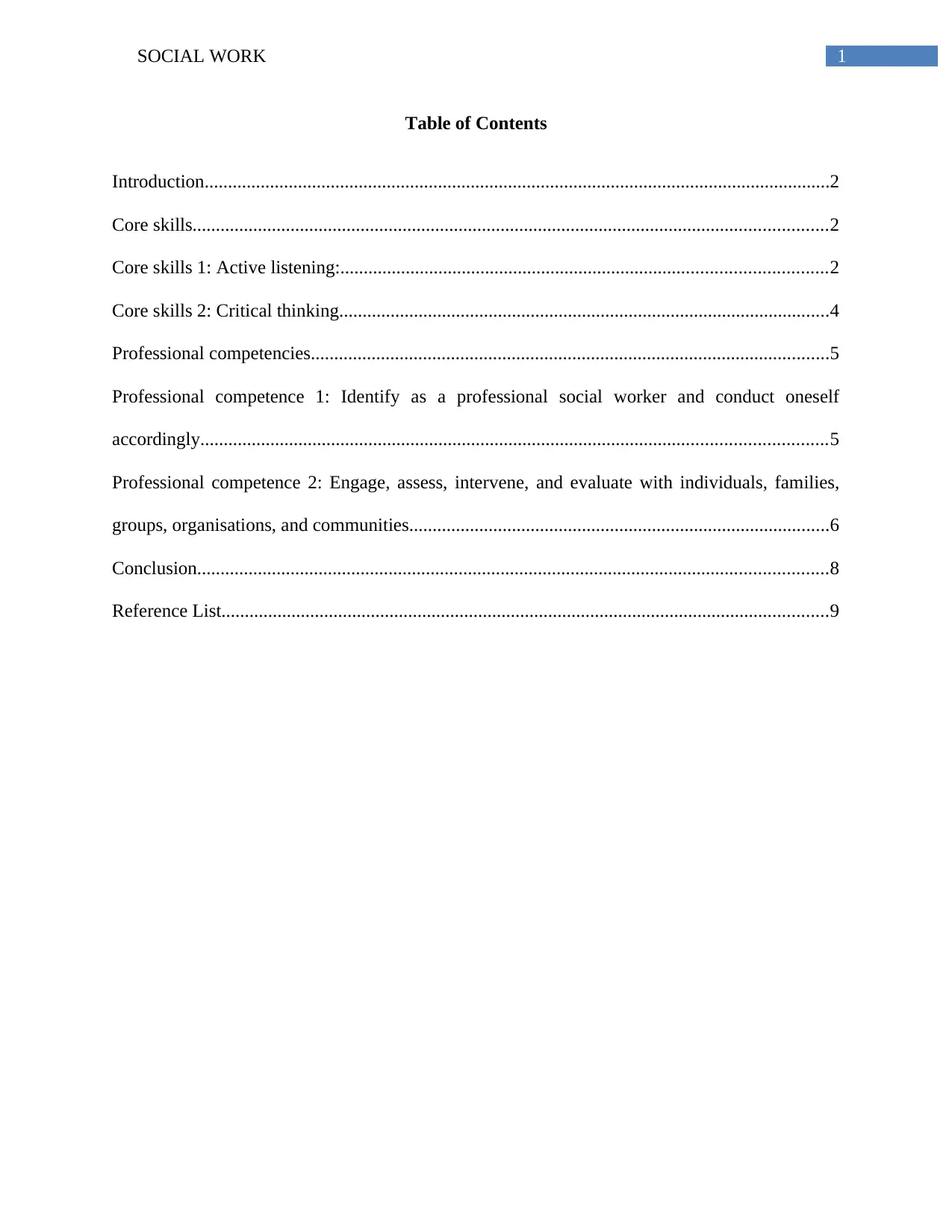
Table of Contents
Introduction......................................................................................................................................2
Core skills........................................................................................................................................2
Core skills 1: Active listening:........................................................................................................2
Core skills 2: Critical thinking.........................................................................................................4
Professional competencies...............................................................................................................5
Professional competence 1: Identify as a professional social worker and conduct oneself
accordingly......................................................................................................................................5
Professional competence 2: Engage, assess, intervene, and evaluate with individuals, families,
groups, organisations, and communities..........................................................................................6
Conclusion.......................................................................................................................................8
Reference List..................................................................................................................................9
Table of Contents
Introduction......................................................................................................................................2
Core skills........................................................................................................................................2
Core skills 1: Active listening:........................................................................................................2
Core skills 2: Critical thinking.........................................................................................................4
Professional competencies...............................................................................................................5
Professional competence 1: Identify as a professional social worker and conduct oneself
accordingly......................................................................................................................................5
Professional competence 2: Engage, assess, intervene, and evaluate with individuals, families,
groups, organisations, and communities..........................................................................................6
Conclusion.......................................................................................................................................8
Reference List..................................................................................................................................9
2SOCIAL WORK
Introduction
Social worker's duties are challenging, yet it is a rewarding career. In addition, social
workers take the responsibilities to help the individuals, groups and families to cope with issues
they are facing in life. Social workers can do direct counselling to families and patients and they
can broader their responsibilities. The social workers need to deal multitude issues of individuals
and they need to handle critical situations also. In this view, in the first part of the essay, two
core skills will be discussed highlighting my values and competencies. In the second part of the
essay, two core competencies of a social worker will be explained.
Core skills
In developing core skills, some skills are common and one must have natural common
sense to do work like a social worker. In this sense, social workers should have qualification.
Core skills 1: Active listening:
One must give full attention in other people's opinion and say. Active listening skill is
one of the major skills that social workers should possess. The social workers should take time to
understand the views about what opposite person is saying. The social workers can ask valid and
appropriate questions not interrupting the flow of discussion (Dubois & Miley, 2012). In this
regard, active listening skills are must have in social working career that can engage the clients
to talk freely without hesitating to share information. Processing actual information can help the
social workers to solve the issues of the client easily and provide proper support. Active listening
is important as the speaker must feel that his/her opinion is valued and listening can be taken as a
vital feature in interpersonal communication.
Introduction
Social worker's duties are challenging, yet it is a rewarding career. In addition, social
workers take the responsibilities to help the individuals, groups and families to cope with issues
they are facing in life. Social workers can do direct counselling to families and patients and they
can broader their responsibilities. The social workers need to deal multitude issues of individuals
and they need to handle critical situations also. In this view, in the first part of the essay, two
core skills will be discussed highlighting my values and competencies. In the second part of the
essay, two core competencies of a social worker will be explained.
Core skills
In developing core skills, some skills are common and one must have natural common
sense to do work like a social worker. In this sense, social workers should have qualification.
Core skills 1: Active listening:
One must give full attention in other people's opinion and say. Active listening skill is
one of the major skills that social workers should possess. The social workers should take time to
understand the views about what opposite person is saying. The social workers can ask valid and
appropriate questions not interrupting the flow of discussion (Dubois & Miley, 2012). In this
regard, active listening skills are must have in social working career that can engage the clients
to talk freely without hesitating to share information. Processing actual information can help the
social workers to solve the issues of the client easily and provide proper support. Active listening
is important as the speaker must feel that his/her opinion is valued and listening can be taken as a
vital feature in interpersonal communication.
⊘ This is a preview!⊘
Do you want full access?
Subscribe today to unlock all pages.

Trusted by 1+ million students worldwide
3SOCIAL WORK
Since my childhood, I have possessed the qualities of active listening and people love to
talk to me. Moreover, in my school life, I was the one to whom all my friends shared their issues
and I liked to resolve their problems and support them. I would like to link individuals with
resources and my activities to achieve the goals. I can advocate benefits one can have from social
workers and social workers need to communicate with having the skills of active listening.
According to Flexner (2011), active listening is about listening genuinely to the clients and
responds the individuals accordingly. Additionally, I believe that listening to other person comes
from the heart and a listening ear that can feel sympathy for individuals. It is important to make a
rapport with the clients in no time that can create a sense of friendship and closeness to the client
and from a sense of trust, the client can share his/her feeling comfortable. While listening, I
would like to sort out problems of the client and it can be helpful to resolve them together. Since
teenage, I have had an open mind and I never judge people according to their views. Each person
has their own sayings and perception.
However, in professional life as social worker, I need to build up active listening skills. In
this sense, I can listen to speakers facing to them and maintain eye contact. In addition, I need to
be attentive. Social workers must listen to words and try to understand voice tone that would be
beneficial about picturing what speaker is saying (Kirst-Ashman, 2010). Interrupting may cause
stop the flow and I would never impose my solutions to the clients. In case of developing the
skills, I have been practising with my academic friends in group studies and with my family
members. I am also an active member of an NGO that provides me opportunity to create active
listening skills.
Since my childhood, I have possessed the qualities of active listening and people love to
talk to me. Moreover, in my school life, I was the one to whom all my friends shared their issues
and I liked to resolve their problems and support them. I would like to link individuals with
resources and my activities to achieve the goals. I can advocate benefits one can have from social
workers and social workers need to communicate with having the skills of active listening.
According to Flexner (2011), active listening is about listening genuinely to the clients and
responds the individuals accordingly. Additionally, I believe that listening to other person comes
from the heart and a listening ear that can feel sympathy for individuals. It is important to make a
rapport with the clients in no time that can create a sense of friendship and closeness to the client
and from a sense of trust, the client can share his/her feeling comfortable. While listening, I
would like to sort out problems of the client and it can be helpful to resolve them together. Since
teenage, I have had an open mind and I never judge people according to their views. Each person
has their own sayings and perception.
However, in professional life as social worker, I need to build up active listening skills. In
this sense, I can listen to speakers facing to them and maintain eye contact. In addition, I need to
be attentive. Social workers must listen to words and try to understand voice tone that would be
beneficial about picturing what speaker is saying (Kirst-Ashman, 2010). Interrupting may cause
stop the flow and I would never impose my solutions to the clients. In case of developing the
skills, I have been practising with my academic friends in group studies and with my family
members. I am also an active member of an NGO that provides me opportunity to create active
listening skills.
Paraphrase This Document
Need a fresh take? Get an instant paraphrase of this document with our AI Paraphraser
4SOCIAL WORK
Core skills 2: Critical thinking
Critical thinking can be described as systematic application of thinking about a real life
situation. Critical thinking in particular situation can be refined and learned by practices as it
needs rational thinking in right time by ‘doing-critiquing' process (Mehta & Wee, 2011). Critical
thinking is important as using instant reasoning is needed to provide correct solutions to the
client and stating strengths and weaknesses of each solution. In this scenario, social worker must
think about alternative solution that might be helpful for the clients. Through active listening and
analytical skills, social workers try to reach conclusion before stating solution to the problems
with appropriate approaches (Wee, 2011). Social workers come across various populations
having experiences, opinions and ideas and these help them to have direct practices and make
critical thinking.
In my perspective, critical thinking is an exercise of logic that helps to reach in solution
in the step-by-step process. Moreover, critical thinking is the judgement of limit of knowledge
and it makes sense of reality in real life. According to Rubin &Babbie (2016), one example of
critical thinking can be given as reading thought and understand the language of the speaker.
Therefore, this process requires understanding the relationship between language and thought as
it is tough to express what is inside mind and thought in clear language. In my case, in my
college life, during the second year, one of my friends began to behave like a suicidal. I tried to
pacify him continually made him understand about living a life. On that occasion, I understood
about critical thinking and answering right on that occasion is very much important. It includes
comparison, evaluation and synthesis of data from various sources and amalgamating them in
personal experiences.
Core skills 2: Critical thinking
Critical thinking can be described as systematic application of thinking about a real life
situation. Critical thinking in particular situation can be refined and learned by practices as it
needs rational thinking in right time by ‘doing-critiquing' process (Mehta & Wee, 2011). Critical
thinking is important as using instant reasoning is needed to provide correct solutions to the
client and stating strengths and weaknesses of each solution. In this scenario, social worker must
think about alternative solution that might be helpful for the clients. Through active listening and
analytical skills, social workers try to reach conclusion before stating solution to the problems
with appropriate approaches (Wee, 2011). Social workers come across various populations
having experiences, opinions and ideas and these help them to have direct practices and make
critical thinking.
In my perspective, critical thinking is an exercise of logic that helps to reach in solution
in the step-by-step process. Moreover, critical thinking is the judgement of limit of knowledge
and it makes sense of reality in real life. According to Rubin &Babbie (2016), one example of
critical thinking can be given as reading thought and understand the language of the speaker.
Therefore, this process requires understanding the relationship between language and thought as
it is tough to express what is inside mind and thought in clear language. In my case, in my
college life, during the second year, one of my friends began to behave like a suicidal. I tried to
pacify him continually made him understand about living a life. On that occasion, I understood
about critical thinking and answering right on that occasion is very much important. It includes
comparison, evaluation and synthesis of data from various sources and amalgamating them in
personal experiences.
5SOCIAL WORK
However, I do think I lack the sense of critical thinking and in critical situation, I cannot
pick out my thoughts correctly. I think, the first thing, I need to develop an understanding links
among various ideas and concepts and I can compose these in writing with bullets. As stated by
Payne (2015), determining significance and relevance about various arguments is important with
identifying the speaker’s consistency in making comments. Social workers need to be consistent
in approaching problems in a systematic way.
Professional competencies
Competencies can be explained as measurable practices which include values, knowledge
and skills. Nonetheless, solving multitudes issues in daily life, the social workers must employ
professional competencies with general skills. In order to achieve these competencies, social
workers need to have extensive training.
Professional competence 1: Identify as a professional social worker and conduct oneself
accordingly
Social workers in the profession represent the mission of social working and its core
values. However, social workers need to know professional history and must commit themselves
to making enhancement of profession. Social workers should follow the way to have professional
growth and conduct. In taking profession of social worker, some of the behaviours need to mould
accordingly. First, it is needed to advocate on behalf of client access and clients must have
services. Secondly, in profession, social workers need to start practice in reflecting personal
reflection and need self-correction wherever needed. The social workers should attend
professional boundaries that demonstrate professional endeavour (Kadushin& Harkness, 2014).
However, I do think I lack the sense of critical thinking and in critical situation, I cannot
pick out my thoughts correctly. I think, the first thing, I need to develop an understanding links
among various ideas and concepts and I can compose these in writing with bullets. As stated by
Payne (2015), determining significance and relevance about various arguments is important with
identifying the speaker’s consistency in making comments. Social workers need to be consistent
in approaching problems in a systematic way.
Professional competencies
Competencies can be explained as measurable practices which include values, knowledge
and skills. Nonetheless, solving multitudes issues in daily life, the social workers must employ
professional competencies with general skills. In order to achieve these competencies, social
workers need to have extensive training.
Professional competence 1: Identify as a professional social worker and conduct oneself
accordingly
Social workers in the profession represent the mission of social working and its core
values. However, social workers need to know professional history and must commit themselves
to making enhancement of profession. Social workers should follow the way to have professional
growth and conduct. In taking profession of social worker, some of the behaviours need to mould
accordingly. First, it is needed to advocate on behalf of client access and clients must have
services. Secondly, in profession, social workers need to start practice in reflecting personal
reflection and need self-correction wherever needed. The social workers should attend
professional boundaries that demonstrate professional endeavour (Kadushin& Harkness, 2014).
⊘ This is a preview!⊘
Do you want full access?
Subscribe today to unlock all pages.
Trusted by 1+ million students worldwide
6SOCIAL WORK
Communication skills should be enhanced with engaging career learning. Moreover, social
workers can use consultation supervision in polishing professional conduct.
In my opinion, in developing a career in social work, it is needed to be sure in making
professional development plan. Moreover, behaviour and appearance as social worker can play a
vital role in making profession as social worker. I want to act accordingly the need of the
situation as social worker and always actively seek the opportunities to flourish myself. While
working as an NGO member in my surrounding, I have been doing the work under work Practice
Standards 2013. However, in Singapore, it is observed that social working is based on social
justice, service, dignity, integrity and competence. I would like to follow primary responsibility
towards clients and foster the highest self-determination. I would like to respect the privacy of
distress people and always charge the fees that would be fair according to Singapore's regulation.
Professional competence 2: Engage, assess, intervene, and evaluate with individuals,
families, groups, organisations, and communities
Professional practice is related to interactive and dynamic engagement to intervene and
evaluate the multiple levels. In addition, social workers must have the knowledge to practice
with families, individuals and organisations.
Engagement:
It is related to the preparation of action with families, organisations that can use empathy
in interpersonal working. I believe in developing the mutual focus on desired outcomes and
working process. In order to engage the clients, I think, I have to develop empathy towards
clients. In addition, practice knowledge is necessary for implementing evidence-based practices.
Communication skills should be enhanced with engaging career learning. Moreover, social
workers can use consultation supervision in polishing professional conduct.
In my opinion, in developing a career in social work, it is needed to be sure in making
professional development plan. Moreover, behaviour and appearance as social worker can play a
vital role in making profession as social worker. I want to act accordingly the need of the
situation as social worker and always actively seek the opportunities to flourish myself. While
working as an NGO member in my surrounding, I have been doing the work under work Practice
Standards 2013. However, in Singapore, it is observed that social working is based on social
justice, service, dignity, integrity and competence. I would like to follow primary responsibility
towards clients and foster the highest self-determination. I would like to respect the privacy of
distress people and always charge the fees that would be fair according to Singapore's regulation.
Professional competence 2: Engage, assess, intervene, and evaluate with individuals,
families, groups, organisations, and communities
Professional practice is related to interactive and dynamic engagement to intervene and
evaluate the multiple levels. In addition, social workers must have the knowledge to practice
with families, individuals and organisations.
Engagement:
It is related to the preparation of action with families, organisations that can use empathy
in interpersonal working. I believe in developing the mutual focus on desired outcomes and
working process. In order to engage the clients, I think, I have to develop empathy towards
clients. In addition, practice knowledge is necessary for implementing evidence-based practices.
Paraphrase This Document
Need a fresh take? Get an instant paraphrase of this document with our AI Paraphraser
7SOCIAL WORK
In this regard, the social workers need to prepare substantively and effectively with taking the
action for families, individuals, communities and organisations.
Assessment:
Social workers have the responsibility of organising, collect and interpret various data of
reviewing client's limitations and strengths (Miley, O'Melia& DuBois, 2016). In order to assess
the improvement of client, it is necessary to collect, interpret and organise data. Mutually
policies and intervention are important to advocating and providing leadership qualities of social
workers. I believe in working together with the client and making intervention goals with
selected objectives. I have been with the strategy with selecting appropriate strategies in
intervention.
Intervention:
In this respect, social workers should initiate in achieving organizational objectives. It is
needed as professional norms to resolve the issues of clients’. In order to enhance the prevention
polices that can enhance client’s capacities (Hepworth, Rooney, Rooney & Strom-Gottfried,
2016). However, in advocating, mediating and negotiating the issues, the intervention police are
significant. I think, in intervening of clients, technological advancements and effectiveness of
practices are needed. In professional standard, it is significant o negotiate, advocate and mediate
with client.
Evaluation:
I think about this to improve the evaluating the intervention of the client’s issues with
monitoring progress. Social workers can design methods of evaluation in taking the programme
In this regard, the social workers need to prepare substantively and effectively with taking the
action for families, individuals, communities and organisations.
Assessment:
Social workers have the responsibility of organising, collect and interpret various data of
reviewing client's limitations and strengths (Miley, O'Melia& DuBois, 2016). In order to assess
the improvement of client, it is necessary to collect, interpret and organise data. Mutually
policies and intervention are important to advocating and providing leadership qualities of social
workers. I believe in working together with the client and making intervention goals with
selected objectives. I have been with the strategy with selecting appropriate strategies in
intervention.
Intervention:
In this respect, social workers should initiate in achieving organizational objectives. It is
needed as professional norms to resolve the issues of clients’. In order to enhance the prevention
polices that can enhance client’s capacities (Hepworth, Rooney, Rooney & Strom-Gottfried,
2016). However, in advocating, mediating and negotiating the issues, the intervention police are
significant. I think, in intervening of clients, technological advancements and effectiveness of
practices are needed. In professional standard, it is significant o negotiate, advocate and mediate
with client.
Evaluation:
I think about this to improve the evaluating the intervention of the client’s issues with
monitoring progress. Social workers can design methods of evaluation in taking the programme
8SOCIAL WORK
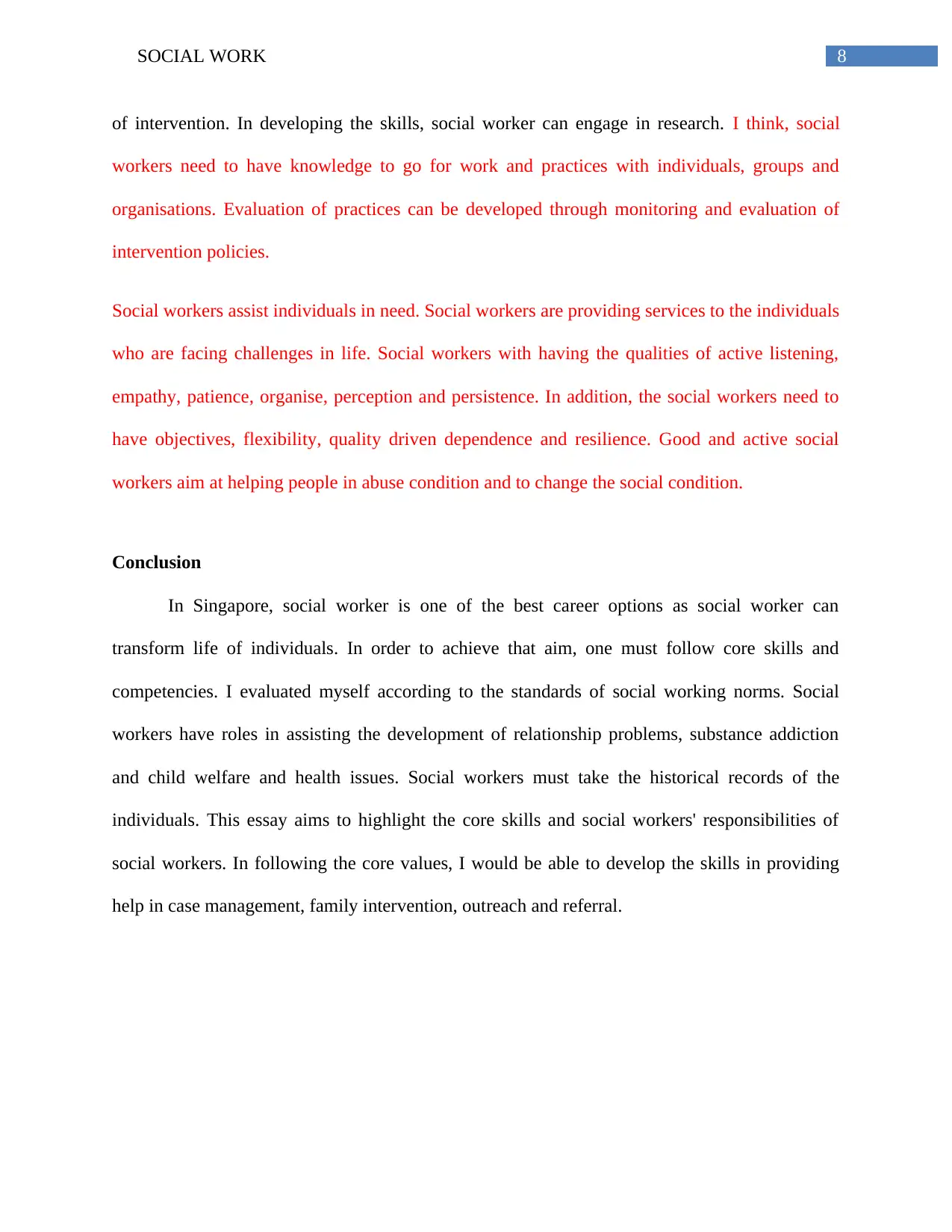
of intervention. In developing the skills, social worker can engage in research. I think, social
workers need to have knowledge to go for work and practices with individuals, groups and
organisations. Evaluation of practices can be developed through monitoring and evaluation of
intervention policies.
Social workers assist individuals in need. Social workers are providing services to the individuals
who are facing challenges in life. Social workers with having the qualities of active listening,
empathy, patience, organise, perception and persistence. In addition, the social workers need to
have objectives, flexibility, quality driven dependence and resilience. Good and active social
workers aim at helping people in abuse condition and to change the social condition.
Conclusion
In Singapore, social worker is one of the best career options as social worker can
transform life of individuals. In order to achieve that aim, one must follow core skills and
competencies. I evaluated myself according to the standards of social working norms. Social
workers have roles in assisting the development of relationship problems, substance addiction
and child welfare and health issues. Social workers must take the historical records of the
individuals. This essay aims to highlight the core skills and social workers' responsibilities of
social workers. In following the core values, I would be able to develop the skills in providing
help in case management, family intervention, outreach and referral.
of intervention. In developing the skills, social worker can engage in research. I think, social
workers need to have knowledge to go for work and practices with individuals, groups and
organisations. Evaluation of practices can be developed through monitoring and evaluation of
intervention policies.
Social workers assist individuals in need. Social workers are providing services to the individuals
who are facing challenges in life. Social workers with having the qualities of active listening,
empathy, patience, organise, perception and persistence. In addition, the social workers need to
have objectives, flexibility, quality driven dependence and resilience. Good and active social
workers aim at helping people in abuse condition and to change the social condition.
Conclusion
In Singapore, social worker is one of the best career options as social worker can
transform life of individuals. In order to achieve that aim, one must follow core skills and
competencies. I evaluated myself according to the standards of social working norms. Social
workers have roles in assisting the development of relationship problems, substance addiction
and child welfare and health issues. Social workers must take the historical records of the
individuals. This essay aims to highlight the core skills and social workers' responsibilities of
social workers. In following the core values, I would be able to develop the skills in providing
help in case management, family intervention, outreach and referral.
⊘ This is a preview!⊘
Do you want full access?
Subscribe today to unlock all pages.
Trusted by 1+ million students worldwide
9SOCIAL WORK
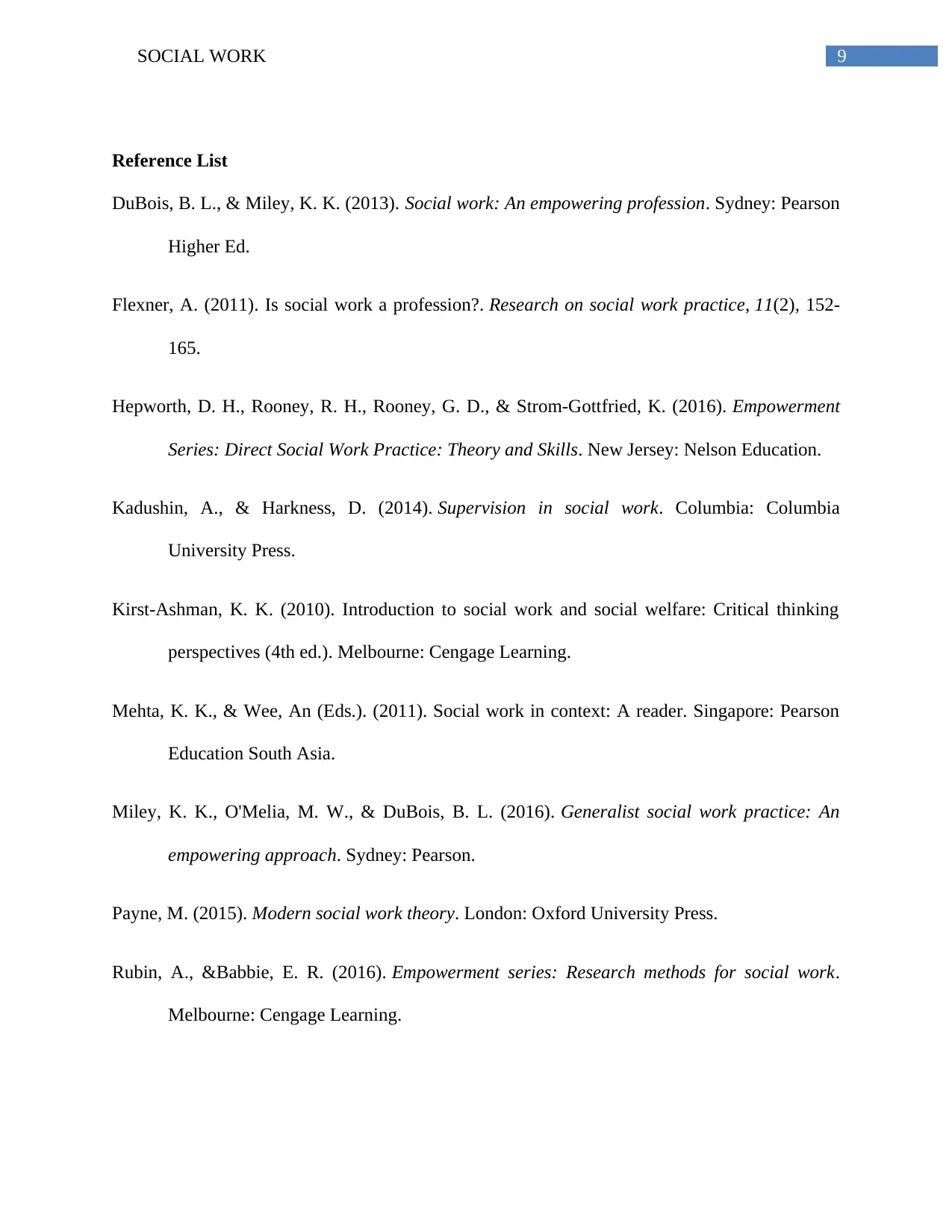
Reference List
DuBois, B. L., & Miley, K. K. (2013). Social work: An empowering profession. Sydney: Pearson
Higher Ed.
Flexner, A. (2011). Is social work a profession?. Research on social work practice, 11(2), 152-
165.
Hepworth, D. H., Rooney, R. H., Rooney, G. D., & Strom-Gottfried, K. (2016). Empowerment
Series: Direct Social Work Practice: Theory and Skills. New Jersey: Nelson Education.
Kadushin, A., & Harkness, D. (2014). Supervision in social work. Columbia: Columbia
University Press.
Kirst-Ashman, K. K. (2010). Introduction to social work and social welfare: Critical thinking
perspectives (4th ed.). Melbourne: Cengage Learning.
Mehta, K. K., & Wee, An (Eds.). (2011). Social work in context: A reader. Singapore: Pearson
Education South Asia.
Miley, K. K., O'Melia, M. W., & DuBois, B. L. (2016). Generalist social work practice: An
empowering approach. Sydney: Pearson.
Payne, M. (2015). Modern social work theory. London: Oxford University Press.
Rubin, A., &Babbie, E. R. (2016). Empowerment series: Research methods for social work.
Melbourne: Cengage Learning.
Reference List
DuBois, B. L., & Miley, K. K. (2013). Social work: An empowering profession. Sydney: Pearson
Higher Ed.
Flexner, A. (2011). Is social work a profession?. Research on social work practice, 11(2), 152-
165.
Hepworth, D. H., Rooney, R. H., Rooney, G. D., & Strom-Gottfried, K. (2016). Empowerment
Series: Direct Social Work Practice: Theory and Skills. New Jersey: Nelson Education.
Kadushin, A., & Harkness, D. (2014). Supervision in social work. Columbia: Columbia
University Press.
Kirst-Ashman, K. K. (2010). Introduction to social work and social welfare: Critical thinking
perspectives (4th ed.). Melbourne: Cengage Learning.
Mehta, K. K., & Wee, An (Eds.). (2011). Social work in context: A reader. Singapore: Pearson
Education South Asia.
Miley, K. K., O'Melia, M. W., & DuBois, B. L. (2016). Generalist social work practice: An
empowering approach. Sydney: Pearson.
Payne, M. (2015). Modern social work theory. London: Oxford University Press.
Rubin, A., &Babbie, E. R. (2016). Empowerment series: Research methods for social work.
Melbourne: Cengage Learning.
Paraphrase This Document
Need a fresh take? Get an instant paraphrase of this document with our AI Paraphraser
10SOCIAL WORK
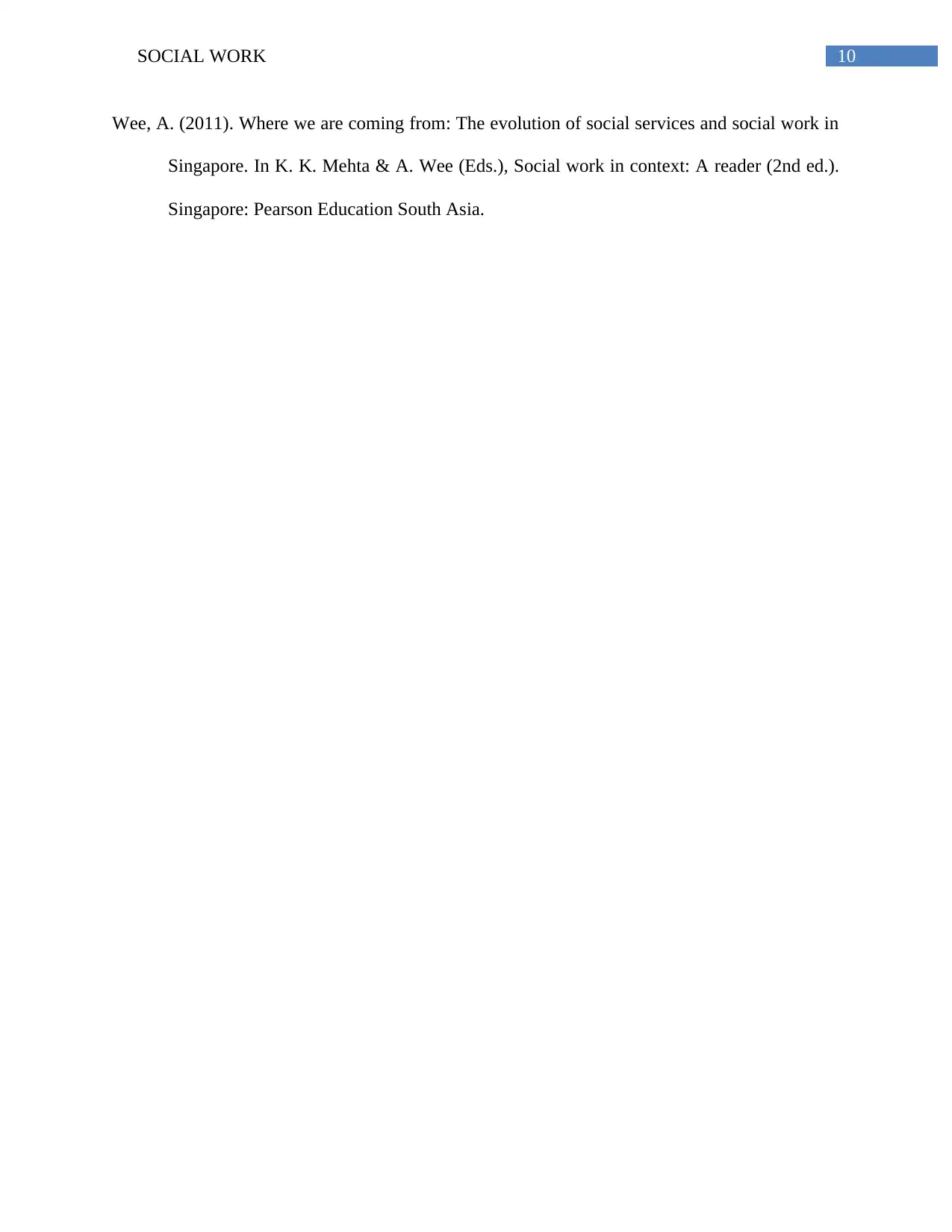
Wee, A. (2011). Where we are coming from: The evolution of social services and social work in
Singapore. In K. K. Mehta & A. Wee (Eds.), Social work in context: A reader (2nd ed.).
Singapore: Pearson Education South Asia.
Wee, A. (2011). Where we are coming from: The evolution of social services and social work in
Singapore. In K. K. Mehta & A. Wee (Eds.), Social work in context: A reader (2nd ed.).
Singapore: Pearson Education South Asia.

1 out of 11


Related Documents


Your All-in-One AI-Powered Toolkit for Academic Success.
+13062052269
info@desklib.com
Available 24*7 on WhatsApp / Email
![[object Object]](/_next/static/media/star-bottom.7253800d.svg)
Unlock your academic potential
Copyright © 2020–2026 A2Z Services. All Rights Reserved. Developed and managed by ZUCOL.