KII4023 - Manage Inventory: Purchasing, Stock Control & Quality
VerifiedAdded on 2023/06/18
|37
|8219
|353
Homework Assignment
AI Summary
This assignment solution for KII4023 Manage Inventory covers various aspects of inventory management within a specific industry sector, focusing on product features, quality expectations, and order form formats. It explores forecasting methods for calculating required quantities of goods, job costing inclusions that may lead to price limitations, and methods for sourcing suppliers and product information. The solution also details purchase order specifications, individual stock ordering responsibilities, standardized formats for costing a restaurant menu, and standard purchase specifications. Furthermore, it describes how to use buffet designs, catering orders, customer specifications, event orders, function orders, menus, recipes, and standard yields to determine purchase requirements. Finally, the assignment lists alcoholic and non-alcoholic beverages that may need to be purchased by a business.
KII4023 : - Manage Inventory

Paraphrase This Document
Need a fresh take? Get an instant paraphrase of this document with our AI Paraphraser

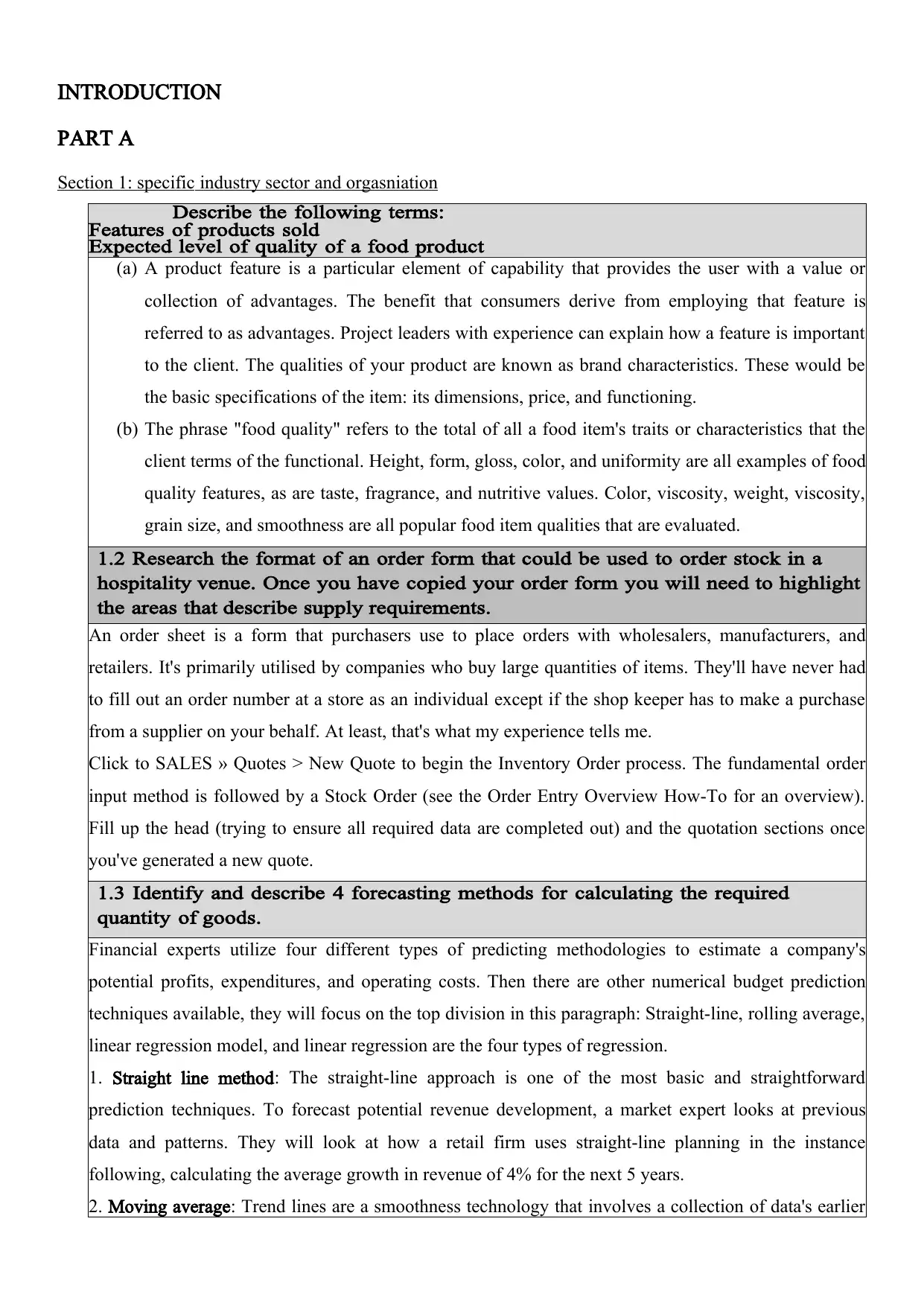
INTRODUCTION
PART A
Section 1: specific industry sector and orgasniation
Describe the following terms:
Features of products sold
Expected level of quality of a food product
(a) A product feature is a particular element of capability that provides the user with a value or
collection of advantages. The benefit that consumers derive from employing that feature is
referred to as advantages. Project leaders with experience can explain how a feature is important
to the client. The qualities of your product are known as brand characteristics. These would be
the basic specifications of the item: its dimensions, price, and functioning.
(b) The phrase "food quality" refers to the total of all a food item's traits or characteristics that the
client terms of the functional. Height, form, gloss, color, and uniformity are all examples of food
quality features, as are taste, fragrance, and nutritive values. Color, viscosity, weight, viscosity,
grain size, and smoothness are all popular food item qualities that are evaluated.
1.2 Research the format of an order form that could be used to order stock in a
hospitality venue. Once you have copied your order form you will need to highlight
the areas that describe supply requirements.
An order sheet is a form that purchasers use to place orders with wholesalers, manufacturers, and
retailers. It's primarily utilised by companies who buy large quantities of items. They'll have never had
to fill out an order number at a store as an individual except if the shop keeper has to make a purchase
from a supplier on your behalf. At least, that's what my experience tells me.
Click to SALES » Quotes > New Quote to begin the Inventory Order process. The fundamental order
input method is followed by a Stock Order (see the Order Entry Overview How-To for an overview).
Fill up the head (trying to ensure all required data are completed out) and the quotation sections once
you've generated a new quote.
1.3 Identify and describe 4 forecasting methods for calculating the required
quantity of goods.
Financial experts utilize four different types of predicting methodologies to estimate a company's
potential profits, expenditures, and operating costs. Then there are other numerical budget prediction
techniques available, they will focus on the top division in this paragraph: Straight-line, rolling average,
linear regression model, and linear regression are the four types of regression.
1. Straight line method: The straight-line approach is one of the most basic and straightforward
prediction techniques. To forecast potential revenue development, a market expert looks at previous
data and patterns. They will look at how a retail firm uses straight-line planning in the instance
following, calculating the average growth in revenue of 4% for the next 5 years.
2. Moving average: Trend lines are a smoothness technology that involves a collection of data's earlier
PART A
Section 1: specific industry sector and orgasniation
Describe the following terms:
Features of products sold
Expected level of quality of a food product
(a) A product feature is a particular element of capability that provides the user with a value or
collection of advantages. The benefit that consumers derive from employing that feature is
referred to as advantages. Project leaders with experience can explain how a feature is important
to the client. The qualities of your product are known as brand characteristics. These would be
the basic specifications of the item: its dimensions, price, and functioning.
(b) The phrase "food quality" refers to the total of all a food item's traits or characteristics that the
client terms of the functional. Height, form, gloss, color, and uniformity are all examples of food
quality features, as are taste, fragrance, and nutritive values. Color, viscosity, weight, viscosity,
grain size, and smoothness are all popular food item qualities that are evaluated.
1.2 Research the format of an order form that could be used to order stock in a
hospitality venue. Once you have copied your order form you will need to highlight
the areas that describe supply requirements.
An order sheet is a form that purchasers use to place orders with wholesalers, manufacturers, and
retailers. It's primarily utilised by companies who buy large quantities of items. They'll have never had
to fill out an order number at a store as an individual except if the shop keeper has to make a purchase
from a supplier on your behalf. At least, that's what my experience tells me.
Click to SALES » Quotes > New Quote to begin the Inventory Order process. The fundamental order
input method is followed by a Stock Order (see the Order Entry Overview How-To for an overview).
Fill up the head (trying to ensure all required data are completed out) and the quotation sections once
you've generated a new quote.
1.3 Identify and describe 4 forecasting methods for calculating the required
quantity of goods.
Financial experts utilize four different types of predicting methodologies to estimate a company's
potential profits, expenditures, and operating costs. Then there are other numerical budget prediction
techniques available, they will focus on the top division in this paragraph: Straight-line, rolling average,
linear regression model, and linear regression are the four types of regression.
1. Straight line method: The straight-line approach is one of the most basic and straightforward
prediction techniques. To forecast potential revenue development, a market expert looks at previous
data and patterns. They will look at how a retail firm uses straight-line planning in the instance
following, calculating the average growth in revenue of 4% for the next 5 years.
2. Moving average: Trend lines are a smoothness technology that involves a collection of data's earlier
⊘ This is a preview!⊘
Do you want full access?
Subscribe today to unlock all pages.

Trusted by 1+ million students worldwide
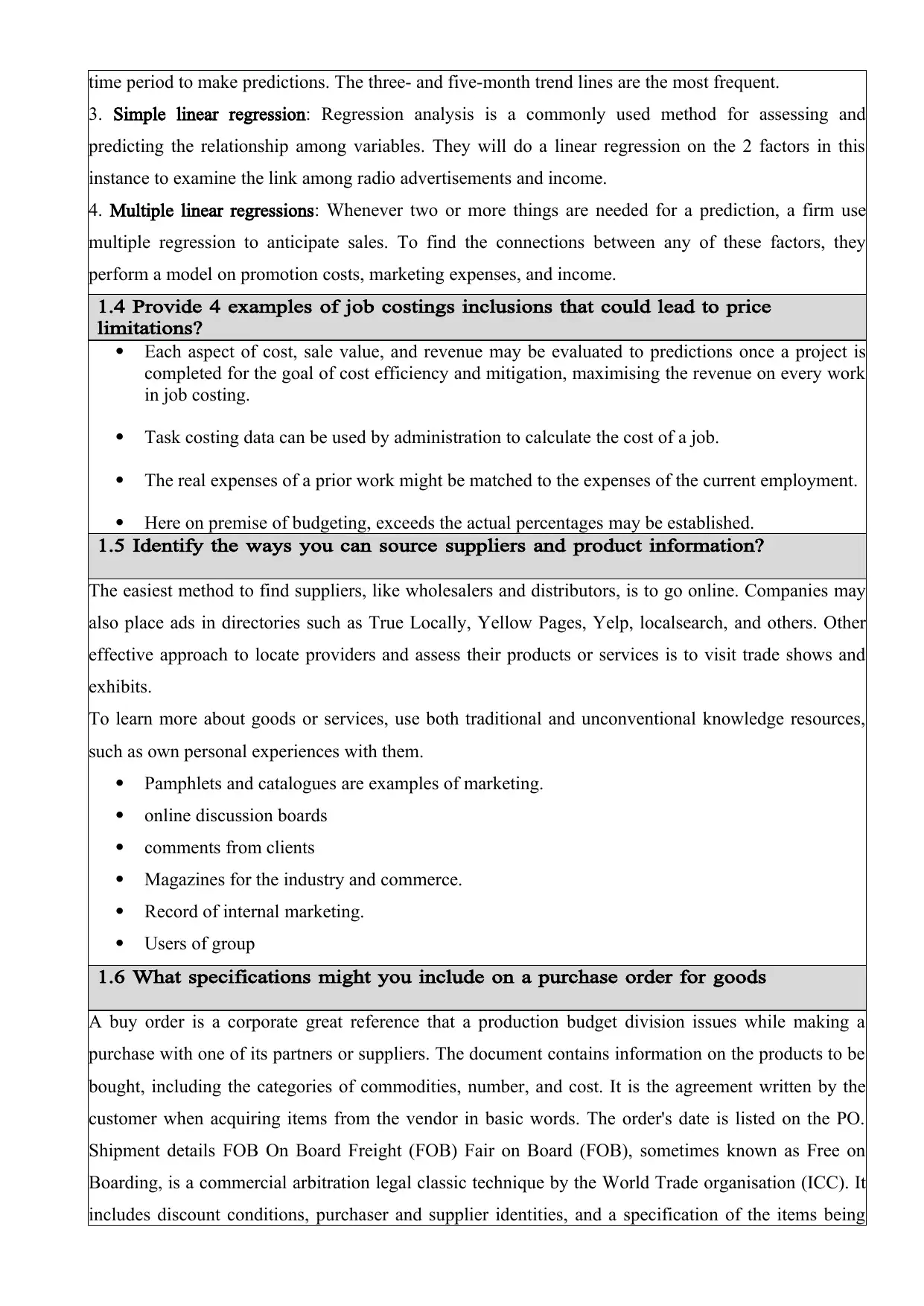
time period to make predictions. The three- and five-month trend lines are the most frequent.
3. Simple linear regression: Regression analysis is a commonly used method for assessing and
predicting the relationship among variables. They will do a linear regression on the 2 factors in this
instance to examine the link among radio advertisements and income.
4. Multiple linear regressions: Whenever two or more things are needed for a prediction, a firm use
multiple regression to anticipate sales. To find the connections between any of these factors, they
perform a model on promotion costs, marketing expenses, and income.
1.4 Provide 4 examples of job costings inclusions that could lead to price
limitations?
Each aspect of cost, sale value, and revenue may be evaluated to predictions once a project is
completed for the goal of cost efficiency and mitigation, maximising the revenue on every work
in job costing.
Task costing data can be used by administration to calculate the cost of a job.
The real expenses of a prior work might be matched to the expenses of the current employment.
Here on premise of budgeting, exceeds the actual percentages may be established.
1.5 Identify the ways you can source suppliers and product information?
The easiest method to find suppliers, like wholesalers and distributors, is to go online. Companies may
also place ads in directories such as True Locally, Yellow Pages, Yelp, localsearch, and others. Other
effective approach to locate providers and assess their products or services is to visit trade shows and
exhibits.
To learn more about goods or services, use both traditional and unconventional knowledge resources,
such as own personal experiences with them.
Pamphlets and catalogues are examples of marketing.
online discussion boards
comments from clients
Magazines for the industry and commerce.
Record of internal marketing.
Users of group
1.6 What specifications might you include on a purchase order for goods
A buy order is a corporate great reference that a production budget division issues while making a
purchase with one of its partners or suppliers. The document contains information on the products to be
bought, including the categories of commodities, number, and cost. It is the agreement written by the
customer when acquiring items from the vendor in basic words. The order's date is listed on the PO.
Shipment details FOB On Board Freight (FOB) Fair on Board (FOB), sometimes known as Free on
Boarding, is a commercial arbitration legal classic technique by the World Trade organisation (ICC). It
includes discount conditions, purchaser and supplier identities, and a specification of the items being
3. Simple linear regression: Regression analysis is a commonly used method for assessing and
predicting the relationship among variables. They will do a linear regression on the 2 factors in this
instance to examine the link among radio advertisements and income.
4. Multiple linear regressions: Whenever two or more things are needed for a prediction, a firm use
multiple regression to anticipate sales. To find the connections between any of these factors, they
perform a model on promotion costs, marketing expenses, and income.
1.4 Provide 4 examples of job costings inclusions that could lead to price
limitations?
Each aspect of cost, sale value, and revenue may be evaluated to predictions once a project is
completed for the goal of cost efficiency and mitigation, maximising the revenue on every work
in job costing.
Task costing data can be used by administration to calculate the cost of a job.
The real expenses of a prior work might be matched to the expenses of the current employment.
Here on premise of budgeting, exceeds the actual percentages may be established.
1.5 Identify the ways you can source suppliers and product information?
The easiest method to find suppliers, like wholesalers and distributors, is to go online. Companies may
also place ads in directories such as True Locally, Yellow Pages, Yelp, localsearch, and others. Other
effective approach to locate providers and assess their products or services is to visit trade shows and
exhibits.
To learn more about goods or services, use both traditional and unconventional knowledge resources,
such as own personal experiences with them.
Pamphlets and catalogues are examples of marketing.
online discussion boards
comments from clients
Magazines for the industry and commerce.
Record of internal marketing.
Users of group
1.6 What specifications might you include on a purchase order for goods
A buy order is a corporate great reference that a production budget division issues while making a
purchase with one of its partners or suppliers. The document contains information on the products to be
bought, including the categories of commodities, number, and cost. It is the agreement written by the
customer when acquiring items from the vendor in basic words. The order's date is listed on the PO.
Shipment details FOB On Board Freight (FOB) Fair on Board (FOB), sometimes known as Free on
Boarding, is a commercial arbitration legal classic technique by the World Trade organisation (ICC). It
includes discount conditions, purchaser and supplier identities, and a specification of the items being
Paraphrase This Document
Need a fresh take? Get an instant paraphrase of this document with our AI Paraphraser
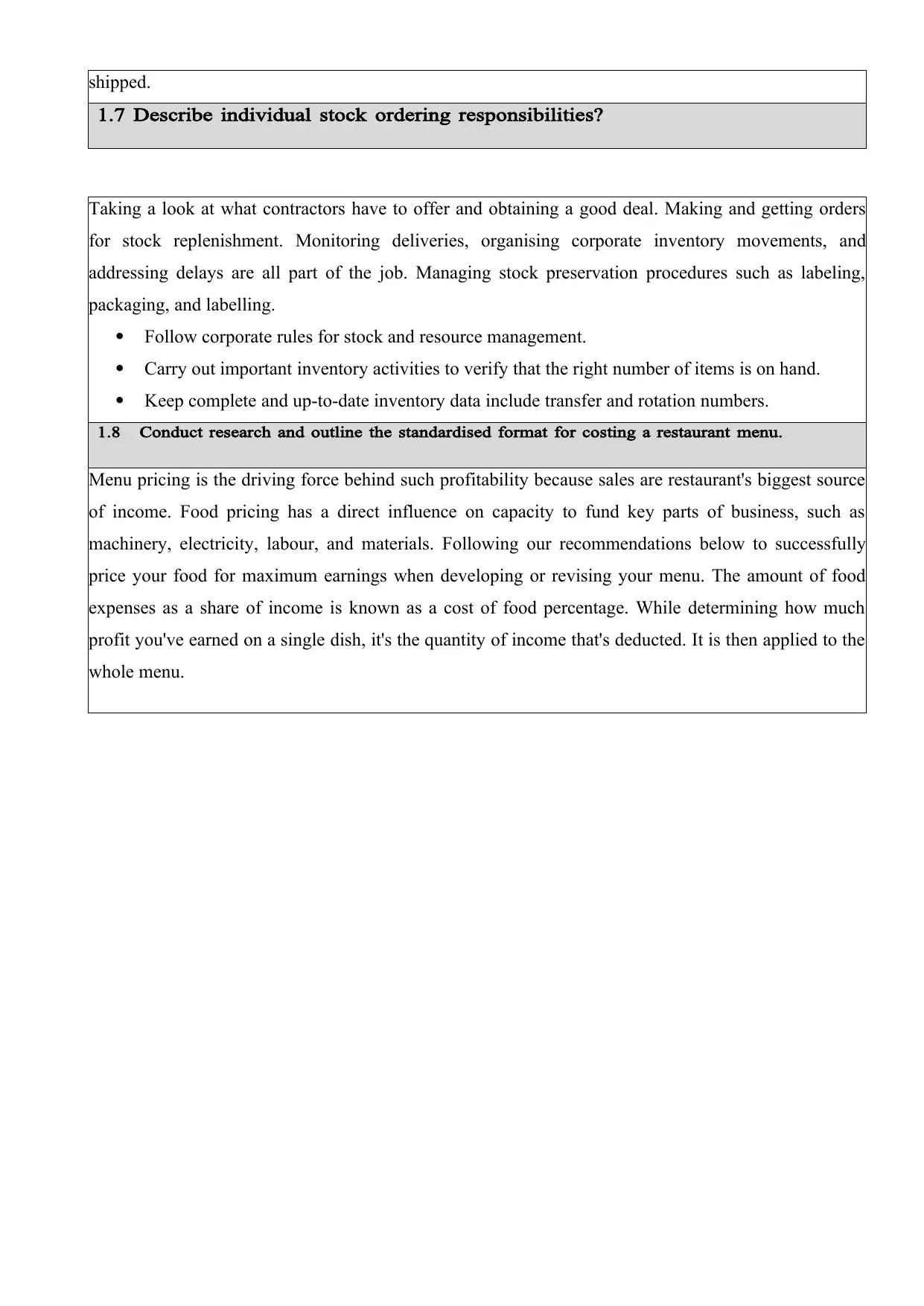
shipped.
1.7 Describe individual stock ordering responsibilities?
Taking a look at what contractors have to offer and obtaining a good deal. Making and getting orders
for stock replenishment. Monitoring deliveries, organising corporate inventory movements, and
addressing delays are all part of the job. Managing stock preservation procedures such as labeling,
packaging, and labelling.
Follow corporate rules for stock and resource management.
Carry out important inventory activities to verify that the right number of items is on hand.
Keep complete and up-to-date inventory data include transfer and rotation numbers.
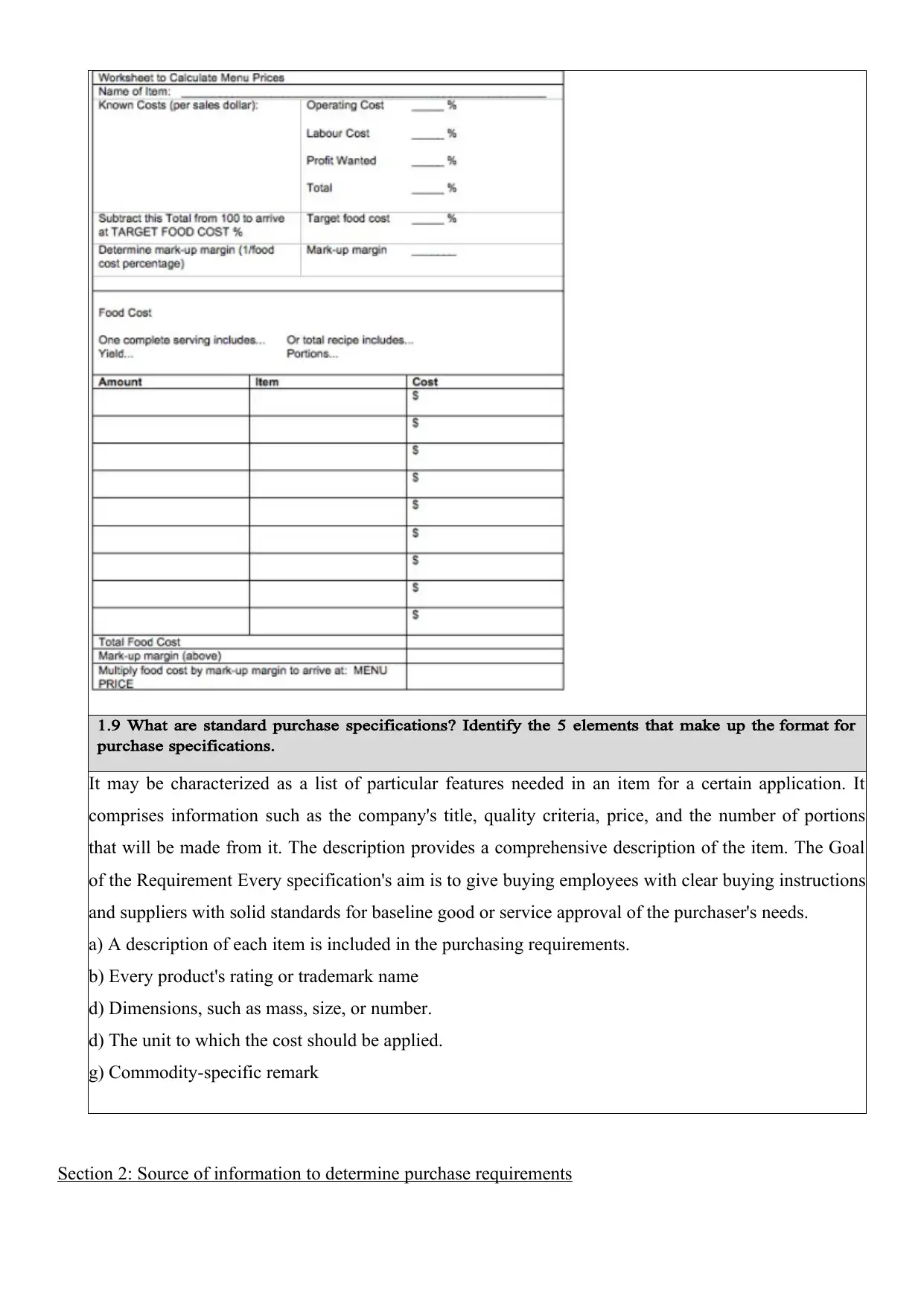
1.8 Conduct research and outline the standardised format for costing a restaurant menu.
Menu pricing is the driving force behind such profitability because sales are restaurant's biggest source
of income. Food pricing has a direct influence on capacity to fund key parts of business, such as
machinery, electricity, labour, and materials. Following our recommendations below to successfully
price your food for maximum earnings when developing or revising your menu. The amount of food
expenses as a share of income is known as a cost of food percentage. While determining how much
profit you've earned on a single dish, it's the quantity of income that's deducted. It is then applied to the
whole menu.
1.7 Describe individual stock ordering responsibilities?
Taking a look at what contractors have to offer and obtaining a good deal. Making and getting orders
for stock replenishment. Monitoring deliveries, organising corporate inventory movements, and
addressing delays are all part of the job. Managing stock preservation procedures such as labeling,
packaging, and labelling.
Follow corporate rules for stock and resource management.
Carry out important inventory activities to verify that the right number of items is on hand.
Keep complete and up-to-date inventory data include transfer and rotation numbers.
1.8 Conduct research and outline the standardised format for costing a restaurant menu.
Menu pricing is the driving force behind such profitability because sales are restaurant's biggest source
of income. Food pricing has a direct influence on capacity to fund key parts of business, such as
machinery, electricity, labour, and materials. Following our recommendations below to successfully
price your food for maximum earnings when developing or revising your menu. The amount of food
expenses as a share of income is known as a cost of food percentage. While determining how much
profit you've earned on a single dish, it's the quantity of income that's deducted. It is then applied to the
whole menu.
1.9 What are standard purchase specifications? Identify the 5 elements that make up the format for
purchase specifications.
It may be characterized as a list of particular features needed in an item for a certain application. It
comprises information such as the company's title, quality criteria, price, and the number of portions
that will be made from it. The description provides a comprehensive description of the item. The Goal
of the Requirement Every specification's aim is to give buying employees with clear buying instructions
and suppliers with solid standards for baseline good or service approval of the purchaser's needs.
a) A description of each item is included in the purchasing requirements.
b) Every product's rating or trademark name
d) Dimensions, such as mass, size, or number.
d) The unit to which the cost should be applied.
g) Commodity-specific remark
Section 2: Source of information to determine purchase requirements
purchase specifications.
It may be characterized as a list of particular features needed in an item for a certain application. It
comprises information such as the company's title, quality criteria, price, and the number of portions
that will be made from it. The description provides a comprehensive description of the item. The Goal
of the Requirement Every specification's aim is to give buying employees with clear buying instructions
and suppliers with solid standards for baseline good or service approval of the purchaser's needs.
a) A description of each item is included in the purchasing requirements.
b) Every product's rating or trademark name
d) Dimensions, such as mass, size, or number.
d) The unit to which the cost should be applied.
g) Commodity-specific remark
Section 2: Source of information to determine purchase requirements
⊘ This is a preview!⊘
Do you want full access?
Subscribe today to unlock all pages.
Trusted by 1+ million students worldwide
Describe, how you might use each of the following sources of information to determine purchase
requirements.
a) Buffet designs
b) Catering orders
c) Customer specifications: Numbers and special requests
d) Event orders and running sheets
e) Function orders
f) Menus
g) Recipes
h) Standard yields
(a) Buffet design: A buffet is essentially a sideboard, hutch, or tasting menus where you arrange
goods that really need for a dinner but can't seem to fit on the dining room table, such as beverages or
dessert! This area is ideal for storing special occasion dishes, bed sheets, and lunches and dinners. In
a dining table, a buffet is a helpful adjunct.
(b) Catering orders: Catering orders are more expensive delivery that includes cooked, ready-to-eat meals.
They must be collected up and gave on schedule to clients who really are prepared to eat them since they are
system generates. Banquet orders are available in a variety of shapes and sizes, ranging from little to
extremely big. A caterer is a services company who prepares food, sets up things, distributes food, distributes
foods and drinks, or important to clean up a meal on Clark premises, which includes both buildings maintained
by Cornell and those that are leased or contracted for the rest of the course.
(c) Customer specifications: Client specifications are defined as "the sum of the expectations imposed on a
contractor's deliverables and services inside an order as stated by the client." As a consequence, it is a
customer documentation including the conclusions of the requirement gathering and therefore a hit list for a
vendor to fulfill. The Customer Requirements Specification (CRS) is a documentation that is typically used to
organize information systems maintenance. It describes in detail difficulties that customers are experiencing
today and anticipate in the future, challenges that the computer support network anticipates, and any future
business environmental elements that are in the process.
(d) Event orders and running sheet: A run sheet is a collection of operations or events that are ordered in time
order. A running sheet, whether for broadcast or the theater, divides the programme into sections and indicates
which guests will come whenever, for just how long, and at what times.
(e) Function orders: A higher cognitive procedure is one that either accepts or outputs a function as an input.
In contrary to first order operations, which do not accept a functional as a parameter or output a functional as
result, second order features do. As a parameter, they all accept a procedure. Both are greater variables
(f) Menus: A menu is an auditory collection of options to which the user may reply by pushing buttons or
talking out. Phone response services and customer support programmers frequently use this sort of menu. As
the customer digs down to the required area or content, product choice will have to be done repeatedly.
(g) Recipes: It is designed to educate both the system aspects of a meal as well as the aesthetic pairing of taste
and color. A recipe specifies the components and processes that the chef employs in the preparation of his
dishes. This technology enables the caterer to educate and pass on his expertise to his employees.
(h) Standard yields: A standard yield is the output produced whenever an item is prepared according to a
leadership's specific standard techniques of preparing, heating, and portion control. OBJECTIVES • To
established a benchmark for the amount and number of servings that can be obtained from a particular food
requirements.
a) Buffet designs
b) Catering orders
c) Customer specifications: Numbers and special requests
d) Event orders and running sheets
e) Function orders
f) Menus
g) Recipes
h) Standard yields
(a) Buffet design: A buffet is essentially a sideboard, hutch, or tasting menus where you arrange
goods that really need for a dinner but can't seem to fit on the dining room table, such as beverages or
dessert! This area is ideal for storing special occasion dishes, bed sheets, and lunches and dinners. In
a dining table, a buffet is a helpful adjunct.
(b) Catering orders: Catering orders are more expensive delivery that includes cooked, ready-to-eat meals.
They must be collected up and gave on schedule to clients who really are prepared to eat them since they are
system generates. Banquet orders are available in a variety of shapes and sizes, ranging from little to
extremely big. A caterer is a services company who prepares food, sets up things, distributes food, distributes
foods and drinks, or important to clean up a meal on Clark premises, which includes both buildings maintained
by Cornell and those that are leased or contracted for the rest of the course.
(c) Customer specifications: Client specifications are defined as "the sum of the expectations imposed on a
contractor's deliverables and services inside an order as stated by the client." As a consequence, it is a
customer documentation including the conclusions of the requirement gathering and therefore a hit list for a
vendor to fulfill. The Customer Requirements Specification (CRS) is a documentation that is typically used to
organize information systems maintenance. It describes in detail difficulties that customers are experiencing
today and anticipate in the future, challenges that the computer support network anticipates, and any future
business environmental elements that are in the process.
(d) Event orders and running sheet: A run sheet is a collection of operations or events that are ordered in time
order. A running sheet, whether for broadcast or the theater, divides the programme into sections and indicates
which guests will come whenever, for just how long, and at what times.
(e) Function orders: A higher cognitive procedure is one that either accepts or outputs a function as an input.
In contrary to first order operations, which do not accept a functional as a parameter or output a functional as
result, second order features do. As a parameter, they all accept a procedure. Both are greater variables
(f) Menus: A menu is an auditory collection of options to which the user may reply by pushing buttons or
talking out. Phone response services and customer support programmers frequently use this sort of menu. As
the customer digs down to the required area or content, product choice will have to be done repeatedly.
(g) Recipes: It is designed to educate both the system aspects of a meal as well as the aesthetic pairing of taste
and color. A recipe specifies the components and processes that the chef employs in the preparation of his
dishes. This technology enables the caterer to educate and pass on his expertise to his employees.
(h) Standard yields: A standard yield is the output produced whenever an item is prepared according to a
leadership's specific standard techniques of preparing, heating, and portion control. OBJECTIVES • To
established a benchmark for the amount and number of servings that can be obtained from a particular food
Paraphrase This Document
Need a fresh take? Get an instant paraphrase of this document with our AI Paraphraser
product.
Section 3: Goods that need to be purchased by a business
3.1 List 4 alcoholic and 4 non-alcoholic beverages that may need to be purchased by a business
Section 3: Goods that need to be purchased by a business
3.1 List 4 alcoholic and 4 non-alcoholic beverages that may need to be purchased by a business
The quantity of alcohol in drunk and alcohol-free beer is the primary distinction. Alcoholic beers
include some alcohol, whereas alcohol-free beverages have relatively less. A drink's alcohol content
is expressed as a percentage and can be calculated.
Fermentation drinks, distilled drinks or spirit, fortification drinks or liquor wines, and liqueurs and
desserts are the four categories of alcoholic drinks.
Non-alcoholic beverages are divided into four groups:
For serving recommendations, hot beverages include tea, coffee, and chocolates.
Fruit juices: cold - pressed or produced juices that are best served combined with sprits or
drunk straight over ice.
Fresh water water should be usually served or at room temp without ice; artificial additives
should be given combined with alcohol or straight with ice.
Cordials/Syrups (sirops, squashes) - used to sweeten and taste blended beverages, or
reduced with steam to create a ‘soft' drink that may be served either with ice.
3.2 When purchasing goods, what are the 6 types of foods that might be required to be purchased?
The nutrients required for life and development are found in foods from the fundamental food
categories. These are also referred to as "daily foods." Each food category supplies a different set of
minerals, and they all play a part in how the body works. Greens, legumes, and fruit, in especially,
defend prevent sickness and are vital components of a balanced diet.
The basic food groups are:
Breads, cereals, rice, pasta, noodles and other grains
Vegetables and legumes
fruit
Milk, yoghurt, cheese and/or alternatives
Lean meat, fish, poultry, eggs, nuts and legumes.
3.3 Other than food, identify at least 7 types of goods that may need to be purchased by a hospitality business?
The hospitality industry is one of the country's most wide and complex businesses, utilising large
numbers of people and generating trillions of dollars in overall income. It's a wonderful career
option for many people, but also covers a wide range of industries that we encounter in everyday
life basis. The hospitality business is a subset of the wider customer economy, as per the Bureau of
Labor And statistics. It is centred on user satisfaction and satisfying the wants and aspirations of
both people and families, usually in a leisure position instead of a formal, commercial
include some alcohol, whereas alcohol-free beverages have relatively less. A drink's alcohol content
is expressed as a percentage and can be calculated.
Fermentation drinks, distilled drinks or spirit, fortification drinks or liquor wines, and liqueurs and
desserts are the four categories of alcoholic drinks.
Non-alcoholic beverages are divided into four groups:
For serving recommendations, hot beverages include tea, coffee, and chocolates.
Fruit juices: cold - pressed or produced juices that are best served combined with sprits or
drunk straight over ice.
Fresh water water should be usually served or at room temp without ice; artificial additives
should be given combined with alcohol or straight with ice.
Cordials/Syrups (sirops, squashes) - used to sweeten and taste blended beverages, or
reduced with steam to create a ‘soft' drink that may be served either with ice.
3.2 When purchasing goods, what are the 6 types of foods that might be required to be purchased?
The nutrients required for life and development are found in foods from the fundamental food
categories. These are also referred to as "daily foods." Each food category supplies a different set of
minerals, and they all play a part in how the body works. Greens, legumes, and fruit, in especially,
defend prevent sickness and are vital components of a balanced diet.
The basic food groups are:
Breads, cereals, rice, pasta, noodles and other grains
Vegetables and legumes
fruit
Milk, yoghurt, cheese and/or alternatives
Lean meat, fish, poultry, eggs, nuts and legumes.
3.3 Other than food, identify at least 7 types of goods that may need to be purchased by a hospitality business?
The hospitality industry is one of the country's most wide and complex businesses, utilising large
numbers of people and generating trillions of dollars in overall income. It's a wonderful career
option for many people, but also covers a wide range of industries that we encounter in everyday
life basis. The hospitality business is a subset of the wider customer economy, as per the Bureau of
Labor And statistics. It is centred on user satisfaction and satisfying the wants and aspirations of
both people and families, usually in a leisure position instead of a formal, commercial
⊘ This is a preview!⊘
Do you want full access?
Subscribe today to unlock all pages.
Trusted by 1+ million students worldwide
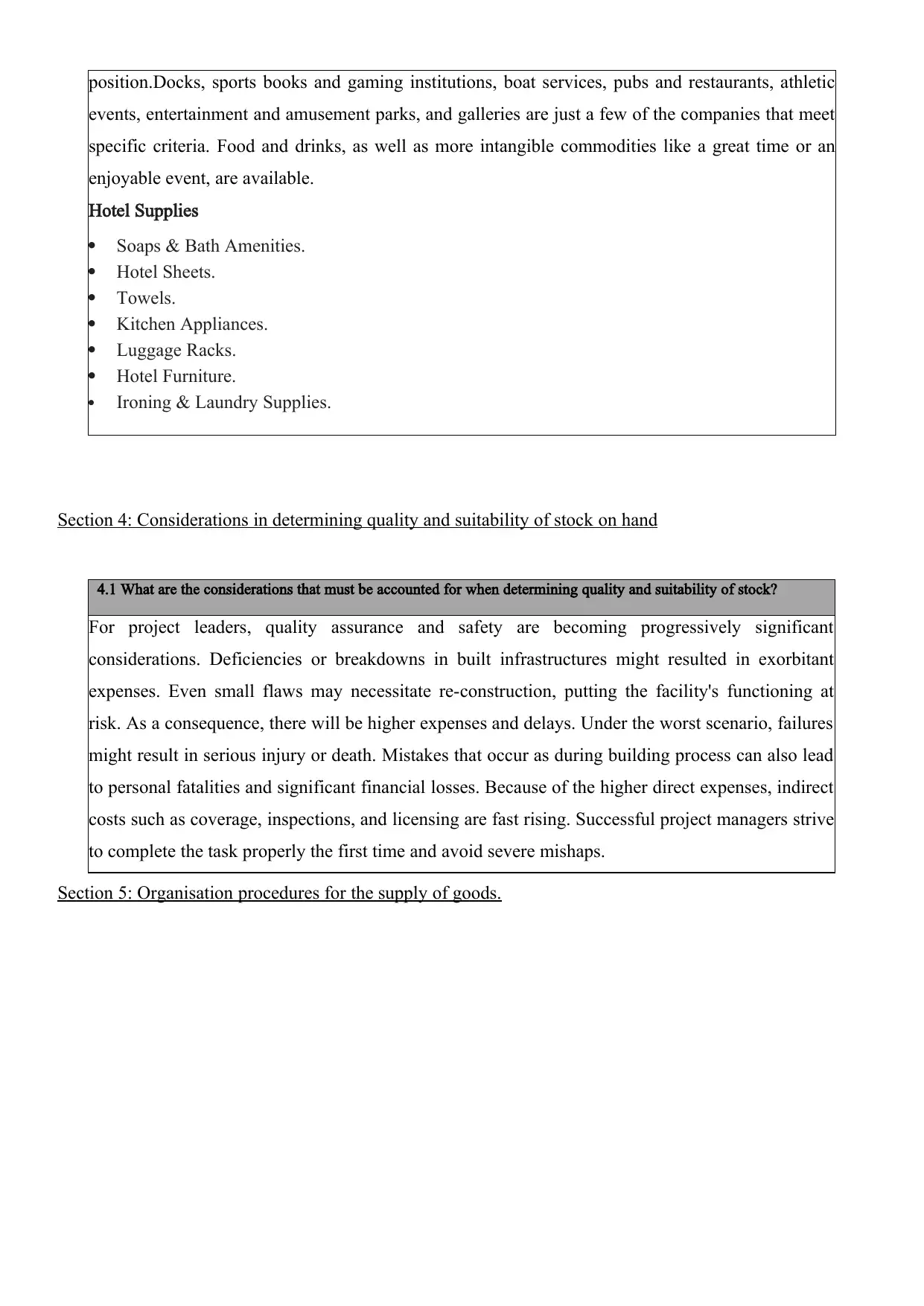
position.Docks, sports books and gaming institutions, boat services, pubs and restaurants, athletic
events, entertainment and amusement parks, and galleries are just a few of the companies that meet
specific criteria. Food and drinks, as well as more intangible commodities like a great time or an
enjoyable event, are available.
Hotel Supplies
Soaps & Bath Amenities.
Hotel Sheets.
Towels.
Kitchen Appliances.
Luggage Racks.
Hotel Furniture.
Ironing & Laundry Supplies.
Section 4: Considerations in determining quality and suitability of stock on hand
4.1 What are the considerations that must be accounted for when determining quality and suitability of stock?
For project leaders, quality assurance and safety are becoming progressively significant
considerations. Deficiencies or breakdowns in built infrastructures might resulted in exorbitant
expenses. Even small flaws may necessitate re-construction, putting the facility's functioning at
risk. As a consequence, there will be higher expenses and delays. Under the worst scenario, failures
might result in serious injury or death. Mistakes that occur as during building process can also lead
to personal fatalities and significant financial losses. Because of the higher direct expenses, indirect
costs such as coverage, inspections, and licensing are fast rising. Successful project managers strive
to complete the task properly the first time and avoid severe mishaps.
Section 5: Organisation procedures for the supply of goods.
events, entertainment and amusement parks, and galleries are just a few of the companies that meet
specific criteria. Food and drinks, as well as more intangible commodities like a great time or an
enjoyable event, are available.
Hotel Supplies
Soaps & Bath Amenities.
Hotel Sheets.
Towels.
Kitchen Appliances.
Luggage Racks.
Hotel Furniture.
Ironing & Laundry Supplies.
Section 4: Considerations in determining quality and suitability of stock on hand
4.1 What are the considerations that must be accounted for when determining quality and suitability of stock?
For project leaders, quality assurance and safety are becoming progressively significant
considerations. Deficiencies or breakdowns in built infrastructures might resulted in exorbitant
expenses. Even small flaws may necessitate re-construction, putting the facility's functioning at
risk. As a consequence, there will be higher expenses and delays. Under the worst scenario, failures
might result in serious injury or death. Mistakes that occur as during building process can also lead
to personal fatalities and significant financial losses. Because of the higher direct expenses, indirect
costs such as coverage, inspections, and licensing are fast rising. Successful project managers strive
to complete the task properly the first time and avoid severe mishaps.
Section 5: Organisation procedures for the supply of goods.
Paraphrase This Document
Need a fresh take? Get an instant paraphrase of this document with our AI Paraphraser
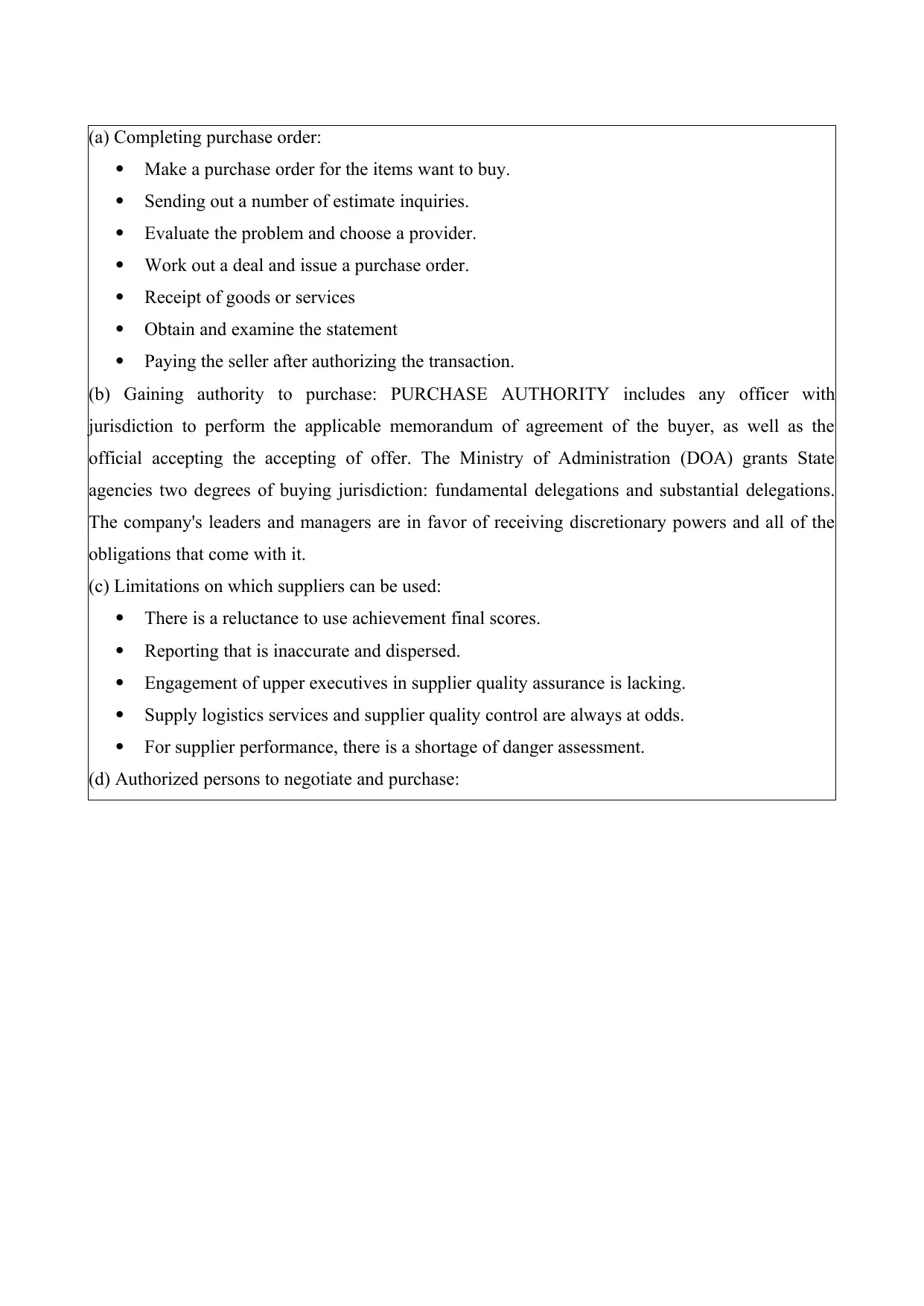
(a) Completing purchase order:
Make a purchase order for the items want to buy.
Sending out a number of estimate inquiries.
Evaluate the problem and choose a provider.
Work out a deal and issue a purchase order.
Receipt of goods or services
Obtain and examine the statement
Paying the seller after authorizing the transaction.
(b) Gaining authority to purchase: PURCHASE AUTHORITY includes any officer with
jurisdiction to perform the applicable memorandum of agreement of the buyer, as well as the
official accepting the accepting of offer. The Ministry of Administration (DOA) grants State
agencies two degrees of buying jurisdiction: fundamental delegations and substantial delegations.
The company's leaders and managers are in favor of receiving discretionary powers and all of the
obligations that come with it.
(c) Limitations on which suppliers can be used:
There is a reluctance to use achievement final scores.
Reporting that is inaccurate and dispersed.
Engagement of upper executives in supplier quality assurance is lacking.
Supply logistics services and supplier quality control are always at odds.
For supplier performance, there is a shortage of danger assessment.
(d) Authorized persons to negotiate and purchase:
Make a purchase order for the items want to buy.
Sending out a number of estimate inquiries.
Evaluate the problem and choose a provider.
Work out a deal and issue a purchase order.
Receipt of goods or services
Obtain and examine the statement
Paying the seller after authorizing the transaction.
(b) Gaining authority to purchase: PURCHASE AUTHORITY includes any officer with
jurisdiction to perform the applicable memorandum of agreement of the buyer, as well as the
official accepting the accepting of offer. The Ministry of Administration (DOA) grants State
agencies two degrees of buying jurisdiction: fundamental delegations and substantial delegations.
The company's leaders and managers are in favor of receiving discretionary powers and all of the
obligations that come with it.
(c) Limitations on which suppliers can be used:
There is a reluctance to use achievement final scores.
Reporting that is inaccurate and dispersed.
Engagement of upper executives in supplier quality assurance is lacking.
Supply logistics services and supplier quality control are always at odds.
For supplier performance, there is a shortage of danger assessment.
(d) Authorized persons to negotiate and purchase:
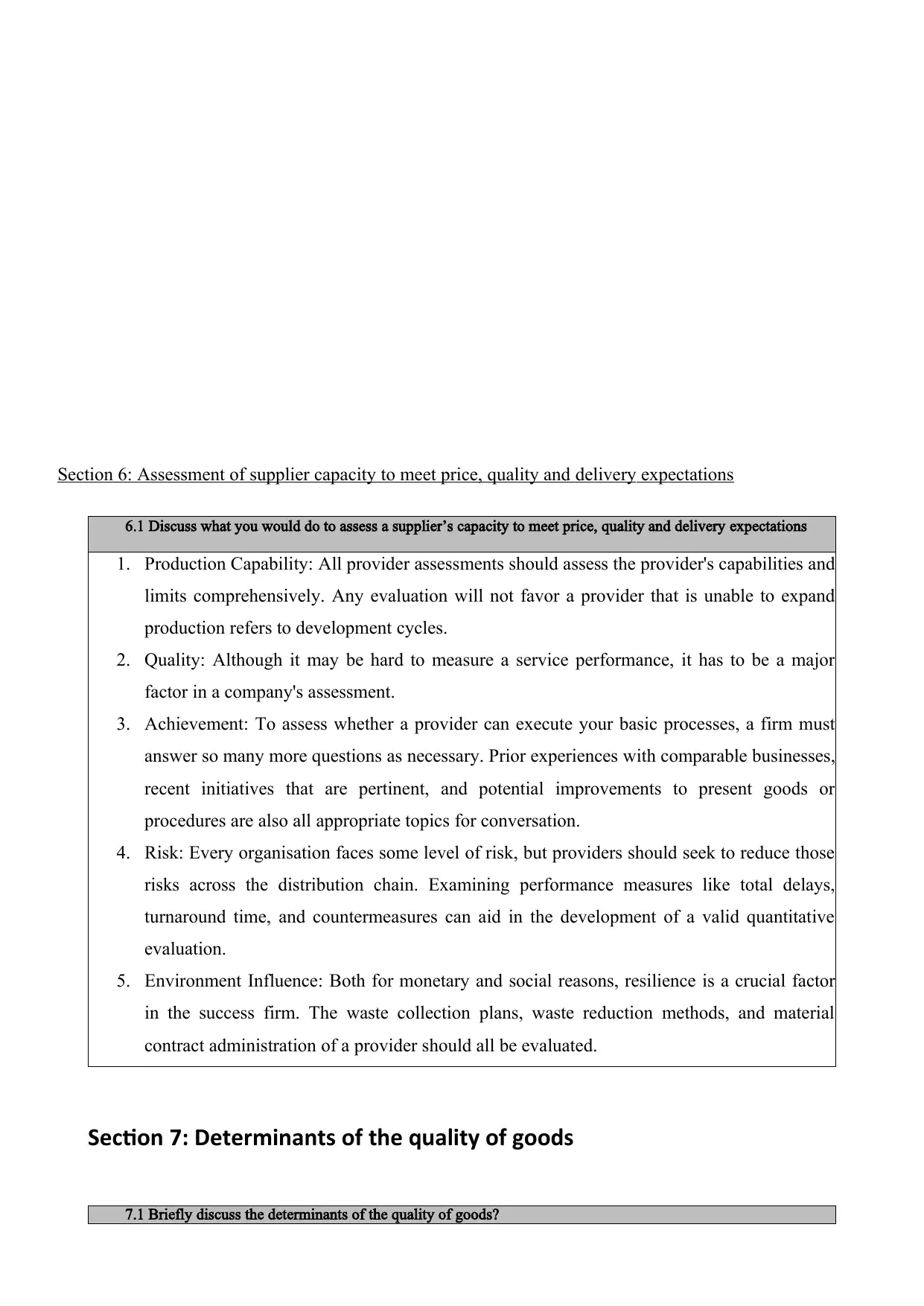
Section 6: Assessment of supplier capacity to meet price, quality and delivery expectations
6.1 Discuss what you would do to assess a supplier’s capacity to meet price, quality and delivery expectations
1. Production Capability: All provider assessments should assess the provider's capabilities and
limits comprehensively. Any evaluation will not favor a provider that is unable to expand
production refers to development cycles.
2. Quality: Although it may be hard to measure a service performance, it has to be a major
factor in a company's assessment.
3. Achievement: To assess whether a provider can execute your basic processes, a firm must
answer so many more questions as necessary. Prior experiences with comparable businesses,
recent initiatives that are pertinent, and potential improvements to present goods or
procedures are also all appropriate topics for conversation.
4. Risk: Every organisation faces some level of risk, but providers should seek to reduce those
risks across the distribution chain. Examining performance measures like total delays,
turnaround time, and countermeasures can aid in the development of a valid quantitative
evaluation.
5. Environment Influence: Both for monetary and social reasons, resilience is a crucial factor
in the success firm. The waste collection plans, waste reduction methods, and material
contract administration of a provider should all be evaluated.
Section 7: Determinants of the quality of goods
7.1 Briefly discuss the determinants of the quality of goods?
6.1 Discuss what you would do to assess a supplier’s capacity to meet price, quality and delivery expectations
1. Production Capability: All provider assessments should assess the provider's capabilities and
limits comprehensively. Any evaluation will not favor a provider that is unable to expand
production refers to development cycles.
2. Quality: Although it may be hard to measure a service performance, it has to be a major
factor in a company's assessment.
3. Achievement: To assess whether a provider can execute your basic processes, a firm must
answer so many more questions as necessary. Prior experiences with comparable businesses,
recent initiatives that are pertinent, and potential improvements to present goods or
procedures are also all appropriate topics for conversation.
4. Risk: Every organisation faces some level of risk, but providers should seek to reduce those
risks across the distribution chain. Examining performance measures like total delays,
turnaround time, and countermeasures can aid in the development of a valid quantitative
evaluation.
5. Environment Influence: Both for monetary and social reasons, resilience is a crucial factor
in the success firm. The waste collection plans, waste reduction methods, and material
contract administration of a provider should all be evaluated.
Section 7: Determinants of the quality of goods
7.1 Briefly discuss the determinants of the quality of goods?
⊘ This is a preview!⊘
Do you want full access?
Subscribe today to unlock all pages.
Trusted by 1+ million students worldwide

1 out of 37


Your All-in-One AI-Powered Toolkit for Academic Success.
+13062052269
info@desklib.com
Available 24*7 on WhatsApp / Email
![[object Object]](/_next/static/media/star-bottom.7253800d.svg)
Unlock your academic potential
Copyright © 2020–2026 A2Z Services. All Rights Reserved. Developed and managed by ZUCOL.